Dynamic Excitation Modes of Couples
Electron-Hole Quantum-Well Structure
Brahma Nand Jha
1and Tarun Kumar Dey
21Department of Physics, M.S.S.G College, Areraj, B.R.A Bihar University, Muzaffarpur – 842001 2Post Graduate Department of Physics, L. S. College, Muzaffarpur.
Abstract : We have theoretically investigated the role of many-body correlations in determining the dynamic excitation modes of coupled electron-hole quantum-well structure over a wide range of particle number density
r
sand well spacing d. The intra-and interwell correlations are treated on the same footing within the self-consistent dynamic mean-field approximation. The excitation modes of the system are obtained from the calculation of the imaginary part of the frequency and wave vector dependent linear density response functionl
m
q
,
. In addition to the usual single particle excitations, the coupled bilayer supports two collective excitation modes (plasmons), namely, the in-phase and out-of-in-phase modes. The in-in-phase mode is strongly affected by manybody correlations. As an interesting result, we find thatl
m
q
,
exhibits, in the sufficiently close approach of two wells, a strong peak at small
at finite q. The appearance of this trong peak in
l
m
q
,
indicates that it costs relatively very little energy toexcite the system into a density-moduled state of wave vector q. This new peak in
l
m
q
,
could possibly be used as an experimental probe to detect the existence of a density-moduled ground state in the coupled electron-hole quantum-well system.IndexTerms - Quantum well, number density, plasons.
I.INTRODUCTION
In this paper[1], we investigated the ground-state behaviour of the symmetric electron-hole (e-h) quantum-well structure by employing the dielectric formalism and treating correlations beyond the static local-field theories within the dynamical or quantum version of the Singwi, Tosi, Land, and Sjolander (qSTLS) approach[2]. As an important
result, our study revealed that the liquid phase in the e-h bilayer could become unstable against phase transition in to a coupled Wigner crystal (WC) ground state at sufficiently low density in the close approach of two layers. Notably, the critical density for the phase transition was predicted to shift towards the higher-density side as compared to the corresponding value in the case of an isolated electron layer. Moreover, at densities higher than the critical density for crystallization, the qSTLS theory predicted transition to a charge-density-wave (CDW) ground state, thus implying a crossover from the CDW state to the WC state at a critical value of carrier density. The prediction of Wigner crystallization agreed qualitatively with the findings of the diffusion Monte Carlo calculations of De Palo et. al.[3]. In
our calculations, the transition to the density modulated phase, i.e., the WC or CDW phase, appeared in the form of a divergence in the liquid state static density susceptibility at a finite wave vector value. Also, the intra-and interlayer pair-correlation functions exhibited pronounced in-phase oscillations typical of an ordered crystalline phase near the transition region. Earlier, Szymanski et. al. had obtained qualitatively similar results for the e-h ground state by using the so-called semi-STLS approach.
If the static properties, viz. the static pair correlation functions and the static density susceptibility, are so markedly affected near the transition region, it would be interesting and important to examine the behaviour of dynamic properties of the e-h bilayer at near system parameters associated with the phase transition of the system into a density-modulated phase. In particular, one could speculate to find the signs of the above structural phase transition in the dynamic excitation spectrum. This makes our motivation for the present work. In this paper, we intend to look into the behaviour of the dynamic excitation modes of the symmetric e-h quantum well structure - a quantity that is directly measurable, for instance, in the X-ray inelastic scattering experiments[4]. In Sec. 2, we present in brief the bilayer model and the theoretical formalism used. Results and discussion are given in Sec. 3. Conclusions are reported in Sec. 4.
II. THEORETICAL FORMALISM AND FONTS
uniform charge neutralizing background. On neglecting the effect of integrating over the finite extent of the particle wave function in the z direction, the Coulomb interaction potential among the carriers is obtained as
( )
q i jij ij
V q
q V q e
d
... (1)where i = 1, 2 is the layer index
ij
1 i j andV q
2
e
2/
q
0 , is the intralayer interaction potential,with
0being the background dielectric constant.In the dielectric approach, the density-density linear response function
q
,
plays the role of a central quantity in determining the many-body properties of the system. For the double layer system, the response function can be compactly expressed in the form of a 2 × 2 matrix, and in the generalized mean-field approximation the elements of the inverse of t he density response matrix are given by :
1
0
, ( ) 1 ( , )
,
ij
ij ij ij
i
q V q G q
q
... (2)
where
i0
q
,
is the density response function of non-interacting carriers in layer (i.e., the Stern function[5]) and( , )
ij
G q
is the dynamic local-field correction (LFC) factor accounting for the correlation effects among the carriers inthe layers i and j. In the quantum version of the STLS approach[1],
G q
ij( , )
is given by
0 2 0 , '; ( ') 1 ' ( , ) (| ' |)4 , ( )
i ij
ij ij ij
i ij
q q V q
dq
G q S q q
n q V q
... (3)Here,
i0
q q
, ';
is the in-homogeneous density response function of non-interacting electrons andS q
ij( )
is thestatic density structure factor. The fluctuation-dissipation theorem, which relates
S q
ij( )
with the imaginary part of the linear response function as
0
( ) ,
ij ij
S q d lm q
n
... (4)closes the set of qSTLS equations for the density response function. Evidently, the response function calculation has to be carried out numerically in a self-consistent way.
The dynamic excitation spectrum can be obtained from the imaginary part of the diagonalized density response function as[6]
0 1 0
1 11 12
,
( , )
1
,
,
,
q
q
q
q
q
... (5)with
11
q
,
= V qn( ) 1 G qn
,
and
12
q,
V12( ) 1q G12
q,
. The + and - signs correspond, respectively, to the in-phase and out-of-phase (
) modes of the density modulations in the two layers.III. RESULTS AND DISCUSSION
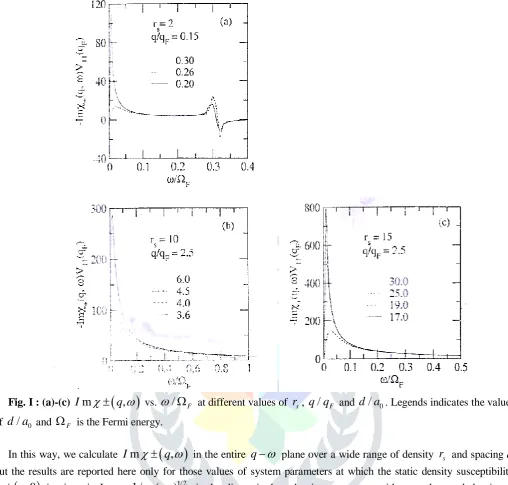
Fig. I : (a)-(c)
I
m
q
,
vs.
/
F at different values ofr
s,q q
/
F andd a
/
0. Legends indicates the valuesof
d a
/
0 and
F is the Fermi energy.In this way, we calculate
I
m
q
,
in the entireq
plane over a wide range of densityr
s and spacing d, but the results are reported here only for those values of system parameters at which the static density susceptibility
q
, 0
is given in I.r
s
1/
a n
0(
)
1/2, is the dimensionless density parameter, with n as the areal density ofcarriers and
a
0 the Bohr atomic radius.For the e-h bilayer, it is the in-phase mode, i.e.
( ,0)
q
, which can exhibit singular behaviour. Therefore, we plot in Fig. 1 (a-c) the results ofI
m
q
,
as a function of frequency
by keeping the wave vector q fixed at a value equal to the one associated with the density-modulated phase at layer parameters lying in the transition region. We note thatI
m
q
,
exhibits a sharp peak at small
at relatively smaller layer spacing, and decreasing the spacing makes the peak to grow higher in its strength and to move towards origin, i.e.
=0. As the layer spacing approaches the critical d associated with the onset of density-modulated phase, the position of the low-frequency peak in
m
,
I
q
seems to converge to
=0. This in turn implies that it costs the system close to the transition point nearly zero or very little energy to excite it from the homogeneous liquid phase into an in-phase inhomogeneous density-modulated state having wave vectorq
c.For sake of completeness, we have also reproduced the behaviour of static density susceptibility
q
, 0
at10
s
r
andd a
/
0
4.5
, 4.0 and 3.6 in Fig. 2. It is apparent that
q
, 0
exhibits a strong peak atq q
/
r
2.5
andFig. 2 :
( ,0)
q
vs.q q
/
F at different values ofd a
/
0 forr
s
10
. Legends indicate the values ofd a
/
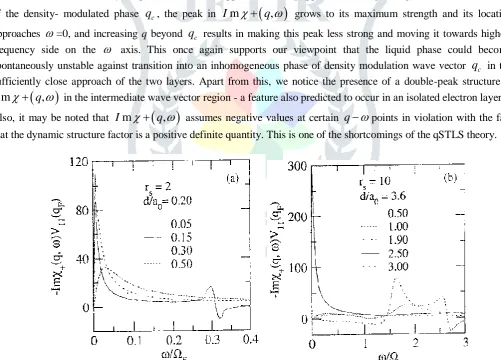
0.We have also plotted in Fig. 2(a-b) the q-dependence of
I
m
q
,
by keeping d fixed at the critical spacingassociated with the instability at
r
s
2
and 10. It is apparent that as q approaches, at a givenr
s, the wave vector valueof the density- modulated phase
q
c, the peak inI
m
q
,
grows to its maximum strength and its locationapproaches
=0, and increasing q beyondq
c results in making this peak less strong and moving it towards higher-frequency side on the
axis. This once again supports our viewpoint that the liquid phase could become spontaneously unstable against transition into an inhomogeneous phase of density modulation wave vectorq
c in the sufficiently close approach of the two layers. Apart from this, we notice the presence of a double-peak structure in
m
,
I
q
in the intermediate wave vector region - a feature also predicted to occur in an isolated electron layer[7].Also, it may be noted that
I
m
q
,
assumes negative values at certainq
points in violation with the fact that the dynamic structure factor is a positive definite quantity. This is one of the shortcomings of the qSTLS theory.Fig. 3 : (a)-(b)
I
m
q
,
vs.
/
F at different values ofr
s,d a
/
0andq q
/
F. Legends indicate the valuesof
q q
/
F and
F is the Fermi energy..IV. CONCLUDING REMARKS
(out-of-phase) liquid-state density-density response funcdtion at small
and finite q could possibly be used as an experimental probe to detect the existence of a density-modulated ground state in the e-h (e-e) quantum well system.REFERENCES
[1] R.K.Moudgil, G. Senatore and L.K.Saini, Phys. Rev. B66 (2002) 205316.
[2] T. Hasegawa and M. Shimizu, J. Phys. Soc. Jpn. 38 (1975) 965.
[3] S.De Palo, F. Rapisarda and G. Senatore, Phys. Rev. Lett. 88 (2002) 206401.
[4] For recent experimental work on the dynamic excitation spectrum of the bilayer, see D.S.Kainth et. al, Phys. Rev. B 57 (1998) R2065; H. Noh et. al. Phys. Rev. B 58 (1998) 12621; D.S.Kainth et. al. Phys. Rev. B59 (1999) 2095.
[5] F. Stern, Phys. Rev. Lett. 18 (1967) 4035.