Durability Studies on Concrete with Manufacturing Sand As A
Partial Replacement of Fine Aggregate In HCL Solution
P Daisy Angelin
1, P Ravi Kishore
21
PG Student, Civil Engineering Department, Aditya Engineering College, Surampalem, AP. 2Assistant Professor & Head Of The Department, Aditya Engineering College, Surampalem, AP.
Abstract:- The most widely used material in this world is concrete. After water, concrete is placed in second position. The use of natural sand in conventional concrete has become of vital importance which is scarce to obtain. Sand is basic concrete making construction material required in large quantities. Manufactured sand is one among such materials to replace river sand which can be used as an alternative fine aggregate in mortars and concrete.
An attempt had been made in the present investigation to discuss the properties of concrete such as workability and compressive strength of concrete which is prepared by replacing natural sand with artificial sand at different replacement levels (0%, 20%, 40%, 60% , 80% and 100%). The results have predicted that replacement of natural sand with manufactured sand in order of 60% will produce concrete of satisfactory workability and compressive strength.
Durability of the concrete is also tested by immersing the cubes in 5% hydrochloric acid solution. The specimens are studied for M20 & M30 grades of concrete for replacement of natural sand with manufactured sand when immersed in hydrochloric acid, the strength results of the specimens that are immersed in hydrochloric acid solution is found out.
Keywords:- Natural sand, Manufactured sand, Durability, Compressive strength
I.
I INTRODUCTION
Cement is widely noted to be most expensive constituents of concrete. Due to its durability to cost ratio it is one of the widely used material. Due to s e ve r e environmental conditions its durability declines. Degradation of concrete structures by corrosion is a serious problem and has major economic implications. Cement used in concrete is a mixture of complex Compounds. Due to these reactions setting and hardening occurs when this type of water is used. No longer is concrete made with cement, aggregates and water only. It is the material which is used more than any other man made material for construction works. Cement can be used as an extensive building material. With the rise in demand and use of cement and in backdrop of waste management, scientists and researchers all over the world are always in search for cultivating additive binders like mineral additives which are found in various forms in nature including blast furnace slag, fly ash and silica fume. The addition of these products in the production of concrete has positive environmental effects, while minimizing problems associated with its disposal. Silica fume is one of the most used mineral admixtures because it contains high percentage of amorphous silica which is having high durability.
Manufactured Sand
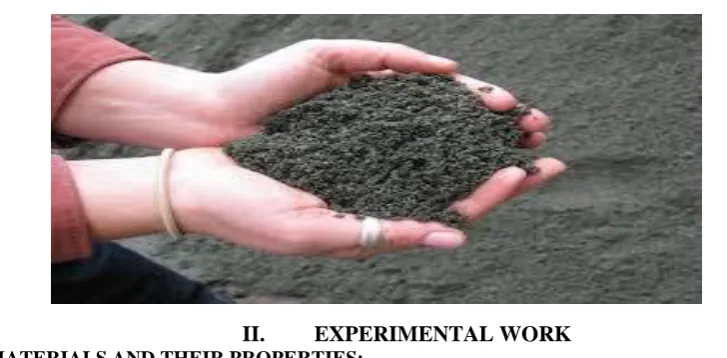
Itis obtained by crushing stone, gravel or slag which is used for aggregate material less than 4.75mm that is processed from crushed rock or gravel and intended for construction use. Apart from this, manufactured sand is of high quality in relation to non- refined from coarse aggregate production.
The major goal of the present work was to consistently study the workability, strength, durability of concrete with manufactured sand and percentage replacement of manufactured sand with natural sand by 0% 20% 40% 60%,80% and 100% respectively. The study was carried out on M20 grade concrete with 0.5 water/cement ratio and M30 grade concrete with 0.45 water/cement ratio which results in increased compressive strength from 8% to 26%, the flexural strength was increased from 1% to 5% and coefficient of permeability was decreased significantly.
II.
EXPERIMENTAL WORK
2.1 MATERIALS AND THEIR PROPERTIES:
The properties of various materials used in making the concrete are discussed in the following sections.
Cement:
OPC Cement of 43 Grade was used for making the cubes in the experimental work.
Natural (River) Sand:
The fineness modulus of the natural river sand is 2.44, conforming to zone II as per IS: 383-1970 was used for the experimentation after washing it with clean water. The specific gravity of the natural sand is 2.59. The water absorption and moisture content values obtained for the sand used was found to be 1.51% and 0.7% respectively.
Manufactured sand (Crushed sand):
The crushed sand having fineness modulus of 2.75 and conforming to zone II as per IS: 383-1970 was used for the experimentation after washing it with clean water. The specific gravity of the artificial sand was found to be 2.57. The water absorption and moisture content values obtained for the sand used was found to be 2.26% and 0.9% respectively.
Coarse Aggregate
Crushed stone aggregates of 20mm size obtained were used for the experimentation. The fineness modulus of coarse aggregates was 6.65 with a specific gravity of 2.75 The water absorption and moisture content values obtained for the sand used was found to be 2.5% and 0.5% respectively.
Hydrochloric Acid: HCL concentration of 5%
Water:
Portable fresh water, free from concentration of acid or organic substances was used for mixing concrete.
Table 1 Physical properties of Fine Aggregate –Manufacturing Sand ( IS 383, IS 2386 PART III )
Properties Value
1 Grading of sand Zone II as per IS 383
2
Bulk Density(Kg/m3)
a) loose
b) compacted
1648 kg/m3
1791 kg/m3
3 Water absorption 2.26 %
4 Specific gravity 2.57
5 Silt content 7 %
6 Surface Moisture 0.9 %
Constituent Manufactured sand (%)
Natural sand Test method
SiO2 62.48 80.78
AL2 O3 18.72 10.52 IS :
4032- 1968
FE2 O3 6.54 1.75
CaO 4.83 3.21
MgO 2.56 0.77
NNa2O Nil 1.37
K2 O 3.18 1.23
Ti O2 1.21 Nil
Loss of ignition 0.48 0.37
Mix Proportions Adopted:
The concrete of M20 grade and M30 grade were designed using the IS Code method (IS: 10262-1982) of mix design and proportions were obtained after applying necessary corrections to suit field conditions. The final mix ratio for M20 was expressed as parts of water: cement: fine aggregate: coarse aggregate 0.50: 1: 2.17 : 3.96 and for M30 as 0.45: 1 :1.6 : 3.13.
Acid attack study:
The resistance of the concrete to chemical attack is found out by immersing them in acid solution. After 28 days period of curing fifteen specimens each of two grades M20 and M30 grade concrete. Five specimens were immersed in 5% HCL solution. To make 30 liters solution of 5% concentrated HCL the stock solution required is 3.375 liters. After 28 days of immersion, change in average compressive strength, split tensile strength and flexural strength were observed.
III.
LABORATORY TESTS AND RESULTS
Various tests were carried out in the laboratory for finding the strength and durability and other important properties of the concrete used during the study. Slump cone test, Compaction test, Vee-bee test, compressive strength, split tensile strength and flexural strength were conducted by using different percentages of manufactured sand as a replacement of natural sand. The details of these tests are given in the following sections.
Workability Tests:
IV.
COMPRESSIVE STRENGTH
The Compressive strength test was conducted in the laboratory as per IS Code (IS: IS 516-1959). Various percentages of manufacturing sand was replaced with natural sand and the results were presented. The cement, sand, coarse aggregate, manufactured sand mixed thoroughly. Nearly 25% of water required is added and thoroughly mixed with an aim to obtain uniform mix. After that balance of 75% water was added and mixed thoroughly with a view to obtain uniform mix.
Compression test on the cube is conducted on the 600T compressive machine. The cubes were cast in the cube moulds with inner dimensions of 150x150x150mm.The graph was plotted between No. of days and compressive strength. The variation of 28 days compressive strength with increase in percentages of manufactured sand for M20 and M30 is increased by 60% which gives more strength than any other replacement for both the grades.
Figure: Variation of 28 days Compressive strength for M20 Grade
M20 + 0%
M20 + 20%
M20 + 40%
M20 + 60%
M20 + 80%
M30 + 0%
M30 + 20%
M30 + 40%
M30 + 60%
M30 + 80%
M30 + 100%
V.
SPLIT TENSILE STRENGTH:
The Split tensile strength tests were conducted in the laboratory as per IS Code (IS: IS 516-1959). Different percentages of manufacturing sand was replaced with natural sand and result were inferred in the results
This test is conducted on 600T Compression machine . The cylinders prepared for testing are 150mm diameter and 300mm in height. The graph was plotted between No. of days and split tensile strength. The variation of 28 days split tensile strength with increase in percentages of manufactured sand for M20 and M30 is increased by 60% which gives more strength than any other replacement for both the grades.
FLEXURAL STRENGTH:
The Flexural strength tests were conducted in the laboratory as per IS Code (IS: IS 516-1959) Different percentages of manufacturing sand was replaced with natural sand and result were inferred in the results.
This test is conducted on 10T Universal testing machine. The flexural beams were cast in steel moulds with inner dimensions of 500x100x100mm. The graph was plotted between No. of days and flexural strength. The variation of 28 days flexural strength with increase in percentage of manufactured sand for M20 and M30 is increase 60% which gives more strength than any other replacement for both the grades.
Acid attack test:
Figure: Comparison of 28 Days Acid Treated Compressive Strength M20 Grade concrete
Before Acid Treatment
After Acid Treatment
Figure: Comparison of 28 days and Acid Treated Compressive Strength M30 Grade
Before Acid Treatment
After Acid Treatment
IV.
RESULTS & CONCLUSIONS
Results were analyzed to derive useful conclusions regarding the workability, durability characteristics of concrete with replacement of natural sand with manufactured sand used in different proportions for M20 and M30 Grades.
M20 + 0% M-SAND
M20 + 20% M-SAND
M20 + 40% M-SAND
M20 + 60% M-SAND
M20 + 80% M-SAND
M20 + 100% M-SAND
0 1 2 3 4 5 6
M30 + 0% M-SAND
M30 + 20% M-SAND
M30 + 40% M-SAND
M30 + 60% M-SAND
M30 + 80% M-SAND
strength 0%, 6.19%, 14.8%, 18.2%, 16.9%,12.2% for split tensile strength and 0%, 5.6%, 14.5%, 22.48%, 16.47%, 14.9% for flexural strength respectively.
The increase in compressive strength, split tensile strength and flexural strength of M30 grade concrete for replacement of natural sand by manufactured sand in proportions of 0%,20%,40%,60%,80%,100% is of order 0%, 5.8%,12.8%, 19.8%, 17.1%, 13.2% for compressive strength 0%, 7.4%, 14.8%, 19.1%, 15.8%, 12.6% for split tensile strength , 0%, 5.65%, 14.5%, 22.48%, 16.47%, 14.9% for flexural strength respectively.
The decrease in the compressive strength , split tensile strength and flexural strength after treating specimens with hydrochloric acid for 28 days of M20 grade concrete for replacement of natural sand by manufactured sand in proportions of 0%,20%,40%,60%,80%,100% is of order 11.7%, 10.18%,9.82%, 7.12%,9.13%,9.659% for compressive strength , 9.91%, 9.33%, 8.63%, 7.38%, 7.79%, 8.60%, for split tensile strength 12.76%, 11.31%, 11.11%, 10.29%, 11.08%, 11.74% for flexural strength respectively.
The decrease in compressive, split, flexural strength with treating specimens with hydrochloric acid for 28 days of M30 Grade concrete for replacement of natural sand by manufactured sand in proportions of 0%, 20%,40%,60%,80%,100% in order of 9.85%, 8.75%, 7.28%, 6.43%, 7.01% ,7.51% for compressive strength 8.75%, 8.16%, 6.71% 5.73% 6.25 % 6.95% for split tensile strength of 11.24%, 10.83%, 9.13%, 8.28%, 9.27% for flexural strength respectively.
V.
CONCLUSIONS
1. The workability and strength properties of concrete had increased by replacing natural sand with 60%
of manufactured sand. However, for more than 60% replacement of natural sand by artificial sand causes reduction in compressive strength of concrete mixes.
2. The replacement of natural sand with manufactured sand will help in preserving the natural resource like sand and also maintains the ecological balance of the nature.
3. The decrease in the average compressive strength and rate of decrease is more in M30 grade M20 grade than that of in M30 grade concrete when immersed in hydrochloric acid solutions.
REFERENCES
[1]. Hudson B.P,” M a n u f a c t u r e d Sand for concrete”, The Indian concrete Journal, May 1997, pp. 237-240., Issue.3
[2]. Vinayak Vijapur, Mohammed Noorullr,(2013),” An Experimental Investigation on the Behavior
of Self Curing Concrete Under Acidic Attack”, International journal of Engineering Research-Online, Vol.1., Issue.3., 2013
[3]. Shaikh, M. G., Daimi, S. A. (2011), Durability studies of concrete made by using artificial sand with
dust and natural sand, International Journal of Earth Sciences and Engineering (ISSN 0974-5904), Vol. 04, No. 06 SPL, pp 823-825
[4]. Mohaiminul Haque, 2Sourav Ray, H.M.A Mahzuz , “Use of stone powder with sand in concrete and
Mortar. A Waste Utilization Approach”, APRN Journal of Science & Technology Vol. 4 NO. 8 , August – 2011 I S S N 2 2 5 - 7 2 1 7
[5]. Siva Kumar A and Prakash M. “Characteristics studies on the mechanical properties of quarry dust addition in Conventional Concrete”, International Journal of C i v i l Engineering and Construction Technology, ISSN: 2141-2634 © 2011 , Volume 2 No. 10,
[6]. “Durable Concrete Structures Design Guide” by S. Rostam, AUG 1, 1992
[7]. Babbie E.& mounton j. The practice or social research, Soutt African edition .Cape TOWN: oxford university press, 2005
[8]. BIS: 12269-1987. Specifications for 43 grade Ordinary Portland Cement. BIS Code
[9]. BIS: 383-1970. “Specification for Coarse and Fine Aggregates from Natural Sources for Concrete, (Second Revision)
[10]. BIS: 2386-1963 Part I to VII . Indian Standard Methods of sampling and analysis of concrete. [11]. BIS: 516-1959. Indian Standard Methods of test for strength of concrete.
[12]. Shetty, M.S. (2004). Concrete Technology, S. Chand & Co. Ltd
[13]. BIS: 10269-2009. And SP 23: 1982 Recommended Guidelines for concrete mix.