Object Oriented System of E-Learning
(OOSEL)
Engr;Hamid Jan, Inayat Ullah, Zanobia Nisar
Sarhad University of Science & IT Peshawar Pakistan[email protected], [email protected], [email protected]
Abstract-- Currently the electronic means of supporting learning has obtained a wider ever acceptance. One of the main task of system of operations and support learning is to organize the process of checking student’s knowledge. The system of learning is required to perform more functions due to stringent requirements over the time, which can be solved by constructing an optimum architecture. We in this paper are proposing the object oriented technique “OOSEL” for solving the problems of checking the student knowledge.
Index Term
--
E-Learning System, Constructors, Objects, Class, TaskRelated Work
In [1, 2], the author view learning resources (content, evaluations, references, activities and so on) as properties (such as content and relationships to other resources) and objects in an object-oriented model that have methods (such as rendering and evaluation). He also pointed out certain shortcomings such as time, cost, inflexibility and interdependency of content with design in the existing web-authoring techniques for the development of online courses.
In [3] the use of SWE techniques for the development of learning objects is proposed. The objective is to avoid the creation of content every time its need arises from scratch and allow content to be applied to larger audiences. The author therefore concentrates on the method of constructing object prototypes, used in object-oriented design leading to the creation of a class that acts as a template (or outline) for which other objects may be created when required. An important element of object-oriented design is inheritance from which new learning objects may be created from existing similar ones by adding more functionality (or features) to them.
In [4] the author discussed another aspect of OOP that is “black box”, according to which the implementation of an object should be hidden from its users. Further, he also identified parallelism between software objects and LOs. In order to control a user customization of the object, objects interfaces (methods) should be used to enable users interactions.
In [4], the author suggested that in order to allow the LO to join other LOs in a variety of situation and usage-scenarios independency, the LOs should be created with high level of abstraction. The paper concludes by suggesting as immediate
necessities the generally accepted, precise and functionally effective definition of a LO and the reengineering of the design and development process of LOs in a “multidisciplinary and cooperative model of development to create knowledge that is appropriate for the emergent network society”.
In [7, 8], the author suggested the opinion of deriving all LOs from a super class of the Learning Object.
Finally, the authors conclude by expressing their beliefs on the future of the OOLO: “We believe that the object-oriented approach can go a long way towards achieving the vision currently being promoted for learning objects. Learning objects with object-oriented features provide a solid foundation for the effective reuse of learning resources on the Web” [8].
I. INTRODUCTION OF SYSTEM
The tasks in the system are meant for learning object like test, questions, assignments and problems, which can be solved by the students. The teacher assigns tasks to students from the bank of tasks. The students solve the task by answering the questions. The task is verified by the system or the teacher may check manually in some cases. After verification, grading is done. During the test an object “Answer” is created and attached to test. A test may have many answers correspond to questions in a test. After the test every question is assigned grade and result is displayed to student.
Modeling of Abstract Class
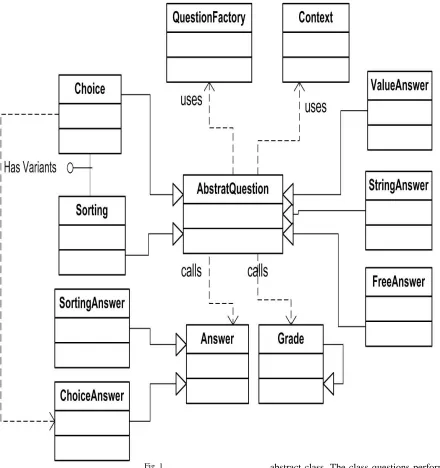
The system consists of different classes which correspond to many tasks. All the classes in the system are inherited from one abstract class “AbstractQuestion” which ensures the generalization of standard properties and attributes and
facilitates their reuse. For example: The realization of new type of class.
The abstract class “E-Exam” realizes the functionality general for all types of tasks. The class contain field which assign grade to answers from incorrect to correct by default [0;1]. In the same way the class defines constants, utilizes by tasks of complex questions and method of evaluating the partially correct answers.
Attributes of the task: • Name of task • Type of task • Complexity • Theme
• Method of checking • The keywords • Authors
and other parameters, characteristic for the tasks of any type.
Types of tasks
The system support tasks of five types Selection from multiple choice Sorting
Introduction of symbol Introduction of number Detail answers
The selection from multiple choices is a task with limited collection of answers. Answers of this type exist in two forms.
The selection of one correct version The selection of several correct versions.
The active modes of this type of tasks are represented by lists indicating multiple choices. In order to select the correct version the user must click the appropriate switch for selection of one answer or place flags in case of several correct answers. Answer to a question is consider correct if all selected version are correct in case of several answer and selection of one correct in case of one correct answer.
Sorting is another task with limited collection of answers. It is necessary to arrange the elements of list in ascending or descending order. The arrangement of elements is achieved with the help of buttons. According to conditions the answer of student is consider correct if all elements are located in correct order. Every question has its own order of correct answers and only the answers of correct order are consider correct.
Introduction to symbol is the task in which symbols are placed in front of correct answers. There is a possibility of lax estimation. The set of the symbols, which are converted into the standard with the aid of the specific collection of rules, is considered as the correct answers in that case. For example, the equivalence of title and lower-case letters (“A” = “a”).
Decimal. Correct answer are many answers with the indication of the accuracy (answer of student is rounded off to the number of signs after comma indicated and it is considered correct, if it coincides with the standard answer, rounded to the same sign). Thus, if in the property accuracy stands 0, then it is necessary to introduce the number, in which all numbers before the comma must be accurate, if - 1, then with the accuracy to ten, 3 - with an accuracy to thousand, 1- with an accuracy to the first sign after comma, etc
There is a possibility to reflect prefix (before the field of introduction) and suffix (after the field of introduction), for example, for the indication of units of measurements.
Figure 2 indicates prefix “” and suffix “”.
Detail answers are the only tasks checked manually by instructor. These types of tasks are used in cases where necessary to give the detail answers to questions. Tasks of these types did not provide an introduction of correct answers with the creation of a question, since they are checked by instructor manually.
Class Answer
The class Answer is inherited from abstract class is the parent class of classes MultipleChoice and SortAnswer. For questions of type Introduction to numbers, Introduction to symbols, Detail answers are realized by class Answer. For questions of type Selection from multiple choice and Sorting are realized by classes MultipleChoice and SortAnswer respectively. An object Answer is created during answering questions by system user. The constructor of class Answer is called at the time of execution of method ProcessContent() of abstact class. While answering, the constructor returns identifier for user who answered the question. Thus, answer is unambiguously connected both with the task and with the system user. For each question there may be multiple answers.
Class Grade
Fig. 1.
Realization
Figure 1 illustrates the objective structure of packet. Each type is realized by separate class and is inherited from
Definition
Instance
Models
Actions
UserModel
RoleModel
SlotModel
QuestionDefinition
Model
QuestionModel
EduUserModel
EduRoleMode
l
AnotherModel
KeywordModel
TestModel
TestDefinitionModel
TestAssignmentModel
ActionAssignTest
ActionTakeTest
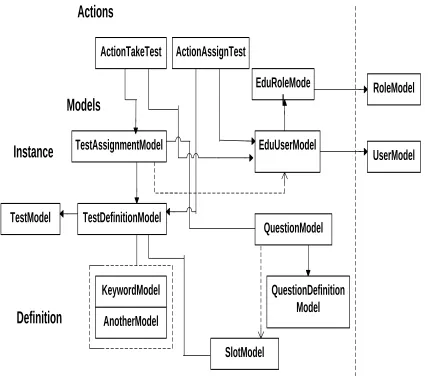
Fig. 2.
Tests
The test within the framework of system is called the totality of the tasks, proposed to student for the solution. These are the objects, comprised of the collection of tasks, and characterized by the specific properties. Actually for each student, the individual copy of test according to the specific rules, is created. The rules, according to which tests are created, are the versions of control room, they are called the templates of test and are determined by the appropriate object.
created. The template of test does not contain specific questions, but contains calls to SlotModel. With the determination of the attributes of template, other essences of system are used; therefore TestDefinitionModel is connected with a number of other classes of domain of definition: • TestGroupModel - group of the tests
• KeywordModel - keywords • AuthorModel - the authors
decrease the time of instructor by the composition of tests, making it possible at the same time to create a large quantity of unique versions of the tests, which satisfy the assigned requirements.
CONCLUSION
This approach is used to ensure the convenient transference of the training objects between different systems, and also the light expansibility of system with the aid of the realization of the objects of new types. The realized model also simplifies, bringing the objects of system to the working standards of the packing of Contents. The results of a study should be used for the development of the system of the remote instruction.
REFERENCES
[1] Robson, R. Object-oriented Instructional Design and Applications to the Web. World Conference on Educational Multimedia, Hypermedia and Telecommunications. 1999. (pp. 698-702).
http://www.eduworks.net/robby/papers/object_oriented.pdf
[2] Robson, R. Object-oriented Instructional Design and Web-based Authoring. In The journal of Interactive Learning Research. On-line: http://www.eduworks.net/robby/papers/objectoriented.pdf [3] Downes Stephen. Learning Objects: Resources for Distance
Education Worldwide. International Review of research in Open and Distance Learning. Athabasca University. Canada. 2001. http://www.irrodl.org/content/v2.1/downes.html- 20 -
[4] Friesen, N. What are educational objects? Interactive Learning Environments, Vol. 9, No. 3, Dec 2001. http://www.careo.org/documents/objects.html
[5] Quinn, C. Learning Objects and Instruction Components.
International Forum of Educational Technology & Society. 2000.
http://ifets.ieee.org/discuss_feb2000.html
[6] Polsani, R. P. Use and Abuse of Reusable Learning Objects.
Journal of Digital Information, Volume 3, Issue 4, Article No. 164, 19/02/2003. http://jodi.ecs.soton.ac.uk/Articles/v03/i04/Polsani/ [7] Mohan Permanand, Brooks Christopher. Learning Objects on the
Semantic Web. http://www.cs.usask.ca/~cab938/9
[8] Mohan Permanand, BrooksChristopher. Engineering a Future for Web-Based Learning Objects. University of West Indies, University of Saskatchewan. 2003. http://www.cs.usask.ca/~cab938/icwe2003_mohan_brooks.pdf [9] Shurville, Simon (2009) Accommodating the newfound strategic
importance of educational technologists within higher education: A critical literature review. Campus-Wide Information Systems
26(3)
[10] Balatsoukas, P., A. Morris and A. O’Brien (2008). Learning Objects Update: Review and Critical Approach to Content Aggregation. Educational Technology &Society 11(2), 119-130. [11] Barab, S., A. Thomas, M. Dodge, R. Carteaux and H. Tuzun
(2005). Making learning fun: Quest Atlantis, a game without guns.
Educational Technology Research and Development 53(1), 86-108.
[12] T. C. C. Groeneboer, D. Stockley. Virtual-u: A collaborative model for online learning environments. In Second International
Conference on Computer Support for Collaborative Learning, Toronto, Canada, December 1997.
[13] R. Cooley, B. Mobasher, and J. Srivastava. Data preparation for mining world wide web browsing patterns. Knowledge and Information Systems, 1(1):5–32, 1999.
[14] Tang, Y. T. and McCalla, G. (2002) Student modeling for a web-based learning environment: a data mining approach. In Proceedings of the 18th National Conference on Artificial Intelligence (AAAI 2002), Canada recommendations
[15] M. Spiliopoulou, L. C. Faulstich, and K. Winkler. A data miner analyzing the navigational behaviour of web users. In workshop on Machine Learning in User Modeling of the ACAI’99, Creta, Greece, July 1999.
[16] O. R. Za¨ýane and J. Luo. Towards evaluating learners’ behaviour in a web-based distance learning environment. In Proc. of IEEE International Conference on Advanced Learning Technologies (ICALT01), pages 357–360, Madison, WI, August 2001.