PRELIMINARY STUDY ON LEANER
PERCEPTIONS AND LEARNER PERFORMANCE
OF OER INTEGRATED ONLINE COURSEWARE
T.C. Sandanayake1, S.P. Karunanayake2, A.P. Madurapperuma3
Faculty of Information Technology, University of Moratuwa, Sri Lanka
Abstract— Technology-infused distance education is the fastest growing sector in modern education. Online learning has become an ubiquitous concept in modern education, while online learning systems provide a rich and flexible learning environment to facilitate the acquisition of knowledge. Open Educational Resources (ORE) which gives and new face for the open and online learning in modern education system. The learner perceptions on course development is one of most essential factor that every course designer must consider. This research study is aiming on conducting a preliminary investigation on learner perceptions of OER integrated online course ware. The study has been carried out in the Faculty of Information Technology of University of Moratuwa. Target group of learners were participated in the research study in the course module E-Education in the Level 4 Semester I. The outcome of this research study will be an input for the OER courseware development with the support of proper pedagogical features.
Index Terms—Learner Performance, Learner Perceptions, Open Educational Resources, Online Learning,
I. INTRODUCTION
OER based online courses, like all instructional technology delivery environments, must be rooted in pedagogical frameworks to be effective for teaching and learning. OER based online learning is still considered to be a relatively new phenomenon for the majority of educators within higher education system in Sri Lanka. The present evaluation of the research study is focuses on existing course designs and learners’ perceptions and learner performance of OER integrated online learning. OER learning materials were incorporated in developing of online course. Pedagogy is focused on enabling learning and intellectual growth of learners in contrast to instruction
that treats learners as the object of curriculum implementation [1]. Effective pedagogy requires teachers to understand how learners learn and must have the capacity and autonomy to design, implement and assess educational activities that meet the needs of individual and all learners [1]. In relation to the new approaches to teaching, learning and the restructuring of higher education practices for online learning, current theories of pedagogy in the ICT era require quiet thorough review.
The OER programmer are available free of charge where the learners get free opportunity to get the knowledge through online learning. Adult learners especially prefer to have more freedom in learning phase [2] Even though e-learning environment provides much independence and freedom for the learner; it is difficult to understand the learner behavior during the learning sessions. Research concerning online communities has produced important frameworks that help to understand online learning dynamics while online and OER programs have significant strengths and offer unprecedented accessibility to quality education, there are weaknesses inherent in the use of this medium that can pose potential threats to the success of any online program [3]. According to McFarlin (2008), for educational technology to be effective, student learning and outcomes must be the focus of its implementation and use [4].
further direction and the way forward on the present research study.
II. AIM AND OBJECTIVES
The major aim of this research study is to conduct a preliminary study to investigate learner perceptions and learner performance of OER integrated online learning course. There are two major objectives of the research study and the first objective is to identify learners’ perception towards OER integrated online courses. Second objective is to investigate learner performance in OER integrated online learning. Here the research was intended to study how actually learners learn in OER integrated online courses and this is to be evaluated through learner perceptions. Also the research was aiming to investigate whether the learners are achieving the intended learning outcomes. This was to be done by learner performances for its assessment activities.
III. THEORETICAL FRAMEWORK
Technological advancement has led to significant changes in the way university education is being provided in the developed countries. The review of the literature on the quality issues in e-learning revealed that online courses target a different segment of student population [5]. While addressing the various issues faced by the student community in virtual learning, it has observed that online learners may not be able to determine their academic needs, concerns, and other pedagogical attributes of education [5], [6]. The questionnaire of the research study was developed based on research studies conducted by Rengasamy Elango’s Quality of e-Learning: An Analysis Based on e-Learners’ Perception of e-Learning. There the study has made an attempt to investigate the issues related to the quality dimensions of e-learning [6]. Here the study has made an attempt to analyze the perception of e-learners on various dimensions of quality such as Relevance of courses, Effectiveness of delivery mode, Course Compliance and Confidence.
Apart from that the research study has further considered the learners’ perceptions on incorporating e-learning into teaching and learning at the University of Ghana done by Michael Tagoe in 2012 in developing the questionnaire [7]. This study was developed based on the Technology Acceptance Model (TAM), whichexamines learners’ perceptions on incorporating e-learning into teaching and learning [7]. Tagoe’s study was mainly focused on the categories as access to computers, prior experience,
and perceived ease of use, perceive usefulness, attitude towards learning and behavioral intention to use e-learning [7].
Buzzetto-More has also conducted an analysis of student’s perception on Various E-Learning Components in 2008 [8]. The research describes the learning perceptions and preferences of learners. Buzzetto-More argue, that regardless of the delivery method, there are numerous tools and features at the disposal of learners and instructors, and it is important for the e-learning community to examine both preferences and usage of these features [8]. Further the survey was designed to assess learners’ technology access, skills, and usage; prior experiences with e-learning, course delivery preferences, perceived satisfaction with e-learning, and perceptions of, and preferences towards, various e-learning components [8].
IV. RESEARCH METHODOLOGY
As indicated previously this research study is aiming on investigating on learner perceptions and learner performance of OER integrated online course. One of the major objectives of this research study is to evaluate the existing approaches of the OER integrated online learning. Therefore the study has analyzed the learners’ perceptions regarding the courses and to evaluate the teaching and learning approach of the OER integrated online learning. The methodology adopted in this research study was questionnaire based evaluation and learner performance records. The learners’ perceptions towards learning were evaluated at the end of the course.
The selected course was offered for the learners who are following B.Sc (Hons) in Information Technology and B.Sc (Hosn) in Information Technology and Management. There were 61 learners registered for the course. This course was an elective course module which offered in the level 4 of both degree programmes. The course was conducted within 14 calendar weeks. Blended teaching and learning which was face to face and online learning was used. The learners’ performance was evaluated through course assignments, quizzes and discussion forums.
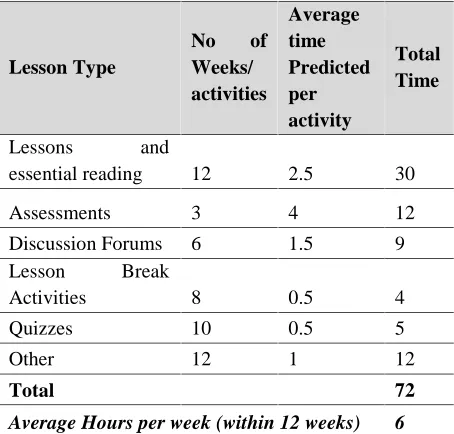
module. The student’s feedback questionnaire consists of both structured and unstructured questions which are open ended. The student’s feedback evaluation has used the five (5) point likert scale structure to get the feedback. The feedback was categories from Strongly Agree to Strongly Disagree. The lesson plan should be outlined in a way that reflects the delivery of lesson content with a correct schedule. The time allotted for preparation, presentation, and evaluation of activities should be appropriate and adequate. The course module E-Education is structured in its lesson and sub lessons according to the given semester plan. Each lesson consists of two hours of teaching hours and one hour of tutorial session which count as direct contact hours of learners. The estimated learning time of the course is as follows. The course structure according to time allocated for course activities are given in Table I given below.
Table I: Course Structure
Lesson Type
No of Weeks/ activities
Average time Predicted per activity
Total Time
Lessons and
essential reading 12 2.5 30
Assessments 3 4 12
Discussion Forums 6 1.5 9
Lesson Break
Activities 8 0.5 4
Quizzes 10 0.5 5
Other 12 1 12
Total 72
Average Hours per week (within 12 weeks) 6
According to Table I, the total hours allocated for the course to conduct face to face sessions are 42. This includes two hours of lectures and one hour of tutorial session which runs through 12 weeks of a semester. Apart from this schedule, the research study has developed some more learning activities, forums, assessments to be accessed via Moodle LMS. The course was developed in such way as per described in the above table above and the average time the learners had to spend on the subject per week is equal to six hours. This includes face to face session and online
sessions. Further the research study has calculated the actual average time spent on a lesson is six hours.
V. ANALYSIS OF RESULTS
The results of the analysis of this research study are categorized in to two main subtopics. The first is about learner perceptions and second is the learner performance.
A. Learner Perceptions
As mentioned in the aim and the objectives of the research, this research study was conducted mainly to evaluate the learner perception and learner performance of OER integrated online learning courses. According to the methodology, the very first evaluation was received by the learners and it is about their familiarity and usage of such courses. The question was “Have you ever taken on OER based online course before? “. The analyses of the results were as follows:
the learners are given numerous activities to complete within a specific time limit. These time limits vary with the number of activities to be performed by the learners. According to Table I the average time to be spent on the lessons per week is 6 hrs. Following Fig.2 shows the learners’ feedback on how they have spent their time on lesson activities per week.
Fig.2: Time Spent on Lessons per Week
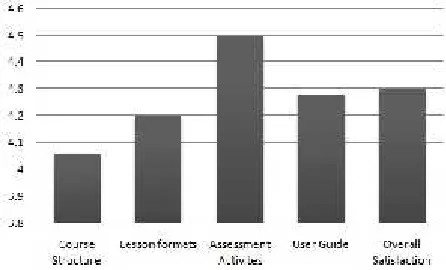
Majority of the learners, which is about 48% have spent 4-5 hours per week. The required and expected average time which is 5-6 hours have spent by about 8% of learners only. Twenty and sixteen percent of learners has been spent 4-5 hours and 3-4 hours respectively on their learning activities. Interestingly there are some set of learners who have shown their interest at a very minimum level. According to the statistics nearly 8% of learners have spent less than 2 hours on the lesson activities. According to the Table II, the analysis shows the calculation of mean and standard deviation of each question of the questionnaire. The following Fig.3 shows the analysis of average mean values of the each category of the questionnaire. According the Table II, the average mean values are more than 4 which shows that the learners have a very positive attitudes towards each and every activity of the course. Specially the learners have a very positive feeling and belief about the assessment activities which is shown bt the Fig 3. Overall satisfacton of the course is also equal to 4.3, which implies that the learners are satisfied with the overall course.
When critially analysing the mean values of the questionaire the lowest mean values were found on the questions “The course structure is clear and user friendly” (X = 3.95082) and “I believe the lessons were properly explained and elaborated.” (X=3.557377). This implies that learners have some negative feelings on the structre and the lesson instructions.
Fig.3: Average Mean Values of the Research feedback When critially analysing the mean values of the questionaire the lowest mean values were found on the questions “The course structure is clear and user friendly” (X = 3.95082) and “I believe the lessons were properly explained and elaborated.” (X=3.557377). This implies that learners have some negative feelings on the structre and the lesson instructions. According to the results displayed above it illustrates that the learners show very positive attitudes and perception towards incorporating OER elements into other courses of their degree progeamme. Specially the assessment activites of the courses can be well guided through the courses of this nature. The learners have mentioned their views on these lines in their further comments.
The next analysis is based on the leaners’ comments made for the question “What do you think about the structure of the course, presentation of lesson material and lesson formats?”.The comments were analyzed and categories according to its positiveness and negativeness. The positive comments were summarized in Table III. This shows the positive and negative views on the structure of the course, presentation of lesson materials and lesson formats Table III: Learners views on Course Structure
Positive Learner views
- Lecture notes are clear and understandable
- Easy type of format - Can do lot of practical work - Well organized
- Slides are clear - Lesson flow is good
- Easy to understand by the target audience - Helpful in developing knowledge and
- Enhance the ability of thinking out of the box
- Interesting lesson activities - New things learnt
- Learners can get interact each other - Easy to access and well organized - Relationship among the lessons were well
created Negative Learner view
- Some presetations were bit lenthy, need to reduce the length.
- Please explain the technical terms more, because we are not familier with education terms
- Prefer the lesson structure, but the lessons should be more interactive.
- Some lessons were difficult to understand, they are more philosophical. Pls make them simple as possible
Table IV: Feedback of OER based Teaching and Learning Methods
Positive feedback Negative Feedback
Learners and facilitators can interact virtually which
is very
comfortable Can be adopted
in many
courses with the technology enhancement Learners enjoy
learning
Very
interesting and easy way to learn.
Anytime anywhere learning is pretty easy and interesting. Learners can
learn using modern
Depends, if only the courses are developed interactively learners are able to enjoy the learning Sometimes it
is not motivate because learners do not
get the
physical connections with the teachers–cant get the actual feeling of learning Learners can
cheat easily It is very easy
for the
learners get
technological advancements. Can improve
the learners abilities such as reading, writing and analyse Less cost for
developing physical infrastructure – can improve the quality of lesson learning materials
away from learning and cheat the instructor. Some courses
are less quality. Specially the learning materials and poor structure of the course. Like to sit with
the friends in the class room rather than learning through online Not all the courses hosted online are not quality in its delivery as the face to face classess. Not suitable
for a highly practical / hands on work oriented subjects Situational
need
Majority of the learners have provided very positive feedback for this question. Learners believe that OER integrated course which is offered for them was very interesting and they had the chance to enhance their knowledge through that. The structure of the lessons was well formed and they found it is easy to access the system. Apart from that learners commented that the lesson structure provide a very good relationship among the every other entity of the course. There were a very few negative comments.
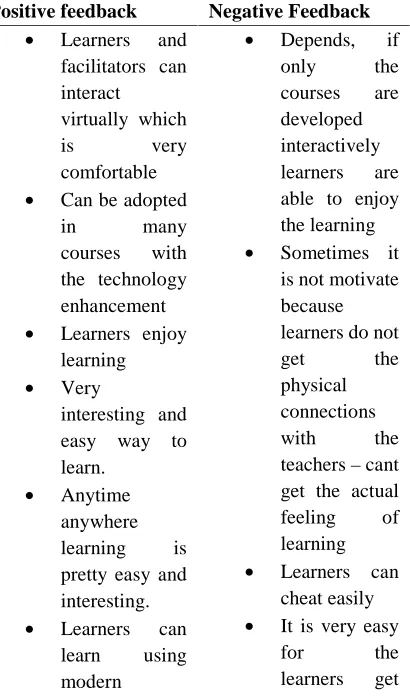
learners about the importance of the OER based online learning courses. It is impressing to see both positive and negative perception towards addressing this question. The positive and negative feedbacks are listed as in Table IV.
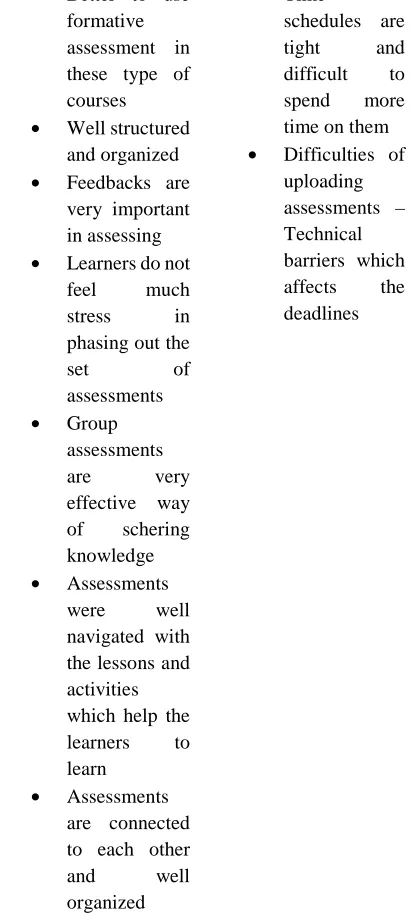
The evaluation of the question “What do you think about the assessment activities which have been used in the course?” is also quit interesting since the learners’ have shown the learners motivation to get online assessment in this particular evaluation. According to the feedback received for this evaluation, it is identified that learners enjoy a lot of online assessment work. The course comprises of both formative and summative assessments. The assessment activities started with the individual assessment activities and gradually moved into group activities. Learners have commented that they need more feedback on the assessment activities offered online. Apart from that the learners have commented that they need some more time in completing the assessments due to the busy schedules. The feedback given for the assessment activities of the OER based course is shown in Table V.
The next question that the research study has reviewed is related to institutional capability and capacity to conduct OER based online courses. It is important to review the feedback of current learners on the future offerings of such courses in their degree programmes. There were good reviews and proposals made by the current learners as listed below in Table VI. Further this research study was looking for the learners’ advices and suggestions based on their own learning experience. It is quite obvious that every educational researcher should critically evaluate the learner feedback on the activities which are offered or practiced.
Table V: Feedback on Assessment Activities Positive feedback Negative Feedback
Better to use formative assessment in these type of courses Well structured
and organized Feedbacks are
very important in assessing Learners do not
feel much stress in phasing out the
set of
assessments Group
assessments are very effective way of schering knowledge Assessments
were well navigated with the lessons and activities which help the learners to learn
Assessments are connected to each other and well organized
Time
schedules are tight and difficult to spend more time on them Difficulties of
uploading assessments – Technical barriers which affects the deadlines
Table VI: Review on Conducting OER based online courses at the Faculty of IT
Better
experience for the learners – can add lot of learning and non learning activities help to develop the knowledge Yes lot of social
learning is required Prefer for
distance learning courses Open learning platforms are better places for learn.
Need to add teleconferencin g
Appropriate for postgraduate programmes – busy Learners will enjoy this courses
Need lot of hands on practical experience for the IT students–lab work
Course management difficulties Keeping
students alive all the time – especially if it is fully online and OER based
Difficulties will occur for different geographical locations of the country. Technologica
l barriers will be a problem
The higher learners who have attempted and completed the course have provided very effective ideas on further development of OER based integrated online learning in the technology oriented faculty. The familiarity and the fluency in technology will be very helpful for them to be in touch with these types of courses in their undergraduate courses. The solutions suggested by the learners for the aforementioned question is also quite interesting. The learners have provided the suggestions as follows:
- Need to add teleconferencing - Brainstorming sessions - Warm up sessions for learners
- High interactivity with the learners and teachers
- Cost effective and sustainable models - LMS needs to be more interactive - Need to attract the learners.
- More live discussion forums where learners can share thoughts
- Provide quick feedback for the assessment activities of the course
B. Learner Performance
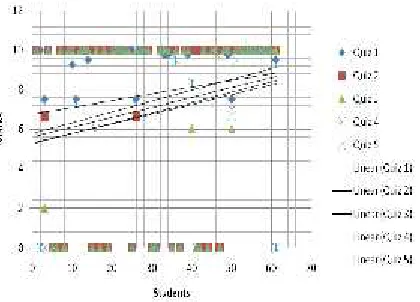
The learner performance records were evaluated based on the marks that the learners have received for the three graded assessments conducted in the course. Apart from that, the self graded quizzes are also conduced and those results are also shown in below figures. The learners were given three different formative assessment activities. The very first assessment was an individual activity and the second and third assessments were grouped, based on the outcome of the first assignment. The marks distribution is shown in the Fig 4. As displayed in the Fig.4 the marks of three formative assessments were distributed in a skewed normal curve. The average mark of assignment 1 is 64, assignment 2 is is 68 and assignment 3 is 72. The marks of the learners for the three assignments lays between 34 to 96.
Fig.4 : Distribution of Assessment Marks
Fig 5: Distribution of Quiz Marks
According to the assessment activites given the only assessment which was not considered in grading was the discussion froums. Due to the number of learners who attempted the discussion forum it was difficult to evaluate based on a specific senario. Only the feedback was given for the discussion forums. This is one of the biggest problems in online discussion forums because it is very diffucut to rationalise the evaluating criteria of the discussion. Therefore the learners were not given marks for the discussion forums of the course.
VI. CONCLUSION
This research study was conducted based on two objectives. The first objective was to identify the learners’ perception of OER integrated online courses. There the study has selected the course E Education which is offered for the B.Sc (Hosn) in IT and B.Sc (Hons) in IT&M learners in their final year. The next objective was to evaluate the learner performance in OER integrated online learning. The questionnaire survey was been created based on the research studies conducted by Rengasamy Elango s Quality of e-Learning: The Analysis Based on e-Learners’ Perception of e-Learning, the study of Learners’ perceptions on incorporating e-learning into teaching and learning at the University of Ghana done by Michael Tagoe in 2012 and the study of learners perception on Various E-Learning Components by Buzzetto-More in 2008. The results were analyzed based on various aspect of OER developments and online learning in higher education. The findings of the research study will be one of the key inputs for the further studies of the research work.
REFERENCES
[1] Teo T.B., Chang S.C.A, Leng R.G.K., Pedagogy Considerations for E-learning, Available:
http://www.itdl.org/journal/may_06/article0 1.htm, 2006
[2] Nishino K., Ohno T., Mizuno S., Aoki, Y K. . Fukumura. “A study on learning styles of Japanese e-learning learners”. in the proceedings of 11th International Conference of Human and Computers. JP, 2008, pp. 299–302.
[3] Aranda, N. , A Brief History of E-learning and Distance Education. Vol , DOI: 45, 2007
[4] McFarlin, B. K. , ‘Hybrid lecture-online format increases student grades in an undergraduate exercise physiology course at a large urban university’, Advanced Physiology Education, vol. 32, no. 1, 2008 ; pp. 86_91
[5] Mangan, K. S., “Expectations evaporate for online MBA programs”, Chronicle of Higher Education, 48(6), p31, 2001
[6] Elango, R. Gudep, V. K. and Selvam, M. “Quality of e-Learning: An Analysis Based on e-Learners’ Perception of e- Learning.”, The Electronic Journal of e-Learning, Volume 6 Issue 1, pp. 31–44, 2008
[7] Tagoe M., Students’ perceptions on incorporating e-learning into teaching and learning at the University of Ghana, International Journal of Education and Development using Information and Communication Technology, (IJEDICT), 2012, Vol. 8, Issue 1, pp. 91-103.
[8] Buzzetto-More N.A., Student Perceptions of Various E-Learning Components, Interdisciplinary Journal of E-Learning and Learning Objects, Volume 4, 2008