Pervasive Computing And Communication
Technologies For U-Learning
Young C. Park, Baekseok University, Korea
ABSTRACT
The development of digital information transfer, storage and communication methods influences a significant effect on education. The assimilation of pervasive computing and communication technologies marks another great step forward, with Ubiquitous Learning (U-learning) emerging for next generation learners. In the evolutionary view the 5G (or beyond 4G) wireless mobile systems will be capable of supporting wwww allowing a highly flexible network and will be able to solve the data traffic and wireless spectrum problems for U- learning in the near future.
Keywords: Pervasive Computing; 5G; Next Generation Learners; Mobile Network; U- Learning
INTRODUCTION
s new technologies evolve and more pervasive forms of technology emerge, computers will become 'invisible' and will be embedded in all aspects of our life. They will be seamlessly integrated into our world in a phenomenon referred to as calm technology. The concept of pervasive computing and U-learning goes beyond portable computers. According to the Chronicle of Higher Education [17], eighty-seven percent of college students in America now own laptops, and fifty-five have smartphones that provide access to the Internet as well as take calls. The number of smartphone users stands at 26.72 million, 50.8 percent of all 52.55 million mobile subscribers and the number of the 4th generation (4G) Long Term Evolution (LTE) subscribers in Korea has surpassed 4 million on April, 2012 [15]. It looks like many students will soon have a three screen day where they bring smartphones to school, use tabs or laptops, and occasionally work on a big screen or interactive whiteboard [2]. Right now, universities and corporate offices are still divided along generational lines, split between what Marc Prensky calls "Digital Natives" and "Digital Immigrants." Where Net Gens do find power is on the Internet because it depends upon a distributed, or shared, delivery system rather than a hierarchal one. This distributed, or shared, power is at the heart of the culture of interaction [13].
The Net Gen needs for learning demand and so the new media enables a shift from traditional broadcast learning to Interactive Learning. It is a major issue in education to build blocks of innovative learning model and to teach Net Gen and prepare them for the 21st century. Sakamura and Koshizuka studied ubiquitous computing technologies for u learning and a digital ubiquitous museum example [14].
Nakashima et al. presented the latest developments in the burgeoning research area of ambient intelligence and smart environments including pervasive computing and ubiquitous computing [12]. Leonidis et al. proposes an integrated architecture for pervasive computing environments, named ClassMATE (Classroom Multiplatform Augmented Technology Environment), which aims to transform the conventional classroom into a context aware AmI (Ambient Intelligence) environment [11]
5G NETWORK FOR PERVASIVE LEARNING
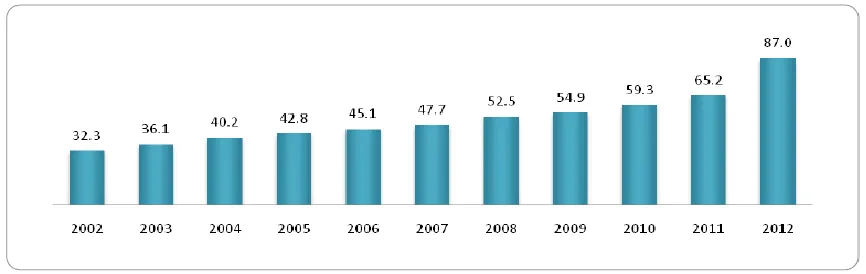
As of September 2012, 87% of the population aged in Korea are ‘wireless Internet users’ who have used Wireless Internet services such as mobile network (2G/3G), wireless LAN, WiBro, LTE (long-term evolution) by wireless devices such as smart phones and laptop computers. Wireless Internet usage rate has continued its increase, year 2012 by 21.8% compared to 65.2% of 2011 (Fig. 1: KISA, Changes in Wireless Internet Usage Rate in Korea).
Figure 1. Changes in Wireless Internet Usage Rate in Korea
Among ‘College or graduate students’ 99.7% are Wireless Internet users and usage rate for Wireless Internet of ‘High school students’ are 95.9%. And the primary access method for Wireless Internet is ‘3G Mobile communication network, while 76.3% use ‘Wireless LAN (WiFi)’. 97 percent of Net Gen own a computer, and 94 percent own a cell phone and 75 percent do schoolwork while instant messaging [9]. In order to meet the complex demands of these Net Gen students, one of the latest trends in education is in the form of media-rich pervasive learning. Pervasive learning facilitated by mobile technologies offers flexibility to learners in terms of community, autonomy, locationality and relationality [16]. Pervasive learning environments with next generation communication technology can have the potential to meet the needs of the Net Gen.
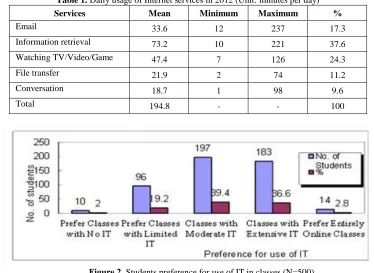
Table 1. Daily usage of Internet services in 2012 (Unit: minutes per day)
Services Mean Minimum Maximum %
Email 33.6 12 237 17.3
Information retrieval 73.2 10 221 37.6
Watching TV/Video/Game 47.4 7 126 24.3
File transfer 21.9 2 74 11.2
Conversation 18.7 1 98 9.6
Total 194.8 - - 100
Figure 2. Students preference for use of IT in classes (N=500)
as an old-fashioned cell phone, and the iPad uses 122 times as much, according to the Federal FCC (Federal Communications Commission) [7].
Pervasive computing involves three converging areas of ICT (information and communication technology): computing (‘devices’), communications (‘connectivity’) and ‘user interfaces’. The 5G family of ITU standards could be implemented around the year 2020. The major difference between current generations and next generation 5G techniques must be something else than increased maximum throughput and some features of 5G technology are as follows [1]: 1) Data Bandwidth: 1 Gbps and higher 2) Multiplexing: CDMA (code division multiple access) 3) Switching: All packet 4) Core Network: Internet based on IPv6 address 5) The 5G technology network offering enhanced and available connectivity just about the world. 3G used spectrum up to 5 MHz, and 4G up to 40 MHz. The millimeter-wave spectrum is found between 3 and 300 GHz, so it has plenty of room to grow. And beyond speed, 5G could additionally become much more reliable than 4G networks, thanks to the spectrum’s ability to “handle 50 to 100 times more traffic.” [4].
Future networks such as 5G will need to be deployed much more densely than today’s networks and, due to both economic constraints and the availability of sites, will need to become significantly more heterogeneous than today. One way to achieve that is to “densify” networks to provide more capacity by adding small cell sites, a core focus of HetNets. This can include the use of multiple picocells, that is, small cellular base stations that cover targeted areas, in a broader mobile coverage zone. The 5G network using HetNet supports multiuser virtual environments and pervasive computing which will allow learners to move beyond the desktop and to get immersive environments that enhance learning [10]. U-learning based on 5G technology is right to fit Net Gen’s learning needs and desires in the future.
CONCLUSIONS
In a developmental education classroom, personalized learning and accelerated course completion is trans- formative. Using ICT technology to deliver accelerated learning models has emerged as a promising strategy for Net Gen students who rely heavily on communications technologies to access information. This growing trend toward ubiquitous computing or pervasive computing using the power of networks has opened the door for learners and instructors to access the world’s knowledge from almost anywhere and at any time.
In this paper, we conducted two surveys in spring semester of 2011 and 2012, respectively, to estimate the Internet traffic generated by Net Gen college students in Korea. Current 4G network can support the data traffic of current heavier users among Net Gens, but the data traffic will increase nearly 1000 folds in the next few years which will result in overloading. It is expected to grow that aggregate smartphone traffic in 2016 will be 50 times greater than it is today. The inevitable inclusion of next generation 5G mobile network using HetNet will help to support U- learning for the Net Gen in the future. 5G network using pervasive computing technologies is able to solve the data traffic and wireless spectrum problems and support the U-learning in the near future.
AUTHOR INFORMATION
Young Park, Ph.D., was a head of military communication system department in ADD, Korea from 1976 to 2000. Since 2001 he has been with Baekseok University, Korea. He was a visiting professor at Harvey Mudd College, California, in 2012.
REFERENCES