Language Functions in Preterm-Born Children:
A Systematic Review and Meta-analysis
abstract
BACKGROUND AND OBJECTIVE: Preterm-born children (,37 weeks’
gestation) have higher rates of language function problems compared with term-born children. It is unknown whether these problems decrease, deteriorate, or remain stable over time. The goal of this research was to determine the developmental course of language functions in preterm-born children from 3 to 12 years of age.
METHODS:Computerized databases Embase, PubMed, Web of
Knowl-edge, and PsycInfo were searched for studies published between January 1995 and March 2011 reporting language functions in preterm-born children. Outcome measures were simple language function assessed by using the Peabody Picture Vocabulary Test and complex language function assessed by using the Clinical Evaluation of Language Fundamentals. Pooled effect sizes (in terms of Cohen’sd) and 95% confidence intervals (CI) for simple and complex language functions were calculated by using random-effects models. Meta-regression was conducted with mean difference of effect size as the outcome variable and assessment age as the explanatory variable.
RESULTS:Preterm-born children scored significantly lower compared
with term-born children on simple (d=–0.45 [95% CI:–0.59 to–0.30];P, .001) and on complex (d= –0.62 [95% CI:–0.82 to–0.43];P,.001) language function tests, even in the absence of major disabilities and independent of social economic status. For complex language function (but not for simple language function), group differences between preterm- and term-born children increased significantly from 3 to 12 years of age (slope =–0.05; P= .03).
CONCLUSIONS:While growing up, preterm-born children have increasing
difficulties with complex language function.Pediatrics2012;129:745–754
AUTHORS:Inge L. van Noort-van der Spek, MA,a
Marie-Christine J. P. Franken, PhD,aand Nynke Weisglas-Kuperus,
MD, PhDb
aDepartment of Otorhinolaryngology andbDivision of
Neonatology, Department of Paediatrics, Erasmus Medical University Centre–Sophia Children’s Hospital, Rotterdam, Netherlands
KEY WORDS
language development, long-term outcome, meta-analytic methods, premature infants, systematic reviews
ABBREVIATIONS
BPVS—British Picture Vocabulary Scale BW—birth weight
CELF—Clinical Evaluation of Language Fundamentals CI—confidence interval
FSN—fail-safeN
FS-IQ—full-scale IQ GA—gestational age
PPVT—Peabody Picture Vocabulary Test SES—socioeconomic status
www.pediatrics.org/cgi/doi/10.1542/peds.2011-1728
doi:10.1542/peds.2011-1728
Accepted for publication Dec 9, 2011
Address correspondence to Inge L. van Noort-van der Spek, MA, Department of Otorhinolaryngology, Erasmus University Medical Centre–Sophia Children’s Hospital, Dr Molewaterplein 60, 3015 GJ Rotterdam, Netherlands. E-mail: [email protected]
PEDIATRICS (ISSN Numbers: Print, 0031-4005; Online, 1098-4275).
Copyright © 2012 by the American Academy of Pediatrics
FINANCIAL DISCLOSURE:The authors have indicated they have nofinancial relationships relevant to this article to disclose.
According to a recent publication of the World Health Organization, worldwide∼13 million babies are born preterm annu-ally.1Preterm birth, defined as born
be-fore 37 weeks of gestation, constitutes a major challenge in perinatal health care. Children born prematurely are at greater risk for major disabilities such as cerebral palsy, mental retar-dation, and severe visual and hearing loss than term-born children.2These
ma-jor disabilities are relatively rare; however, more subtle developmental problems have often been described in preterm-born children. Meta-analyses highlighted substantial impairment in multiple de-velopmental domains in preterm-born children throughout childhood, such as cognitive and motor development, behavior, and academic achievement.3–5
Preterm birth coincides with higher rates of problems with language function compared with term-born children.6–8
Language function can be divided into 5 components: semantics (rules govern-ing the meangovern-ing of words and senten-ces), phonology (rules governing speech sounds to signal meaning), morphology (rules governing change in word mean-ing related to change in word form), syntax (rules governing how words can be combined to form phrases, clauses, and sentences), and pragmatics (rules governing the use of language in a social context). In brain and linguistic research, language functions are often divided into simple and complex to discriminate be-tween more basic and more complex verbal processes.9,10 Simple language
function comprises, for instance, vocab-ulary and the acquisition of short main clauses. Complex language function, characterized by the integration across multiple language components, compri-ses the meaning of complex concepts, including verbs or relational terms, and sentences consisting of main and subor-dinate clauses.
Despite the large amount of research conducted on language function in
preterm-born children, it is still un-known to what extent problems in language function at an early age de-crease, deteriorate, or remain stable over time. Because language function is essential in all kinds of social and ac-ademic life,11,12insight in the
develop-mental course of language functions in preterm-born children is of great value. Timely detection and appropri-ate intervention of language problems in this vulnerable population may prevent emotional, social, and learn-ing deficits, and may improve long-term outcomes, reducing the need for special education.11–13
The aim of this study was to investigate the developmental course of language functions in preterm-born children compared with term-born children throughout childhood by performing a meta-analysis. A meta-analysis on the developmental course of language functions is useful because of the larger sample size and the larger number of age points compared with the few lon-gitudinal single studies addressing this topic.
METHODS
Selection of Studies
In undertaking this study, the guidelines made by the Meta-analysis of Obser-vational Studies in Epidemiology group were followed.14First, the computerized
databases Embase, PubMed, Web of Knowledge, and PsycInfo were searched for articles by combining the search terms prematur*, preterm, low birth weight, gestational age AND speech, language, communicat*, interact*, ver-bal, and psycholinguistics. Second, ref-erence lists of published articles were hand-searched to identify additional relevant studies. Third, experts on pre-term outcome (pediatricians and neu-ropsychologists) were contacted to ascertain additional studies.
The following inclusion criteria were used: (1) the study included children born
preterm (gestational age ,37 weeks); (2) the study was published between January 1995 and March 2011 (1995 was chosen because of the significant improvements in neonatal care that had resulted in a much better condition of preterm-born children from that time on [eg, the combination of ante-natal steroids to improve lung matura-tion before delivery and improved obstetric management15]); (3) the study
was published in an English-language peer-reviewed journal; (4) the study reported mean or median language outcomes collected with a reliable and validated language test; (5) a case-control design was used to minimize stratification bias; (6) the language test was used in at least 5 studies included in this meta-analysis to ensure stability of the results16; and (7) the study was
of sufficient quality, according to the Newcastle-Ottawa Scale.17Studies were
excluded if they did not meet all of these inclusion criteria. If the same population of preterm-born children was the subject of several studies, only the study with the largest sample size was included.
Quality Assessment
Quality assessment was undertaken in-dependently by 2 authors (Van Noort-van der Spek and Franken) by using the Newcastle-Ottawa Scale.17This scale
assesses the quality of case-control studies in terms of selection of chil-dren (4 criteria), comparability of study groups (1 criterion), and outcome as-sessment (3 criteria). The total rating score ranges from 1 to 9, with 9 being the most favorable. Disagreements be-tween authors with regard to data ex-traction and quality assessment were resolved by discussion.
Outcome Measures
version [PPVT-III],19the British version,
the British Picture Vocabulary Scale [BPVS],20 and the second version
[BPVS-II]21) or the Clinical Evaluation of
Language Fundamentals (CELF, including the preschool version, [CELF-P]22and
the third version [CELF-3]23) could be
included.
The included language tests are well established, generally accepted, and have good reliability and validity. The PPVT is a pictubased measure of re-ceptive vocabulary, a simple language function within the domain of semantics. All versions of the PPVT have a mean6 SD of 100615.
The CELF is a comprehensive test of complex receptive and expressive lan-guage function, including subtests for semantics, grammar, syntax, and work-ing memory for language. All versions of the CELF yield composite scores for re-ceptive language, expressive language, and total language, with a mean6SD of 100615.
Mean gestational age (GA), mean birth weight (BW), major disabilities, year of birth, gender, assessment age, socio-economic status (SES), and mean full-scale IQ (FS-IQ) were obtained from each study.
Statistical Analyses
Statistical analyses were performed by using Stata version 11 (Stata Corp, College Station, TX). All statistical test-ing was 2-sided, andP,.05 was con-sidered significant.
Random-effects models instead offi xed-effects models were used, providing a more conservative estimate of vari-ance in sample characteristics between studies. A standardized difference between the mean language scores of cases (preterm-born children) and controls (term-born children) was weighted according to the sample size for each study. To meet the assumption of independence of effect size, 1 point estimate of effect from each study was
included. If studies reported results for subgroups of preterm-born children or controls, a weighted group mean and weighted SD were calculated by multi-plying each subgroup mean and SD, respectively, by its sample size, adding the subtotals, and dividing the obtained sum by the total sample size.24,25In case
of a longitudinal study, the first as-sessment was used to minimize the risk of a learning effect by second testing and to optimize the age range. Pooled effect sizes were calculated by using the standardized difference of means and the corresponding weight for each study. Results are reported as Cohen’s d and 95% confidence intervals (CIs). Cohen’s guidelines were used to classify the magnitude of effect sizes: d= 0.2 represents a small effect,d= 0.5 a me-dium effect, andd= 0.8 a large effect.26
Cochran’s Q statistic and the I2 index were conducted to assess homogeneity of effect size across studies. Statistically significant heterogeneity was consid-ered atP,.05 and I2.50. Galbraith plots were constructed to identify outliers in analyses with significant heterogeneity. Meta-regression and subgroup analyses were performed to explore potential sources of sta-tistical heterogeneity between studies, including GA, BW, major disabilities, year of birth, gender, FS-IQ, and SES. FS-IQ is identified as a possible cause of hetero-geneity because deficits in language function may be part of general cognitive difficulties, or may represent specific language impairments.
The possibility of publication bias was assessed by using the Egger test and visual inspection of a funnel plot. We also performed Rosenthal’s fail-safe N (FSN), which measures the number of additional “negative” studies (studies in which the effect was zero) that would be needed to increase the P value for the meta-analysis to..05. A FSN is considered robust if the estimate of unpublished studies is .5 times the number of
studies published.16 In addition, the
correlation between sample size and effect size was investigated by using the Pearson correlation coefficients.
Finally, meta-regression according to assessment age was conducted, with mean difference of effect size as the outcome variable and age at assess-ment as the explanatory variable.
RESULTS
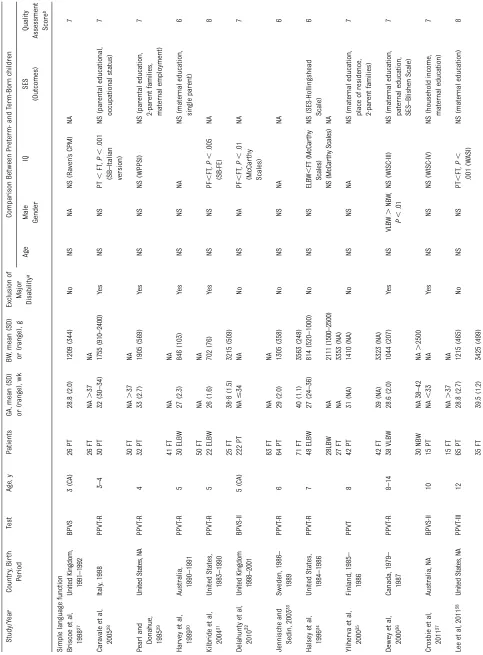
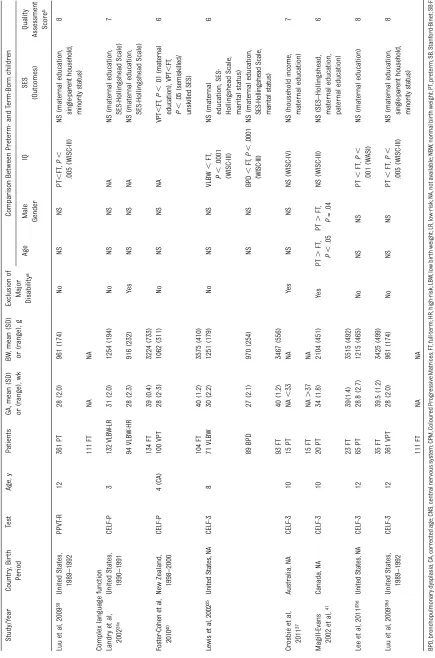
The literature search yielded 2214 arti-cles. After review of the abstracts, 186 articles were identified as potentially eligible for inclusion, and the full-text articles were retrieved for review. Re-sults of the publication search and se-lection are presented in Fig 1. Finally, 17 studies could be included in which out-comes of language function were mea-sured with the PPVT (PPVT-R, PPVT-III, BPVS, and BPVS-II) and the CELF (CELF-P and CELF-3). The characteristics of these studies are presented in Table 1. The meta-analytic sample comprised a total of 1529 preterm-born children and 945 term-born born children.
Simple Language Function
Simple language function, in terms of receptive vocabulary, was assessed in 13 studies with the PPVT.27–39
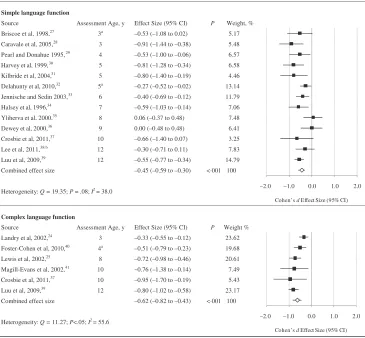
Random-effects meta-analysis revealed that preterm-born children had significantly lower receptive vocabulary scores com-pared with term-born children, as in-dicated by the combined effect size of d=–0.45 (95% CI:–0.59 to–0.30;P, .001) (Fig 2). Significantly lower recep-tive vocabulary scores in preterm-born children compared with term-born children were found in 8 of the 13 studies.28–34,39 No statistically signifi
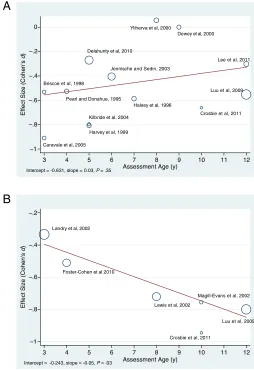
Meta-regression according to assess-ment age did not reveal a significant increasing or decreasing difference be-tween preterm- and term-born children from 3 to 12 years of age regarding simple language function in terms of receptive vocabulary (intercept =
–0.631, slope = 0.03,P= .35) (Fig 3).
Complex Language Function Complex language function, in terms of total language, was assessed in 6 studies with the CELF.24,25,37,39,40,41
Recep-tive and expressive language was assessed with the CELF in 5 stud-ies.2 5 , 3 8–4 1Preterm-born children had
significantly lower total language, re-ceptive, and expressive language scores compared with term-born children, as indicated by the combined effect size for total language (d=–0.62 [95% CI:–0.82 to –0.43]; P, .001) (Fig 2), receptive language (d=–0.69 [95% CI:–0.82 to– 0.55]; P , .001), and expressive lan-guage (d=–0.61 [95% CI:–0.74 to–0.47]; P , .001) (Supplemental Fig 4). Sig-nificantly lower complex language func-tion in preterm-born children compared with term-born children was found in all studies. Significant heterogeneity across the studies did exist for total language (Q = 11.27,P,.05, I2= 55.6). No signif-icant heterogeneity was found across
the studies for receptive (Q = 2.00,P= .74, I2= 0) or expressive (Q = 3.21,P= .52, I2= 0) language. A Galbraith plot to detect potential sources of het-erogeneity for total language revealed that the study by Landry et al24was an
outlier. The only salient characteristic of this study was the relatively young assessment age; namely, 3 years. In a subgroup analysis without this study, strong evidence for absence of het-erogeneity was found (Q = 3.00, P= .56, I2 = 0) (Supplemental Fig 5). Sources of significant heterogeneity were not found by meta-regression analyses on mean GA (5 studies,P= .49), mean BW (5 studies, P = .93), gender (6 studies, P= .44), or effect sizes of mean FS-IQ (5 studies,P= .12).
Subgroup analyses were performed to assess the effect of SES and major disabilities on the estimated effect sizes of complex language function, in terms of total language. The effect of SES and major disabilities was analyzed accord-ing to subgroup analyses instead of meta-regression, due to the variety of outcome measures for SES and major disabilities used among the included studies. A subgroup analysis for years of birth could not be performed because only 3 of 6 studies included year of birth data, ranging from 1989 to 2000. Afirst subgroup analysis comprised 5 studies in which there was no significant dif-ference regarding SES between the preterm-born children and their con-trols. One of the 6 studies was excluded because of a significant difference of SES between preterm- and term-born chil-dren. This analysis showed a combined effect size ofd=–0.66 (95% CI:–0.90 to– 0.41;P,.001), indicating a significant lower mean total language in preterm-born children compared with term-preterm-born children independent from SES (Sup-plemental Fig 6). The pooled effect size of all studies on total language (–0.62) was not different from the pooled effect size of the 5 studies without significant FIGURE 1
differences of SES (–0.66). Therefore, the conclusion may be drawn that the effect sizes for total language were not influenced by SES. A second subgroup analysis comprised 3 studies in which only preterm-born children without major disabilities were included. This analysis revealed a combined effect size ofd=–0.54 (95% CI:–1.01 to–0.07; P,.05), indicating a significant lower mean total language even in preterm-born children without major disabil-ities compared with term-born children (Supplemental Fig 7). The pooled effect size of all studies on total language (–0.62) was slightly higher than the pooled effect size of the 3 studies with preterm-born children without major disabil-ities (–0.54). Therefore, the effect sizes
for total language were somewhat influenced by major disabilities.
A funnel plot and Egger test results showed no publication bias for total language (P= .51), receptive language (P= .64), or expressive language (P = 0.87). The FSN was 205 for total lan-guage, 162 for receptive lanlan-guage, and 127 for expressive language. The cor-relation with sample size was not significant for total, receptive, and expressive language (r= 0.31,P= .54; r=–0.53,P= .35; andr=–0.37,P= .54, respectively).
Meta-regression according to assessment age revealed a significant increasing dif-ference between preterm- and term-born children regarding complex language functions, in terms of total language, from
3 to 12 years of age (intercept =–0.243, slope =–0.05,P= .03) (Fig 3).
DISCUSSION
This meta-analysis revealed that preterm-born children score significantly lower compared with term-born children on simple, as well as on complex, lan-guage function tests throughout child-hood, even in the absence of major disabilities and independent of SES. More important, for complex language function, group differences between both preterm- and term-born children significantly increased from 3 to 12 years of age. For simple language func-tion, no significant increase or de-crease between preterm- and term-born FIGURE 2
Random-effects sizes and heterogeneity statistics for A, simple language function (in terms of receptive vocabulary measured by using the PPVT) and B, complex
language function (in terms of total language measured by using the CELF).aAge-corrected for prematurity.bPreterm- and term-born children with PPVT score
children from 3 to 12 years of age was found.
We compared our cross-sectional data on simple language function with the longitudinal data of Luu et al42and our
data on complex language function with the longitudinal data of Landry et al.24In
the longitudinal study of Luu et al, data from preterm-born children compared with normative data did, in contrast to our study, display catch-up gains on simple language functions measured by using the revised version of the PPVT from 3 to 12 years of age. In the longi-tudinal study of complex language functions by Landry et al, preterm-born children from 3 to 8 years of age showed lower levels and slower rates of language development on the basis of
CELF scores compared with term-born children. Both groups consisted of chil-dren from low-SES families.
Our results suggest that complex lan-guage function might be a more useful index of language functioning in preterm-born children than simple language function. From a linguistic perspective, thisfinding could be explained by the fact that complex language function depends more on higher-order semantic and syn-tactic knowledge, entailing integration across language domains and having a significant working memory component.
Recent findings from functional neu-roimaging studies seem to support the hypothesis that early brain damage associated with preterm birth might be
an important determinant of the de-velopment of complex language func-tions.43There is growing evidence that
higher-order cognition is based on cofunctioning of a set of cortical areas in a dynamic large-scale framework, highlighting the central role of cortical communication.44Absence of language
disabilities or amelioration of skills could be interpreted as evidence of neu-ral and functional plasticity in response to early brain damage.43Conversely, the
presence of deficits in complex language functions could be an indication that the plasticity of the developing brain is limited. Recently, however, it has been demonstrated that experience and learning can bring a positive change in cortico-cortical white matter tracts in children with reading problems.45To
our knowledge, no studies on this issue addressing language functions exist.
An important implication of our meta-analysis is that the usual follow-up care in preterm-born children should include assessment and remediation of simple language functions as well as the more vulnerable, complex language functions, facilitating later academic achievement and social interaction. Traditionally, this is not current prac-tice. If a preterm-born child had delayed simple language functions as a toddler and subsequently test scores are within normal limits in the preschool years, the child should still be followed up from 5 to 12 years of age for complex language function and treated in case of insufficient scores.
Future research with longitudinal designs is needed to infer the causal directions underlying the developmental course of complex language functions. Several studies have concluded that many of the language deficits in preterm-born children were more likely a result of general cognitive problems than evidence for specific language impairment.7,8
Def-icits in speech sound production, how-ever, remain present after controlling FIGURE 3
for cognitive function.6,7A few studies
have focused on long-term memory development in preterm-born children, showing very poor phonological work-ing memory that puts these children at risk for persisting language diffi cul-ties.27Future research should therefore
also focus on the developmental course of phonological working memory skills providing insight into the increasing difficulties with complex language func-tions. The assessment of phonological working memory skills and complex language functions, combined with func-tional neuroimaging, could address co-functioning of a set of cortical areas in a dynamic, large-scale framework.
To our knowledge, this is thefirst meta-analysis to evaluate the developmental course of language functions compar-ing preterm- and term-born children throughout childhood. A meta-analysis on this topic is of importance to gain a better understanding of the underlying mechanisms contributing to long-term learning and behavior problems reported in preterm-born individuals.
ACKNOWLEDGMENTS
We thank I.S.M. de Coo, MD, PhD (Depart-ment of Pediatric Neurology, Erasmus Medical University Centre Rotterdam– Sophia Children’s Hospital), and C.S.H. Aarnoudse-Moens, MSc (Department of
Paediatrics, Division of Neonatology, Erasmus Medical University Centre-Sophia Children’s Hospital) for their useful com-ments on the manuscript. We also thank E.W. Steyerberg, PhD (Department of Public Health, Erasmus Medical Univer-sity Centre Rotterdam) for statistical review of the manuscript, B. van der Holt, PhD (Department of Biostatistics, Erasmus Medical University Centre– Daniel den Hoed) for statistical ad-vice, and G.K. Smith-Venderbos, MSc (Department of Pediatric Neurology, Erasmus Medical University Centre Rotterdam–Sophia Children’s Hospital) for reviewing the English language of the manuscript.
REFERENCES
1. Beck S, Wojdyla D, Say L, et al. The world-wide incidence of preterm birth: a system-atic review of maternal mortality and
morbidity.Bull World Health Organ. 2010;88
(1):31–38
2. Saigal S, Doyle LW. An overview of mortality and sequelae of preterm birth from
in-fancy to adulthood.Lancet. 2008;371(9608):
261–269
3. Bhutta AT, Cleves MA, Casey PH, Cradock MM, Anand KJ. Cognitive and behavioral
outcomes of school-aged children who
were born preterm: a meta-analysis.JAMA.
2002;288(6):728–737
4. de Kieviet JF, Piek JP, Aarnoudse-Moens CS,
Oosterlaan J. Motor development in very preterm and very low birth weight children from birth to adolescence: a meta-analysis.
JAMA. 2009;302(20):2235–2242
5. Aarnoudse-Moens CS, Weisglas-Kuperus N, van Goudoever JB, Oosterlaan J. Meta-analysis of neurobehavioral outcomes in very preterm and/or very low birth weight
children.Pediatrics. 2009;124(2):717–728
6. van Noort-van der Spek IL, Franken MC, Wieringa MH, Weisglas-Kuperus N. Phono-logical development in very-low-birthweight
children: an exploratory study. Dev Med
Child Neurol. 2010;52(6):541–546
7. Wolke D, Meyer R. Cognitive status, language attainment, and prereading skills of 6-year-old very preterm children and their peers:
the Bavarian Longitudinal Study. Dev Med
Child Neurol. 1999;41(2):94–109
8. Barre N, Morgan A, Doyle LW, Anderson PJ. Language abilities in children who were
very preterm and/or very low birth weight:
a meta-analysis.J Pediatr. 2011;158(5):766.
e1–774.e1
9. Brockway JP, Follmer RL, Preuss LA, et al.
Memory, simple and complex language,
and the temporal lobe.Brain Lang. 1998;61
(1):1–29
10. Aylward GP. Neurodevelopmental outcomes
of infants born prematurely.J Dev Behav
Pediatr. 2005;26(6):427–440
11. Beitchman JH, Wilson B, Brownlie EB, Walters H, Inglis A, Lancee W. Long-term consistency
in speech/language profiles: II. Behavioral,
emotional, and social outcomes.J Am Acad
Child Adolesc Psychiatry. 1996;35(6):815–825
12. Young AR, Beitchman JH, Johnson C, et al. Young adult academic outcomes in a
longi-tudinal sample of early identified language
impaired and control children. J Child
Psychol Psychiatry. 2002;43(5):635–645
13. van Agt HM, van der Stege HA, de Ridder-Sluiter H, Verhoeven LT, de Koning HJ. A Cluster-Randomized Trial of Screening for
Language Delay in Toddlers: Effects on School Performance and Language
De-velopment at Age 8.Pediatrics. 2007;120(6):
1317–1325
14. Stroup DF, Berlin JA, Morton SC, et al. Meta-analysis of observational studies in epidemiology: a proposal for reporting. Meta-analysis Of Observational Studies in
Epide-miology (MOOSE) group.JAMA. 2000;283(15):
2008–2012
15. Halliday HL, Ehrenkranz RA, Doyle LW. Early
postnatal (,96 hours) corticosteroids for
preventing chronic lung disease in preterm
infants.Cochrane Database Syst Rev. 2003;
1(1):CD001146
16. Rosenthal R. Writing meta-analytic reviews. Psychol Bull. 1995;118:183–192
17. Wells GA, Shea B, O’Connell D, et al. The
Newcastle-Ottawa Scale (NOS) for Assess-ing the Quality of Nonrandomised Studies in Meta-Analyses. Ottawa, Ontario, Canada: Ottawa Health Research Institute; 2003
18. Dunn LM, Dunn LM.PPVT: Peabody Picture
Vocabulary Test–Revised Form. Circle Pines, MN: American Guidance Service; 1981
19. Dunn LM, Dunn LM. Peabody Picture
Vo-cabulary Test–III. Circle Pines, MN: Ameri-can Guidance Service; 1997
20. Dunn LM, Dunn LM, Whetton CW, Pintilie D. The British Picture Vocabulary Scale. Windsor, UK: National Foundation for Edu-cational Research; 1982
21. Dunn LM, Dunn LM, Whetton CW, Burley J. The British Picture Vocabulary Scale. 2nd ed. Windsor, UK: National Foundation for Educational Research; 1997
22. Wiig EH, Secord W, Semel E.Clinical
Evalua-tion of Language Fundamentals—Preschool: Examiner’s Manual. New York, NY: Psycho-logical Corp; 1992
23. Semel E, Wiig E, Secord W.CELF-3 Clinical
Evaluation of Language Fundamentals. 3rd ed. New York, NY: Psychological Corp; 1995
24. Landry SH, Smith KE, Swank PR. Environ-mental effects on language development in normal and high-risk child populations. Semin Pediatr Neurol. 2002;9(3):192–200
bronchopulmonary dysplasia. J Commun Disord. 2002;35(5):393–406
26. Cohen J.Statistical Power Analyses for the
Behavioral Sciences. 2nd ed. New York, NY: Erlbaum; 1988
27. Briscoe J, Gathercole SE, Marlow N. Short-term memory and language outcomes
af-ter extreme prematurity at birth.J Speech
Lang Hear Res. 1998;41(3):654–666
28. Caravale B, Tozzi C, Albino G, Vicari S. Cognitive development in low risk preterm
infants at 3-4 years of life.Arch Dis Child
Fetal Neonatal Ed. 2005;90(6):F474–F479
29. Pearl R, Donahue M. Brief report: four years
after a preterm birth: children’s development
and their mothers’beliefs and expectations.
J Pediatr Psychol. 1995;20(3):363–370
30. Harvey JM, O’Callaghan MJ, Mohay H.
Ex-ecutive function of children with extremely
low birthweight: a case control study.Dev
Med Child Neurol. 1999;41(5):292–297
31. Kilbride HW, Thorstad K, Daily DK. Preschool outcome of less than 801-gram preterm infants compared with full-term siblings. Pediatrics. 2004;113(4):742–747
32. Delahunty C, Falconer S, Hume R, et al; Scottish Preterm Thyroid Group. Levels of neonatal thyroid hormone in preterm infants and neurodevelopmental outcome at 5 1/2
years: millennium cohort study.J Clin
Endo-crinol Metab. 2010;95(11):4898–4908
33. Jennische M, Sedin G. Gender differences in outcome after neonatal intensive care: speech
and language skills are less influenced in
boys than in girls at 6.5 years.Acta
Pae-diatr. 2003;92(3):364–378
34. Halsey CL, Collin MF, Anderson CL. Ex-tremely low-birth-weight children and their peers. A comparison of school-age
out-comes.Arch Pediatr Adolesc Med. 1996;150
(8):790–794
35. Yliherva A, Olsén P, Suvanto A, Järvelin MR. Language abilities of 8-year-old preterm children among the northern Finland
1-year birth cohort for 1985-1986. Logoped
Phoniatr Vocol. 2000;25(3):98–104
36. Dewey D, Crawford SG, Creighton DE, Sauve
RS. Parents’ratings of everyday cognitive
abilities in very low birth weight children. J Dev Behav Pediatr. 2000;21(1):37–43
37. Crosbie S, Holm A, Wandschneider S, Hemsley G. Narrative skills of children born
preterm.Int J Lang Commun Disord. 2011;
46(1):83–94
38. Lee ES, Yeatman JD, Luna B, Feldman HM.
Specific language and reading skills in
school-aged children and adolescents are associated with prematurity after
control-ling for IQ. Neuropsychologia. 2011;49(5):
906–913
39. Luu TM, Ment LR, Schneider KC, Katz KH, Allan WC, Vohr BR. Lasting effects of preterm birth
and neonatal brain hemorrhage at 12 years
of age.Pediatrics. 2009;123(3):1037–1044
40. Foster-Cohen SH, Friesen MD, Champion PR, Woodward LJ. High prevalence/low severity language delay in preschool children born
very preterm.J Dev Behav Pediatr. 2010;31
(8):658–667
41. Magill-Evans J, Harrison MJ, Van der Zalm J, Holdgrafer G. Cognitive and language development of healthy preterm infants at
10 years of age.Phys Occup Ther Pediatr.
2002;22(1):41–56
42. Luu TM, Vohr BR, Schneider KC, et al.
Tra-jectories of receptive language
deve-lopment from 3 to 12 years of age for very
preterm children. Pediatrics. 2009;124(1):
333–341
43. Nosarti C, Giouroukou E, Healy E, et al. Grey and white matter distribution in very pre-term adolescents mediates
neurodevel-opmental outcome.Brain. 2008;131(pt 1):
205–217
44. Aram DM, Eisele JA. Plasticity and recovery of higher function following early brain
injury. In: Boller F, Grafman J, eds.
Hand-book of Neuropsychology. Amsterdam,
Netherlands: Elsevier; 1992:73–91
45. Keller TA, Just MA. Altering cortical con-nectivity: remediation-induced changes in
the white matter of poor readers.Neuron.
DOI: 10.1542/peds.2011-1728 originally published online March 19, 2012;
2012;129;745
Pediatrics
Weisglas-Kuperus
Inge L. van Noort-van der Spek, Marie-Christine J. P. Franken and Nynke
Services
Updated Information &
http://pediatrics.aappublications.org/content/129/4/745 including high resolution figures, can be found at:
References
http://pediatrics.aappublications.org/content/129/4/745#BIBL This article cites 36 articles, 6 of which you can access for free at:
Subspecialty Collections
al_issues_sub
http://www.aappublications.org/cgi/collection/development:behavior
Developmental/Behavioral Pediatrics
following collection(s):
This article, along with others on similar topics, appears in the
Permissions & Licensing
http://www.aappublications.org/site/misc/Permissions.xhtml in its entirety can be found online at:
Information about reproducing this article in parts (figures, tables) or
Reprints
DOI: 10.1542/peds.2011-1728 originally published online March 19, 2012;
2012;129;745
Pediatrics
Weisglas-Kuperus
Inge L. van Noort-van der Spek, Marie-Christine J. P. Franken and Nynke
Meta-analysis
Language Functions in Preterm-Born Children: A Systematic Review and
http://pediatrics.aappublications.org/content/129/4/745
located on the World Wide Web at:
The online version of this article, along with updated information and services, is
http://pediatrics.aappublications.org/content/suppl/2012/03/14/peds.2011-1728.DCSupplemental Data Supplement at:
by the American Academy of Pediatrics. All rights reserved. Print ISSN: 1073-0397.