COMPARISON OF SIMPLIFIED GRADIENT
DESCENT ALGORITHMS FOR DECODING LDPC
CODES
Boorle Ashok Kumar
1, G Y. Padma Sree
21
PG Scholar, Al-Ameer College Of Engineering & Information Technology,
Anandapuram, Visakhapatnam, (India)
2
Assistant Professor, Dept of ECE, Al-Ameer College Of Engineering & Information Technology,
Anandapuram, Visakhapatnam, (India)
ABSTRACT
In this paper it is shown that multi GDBF algorithm exhibits much faster convergence as compared to the
single GDBF algorithm. The multi GDBF algorithm require less iterations when compared to the single GDBF
algorithm for the search point to closely approach the local maximum point taking into consideration the
gradient descent bit flipping (GDBF) algorithms exhibiting better decoding performance than known BF
algorithms. A novel class of bit-flipping (BF) algorithm for decoding low-density parity-check (LDPC) codes is
presented. The behaviour of the proposed algorithms can be explained from the view point of optimization of the
objective function. The GDBF algorithm with escape process performance very well compare with known BF
algorithms, such as weighted BF (WBF) algorithms. A natural relationship between weighted bit-flipping
(WBF) decoding and message-passing decoding is explored. This understanding can help us develop a dual
WBF decoding algorithm from one type of message-passing decoding algorithm and vice versa. The GDBF
algorithms can be regarded as a maximization process of the object function using the bit-flipping gradient
descent method (i.e., bit-flipping dynamics, which minimizes the energy. The dynamics of the decoder is
naturally derived by differentiating the energy function, and the gradient descent formulation introduces an
energy landscape of the state-space of the BF-decoder.
Keyword: GDBF, BF, MWBF, LDPC Code.
I. INTRODUCTION
The gradient descent bit flipping (GDBF) algorithms for decoding low-density parity-check (LDPC) codes [1]
shows better decoding performance than known BF algorithms, such as weighted BF (WBF) algorithm [2], the
modified weighted BF (MWBF) algorithm [3] and other BF variants [4], [5], [6], have been proposed. The first
BF algorithm was developed by Gallager [1]. In decoding process of Gallager’s algorithm, some reliable bits (in
a binary quantized received word) corresponding to unsatisfied parity checks are flipped for each iteration. The
successors of Gallager’s algorithm, namely, find reliable bits and then flip them. In general, the bit error rate (BER) performance of the BF algorithm is inferior to that of the sum-product algorithm or the min-sum
algorithm, in general, the BF algorithm enables the design of a much simpler decoder, which is easier to
implement. Thus, bridging the performance gap between BF decoding and belief propagation (BP) decoding is
an important technical challenge. In this, a novel class of BF algorithm for decoding LDPC codes is proposed.
The proposed algorithms, which are referred to as gradient descent bit flipping (GDBF) algorithms, can be
gradient descent formulation. The behaviour of the proposed algorithms can be explained from the viewpoint of
the optimization of a non-linear objective function. Multi-bits flipping GD-BF algorithm gives much fast
convergence. At the expense of error correcting performance, bit flipping methods allow for significantly less
complex decoding because they flip one or more bits at a time based on some objective function. A simple bit
flipping technique can be described as follows. Let y be the soft-decision received vector and x be the binary
hard decision of the vector y, then the syndrome, s, is defined as
s=x
where, H is a M × N parity check matrix and s = (s1, s2, . . . , sM) represents the M individual parity checks. Bit
flipping looks at the parity checks each received bit is involved in, if the total number of check failures the bit is
involved in exceeds some threshold, the sign of the received bit is inverted to form an updated received vector.
The next iteration of the algorithm will re-calculate the syndrome vector using the updated hard-decision vector.
This process is repeated until all checks are error free or the number of iterations reaches some preset threshold.
There are many variants to the basic bit flipping algorithm most notably the Weighted Bit Flipping (WBF)
algorithm, which in formulating a count of failedchecks adds a weighting factor based on the magnitude of the
received sample. The Modified weighted BF (MWBF) algorithm introduces an additional scaling factor, -f(x),
for the soft-decisionvalues in improved error correcting performance. Recently, Wadayama formulated a new
way of calculating the decision metric based on the gradient descent formulation. The Gradient Descent Bit
Flipping (GDBF) algorithms outperform the WBF and MWBF algorithms in error correcting ability and more
significantly in the number of average iterations needed for successful decoding. The BF (bit flipping) decoding
algorithm is discussed in [7]. It is described clearly about the weighted bit flipping (WBF), modified weighted
bit flipping (MWBF) algorithm and gradient descent bit flipping (GDBF) algorithm.
II. GRADIENT DESCENT BF ALGORITHM
In general, although the multi BF algorithm exhibits faster convergence than the single BF algorithm, the multi
BF algorithm suffers from the oscillation behaviour of a decoder state, which is not easy to control. The frame
work of the single BF algorithm is summarized as follows:
Step 1 : For
Let ( ).
Step 2 : If the parameter equation holds for all i ϵ[1,m], output x, and then exit.
Step 3 : Find the flip position given by 𝓁:= Δk(𝓍) and then flip the symbol : 𝓍𝓁:=-𝓍𝓁. The
function Δk(x) is referred to as an inversion function.
Step 4 : If the number of iterations is less than the maximum number of iterations Lmax, then return to Step 2;
otherwise output 𝓍 and exit.
Both the BF algorithms reviewed in the reference [7] and the GDBF algorithm flip only one bit for each
iteration. In terms of the numerical optimization, in these algorithms, a search point moves toward a local
maximum with a very small step (i.e., 1 bit flip) in order to avoid oscillation around the local maximum (See
Fig.1(A)). However, the small step size leads to slower convergence to a local maximum. The multi bit flipping
algorithm is expected to converge faster than the single bit flipping algorithm because of its larger step size. If
maximum point and leads to oscillation in a multi-bit flipping BF algorithm (Fig.1(B)). It is necessary to adjust
the step size dynamically from a large step size to a small step size in an optimization process (Fig.1(C)).
Fig.1. (A) converging but slow, (B) not converging but fast, (C) converging and fast
The objective function can adjust the step size (i.e., number of flipping bits). The multi GDBF algorithm is a
GDBF algorithm that incorporates the multi-bit flipping concept. The inversion function of GDBF algorithm
(single BF algorithm) is defined as
(1)
To define the multi GDBF algorithm, we used two parameters 𝜃 and 𝜇.where the parameter 𝜃 is the inversion
threshold and the variable 𝜇 is the mode flag. At the beginning of the decoding process, the mode flag µ is set to
0 .Step 3 of the BF algorithm should be replaced with the following multi-bit flipping procedure:
Step 3 Evaluate the value of the objective function, and let := 𝑓(𝒙). If 𝜇 = 0, then execute Sub-step 3-1
(multi-bit mode), else execute
Sub-step 3-2 (single bit mode).
3-1 Flip all bits satisfying
Re-evaluate the value of the objective function, and let := 𝑓(𝒙). If > holds, then let 𝜇
= 1.
3-2 Flip a single bit at the 𝑗th position where .
The multi GDBF algorithm shows much faster convergence than the single GDBF algorithm. It suffers from
oscillations where single GDBF algorithm has no oscillation. It is not easy to control when compare to the
single GDBF algorithm. A local maximum captures an untransmitted codeword when decoding failure occurs.
Since the weight of the final position of a search point is so small, a small perturbation of a captured search
point appears to be helpful for the search point to escape from an undesirable local maximum. Such a
perturbation process can be expected to improve the BER performance of BF algorithms. to multi bit mode with
an appropriate threshold to a trapped search point arrived at a non codeword local maximum is the simplest way
for adding perturbation in the escape process. In general, the escape process reduces the object function value.
After the escape process, the search point again begins to climb a hill, which may be different from that of the
trapped search point.
Here, we modify the multi GDBF algorithm with the reference of GDBF algorithm [7].
III. PROCESS
OF ESCAPE FROM A LOCAL MAXIMUMA decoding failure occurs when a search point is captured by a local maximum, which is not a transmitted
search point appears to be helpful for the search point to escape from an undesirable local maximum. Such a
perturbation process can be expected to improve the BER performance of BF algorithms. One of the simplest
ways to add a perturbation to a trapped search point is to forcibly switch the flip mode from the single-bit mode
to the multi-bit mode with an appropriate threshold when the search point arrives at a non codeword local
maximum. This additional process is referred to as the escape process. In general, the escape process reduces
the object function value, i.e., the search point moves downward in the energy landscape. After the escape
process, the search point again begins to climb a hill, which may be different from that of the trapped search
point. Here, we modify the multi GDBF algorithm by incorporating two thresholds: 𝜃1 and 𝜃2. The threshold 𝜃1
is the threshold constant used in the multi-bit mode at the beginning of the decoding process. After several
iterations, the multi-bit mode is changed to the single-bit mode, and the search point may then eventually arrive
at the non codeword local maximum. In such a case, the decoder changes to the multi-bit mode (i.e., 𝜇= 0) with
threshold 𝜃2. Thus, the threshold 𝜃2 can be regarded as the threshold for downward movement. Although 𝜃2 can
be a constant value, in terms of the BER performance, it is advantageous to choose randomly6. In other words,
𝜃2 can be a random variable. After the downward move (only one iteration), the decoder changes the threshold
back to 𝜃1. The above process continues until the parity check condition holds or the number of iterations
becomes 𝐿𝑚𝑎𝑥. Figure 2 illustrates the concept of the escape process.
Fig.2. Idea of Escape Process
IV. SIMULATED
RESULTSThe behaviour and decoding performance of (single and multi) GDBF algorithms obtained from computer
Fig.3. Objective function values in GDBF processes as a function of the number of iteration (single GDBF
v.s. multi GDBF)
2 3 4 5 6 7 8 9 10
10-3
10-2
10-1
100
SNR
B
it
e
r
r
o
r
r
a
t
e
Multi GDBF Multi GDBF Escape
WBF
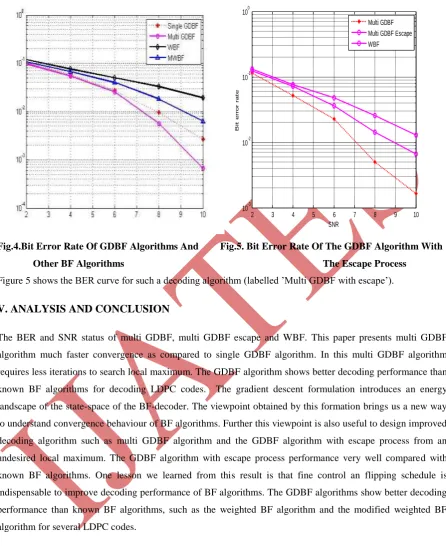
Fig.4.Bit Error Rate Of GDBF Algorithms And Fig.5. Bit Error Rate Of The GDBF Algorithm With
Other BF Algorithms The Escape Process
Figure 5 shows the BER curve for such a decoding algorithm (labelled ’Multi GDBF with escape’).
V. ANALYSIS AND CONCLUSION
The BER and SNR status of multi GDBF, multi GDBF escape and WBF. This paper presents multi GDBF
algorithm much faster convergence as compared to single GDBF algorithm. In this multi GDBF algorithm
requires less iterations to search local maximum. The GDBF algorithm shows better decoding performance than
known BF algorithms for decoding LDPC codes. The gradient descent formulation introduces an energy
landscape of the state-space of the BF-decoder. The viewpoint obtained by this formation brings us a new way
to understand convergence behaviour of BF algorithms. Further this viewpoint is also useful to design improved
decoding algorithm such as multi GDBF algorithm and the GDBF algorithm with escape process from an
undesired local maximum. The GDBF algorithm with escape process performance very well compared with
known BF algorithms. One lesson we learned from this result is that fine control an flipping schedule is
indispensable to improve decoding performance of BF algorithms. The GDBF algorithms show better decoding
performance than known BF algorithms, such as the weighted BF algorithm and the modified weighted BF
algorithm for several LDPC codes.
REFERENCES
[1] R. G. Gallager, “Low-density parity-check codes," in Research Monograph Series. Cambridge, MA: MIT
Press, 1963.
[2] Y. Kou, S. Lin, and M. P. C Fossorier, “Low-density parity-check codes based on finite geometries: a
rediscovery and new results," IEEE Trans. Inf. Theory, pp. 2711–2736, vol. 47, Nov. 2001.
codes," IEEE Commun. Lett., pp. 165-167, vol. 8, Mar. 2004.
[4] M. Jiang, C. Zhao, Z. Shi, and Y. Chen, “An improvement on the modified weighted bit flipping decoding
algorithm for LDPC codes," IEEE Commun. Lett., vol. 9, no. 9, pp. 814-816, 2005.
[5] F. Guo and H. Henzo, “Reliability ratio based weighted bit-flipping decoding for low-density parity-check
codes," IEEE Electron. Lett., vol. 40, no. 21, pp. 1356-1358, 2004.
[6] C. H.Lee, and W.Wolf, “Implmentation-efficient reliability ratio based
[7] weighted bit-flipping decoding for LDPC codes," IEEE Electron. Lett., vol. 41, no. 13, pp. 755-757, 2005
[8] T. Wadayama, K. Nakamura, M. Yagita, Y. Funahashi, S. Usami, and I. Takumi, “Gradient descent bit
flipping algorithms for decoding LDPC codes,” in Proc. International Symposium on Information Theory