Components Associated With Home Visiting Program
Outcomes: A Meta-analysis
abstract
BACKGROUND: Although several systematic reviews have concluded that home visiting has strong evidence of effectiveness, individual eval-uations have produced inconsistent results. We used a
component-based, domain-specific approach to determine which characteristics
most strongly predict outcomes.
METHODS:Medline and PsycINFO searches were used to identify eval-uations of universal and selective home visiting programs implemented in the United States. Coders trained to the study criterion coded char-acteristics of research design, program content, and service delivery.
We conducted random-effects, inverse-variance–weighted linear
regres-sions by using program characteristics to predict effect sizes on 6 outcome domains (birth outcomes, parenting behavior and skills, ma-ternal life course, child cognitive outcomes, child physical health, and child maltreatment).
RESULTS:Aggregated to a single effect size per study (k = 51), the mean
effect size was 0.20 (95% confidence interval: 0.14 to 0.27), with a range
of–0.68 to 3.95. Mean effect sizes were significant and positive for 3 of
the 6 outcome domains (maternal life course outcomes, child cogni-tive outcomes, and parent behaviors and skills), with heterogeneity of effect sizes in all 6 outcome domains. Research design characteristics generally did not predict effect sizes. No consistent pattern of effective components emerged across all outcome domains.
CONCLUSIONS:Home visiting programs demonstrated small but
sig-nificant overall effects, with wide variability in the size of
domain-specific effects and in the components that significantly predicted
domain-specific effects. Communities may need complementary or
al-ternative strategies to home visiting programs to ensure widespread
impact on these 6 important public health outcomes. Pediatrics
2013;132:S100–S109
AUTHORS:Jill H. Filene, MPH,aJennifer W. Kaminski, PhD,b
Linda Anne Valle, PhD,band Patrice Cachat, MSWa
aJames Bell Associates, Arlington, Virginia; andbCenters for
Disease Control and Prevention, Atlanta, Georgia
KEY WORDS
birth outcomes, child cognitive development, child maltreatment, child physical health, early childhood, effectiveness, home visiting, infancy, maternal life course, meta-analysis, parenting behavior
ABBREVIATIONS
CI—confidence interval
HomVEE—Home Visiting Evidence of Effectiveness
Ms Cachat collected data and critically reviewed the manuscript; Ms Filene conceptualized and designed the study, designed the data collection instruments, and drafted the initial manuscript; Dr Kaminski conceptualized and designed the study, designed the data collection instruments, conducted the analyses, and drafted the initial manuscript; and Dr Valle conceptualized and designed the study, designed the data collection instruments, and reviewed and revised the manuscript. All authors approved
thefinal manuscript as submitted.
Thefindings and conclusions in this report are those of the
authors and do not necessarily represent the official position of
the Centers for Disease Control and Prevention.
www.pediatrics.org/cgi/doi/10.1542/peds.2013-1021H
doi:10.1542/peds.2013-1021H
Accepted for publication Aug 26, 2013
Address correspondence to Jill H. Filene, MPH, James Bell Associates, 3033 Wilson Blvd, Suite 650, Arlington, VA 22201.
E-mail:fi[email protected]
PEDIATRICS (ISSN Numbers: Print, 0031-4005; Online, 1098-4275).
Copyright © 2013 by the American Academy of Pediatrics
FINANCIAL DISCLOSURE:The authors have indicated they have
nofinancial relationships relevant to this article to disclose.
FUNDING:This study was supported by The Pew Center on the States. The views expressed are those of the authors and do not
necessarily reflect the views of the Pew Center on the States or
The Pew Charitable Trusts.
POTENTIAL CONFLICT OF INTEREST:The authors have indicated
Early childhood marks a period of rapid growth and development that lays the foundation for future health and success
in school and life.1Because parents play
a critical role in shaping children’s early
development, interventions that reach families in these early years have great potential for producing long-term
bene-fits.2Prenatal and early-childhood home
visiting is a widely endorsed method for delivering a vast array of preventive and early intervention services to families in need of support. By engaging families in home visiting programs during the prenatal or early-childhood period,
pro-viders seek to improve children’s
long-term developmental trajectories by fostering improved parenting knowl-edge and skills, social support, coping and problem-solving skills, and access
to community and health services.3
Despite national and international en-dorsement of home visiting as a strategy to prevent child maltreatment and promote enhanced functioning and
well-being for children and families,4–8
previous meta-analyses and literature reviews of home visiting programs across a wide range of outcomes suggest
mixed, modestfindings depending on the
programs and outcomes examined.6,9–12
A recent review funded by the US De-partment of Health and Human Services, the Home Visiting Evidence of
Effective-ness (HomVEE) review, identified 13
models that met the department’s
crite-ria for effectiveness.13 Across and even
within these “evidence-based” models,
the findings have been inconsistent,
leaving gaps in knowledge about the effectiveness of home visiting across various outcome domains. The mixed
findings may be due to program design,
the match between program components and expected outcomes, or the quality of implementation of the program or the evaluation. Alternatively, the differences in effects might simply be explained by the variation in the way home visiting programs are comprised and delivered.
Best-practice recommendations con-cerning home visiting have generally either taken the form of suggesting wholesale adoption of models that have been shown to be effective (eg, HomVEE [homevee.acf.hhs.gov], Promising Prac-tices Network [promisingpracPrac-tices.net]) or have been based on clinical impression about particular approaches (eg, rec-ommendations for a particular schedule of home visits). Although model ratings are important for guiding practitioners in adopting a program model, any partic-ular program may not include the most effective combination of components to produce maximum results for a given population or community. In addition, as the Maternal, Infant, and Early Childhood
Home Visiting Program14 impels
in-creased focus on outcomes, a pressing question is how to best build the effec-tiveness of a program model or enhance models that may already be in operation; that is, what elements (eg, content, ser-vice delivery methods) in home visiting programs seem most important for program success?
Although 2 systematic reviews con-ducted before 2002 examined the re-lationship between parent and child outcomes and a small subset of program
components,12,15 no reviews have fully
disassembled home visiting programs into individual components or included studies conducted during the last de-cade. Therefore, a component analysis applying meta-analytic techniques was used to synthesize the results of pub-lished evaluations of home visiting programs to determine which individ-ual home visiting program components have the most power to predict key parent and child outcomes.
METHODS
Search Strategy
In September 2010, the PsycINFO and Medline databases were searched for literature published between 1979 and
2010 with evaluations of home visiting programs. Studies were limited to those published in English as a journal article, book, or book chapter, although pro-grams could be implemented in any language. Details of the search strategy are outlined in the Appendix. The initial search was designed to be very broadly inclusive of home visiting programs.
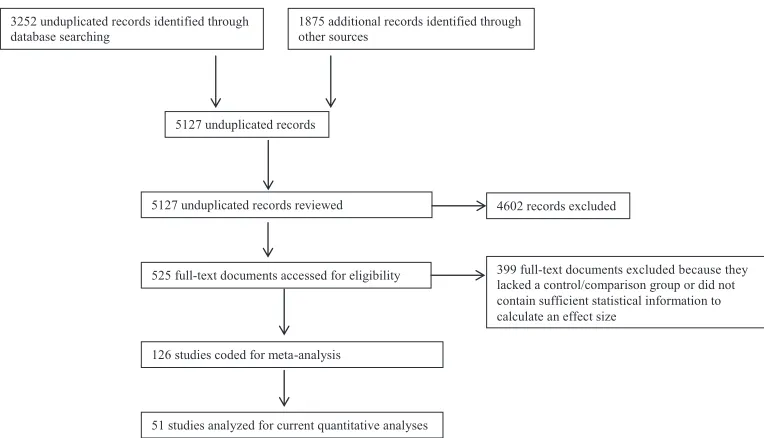
The original literature search resulted in 3252 unduplicated studies. Of these, 49 were literature reviews and
meta-analyses, from which we identified
additional relevant publications. A sec-ondary search was conducted on au-thor names that appeared at least twice in the original search results. In addi-tion, unduplicated studies from HomVEE were examined. These follow-up strat-egies yielded an additional 1875 re-cords, providing 5127 total abstracts for possible inclusion.
Study Selection
Inclusion criteria were selected to define
the scope of the meta-analysis as evalu-ations of universal and selective (ie, forat-risk families) programs that used home visiting as a primary delivery strategy for pregnant women and families with chil-dren from birth through age 3 years in the United States. Programs that conducted only 1 or 2 home visits were excluded as
dissimilar to the rest of thefield. Home
visiting programs targeting families for
existing identified problems (eg, family
preservation programs or programs that provided services to families with a sub-stantiated child maltreatment case) were excluded. Similarly, criteria were se-lected to ensure that evaluation results could be generalized to a broad pop-ulation of typically developing children and parents. Thus, we excluded pro-grams that targeted parents or children because of developmental disabilities, chronic illness, feeding disorders, or bereavement because the programs provide specialized components not
Figure 1 presents the PRISMAflow di-agram for study inclusion. Abstracts
identified in the literature search were
screened by 2 project staff members to determine eligibility. A study was ex-cluded at this point only if both staff members agreed that it met none of the inclusion criteria; 525 documents were retrieved and reviewed in full text. To allow for calculation of com-parable effect sizes, studies that used a single-case evaluation method, lacked a control or comparison group, or did not contain enough statistical infor-mation to calculate effect sizes were excluded. The resulting 126 studies were coded for meta-analysis; a sub-sample of the 51 articles including the 6 outcome measures (maternal life course, birth outcomes, parent behav-iors and skills, child cognitive out-comes, child physical health, and child maltreatment) selected for this study were analyzed.
Data Abstraction
Coding forms adapted from Kaminski
et al16 captured information about the
document, author(s), home visiting pro-gram, participants, evaluation design,
outcome measures, and statistical
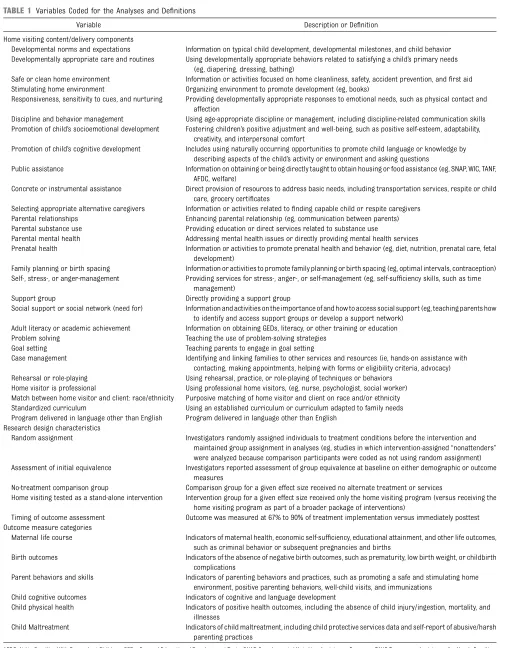
results. Table 1 lists and describes the variables coded for these analyses. Full
coding forms are available from thefirst
author. When an article referred to a secondary study or article providing additional program information, that secondary document was obtained, and the information was coded. Before cod-ing independently, data abstractors were trained to criteria of coding 3
consecutive articles with .90%
accu-racy.
Summary Measures
Effect sizes analogous to Cohen’sd
sta-tistic17were calculated from means and
standard deviations whenever possible or from other reporting methods, in-cluding categorical data, correlations, and odds ratios, by using Comprehen-sive Meta-Analysis 2 software (Biostat,
Inc, Englewood, NJ).18 Effect sizes were
calculated based on unadjusted data if available or adjusted data if not. Once effect sizes were calculated, they were exported into SPSS version 20 (IBM SPSS Statistics, IBM Corporation, Armonk, NY) for analyses by using macros for
multi-variate analyses of effect sizes.19,20 We
applied Hedges’small sample correction
to all effect sizes before analysis and weighted each by the inverse of the
variance.21
Within and across articles, some sam-ples were represented multiple times (eg, the same sample assessed at ferent time points, assessed with dif-ferent measures, or reported in difdif-ferent articles). Including all published reports of those samples would have allowed a small number of frequently published programs to bias the results. Thus, for each analysis, we selected or aggre-gated effect sizes such that each sample (eg, a program implemented in a par-ticular location) only provided a single effect size for that analysis. Data on birth outcomes at any time point in a study were included. For all other outcomes, immediate posttest assessments were preferred. If immediate posttest data were not available for a particular sample, we included assessments that occurred during the intervention but after two-thirds of the intervention was delivered. Follow-up data were excluded due to a lack of comparability in the
length of follow-up periods. When“total”
scores and “subscale” scores from
FIGURE 1
TABLE 1 Variables Coded for the Analyses and Definitions
Variable Description or Definition
Home visiting content/delivery components
Developmental norms and expectations Information on typical child development, developmental milestones, and child behavior
Developmentally appropriate care and routines Using developmentally appropriate behaviors related to satisfying a child’s primary needs
(eg, diapering, dressing, bathing)
Safe or clean home environment Information or activities focused on home cleanliness, safety, accident prevention, andfirst aid
Stimulating home environment Organizing environment to promote development (eg, books)
Responsiveness, sensitivity to cues, and nurturing Providing developmentally appropriate responses to emotional needs, such as physical contact and
affection
Discipline and behavior management Using age-appropriate discipline or management, including discipline-related communication skills
Promotion of child’s socioemotional development Fostering children’s positive adjustment and well-being, such as positive self-esteem, adaptability,
creativity, and interpersonal comfort
Promotion of child’s cognitive development Includes using naturally occurring opportunities to promote child language or knowledge by
describing aspects of the child’s activity or environment and asking questions
Public assistance Information on obtaining or being directly taught to obtain housing or food assistance (eg, SNAP, WIC, TANF,
AFDC, welfare)
Concrete or instrumental assistance Direct provision of resources to address basic needs, including transportation services, respite or child
care, grocery certificates
Selecting appropriate alternative caregivers Information or activities related tofinding capable child or respite caregivers
Parental relationships Enhancing parental relationship (eg, communication between parents)
Parental substance use Providing education or direct services related to substance use
Parental mental health Addressing mental health issues or directly providing mental health services
Prenatal health Information or activities to promote prenatal health and behavior (eg, diet, nutrition, prenatal care, fetal
development)
Family planning or birth spacing Information or activities to promote family planning or birth spacing (eg, optimal intervals, contraception)
Self-, stress-, or anger-management Providing services for stress-, anger-, or self-management (eg, self-sufficiency skills, such as time
management)
Support group Directly providing a support group
Social support or social network (need for) Information and activities on the importance of and how to access social support (eg, teaching parents how
to identify and access support groups or develop a support network)
Adult literacy or academic achievement Information on obtaining GEDs, literacy, or other training or education
Problem solving Teaching the use of problem-solving strategies
Goal setting Teaching parents to engage in goal setting
Case management Identifying and linking families to other services and resources (ie, hands-on assistance with
contacting, making appointments, helping with forms or eligibility criteria, advocacy)
Rehearsal or role-playing Using rehearsal, practice, or role-playing of techniques or behaviors
Home visitor is professional Using professional home visitors, (eg, nurse, psychologist, social worker)
Match between home visitor and client: race/ethnicity Purposive matching of home visitor and client on race and/or ethnicity
Standardized curriculum Using an established curriculum or curriculum adapted to family needs
Program delivered in language other than English Program delivered in language other than English
Research design characteristics
Random assignment Investigators randomly assigned individuals to treatment conditions before the intervention and
maintained group assignment in analyses (eg, studies in which intervention-assigned“nonattenders”
were analyzed because comparison participants were coded as not using random assignment)
Assessment of initial equivalence Investigators reported assessment of group equivalence at baseline on either demographic or outcome
measures
No-treatment comparison group Comparison group for a given effect size received no alternate treatment or services
Home visiting tested as a stand-alone intervention Intervention group for a given effect size received only the home visiting program (versus receiving the
home visiting program as part of a broader package of interventions)
Timing of outcome assessment Outcome was measured at 67% to 90% of treatment implementation versus immediately posttest
Outcome measure categories
Maternal life course Indicators of maternal health, economic self-sufficiency, educational attainment, and other life outcomes,
such as criminal behavior or subsequent pregnancies and births
Birth outcomes Indicators of the absence of negative birth outcomes, such as prematurity, low birth weight, or childbirth
complications
Parent behaviors and skills Indicators of parenting behaviors and practices, such as promoting a safe and stimulating home
environment, positive parenting behaviors, well-child visits, and immunizations
Child cognitive outcomes Indicators of cognitive and language development
Child physical health Indicators of positive health outcomes, including the absence of child injury/ingestion, mortality, and
illnesses
Child Maltreatment Indicators of child maltreatment, including child protective services data and self-report of abusive/harsh
parenting practices
particular measures were reported, preference was given to the total score if it fell within a single outcome
cate-gory. When a single study included$3
study arms, the effect size most closely attributable to the effect of only the home visiting program (eg, treatment versus no-treatment comparison, or treatment plus enhancement versus enhancement only) was selected.
Analytic Plan
We first examined overall program
effects on the 6 outcome categories by aggregating to a single effect size per study sample. We calculated overall
weighted mean effect size, 95% confi
-dence interval (CI), and Q and I2
sta-tistics.22 Adhering to the analytic
strategies set forth by Kaminski et al,16
we next investigated outcome-specific
mean effect sizes by aggregating to a single effect size per study sample for each outcome category, as well as CIs
and Q and I2statistics. We used
inverse-variance–weighted analyses of
vari-ance to examine the impact of 4 indi-cators of methodologic rigor (random assignment, assessment of initial equivalence, using a pure no-treatment comparison group, and testing the ef-fect of the home visiting program as a stand-alone intervention versus as part of a larger package of inter-ventions) and timing of the outcome measure (before versus at the end of treatment) on effect sizes for each outcome category. Finally, we used
inverse-variance–weighted linear
re-gression to test the impact of program components on effect sizes, with the goal of determining the predictors of strongest program effects. Only com-ponents theoretically expected to con-tribute to particular outcomes were tested for those outcomes. As the in-tent of the analyses was to model var-iability among studies, all reported results were obtained via random-effects models.
RESULTS
The overall weighted effect size of thefinal
set of 51 studies was 0.20 (95% CI: 0.14 to
0.27). The 251 effect sizes ranged from–
0.68 to 3.95. The Q test of homogeneity of
effect sizes was significant (P, .001),
with an I2value of 65%. Table 2 shows the
number of studies and summary statis-tics according to outcome category. Three outcome categories (maternal life course, child cognitive outcomes, and parent behaviors and skills) resulted in
significant, positive average effect sizes.
Average effects sizes were not signifi
-cantly different from zero for birth out-comes, child physical health, and child maltreatment. Between 52% and 86% of the heterogeneity observed for each outcome was attributable to true vari-ance rather than to chvari-ance, suggesting the need to further examine the nature of the heterogeneity.
In the inverse-variance–weighted
anal-ysis of variances, only 1 research design
variable was a significant predictor of
any outcome: effect sizes of maternal life outcomes were higher among stud-ies reporting outcomes during treat-ment (mean effect size: 0.23 [95% CI: 0.13 to 0.33]) than studies reporting out-comes immediately posttest (mean
ef-fect size: 0.02 [95% CI: –0.11 to 0.15]).
Measurement timing was therefore in-cluded as a covariate in the regression analysis of maternal life outcomes.
Results of the inverse-variance–weighted
linear regressions assessing relation-ships between program components and effect sizes are presented in Table 3. Controlling for timing of assessment, no
components significantly predicted
ma-ternal life outcomes. Effect sizes based
on birth outcomes were significantly
larger for programs using nonpro-fessional home visitors, programs that matched clients and home visitors on race and/or ethnicity, and programs that included problem solving. Effect sizes for the parent behaviors and skills
out-come were significantly larger for
programs that taught parents devel-opmental norms and appropriate ex-pectations, discipline and behavior management techniques, responsive and sensitive parenting practices, and programs that addressed parental
substance use. Children’s cognitive
outcomes were better in programs that taught parents responsive and sensitive parenting practices and pro-grams reporting that they required parents to role-play or practice skills during home visits. Using professional
home visitors was a significant
pre-dictor of better child physical health outcomes, as was teaching discipline and behavior management techniques. However, providing parents with a sup-port group was associated with smaller effect sizes on child physical health. Better child maltreatment outcomes were associated with teaching parents how to select alternative caregivers for children and problem solving.
To ensure that these results were not
unduly influenced by effect sizes based
on results reported in studies as ad-justed statistics, we removed those effect sizes and re-examined regression
analyses with significant components.
Of the 14 components reported earlier
as significant, 3 could not be analyzed
without the adjusted effect sizes due to low frequency (the 2 components
sig-nificant for child maltreatment
out-comes and the relationship between child physical health outcomes and teaching discipline and behavior man-agement techniques). Ten of the other 11 components maintained statistical
significance in these sensitivity
analy-ses. The effect of teaching parents problem-solving strategies on birth
outcomes was no longer significant and
thus may be a less robustfinding than
other component effects.
DISCUSSION
selected outcome domains) was signif-icant and equivalent to approximately
one-fifth of a standard deviation favoring
the intervention group. Translated to an odds ratio, such an effect is equivalent to
the comparison group being∼1.5 times
more likely to have poorer outcomes. Consistent with results of previous meta-analyses of home visiting
pro-grams,6,9,12,15parents and children
par-ticipating in home visiting programs achieved more positive outcomes over-all than parents and children in control/ comparison groups. However,
outcome-specific mean effect sizes revealed
significant but small effects only on
maternal life course, child cognitive outcomes, and parent behaviors and skills. In contrast, home visiting
pro-grams did not produce significant
av-erage effects on 3 frequent program targets (birth outcomes, child physical health, and child maltreatment), sug-gesting that programs were, on aver-age, not effective in addressing these
outcomes. The nonsignificant effect
sizes, combined with the relatively
small significant effect sizes, suggest
that communities may need comple-mentary or alternative strategies to home visiting programs to have a greater impact on these important public health outcomes.
Although surveillance bias (ie, program involvement increases the likelihood of detecting maltreatment) may partially
explain the lack of a significant effect size
on child maltreatment outcomes mea-sured through child protective services data, previous studies have found sur-veillance bias effects to attenuate but not eliminate group differences where
they exist.23,24 In addition, the present
analyses included self-reports of abu-sive parenting practices in addition to child protective services reports. Thus, the presence of a surveillance bias would likely not fully explain the lack of
statistical significance.
Research design variables were
gen-erally not significantly predictive of
ef-fect sizes, whereas many program components were. Similar to other systematic reviews, no clear and con-sistent pattern of effective home visiting program components emerged across
outcome domains.12Only 3 components
were predictors of larger effects on.1
outcome; 1 of those components was only robust for 1 outcome in the
sen-sitivity analyses. All other significant
components were only predictive of effect sizes for a single outcome do-main. These results suggest that the
“home visiting” label represents a
di-versity of approaches with differing effectiveness, and that attention to
specific program content and delivery
characteristics is critical to the effec-tiveness of these programs.
The components that emerged as
sig-nificant for.1 outcome (teaching
sen-sitive and responsive parenting, teaching discipline and behavior
man-agement techniques, and teaching
problem-solving) make intuitive sense; teaching new parenting skills and behaviors was associated with greater effects on parenting behaviors, which may also translate into more positive impacts on other, sometimes more dis-tal, outcomes, such as child cognitive development, child physical health, and child maltreatment. Using professional
home visitors was unexpectedly associ-ated with smaller program effects on birth outcomes but larger effects on child physical health outcomes. The in-consistency in these results may be due to the professional background or type of professional providing the services, as different professionals may be more or less effective with different health outcomes. Alternatively, the inconsistent results might be due to other differences not analyzed here between programs using professional and nonprofessional home visitors. Programs that enroll participants prenatally and use pro-fessional home visitors may want to look for ways to boost their effectiveness,
specifically on birth outcomes.
It is important to note that not all com-ponents were tested for each outcome, either because the components were not theoretically linked to the outcome or due to limited variability of the compo-nent among studies reporting a
partic-ular outcome. In addition, nonsignificant
components may be contributing to program outcomes (eg, as precursors to or in combination with other compo-nents) in interactive ways that cannot be tested by using these analytic methods.
The presence of a significant component
thus indicates a robust effect, but the
absence of significance for a component
does not necessarily imply a lack of impact. We can only conclude that the
nonsignificant components did not by
themselves distinguish more successful programs from less successful pro-grams on that outcome and are thus components that are unlikely to be
suf-ficient to produce outcomes they did not
significantly predict.
TABLE 2 Number of Studies, Mean Effect Sizes, and Results of Heterogeneity Analyses According to Outcome Category
Variable Maternal Life
Course Outcomes
Birth Outcomes Parent Behaviors
and Skills
Child Cognitive Outcomes
Child Physical Health
Child Maltreatment
No. of studies in analysis 12 14 32 24 15 9
Mean effect size (95% CI) 0.20 (0.07 to 0.32)* 0.061 (–0.08 to 0.20) 0.23 (0.13 to 0.33)* 0.25 (0.11 to 0.38)* 0.11 (0.00 to 0.22) 20.08 (–0.24 to 0.07)
Heterogeneity analysis P,.02 P,.0001 P,.0001 P,.0001 P,.0001 P,.01
I2 52% 86% 75% 78% 80% 65%
Our results for the impact of different components must be taken as correla-tional and not as an experimental ma-nipulation. Our results are also based on published studies and are dependent on the completeness of reporting of com-ponents within each study. Many
theo-retically interesting and relevant
program characteristics (eg, program dosage, sample demographic
charac-teristics,fidelity of implementation, staff
training, home visitor caseload, study or program attrition) could not be tested
due to insufficient numbers of studies
reporting those characteristics. For ex-ample, the timing of enrollment in home visiting programs during pregnancy
might be associated with a program’s
ability to promote positive birth out-comes; variability in gestation at en-rollment could explain the lack of
significance with birth outcomes.
However, this relationship could not be
tested due to insufficient reporting on
initiation of services.
CONCLUSIONS
The present meta-analysis marks
a distinct departure from the common practice of recommending the whole-sale adoption of evidence-based pro-grams. Although model ratings are important for guiding practitioners in adopting a packaged program model, any particular program may not include the most effective combination of components to produce maximum results. Instead of considering each program as a black box, the coding scheme used in the present study allowed the authors to disassemble home visiting programs and examine
the impact of specific components. The
results suggest that certain existing components are more likely to be as-sociated with positive effects on
spe-cific outcomes. Although careful
evaluation of modifications or
adapta-tions to existing programs would be critical, changes to include more of the
significant components identified are
likely to produce programs that are more potent with respect to these parent and child outcomes. For other
outcomes, components that signifi
-cantly predict positive outcomes
re-main to be identified. Ourfindings point
to new program and research
oppor-tunities within the home visitingfield,
whether through the development or selection of a home visiting program, or for improving programs already
la-beled efficacious or effective.
REFERENCES
1. Shonkoff J, Phillips D. From Neurons to Neighborhoods: The Science of Early Childhood Development. Washington, DC: National Academies Press; 2000
2. Brooks-Gunn J, Markman LB. The contri-bution of parenting to ethnic and racial gaps in school readiness. Future Child. 2005;15(1):139–168
3. Guterman N.Stopping Child Maltreatment Before it Starts: Emerging Horizons in Early Home Visitation Services. Thousand Oaks, CA: Sage; 2001
4. Krugman RD. Universal home visiting: a recommendation from the US Advisory Board on Child Abuse and Neglect.Future Child. 1993;3(3):184–191
5. American Academy of Pediatrics. Council on Child and Adolescent Health. The role of home-visitation programs in improving health outcomes for children and families. Pediatrics. 1998;101(3 pt 1):486–489
6. Bilukha O, Hahn RA, Crosby A, et al; Task Force on Community Preventive Services. The effectiveness of early childhood home visitation in preventing violence: a system-atic review.Am J Prev Med. 2005;28(2 suppl 1):11–39
7. National Governors Association, Center for Best Practices. The benefits andfinancing
of home visiting programs. Available at: www.nga.org/Files/pdf/BENEFITSFINANCING-HOME.pdf. Accessed August 23, 2008
8. Butchart A, Harvey AP, Mian M, Furniss T. Preventing Child Maltreatment: A Guide to Taking Action and Generating Evidence. Geneva, Switzerland: World Health Organi-zation; 2006
9. Gomby DS. Home Visitation in 2005: Out-comes for Children and Parents. Invest in Kids Working Paper No. 7. Washington, DC: Committee for Economic Development; 2005
10. Guterman NB. Enrollment strategies in early home visitation to prevent physical child abuse and neglect and the“universal versus targeted”debate: a meta-analysis of population-based and screening-based programs. Child Abuse Negl. 1999;23(9): 863–890
11. Layzer JI, Goodson BD, Bernstein L, Price C. National Evaluation of Family Support Pro-grams. Final Report. Volume A: The Meta-Analysis. Cambridge, MA: Abt Associates, Inc; 2001
12. Sweet MA, Appelbaum MI. Is home visiting an effective strategy? A meta-analytic re-view of home visiting programs for families with young children.Child Dev. 2004;75(5): 1435–1456
13. Avellar S, Paulsell D, Sama-Miller E, Del
Grosso P. Home visiting evidence of
effec-tiveness review: executive summary. Office of Planning, Research and Evaluation,
Administration for Children and Families,
US Department of Health and Human
Services. Washington, DC. Available at: http://homvee.acf.hhs.gov/HomVEE_Executive_
Summary_2012.pdf. Accessed November 22,
2012
14. Health Resources Service Administration. Maternal, Infant, and Early Childhood Home
Visiting Program. Available at: http://mchb.
hrsa.gov/programs/homevisiting. Accessed
December 5, 2012
15. Nievar M, Van Egeren LA, Pollard S. A meta-analysis of home visiting programs:
mod-erators of improvements in maternal
be-havior. Inf Mental Hlth J. 2010;31(5):499– 520
16. Kaminski JW, Valle LA, Filene JH, Boyle CL. A
meta-analytic review of components
asso-ciated with parent training program
effec-tiveness. J Abnorm Child Psychol. 2008;36 (4):567–589
17. Hedges LV, Olkin I.Statistical Methods for
Meta-Analysis. Boston, MA: Academic Press;
18. Bornstein M, Hedges L, Higgins J, Roth-stein H. Comprehensive Meta-Analysis Version 2. Englewood, NJ: Biostat, Inc; 2005
19. Lipsey MW, Wilson D.Practical Meta-Analysis. Thousand Oaks, CA: Sage; 2001
20. Wilson DB. Meta-analysis macros for SAS, SPSS, and Stata. Available at: http://mason.
gmu.edu/∼dwilsonb/ma.html. Accessed January 23, 2012
21. Hedges LV. A random effects model for effect sizes.Psychol Bull. 1983;93(2):388– 395
22. Higgins JP, Thompson SG, Deeks JJ, Altman DG. Measuring inconsistency in meta-analyses. BMJ. 2003;327(7414):557–560
23. Olds D, Henderson CR Jr, Kitzman H, Cole R. Effects of prenatal and infancy nurse home visitation on surveillance of child mal-treatment.Pediatrics. 1995;95(3):365–372
APPENDIX 1 Search Strategy and Search Terms
Search Step Search Entries
S1. Program/Evaluation Terms (parent and (training or education or program)) or ((support or treatment or intervention
prevention) and ((parent or family) and results)
S2. General Program Target Terms (parenting skills or home environment or family relations or parent child relations or mother
child relations or father child relations or childhood development or at risk protective or (resilient or resilience or resiliency) or child management or competence))
S3. Specific Child Outcome Terms ((youth violence or juvenile delinquency or delinquent or conduct disorder or conduct problem
or behavior problem or noncompliant or noncompliance or aggression or aggressive or
(bully or bullying) or adhd or attention deficit disorder or academic problems or school
adjustment or school problems or school dropout or impulsivity or impulse control or externalizing or prosocial or problem solving or communication skills or social skills or discipline or assertiveness or self esteem or drug abuse or substance abuse or alcohol or smoking or cigarette or sexual acting out or abuse or neglect or maltreatment or anxiety or depression or mental illness or suicide or eating disorder or internalizing or emotional adjustment or (Child* and (abuse or neglect or maltreatment or health or injury or violence
or ingestion or poison* or attachment or immuniz* or“emergency department”)) or
“infant mortality”or ((juvenile or adolescent) AND delinquen*) or (child and (cognit* or
language or“social-emotional”or“socioemotional”or“socio-emotional”or physical or
health) and development)) or“school readiness”or“school achievement”or“child
development”or“developmental delay”or (child AND behavior*) or (child AND disab*) or
((Preterm or“pre-term”or premature) AND birth) or“low birth weight”or“low
birthweight”
S4. Specific Maternal/Family Outcome Terms ((parent* or family or matern* or mother* or father* or patern*) and (employment or career
or stress or depress* or efficacy or“mental health”or health)) or ((subsequent or teen)
AND (birth or pregnan*)) or“home environment”or“self sufficiency”or“self-sufficiency”
or (parent* AND (skill* or ability*)) or (reduc* AND (crime or“domestic violence”or“family
violence”or“intimate partner violence”) or ((community AND coordinate*) or referral*) or
(smoking or tobacco)) and (parent and (training or education or program)))
S5. Compiling results from“General Program Target Terms,”
“Specific Child Outcome Terms,”and“Specific Maternal/Family
Outcome Terms”searches
S2 or S3 or S4
S6. Restricting Program Targets/Outcomes to Parenting Program Evaluations
S1 and S5
S7. Restricting Relevant Parenting Program Evaluations to those delivered in the home
S6 and“home”
S8. Restricting Relevant Home Visiting Program Evaluations to those published in English
Limit S7 to English language
Articles for this meta-analysis were identified from a literature search for a wider set of parenting interventions and thus returned a larger set of article citations than might have been returned by a more focused search only for home visiting programs. The overall search strategy built on the search for Kaminski et al16that was conducted in September 2002 and included articles published between 1990 and 2002. On September 16, 2010, we conducted a complementary, updated search to include studies published before 1990 and since 2002. The articles returned from the new search were added to the previous database. For simplicity of presentation, the search strategy shown here lists the terms and actions that would have returned the full set of publication years if the entire search had been conducted on September 16, 2010, instead of in 2 sections.
The search discussed here was conducted via OvidSP by using PsycINFO as the database. Terms in quotation marks were searched only as those explicit terms. Terms not in quotation marks were searched as a multipurpose term (ie, .mp) appearing in any relevantfield. The option to conduct an“exploded”search was engaged whenever available for an entered search term. An * indicates a“wildcard”search wherein any possible endings of that term were included (eg, behavior* searched for behavior, behaviors, behavioral). The search entries were repeated in Medline with necessary adjustments for that search engine. The returned articles from the 2 databases were then combined. Unpublished dissertations and duplicates were deleted from the
DOI: 10.1542/peds.2013-1021H
2013;132;S100
Pediatrics
Jill H. Filene, Jennifer W. Kaminski, Linda Anne Valle and Patrice Cachat
Meta-analysis
Components Associated With Home Visiting Program Outcomes: A
Services
Updated Information &
http://pediatrics.aappublications.org/content/132/Supplement_2/S100 including high resolution figures, can be found at:
References
#BIBL
http://pediatrics.aappublications.org/content/132/Supplement_2/S100 This article cites 12 articles, 3 of which you can access for free at:
Permissions & Licensing
http://www.aappublications.org/site/misc/Permissions.xhtml in its entirety can be found online at:
Information about reproducing this article in parts (figures, tables) or
Reprints
DOI: 10.1542/peds.2013-1021H
2013;132;S100
Pediatrics
Jill H. Filene, Jennifer W. Kaminski, Linda Anne Valle and Patrice Cachat
http://pediatrics.aappublications.org/content/132/Supplement_2/S100
located on the World Wide Web at:
The online version of this article, along with updated information and services, is
by the American Academy of Pediatrics. All rights reserved. Print ISSN: 1073-0397.