SEMANTICALLY PLAGIARISM DETECTION
SYSTEM USING WEB SERVICES
Kamalpreet Sharma
1, Dr. Balkrishan Jindal
21
Student of Yadvindra College of Engineering Punjabi University Patiala,
Guru Kashi Campus, Talwandi Sabo, Punjab, (India)
2
Assistant Professer of Yadvindra College of Engineering Punjabi University Patiala,
Guru Kashi Campus,Talwandi Sabo, Punjab, (India
)
ABSTRACT
Plagiarism is the “wrongful appropriation” and “stealing and publication” of another author's “language, thoughts, ideas, or expressions” and the representation of them as one's own original work. Plagiarism can also
be hidden when text is translated from one language to another with no credit to the version, which is called
cross- language plagiarism. Plagiarism is widely found in text, document’s, papers, codes, images. Plagiarism
detection systems find copies, not plagiarism and for translations or heavily edited material, the systems are
powerless. We have proposed a new system by using web services for detecting different types of plagiarism,
this system able to detect synonyms, translations of words.
Keywords:
Intelligent Plagiarism, Literal Plagiarism, Semantic Analysis, Web Services
I.
INTRODUCTION
Plagiarism can be defined as turning of someone else’s work as our own without reference to original source.
Plagiarism is copying another person's ideas, words or writing and pretending that they are one's own work. It
can involve violating copyright laws. College students who are caught plagiarizing can be expelled from school,
and writers who plagiarize will often be taken less seriously. Commonly in practice there are different
plagiarisms methods like Copy – paste plagiarism (copying word to word textual information), Paraphrasing
(copying same content in different words),Translated plagiarism (content translation and use without reference
to original work), Artistic plagiarism (presenting same work using different media: text, images etc.), Idea
plagiarism (using similar ideas which are not common knowledge), Code plagiarism (using program codes
without permission or reference),No proper use of quotation marks (failing to identify exact parts of borrowed
content),Misinformation of references (adding reference to incorrect or non existing source).
1.1 Types of Plagiarism
1.1.1 Literal Plagiarism
Literal plagiarism is a common and major practice wherein plagiarists do not spend much time in hiding the
academic crime they committed. For example, they simply copy and paste the text from the Internet. Aside from
Fig. 1 Types of Plagiarism
1.1.2 Intelligent Plagiarism
Intelligent plagiarism is a serious academic dishonesty wherein plagiarists try to deceive readers by changing the
contributions of others to appear as their own. Intelligent plagiarists try to hide, obfuscate, and change the
original work in various intelligent ways, including text manipulation, translation and idea adoption.
1.1.2.1 Text Manipulation: Plagiarism can be obfuscated by manipulating the text and changing most of its
appearance
1.1.2.2 Translation: Obfuscation can also be done by translating the text from one language to another without
proper referencing to the original source.
1.1.2.3 Idea Adoption: Idea adoption is the most serious plagiarism that refers to the use of other’s ideas, such
as results, contributions, findings, and conclusions, without citing the original source of ideas.
1.2 Plagiarism Detection Methods
1.2.1 Fingerprinting
Fingerprinting is currently the most widely applied approach to plagiarism detection. This method forms
representative digests of documents by selecting a set of multiple substrings (n-grams) from them.
1.2.2 Citation analysis
Citation-based plagiarism detection relies on citation analysis, and is the only approach to plagiarism detection
that does not rely on the textual similarity. It examines the citation and reference information in texts to identify
similar patterns in the citation sequences. As such, this approach is suitable for scientific texts, or other
academic documents that contain citations.
1.2.3 Stylometry
Stylometry subsumes statistical methods for quantifying an author’s unique writing style and is mainly used for
authorship attribution. By constructing and comparing Stylometry models for different text segments, passages
that are stylistically different from others, hence potentially plagiarized, can be detected.
1.2.4 String Matching
String matching is a prevalent approach used in computer science, compare original string with suspicious
document to detect plagiarized string.
1.2.5 Bag of words
Bag of words analysis represent the adoption of vector space retrieval, a traditional IR concept, to the domain of
plagiarism detection. Documents are represented as one or multiple vectors, e.g. for different document parts,
Literal Plagiarism Intelligent Plagiarism
which are used for pair wise similarity computations. Similarity computation may then rely on the
traditional cosine similarity measure, or on more sophisticated similarity measures.
1.3 Parameters that Effect Plagiarism
1.3.1 Synonyms: A synonym is a word or phrase that means exactly or nearly the same as another word or
phrase in the same language. For example, if we talk about a long time or an extended time, long and extended
are synonymous with in that context.
1.3.2 Active Passive: A sentence whose agent is marked as grammatical subject is called an active sentence. In
contrast, a sentence in which the subject has the role of patient or theme is named a passive sentence, and its
verb is expressed in passive voice. E.g. (Harry ate six shrimp at dinner (active)) (At dinner, six shrimp were
eaten by Harry (passive)).
1.3.3 Tense: In grammar, tense is a category that expresses time reference. Basic tenses found in many
languages include the past, present and future, E.g. (The sun sets in the west) (All the cars stop at this crossing).
II. RELATED WORK
Protection of digital documents from illegal copy has received much attention recently. Most of techniques for
copy case detection are based on ideas of substring matching. In paper [3] string matching approach basically
identifies maximum matches in pairs of strings, which not possible for large amount of data. In paper [4] and
paper [5] keyword similarity mechanism is used but fail give any method for semantic plagiarism detection.
III. METHODOLOGY
The user uploads the document to check the plagiarism in its document. The proposed system decomposed the
document into single words. By web crawling process using web services, system performs the semantic
comparison and also compares the user document with web to check plagiarism in the user document. After the
comparison the user document result will be send to the user with highlighted link, it define source of data i.e.
from where user document is copied. If no links are displayed then there is no plagiarism in user document.
3.1 Algorithm
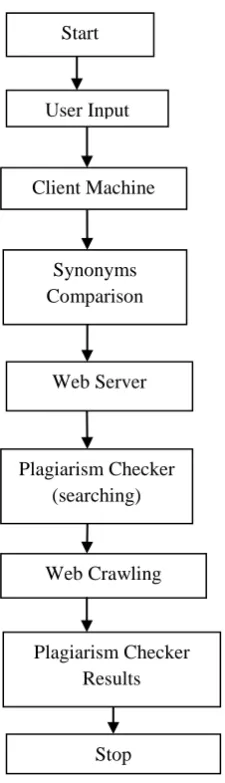
1. User uploads documents in proposed software to detect plagiarism.
2. On client machine decomposition of documents is performed.
3. In next phase software check the document semantically.
4. Plagiarism Checker System performs searching using web services follows web crawling process.
5. Proposed System display results, if data is copied from any source gives hyperlinks and if not found then
Fig. 2 Shows Algorithm of Proposed Method
IV. RESULTS
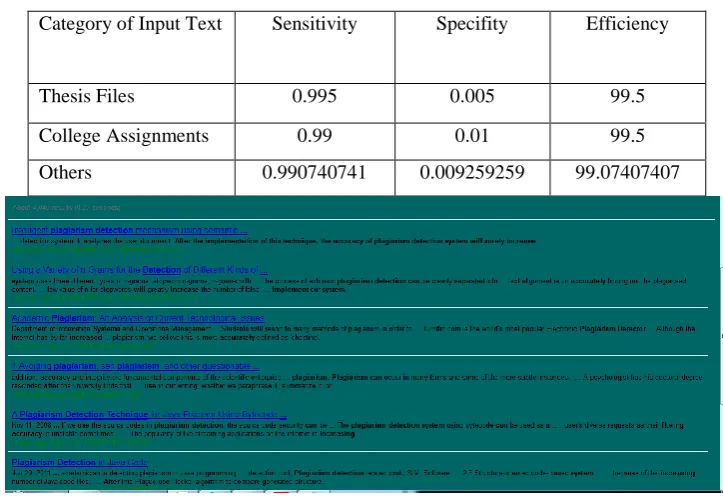
Proposed System display plagiarism detection search results shown in figure 3, it is based on multi gram
approach. It check plagiarism through web, no local database is created. It split the document into single word.
Proposed system gives the links of source from where data is copied. Through these formulas proposed system
efficiency is calculated.
Sensitivity = No of links detected about plagiarized data/ Total no of Inputs
Specifity = No of links not detected about plagiarized data/ Total no of Inputs Plagiarism Checker
Results Web Crawling
Stop Web Server
Plagiarism Checker (searching) User Input
Synonyms Comparison Client Machine
Table 1 Shows the Output of System
Category of Input Text Sensitivity Specifity Efficiency
Thesis Files 0.995 0.005 99.5
College Assignments 0.99 0.01 99.5
Others 0.990740741 0.009259259 99.07407407
Fig. 3 Showing Links of plagiarized data by proposed system for document
The proposed method is compared with 100 thesis files, 105 college assignments and other source of data to
detect plagiarism. The efficiency of proposed method is shown in figure 4, 99% efficient results as compare to
existing system. It is a fast, accurate and efficient method for semantic plagiarism detection using web services.
Fig. 4 Shows the Efficiency of Proposed Method
V. CONCLUSION
The proposed system works on semantic plagiarism detection using web services, detect plagiarized data fast
and accurately as compare to existing system. It removes the limitation of existing system as they are based on
REFERENCES
[1] M.S. Alzahrani, N. Salim and V. Palade, Uncovering highly obfuscated plagiarism cases using fuzzy
semantic-based similarity model, 3, 2015, 248-268.
[2] N. More, and A. Bhootra, Plagiarism Detection in Source Code", International Journal for Innovative
Research in Science and Technology, 1,2015, 109-112.
[3] J.D. Velasquez, and E. Marrese, Tools for external plagiarism detection in DOCODE, Proc. IEEE
International Joint Conference on Web Intelligence and Intelligent Agent Technologies, Warsaw, 2, 2014,
296-303.
[4] N. Meuschke and B. Gipp, Reducing Computational Effort for Plagiarism Detection by using Citation
Characteristics to Limit Retrieval Space, IEEE Joint Conference on Digital Libraries, London,8-12 Sept.
2014,197-200.
[5] S. Arrish, F.N Afif, A. Maidorawa and M. Salim, Shape-Based Plagiarism Detection for Flowchart Figures
in Texts, International Journal of Computer Science and Information Technology, 6(1),2014, 113-124.
[6] S. Mulcahy and C. Goodacre, Opening Pandora’s Box of academic integrity: Using plagiarism detection
software, International Journal of Computer Science and Information Technology, 6(1), 2014, 688-696.
[7] D. Ceglarek, Evaluation of The SHAPD2 Algorithm Efficiency in Plagiarism Detection, IEEE
International Conference on Technological Advances In Electrical, Electronics and Computer Engineering,
Konya, 9-11 May 2013, 465-470..
[8] J. Agarwal, R.H. Goudar, P. Kumar, K. Sharma, V. Parshav, R.Sharma, A. Srivastava and R. Rao,
Intelligent Plagiarism Detection Mechanism using Semantic technology: A Different Approach, IEEE
International Conference on Advances in Computing , Communication and Informatic, Mysore,22-25
Aug. 2013, 779-783.
[9] N. Idika, H. Phan and V. Mayank, Achieving Linguistic Provenance via Plagiarism Detection, IEEE
International Conference on Document Analysis and Document, Washington, 25-28 Aug. 2013,648-652.
[10] Cosma and M. Joy, An Approach to Source-Code Plagiarism Detection and Investigation Using Latent