Codeine Intoxication in the Neonate
Barbarajean Magnani, PhD, MD*‡, and Richard Evans, MD‡
ABSTRACT. Although opiates can provide patients with relief from pain and the discomfort of cough, the routine prescription of these drugs for infants demands caution and concern. Infants, particularly neonates, are not merely small adults requiring smaller dosages, but rather uniquely different patients. Neonates present with an immature physiology and biochemistry with respect to drug metabolism. We report a case of codeine intoxi-cation in the neonate, in which the drug was prescribed for cough control during an emergency department visit. Pediatrics 1999;104(6). URL: http://www.pediatrics.org/ cgi/content/full/104/6/e75;codeine, neonate, toxicity, mor-phine, fatality.
CASE REPORT
B
aby Z was born at 36 weeks’ gestation withApgar scores of 9 and 9. By examination he seemed to be a healthy 36-week infant with a birth weight of 6 pounds. He progressed satisfacto-rily and was discharged to home 2 days later.
At 29 days of age, baby Z was brought to the local hospital for evaluation of frequent cough and occa-sional vomiting, which had started the previous day. Physical examination at that time revealed a rectal temperature of 98.2°F, a pulse of 160, and respira-tions of 32. A chest radiograph showed no evidence of active cardiac or pulmonary pathology and the infant was diagnosed with an upper respiratory in-fection. Baby Z was discharged to home with instruc-tions to treat with Triaminic syrup (Sandoz Con-sumer, East Hanover, NJ) and Pedialyte (Ross Laboratories, Columbus, OH).
The baby did not improve over the course of the day and returned to the hospital emergency depart-ment later that afternoon. Physical examination re-vealed a temperature of 97°F, a pulse of 160, and respirations of 28. The chest was clear, the heart was in normal sinus rhythm, and the abdomen was soft. The assessment at this time was a viral tracheitis. The patient was discharged to home with instructions to take 1 mL Novahistine DH (SmithKline Beecham Pharmaceuticals, Pittsburgh, PA) every 6 hours for 3 days (Novahistine DH contains 2 mg of codeine per milliliter, and in this infant, the dose would have
been .63 mg/kg), to discontinue the Triaminic med-ication, and to see the pediatrician in 2 days.
At 8 pm the baby was given a 1-mL dose of oral Novahistine DH. At 2amon the next day, a second 1-mL dose was given. At 3am,the baby seemed to be in no distress according to the mother. At 4am, the mother noted that the baby was unusually quiet and when she checked, the baby was not breathing. An ambulance was called, and the baby was transported to the hospital, where resuscitative efforts continued in the emergency department. Despite lifesaving measures, the patient died.
Autopsy and Toxicology Results
Notable findings at autopsy included severe bron-chitis/bronchiolitis and mild bilateral pulmonary congestion.
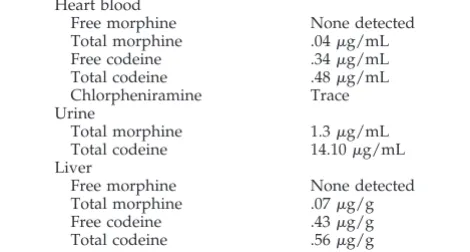
Codeine and metabolites in postmortem samples of blood, urine, and liver extract were identified and quantitated by gas chromatography, mass spectrom-etry.1Codeine is metabolized by several mechanisms (discussed below), and the metabolites can be ana-lyzed either as the total (the combined free drug plus the hydrolyzed conjugates) or the free drug alone. The difference between the total and free drug con-centrations equals the amount of conjugated drug.2 Postmortem toxicological findings are reported in Table 1.
The cause of death, determined by the chief med-ical examiner, was acute opiate intoxication with contributory findings of severe bronchitis/bronchi-olitis.
DISCUSSION
Novahistine DH is an antitussive, decongestant, and antihistamine preparation. In each 5-mL formu-lation, there are 30 mg of pseudoephedrine hydro-chloride, 10 mg of codeine phosphate, 2 mg of chlor-pheniramine maleate, and 5% alcohol. With 2 doses of Novahistine DH, this infant received 4 mg of codeine within a 6-hour period or 1.26 mg/kg. Given the slower metabolism of codeine in infants,3 this dosage is consistent with the postmortem toxicolog-ical findings of .34 mg/L of free codeine (Table 1). Toxicological postmortem findings in the blood, urine, and liver of the infant in this case showed both codeine and its primary metabolite morphine. In ad-dition, a trace of chlorpheniramine, an antihistamine, also was found in the blood.
Codeine is given to suppress the cough reflex by a direct effect on the cough center in the medulla. In addition, codeine provides mild analgesia and mild sedation. Intoxication results in somnolence, ataxia,
From the *Department of Pathology and Laboratory Medicine, Boston Medical Center, Boston University School of Medicine, and the ‡Office of the Chief of Medical Examiner, Commonwealth of Massachusetts, Boston, Massachusetts.
Received for publication Dec 11, 1998; accepted Jun 4, 1999.
Reprint requests to (B.M.) Department of Laboratory Medicine, Boston Medical Center, 88 E Newton St, Boston, MA 02118. E-mail: magnani@ zeus.bwh.harvard.edu
PEDIATRICS (ISSN 0031 4005). Copyright © 1999 by the American Acad-emy of Pediatrics.
miosis, vomiting, and skin itching and can produce respiratory depression.4
As an opiate analgesic, codeine occurs naturally in opium and is produced commercially by 3-O-meth-ylation of morphine. It is metabolized by conjugation to codeine-6-glucuronide and to a minor extent is biotransformed via O-demethylation to morphine and via N-demethylation to norcodeine.5 Codeine-6-glucuronide is the major metabolite found in urine, whereas codeine is excreted only as a small propor-tion of the original dose.
Many authors feel that the opiate effects of codeine are primarily attributable to morphine.6The clinical observation of the increased sensitivity of infants to opiates is probably the result of drug accumulation rather than an increased receptor sensitivity to mor-phine.7 The differences in drug metabolism in the neonate and infant have been well-described6 –13with particular emphasis on pharmacokinetic differences between adults and neonates (preterm neonates dif-fering from full-term neonates and children).14These differences suggest caution and discretion in giving drugs to neonates because of the differences in these patients’ rates of absorption, distribution, and metab-olism of drugs, compared with those of older chil-dren or adults.
The primary metabolic pathway of glucuronida-tion is low at birth, and the adult level is not reached until 3 years of age.13Newborns have been noted to have a reduced ability to conjugate drugs with glu-curonic acid and glycine but an increased capacity to conjugate them with sulfate.15 Therefore, codeine is seldom recommended for infants,6 months of age, because the major metabolic pathway for the metab-olism of codeine is not fully developed.16In addition, the rate of morphine elimination is much slower in the neonate than in older children or adults because of lower clearance rates. This suggests that propor-tionally higher serum opiate concentrations are found in neonates.6Longer half-lives of codeine and morphine have been found in small infants.3
Fatal cases of codeine intoxication have been re-ported in children.16 All reported cases involved co-deine in preparations with an antihistamine and de-congestant. Antihistamines, particularly the first generation histamine receptor type 1 blockers such as chlorpheniramine, contain both sedative and an-ticholinergic activity,17and concomitant use with
co-deine can potentiate the effects on central nervous system depression.
Case reviews of codeine intoxication in children 1 to 6 years of age by von Muhlendahl and colleagues4 have shown that ingestion of.5 mg/kg of codeine led to respiratory failure 30 minutes to 15 hours after ingestion. They reported 2 deaths in their series, and state the importance of monitoring respiration in codeine intoxication until all symptoms have disap-peared. In addition, as illustrated in this case and reported by von Muhlendahl,4conditions that limit the ability to obtain adequate oxygenation (eg, bron-chitis or bronchiolitis) may compound the respira-tory depressive effects of opiates.
In fatal cases of adult codeine intoxication,4 the concentration range of whole blood codeine has been reported to be 1.0 to 8.8 mg/L, with whole blood morphine levels of 0 to .5 mg/L. Fatal concentrations in the liver are reported to be 0 to .5 mg/kg and 0 to 6.3 mg/kg for codeine and morphine, respectively. However, the postmortem concentration of codeine is subject to redistribution and, as a result, may vary depending on the site from which the blood is sam-pled. In codeine only overdose (ie, no other drug ingestion), ratios of heart to peripheral blood codeine concentrations range from 2.3 to 3.5.19
This case underscores the importance of recogniz-ing the differences in the neonate drug metabolism, compared with the metabolism of older children and adults. The premature infant is susceptible to drug intoxication as a result of an immature enzyme sys-tem. Additional caution is advised when underlying respiratory conditions exist, because these may com-pound the effects of opiates and contribute to respi-ratory depression.
ACKNOWLEDGMENTS
We thank the toxicology laboratory of the Office of Medical Examiners in Providence, Rhode Island for toxicological analysis and Dr Elizabeth Laposata, Chief Medical Examiner, Rhode Is-land, for her cooperation in letting us highlight this case.
REFERENCES
1. Spiehler V, Brown R. Unconjugated morphine in blood by radioimmu-noassay and gas chromatography/mass spectrometry.J Forenic Sci. 1987;32:906 –916
2. Cone EJ, Welch P, Paul BD, Mitchell JM. Forensic drug testing for opiates. III. Urinary excretion rates of morphine and codeine following codeine administration.J Anal Toxicol.1991;15:161–166
3. Quiding H, Olsson GL, Boreus LO, Bondesson U. Infants and young children metabolise codeine to morphine: a study after single and repeated rectal administration.Br J Clin Pharmacol. 1992;33:45– 49 4. von Muhlendahl KE, Scherf-Rahne B, Krienke EG, Baukloh G. Codeine
intoxication in childhood.Lancet. 1976;2:303–305
5. Vree TB, Verwey-Van Wissen CP. Pharmacokinetics and metabolism of codeine in humans.Biopharm Drug Dispos. 1992;13:445– 460
6. Koren G, Maurice L. Pediatric uses of opioids.Pediatr Clin North Am. 1989;36:1141–1155
7. Besunder JB, Reed MD, Blumer JL. Principles of drug biodisposition in the neonate: a critical evaluation of the pharmacokinetic-pharmacody-namic interface.Clin Pharmacokinet. 1988;14:256 –286
8. Besunder JB, Reed MD, Blumer JL. Principles of drug biodisposition in the neonate: a critical evaluation of the pharmacokinetic-pharmacody-namic interface.Clin Pharmacokinet. 1988;14:189 –216
9. Gilman JT. Therapeutic drug monitoring in the neonate and paediatric age group: problems and clinical pharmacokinetic implications.Clin Pharmacokinet. 1990;19:1–10
10. Jaffe JH, Martin WR. Opioid analgesics and antagonists. In: Gilman AG, Goodman LS, Rall TW, Murad F, eds.The Pharmacological Basis of
TABLE 1. Postmortem Toxicological Findings Heart blood
Free morphine None detected Total morphine .04mg/mL Free codeine .34mg/mL Total codeine .48mg/mL Chlorpheniramine Trace Urine
Total morphine 1.3mg/mL Total codeine 14.10mg/mL Liver
Free morphine None detected Total morphine .07mg/g Free codeine .43mg/g Total codeine .56mg/g
Therapeutics. New York, NY: Macmillan Publishing Co; 1985:491–531 11. Wilson K, Hanson J. The effects of extremes of age on drug action.
Methods Find Exp Clin Pharmacol. 1980;2:303–312
12. Koren G. Therapeutic drug monitoring principles in the neonate.Clin Chem. 1997;43:222–227
13. Warner A. Drug use in the neonate: interrelationships of pharmacoki-netics, toxicity, and biochemical maturity.Clin Chem. 1986;32:721–727 14. Morselli PL. Clinical pharmacology of the perinatal period and early
infancy.Clin Pharmacokinet. 1989;17:13–28. Supplement
15. Miller RP, Roberts RJ, Fischer LJ. Acetaminophen elimination kinetics in neonates, children, and adults.Clin Pharmacol Ther. 1976;19:284 –294
16. Segal S, Cohen SN, Freeman J, et al. Use of codeine- and dextromethor-phan-containing cough syrups in pediatrics. Pediatrics. 1978;62: 118 –122
17. Ellenhorn MJ, Schonwald S, Ordog G, Wasserberger, eds. H1-Receptor
Drugs. In:Ellenhorn’s Medical Toxicology. Second Ed. Baltimore, MD: Williams & Wilkens; 1997:883– 898
18. Baselt RC, Cravey RH.Disposition of Toxic Drugs and Chemicals in Man. Fourth Ed. Foster City, CA: Chemical Toxicology Institute; 1995:191–194 19. Anderson WH, Prouty RW. Postmortem redistribution of drugs. In: Baselt RC, ed.Advances in Analytical Toxicology. Chicago, IL: Year Book Medical; 1989:70 –102
http://www.pediatrics.org/cgi/content/full/104/6/ at Viet Nam:AAP Sponsored on August 30, 2020 e75 3 of 3
www.aappublications.org/news
DOI: 10.1542/peds.104.6.e75
1999;104;e75
Pediatrics
Barbarajean Magnani and Richard Evans
Codeine Intoxication in the Neonate
Services
Updated Information &
http://pediatrics.aappublications.org/content/104/6/e75
including high resolution figures, can be found at:
References
http://pediatrics.aappublications.org/content/104/6/e75#BIBL
This article cites 14 articles, 3 of which you can access for free at:
Subspecialty Collections
http://www.aappublications.org/cgi/collection/toxicology_sub
Toxicology
http://www.aappublications.org/cgi/collection/neonatology_sub
Neonatology
sub
http://www.aappublications.org/cgi/collection/fetus:newborn_infant_
Fetus/Newborn Infant
following collection(s):
This article, along with others on similar topics, appears in the
Permissions & Licensing
http://www.aappublications.org/site/misc/Permissions.xhtml
in its entirety can be found online at:
Information about reproducing this article in parts (figures, tables) or
Reprints
http://www.aappublications.org/site/misc/reprints.xhtml
Information about ordering reprints can be found online:
at Viet Nam:AAP Sponsored on August 30, 2020
www.aappublications.org/news
DOI: 10.1542/peds.104.6.e75
1999;104;e75
Pediatrics
Barbarajean Magnani and Richard Evans
Codeine Intoxication in the Neonate
http://pediatrics.aappublications.org/content/104/6/e75
located on the World Wide Web at:
The online version of this article, along with updated information and services, is
by the American Academy of Pediatrics. All rights reserved. Print ISSN: 1073-0397.
the American Academy of Pediatrics, 345 Park Avenue, Itasca, Illinois, 60143. Copyright © 1999 has been published continuously since 1948. Pediatrics is owned, published, and trademarked by Pediatrics is the official journal of the American Academy of Pediatrics. A monthly publication, it
at Viet Nam:AAP Sponsored on August 30, 2020
www.aappublications.org/news