S
BOSNIAN JOURNAL OF BASIC MEDICAL SCIENCES 20010; 10 (SUPPLEMENT 1): S73-S78
&
Abstract
Depression is the most frequent psychological complication of haemodialysis (HD) patients (pts) and has been associated with impaired Quality of Life (QoL). Th e aim of our study was to investigate the prevalence of depression in HD pts in relation to sociodemographic factors and the relationship between depression and QoL.
pts from Clinic for haemodialysis in Sarajevo, B&H were participating in the study. Mean age was ,±, years and mean HD duration was ,±, months. From the test material we applied BDI and SF-.
of our pts have shown depression (BDI>) in various degrees (-mild depression, ,-moderate depression and ,-severe depression). As we could expect, the most emphasized symptoms of de-pression were somatic symptoms. , of pts have shown QoL lower then average. Sociodemographic data such as gender, marital status and HD duration did not infl uence signifi cantly on pt’s QoL and oc-currence of depression (p>,). As the age of the pts increased, level of depression increased too and QoL signifi cantly decreased (p<,). Employed pts have shown signifi cantly better QoL and lower level of depression in relation to unemployed pts (p<,). As the educational level of pts increased, QoL in-creased too and level of depression signifi cantly dein-creased (p<,). Pts in st HD shift were signifi cantly
more depressed and have signifi cantly worse mental health in compare to pts in rd HD shift (p<,).
Our results showed a high prevalence of depressive symptoms among the study group that was linked to trend of poor QoL.
KEY WORDS: BEN, Bosnia, endemic, non-endemic, family burden, GFR
DEPRESSION IN
HEMODIALYSIS
PATIENTS
Badema Čengić*, Halima Resić
Clinic for Haemodialysis, University of Sarajevo Clinics Centre, Bolnička , Sarajevo, Bosnia and Herzegovina
S
BOSNIAN JOURNAL OF BASIC MEDICAL SCIENCES 20010; 10 (SUPPLEMENT 1): S74-S78Introduction
Procedure of haemodialysis (HD) treatment besides objective organic diffi culties also causes bigger or less changes in psychological status and personality of HD patients (pts). These changes are result of continu-ous stressful situation, to what pts are exposed three times per week, as well as numerous changes that they face on personal, social and professional sphere (necessity to change the lifestyle habits, dependence of HD procedure and medical staff, loss of job and social position, reduced financial status, dietary re-gime, sexual dysfunction, problems related dialysis access, anxiety regarding mortality). However, the psychological response of pts to HD will mostly de-pend on his/her premorbid personality, the extent of support by family and eventual comorbid illness (). Depression is the most common and probably the most important psychopathological complication of HD pts (-,,,,). Depression reduces pt’s quality of life (QoL) and can progress to suicide or termination of HD if unrecognized or untreated (-,-,). Pts often deny being depressed, because they don’t want to be stigmatized (). Dialysis pts frequently exhibit a depressive aff ect, witch contribute to marital, family and occupational problems (). Th ere is a lower preva-lent of depression and depressive affect in employed pts, pts with greater social support, greater spiritual-ity /religious involvement and in pts with HD duration more then year (). While daily HD may be more ef-fective in controlling uraemia, daily impact of dialysis and increased treatment related stress may worsen the burden of the treatment and lead to depression (). According to the Dialysis Outcomes and Practice Pat-terns Study (DOPPS) ongoing in countries, the prevalence of depression ranges from ,-, (). Th e exact incidence of depression in dialysis pts is unclear because of different criteria utilized for diag-nosis of depression (-,-,). In a classic compara-tive study of dialysis pts, Smith et al. using the BDI test demonstrated that of pts satisfied the cut-off for depression, compared to via a professional psy-chiatric evaluation (). According to the studies from various countries the prevalence of severe depression is - and mild to moderate depression is ,- in dialysis pts (). However, it is imperative to exclude uraemia and assure adequate dialysis before diagnos-ing depression, since the symptoms of depression and those originating from a somatic disorder are similar (,,). Th ose somatic symptoms of depression usually dominated and include: sleep disturbances, changes in
appetite and weight, fatigue, overall aches and pains, gastrointestinal disturbances, backaches, headaches and sexual dysfunction (,,). However, an emphasis upon the cognitive (psychological) symptoms of depres-sion rather than somatic may be diagnostically helpful (,). Psychological symptoms are: anxiety, irritability, reduced concentration and motivation, feeling of hope-lessness and helphope-lessness, excessive guilt, thoughts of suicide, hypersensitivity, criticism, perfectionism and indecisiveness (,). Also diagnostically important be-havioural symptoms are: psychomotor retardation or agitation, crying spells, anger attacks, interpersonal con-frontation, avoidant behaviour or social withdrawal, re-duced productivity, compulsive or ritualistic behaviour, substance abuse and self injury (). Approximately , of dialysis pts commits suicide (,,,). Dietary indis-cretion, poor compliance with the dialysis prescription (shortening or skipping treatments), altering vascular access and withdraw from dialysis treatment may also be related to suicidal intent (,). Depressive aff ect, al-cohol dependence and mental illness are strongly asso-ciated with suicide (). Th e increased risk of suicide in this population should always be kept in mind. Th e pts must be questioned about suicidal thoughts and plans and psychiatric referral made immediately if necessary. Psychologist in dialysis unit may be helpful in categoriz-ing depression and directcategoriz-ing therapeutic options. Com-bined treatment with antidepressants, psychological counselling and cognitive-behavioural therapy results in greater success than medicament treatment alone. The aim of our study was to investigate sociode-mographic factors and prevalence of depression in HD pts on the one hand and the relationship between depression and QoL on the other hand.
Materials and Methods
S
BOSNIAN JOURNAL OF BASIC MEDICAL SCIENCES 20010; 10 (SUPPLEMENT 1): S75-S78
Methods: We used -item version of Beck Depression Inventory (BDI) to assess the severity of depression. Higher scores indicate greater depressive symptoms. Th e cut-off value of ≥ was used. In order to evaluate QoL of pts, SF- for dialysis pts was used. SF- is a multi-purpose, short-form health survey with only questions. It measure psychometrically-based Physi-cal Health (PH) and Mental Health (MH). subsPhysi-cales measure PH: Physical Functioning (PF), Role-Physical (RP), Bodily pain (BP) and General Health (GH). subscales measure MH: Vitality (VT), Social Func-tioning (SF), Role-Emotional (RE) and Mental Health (MH). Higher scores indicate better QoL of pts. Aver-age score of SF- for medically ill population is about . HD pts who were participated in the study com-pleted the test material during the HD treatment or while waiting for it. Th e questionnaire was explained to the pts by psychologist and when required, assistance was given in reading and understanding the questions.
Statistical analysis: Results of the study were displayed as means, standard deviations, frequencies and percent-age. The normality of the distribution of each of the tested variables was assessed by Kolmogorov-Smirnov’s Z-value test before choosing the method of data analy-sis. We compared the sociodemographic characteristics of pts and depression using chi-squared analysis. We also compared sociodemographic characteristics of pts and QoL, as well depression and QoL using ANOVA, MANOVA and Post Hoc Bonferroni Test. P<, was considered statistically signifi cant. Th e SPSS for Win-dows version was used for statistical calculations.
Results
of our HD pts have shown depression (BDI>) in various degrees. It was about mild depression of of pts, moderate depression of , of pts and severe depression of , of pts. The most emphasized so-matic symptoms of depression were: , of pts suf-fer from loss of energy, , from fatigue, , from sleep disturbances, , from sexual dysfunction and from changes in appetite. With regard to psycho-logical symptoms, the most emphasized were: unhedo-nia (,), pessimism (,), low self-esteem (), anxiety (,), indecisiveness (,), irritability (), depressive aff ect (,), feeling unsuccessful (,), reduced concentration (), self-criticism (,), feel-ing of punishment (,), feelfeel-ings of guilt () and sui-cidal ideation (). In addition, behavioural symptoms were: social withdrawal () and crying spells ().
It seems that gender, marital status and HD duration did not infl uence signifi cantly in occurrence of depres-sion (p>,). However, when the cohort was strati-fi ed according to the age (-, - and > years) a signifi cant diff erence between various age groups was found in relation to the depression (p<,). Older pts were significantly more depressed in compared to younger pts. Employment status was found to sig-nifi cantly aff ect on appearance of depression (p<,). Unemployed pts were signifi cantly more depressed in relation to employed pts. Furthermore, there was signifi -cant diff erence in appearance of depression in relation to educational level (p<,). As the educational level of pts increased, level of depression significantly de-creased. Pts in diff erent HD shifts signifi cantly diff ered in appearance of depression (p<,) (see Table .).
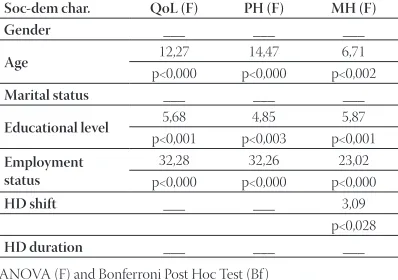
According to the results of SF-, our HD pts have dem-onstrated QoL slightly better then average for medically ill population (,±,). However, standard devia-tion is very high, so , of our HD pts have shown QoL lower then average. As we could aspect, due to the medical ill, HD pts have demonstrated better MH (,±,), then PH (,±,). Demographical data such as gender and marital status did not infl uence signifi cantly on pt’s QoL (p>,). However, there was
Soc-dem char. Depression χ² p value Gender ___ ___
Age 24,56 <0,000
Marital status ___ ___
Educational level 16,97 <0,049
Employment status 15,25 <0,002
HD shift 19,12 <0,024
HD duration ___ ___
Chi-Square (χ²)
Soc-dem char. QoL (F) PH (F) MH (F) Gender ___ ___ ___
Age 12,27 14,47 6,71
p<0,000 p<0,000 p<0,002
Marital status ___ ___ ___
Educational level 5,68 4,85 5,87
p<0,001 p<0,003 p<0,001
Employment status
32,28 32,26 23,02
p<0,000 p<0,000 p<0,000
HD shift ___ ___ 3,09 p<0,028
HD duration ___ ___ ___ TABLE 1. Relation between appearance of depression and sociode-mographic characteristics of our HD patients
ANOVA (F) and Bonferroni Post Hoc Test (Bf )
S
BOSNIAN JOURNAL OF BASIC MEDICAL SCIENCES 20010; 10 (SUPPLEMENT 1): S76-S78highly signifi cant diff erence in QoL between pts in dif-ferent age groups. Indeed, the increased age of pts re-sulted in signifi cantly decreased QoL (p<,) as well as in their PH (p<,) and MH (p<,) separately. In addition, Bonferroni Post Hoc Test have shown that there were signifi cant diff erences in almost all subscales of QoL between all age group of pts, especially be-tween younger (- y) and older (-…) group of pts (p<,). In relation to age, pts did not diff ered signifi -cantly only in GH and RE (p>,). Furthermore, when the employment status was analyzed, we found out that employed pts had signifi cantly better QoL (p<,), PH (p<,), MH (p<,) and all their subscales (p<,) in relation to unemployed pts. In order to explore the relationship between educational level and QoL, we found out that as the educational level of pts increased, their QoL (p<,), PH (p<,) and MH (p<,) signifi cantly increased too (p<,). According to edu-cational level, pts diff ered signifi cantly in all subscales of QoL too (p<,). Due to the Bonferroni Post Hoc Test, the diff erences were signifi cant mostly between pts with primary school fi nished and pts with univer-sity degree (p<,). Th ere was no signifi cant diff erence in QoL in general and PH between pts in diff erent HD shifts (p>,). However, pts in diff erent HD shift dif-fered signifi cantly in MH (p<,) (see Table .). Inter-estingly, pts in the rd nocturnal HD shift have shown
signifi cantly better MH (SF, RE) in relation to pts in the st daily HD shift (Bf=,, p<,). QoL (PH and MH)
was not found to diff er signifi cantly when compared by HD duration (p>,). However, there was signifi cant diff erence in PF between pts with diff erent HD tion (F=,, p<,). Accordingly, pts with HD dura-tion between - y have shown naturally signifi cantly better PF in relation to pts with HD duration more then y (Bf=-,, p<,). Due to the analysis of descrip-tive statistic, the best QoL (PH, MH) have shown pts with HD duration between - y (,±,) and the worst pts with HD duration between - y (,±,).
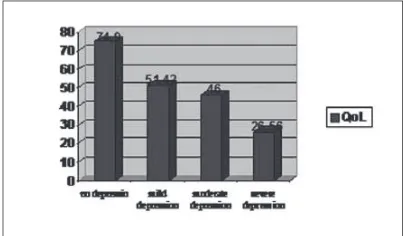
And fi nally, there were signifi cant diff erences in QoL in general (p<,), PH (p<,), MH (p<,) and all their subscales (p<,) between pts of dif-ferent levels of depression (see Table .). Accord-ingly, as the level of depression of pts increased, their
QoL significantly decreased. There was only no significant difference in QoL (PH, MH) between pts with mild and moderate depression (Figure ).
Discussion
More then half of our HD pts were diagnosed as hav-ing depression in various degrees () and QoL lower then average (,) . Previous studies have also shown that depression is the most common psychological complications of HD pts, which can reduce pt’s QoL (-,,,,). In spite of that, similar studies have reported lower percentage of depression among HD pts. Kimmel and Levy reported that of HD suff er from depression, Hedayati et al. reported ,, Son et al. , and Drayer et al. (,,,). A possible cause for lower percentage of pts suff ering from depres-sion in similar studies laying in fact that their authors mostly use BDI score greater then for measuring depression, because of risk of overlap of some somatic symptoms of depression with pt’s objective difficul-ties related to HD. Th e second possible cause for that is that we in our country unfortunately don’t practices cadaveric transplantation yet. So, for the most of our pts, HD is not temporary solution. Successful trans-plantation is associated with reduced levels of anxiety and depression (). Accordingly, the most empha-sized psychological symptom of depression in our HD pts was unhedonia (,) and the most emphasized somatic symptom of depression was loss of energy (,). According to Lopes et al., reduced energy, loss of libido and psychomotor retardation can be seen as predisposing factors to depression and result of sion (). Th e most of our pts suff er from mild depres-sion (), but severe depresdepres-sion is pretty emphasized too (,). of our pts had suicidal ideation, much less then in the study of Yucedal et al. (,) (). In the last years, pts from our HD Clinic had commit-ted suicide. Both pts suff ered from severe depression.
QoL (F) PH (F) MH (F) Depression 36,14 26,74 39,73
p<0,000 p<0,000 p<0,002
ANOVA (F) and Bonferroni Post Hoc Test (Bf )
S
BOSNIAN JOURNAL OF BASIC MEDICAL SCIENCES 20010; 10 (SUPPLEMENT 1): S77-S78
It seems that gender and marital status did not infl uence signifi cantly on appearance of depression and pt’s QoL. Similar studies have reported controversial results. Be-sides Lopes et al., which had reported signifi cantly fre-quent depression in female pts, the most of other similar studies are in agreement with our result related to gen-der (,,,). On the other hand, when the association between marital status and depression / QoL was ana-lyzed, we expect just the opposite - social support and marital satisfaction usually relate with decreased depres-sive aff ect (,). Th e reason for this opposite result may be due to the fact that married HD pts, in general have more responsibilities and obligations related to dialysis and additionally related to the family. However, when the cohort was stratifi ed according to the age a signifi -cant diff erence between various age groups was found in relation to the depression and QoL. Indeed, the in-creased age of pts resulted in significantly inin-creased depression and decreased QoL, witch is in accordance with the similar study of Drayer et al., but it is in oppo-site with the results of the study of Lopes et al. (,). The main reason for our results lying in the fact that older pts naturally have higher prevalence of comorbidi-ties (hypertension, coronary heart disease, diabetes mel-litus,...) witch show a tendency to increase depression and decrease QoL. Furthermore, when the employment status was analyzed, we found out that employed pts were signifi cantly less depressed and had signifi cantly better QoL in relation to unemployed pts, which is in accordance with many similar studies (,,). For HD pts the most stressful thing experience is relating to em-ployment status and how the disease will impact their fi nances. In the most of cases HD pts cannot work con-tinuously and in full capacity after beginning on HD pro-gram. According to Yucedal et al., the main anxiety and depression sources of HD pts were loss of libido and unemployment (). In order to explore the relationship between educational level and depression / QoL, we found out that as the educational level of pts increased, depression signifi cantly decreased and QoL signifi cantly increased. Th e main diff erences were between pts with
primary school fi nished and pts with university degree. We suppose that pts with higher formal education are
more educated about their illness and dialysis too and that they are more compliant with dialysis, dietary re-gime and medication prescription, which have a positive eff ect on their physical and mental health. Furthermore, pts in diff erent HD shifts signifi cantly diff ered in appear-ance of depression and in their MH. Interestingly, pts in the st daily HD shift in signifi cantly higher number
were depressed and showed signifi cantly worst MH in compared to pts in the rd nocturnal HD shift. Th e
rea-soning behind this observation may be viewed in the fact that our rd nocturnal HD shift is mainly consist from
our employed HD pts, who are less depressed and have better QoL. While daily HD may be more eff ective in controlling uraemia, for some pts daily impact of dialysis and increased treatment related stress may amplify the burden of treatment (). Neither depression, nor QoL were found signifi cantly diff erent in relation to HD du-ration. However, from the analysis of descriptive statis-tics of both variables, we can see that as the HD duration increased, severity of depression and QoL slightly in-creased. After st year on HD treatment QoL slowly
de-creased, and then after y inde-creased, probably because of better adjustment to the psychological burden of HD. Many similar studies confi rm greater prevalence of de-pression in pts with HD duration more then y (,,). And fi nally, as the level of depression of pts increased, their QoL significantly decreased, which is in accor-dance with the results of all similar studies (,,,).
Generalizability of the results of our study is lim-ited as the sample was composed only of pts from Sarajevo, Bosnia and Herzegovina. Due to the large sample of pts, for diagnosing depression we use only BDI (cut off ≥), not psychiatric diagnosis of de-pressive disorder based on DSM IV. So, it is possible that we overdiagnosed depression. However, all pts should be asked and encouraged to complete BDI ev-ery months, which may help HD staff to identify pts who need special care in order to improve their QoL.
Conclusion
S
BOSNIAN JOURNAL OF BASIC MEDICAL SCIENCES 20010; 10 (SUPPLEMENT 1): S78-S78References
() Kimmel P.L., Levy N.B. Psychology and Rehabilitation In: Daugir-das J.T.., Blake P.G.., Ing T.S., editors, Handbook of dialysis. Lip-pincott, Williams & Wilkins. ; pp.: -.
() Chilcot J., Wellsted D., Da Silva-Gane M., Farrington K. Depres-sion on Dialysis. Nephron Clin. Pract. ; :c-c.
() Schmidt R.J., Holley J.L. Psychiatric illness in dialysis patients In: UpToDate ; pp.: -.
() Bargiel-Matusiewicz K. Psychological infl uence on the psychical state of haemodialysis patients. J. Physiol. Pharmacol. ; (): -.
() Mladenovska D., Zafi rovska K., Petrusevska N., Selim Gj., Tra-jceska L. Appearance of Psychopathological Tendencies in the Early Phase of Haemodialysis Treated Patients. BANTAO Jour-nal. ; (): -.
() Lopes A.A., Albert J.M., Young E.W., et al. Screening for depres-sion in haemodialysis patients: Associations with diagnosis, treat-ment, and outcomes in the DOPPS. Kidney Int. ; : -.
() Yucedal C., Olmez N., Gezen G. Depression in dialysis patients. EDTNA/ERCA JOURNAL. , : -.
() Kimmel P.L, Peterson R.A. Depression in End-Stage Renal Dis-ease Patients Treated With Haemodialysis: Tools, Correlates, Outcomes, and Needs. Semin. Dial. ; (): -.
() Tossani E., Cassano P., Fava M. Depression and Renal Disease. Semin. Dial. ; (): -.
() Wuerth D., Finkelstein S.H., Finkelstein F.O. Th e Identifi cation and Treatment of Depression in Patients Maintained on Dialysis. Semin. Dial. ; (): -.
() Hedayati S.S., Bosworth H.B., Briley L.P. Death or hospitalization of patients on chronic haemodialysis is associated with a physi-cian-based diagnosis of depression. Kidney Int. ; : -.
() Finkelstein F.O., Wuerth D., Troidle L.K., Finkelstein S.H. De-pression and end-stage renal disease: a therapeutic challenge. Nephron. Clin. Pract. ; : c-c.
() Grant D., Almond M.K., Newnham A., Roberts P., Hutchings A. Th e Beck depression Inventory Requires Modifi cation in Scoring before Use in a Haemodialysis Population in the UK. Nephron. Clin. Pract. ; : -.
() Son Y.J., Choi K.S., Park Y.R., Bae J.S, Lee J.B. Depression, symp-toms and the quality of life in patients on haemodialysis for end-stage renal disease. Am. J. Nephrol. ; (): -.
() Drayer R.A., Piraino B., Reynolds C.F. Characteristics of depres-sion in haemodialysis patients: symptoms, quality of life and mor-tality risk. Gen. Hosp. Psychiatry. ; (): -.
() Turk S., Atalay H., Altintepe L. Treatment with antidepressive drugs improved quality of life in chronic haemodialysis patients. Clin. Nephrol. ; (): -.