Introduction
Hospitals are the weakest segment of the Slovak health care system. Their basic problems are evident in outdated material-technical base, demotivation of physicians, lack of care for the chronically and severely ill patients, regulated and non-competing system of health insurance companies, dysfunctional system of trainings for physician and health professionals. Health care providers (HCP) assess the current health care system as completely unstable. The long-term negative phenomena of the most Slovak hospitals is their loss making management, which affects the condition of the buildings, equipment, reward system, as well as the working conditions, the logistics system of medicines, medical materials, etc. There is a long term absence of the investment resources, which were in the past covered by the capital subsidies from the State budget. Hospitals suffer from the rapid lack of investment capital into the buildings, technologies and specialized equipment. This problem is closely related to the insufficient development of innovation and development of highly specialized health care. One of the possible savings of health insurance companies’ funds is introducing day surgery option, respectively day surgery, which would be beneficial also for patients. It is also supported by the government's program of the Ministry of Health of the Slovak Republic (MH SR) under the reduction of beds in hospitals and declared highly effective treatment consisting of cured patients for the shortest possible time, without unnecessary pain and stress, but of the highest quality, without unnecessary hospital
infections appearance and with as low as possible expenses. Day surgery has its proponents, but also opponents. Positive or negative opinion on its use in Slovakia depends on who is assessing it: health insurance companies are seeking for efficient use of available financial resources in hospitals, but those are perma-nently in debt [13]. Health insurance companies contribute with significantly reduced payments for services of day surgery against the payments for completed hospitalization. The reason is poorly constructed and economically de-motivating system that significantly lags behind the European average. Health systems need to be assessed comprehensively, since the adoption of measures only in one area may substantially affect the other areas and cause many adverse effects, possibly with the worse implications than before the change itself [14]. To search for alternatives in the process of increasing the efficiency of the health care system in Slovakia it is necessary to launch a broad debate about the whole system [2], [10] and its functionality, to set up the goals, to provide all required and objective analyzes [19], to search for all possible variants of solutions [39], to reach an agreement and particularly to meet the agreed rules by all involved stakeholders in order to meet the targets [31], [20], [24], [38]. There are very few studies based on comparison of tradi-tional hospitalization with performances provided during day surgery [5]. Those that have been realized show no significant differences in the results (e.g. [5], [6], [9], [11], [17]. Their conclusions focus mainly on the safety dimension of day surgery performance, also on the subject in compliance with all recommended
THE FUNCTIONALITY COMPARISON OF THE
HEALTH CARE SYSTEMS BY THE
ANALYTICAL HIERARCHY PROCESS
METHOD
Business Administration and Management
instructions and organizational principles of theday surgery program.
1. Day Surgery in Slovak Republic
and Abroad
At the present, in Slovakia is day surgery more increasingly considered as a standard planned procedure, it can be advantageous not only for the patient and his family, but also for health care provider. „Day surgery” is defined as a surgery or procedure, when the patient is admitted or released from surgical care on the same day [1]. Stay in the hospital during the night up to 23 hours is termed as „prolonged recovery” [1]. A term „short stay“ is used for surgery, where required hospital stay takes more than 23 hours, but no longer than 72 hours [18]. Despite of IAAS efforts to standardize international terminology to facilitate comparisons of surgical data between the countries, there are still the differences. There is no standar-dized terminology of day surgery procedures, as well as the places of their realization, places and length of recovery after procedures and so on. Development of high quality day surgery care services in European countries is also a priority for their governments in health care field. A recent survey conducted in 19 countries pointed to the significant differences in the percentage of realized procedures of day surgery [34]. Their range varies from less than 10% (e.g., Slovakia and Poland), to the around 80% (such as USA, Canada) [7], [29], [34]. These differences are evident between the countries but also within the countries, between the hospitals in the concrete country, in its departments, as well as between the specialists in the equal hospital. As the most determining factor of stated differences could be indicated the existence of different rules and incentives in different countries, different financial payments for day surgery, doctors resistance (including anesthesiologists) to the changes in the implementation of new procedures and the like (e.g. [21], [30]). IAAS (International Association for ambulatory surgery) recommends also a subsequent benchmarking for day surgery quality assessment based on selected types of indicators, such as cancellation of planned procedures, unplanned admission to the hospital, re-admission to the surgical procedure (ambulatory or hospital), patient satisfaction with the surgery performance and the like.
1.1 Critical Aspects of Day Surgery
in Slovak Republic
Previous researches of day surgery use in Slovakia [13], [14] declare the fact that although day surgery is a highly effective instrument for providing health care, it is applied in unstable conditions of Slovak healthcare system. It is a suitable subject for polemics of various representatives of the health care system, as well as the professional and general public, who does not have adequate information. Informa-tion also absent on the web pages of individual health insurance companies. Day surgery is carried out under the professional guidance of the Ministry of Health of the Slovak Republic issued in 2006. At that time, about one third of the patients, especially in large public hospitals were hospitalized less than 72 hours.
1.2 Day Surgery in the Process of
Beds Reduction in Health Care
System
In connection with the day surgery development is necessary to mention the process of the hospital beds reduction. Reducing the number of hospital beds previously used for inpatient care can be considered from a financial perspective as an important benefit of day surgery. Slovakia is among the OECD countries with the lowest efficiency of health care, while in the number of beds per 1,000 inhabitants is above the average of the OECD [37]. Reduction of the hospital beds was repeatedly planned by previous governments in Slovakia, touching also the hospitals that were not intended to be cancelled. Although, the expected output of rationalization of hospitals in the long run in conjunction with other measures, which should increase the performance management of public resources in the health sector, strives to the increasment of the quality and accessibility of health care for citizens, it can also cause a transitory exacerbation of the access to the health care. As reported by the National Health Information Center (NHIC) statistics, since 2000 is reported a decline trend of the number of hospital beds in all segments (acute, psychiatric as well as beds for long-term patients). Between the years 2000–2007 there was a reduction of beds by 37.3% (in 2000 was their number 42,332 and in 2007 a total of 26,546 beds). Decrease in the number of beds was also reflected in the decline of the number of employed physicians by 13.2% (from 6,143 to 5,334), as well as the reduction of other medical personnel [36], [37]. In 2011, the General Health Insurance Company reduced about 3,000 unnecessary beds and has not contracted about 150 hospital departments, which were often duplicated or ineffective. Despite of the referred rationalization actions, Slovakia remains in ranking among the OECD countries with the lowest efficiency of health care, while in the total number of hospital beds per 1,000 inhabitants is above the average of OECD countries (even in acute beds) [36]. It is apparent from the above that the scope for further hospital rationalization exists, although the process of reduction of beds causes a critical controversy among the experts in the sense, that stated system of saving finances is liquidating for hospitals. After the reduction of
beds was expected a lower supply of funds from health insurance companies, which would jeopardize the ability of hospitals to pay their liabilities. Finally, the hospital would get more into the debt, because even at the lower inflow of the finances, they will have to cure the patients.
2. Comparison of Health Care
Systems in Hospitals
Day surgery in Slovakia and abroad benefits from the positive results of several studies and medical practice declaring the fact, that the best ongoing treatment and recovery of patients after surgery is at home environment. Modern medicine, as well as ongoing development of operational techniques and related methods of the post-operative care, enables to shorten hospital stay to a minimum and it prompts to return to the normal life [32]. Current educa-tional modalities limit the negative influence of interindividual variability of surgical skills, thus increasing the potential for uncomplicated postoperative course [4]. However, the most standard, uncomplicated surgeries in Slovakia are accompanied by unnecessarily long hospital stay. When evaluating the day surgery efficiency it is necessary to bear in mind that the financial savings occur when the hospita-lization surgeries substitute the execution of day surgery performances and bed are reduced. Day surgery efficiency depends on many factors: pricing strategies of health insurance companies, place of day surgery performance, the patient age, comorbidities [33], degree of technical failure of the surgeon, social aspects and so on [3], [8] [15], [16], [35]. The heterogeneity of these factors on the one hand makes the process of day surgery performances significantly difficult to compare with the system of inpatient care. But in the individual components of the functioning of both systems are clear unambiguous criteria that are necessary to ensure the functionality of the process of health care providing. To compare those two systems, we have choosen already mentioned AHP method.
2.1 AHP in the Process of
Business Administration and Management
first publication in the 70s of the 20th century, ithas undergone several improvements and it provides complex and coherent approach to the structuring of the problem, to quantify the elements related to the overall objectives and evaluates an alternative solutions. AHP can be used in various decision-making situations spheres (government, business, industry, health, education).
AHP method is based on the creation and analysis of hierarchical structure of the solving task. By the hierarchical structure of the term we understand to the structure, containing a number of levels, where each of them contains several elements. The arrangement of the different levels of hierarchical structure corres-ponds with the way of the arrangement from the general to the specific. The more general elements are in relation to that decision-making problem, the higher level of hierarchy they get. The typical simple task of multicriteria option analysis includes the following levels:
first level – objective evaluation, which could be the arrangement of variants,
second level – evaluation criteria,
third level – assessed variants.
When quantifying relations in the hierarchy, it usually progresses from the top to the bottom. The method of quantitative pair comparison by Saaty is used; it is based on the importance of comparing all pairs of elements evaluation [25], [26], [28]. The output of AHP is important for
the evaluation of criteria, therefore it is very important to pay attention to the procedures which helps to determine weights of the criteria responsibly and exactly. For decision making are also important experiences, it helps to sort out evaluation criteria for monitoring so-called informative signs, which provide largest volume of real information for deciding. Decisions made on the base of the best decision-making method may not be correct; if the input data in preparation phase are not perfectly managed and sufficient quality information are missinf. In the first phase, before applying the method of evaluating, the evaluating entity has to define all criteria and sub-criteria under which the eva-luation will take place. Selection of individual criteria and sub-criteria is carried out on the basis of current knowledge and experiences of each evaluating entity. If it is a very first evaluation of some entity, the criteria must be sorted out more or less according to its own intuition, respectively according to some evaluating subject template, or according to the tasks that is the subject of decision making.
2.1.1 The Structure of the AHP Method
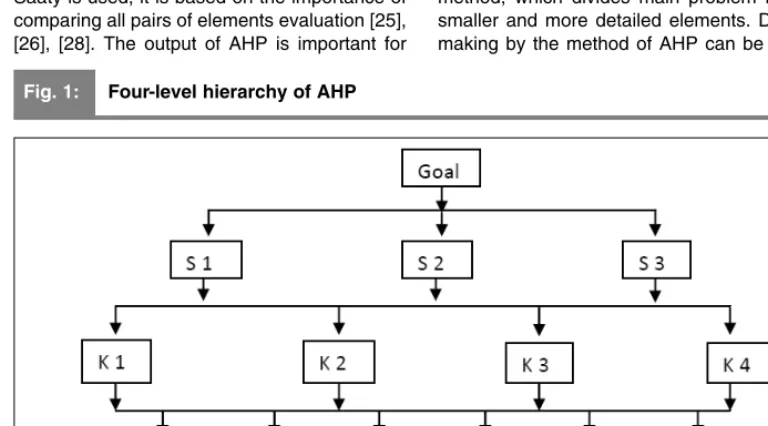
Method of AHP is a flexible model for decision making, clarifying issues that have several possible solutions. AHP is carried out by an expert method and then by a mathematical method, which divides main problem into the smaller and more detailed elements. Decision making by the method of AHP can be divided
Fig. 1: Four-level hierarchy of AHP
into three different levels [25]: 1) hierarchy, 2) priorities, 3) consistency.
Hierarchy – decomposition of the properties into homogeneous clusters and then further dividing into smaller units, we can gradually integrate a large amount of information into hierarchical structure, creating a more complete picture of the system. Hierarchy on Figure 1 represents a problem of multicriteria decision making.
Setting priorities – to determine the
inten-sities of the impact effect of various components
on the system as a whole, we need to transfer a certain types of measurement. AHP allows comparing and measuring the intangible qualitative factors (e.g. social, political, etc.). In absolute comparisons are compared the alternatives with the established standard, which was developed on the basis of past experiences. In relative comparisons are alternatives compared in pairs usually through the commonly used evaluation terms (e.g. worse, better, etc.). AHP uses for both types of comparisons, cardinal scales are stated in Table 1.
Tab. 1: Basic scales for pair comparison
Evaluation
degree Comparison of elements x and y Explanation
1 x is as important as y Both elements contribute equally to the result
2 x is less important as y The first element is slightly more important than the other 3 x is slightly important than y Experiences and assuming slightly prefer the first element
before the second
4 x is slightly more important than y Slightly stronger preference than the previous 5 x is strongly more important than y Strong preference of the first element before the second 6 x is much more strongly important than y Slightly stronger preference than the previous 7 x is very strongly important than y Very strong preference of the first element before
the second
8 x is very, very strongly more important than y Slightly stronger preference than the previous one 9 x is extremely more important than y The facts that prefer the first element over the second
one have the highest evidential level.
Source: [25]
Information about the significance of the criteria obtained on the base of the paired comparison can be determined as the values sij, which indicates the ratio of the significance of the evaluation criteria kito criterion kj, where i,j = 1,2,...,n. It is required that sij meets for all i, j = 1,2,...n, where n is the number of evaluation criteria, under the following conditions [25]:
sij> 0, sij= sji-1, sii= 1 (1)
Variables sij, relative significance of criteria have to be arranged in a square matrix of relative significance S.
Consistency – in determining the relations
Business Administration and Management
As reported by Saaty and Joyce [26], whenusing AHP method for decision making, four axioms have to be met:
Inverse axiom: if an alternative A is n-times
preferred to B, then B alternative is 1/n-times preferred to A. It is a rule of reciprocity expressed by the formula:
(3)
Homogeneous axiom: comparison using
pairing is significant only if the elements are comparable.
Dependent axiom: comparison at a lowest
level (sub-criterion) depends on the element at a higher level (the higher criterion), the rule of transitivity.
Consequential axiom: if any criterion in the
hierarchy will be changed, new re-valuation for the new hierarchy is expected.
In practical application of method AHP, the elements of decision matrix, are very often not consistent. So there is needed to calculate inconsistency index, expressed by the formula [25]:
(4)
where λmaxis the biggest eigenvalue of matrix
S and n is its dimension. If Is = 0, than the matrix is consistent.
The higher the values of inconsistency index (Is) acquires, the more inconsistent are the pairwise comparisons in the matrix of paired comparisons. In case of higher inconsistency Saaty recommends, that expert should reconsider its assessment of criteria and modify the matrix of relative significances S, to increase its consistency [27]. On the contrary, the closer to zero is the value Is, the greater is the consistency of the pairwise comparisons in matrix. In practical application Saaty
recom-mends to accept the value of inconsistency index lower than 0.1, as it was applied in our calculations.
2.2 Practical Application of AHP –
Determination of Criteria and
Sub-Criteria
Listed criteria are relatively widely understood. For this reason, it is necessary that in the process of defining the criteria, the experts should break down those criteria into sub-criteria to the level where it is necessary. The level of the segmen-tation is unlimited. In this case, we have chosen to break down the criteria only to one lower level,
to the sub-criteria. In practice it is possible that these sub-criteria will be subdivided to other criteria. For the second level of sub-criteria were based on expert estimation of the expert group set the items shown in Table 3 From the table is also clear the competence of the various sub-criteria to the main criteria. Tab. 2: Set of health care systems functionality criteria based on expert evaluation
Criterion Criterion title
K1 Strategic objective of health care system K2 Stability of health care system K3 Measurability
K4 Causality
K5 Coherence with funding sources K6 Continuity, sustainability and feedback K7 Self-evaluation of health care
Source: own
Set of health care systems functionality sub-criteria based of expert
Tab. 3:
evaluation (part 1)
Sub-criterion Sub-criterion title
S1.1 Implementation of the consistent strategic analysis and assessment of the appropriateness of the health care system for current conditions in the Slovak healthcare
S1.2 Consensus on a vision and/or mission and/or critical success factors
S1.3 Regular analysis and assessment of the overall strategic performance of the hospital
S1.4 Revising the existing strategic areas and the possibility of accepting other potential strategic areas S1.5 Support of the major decision-making organization managements (MZ SR, health insurance companies,
The Healthcare Surveillance Authority, AHS) when using health care system and their participation on the relevant results of the health care system
S2.1 Regular redefinition of the objectives and actions within the health care system S2.2 Defined objectives reflect the equilibrium view on the strategy for hospital S2.3 Defined strategic actions reflect the equilibrium view on the strategy of the hospital S2.4 Regular analysis and evaluation of the balance between existing strategic measures
S3.1 To the strategic objective are assigned appropriately chosen strategic measure methods of the values measuring
S3.2 To the strategic measures are assigned their target values and critical values S3.3 Specified conditions and terms of regular quantification of the measures
S3.4 Regular analysis and evaluation of existing measures, target and critical values, measures and choice of other potential target and critical value of measures
S4.1 Causal relationships are defined between the strategic perspectives S4.2 Causal relationships are defined between the strategic objectives S4.3 Causal relationships are defined between the measures
Business Administration and Management
Set of health care systems functionality sub-criteria based of expert
Tab. 3:
evaluation (part 2)
Sub-criterion Sub-criterion title
S5.1 Defined strategy and subsequent planes are linked to the state budget of SR
S5.2 Hospital sources are within the system of day surgery aligned with strategic actions, respectively strategic initiatives
S5.3 Non-strategic investments, respectively non-strategic activities were selected and eliminated by introduction of new forms of healthcare
S5.4 Results of analyzes affect the review of the strategy, i.e. strategic objectives and resources
S5.5 Regularly are analyzed and evaluated links to the sources of hospitals to the strategic activities identified in the health care system
S5.6 Based on the results of analysis and revisions of the strategic assumptions, if necessary, we revise existing links of budget and strategy of day surgery system
S6.1 Project to establish health care system was planned in detail from the methodological, technical and organizational perspective
S6.2 The introduction of the health care system had the full support and participation from the side of superior units and relevant organizations s
S6.3 For day surgery functioning was chosen and implemented an appropriate information system S6.4 Extending health care system within the hospital was managed and controlled process
S6.5 Leadership of organizations supports the use of the health care system and participates in the relevant results
S6.6 Continuous operation of the health care system and regular reporting is ensured
S7.1 For the introduction of the health care system was elaborated cost analysis and/or analysis of risk and benefits
S7.2 Conditions and rules for the regular evaluation of the health care system in terms of benefits, risks, and cost-effectiveness were specified
S7.3 The health care system is regularly analyzed and evaluated - its benefits, costs, gaps, risks and so on. S7.4 In case of revising conditions and rules of functionality and their use of health care system, an effort for
continuous improvement is registered
Source: own
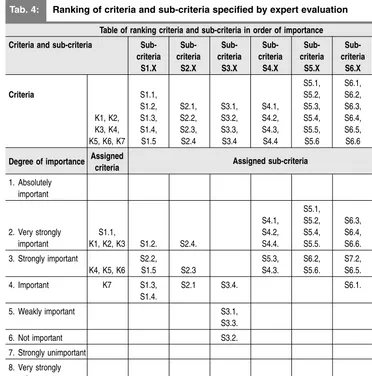
In the first round of the expert evaluation were defined criteria and sub-criteria. Subsequently, the experts were provided with the lists of criteria and sub-criteria in order to assess their importance. The experts could assign a degree of importance to criteria and sub-criteria from 1 (absolutely important) to the level 9 (totally unimportant). Experts were given a table of criteria and sub-criteria and then using the modal criterion, the importance of each criterion was evaluated. Results are stated in the following Table 4.
Consequently, using these links between those criteria and sub-criteria we determined the elements of matrix. Value matrix S is defined precisely on the basis of mutual comparison of the criterion importance, respectively associated
It can also be exactly written. Let kirepresents an evaluation of the importance of i-th criterion/ /sub-criteria. Mutual evaluation of the importance of the two criteria/sub-criteria then can be defined as sij, as criterion i is more important than criterion j which is stated by the formula:
sij= kj– ki+ 1 if ki< kj, (5)
sij= 1 / (ki – kj+ 1 ) when ki> kj. (6)
Weights are stated as:
where m is an index of a superior main criterion.
Results are written in table 5 and table 6. Tab. 4: Ranking of criteria and sub-criteria specified by expert evaluation
Table of ranking criteria and sub-criteria in order of importance
Criteria and sub-criteria Sub- Sub- Sub- Sub- Sub- Sub-
Sub-criteria Sub-criteria Sub-criteria criteria criteria criteria criteria
S1.X S2.X S3.X S4.X S5.X S6.X S7.X
S5.1, S6.1,
Criteria S1.1, S5.2, S6.2,
S1.2, S2.1, S3.1, S4.1, S5.3, S6.3, S7.1, K1, K2, S1.3, S2.2, S3.2, S4.2, S5.4, S6.4, S7.2, K3, K4, S1.4, S2.3, S3.3, S4.3, S5.5, S6.5, S7.3, K5, K6, K7 S1.5 S2.4 S3.4 S4.4 S5.6 S6.6 S7.4
Degree of importance Assigned
criteria Assigned sub-criteria
1. Absolutely important
S5.1,
S4.1, S5.2, S6.3, 2. Very strongly S1.1, S4.2, S5.4, S6.4,
important K1, K2, K3 S1.2. S2.4. S4.4. S5.5. S6.6. S7.1 3. Strongly important S2.2, S5.3, S6.2, S7.2,
K4, K5, K6 S1.5 S2.3 S4.3. S5.6. S6.5. S7.4. 4. Important K7 S1.3, S2.1 S3.4. S6.1. S7.3.
S1.4.
5. Weakly important S3.1, S3.3. 6. Not important S3.2. 7. Strongly unimportant
8. Very strongly unimportant 9. Absolutely
unimportant
Business Administration and Management
Tab. 5: Matrix S for basic criteria
Source: own
Tab. 6: Matrices S for individual sub-criteria
Since not all individual elements of matrices are consistent, we calculated the indexes of inconsistency. Calculation was carried out by
using of the program tool MS Excel and acquired results are shown in Table 7.
Tab. 7: Inconsistency index of main criterions and sub-criterions
IK Is1 Is2 Is3 Is4 Is5 Is6 Is7
0.001731 -0.06141 -0.00626 0.00249 0 0 -0.00166 0.00249
Source: own
Table 7 shows that pairwise comparisons of criteria and sub-criteria are sufficiently consistent, because all indexes of inconsistency are in absolute value smaller than 0.1. Our suggested criteria and sub-criteria rated by experts are thus suitable for evaluating by using AHP method.
2.3 Evaluation of Variants
(Standardized and
Non-Standardized Evaluation)
In the second part of the implementation of the expert evaluation we conducted individual evaluation of both variants, namely day surgery
system and hospitalization system of health care. Experts on such matters evaluated both variants separately for each sub-criterion. While using rating scales from 0 to 5, where 5 represents the best value (most appropriate option) and the worst value of 0 (worst possible option). Individual variants were evaluated by non-standardized and by standardized method. When using standardized method, the figures obtained from experts were divided into the intervals. Respecting the recommendation of paper [27], we divided the interval <0,5> into 8 equal intervals, which are characterized in Table 8.
Tab. 8: Intervals of standardized evaluation of alternatives
Points 1. 2. 3. 4. 5. 6. 7. 8.
From 0 0.625 1.25 1.875 2.5 3.125 3.75 4.375 To 0.625 1.25 1.875 2.5 3.125 3.75 4.375 5
Source: own
Business Administration and Management
The classifications from Table 9 were used for creating two-dimensional Saaty matrices for both systems and for each sub-criterion
separately. We proceeded Table 10 and results were overwritten into the Table 11.
Tab. 9: The sub-criteria values and their classification into intervals
Source: own
Tab. 10: Process of the construction of Saaty matrices
If the values xAand xBare equal 1; 1 If the values xAand xBare unequal, but in the same interval 1/2; 2 If the values xAand xBare in adjacent intervals 1/3; 3 If the values xAand xBare in interval, among which is 1 different interval 1/4; 4 If the values xAand xBin intervals, among which is n intervals (maximum 6 intervals) 1/(n+3); n+3
Tab. 11: Saaty matrices for both systems and sub-criteria
Business Administration and Management
Final evaluation of the variant A iscomputed using the following relation:
(8)
the variant B using the relation:
(9)
where m is an index of a superior main criterion, n is an index of sub-criterion within a main criterion.
While wiare weights of criteria from Table 5, wijare weights of sub-criteria from Table 6 and values wijA resp. wijB are weights of Saaty matrices from Table 11. Final values are shown in the Table 12.
In the prior evaluation we used a range, where the smallest value represented the worst alternative and the highest value represented the best alternative. Therefore, in the overall
Tab. 12: Results of evaluation via standardized and non-standardized evaluation
Evaluation Variant A Variant B Difference
(day surgery) (traditional hospitalization health care)
Non-standardized 2.8158 2.8037 0.43%
Standardized 0.5927 0.4074 31.27%
Source: own
assessment we conclude that higher variant rating is, the better is given option to the compared variant. In both cases, alternative A was better than alternative B.
Based on the results from the application of AHP in comparison with functionality of health care systems we conclude higher efficiency of day surgery system. Day surgery is the area where we see a clear possibility of savings not only in the health care system, but also in national economic context. From an economic perspective, this area provides opportunities to reduce operating costs of hospitals and thus the required payments by the health insurance companies, but it also may have a positive impact on the area of health insurance, which would reflect in a more rapid re-engagement of the patient to the labor force. Mentioned analysis should be supported by the other complemen-tary analyses, necessary for the development of day surgery in Slovakia. This is a call for an active participation of the Ministry of Health of the Slovak Republic, as well as the National Health Information Center, who are currently participating in our analyses of health care systems. The analysis can help to improve processes within the reporting system in Slovakia, as well as in decision-making processes in our healthcare system.
Conclusion
quality and accessibility of health care, consistently protect the consumers of health services and ultimately increase the prestige of the Slovak Republic for the more rationally behaving external environment. For achievement of all above stated, it is necessary to have a quality national and international registries that would provide all necessary information for the analyses of effective deployment and use of day surgery, comparable with foreign countries. International institutions such as the OECD, Eurostat, WHO declare also the significant methodological problems in the reporting of surgical procedures in each country and they encourage the cooperation to eliminate them [22]. Slovakia still records very low quotient of day surgery procedures of the total number of surgical procedures, while abroad is significant evidence of its progress. Our analysis confirmed the higher functionality of the day surgery system in comparison with traditional hospitalization health care. For a further complementary analysis of effectivity, not only focused on day surgery, it is necessary to access to the deeper and more structured data. It is required to increase an information discipline of health care providers, cooperation with national register and strengthen the legislative support (participation of Ministry of Health in SR). Without the analyzing of day surgery level of functionality, efficiency, specification of its determinants, detection of day surgery weaknesses and taking actions for their elimination, the future progress in setting up and using of day surgery is not possible.
This research paper is made possible through the support from VEGA Project No. 1/0929/14 „Multidimensional economic and financial evaluation of the implementation process and the use of one day health care and quantification of the financial impact on the health system in the Slovak Republic“.
References
[1] BADS. BADS directory of procedures [online]. London: British Association of Day Surgery, c2009 [cit. 2012-07-08]. Available from: http://www.bads.co.uk. [2] BARTÁK, M. Ekonomika zdraví. Sociální,
ekonomické a právní aspekty péãe o zdraví.
1. vyd. Praha: Wolters Kluver âR, 2010. 224 p. ISBN 978-80-7357-503-8.
[3] BERGLAND, A., GISLASON, H., RAEDER, J. Fast-track surgery for bariatric laparoscopic gastric bypass with focus on anaesthesia and peri-operative care. Experience with 500 cases. Acta
Anaesthesiologica Scandinavica. 2008, Vol. 52,
Iss. 10, pp. 1394-1399. ISSN 1399-6576. [4] BUZINK, S., ·OLTÉS, M., RADO≈AK, J., et al. Laparoscopic Surgical Skills Programme: Preliminary Evaluation of Grade I Level 1 Courses by Trainees. Videosurgery and other Miniinvasive
Techniques. 2012, Vol. 7, No. 3, pp. 188-192.
ISSN 1895-4588.
[5] CASTORO, C., BERTINATO, L., BACCA-GLINI, U., et al. With the collaboration of IAAS
Executive Committee Members. Policy Brief. Day
surgery: making it happen. WHO European Centre for Health Policy 2007.
[6] CORVERA, G., GESPEDES, B., YSUNZA, A. et. al. Ambulatory vs. in-patient stapedectomy: a ran-domized twenty-patient pilot study. Otolaryngology
– Head and Neck Surgery. 1996, Vol. 114, No. 3,
pp. 355-359. ISSN 0194-5998.
[7] CULLEN, K.A., HALL, M.J., GOLOSINSKIY, A. Ambulatory Surgery in the United States, 2006.
National health statistics reports. 2009-01-28, no 11.
Revised. Hyattsville, MD: National Center for Health Statistics. 2009. 28 p. Available also from: http://www.cdc.gov/nchs/data/nhsr/nhsr011.pdf. [8] DEDIVITIS, R.A., PFUETZENREITER, E.G., CASTRO, M.A.F., DENARDIN, O.V.P. Analysis of safety of short-stay thyroid surgery. Acta
Otorhino-laryngologica Italica. 2009, Vol. 29, No. 6, pp. 326-330.
ISSN 0392-100X.
[9] DIRKSEN, C.D., SMITZ, R.F., HANS, K.M. et al. Ambulatory laparoscopic cholecystectomy is as effective as hospitalization and from a social perspective less expensive: a randomized study.
Nederlands tijdschrift voor geneeskunde. 2001,
Vol. 145, No. 50, pp. 2434-2439. ISSN 0028-2162. [10] DLOUH¯, M., BARTÁK, M. Mental Health Financing in Six Eastern European Countries.
E+M Ekonomie a Management. 2013, Vol. 16, Iss.
4, pp. 4-13. ISSN 1212-3609.
[11] FEDOROWICZ, Z., LAWRENCE, D., GUTIER-REZ, P. Day care versus inpatient surgery for
age-related cataract. The Cochrane Database of
Business Administration and Management
Surgery. 2004, Vol. 139, Iss. 1, pp. 67-72. ISSN
0004-0010.
[13] GAVUROVÁ, B., ·OLTÉS, V. EfektívnosÈ
slovenského zdravotníctva – anal˘za komparaã-n˘ch aspektov a identifikácia rozvojov˘ch moÏností. 1. vyd. Ko‰ice: TU, 2013. 116 p. ISBN
978-80-553-1451-8.
[14] GAVUROVÁ, B., ·OLTÉS, V., KAFKOVÁ, K., âERN¯, ª. Vybrané aspekty efektívnosti
sloven-ského zdravotníctva. JednodÀová zdravotná starostlivosÈ a jej rozvoj v podmienkach Sloven-skej republiky. Ko‰ice: Technická univerzita, 2013.
275 p. ISBN 978-80-553-1438-9.
[15] GURUSAMY, K., JUNNARKAR, S., FAROUK, M., DAVIDSON, B.R. Meta-analysis of randomized controlled trials on the safety and effectiveness of day-case laparoscopic cholecystectomy. British
Journal of Surgery. 2008, Vol. 95, Iss. 2, pp. 161-168.
ISSN 1365-2168.
[16] HOFER, R.E., KAI, T., DECKER, P.A., WARNER, D.O. Obesity as a risk factor for unanticipated admissions after ambulatory surgery. Mayo Clinic Proceedings. 2008, Vol. 83, Iss. 8, pp. 908-916. ISSN 0025-6196.
[17] HOLLINGTON, P., TOOGOOD, G.J., PADBURY, R.T. A prospective randomized trial of day-stay only versus overnight-stay laparoscopic cholecystectomy. Australian and New Zealand
Journal of Surgery. 1999, Vol. 69, Iss. 12, pp.
841-843. ISSN 0004-8682.
[18] IAAS. Clinical indicators for ambulatory
surgery [online]. International Association for
Ambulatory Surgery, 2003 [cit. 2010-05-15]. Available from: www.iaas-med.com.
[19] JANKE, F., PRÍDAVOK, M. B2B network performance: practical aspects of network supply adequacy indicator. In: DOUCEK, P., CHROUST, G., O·KRDAL, V. (eds.). IDIMT-2012: ICT Support
for Complex Systems: 20th Interdisciplinary Information Management Talks: Sept. 12-14, 2012, JindfiichÛv Hradec, âeská republika. Linz:
Trauner Verlag, 2012. pp. 337-346. ISBN 978-3-99033-022-7.
[20] JANKE, F., PACKOVÁ, M. Impact of ICT invest-ments on performance of companies in transitio-neconomies: Evidence from Czech Republic, Hungary and Slovakia. Quality Innovation Prosperity. 2013, Vol. 17, No. 2, pp. 9-21. ISSN
1335-1745.
[21] JARRETT, P., STANISZEWSKI, A. The development of ambulatory surgery and future challenges. In: LEMOS, P., JARRETT, P., PHILIP, B. (eds.). Day Surgery Development and Practice.
London: International Association for Ambulatory Surgery (IAAS) 2006, pp. 21-34. ISBN 978-989-20-0234-7.
[22] LAFORTUNE, G., BALESTAT, G., DURAND, A. Comparing activities and performance of the
hospital sector in Europe: how many surgical procedures performed as inpatient and day cases? OECD Health Division, Directorate for
Employment, Labour and Social Affairs, 2012. 80 p. Available also from: http://www.oecd.org/ health/Comparing-activities-and-performance-of- the-hospital-sector-in-Europe_Inpatient-and-day-cases-surgical- procedures.pdf.
[23] MATTILA, K. Day Surgery in Finland.
Ran-domized and cross-sectional studies on treatment, quality, and outcome. Doctoral dissertation.
University of Helsinki, Faculty of Medicine, Institute of Clinical Medicine, Department of Anaesthesiology and Intensive Care Medicine. Helsinki, 2010. ISBN 978-952-92-7350-8. [24] PAVLIKOVÁ, ª., SINIâÁKOVÁ, M. Labor Market Indicators and Their Causalities: the Case of the New European Union Member States. In
Procedia Economics and Finance: Emerging Markets Queries in Finance and Business: EMFB 2012: 24.27 October 2012. Tîrgu-Mures¸, România, Vol. 3, pp. 1229-1237. ISSN 2212-5671. [25] RAMÍK, J. Analytick˘ hierarchick˘ proces
(AHP) a jeho vyuÏití v malém a stfiedním pod-nikání. Slezská univerzita v Opavû. Obchodnû
podnikatelská fakulta v Karviné, 2000. 217 s. ISBN 80-7248-088-X.
[26] SAATY, T.L., JOYCE, A.M. Thinking with
models. 1st ed. Great Britain: Pergamon Press,
1981. 181 p. ISBN 0-08-026475-1.
[27] SAATY, T.L. Multicriteria decision making - the
analytic hierarchy process. Planning, priority setting, resource allocation. 2nd ed. RWS Publ,
1990. 287 p. ISBN 978-0962031724.
[28] SAATY, T.L., KEAMS, K.P. Analytical
Plan-ning. 1st ed. Great Britain: Pergamon Press, 1985.
208 p. ISBN 0-08-032599-8.
[29] SEGERDAHL, M., WARREN-STOMBERG, M., RAWAL, N., BRATTWALL, M., JAKOBSSON, J. Clinical practice and routines for day surgery in Sweden: results from a nation-wide survey. Acta
Anaesthesiologica Scandinavica. 2008, Vol. 52,
Iss. 1, pp. 117-124. ISSN 1399-6576.
[30] SMITH, I., McWHINNIE, D., JACKSON, I. Day
Case Surgery. British Association of Day Surgery.
[31] SZABO, Z.K., ·OLTÉS, M., HERMAN, E. Innovative Capacity and Performance of Transition Economies: Comparative Study at the Level of Enterprises. E+M Ekonomie a Management. 2013, Vol. 16, Iss. 1, pp. 52-68. ISSN 1212-3609. [32] ·OLTÉS, M., PAÎINKA, P., RADO≈AK, J. Laparoskopická hernioplastika TAPP v lieãbe slabinovej prietrÏe – 10-roãné skúsenosti.
Rozhledy v chirurgii. 2010, Vol. 89, No. 6, pp.
384-389. ISSN 0035-9351.
[33] ·OLTÉS, M., PAÎINKA, P., RADO≈AK, J. Termické lézie v laparoskopickej chirurgii.
Endos-kopie. 2011, Vol. 20, No. 1, pp. 14-16. ISSN 1211-1074.
[34] TOFTGAARD, C., PARMENTIER, G. Inter-national terminology in ambulatory surgery and its worldwide practice. In: LEMOS, P., JARRETT, P., PHILIP, B. (Eds.). Day Surgery Development and
Practice. London: International Association for
Ambulatory Surgery (IAAS) 2006, pp. 35-59. ISBN 978-989-20-0234-7.
[35] WASOWICZ-KEMPS, D.K. Trends in day
surgery in the Netherlands.Thesis, university of Utrecht, with summary in Dutch. Enschede:
Gildeprint B.V., 2008. ISBN 9789071382314. [36] ZACHAR, D. O plánovanej ìal‰ej redukcii
lôÏok v nemocniciach [online]. Bratislava: INEKO,
i-Health, c2013 [cit. 2013-07-08]. Available from: http://www.i-health.sk/1189_inekomentare-o-planovanej-dalsej-redu kcii-lozok-v-nemocniciach.
[37] ZACHAR, D. O rozpoãtovan˘ch prostriedkoch
pre zdravotníctvo v roku 2013 a o v˘‰ke platieb ‰tátu za svojich poistencov [online]. Bratislava:
INEKO, i-Health, c2013 [cit. 27.08.2013] Available from: http://www.i-health.sk/inekomentare/1201_ o-rozpoctovanychprostriedkoch-pre-zdravot- nictvo-v-roku-2013-a-o-vyske-platieb-statu-za-s vojich poinictvo-v-roku-2013-a-o-vyske-platieb-statu-za-stencov.
[38] ZÁVADSKÁ, Z., ZÁVADSK¯, J., SIROTIA-KOVÁ, M. Process model and its real application in the selected management areas. E+M
Eko-nomie a Management. 2013, Vol. 16, Iss. 1, pp.
113-127. ISSN 1212-3609.
[39] ÎIÎKA, M. Services in the Context of Entrepreneurial Environment of the Czech Republic. E+M Ekonomie a Management. 2012, Vol. 15, Iss. 4, pp. 97-109. ISSN 1212-3609.
prof. RNDr. Vincent ·oltés, CSc.
Technical University of Ko‰ice Faculty of Economics [email protected]
doc. Ing. Beáta Gavurová, PhD. MBA
Business Administration and Management
Abstract
THE FUNCTIONALITY COMPARISON OF THE HEALTH CARE SYSTEMS BY
THE ANALYTICAL HIERARCHY PROCESS METHOD
Vincent ·oltés, Beáta Gavurová
Day surgery is one of the areas that are still not implemented in Slovakia in the intentions of finding significant economic savings in the health care system. The primary objective to use day surgery was to separate the patients with lighter chirurgical procedure, to less traumatize the patients with hospitalization, to protect the patient from nosocomial infections and to make recovery easier in greater comfort of the own home. The primary impulse for dealing with the effectiveness of health care systems, with an emphasis on day surgery, were conflicting responses regarding the efficiency and effectiveness of deployment and use of day surgery performance. On the one hand, we find the direct and indirect evidence of functional application of day surgery performance in health facilities in Slovakia and its potential benefits in achieving the aims of health policy of the SR. On the other hand there are critical responses on lack of the effects of the day surgery use, which are associated with low valuation of stated procedures which are inadequate to the real costs. It hinders its development in comparison with the development abroad. The main aim of this article is to compare the functionality of day surgery care in comparison with the system orientated on traditional hospitalization, using the opinion of the experts who represent the system of health care in Slovakia. For orientation in criteria characterizing the functionality of health care systems in Slovakia, we started from the premise that the functionality of health care system is a basis of its effectiveness. Given the considerable heterogeneity of compared criteria of health care systems we have chosen the method of Analytical Hierarchy Process as the optimal method, supported by the expert group method.
Key Words: Health care system, in-hospital care, day surgery, Analytical Hierarchy Process,
functionality of day surgery.
JEL Classification: I11, I12, I14, I18, I19.