University of Pennsylvania
ScholarlyCommons
Publicly Accessible Penn Dissertations
1-1-2016
Statistical Methods for Compositional and
Tree-Structured Count Data in Human Microbiome
Studies
Pixu Shi
University of Pennsylvania, [email protected]
Follow this and additional works at:
http://repository.upenn.edu/edissertations
Part of the
Biostatistics Commons
This paper is posted at ScholarlyCommons.http://repository.upenn.edu/edissertations/2013 For more information, please [email protected].
Recommended Citation
Shi, Pixu, "Statistical Methods for Compositional and Tree-Structured Count Data in Human Microbiome Studies" (2016).Publicly Accessible Penn Dissertations. 2013.
Statistical Methods for Compositional and Tree-Structured Count Data in
Human Microbiome Studies
Abstract
In human microbiome studies, sequencing reads data are often summarized as counts of bacterial taxa at
various taxonomic levels. In this thesis, we develop statistical methods for analyzing such counts data. We first
consider regression analysis with bacterial counts normalized into compositions as covariates. In order to
satisfy the subcompositional coherence of the resulting model, linear models with a set of linear constraints
on the regression coefficients are introduced. A penalized estimation procedure for estimating the regression
coefficients and for selecting variables under the linear constraints is developed. A method is also proposed to
obtain de-biased estimates of the regression coefficients that are asymptotically unbiased and have a joint
asymptotic multivariate normal distribution. This provides valid confidence intervals of the regression
coefficients and can be used to obtain the p-values. Simulation results have shown the validity of the
confidence intervals and smaller variances of the de-biased estimates when the linear constraints are imposed.
The proposed methods are applied to a gut microbiome data set and identify four bacterial genera that are
associated with the body mass index after adjusting for the total fat and caloric intakes.
We then consider the problem of testing difference between two repeated measurements of microbiome from
the same subjects. Multiple microbiome measurements are often obtained from the same subject to assess the
difference in microbial composition across body sites or time points. Existing models for analyzing such data
are limited in modeling the covariance structure of the counts and in handling paired multinomial data. We
propose a new probability distribution for paired multinomial count data, which allows flexible covariance
structure of the counts and can be used to model repeatedly measured multivariate counts. Based on this new
distribution, a test statistic is developed to test the difference in compositions of paired multinomial count
data. The proposed test can be applied to count data observed on taxonomic trees in order to test difference in
microbiome compositions and to identify subtrees with different subcompositions. Simulation results shown
that the proposed test has correct type 1 errors and increased power compared to some commonly used
methods. An analysis of an upper respiratory tract microbiome data set is used to illustrate the proposed
methods.
Degree Type
Dissertation
Degree Name
Doctor of Philosophy (PhD)
Graduate Group
Epidemiology & Biostatistics
First Advisor
Keywords
compositional data, high-dimensional regression, hypothesis testing, microbiome, paired count data,
taxonomic tree
Subject Categories
STATISTICAL METHODS FOR COMPOSITIONAL AND TREE-STRUCTURED COUNT DATA IN HUMAN MICROBIOME STUDIES
Pixu Shi
A DISSERTATION
in
Epidemiology and Biostatistics
Presented to the Faculties of the University of Pennsylvania
in
Partial Fulfillment of the Requirements for the
Degree of Doctor of Philosophy
2016
Supervisor of Dissertation
Hongzhe Li, Professor of Biostatistics
Graduate Group Chairperson
John H. Holmes, Professor of Medical Informatics in Epidemiology
Dissertation Committee
Nandita Mitra, Associate Professor of Biostatistics
Frederic D. Bushman, William Maul Measey Professor in Microbiology
T. Tony Cai, Dorothy Silberberg Professor in Statistics
ACKNOWLEDGEMENT
I would like to thank my advisor Dr. Hongzhe Li, who has been an extraodinary mentor during the
past four years. His expertise, vision and perspicacity in the field make it possible for me to work
on such an exciting and promising research topic. My life as a PhD student has been very smooth
given his kindness, generosity and constant support. I feel very fortunate to start my career working
with Dr. Li.
I would like to thank my committee chair Dr. Nandita Mitra for watching over me in every step from
matriculation to graduation. Her upbeat and warm personality makes it a delightful experience to
work with her. I am also very grateful to my committee members Dr. Rick Bushman, Dr. Tony Cai
and Dr. James Lewis for providing valuable comments and encouragements.
I would like to express my gratitude to my coauthors Dr. Wei Lin, Dr. Dylan Small, Colin Fogarty
and my fellow student Eric Zhang Chen for their help in my research. I am also thankful for having
the joyful company of my friends from Penn Biostatistics.
Last of all, I would like to thank my husband Anru Zhang for being supportive in every aspect of
my life. He bears with my crankiness when I have difficulties and brings fresh views to my work by
ABSTRACT
STATISTICAL METHODS FOR COMPOSITIONAL AND TREE-STRUCTURED COUNT DATA IN
HUMAN MICROBIOME STUDIES
Pixu Shi
Hongzhe Li, PhD
In human microbiome studies, sequencing reads data are often summarized as counts of bacterial
taxa at various taxonomic levels. In this thesis, we develop statistical methods for analyzing such
counts data. We first consider regression analysis with bacterial counts normalized into
composi-tions as covariates. In order to satisfy the subcompositional coherence of the resulting model, linear
models with a set of linear constraints on the regression coefficients are introduced. A penalized
estimation procedure for estimating the regression coefficients and for selecting variables under
the linear constraints is developed. A method is also proposed to obtain de-biased estimates of the
regression coefficients that are asymptotically unbiased and have a joint asymptotic multivariate
normal distribution. This provides valid confidence intervals of the regression coefficients and can
be used to obtain the p-values. Simulation results have shown the validity of the confidence
in-tervals and smaller variances of the de-biased estimates when the linear constraints are imposed.
The proposed methods are applied to a gut microbiome data set and identify four bacterial genera
that are associated with the body mass index after adjusting for the total fat and caloric intakes.
We then consider the problem of testing difference between two repeated measurements of
mi-crobiome from the same subjects. Multiple mimi-crobiome measurements are often obtained from the
same subject to assess the difference in microbial composition across body sites or time points.
Ex-isting models for analyzing such data are limited in modeling the covariance structure of the counts
and in handling paired multinomial data. We propose a new probability distribution for paired
multi-nomial count data, which allows flexible covariance structure of the counts and can be used to
model repeatedly measured multivariate counts. Based on this new distribution, a test statistic is
developed to test the difference in compositions of paired multinomial count data. The proposed
test can be applied to count data observed on taxonomic trees in order to test difference in
shown that the proposed test has correct type 1 errors and increased power compared to some
commonly used methods. An analysis of an upper respiratory tract microbiome data set is used to
TABLE OF CONTENTS
ACKNOWLEDGEMENT . . . ii
ABSTRACT . . . iii
LIST OF TABLES . . . vii
LIST OF ILLUSTRATIONS . . . ix
CHAPTER 1 : INTRODUCTION . . . 1
1.1 Human microbiome and human health . . . 1
1.2 Investigating human microbiome through sequencing . . . 2
1.3 Data structure . . . 3
1.4 Organization of this thesis . . . 4
CHAPTER 2 : VARIABLE SELECTION IN REGRESSION WITH COMPOSITIONAL COVARIATES . 7 2.1 Introduction . . . 7
2.2 Variable selection in the linear log-contrast model . . . 8
2.3 Computation . . . 10
2.4 Theoretical properties . . . 12
2.5 Numerical studies . . . 15
2.6 Discussion . . . 19
CHAPTER 3 : REGRESSION ANALYSIS FOR MICROBIOME COMPOSITIONAL DATA . . . 21
3.1 Introduction . . . 21
3.2 Regression Models for Compositional Data . . . 23
3.3 Penalized Estimation . . . 26
3.4 A De-biased Estimator and Its Asymptotic Distribution . . . 28
3.5 Association Between Body Mass Index and Gut Microbiome . . . 32
3.6 Simulation Evaluation and Comparisons . . . 35
CHAPTER 4 : AMODEL FOR PAIRED-MULTINOMIAL DATA AND TESTING ON TAXONOMIC TREE 43
4.1 Introduction . . . 43
4.2 Paired Multinomial Distribution of Paired Multivariate Count Data . . . 45
4.3 Statistical Test Based on Paired Multinomial Samples . . . 47
4.4 Analysis of Microbiome Count Data Measured on the Taxonomic Tree . . . 49
4.5 Simulation Studies . . . 51
4.6 Analysis of Microbiome Data in the Upper Respiratory Tract . . . 55
4.7 Discussion . . . 56
CHAPTER 5 : FUTURETOPICS . . . 63
5.1 Log-Contrast Generalized Linear Models . . . 63
5.2 Statistical Inference for Signal-Noise-Ratio . . . 64
APPENDIX . . . 65
CHAPTER A : PROOFS . . . 65
A.1 Proofs for Chapter 2 . . . 65
A.2 Proofs for Chapter 3 . . . 68
A.3 Proofs for Chapter 4 . . . 74
LIST OF TABLES
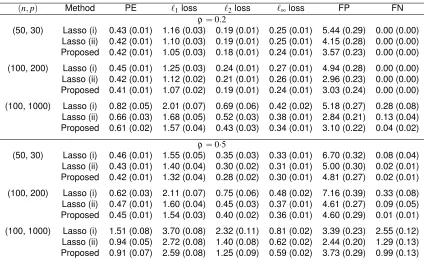
TABLE 2.1 : Means and standard errors (in parentheses) of various performance mea-sures for three methods based on 100 simulations . . . 16 TABLE 2.2 : Selection probabilities and refitted coefficients of four selected genera in the
gut microbiome data . . . 19
TABLE 3.1 : True/False positive rates of the significant variables selected based on95% confidence intervals constructed using multiple, one and no linear constraints, labeled by ‘Multi’, ‘One’ and ‘No’ respectively. Variable correlationsζ, num-bers of variablespand sample sizes (n) are considered. . . 39 TABLE 3.2 : Testing set prediction error of the LASSO estimator, refitted estimator with
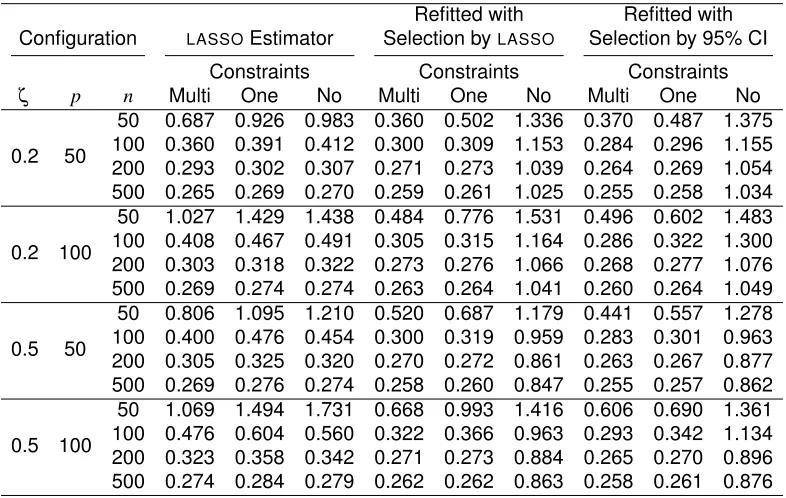
variables selected by byLASSO, and refitted estimator with variables select-ed basselect-ed on95% confidence intervals. For each estimator, model was fit using multiple, one and no linear constraints. Variable correlationsζ, num-bers of variablespand sample sizes (n) are considered. . . 40
TABLE 4.1 : p−values of different comparisons between two body sites and between
LIST OF ILLUSTRATIONS
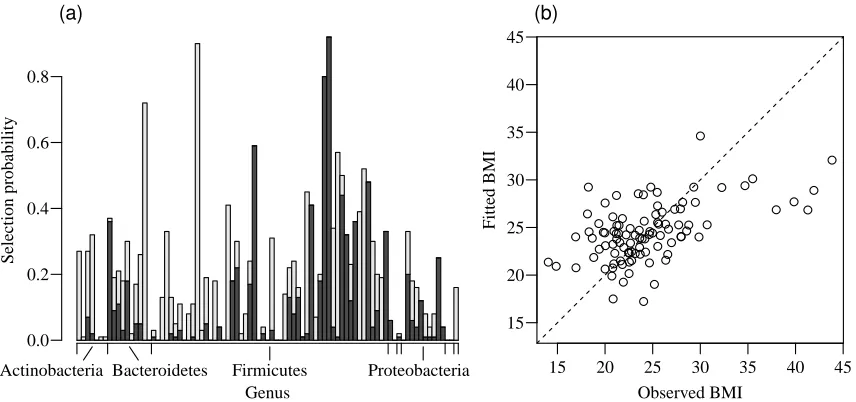
FIGURE 2.1 : Analysis of gut microbiome data. (a) Selection probabilities with boot-strapped crossvalidation for 87 genera that belong to eight phyla. Selec-tions with a positive sign and a negative sign are shown by dark grey blocks and light grey blocks, respectively; only four major phyla are indicated. (b) Fitted versus observed values ofBMI. . . 18
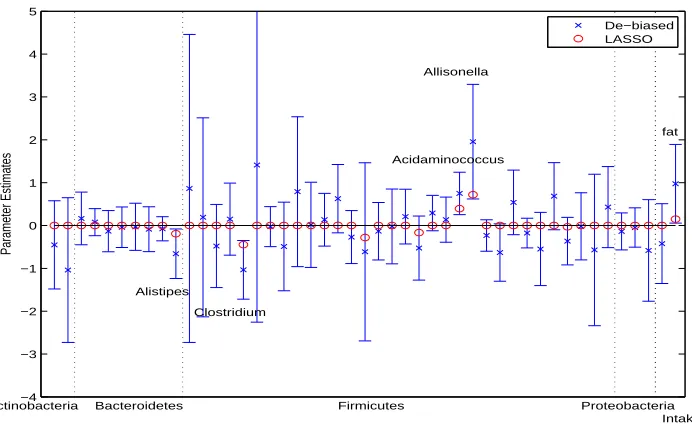
FIGURE 3.1 : Analysis of gut microbiome data. Lasso estimates, de-biased estimates and 95% confidence intervals of the regression coefficients in the model treating the composition of 45 genera as covariates together with total fat and caloric intakes. Dashed vertical lines separate bacterial genus into different phyla. . . 34 FIGURE 3.2 : Analysis of gut microbiome data. Lasso estimates, de-biased estimates
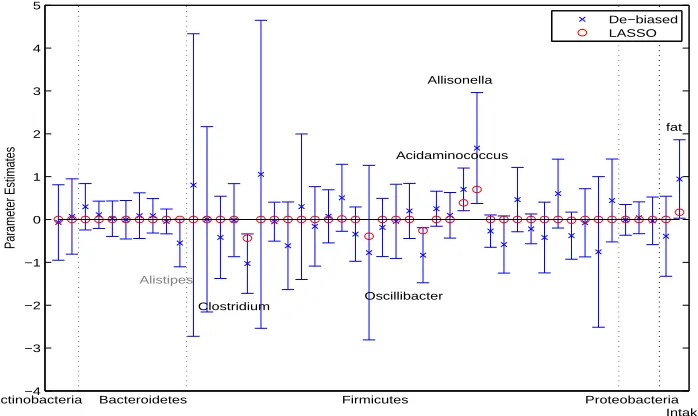
and 95% confidence intervals of the regression coefficients in the model treating the subcompositions of the genera in each phylum as covariates together with total fat and caloric intakes. Dashed vertical lines separate bacterial genus into different phyla. . . 35 FIGURE 3.3 : Analysis of gut microbiome data. Observed and predictedBMIusing LOOCV
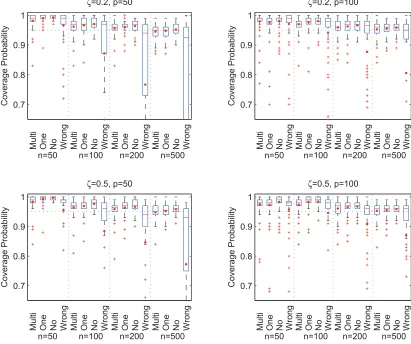
and variables selected based on 95% confidence intervals, together with total fat and caloric intakes. . . 36 FIGURE 3.4 : Coverage probabilities of confidence intervals based on 100 replications.
For each model, minimum, median (in red line), mean (in red dot) and maximum of the coverage probabilities over compositional covariates are shown. The confidence intervals are constructed using multiple, one, no and wrong linear constraints, labeled by ‘Multi’, ‘One’, ‘No’ and ‘Wrong’ respectively. . . 37 FIGURE 3.5 : Average lengths of confidence intervals based on 100 replications. For
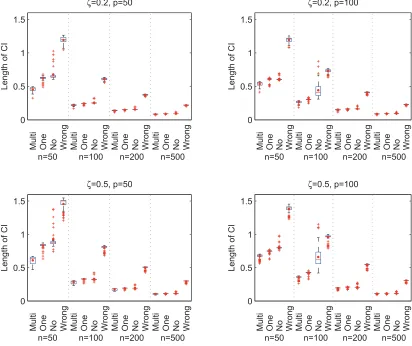
each model, minimum, median (in red line), mean (in red dot) and maxi-mum of the lengths of the intervals overall all compositional covariates are shown. The confidence intervals are constructed using multiple, one, no and wrong linear constraints, labeled by ‘Multi’, ‘One’, ‘No’ and ‘Wrong’ respectively. . . 38 FIGURE 3.6 : Coverage probabilities and length of confidence intervals based on 500
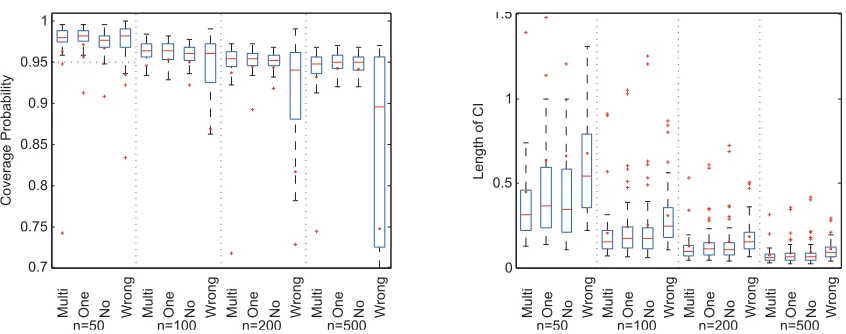
replications. Data are simulated by resampling the gut microbiome compo-sition data in Section 3.5. . . 41
FIGURE 4.1 : Simulation results: size and power of the paired and unpaired tests for data simulated under the PairMN model (a) and the correlated log-normal model (b) for sample sizen=20,50and 100. x-axis is the correlation parameterρ. 58 FIGURE 4.2 : Taxonomic tree of the gut microbiome samples from which the simulated
data are generated. In our simulations, the count of genus Streptococcus is perturbed to generate samples from the alternative distribution. . . 59 FIGURE 4.3 : Comparison of rejection rate of the proposed method with PERMANOVA
with the level of test atα=0.05. X-axis is the perturbation percentage pε,
FIGURE 4.4 : Identification of subtrees with differential subcompositions with FDR set to 0.05. Y-axis shows the percent of discovery of the corresponding subtree in 100 simulations with FDR controlled at 0.05. The empirical FDR is close to 0.05. . . 60 FIGURE 4.5 : Parental nodes and the child nodes that showed differential
subcomposi-tion between nasopharynx and oropharynx. . . 61 FIGURE 4.6 : Parental nodes and the child nodes that showed differential
CHAPTER 1
I
NTRODUCTION1.1. Human microbiome and human health
A typical human body is inhabited by at least 10-100 trillion microbes, outnumbering the human
cells by an estimated 10-fold (Turnbaugh et al., 2007). The community formed by microbes,
mi-crobiota, includes bacteria, fungi, archaea and viruses, and can be found at various human body
sites such as gut, skin, oral cavity, vagina, respiratory tract,etc.. The collective genome of human
microbiota, also known as thehuman microbiome, is estimated to contain∼150 times more genes
than the human genome (Qin et al., 2010). Compared with the human genome, the human
micro-biome has much more diversity. The microbiota found at different body sites of the same individual
can differ remarkably, and even at the same body site, human microbiome can display substantial
inter-individual variation (Consortium et al., 2012) and temporal variation within the same individual
(Flores et al., 2014; Grice et al., 2009).
Many recenyt studies have been investigating the role of microbiome in human health. For
exam-ple, the gut microbiome has been shown to be associated with many human diseases such as
obesity, diabetes and inflammatory bowel disease (Ley et al., 2005, 2006; Manichanh et al., 2012;
Qin et al., 2012; Turnbaugh et al., 2006); the skin microbiome has been postulated to have
contri-bution to several skin disorders (Grice et al., 2009; Kong et al., 2012). The health and lifestyles of
host have also been shown to affect the composition of microbiome. Studies have found that
long-term dietary habits affect the composition of gut microbiota (Wu et al., 2011, 2014). The microbial
communities in the upper respiratory tract of cigarette smokers differ between smokers and
non-smokers (Charlson et al., 2010; Morris et al., 2013). The host genotypes also have influence on the
microbiota compositions (Spor, Koren, and Ley, 2011; Turnbaugh et al., 2006). These links between
human microbiome and human health indicate the possibility of designing therapeutic strategies for
treatment of complex diseases and conditions by modulating the microbial composition (Cani and
Delzenne, 2011; Hsiao et al., 2013; Smits et al., 2013; Virgin and Todd, 2011), and the potential of
using microbiome as biomarkers for disease prevention and early diagnostics (Gevers et al., 2014;
the Human Microbiome Project (HMP) (Peterson et al., 2009) and The European Union Project
on metagenomics of the human intestinal tract (MetaHIT) (Ehrlich, Consortium, et al., 2011) have
provided important data on human microbiome.
1.2. Investigating human microbiome through sequencing
To understand the impact of the human microbiome on human health, it is necessary to
character-ize and decipher the content of human microbiome. Prior to the invention of Sanger sequencing
technology in 1977 (Sanger, Nicklen, and Coulson, 1977), microbiota characterization largely relied
on culture-based methods, which are highly biased and time-consuming. The advent of Sanger
se-quencing allowed for some more thorough view of microbial communities, but is still limited in use
by its high cost and low throughput. With the development of next-generation sequencing
tech-nology such as Roche (454) pyrosequencing, Illumina Solexa sequencing and Applied Biosystems
SOLiD sequencing, researchers are now able to study the human microbiome with much lower cost
compared to older Sanger method, yet still achieve a coverage of microbial genes thorough enough
to characterize the true microbial population.
Two high-throughput sequencing based approaches have been used for interrogating complex
mi-crobial communities. The first approach is based on sequencing the 16S ribosomal RNA (rRNA)
amplicons. The 16S rRNA is a structural component of the prokaryotic ribosomes, and thus is
p-resented in all bacteria and archaea cells. The 16S rRNA gene contains highly conserved regions
that can be used as primer binding sites in PCR amplification, while its hypervariable regions can
be used to identify different bacterial lineages. After sequencing, the 16S sequences are clustered
into sequence clusters calledOperational Taxonomic Units (OTUs) using software pipelines such
as Qiime (Caporaso et al., 2010). The representative sequences of each OTU are then compared
to the existing 16S databases such as Greengenes (DeSantis et al., 2006), RDP (Cole et al., 2007)
and EzTaxon-e (Kim et al., 2012) to obtain taxonomic assignments. The ubiquitous presence of
16S rRNA enables lineage assignments at the levels of kingdom, phylum, class, order, family and
genus simultaneously.
Another approach is based on shotgun metagenomic sequencing, which sequences all the
micro-bial genomes presented in the sample, rather than just one marker gene. This approach enables
microorganisms such as viruses. The accuracy of this approach in quantifying gene/microbe
abun-dance is highly dependent on the DNA preparation protocols, which demands special cautions for
comparative metagenomic studies (Morgan, Darling, and Eisen, 2010). The massive amount of
short reads produced also requires efficient computational tools to perform read mapping and
as-sembly, which imposes more challenges in the applications of this approach. Several databases
and software tools have been developed to analyze the shotgun metagenomic data (Huson et al.,
2007; Meyer et al., 2008; Segata et al., 2012; Seshadri et al., 2007).
1.3. Data structure
1.3.1. Tree-structured count data on taxonomic tree
The taxonomic tree is a tree-structured diagram that illustrates the taxonomic classifications of
bi-ological organisms, with each tree node representing a taxon from the taxonomic rank of kingdom
to species. For 16S rRNA sequencing, since the same marker gene is used in taxonomic
assign-ments at all ranks, each read compared to the reference database can be subsequently aligned to
a node of the taxonomic tree depending on its taxonomic assignment. The resulting data is a set
oftree-structured count datawith each count number representing the number of reads aligned to
the corresponding node on the taxonomic tree.
This data format has several features: (1). The total number of reads varies greatly from sample to
sample. This can be attributed to the difference in sequencing depth and the amount of DNA
yield-ing materials. (2). The number of reads at each internal node is larger or equal to the sum of read
numbers at all its child nodes. This comes from the fact that if a read is assigned a certain taxon,
then all the higher ranked taxa along this lineage can also be assigned to this read. (3). There may
be a lot of zero counts, which can be caused by the rarity or absence of the corresponding bacteria.
The analysis of tree-structured count data is difficult due to high dimensionality, non-normality and
the tree structure underlying the data. Many of the current methods applied to this type of data have
been distance-based (Turnbaugh et al., 2006; Wu et al., 2011; Yatsunenko et al., 2012), where a
distance measure is defined and computed between each pair of the microbiome samples. One
commonly used distance measure is the UniFrac distance (Lozupone and Knight, 2005), upon
et al., 2012) and the phylogenetic Kantorovich–Rubinstein metric (Evans and Matsen, 2012). The
statistical methods based on these distance measures, such as Permutational multivariate analysis
of variance (PERMANOVA) (Anderson, 2001) and Principal Coordinate Anlaysis (PCoA) (Gower,
1966; Torgerson, 1958) are widely applied, their results are very dependent on the specific choice
of distance measure (Chen et al., 2012).
1.3.2. High-dimensional compositional data
Due to the varying number of reads across samples, the read counts from 16S rRNA sequencing
and shotgun metagenomic sequencing are often normalized into vectors of proportions at a given
taxonomic level. The resulting data are also referred to ascompositional data (Aitchison, 1982).
The unique feature that the components of a composition must sum to one renders many
stan-dard multivariate statistical methods inappropriate or inapplicable. Methodological developments
for compositional data analysis have resulted in a fruitful line of research, as thoroughly surveyed
by Aitchison (2003). While the dimensionality of compositional data from culture based microbial
analysis is often very small due to the limited number of cultivable bacteria, high-throughput
se-quencing technologies make it possible to identify hundreds of genera and species of bacteria
within one microbiome sample set. These large compositional data sets, whose dimensionality is
comparable to or much larger than the sample size, pose new challenges to existing
methodol-ogy. However, little formal attempt has been made to develop principled analysis tools for such
high-dimensional compositional data.
1.4. Organization of this thesis
My thesis focuses on the analysis of both high-dimensional compositional data and tree-structured
count data on taxonomic tree. In Chapter 21, we aim to address the variable selection problem in
regression analysis with high-dimensional compositional covariates. We propose an`1
regulariza-tion method for the estimaregulariza-tion and variable selecregulariza-tion in high-dimensional linear log-contrast model
that considers the unique features of the compositional data. We formulate the proposed
proce-dure as a constrained convex optimization problem and introduce a coordinate descent method
of multipliers for efficient computation. In the high-dimensional setting where the dimensionality
grows at most exponentially with the sample size, model selection consistency and`∞bounds for
the resulting estimator are established under conditions that are mild and interpretable for
compo-sitional data. The numerical performance of our method is then evaluated by simulation studies
and its usefulness is illustrated by an application to a microbiome study relating body mass index
to human gut microbiome composition.
In Chapter 32, we consider the inference problem of high-dimensional regression analysis with
compositional data, where the goal is to identify the bacterial taxa that are associated with a
con-tinuous response such as the body mass index (BMI). In order to satisfy the subcompositional
coherence of the results, we propose to use linear models with a set of linear constraints on the
regression coefficients. Such models allow regression analysis for subcompositions and include
the log-contrast model for compositional covariates as a special case. An`1penalized estimation
procedure for estimating the regression coefficients and for selecting variables under the linear
con-straints is developed. To provide valid confidence intervals of the regression coefficients and obtain
the correspondingp-values, a method is proposed to obtain de-biased estimates of the regression
coefficients that are asymptotically unbiased and have a joint asymptotic multivariate normal
distri-bution. Simulation results show the validity of the confidence intervals and smaller variances of the
de-biased estimates when the linear constraints are imposed. The proposed methods are applied
to the same gut microbiome dataset as Chapter 2 and results are compared.
In Chapter 43, we consider the problem of testing difference between repeatedly measured
micro-biome data quantified as counts on taxonomic tree. Such repeated data often occur when multiple
samples are taken from the same subject to assess the difference in microbial composition across
body sites or time points. To model the covariance structure of the count data with flexibility, we
propose a general class of probability distributions for paired multinomial count data, which allows
us to model repeatedly measured multivariate counts. Based on this new distribution, we develop a
test statistic to evaluate the difference in the mean parameters of paired multivariate count data. We
then provide a procedure that applies the proposed test to count data observed on an taxonomic
tree in order to assess difference in microbiome compositions and to identify subtrees with different
sub-compositions. Our simulation results indicate that proposed test has correct type 1 errors and
increased power compared to some commonly used methods. The proposed methods are
illus-trated by an analysis of the human pharynx microbiome data, where nasopharynx microbiome is
compared with oropharynx microbiome, and smokers microbiome is compared with non-smokers.
CHAPTER 2
V
ARIABLE SELECTION IN REGRESSION WITH COMPOSITIONAL COVARIATES2.1. Introduction
Compositional data, which consist of the proportions or percentages of a composition, appear
frequently in a wide range of applications; examples include geochemical compositions of rocks
in geology, household patterns of expenditures in economics, species compositions of biological
communities in ecology, and topic compositions of documents in machine learning. The unique
feature that the components of a composition must sum to one renders many standard
multivari-ate statistical methods inapproprimultivari-ate or inapplicable. Since the seminal work of Aitchison (1982),
methodological developments for compositional data analysis have resulted in a fruitful line of
re-search, as thoroughly surveyed by Aitchison (2003). The recently increasing availability of large
compositional data sets, whose dimensionality is comparable to or much larger than the sample
size, poses new challenges to existing methodology. However, little formal attempt has been made
to develop principled analysis tools for such data. A typical example arises in metagenomic studies
of microbial communities based on 16S rRNA gene sequencing, where the relative abundances of
hundreds to thousands of bacterial taxa on a few tens to hundreds of individuals are available for
analysis; see, for example, Chen and Li (2013).
The aim of this chapter is to address the variable selection problem in high-dimensional
regres-sion with compositional covariates. To mitigate the difficulty with high dimenregres-sionality, it is crucial to
select parsimonious models that tend to improve the performance of statistical procedures and
in-terpretability of the resulting inferences. Regularization methods for simultaneous variable selection
and estimation in linear regression and more general contexts have received intense recent
inter-est. In particular, the`1regularization or lasso approach (Tibshirani, 1996) has enjoyed widespread
popularity, and its theoretical properties in high-dimensional regression are now well understood;
see, for example, B ¨uhlmann and Van De Geer (2011) for an overview. Owing to the special nature
of compositional data, however, the usual linear regression model is inappropriate for our
purpos-es. In this chapter we consider the linear log-contrast model of Aitchison and Bacon-shone (1984),
the expected response does not depend on the basis counts from which a composition is obtained.
This is the case in our microbiome data example, where the number of sequencing reads varies
drastically across samples and should not play a role in predicting the response of interest.
We propose an`1regularization methodology for variable selection and estimation in high-dimensional
linear log-contrast models. We formulate the proposed procedure as a constrained convex
opti-mization problem, develop efficient algorithms for computation, and provide strong theoretical
guar-antees. Since the constraint in the problem couples the parameters, coordinate descent methods
for solving`1-regularized least squares problems (Friedman et al., 2007) are not directly applicable.
We therefore combine coordinate descent with the method of multipliers to introduce an efficient
algorithm for solving the optimization problem. To establish model selection consistency and `∞
bounds for the resulting estimator, we impose conditions analogous to the irrepresentability
condi-tion for linear regression in Zhao and Yu (2006). Our condicondi-tions, however, differ from those for linear
regression models in important ways, which account for the compositional effect and adapt well to
the dependence structure of compositional data.
2.2. Variable selection in the linear log-contrast model
Log-contrast models were originally introduced by Aitchison and Bacon-shone (1984) for modeling
experiments with mixtures, and have proved to be useful for a wide variety of regression problems
with a composition playing the role of covariate. Suppose that we observe ann-vectoryof
respons-es and ann×pmatrixX= (xi j)of covariates, with each row ofX lying in the(p−1)-dimensional
positive simplexSp−1={(x1, . . . ,xp): xj>0,j=1, . . . ,p,∑pj=1xj=1}. Because of the unit-sum
con-straint, thepcomponents of a composition cannot vary freely, traditional methodology often requires
the omission of certain components to ensure identifiability and encounters intrinsic difficulties in
providing sensible interpretations for the regression parameters. To resolve the difficulties with the
compositional constraint, Aitchison and Bacon-shone (1984) proposed to apply the log-ratio
trans-formation (Aitchison, 1982) to compositional covariates, resulting in the linear log-contrast model
y=Zpβ\∗p+ε, (2.1)
whereZp={log(xi j/xip)}is then×(p−1)log-ratio matrix, whosepth component is the reference
ε is an n-vector of independent noise distributed as N(0,σ2). By introducing a new coefficient
βp∗=−∑pj=−11β∗j, model (2.1) can be more conveniently expressed in the symmetric form
y=Zβ∗+ε,
p
∑
j=1
βj∗=0, (2.2)
whereZ= (z1, . . . ,zp) = (logxi j)is then×pdesign matrix andβ∗= (β1∗, . . . ,βp∗)>is the p-vector of
regression coefficients. We do not include an intercept in the model, since it can be eliminated
by centering the response and predictor variables. We are concerned with the high-dimensional
sparse setting, where the dimensionalitypis comparable to or much larger than the sample sizen,
while only a small portion of the regression coefficients are nonzero.
Applying the `1regularization approach to model (2.2), we consider the constrained convex
opti-mization problem
ˆ
β=argmin
β
1
2nky−Zβk
2
2+λkβk1
subject to
p
∑
j=1
βj=0, (2.3)
whereβ= (β1, . . . ,βp)>,λ>0is a regularization parameter, andk · k2andk · k1denote the`2and`1
norms, respectively. The zero-sum constraint in problem (2.3) is crucial for the resulting estimator to
enjoy interpretive advantages over a standard lasso estimator. Specifically, the proposed estimator
possesses the following desirable properties:
(i) Scale invariance: the estimator is unchanged under the transformationX7→T Xfor an arbitrary
diagonal matrixT =diag(t1, . . . ,tn)with allti>0;
(ii) Permutation invariance: the estimator is invariant under any permutation π of the p
compo-nents, meaning that it is unchanged ifπ is applied to both the columns ofX and the
compo-nents ofβˆ;
(iii) Selection invariance: the estimator is unchanged if one knew in advance which components
would be estimated as zero and applied the procedure to the subcomposition formed by the
remaining components.
Properties (i) and (iii) are due to the zero-sum constraint; they ensure that the inferences are
unaffected by correctly excluding some or all of the zero components. Property (ii) is immediately
seen from the symmetric formulation of problem (2.3), but would not be guaranteed by first
trans-forming the pcomponents into a(p−1)-dimensional feature space and then applying a standard
variable selection procedure.
By eliminating the constraint withβp=−∑pj=−11βj, we can rewrite problem (2.3) as the unconstrained
problem
ˆ
β\p=argmin
β\p
1
2nky−Z
p
β\pk22+λkDβ\pk1
,
where β\p= (β1, . . . ,βp−1)>, D= (Ip−1,−1p)>∈Rp×(p−1), and Ir and 1r denote the r×r identity
matrix and ther-vector of 1s, respectively. This asymmetric form can be recognized as an instance
of the generalized lasso problem considered by Tibshirani et al. (2011), but existing developments
do not specialize in our case to give an appropriate algorithm or theory for several reasons. First,
eliminating one arbitrary component and applying a generic algorithm to the (p−1)-dimensional
problem generally does not yield numerical solutions that are permutation invariant. Second, a
coordinate descent algorithm that is fast and applicable to a prespecified set of λ values is not
yet available. Third, theory for the generalized lasso problem does not provide useful insights into
the compositional constraint and its effect on variable selection. All these limitations call for the
development of computational methods and theoretical results that are relevant to the analysis of
compositional data.
2.3. Computation
2.3.1. Optimization algorithm
Coordinate descent algorithms have been shown to be very efficient for solving large-scale`1
reg-ularization problems (Friedman et al., 2007). They are not directly applicable to problem (2.3),
however, because the nondifferentiable `1 terms are inseparable under the zero-sum constraint.
Here we propose an efficient, easily implemented algorithm based on an iterative modification of
coordinate descent by combining it with the method of multipliers or the augmented Lagrangian
To derive the algorithm, we first form the augmented Lagrangian for problem (2.3) as
Lµ(β,γ) =
1
2nky−Zβk
2
2+λkβk1+γ
p
∑
j=1
βj+
µ 2
p
∑
j=1
βj
2 ,
whereγ is the Lagrange multiplier andµ>0is a penalty parameter. The method of multipliers for
problem (2.3) consists of the iterations
βk+1←argmin
β
Lµ(β,γ k),
γk+1←γk+µ
p
∑
j=1
βkj+1.
Define byα=γ/µ the scaled Lagrange multiplier. The above iterations can be more conveniently
expressed as
βk+1←argmin
β
1
2nky−Zβk
2
2+λkβk1+ µ 2
p
∑
j=1
βj+αk
2
, (2.4)
αk+1←αk+
p
∑
j=1
βkj+1. (2.5)
Now the`1terms in (2.4) are separable and the subproblem can be solved by coordinate descent.
With the other components held fixed, the jth component ofβ is updated by
βjk+1← 1
vj+µSλ 1 nz > j
y−
∑
i6=j
βik+1zi
−µ
∑
i6=j
βik+1+αk
, (2.6)
wherevj=kzjk22/nandSλ(t) =sgn(t)(|t| −λ)+is the soft thresholding operator. Combining (2.4)–
(2.6) yields the following coordinate descent method of multipliers for solving problem (2.3).
Input: y,Z, andλ.
Output:βˆ
1: Initializeβ0with 0 or a warm start,α0=0,µ>0, andk=0.
2: For j=1, . . . ,p,1, . . . ,p, . . ., updateβkj+1by (2.6) until convergence. 3: Updateαk+1by (2.5).
4: k←k+1and repeat Steps 2 and 3 until convergence. Outputβˆ=βk+1.
Algorithm 1:Coordinate descent method of multipliers.
Minimization of subproblem (2.4), which is carried out in Step 2 of Algorithm 1, need not be exact; it
suffices to adopt a stopping criterion such that the minimization is asymptotically exact. This results
regarding the convergence of Algorithm 1 with inexact minimization.
Proposition 1. Assume that Step 2 of Algorithm 1 finds at iteration kan approximate minimizer
βk+1such thatLµ(βk+1,γk)≤minβLµ(β,γk) +δkfor allk, whereδk≥0and∑∞k=0
√
δk<∞. Then the sequence{βk}generated by Algorithm 1 is bounded. Moreover, every cluster point of{βk} is an
optimal solution of problem(2.3).
2.3.2. Tuning parameter selection
The regularization parameterλ can be selected by the generalized information criterion for
high-dimensional penalized likelihood proposed by Fan and Tang (2013). They showed that the criterion
with a uniform choice of the model complexity penalty identifies the true model with probability
tending to 1 when the dimensionality p grows at most exponentially with the sample sizen. For
model (2.2) and our regularization method, we define
GIC(λ) =log ˆσλ2+ (sλ−1)
log logn
n log(p∨n),
whereσˆλ2=ky−Zβˆλk
2
2/n,βˆλ is the regularized estimator,p∨n=max(p,n), andsλ is the number of
nonzero coefficients inβˆλ. Because of the zero-sum constraint, the effective number of free
param-eters issλ−1forsλ≥2. We then select the optimalλ by minimizingGIC(λ). Alternatively, one can
applyK-fold crossvalidation withK=5or 10 to chooseλ, which tends to select a larger model and
trades off between model selection consistency and prediction accuracy. Although crossvalidation
is computationally more expensive, it is less parsimonious and can often yield a more satisfactory
performance in practice.
The penalty parameter µ that is needed to enforce the zero-sum constraint does not affect the
convergence of Algorithm 1 as long asµ>0, and we takeµ=1in all computations.
2.4. Theoretical properties
We establish model selection consistency and`∞ bounds for the proposed estimator under
deter-ministic designs. We first introduce some notation. LetZr denote the log-ratio matrix with therth
component taken as the reference component, andCr=n−1(Zr)>Zrthe corresponding sample
log-ratio covariance matrix. Let S={j:β∗j 6=0}denote the support ofβ∗, ands=|S| the cardinality
We will use subsets to index a vector or matrix; for example,CSrcS
\r is the submatrix formed by the
(i,j)th entries ofCrwithi∈Scand j∈S\r. Define byβmin=minj∈S|β∗j|the minimum signal. Letk · k∞
denote the`∞or matrix∞-norm, i.e.,kAk∞=maxi∑j|ai j|for a matrixA= (ai j).
We assume without loss of generality that p∈S. Central to guaranteed support recovery through
our`1regularization method is the following condition.
Condition 1. There exists someξ∈(0,1]such that
kCSpcS \p(C
p S\pS\p)
−1{sgn(β∗
S\p)−sgn(β ∗
p)1s−1}+sgn(βp∗)1p−sk∞≤1−ξ. (2.7)
Also, our assumption for the minimum signal threshold involves the quantityϕdefined by
ϕ=kDSS\p(C
p S\pS\p)
−1(D
SS\p) >
k∞. (2.8)
Although the definitions ofξ andϕseem to depend on the choice of the reference component, we
show that this is not the case. LetDr denote the matrix formed by interchanging therth and pth
rows ofD. The following proposition states the permutation invariance ofξ andϕ.
Proposition 2. For everyr∈S\p, we have
CrScS \r(C
r S\rS\r)
−1{sgn(β∗
S\r)−sgn(β ∗
r)1s−1}+sgn(βr∗)1p−s
=CSpcS
\p(C p S\pS\p)
−1{sgn(β∗
S\p)−sgn(β ∗
p)1s−1}+sgn(βp∗)1p−s,
(2.9)
and
DrSS\
r(C r S\rS\r)
−1(Dr SS\p)
>=
DSS\p(C p S\pS\p)
−1(D
SS\p) >.
(2.10)
Condition 1 is in the spirit of the irrepresentability condition for linear regression in Zhao and Yu
(2006), though important differences exist. It is worthwhile to compare Condition 1 with its
counter-parts for two usual lasso estimators:
(i) the condition
kCSpcS \p(C
p S\pS\p)
−1sgn(β∗
for the lasso problem
ˆ
β\(ip)=argmin
β\p
1
2nky−Z
p
β\pk22+λkβ\pk1
, (2.12)
which is a direct application of lasso to model (2.1);
(ii) the condition
kCScS(CSS)−1sgn(βS∗)k∞≤1−ξ, (2.13)
whereC=n−1Z>Z, for the lasso problem
ˆ
β(ii)=argmin
β
1
2nky−Zβk
2
2+λkβk1
, (2.14)
which simply ignores the zero-sum constraint in problem (2.3).
Expression (2.11) lacks the permutation invariance of Condition 1, reflecting the fact that the pth
component is not regularized in problem (2.12) and hence no recovery guarantees can be provided.
Condition (2.13) is ideally suited to nearly orthogonal designs, but would be problematic for designs
with generally negative correlations such as those common in compositional data analysis. In
contrast, the extra termsgn(βp∗)1p−sin Condition 1 allows it to adapt well to the negative correlations
resulting from the compositional constraint.
To develop further intuition for Condition 1, we consider the illustrative example where the covariate
matrixX is generated from an orthogonal designW = (wi j)withW>W =nI by the transformation
xi j=ewi j/∑kp=1ewik. This represents an extreme case where the dependence among the
com-ponents is purely due to the unit-sum constraint. In this example, we haveCp=n−1(Zp)>Zp=
n−1D>W>W D=D>D=Ip−1+1p−11>p−1, and then
CSpcS
\p=1p−s1 >
s−1, (C
p S\pS\p)
−1= (I
s−1+1s−11>s−1) −1=I
s−1−s−11s−11>s−1.
Some straightforward calculation yields that the left-hand side of (2.7) equals
s−1|1>s sgn(βS∗)| ≤(s−2)/s<1,
ξ can be taken close to 1 provided that the signals are nearly evenly divided between positive and
negative signs.
We are now ready to state our main result regarding the model selection consistency of the
pro-posed estimator. We assume without loss of generality that the columns ofZ are normalized such
thatmaxjkzjk2≤
√
n.
Theorem 1. Assume that Condition 1 holds, the regularization parameterλsatisfiesλ≥c1σ{(logp)/n}1/2/ξ
for some constantc1>2
√
2, and the minimum signal satisfiesβmin>3ϕ λ/2. Then, with probability
at least1−p−c2 for some constantc
2>0, problem(2.3)has an optimal solutionβˆ that satisfies the
following properties:
(i) sign consistency:sgn(βˆ) =sgn(β∗);
(ii) `∞loss:kβˆS−βS∗k∞≤3ϕ λ/2.
To understand the asymptotic implications of Theorem 1, assume for simplicity that ξ and ϕ are
constants. Then Theorem 1 implies that the proposed estimator is model selection consistent and
uniformly estimation consistent as long aslogp=o(n). Taking the smallest possibleλ, we have
the convergence ratekβˆS−βSk∞=OP[{(logp)/n}1/2]. These rates parallel those for the usual lasso
estimator (Wainwright, 2009), but are established here under a different form of the irrepresentability
condition, which explicitly takes the zero-sum constraint into account.
2.5. Numerical studies
2.5.1. Simulations
We conducted simulation studies to compare the numerical performance of the proposed method
with two usual lasso estimators defined in (2.12) and (2.14), which we refer to as lasso (i) and lasso
(ii), respectively. In lasso (i), the reference component is taken at random from the pcomponents,
and afterβˆ\(ip)is obtained, we letβˆp(i)=−1>βˆ\(ip). Note that both lasso (i) and the proposed estimator
satisfy the zero-sum constraint, whereas lasso (ii) does not.
We generated the covariate data in the following way. We first generated ann×pdata matrixW=
(wi j)from a multivariate normal distributionNp(θ,Σ), and then obtained the covariate matrix X=
Table 2.1: Means and standard errors (in parentheses) of various performance measures for three methods based on 100 simulations
(n,p) Method PE `1loss `2loss `∞loss FP FN
ρ=0.2
(50, 30) Lasso (i) 0.43 (0.01) 1.16 (0.03) 0.19 (0.01) 0.25 (0.01) 5.44 (0.29) 0.00 (0.00) Lasso (ii) 0.42 (0.01) 1.10 (0.03) 0.19 (0.01) 0.25 (0.01) 4.15 (0.28) 0.00 (0.00) Proposed 0.42 (0.01) 1.05 (0.03) 0.18 (0.01) 0.24 (0.01) 3.57 (0.23) 0.00 (0.00)
(100, 200) Lasso (i) 0.45 (0.01) 1.25 (0.03) 0.24 (0.01) 0.27 (0.01) 4.94 (0.28) 0.00 (0.00) Lasso (ii) 0.42 (0.01) 1.12 (0.02) 0.21 (0.01) 0.26 (0.01) 2.96 (0.23) 0.00 (0.00) Proposed 0.41 (0.01) 1.07 (0.02) 0.19 (0.01) 0.24 (0.01) 3.03 (0.24) 0.00 (0.00)
(100, 1000) Lasso (i) 0.82 (0.05) 2.01 (0.07) 0.69 (0.06) 0.42 (0.02) 5.18 (0.27) 0.28 (0.08) Lasso (ii) 0.66 (0.03) 1.68 (0.05) 0.52 (0.03) 0.38 (0.01) 2.84 (0.21) 0.13 (0.04) Proposed 0.61 (0.02) 1.57 (0.04) 0.43 (0.03) 0.34 (0.01) 3.10 (0.22) 0.04 (0.02)
ρ=0·5
(50, 30) Lasso (i) 0.46 (0.01) 1.55 (0.05) 0.35 (0.03) 0.33 (0.01) 6.70 (0.32) 0.08 (0.04) Lasso (ii) 0.43 (0.01) 1.40 (0.04) 0.30 (0.02) 0.31 (0.01) 5.00 (0.30) 0.02 (0.01) Proposed 0.42 (0.01) 1.32 (0.04) 0.28 (0.02) 0.30 (0.01) 4.81 (0.27) 0.02 (0.01)
(100, 200) Lasso (i) 0.62 (0.03) 2.11 (0.07) 0.75 (0.06) 0.48 (0.02) 7.16 (0.39) 0.33 (0.08) Lasso (ii) 0.47 (0.01) 1.60 (0.04) 0.45 (0.03) 0.37 (0.01) 4.61 (0.27) 0.09 (0.05) Proposed 0.45 (0.01) 1.54 (0.03) 0.40 (0.02) 0.36 (0.01) 4.60 (0.29) 0.01 (0.01)
(100, 1000) Lasso (i) 1.51 (0.08) 3.70 (0.08) 2.32 (0.11) 0.81 (0.02) 3.39 (0.23) 2.55 (0.12) Lasso (ii) 0.94 (0.05) 2.72 (0.08) 1.40 (0.08) 0.62 (0.02) 2.44 (0.20) 1.29 (0.13) Proposed 0.91 (0.07) 2.59 (0.08) 1.25 (0.09) 0.59 (0.02) 3.73 (0.29) 0.99 (0.13)
PE, prediction error; FP, number of false positives; FN, number of false negatives.
distribution (Atchison and Shen, 1980). To reflect the fact that the components of a composition in
metagenomic data often differ by orders of magnitude, we letθ= (θj)withθj=log(0·5p)for j=
1, . . . ,5andθj=0otherwise. To describe different levels of correlations among the components, we
letΣ= (ρ|i−j|)withρ=0·2or0·5. We generated the responses according to model (2.2) withβ∗=
(1,−0·8,0·6,0,0,−1·5,−0·5,1·2,0, . . . ,0)>andσ =0·5, so that three of the six nonzero coefficients
were among the five major components and the rest among the minor components.
We set(n,p) = (50,30),(100,200), and(100,1000), and repeated 100 simulations for each setting.
The tuning parameterλ was selected byGIC as described in§2.3.2. We used six performance
measures for comparisons. The prediction errorky−Zβˆk22/nwas computed from an independent
test sample of sizen. The estimation accuracy was assessed by the`qlosseskβˆ−β∗kqwithq=1,2,
and∞. Two variable selection measures were the number of false positives and the number of false
negatives, where positives and negatives refer to nonzero and zero coefficients, respectively. The
means and standard errors of these performance measures for three methods are reported in Table
As seen from Table 2.1, the lasso (i) estimator has inferior performance in almost all settings, since
the reference component is not regularized and is always included in the selected model. The
lasso (ii) estimator performs better than lasso (i), but always violates the zero-sum constraint in
finite samples. The proposed estimator performs slightly better than lasso (ii) in terms of prediction
and estimation. The variable selection performance of the proposed estimator is comparable to
lasso (ii) with low to moderate dimensionality, but it tends to select fewer false negatives at the
cost of slightly increased false positives in high dimensions. This is reasonable because missing
important variables is more influential than including unimportant variables with shrunk coefficients.
A potential remedy for the violation of the zero-sum constraint in the lasso (ii) estimator would be
to refit the unpenalized linear log-contrast model with the constraint using the selected variables,
which is also useful for reducing the bias caused by the`1penalty. In the Supplementary Material,
we compare the performance of the two-step procedures formed by adding a refitting step to lasso
(ii) or the proposed method, confirming the advantages of our method in the more challenging
settings.
2.5.2. Application to gut microbiome data
Gut microbiome composition is considered an important factor that affects energy extraction from
the diet and contributes to human health and diseases such as obesity. We illustrate the proposed
method by an application to the data set reported in Wu et al. (2011), where a cross-sectional study
of 98 healthy volunteers was carried out at the University of Pennsylvania for investigating
long-term dietary effect on gut microbiome composition. Stool samples were collected on these subjects
and DNA samples were analyzed by 454/Roche pyrosequencing of 16S rRNA gene segments of
the V1–V2 region. The pyrosequences were denoised to yield an average of 9265, with standard
deviation 3864, reads per sample. After taxonomic assignment of the denoised sequences, 3068
operational taxonomic units were combined into 87 genera that appeared in at least one sample.
Since the number of sequencing reads varies greatly across samples, these count data should not
be used directly in a standard regression analysis, and we transformed them into compositional
data after replacing zero counts by the maximum rounding error 0·5 (Aitchison, 2003 §11·5).
De-mographic information including body mass index (BMI) was also collected on these subjects. We
are interested in identifying a subset of important genera whose subcomposition is associated with
We applied the proposed method to this data set with BMIas the response, and used a refitted
version of tenfold crossvailidation to choose the tuning parameter, where the prediction error for
each sample split was computed with the refitted coefficients obtained after model selection and
without penalization. To obtain stable selection results, we generated 100 bootstrap samples and
applied the same crossvalidation procedure to select the genera. The selection probabilities of
87 genera with bootstrapped crossvalidation are shown in Fig. 2.1(a). Four genera were selected
over 70 times out of the 100 bootstrap replicates. We also followed the approach of stability
se-lection (Meinshausen and B ¨uhlmann, 2010) to assess the stability of the selected genera, where
100 subsamples of size n/2 were taken to compute the selection probabilities. All four genera
had a selection probability greater than 0·85, indicating that the selection results are quite stable.
These four genera along with their selection probabilities and refitted coefficients are presented in
Table 2.2. A plot of the fitted versus observed values ofBMIin Fig. 2.1(b) shows that the model with
four selected genera fits the data reasonably well except for five obese subjects.
(a) (b) Genus 0.0 0.2 0.4 0.6 0.8 Selection probability
Actinobacteria Bacteroidetes Firmicutes Proteobacteria
● ● ●● ● ● ● ● ● ●● ● ● ● ● ● ● ● ● ●● ● ● ● ● ● ● ●● ● ●● ● ● ● ● ● ● ● ● ● ● ● ● ● ● ● ● ● ● ● ● ● ● ● ● ● ● ● ● ● ● ● ● ● ● ● ● ● ● ● ● ● ● ● ● ● ● ● ● ● ● ● ● ● ● ● ● ● ● ● ● ● ● ●● ● ●
15 20 25 30 35 40 45
15 20 25 30 35 40 45 Observed BMI Fitted BMI
Figure 2.1: Analysis of gut microbiome data. (a) Selection probabilities with bootstrapped cross-validation for 87 genera that belong to eight phyla. Selections with a positive sign and a negative sign are shown by dark grey blocks and light grey blocks, respectively; only four major phyla are indicated. (b) Fitted versus observed values ofBMI.
Since our simulations have demonstrated that the lasso (i) estimator is inferior in all respects, we
compare our method only with the lasso (ii) estimator. With selection probabilities above the cutoff
value of 0·7, three genera were selected by lasso (ii) with bootstrapped crossvalidation, which
Table 2.2: Selection probabilities and refitted coefficients of four selected genera in the gut micro-biome data
Selection probability Refitted
Phylum Genus Boot. CV Stab. Sel. coefficient
Bacteroidetes Alistipes 0.72 0.89 -0.76
Firmicutes Clostridium 0.90 0.96 -1.35
Firmicutes Acidaminococcus 0.80 0.92 -0.61
Firmicutes Allisonella 0.92 0.87 -1.50
Boot. CV, bootstrapped crossvalidation; Stab. Sel., stability selection.
performance of the two methods, we randomly divided the data into a training set of 70 subjects
and a test set of 28 subjects, and used the fitted model chosen by crossvalidation based on the
training set to evaluate the prediction error on the test set. The prediction error averaged over 100
replicates was 30·30 for the proposed method and 30·55 for lasso (ii), with standard errors 0·97 and
1·04, respectively, suggesting that the prediction performance of the proposed method is slightly
better than or similar to that of lasso (ii).
It is interesting to contrast the variable selection results at the phylum level: the proposed method
selected both bacteroidetes and firmicutes as associated withBMI, whereas lasso (ii) selected only
the firmicutes. Thus, our method seems more consistent with the previous finding that the relative
proportion of bacteroidetes to firmicutes is decreased in obese mice and humans by comparison
with lean subjects (Ley et al., 2005, 2006). One biological explanation for the finding as
suggest-ed by metagenomic and biochemical analyses is that the firmicutes-enrichsuggest-ed microbiome holds
a greater metabolic potential than the bacteroidetes-enriched microbiome for more efficient
ener-gy harvest from the diet, which in turn contributes to changes in enerener-gy balance and subsequent
weight gain (Turnbaugh et al., 2006). Furthermore, our selection results at the genus level indicate
that obesity may be associated with changes in gut microbiome composition at a finer taxonomic
level than previously thought.
2.6. Discussion
The linear log-contrast model assumes that the absolute amounts of the covariate components
have no effect on the response. We have adopted this modeling approach in the microbiome data
analysis because the total amount of the microbiome cannot be reliably measured in experiments.
model in which the total amount also plays a role in affecting the response. To this end, one may
consider the semiparametric varying-coefficient log-contrast model
yi=β0(ai) + p
∑
j=1
βj(ai)logxi j+εi,
p
∑
j=1
βj(ai) =0,
withai being the total amounts. This reduces to model (2.2) when all the coefficientsβ0, . . . ,βpare
constants. A regularized estimation procedure for this model could be developed by combining the
ideas of our approach and the kernel lasso method in Wang and Xia (2012).
Another possible extension of our method for microbiome data analysis would be to take into
ac-count the phylogenetic relationships among the bacterial taxa. Under the biologically plausible
assumption that phylogenetically close taxa tend to have similar effects on the clinical trait, one can
combine the`1penalty in our regularization problem with a Laplacian penalty that encourages
s-moothness among the regression coefficients of closely related taxa on the phylogenetic tree (Chen
et al., 2013). Such an extension is likely to increase the power of identifying important taxa that are
CHAPTER 3
R
EGRESSION ANALYSIS FOR MICROBIOME COMPOSITIONAL DATA3.1. Introduction
The human microbiome includes all microorganisms in and on the human body. These microbes
play important roles in human metabolism, nutrient intake and energy generation and thus are
es-sential in human health. The gut microbiome has been shown to be associated with many human
diseases such as obesity, diabetes and inflammatory bowel disease (Manichanh et al., 2012; Qin
et al., 2012; Turnbaugh et al., 2006). Next generation sequencing technologies make it possible
to study the microbial compositions without the need for culturing the bacterial species. There
are, in general, two approaches to quantify the relative abundances of bacteria in a community.
One approach is based on sequencing the 16S ribosomal RNA (rRNA) gene, which is ubiquitous
in all bacterial genomes. The resulting sequencing reads provide information about the bacterial
taxonomic composition. Another approach is based on shotgun metagenomic sequencing, which
sequences all the microbial genomes presented in the sample, rather than just one marker gene.
Both 16S rRNA and shotgun sequencing approaches provide bacterial taxonomic composition
in-formation and have been widely applied to human microbiome studies, including the Human
Micro-biome Project (HMP) (Turnbaugh et al., 2007) and the Metagenomics of the Human Intestinal Tract
(MetaHIT) project (Qin et al., 2010).
Several methods are available for quantifying the microbial relative abundances based on the
se-quencing data, which typically involve aligning the reads to some known database (Segata et al.,
2012). Since the DNA yielding materials are different across different samples, the resulting
num-bers of sequencing reads vary greatly from sample to sample. In order to make the microbial
abundance comparable across samples, the abundances in read counts are usually normalized to
the relative abundances of all bacteria observed. This results in high-dimensional compositional
data with a unit sum. Some of the most widely used metagenomic processing softwares such as
MEGAN (Huson et al., 2007) and MetaPhlAn (Segata et al., 2012) only output the relative
abun-dances of the bacterial taxa at different taxonomic levels.
identify the bacterial taxa that are associated with a continuous response such as the body mass
index (BMI). Compositional data are strictly positive and multivariate that are constrained to have a
unit sum. Such data are also referred to as mixture data (Aitchison and Bacon-shone, 1984; Cornell,
2011; Snee, 1973). Regression analysis with compositional covariates needs to account for the
intrinsic multivariate nature and the inherent interrelated structure of such data. For compositional
data, it is impossible to alter one proportion without altering at least one of the other proportions.
Linear log-contrast model (Aitchison and Bacon-shone, 1984) has been proposed for compositional
data regression where logarithmic-transformed proportions are treated as covariates in a linear
regression model with the constraint of the sum of the regression coefficients being zero. Lin et al.
(2014) proposed a variable selection procedure for such models in high-dimensional settings and
derived the weak oracle property of the resulting estimates. In analysis of microbiome data, it is also
of biological interest to study the subcompositions of bacteria taxa within higher taxonomic levels,
such as subcompositions of species under a given genus or phylum, or subcompositions of genera
within a phylum. In subcompositional data, the proportions of species have been calculated relative
to total proportions of the species under a given genus; that is, the values in the subcomposition
have been re-closed to add up to 1. Regression analysis of such subcompositional data is also
considered in this chapter.
One of the founding principles of compositional data analysis is that of subcompositional coherence
(Aitchison, 1982): any compositional data analysis should be done in a way that we obtain the same
results in a subcomposition, regardless of whether we analyze only that subcomposition or a larger
composition containing other parts. This is especially relevant in high-dimensional regression
anal-ysis with compositional covariates, where the goal is to select the bacteria whose compositions are
associated with the response. Once such bacteria are identified, it is desirable to recalculate the
subcomposition only within those identified. However, these subcompositions have different values
from those calculated based on a larger set of bacterial taxa. The log-contrast model of Aitchison
and Bacon-shone (1984) and Lin et al. (2014) satisfies this principal by imposing a linear constraint
on the regression coefficients. This chapter extends this model for analysis of microbiome
subcom-positions, where multiple linear constraints are imposed in order to achieve the subcompositional
coherence.
by James, Paulson, and Rusmevichientong (2015), where the regression coefficients are subject
to a set of linear constraints. A computational algorithm through reformulating the problem as an
unconstrained optimization problem was proposed and non-asymptotic error bounds of the
esti-mates were derived. Different from James, Paulson, and Rusmevichientong (2015), this chapter
presents an efficient computational algorithm based on the coordinate descent method of
multi-pliers and augmented Lagrange of optimization problem. Since the resulting estimates are often
biased due to`1penalty imposed on the coefficients, variance estimation and statistical inference
of the resulting estimates are difficult to derive. In order to make the statistical inference on the
re-gression coefficients and to obtain the confidence intervals, asymptoticly unbiased estimates of the
regression coefficients are first obtained through a de-biased procedure and their joint asymptotic
distribution is derived. The proposed de-biased procedure extends that of Javanmard and
Monta-nari (2014) to take into account the linear constraints on regression coefficients. However, due to
the linear constraints on the regression coefficients, the theoretical developments are different from
Javanmard and Montanari (2014).
Section 3.2 presents linear regression models with linear constraints for compositional covariates.
Section 3.3 presents an efficient coordinate descent method of multipliers to implement the
pe-nalized estimation of the regression coefficients under linear constraints. Section 3.4 provides an
algorithm to obtain de-biased estimates of the coefficients and derives their joint asymptotic
distri-bution. Section 3.5 presents results from an analysis of gut microbiome data set in order to identify
the bacterial genera that are associated withBMI. Methods are evaluated in Section 3.6 through
simulations.
3.2. Regression Models for Compositional Data
3.2.1. Linear log-contrast model
Linear log-contrast model (Aitchison and Bacon-shone, 1984) has been proposed for
composi-tional data regression. Specifically, suppose ann×p matrixXconsists ofn samples of the
com-position of mixture with p components, and supposeY is a response variable depending on X.
The nature of composition makes each row of X lie in a (p−1)-dimensional positive simplex
Bacon-shone (1984) introduced a linear log-contrast model as follows:
Y=Zpβ\p+ε, (3.1)
whereZp={log(x
i j/xip)} isn×(p−1) log-ratio matrix with the pth component as the reference
component, β\p= (β1, . . . ,βp−1)is the regression coefficient vector, and noiseε is independently
distributed asN(0,σ2). An intercept term is not included in the model, since it can be eliminated by
centering the response and predictor variables.
The selection of reference component is crucial to analysis, especially in high-dimensional settings.
To avoid choosing an arbitrary reference component, Lin et al. (2014) reformulated model (3.1) as
a regression problem with a linear constraint on the coefficients by lettingβp=−∑pj=−11βj,
Y=Zβ+ε, 1>pβ =0, (3.2)
where1p= (1, . . . ,1)>∈Rp,Z= (z1, . . . ,zp) = (logxi j)∈Rn×p, andβ = (β1, . . . ,βp)>.
3.2.2. Subcompositional regression model
In analysis of microbiome data, the relative abundances of taxa are often obtained at different
taxonomic ranks, including species, genus, family, class and phylum. It is of interest to study
whether the composition of taxa that belong to a given taxon at a higher rank is associated with
the response, in which case subcompositions of taxa (e.g., all the genera that belong to a given
phylum) are calculated. Supposertaxa at a given rank are considered withmgtaxa at the lower
rank that belong to taxong. LetXgsbe the relative abundance of thesth taxon that belong to thegth
taxon at a higher rank, forg=1,· · ·,r,s=1,· · ·,mgsuch that
mg
∑
s=1
Xgs=1,forg=1,· · ·,r.
Letn×mgmatrixXgrepresentsnsamples of the subcomposition ofmgtaxa. The following model
can be used to link the subcompositions to a responseY,
Y=
r
∑
g=1