
RNAi THERAPEUTICS
9
0
0
Full text
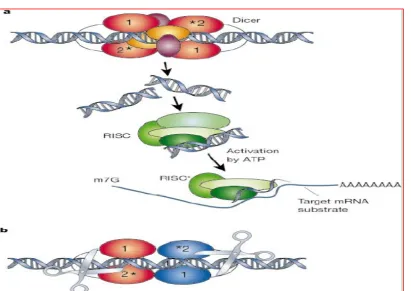
(2) K. Babu Nageswararao et al. IRJP 2 (3) 2011 38-46 least 70-100 nucleotides away from the transitional initiation site and AU : GC content should be as close to 50% as possible6. The siRNA duplexes synthesized by this type are effective in silencing of cytoskeletal proteins like lamin A/C, lamin B1, Nuclear Mitotic Apparatus protein (NUMA) and vimentin in human cell lines7 .when siRNA specific to RAPTOR (a protein in mediating signal transduction induced by rapamycin) was added to target of rapamycin (TOR) over expressing cells the down stream signaling of protein was abolished showing siRNA inhibition of biological Pathways. B. Enzymatic synthesis siRNA duplexes are synthesized in this type by enzymatically cleaving long dsRNA homologues to the target gene invitro using RNase-III extracted from Escherichia coli. Generation of long dsRNA is typically performed by invitro transcription of target gene both in sense and antisense using T7 RNA polymerase8. The advantage of such an enzymatic approach is rapid and effortless identification of the optimal siRNA species for silencing the desired biological function. C. In-vivo synthesis In contrast to the above types of synthesizing siRNA, a widely used siRNA in vivo synthesis involves the processing of long dsRNA to small interfering RNAs (siRNAs) by action of dsRNA specific endonuclease known as “DICER” 9,10. The resultant siRNAs are double stranded and 21-24 nucleotides in length. II. miRNA & rasiRNA miRNA are known as microRNAs and they are produced from premiRNA through a multiple maturation process11. The premiRNA is expressed in the nucleus from endogenous long transcripts and is processed into ~ 70nt hairpins by the RNaseIII family member drosha to become premiRNA. The premiRNA is exported to the cytoplasm by exportin-512 and is further cleaved by R2 D2 dicer heterodimer into the mature miRNA. In organisms like C.elegans, S.pombe, some of the small RNAs are homologous to regions of repetitive DNA which are termed as RasiRNAs including transposons, retrotransposons, centromeric repeats, satellite and microsatellite DNA13,14,, recruit and maintain regions of silenced chromatin and contain these repetitive sequence by activating sequence specific DNA methylation and histone methylation and by recruiting heterochromatin associated protein15,16. Transcription from opposing promoters found in repetitive DNA elements, such as centromeric repeats and satellite DNAleads to the formation of long dsRNAs which are cleaved by DICER presumably the R2D2 DICER heterochromatin to siRNAs13.. IRJP 2 (3) Mar 2011. ENZYME COMPLEXES INVOLVED IN RNA GENE SILENCING Complexes like DICER, RISC, RITS, etc., are mainly involved in various gene silencing mechanisms. I. DICER The long dsRNA in cytoplasm are processed into small interfering RNAs (siRNAs) by the action of dsRNA specific endonuclease (an RNAse-III enzyme) known as “DICER”9,10. But through invitro, the principle siRNA generating enzyme is actually a DICER R2 D2 heterodimer which remains associated with siRNA. There is some evidence that DICER has also additional roles in RNAi, since the efficiency impaired when DICER itself is also silenced17. In drosophila there are two DICERS: DCR-1 AND DCR-2. In their eggs lacking functional DCR-2, there is an impaired response of RNAi to synthetic siRNAs. An important advance in the RNA field was the demonstration that synthetic 21nucleotide duplexes with the same structure as DICER generated siRNAs could also be incorporated into RISC and induce the degradation of homologous target RNA18. Action of dicer is described in Fig. 2. II. RISC RISC means “RNA Induced Silencing Complex”. The siRNAs are incorporated into a multi subunit Ribonucleoprotein complex called “RISC”. ATP dependent unwinding of the siRNAs activates RISC. The antisense (guide) strand of siRNA directs the endonuclease activity of the RISC to the homologous (target) site on the m-RNA resulting m-RNA cleavage19. The RISC siRNA is initially duplexed but unwinds in the activated mRNA cleavage competent from of RISC (“HOLORISC”). In addition activated RISC also contains the highly conserved argonaute 2 (Ago 2) recently identified as the RNAi endonuclease (or slicer) 20-24 . The actual identity of slicer is not yet known. III. RITS A protein complex called (RNA–induced initiation of transcriptional gene silencing RITS) required for heterochromatin assembly in s.pombe has been recently purified and found to contain Ago1 (a known component of the RNAi pathway) the heterochromatin associated chp1 and the novel protein Tas3 (targeting complex subunit3)25. The siRNAs produced by R2D2/DICER heterodimer are unwound and taken up by RITS which directs the establishment of silenced chromatin over the region of DNA homologous to the siRNAs. MECHANISM OF GENE SILENCING I. Classical way of gene silencing through siRNA Step1. Long double stranded RNA (dsRNA) is recognized and processed by DICER/R2D2 heterodimer and RNAs-III enzyme into duplexes of short interfering. Page 38-46.
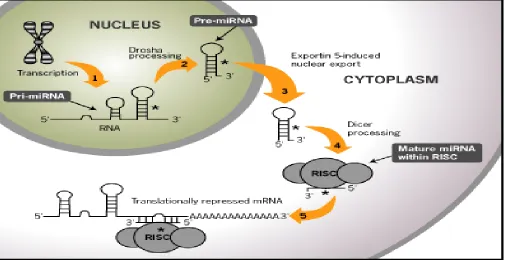
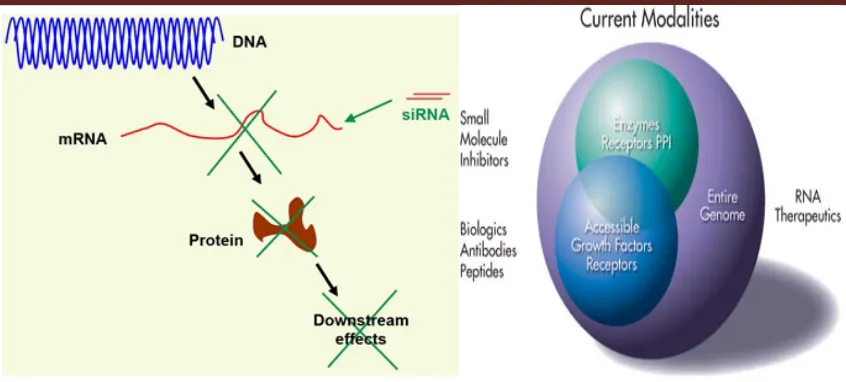
(3) K. Babu Nageswararao et al. IRJP 2 (3) 2011 38-46 RNA (siRNA). In the conversion of dsRNA to siRNA ATP are utilized and the phosphates are bound to terminal sides of siRNA with the help of cellular kinases. Step 2. The siRNA are incorporated into the “Multiprotein RISC” which is inactive. Step 3. The duplex siRNA is unwound in an ATP dependent manner starting at the 5 terminas that has the lowest free energy of base pairing26 which causes the activation of RISC. Step 4. The Antisense siRNA strand binds to target messenger RNA (m-RNA) that bear a high degree of sequence complementarity to the siRNA which cleaves the target m-RNA. Cleavage of the target m-RNA begins at single site f10 nucleotides upstream of the 5' –most residue of the siRNA target m-RNA duplex27. Step 5. The cleavage of m-RNA at a specific site into smaller strands causes the inhibition of protein translation specific to that m-RNA. Classical way is represented in Fig. 3 II. Gene silencing through miRNA pathway Step 1.The premiRNA is expressed in the nucleus from the endogenous long transcripts and processed into the ~ 70nt hairpins by the RNaseIII family member drosha to become premiRNA11. Step 2. The premiRNA is exported to the cytoplasm by exportin-512 Step 3. In the cytoplasm the pre-miRNA is cleaved by the R2D2/DICER heterodimer into the mature miRNA. Step 4. The miRNA is loaded into the RISC which causes the unwinding of miRNA. Step 5. The unwinding miRNA binds to the target mRNA that have only partial sequence complementary to the mRNA which leads to the repression of protein translation. miRNA pathway is represented in Fig. 4 III. Gene silencing through rasiRNA pathway Step 1. Transcription from opposing promoters found in repetitive DNA elements such as centromeric repeats and satellite DNA leads to formation of long dsRNAs. Step 2. These long dsRNAs are cleaved by DICER/R2D2 heterodimer into siRNAs. Step 3. These are unwounded and taken up the RNAinduced transcriptional silencing the establishment of the silences chromatin over the region of DNA homologous to the siRNAs. Step 4. This silenced chromatin is characterized by methylation of lysine-9 residue of histone H3 and the recruitment of heterochromatin associated proteins HP1 and HP2 in Drosophila polygene chromosomes. APPLICATIONS OF RNAI The molecular RNAi tool will permit investigators to routinely implement “loss-of-function” screens and helps to develop rapid test for genetic interactions in the. IRJP 2 (3) Mar 2011. mammalian cells. The wide spectrum of RNAi application to various fields is represented as below. An overview of siRNA function is depicted in Fig. 5 I. RNAi AS A THERAPEUTIC RNAi is widely used for therapeutics because of the following reasons: Ø All the cells contain the machinery to carry out RNA and all genes are potential targets for RNAi. Ø Relative use of the synthesis and low cost of production of RNAi therapeutics. Ø In addition, siRNA are chemically stable and can be stored lyophilized without refrigeration. RNAi as a therapeutic is depicted in Fig. 6. 1. Antiviral Therapeutics A. HPV (Human Papillomavirus) HPV is called as “Human papilloma virus” which causes Cervical cancer in women. This virus produces a protein that suppresses the activity of genes in the human anticancer defense system. Therefore, the suppression of HPV encoded viral gene products being done by RNAi could help to inhibit the growth of cancer. B. HCV (Hepatitis C Virus) Using RNAi the suppression of the function of cellular genes those required for HCV replication which are involved in the host cell interactions and viral morphogenesis28. Recently the technique of siRNA is adopted to target the host FASPROTEIN to reduce the severe forms of hepatitis in a mice model29. C. HIV (Human Immunodeficiency Virus) siRNA has been successful in treatment of HIV (Human Immuno Deficiency Virus) and even Severe Acute Respiratory Syndrome (SARS) associated corona virus30. siRNA inhibits the replication of HIV by targeting viral (P24,vif,nef, tat and rev) or cellular genetic receptors like primary HIV receptor CD4, HIV co-receptor CXCR-431 and other receptors like CCR-5 resulting in the prevention of viral entry into target cells32-34. A practical utilization of blocking HIV entry into the cells could be transfecting haematopoeitic stem cells with siRNA expressing constructs so that progeny cells are not susceptible to infection35. This approach was effective in rendering monocytes derived from transfected progenitors resistant to HIV infection. 2. Anticancer Therapeutics A. Gene suppression by the siRNAs is a powerful tool to analyze the function of the proteins [invitro and invivo] especially for the rational design of drugs to block the tumor relevant genes. Initially in invitro studies have demonstrated effective silencing of a wide variety of mutated oncogenes such as K-RAS-(46), mutated P- 53(47), HER-2/neu–(48) and BCR-ABL36. IN-VIVO utilization of siRNA was effectively performed by. Page 38-46.
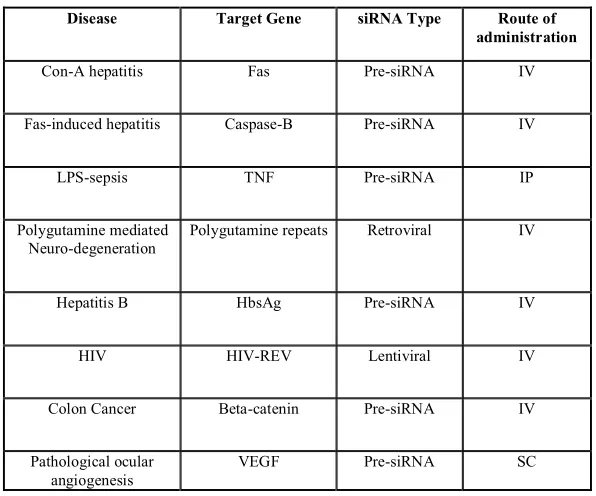
(4) K. Babu Nageswararao et al. IRJP 2 (3) 2011 38-46 targeting the colorectal cancer associated gene BETA CATENIN which observes decreased proliferation and diminished invasiveness. Similarly silencing of the oncogene H-RAS led to the inhibition of in-vivo tumour growth of human ovarian cancer in SCID MOUSE37. Table showing the use of different siRNA in various diseases is depicted in Table -1 B. siRNA inhibition of BCL-2 family members is associated with increased susceptibility of prostate cancer to chemotherapeutic intervention38. The ability to create “PERMANENT-KNOCKDOWN” cancer cell lines will help us to understand the “loss of function phenotype and subsequently develop commercially important cancer preventive targets” very recently this reverse genetic approach has been adopted to study modulation of the polygutamine repeat associated with “HUNTINGTONS DISEASE” a neuro degenerative disorder using viral promoter based vectors and direct injection into mice embryos 3. Immunology One of the most devastating immune-mediated pathologies is bacterial sepsis mediated by systemic release of TNF-α. The utilization of siRNA to silence this gene has been successfully accomplished in the Murein Model of Sepsis39. Manipulation of the macrophages, peripheral blood mononuclear cells and Tcells was successfully accomplished with siRNA which demonstrated the pharmacological activity of the siRNA and the prospect of using siRNA as an Immune Suppressant. Previous approaches to suppressing T-cell responses including administration of drugs (e.g. cyclosporine), antibodies (e.g. antiCD154) or fusion proteins (e.g. CTLA-4-Ig) which have drawbacks like organ toxicity, lack of specificity etc. So, to overcome the drawbacks the therapeutic gene silencing of siRNA was accomplished in recent years. II. RNAi in agro biotech industry By the RNAi work performed in plant “ARABIDOPSIS”. It was identified that not only new varieties of plant production but also prevention of plant virus infections can be attained. This strategy is used in agro biotech industry to study plant host virus interactions. III. Functional Genomics The RNAi approach has been applied in study of several genetic “functions involved in cell growth cell cycle, cytoskeleton, signaling, and membrane trafficking transcription and DNA methylation. The functions of this gene were studied in about 25 mammalian cells either by incorporating synthetic siRNAs are using cloned plasmids that carries siRNA sequences40. The biggest advantage of the RNAi platform is it is highly adaptable. IRJP 2 (3) Mar 2011. process, significantly reducing the product development cycle and enhancing the target validation and development. IV. Genome wide screening The genome RNA strategy ahs been used in high throughput phenotype screenings to identify several hundred genes that are involved in the cell cycle embryonic or germ line development ovary and vulva specific in “clenohabditis. Elegans” etc., instead of knocking down a single gene at a time which could take a year effort the RNA method allows scientist for the 1st time to knock out every gene in an organism in a few months. V. Target Validation Target validation which is a major problem for biopharmaceutical industry can be reduces by applying the technique of RNAi. Target validation determines whether a known validate gene is responsible for a disease and whether altering expression of the gene is likely to result in the therapeutic effect. By using RNAi based target validation the fast track discovery of drug targets in short period in a most cost effective approach can be attained. VI. Drug screening and Development Selection and validation of molecular targets is a great importance for drug development in the post genomic era. The identification of the genes responsible for the identification of many diseases which is a major challenge in drug development can be achieved by the RNAi technique in a rapid and more economical way. RNAi also facilitate the drug screening and development by identifying the genes that can confer drug resistance or genes whose mutant phenotypes are meliorated by drug treatment. RNA methods could be extended to study the gene expression of insect and parasite genomes and develop better gene based siRNA with various interdisciplinaries is depicted in Fig.7. Various organisations working with the siRNA therapeutics is depicted in Table-2. ACKNOWLEDGEMENTS We wish to give a sincere gratitude to our professor(s), Mr. S.S. Manikiran, Mrs. S. Prasanthi, and Mrs. K. Lakshmi for their intellectual support and excellent guidance. REFERENCES 1. Guo s, kemphues Kj.par-1, a gene required for establishing polarity in C.elegans embryos, encodes a putative Ser/Thr kinase that is asymmetrically distributed.Cell 1995; 81: 611-20. 2. Fire A, Xu S, Montgomery MK, Kostas SA, Driver SE, Mello CC. potent and specific genetic interference by double-stranded RNA in Caenorhabditis elegans.Nature.1998; 391;806-11. 3. Napoli C, Lemieux C, Jorgensen R. Introduction of a chimeric chalcone Synthase gene into petunia results in reversible co suppression of homologues genes in trans. Plant Cell 1990;2;279-89.. Page 38-46.
(5) K. Babu Nageswararao et al. IRJP 2 (3) 2011 38-46 4. Hannon GJ. RNA interference.Nature 2002; 418:244-51. 5. Dykxhoorn DM, Novina CD, sharp PA.Killing the messenger: short RNAs that silence gene expression. Nat Rev Mol Cell Biol2003; 4:457-67. 6. Caplen NJ, Mousses S. Short interfering RNA (siRNA)-mediated RNA interference (RNAi) in human cells. Ann N Y Acad Res 2003; 1002: 56-62. 7. Elbashir SM, Harborth J, Lendeckel W, Yalcin A, Weber K, Tuschl T. Duplexes of 21- nucleotide RNAs mediate RNA interference in cultured mammalian cells. Nature 2001; 411: 494498. 8. Katoh T, Susa M, Suzuki T, Umeda M, Watanabe K. Simple and rapid synthesis of siRNA derived from invitro transcribed siRNA. Nucleic acids Res Suppl 2003: 249- 250. 9. Hammond SM, Bernstein E, Beach D, Hannon GJ. An RNAdirected nuclease mediates post-transcriptional gene silencing in Drosophila cells. Nature-2000; 404:293-6. 10. Bernstein E, Caudi WAA, Hammond SM, Hannon GJ. Role for a bidentate ribonucleus in the initiation step of RNA interference Nature-2001; 409:363-6. 11. Lee Y, Jeon K, Lee JT, et al. MicroRNA maturation; stepwise processing & sub cellular Localization. EMBO. J 2002; 21:4663-70. 12. Yi R,Qin Y, Macara IJ, et al. Exportin-5 mediates the nuclear export of pre-microRNAs & short hairpinRNAs Genes Dev 2003;17:3011 16. 13. Aravin AA, Lagos-Quintana M, Yalcin A, et al. The small RNA profile during Drosophila melanogaster development. Dev. Cell 2003; 5:337-50. 14. Lagos-Quintana M, Rauhut R, Meyer J, et al. New microRNAs from mouse & human RNA 2003; 9:175-79. 15. Tabara H, Sarkissian M, Kelly WG, et al. The rde-1 gene, RNA interference & transposon silencing in C.elegans. cell 1999; 99:12332. 16. Schramke V, Allshire R.Hairpin RNAs & retrotransposon LTRs effect RNAi & chromatin-based gene silencing. Science 2003; 301:1069-74. 17. Doi N, Zenno S, Ueda R, Ohki-Hamaza-ki H, Ui-Tei K, Saigo K. Short interfering RNA- mediated gene silencing in mammalian cells requires Dicer and eIF 2C translation initiation factors. Curr Biol 2003; 13:41-6. 18. Elbashir S , Harborth J, Lendeckel W, Yalcin A, Weber K, Tuschl T. Duplexes of 21- nucleotide RNAs mediate RNA interference in cultured mammalian cells. Nature 2001; 411: 494498. 19. Dykxhoorn DM, Novina CD, sharp PA. Killing the messenger: short RNAs that silence gene expression. Nat Rev Mol Cell Biol2003;4:457-67. 20. Hammond SM, Boettcher S, Caudy AA, et al. Argonaute2,a link between genetic & biochemical analyses of RNAi. Science 2001; 293:1146-50. 21. Caudy AA, ketting RF, hommond SM, et al. A micrococcal nucleus homologue in RNAi effector complexes.Nature 2003; 425:411-14. 22. Caudy AA, Myers M, Hannon GJ, et al. Fragile X-related protein & VIG associated with the RNAinterference machinery. Genes Dev. 2002; 16:2491-96.. IRJP 2 (3) Mar 2011. 23. Caudy AA, Myers M, Hannon GJ, et al. Fragile X-related protein & VIG associated with the RNAinterference machinery.Genes Dev. 2002; 16:2491-96. 24. Liu J, Carmell MA, Rivas FV, et al. Argonaute2 is the catalytic engine of mammalian RNAi. Science 2004; 305:1437-4. 25. Song JJ, Smith SK,Hannon GJ, et al. Crystal structure of Argonaute & its implications for RISC Slicer activity. Science 2004; 305:1434 37. 26. Verdel A, Jia S, Gerber S et al. RNAi-mediated targeting of heterochromatin by the RITS complex. Science 2004; 303:672-76. 27. Schwarz DS, Hutvagner G, Du t, et al. Asymmetry in the assembly of the X & 22-nucleotide RNAs. Genes Dev. 2003; 15:188-200. 28. McCaffrey, AP et al. Nature 2002; 418:38-39. 29. Song E,Lee,SK, Wang,J, Ince,N,Ouyang, N, Nin, J.Chen, J.Shankar, P.Lieberman,J. RNAinterference targeting Fas protects mice from fulminant Hepatitis. Nature 2003; 3:347-351. 30. Zhang R, Guo Z, Lu J et al. Inhibiting severe acute respiratory syndrome-associated corona virus by small interfering RNA. Chin Med J (Engel) 2003; 116:1262- 1264. 31. Ji J, Wernli M, Klimkait T, Erb P. Enhanced gene silencing by the application of multiple specific small interfering RNAs. FEBS L ett 2003; 552:247-252. 32. Lee, NK, Dohjima, T, Bauer, G, Li, H,Li, MJ, Ehsani, A, Rossi,J. Expression of small interfering RNAs targeted against HIV1 rev transcripts in human cells . Nature Biotechnology 2002; 20:500-505. 33. Martine, MConaventura, C.EsteJA. RNAinterfernce of HIV replication. Trends in Immunology 2002;1-3. 34. Novina, CD, Murray, MF, Dykxhoorn, DM, Beresford, BJ, Riess, J , Lee, SK,Collman, RG Lieberman, J, Shankar, P, sharp, PA. siRNA directed inhibition of HIV-1 infection. Nature Medicine 2002; 8:681- 686. 35. Li MJ, Bauer G, Michienzi A et al. Inhibition of HIV-1 infection by lentiviral vectors expressing POL III- promoted anti-HIV RNAs. Mol Ther 2003; 8:196- 206. 36. Scherr M, Battmer K, Winkler T, Heidenreich O, Ganser A, Eder M. Specific inhibition of bcr-abl gene expression by small interfering RNA. Blood 2003; 101:1566-1569. 37. Yang G, Thompson GA, Fang B, Liu J. Silencing of H-ras gene expression by retrovirus- mediated siRNA decreases transformation efficiency & tumor growth in a model of human ovarian cancer. Oncogene2003; 22:5694-570. 38. Ray S, Almasan A. Apoptosis induction in prostate cancer cells & xenografts by combined treatment with Apo2 ligand / tumor necrosis factor- related apoptosis inducing ligand & CPT- 11. Cancer res 2003; 63:4713-4723. 39. Sorensen DR, Leirdal M, Sioud M. Gene silencing by systematic delivery of synthetic siRNAs in adult mice. J Mol Biol 2003; 327:761-766. 40. Tuschi,T, Borkhardt, A. Small interfering RNAs; a revolutionary tool for the analysis of gene function & gene therapy. Mol. Interventions 2002; 2:158-167.. Page 38-46.
(6) K. Babu Nageswararao et al. IRJP 2 (3) 2011 38-46 Table 1: SIRNA in various diseases Disease. Target Gene. siRNA Type. Route of administration. Con-A hepatitis. Fas. Pre-siRNA. IV. Fas-induced hepatitis. Caspase-B. Pre-siRNA. IV. LPS-sepsis. TNF. Pre-siRNA. IP. Polygutamine mediated Neuro-degeneration. Polygutamine repeats. Retroviral. IV. Hepatitis B. HbsAg. Pre-siRNA. IV. HIV. HIV-REV. Lentiviral. IV. Colon Cancer. Beta-catenin. Pre-siRNA. IV. Pathological ocular angiogenesis. VEGF. Pre-siRNA. SC. Table 2: Organisations working with the SIRNA therapeutics REAGENT DEVELOPMENT ORGANISATIONS. R&D ORIENTED ORGANISATIONS · · · · · ·. IRJP 2 (3) Mar 2011. Alnylam Pharmaceuticals, Cambridge, MA Anadys Pharmaceuticals, San Diego, CA Cenix Biosciences, Dresden, Germany ISIS Pharmaceuticals, Carlsbad, CA Nucleonics, Inc. Malvern, PA Ribopharma Ag, Kulmbach, Germany. · · · · · ·. Ambion, Inc.Austin, TX (cloning vectors) BD Biosciences Clontech, PaloAlto, CA (cloning vectors) Dharmacon, Inc.Laayegatte, CO ( siRNA synthesis) Imgenex, Inc.San Diego, CA(cloning vectors) Invitrogen, (Transfection reagents) Mirus Corporation, Madison, WI (Transfection reagents). Page 38-46.
(7) K. Babu Nageswararao et al. IRJP 2 (3) 2011 38-46. Figure 1: Overview of all siRNAs. Figure 2: Action of dicer. IRJP 2 (3) Mar 2011. Page 38-46.
(8) K. Babu Nageswararao et al. IRJP 2 (3) 2011 38-46. Figure 3: Classical way of gene silencing through siRNA. Figure 4: Gene silencing through mirna pathway. IRJP 2 (3) Mar 2011. Page 38-46.
(9) K. Babu Nageswararao et al. IRJP 2 (3) 2011 38-46. Figure 5: overview of siRNA function. Drug screening. Integrated ‘OMICS’ RNAi /siRNA. Figure 6: RNAi as a therapeutic. Genome wide screenings Therapeutic development. Target validation Agro biotech. Figure 7: SiRNA with various interdisciplinaries. IRJP 2 (3) Mar 2011. Page 38-46.
(10)
Figure
Related documents
Kay GG, Wesnes KA: Pharmacodynamic effects of darifenacin, a muscarinic M3 selective receptor antagonist for the treatment of overactive bladder, in healthy volunteers.. Kelleher
We model oxygen diffusion in rutile titania as two unique processes occurring at a clean (110) surface and within the bulk: surface injection and annihilation of the
That study concluded that tacrolimus powder in orabase 0.1% seems to be an alternative to topical steroids in the treatment of OLP and lichenoid lesions, especially in patients who
Thus it is essential to study the efficiency levels of Indian commercial banks to understand the impact of financial sector reforms on its performance.. The
Y Kamishima, N Inoue, K Shinoda, S Sato, Multimedia event detection using GMM supervectors and SVMS, in Proceedings of IEEE International Conference on Image Processing, 2012
Discriminant analysis using d-spacing data from X-ray diffractometry 8a4'2~ is an easy and objective method for clas- sifying all native celluloses as the I~-rich type
In the present work, the author has developed a simple, rapid, accurate and sensitive HPLC method for the determination of esomeprazole by using HPLC technique, and the method
The percentage of the MMPI-2-RF normative sample (NS) and of the Forensic, Pre-trial Criminal (Men) comparison group (CG) that answered each item in the keyed direction are provided
