Foundation, the Reconstructive Plastic Surgery Research Founda-tion, the Maurice and Phyllis Paykel Trust, Lottery Health Re-search, and the Health Research Council of New Zealand.
We are grateful to C. Marstella for her assistance in the prep-aration of this manuscript.
REFERENCES
1. Mulliken JB, Young AE.Vascular Birthmarks: Hemangiomas and Vascular Malformations.Philadelphia, PA: WB Saunders; 1988:41–103
2. Hidano A, Nakajima S. Earliest features of the strawberry mark in the newborn.Br J Dermatol.1972;87:138 –144
3. Amir J, Metzker R, Krikler R, Reisner SH. Strawberry haemangioma in preterm infants.Pediatr Dermatol.1986;3:131–132
4. Margileth AM, Museles M. Cutaneous hemangiomas in children: diag-nosis and conservative management.JAMA.1965;194:523–552 5. Cheung DSM, Warman ML, Mulliken JB. Haemangioma in twins.Ann
Plast Surg.1997;38:269 –274
6. Takahashi K, Mulliken JB, Kozakewich HPW, Rogers RA, Folkman J, Ezekowitz RAB. Cellular markers that distinguish the phases of hem-angioma during infancy and childhood.J Clin Invest.1994;93:2357–2364 7. Folkman J, Klagsbrun A. Angiogenesis factors. Science. 1987;235:
442– 447
8. Folkman J. Angiogenesis in cancer, vascular, rheumatoid, and other diseases.Nature Med.1995;1:27–31
9. Fishman SJ, Mulliken JB, MacDonald DM, Folkman J. Urinarybasic fibroblastic growth factor is useful in differentiating hemangiomas from vascular malformations. Proceedings of the 11th International Work-shop on Vascular Anomalies; Rome, Italy; June 23–26, 1996; page 14 10. Mulliken JB, Boon LM, Takahashi K, Ohlms LA, Folkman J, Ezekowitz
AB. Pharmacologic therapy for endangering hemangiomas.Curr Opin Dermatol.1995;109 –113
11. Zide BM, Glat PM, Stile FL, Longaker MT. Vascular lip enlargement: part I. Hemangiomas—tenets of therapy.Plast Reconstr Surg.1997;100: 1664 –1673
12. Landthaler M, Hohenleutner U, Abd El-Raheem T. Laser therapy of childhood haemangiomas.Br J Dermatol.1995;133:275–281
13. Cremer H. The importance of contact cryosurgery in early therapy of hemangiomas in infancy. Proceedings of the 11th International Work-shop on Vascular Anomalies; Rome, Italy; June 23–26, 1996; page 6 14. Breuninger LM, Dempsey WL, Uhl J, Murasco DM. Hydrocortisone
regulation of IL-6 protein production by purified population of human peripheral blood monocytes. Clin Immunol Immunopathol. 1993;69: 205–214
15. Almawi WY, Beyhum HN, Rahme AA, Rieder MJ. Regulation of cyto-kine and cytocyto-kine receptor expression by glucocorticoids.J Leukoc Biol. 1996;60:563–572
16. Brattsand R, Linden M. Cytokine modulation by glucocorticoids: mech-anisms and actions in cellular studies.Aliment Pharmacol Ther.1996;10: 81–90
17. Cai J, Zheng T, Lotz M, Zhang Y, Masood R, Gill P. Glucocorticoids induce Kaposi’s sarcoma cell proliferation through the regulation of TGF-b.Blood.1997;89:1491–1500
18. Barnes PJ. Anti-inflammatory mechanisms of glucocorticoids. Trans Biochem Soc.1995;23:940 –945
19. Ru¨ger BM, Dunbar PR, Hasan Q, Sawada H, Kittleberger R, Greenhill N, Neale TJ. Human mast cells produce type VIII collagen in vivo.Int J Exp Pathol.1994;75:397– 404
20. Ru¨ger BM, Hasan Q, Greenhill NS, Davis PF, Dunbar PR, Neale TJ. Mast cells and type VIII collagen in human diabetic nephropathy. Diabetolo-gia.1996;39:1215–1222
21. Hasan Q, Dunbar PR, Murray-McIntosh RP, Neale TJ. Transforming growth factorbisoforms in human glomerulonephropathies. Nephrol-ogy.1998;4:353–359
22. Jurecic R, Nguyen T, Belmont JW. Differential mRNA display using anchored oligo-dT and long sequence-specific primers as arbitrary primers.Trends Genet.1996;12:502–504
23. Kushner BJ. The treatment of periorbital infantile hemangioma with intralesional corticosteroid.Plast Reconstr Surg.1985;76:517–524 24. Wyman LC, Fulton GP, Shulman MH. Direct observations on the
cir-culation in the hamster cheek pouch in adrenal insufficiency and ex-perimental hypercorticalism.Ann N Y Acad Sci.1953;56:643– 658 25. Border WA, Rouslahti E. Transforming growth factor-bin disease: the
dark side of tissue repair.J Clin Invest.1993;90:1–7
26. Dethlefsen SM, Mulliken JB, Glowacki J. An ultrastructural study of mast cells interactions in hemangiomas.Ultrastruct Pathol. 1986;10: 175–183
27. Sekeris CE. The mitochondrial genome is a primary site of action of
steroid and thyroid hormones.In Vivo.1990;4:317–320
28. Demonnacos C, Djordjevic-Markovic R, Tsawdaroglou N, Sekeris CE. The mitochondrion as a primary site of action of glucocorticoids: the interaction of the glucocorticoid receptor with mitochondrial DNA sequences showing partial similarity to the nuclear glucocorticoid re-sponsive elements.J Steroid Biochem Mol Biol.1995;55:43–55
29. Tsiriyotis C, Spandidas DA, Sekeris CE. The mitochondrion as a pri-mary site of action of glucocorticoids: mitochondrial nucleotide se-quences, showing similarity to hormone response elements, confer dexamethasone inducibility to chimaeric genes transfected in LATK2
cells.Biochem Biophys Res Comm.1997;35:349 –54
30. Kodama S, Yamanda H, Annale L, Barret C. Elevated expression of mitochondrial cytochromeband NADH dehydrogenase subunit 4/4L genes in senescent human cells.Exp Cell Res.1995;219:82– 86 31. Lee M, Kim H, Jeon D, et al. Iron metabolism-related genes and
mito-chondrial genes are induced during involution of mouse mammary gland.Biochem Biophys Res Comm.1996;224:164 –168
32. Knighton DR, Silver MA, Hunt TK. Regulation of wound-healing angiogenesis: effect of oxygen gradients and inspired oxygen concen-tration.Surgery.1981;90:262–270
33. Knighton DR, Hunt TK, Scheuentuhl H, Halliday BJ, Werb Z, Banda MJ. Oxygen tension regulates the expression of angiogenesis factor by mac-rophages.Science.1983;221:1283–1285
Gastric Perforation Attributable to
Liquid Nitrogen Ingestion
ABSTRACT. Despite the widespread use of liquid nitro-gen in medicine and industry, there are only a few reports of injuries associated with its use. We report a case of a 13-year-old boy who developed gastric perforation after liquid nitrogen ingestion. This is a previously unreported complication. Pediatrics 2000;105:121–123; liquid nitrogen, perforation, stomach, inhalation, ingestion.
ABBREVIATION. GI, gastrointestinal.
I
njuries related to liquid nitrogen exposure are
usually either attributable to direct contact (face,
limbs) or a result of inhalation of the evaporated
liquid (damage to the mucosa of the upper
respira-tory or gastrointestinal [GI] tract). Ingestion of liquid
nitrogen is extremely uncommon and gastric
perfo-ration has not previously been reported. This article
reports such a case.
CASE PRESENTATION
A 13-year-old boy was transferred to our hospital after ingest-ing of a mixture of orange crystals with liquid nitrogen. This was a part of a science experiment in which students were given orange crystals, liquid nitrogen, and water to mix and produce a frozen drink to demonstrate the freezing effect of liquid nitrogen. After swallowing the still smoking mixture, he instantly devel-oped an intense burning sensation in the back of his throat and severe abdominal pain, followed by abdominal distention and shortness of breath. On examination in the referring hospital he was hemodynamically stable. Bilateral cervical subcutaneous em-physema was noted. There were no burns to his face, lips, or tongue. There was decreased air entrance to both lungs. The
Received for publication Jan 1, 1999; accepted May 5, 1999.
Reprint requests to (B.Z.K.) Department of Radiology, Hadassah Medical Center, PO Box 12000, Jerusalem 91120, Israel. E-mail: bkoplewitz@ hadassah.org.il
PEDIATRICS (ISSN 0031 4005). Copyright © 2000 by the American Acad-emy of Pediatrics.
EXPERIENCE AND REASON 121 at Viet Nam:AAP Sponsored on August 30, 2020
www.aappublications.org/news
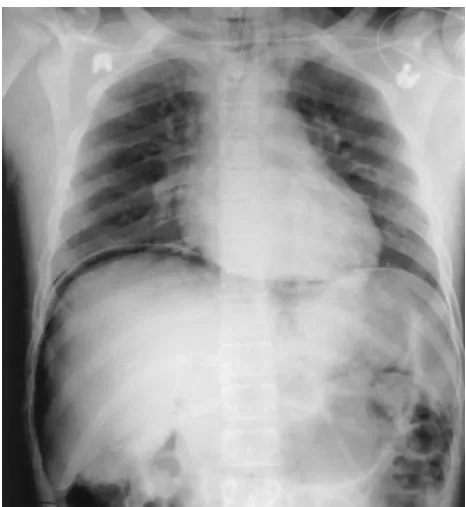
abdomen was distended and rigid. Chest radiograph showed bilateral cervical subcutaneous emphysema and intraperitoneal free air (Fig 1). Intubation was performed for airway protection and the patient was transferred to our hospital. On examination on arrival the abdomen was grossly distended, tympanic, and diffusely tender. Nasogastric tube drained brown liquid that was positive for occult blood. Laboratory examinations showed mild respiratory acidosis (pH 7.28, Pco254 mm Hg, Po263 mm Hg,
HCO3226 mEq/L, base excess:21) but were otherwise normal.
The patient was taken to the operating room for exploration because of a presumed bowel perforation.
At operation, a large gush of air was evacuated by an upper abdominal midline incision. There was no evidence for blood or free fluid in the abdomen. Two small perforation sites were found in the posterior aspect of the stomach along the lesser curvature. The adjacent gastric mucosa appeared healthy and viable. The two perforation sites were united and closed in two layers. Examina-tion of the gastroesophageal juncExamina-tion and the remainder of the abdomen did not reveal any other injury. Follow-up upper GI series was performed on the 7th postoperative day and showed no evidence of esophageal perforation or injury. There was an irreg-ular area delineated by contrast along the lesser curvature, pre-sumably at the site of the sutured perforation (Fig 2). The patient had an uncomplicated recovery course and was discharged 10 days after the operation. The 4-month clinic visit was normal and he was discharged from long-term follow-up.
Because this child ingested the liquid nitrogen in a formal learning setting, the issue of child protection arose and an inves-tigation was conducted by the authorities. It was then determined that this was an experiment that had been conducted at this setting for many years without consequences and that instructions for this experiment were also available on the Internet. No child protec-tion concerns were verified.
DISCUSSION
Nitrogen is normally a colorless and odorless,
nearly inert, slow reacting gas with a boiling point of
2
195°C. It is widely used in scientific and industrial
institutions, mainly for freezing and cooling, and
also serves as a therapeutic agent in various medical
disciplines. Despite its widespread use, there are
only occasional reports of associated injuries.
1–3Injuries directly related to storage or use of liquid
nitrogen are usually a result of cold burn to the organ
exposed by direct contamination or inhalation.
Inad-vertent spillage may result in severe frostbite,
possi-bly leading to gangrene that may also cause infection
or may necessitate amputation of the affected organ.
1Inhalation may lead to mucosal injury of the upper
airway, oropharynx, or hypopharynx, with the risk
of delayed perforation at these sites.
2Potential
com-plications include infection and healing-associated
strictures. Inspired gas may replace oxygen in the
blood stream and cause neurologic symptoms
attrib-utable to asphyxia, and death.
3The use of liquid nitrogen for making ice cream is
available on the Internet, based on an article
pub-lished in 1994.
4This article stresses 2 important
safety points. The first is to avoid contact with liquid
nitrogen or objects exposed to its extreme cold. The
second is to wait until the ice cream has stopped
giving off fog, which is a signal that all of the liquid
nitrogen has evaporated, before eating it.
A combination of 2 mechanisms is probably
re-sponsible for gastric perforation in this patient: focal
perforation caused by the very low temperature of
the swallowed nitrogen, together with rapid
expan-sion within the closed cavity of the stomach on
evap-oration. The patient did not have pathologic changes
elsewhere in the abdomen.
The very low temperature of liquid nitrogen may
cause mucosal ulcers that may lead to later
perfora-tion when involving respiratory or digestive tract
mucosa. Despite accurate history and a detailed
physical examination, no burns were found in the
oropharynx or hypopharynx of this patient to
ex-plain his burning sensation; this may be attributed to
the very low temperature of the swallowed
sub-stance. Because of the lack of chest pain or
pharyn-geal findings, we did not suspect esophapharyn-geal injury,
and the findings of subcutaneous and mediastinal
emphysema are likely a result of air leak from the
peritoneum. The patient did not have any neurologic
signs or symptoms (the presence of which would
Fig 1. Admittance chest radiograph, demonstrating cervical sub-cutaneous emphysema and intraperitoneal free air.
Fig 2. Postoperative upper GI series in the prone position, show-ing irregularity at the sutured perforation site along the lesser curvature (arrow).
have indicated gas inspiration with hypoxemia
at-tributable to oxygen replacement) and had an
un-eventful recovery.
The only similar case was that of a chemical
engi-neering student who drank a beaker of liquid
nitro-gen and developed immediate pain and collapsed.
He was found to have free air under the diaphragms
and pneumomediastinum but no perforations. Full
recovery followed supportive care (Cynthia Aaron,
personal communication, 1998).
Although liquid nitrogen instantaneously becomes
a gas in room temperature, it appears that the
inges-tion of a liquid nitrogen mixture may cause mucosal
injury and perforation of the intraabdominal GI tract
with immediate or delayed presentation; symptoms
may be unrelated to the true nature of the more
severe pathology. High index of suspicion of a
pos-sible gastric injury (despite lack of facial or
oropha-ryngeal findings) should be maintained and can lead
to a prompt diagnosis and an appropriate
manage-ment. Efforts should be made to educate the general
public and especially science teachers regarding the
potential harmful effects of liquid nitrogen in food
products.
Benjamin Z. Koplewitz, MD, BSc*
Alan Daneman, MB, BCh, Sc, FRACR, FRCPC* Sigmund H. Ein, BA, MDCM, FRCS(C), FACS,
FAAP¶
Michael A. McGuigan, MD, CM, MBA‡ Marcellina Mian, MDCM§
*Departments of Diagnostic Imaging, ‡Clinical Pharmacology/Toxicology, and §SCAN Program ¶Division of General Surgery
Hospital for Sick Children and the University of Toronto
Toronto, Ontario, Canada M5G 1X8
REFERENCES
1. Roblin P, Richards A, Cole R. Liquid nitrogen injury: a case report. Burns.1997;23(7– 8):638 – 640
2. Rockawold G, Buran DJ. Inhalation of liquid nitrogen vapor.Ann Emerg Med.1982;11:553–555
3. Kernbach-Wighton G, Hijewski H, Schwanke P, et al. Clinical and morphological aspects of death due to liquid nitrogen.Int J Legal Med. 1998;111:191–195
4. Kurnti N, This-Benckhard H. Chemistry and physics in the kitchen.Sc Am.1994;270:66 –71
Forehead Lipoblastoma Mimicking
a Hemangioma
ABSTRACT. A case of forehead lipoblastoma simulat-ing a hemangioma in a male infant is reported, to alert pediatricians to this rare tumor and to increase the index of suspicion in atypical hemangiomas.
A 2-month-old male infant developed a protruding forehead mass with increased vascularity. It demon-strated progressive and accelerated growth over the sub-sequent 6 months, unresponsive to steroid therapy. A magnetic resonance imaging scan supported the diagno-sis of hemangioma because of the hypervascular nature of the lesion. Surgical excision was performed because of visual obstruction. Pathologic examination of the speci-men was consistent with a very primitive lipoblastoma. This tumor is a rare, benign lesion of immature fat cells that is found almost exclusively in the pediatric popula-tion. Lipoblastomas are more common in males than females and frequently present as asymptomatic, rapidly enlarging, soft lobular masses on the extremities. Com-plete surgical excision is the definitive treatment. In the vast majority of reported cases, however, the preopera-tive diagnosis was incorrect, underscoring the diagnostic dilemma presented by these rare tumors.Pediatrics2000; 105:123–128;lipoblastoma, hemangioma.
ABBREVIATIONS. MRI, magnetic resonance imaging; CT, com-puted tomography;
A
lthough hemangiomas are by far the most
common benign tumors of infancy, other
tu-mors will infrequently occur and must be
included in the differential diagnosis.
CASE REPORT
A 7-month-old white boy was referred to the Children’s Hos-pital of Philadelphia for evaluation of a rapidly enlarging forehead mass (Fig 1). His history was notable for having been born 6 weeks prematurely, requiring a 10-day stay in the neonatal intensive care unit and apnea monitoring for 5 months. His parents first noticed a flat red spot on the child’s forehead at 2 months of age. Over the next several months, the spot progressively enlarged (Fig 2). The lesion evolved into a tense lobule with a purple hue and promi-nent cutaneous vessels.
Although hemangioma was felt to be the most likely diagnosis, the rather firm nature of the lesion and relative lack of increased warmth normally associated with hypervascular tissue prompted a magnetic resonance imaging (MRI) study. The study was con-sistent with a large hemangioma measuring 3 3 4.53 5.5 cm overlying the right frontal bone without intracranial extension (Fig 3A and B). Initial ophthalmologic examination did not reveal any evidence of amblyopia, but oral steroid therapy was begun (3 mg/kg/d) because of the risk of impending visual obstruction.
The mass continued to enlarge over the subsequent month, unresponsive to steroid therapy. A repeat ophthalmologic evalu-ation revealed a diffuse amblyopia, attributed to the obstruction of the visual field by the expanding lesion, and a daily patching regimen was begun.
At 8 months of age, the mass measured 7 cm in maximum dimension (Fig 4), and the decision was made to proceed with surgical excision because it continued to expand despite maxi-mum medical treatment, it was causing significant visual obstruc-tion and potentially irreversible disuse amblyopia, and surgical resection of the redundant skin would be necessary even with spontaneous regression. His insurance carrier mandated a second opinion regarding the need for surgery, and evaluation by multi-ple physicians at another institution again confirmed the lesion to be a hemangioma requiring surgical excision because of visual obstruction.
Intraoperative dissection revealed numerous enlarged periph-eral veins, a well encapsulated mass, markedly attenuated fron-talis muscle, and a single enlarged feeding artery from the frontal branch of the right superficial temporal artery. Redundant skin was used to achieve complete skin closure. In subsequent fol-low-up he demonstrated uneventful healing with good symmetry (Fig 5).
Pathologic examination documented an ovoid mass measuring 8.5 3 7.0 3 6.0 cm and weighing 236 g. Multiple thin-walled
Received for publication Feb 8, 1999; accepted Jun 8, 1999.
Address correspondence to David W. Low, MD, Division of Plastic Surgery, Children’s Hospital of Philadelphia, 34th and Civic Center Blvd, Philadel-phia, PA 19104. E-mail: [email protected]
PEDIATRICS (ISSN 0031 4005). Copyright © 2000 by the American Acad-emy of Pediatrics.
EXPERIENCE AND REASON 123 at Viet Nam:AAP Sponsored on August 30, 2020
www.aappublications.org/news
DOI: 10.1542/peds.105.1.121
2000;105;121
Pediatrics
McGuigan and Marcellina Mian
Benjamin Z. Koplewitz, Alan Daneman, Sc, FRACR, Sigmund H. Ein, Michael A.
Gastric Perforation Attributable to Liquid Nitrogen Ingestion
Services
Updated Information &
http://pediatrics.aappublications.org/content/105/1/121
including high resolution figures, can be found at:
References
http://pediatrics.aappublications.org/content/105/1/121#BIBL
This article cites 3 articles, 0 of which you can access for free at:
Subspecialty Collections
http://www.aappublications.org/cgi/collection/cme
CME
following collection(s):
This article, along with others on similar topics, appears in the
Permissions & Licensing
http://www.aappublications.org/site/misc/Permissions.xhtml
in its entirety can be found online at:
Information about reproducing this article in parts (figures, tables) or
Reprints
http://www.aappublications.org/site/misc/reprints.xhtml
Information about ordering reprints can be found online:
at Viet Nam:AAP Sponsored on August 30, 2020
www.aappublications.org/news
DOI: 10.1542/peds.105.1.121
2000;105;121
Pediatrics
McGuigan and Marcellina Mian
Benjamin Z. Koplewitz, Alan Daneman, Sc, FRACR, Sigmund H. Ein, Michael A.
Gastric Perforation Attributable to Liquid Nitrogen Ingestion
http://pediatrics.aappublications.org/content/105/1/121
located on the World Wide Web at:
The online version of this article, along with updated information and services, is
by the American Academy of Pediatrics. All rights reserved. Print ISSN: 1073-0397.
the American Academy of Pediatrics, 345 Park Avenue, Itasca, Illinois, 60143. Copyright © 2000
has been published continuously since 1948. Pediatrics is owned, published, and trademarked by
Pediatrics is the official journal of the American Academy of Pediatrics. A monthly publication, it
at Viet Nam:AAP Sponsored on August 30, 2020
www.aappublications.org/news