Social Connectedness Smart Services for
Elderly
Dr. Shubhangi D.C #1, Keertirani*2
#
Department of Studies in Computer Science and engineering, Visvesvaraya Technological University Center for PG Studies, Kalaburgi, Karnataka India
#
Department of Studies in Computer Science and engineering, Visvesvaraya Technological University Center for PG Studies, Kalaburgi, Karnataka, India
Abstract
As attainment older, senior individuals face many challenges in their daily activities like drop their memory capacities, visual abilities and decision abilities, which subsidize to the difficulties about life tuning and social connectedness. This exploration is to strategy an assistive instrument system for senior individuals using emergent expertise in ICT. This structure will construct an insolent environment and advance the communal connectedness for senior folks by providing the purpose required in daily lives of them for remembrances, visuals and decisions. There are four major constituents in the system: Object Detection, Speech Recognition, Time Reminder and Home Automation. The aim of the coordination design is low-cost-high-performance, human-centered. In addition, advanced IoT technologies are used to contrivance the mobile procedure of elderly people. Additionally, the supplementary folks can follow the eminences of their consistent senior individuals by the system.
Keywords - Android, Object Detection, IOT, Senior Individuals.
I. INTRODUCTION
Vast mainstream of the senior folks are resigned and they mount alternative distraught congregation due to low livelihoods. Furthermore, because of standard blurring and deterioration in functioning, the capabilities of recollection, visualization, and choice for senior individuals bit by bit decrease when mellowing. This acquires issues about corporeal adjustment and community connectedness, and senior folks likewise turn into a hindered summative in living. Endowing assistive gadgets with in significant effort and elite for their everyday workouts is a distinctive and dangerous dispassionate for sure. When all is said in done, people learn evidence through discernment and understanding. In this data era, data and communique innovation (I-C-T) is broadly established in assistive devices in addition to the examination of ICT-based assistive devices have been an investigation drift. The foremost thought of IoT is to make things contagious with each other to confer some specific objectives. Copious
improvements for dissertation reaction are discharged for voice-based machine clarification. Google discourse API and sphinx (cmusphinx.sourceforge.net) are two prominent open hotspots for sermon acknowledgment. In this data era, data and communique innovation (I-C-T) is broadly established in assistive devices in addition to the examination of ICT-based assistive devices have been an investigation drift. The foremost thought of IoT is to make things contagious with each other to confer some specific objectives. Copious improvements for dissertation reaction are discharged for voice-based machine clarification. Google discourse API and sphinx (cmusphinx.sourceforge.net) are two prominent open hotspots for sermon acknowledgment.
Open-source programming bundles for PC vision by reflective wisdom (like superlative profound vision) are developing at this point. A few crucial researches bunch for voice salutation trustworthy that it has more chances to give enhanced voice salutation benefit by reflective learning. VH is furthermore manageable for senior folks; conversely it's anything but a totally assistive tackle for senior folks in their day by day lives.
II. RELATEDWORK
III.SYSTEMARCHITECTURE
We propose this system for senior individuals to enhance their living characteristics and encourage the social connectedness for them utilizing present day assistive innovation. The plan approach of this system is minimal effort and powerful so the acknowledgment is reasonable.
Fig 1: System Architecture
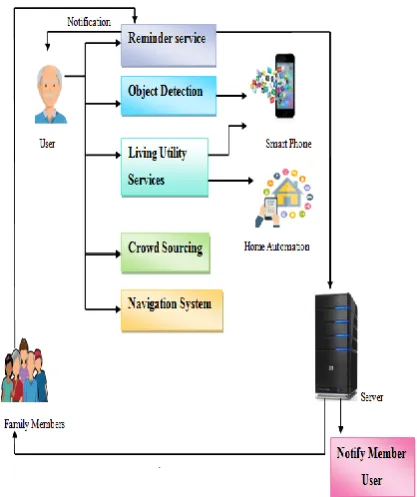
The figure 1 shows the system architecture. Users can add details, add reminder, input voice command, ask for help and can also navigate the places. They used to get the notification from the reminder which they have added. Mobile application can identify the objects, query some execution and can also perform different mobile operations such as can make call, read SMS, send SMS. Server save the details, find the nearby user, send notifications to the respective use. The methods and algorithm used for system design is explained in below.
The object detection algorithm is applied to many objects which are taken by camera. Camera captures the objects and the image is processed and identifies the object and sends audio alert to the user phone. The subsequent functions are sustained: façade recognition, recognizing food and food materials, capital recognition, shade recognition, medicine recognition, commodities recognition and also recognizing garments.
IV. OBJECT DETECTION ALGORITHM
Input: Training images: j
Input: Training labels:
Input: Weights for each training image:
Input: Weak classifier with k-rectangle Haar-like feature: h
Input: Possible weight values: v Set to .
for t=1 to do
Set weights to be assigned to the rectangles of h. Find and that minimize the training error .
arg min where,
if then
, , ,
Output: Trained weak classifier:
Output: Error of the weak classifier:
Speech Recognition is widely used for better voice recognition performance. Fundamentally, an Automatic-Speech Recognition structure contains two parts: phoneme recognition and utterance decoding. Word sequence decoding is determined as below where is word sequence and is the Language Model (LM).
Where is the Acoustic Model (AM), are the initial state probability and state transition probability. In GMM-HMM is used to balance between LM and HM scores.
Where Speech vector generated from the probability density
is a stream weight for stream s and
is multivariate Gaussian with covariance matrix and mean vector .
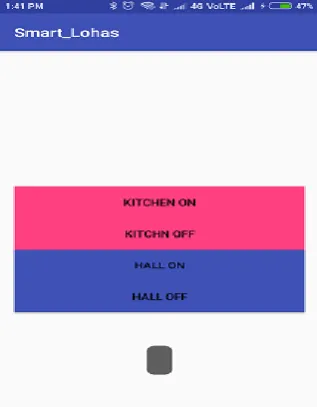
Home Automation performs the functions like switch on and off lights by using Android app. This system is designed to assist and provide support in order to fulfill the needs of elderly in home. Fig. 2 shows an example of a of Home Automation.
Fig. 2 Example of Home Automation
Reminder service is used to get the notification from the reminder which they have added. Users are able to set schedule time slits, schedule categories for instance: scheduling appointments, captivating medicines, going to cot and having feasts, prompt approaches for instance content announcements or reading a thunderous or explicit acoustic playing and subsequently prompting time intervals.
IV.RESULT&DISCUSSION
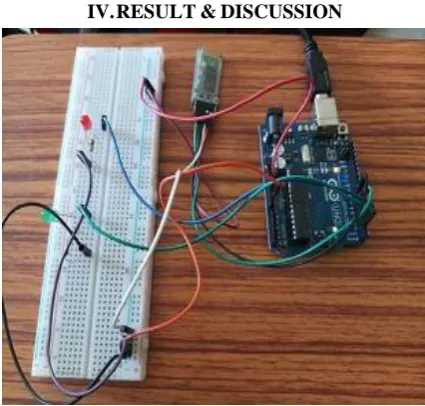
Fig. 3 Hardware module
Fig. 4 Example of objects used for testing
Fig. 5 Registration page
Fig. 7 Home Automation
Fig. 8 Object Detection
TABLEI
OBJECT DETECTION ACCURACY
We can calculate the accuracy of the each object by using Bayes rule.
Where is object and pose given a certain local measurement . is probability density function , prior probability and prior probability of the image measurement .
V. CONCLUSIONS
This paper provides smart services, an assistive outline on Android gadgets to enhance the social connectedness for senior folks. This system made out of Object Detection, Speech Recognition, Time Reminder, Home Automation, Crowd-sourcing and, is to give assistive instruments to memory, vision and choice in senior individuals everyday lives by utilizing rising innovations. The framework additionally voice intuitive and cloud-based with the goal that senior individuals can without much of a stretch utilize it and contact their supporters.
Furthermore, it is easy to use and very helpful and has important uses in daily life. Hopefully this application will help elder persons and provide services for their daily activities. In future work we can contribute new plans and usage of assistive frameworks for senior individuals.
REFERENCES
[1] H.Agrawal, C. Mathialagan, Y. Goyal, N. Chavali, P. Banik, A.Mohapatra, et al., "CloudCV: Large-Scale Distributed Computer Visionas a Cloud Service," in Mobile Cloud Visual Media Computing, G. Huaand X.-S. Hua, Eds., ed: Springer International Publishing, 2015, pp.265-290.
[2] L.Albraheem, R. AlDosari, S. AlKathiri, H. AlMotiry, H. Abahussain,L. AlHammad, et al., "Third Eye: An Eye for the Blind to Identify Objects Using Human-Powered Technology," in Cloud Computing(ICCC), 2015 International Conference on, 2015, pp. 1-6.
[3] D.Amodei, R. Anubhai, E. Battenberg, C. Case, J. Casper, B.Catanzaro, et al., "Deep speech 2: End-to-end speech recognition in english and mandarin," arXiv preprint arXiv:1512.02595, 2015.
[4] B.Ando, S. Baglio, C. O. Lombardo, and V. Marletta, "RESIMA : Adaptive paradigms for the user localization in indoor environments," inInstrumentation and Measurement Technology Conference (I2MTC),2015 IEEE International, 2015, pp. 1024-1029.
[5] B.Ando, S. Baglio, C. O. Lombardo, V. Marletta, E. A. Pergolizzi, and A. Pistorio, "RESIMA: A new WSN based paradigm to assist weak people in indoor environment," in Measurements and NetworkingProceedings (M&N), 2013 IEEE International Workshop on, 2013, pp.206-209. [6] E.Baker, "Open source data logger for low-cost
environmental monitoring," Biodiversity Data Journal, vol. 2, p. e1059, 2014.
Object names
Total trails
Accuracy Average Time(s)
Switch 4 0.533 0.7
Fan 2 0.644 0.6
Keyboard 5 0.788 0.8
Watch 3 0.645 0.6
Chair 4 0.656 0.9
Water Bottle
2 0.566 0.7
[7] G.Bhattacharya, J. Alam, T. Stafylakis, and P. Kenny, "Deep Neural Network based Text-Dependent Speaker Recognition: Preliminary Results," in Odyssey 2016, pp. 9-15.
[8] J.P.Bigham, R. E. Ladner, and Y. Borodin, "The design of human powered access technology," presented at the proceedings of the13th international ACM SIGACCESS conference on Computers and accessibility, Dundee, Scotland, UK, 2011.
[9] J.P.Bigham, C. Jayant, H. Ji, G. Little, A. Miller, R. C. Miller, et al.,"VizWiz: nearly real-time answers to visual questions," presented at the Proceedings of the 23nd annual ACM symposium on User interface software and technology, New York, New York, USA, 2010.
[10] I.Boujelbane, S. H. Said, and T. Zaharia, "Multi-object recognition and tracking with feature points matching and spatial layout consistency," in Consumer Electronics ??? Berlin (ICCE-Berlin), 2014 IEEE FourthInternational Conference on, 2014, pp. 355-359.
[11] E.Brady, M. R. Morris, Y. Zhong, S. White, and J. P. Bigham, "Visual challenges in the everyday lives of blind people,"
presented at the Proceedings of the SIGCHI Conference on Human Factors in Computing Systems, Paris, France, 2013. [12] K.Cho, B. Van Merriënboer, C. Gulcehre, D. Bahdanau, F.
Bougares,H. Schwenk, et al., "Learning phrase representations using RNNencoder-decoder for statistical machine translation," arXiv preprintarXiv:1406.1078, 2014. [13] G.Dahl, D. Yu, L. Deng, and A. Acero, "Context-Dependent
Pretrained Deep Neural Networks for Large Vocabulary Speech Recognition," Audio, Speech, and Language Processing, IEEETransactions on, vol. 20, pp. 30 - 42, 2012. [14] T.de Alencar, L. Machado, L. de Oliveira Neris, and V. de