2015 | VOLUME 11 | 395 © ARCHIVES OF BUDO | HEALTH PROMOTION AND PREVENTION
Martial arts bibliotherapy – the possibility of
compensating the negative effects of the continuous
education for aggression by electronic media and
the aggressive interpersonal relationship of children
and adults
Jarosław Klimczak
1ABCDE, Leon Andrzej Krzemieniecki
2ABCD, Dariusz Mosler
2BCD1
Faulty of Environmental Sciences, Department of Tourism, Recreation and Ecology, University of Warmia and Mazury in
Olsztyn, Poland
2
Gdansk University of Physical Education and Sport, Faculty of Physical Education, Poland
Source of support:
departmental sources
Received:
14 April 2015;
Accepted:
06 October 2015;
Published online:
15 December 2015
ICID:
1188262
Abstract
Bibliotherapy is a form of psychological support and is used in psychotherapy. The term bibliotherapy has ap-peared for the first time in Atlantic Month journal in 1916 and was defined in Oxford English Dictionary in 1920. Special usefulness of the bibliotherapy was verified by the military libraries in a field hospitals during the First World War. Wounded soldiers about traumatic experiences from the battlefield nurses and volunteers were reading a book about the entertainment character. The result of these tragic experiences is defined phe-nomenon of the combat stress reaction (CSR).
The aim of this paper is based on general principles of bibliotherapy assumptions and criteria for the creation in future models of martial arts bibliotherapy (MAB) as a method of support for people susceptible of learn-ing aggressive behaviour (preventive aspect) and for people with diagnosed aggressiveness (therapy aspect). The aim of the mentioned clinical effects of the bibliotherapy is to realize the possibility of compensating the
negative effects of continuous education to aggression by electronic media and aggressive interpersonal rela-tionships of children and adults, if only in the near future qualified experts (with social acceptance and sup-port) will competently use the MAB.
Key words: aggressiveness · agonology · combat sports · Declarations HMA against MMA· mental disorders · violence
Author’s address: Jarosław Klimczak, Faculty of Environmental Sciences, Department of Tourism, Recreation and Ecology,
University of Warmia and Mazury in Olsztyn, Michała Oczapowskiego 2, 10-719 Olsztyn, Poland; e-mail: [email protected]
Authors’ Contribution: A Study Design B Data Collection C Statistical Analysis D Manuscript Preparation E Funds Collection
I
ntroductIonBibliotherapy is a form of psychological support and is used in psychotherapy. The term bibliotherapy has appeared for the first time in Atlantic Month journal in 1916 and was defined in Oxford English Dictionary in 1920. In 1923, American Library Association (ALA) published the first in the world instruction about selection of book collections for patients [1]. From 1966 ALA has accepted, that bibliotherapy is a usage of selected reading materials as a therapeutic support in medicine and psychiatry, and also guidance in solving personal issues through dedicated reading [2]. Bibliotherapy is a form of mental support and has application in psychotherapy.
Special usefulness of the bibliotherapy was verified by the military libraries in a field hospitals during the First World War. Wounded soldiers about traumatic experiences from the battlefield nurses and volunteers were reading a book about the entertainment char-acter. The result of these tragic experiences is defined phenomenon of the combat stress reaction (CSR) [3, 4].
Degradation of interpersonal relationships in the modern world triggers numerous negative stim-uli. Therefore, one must often cope with insecurity, appreciate oneself in a competition, defend against pessimism, sadness and sense of hopelessness. The tra-dition of verbal messages (the canon of bibliotherapy) is superseded with civilisation of image and sound. In such situation, effective use of reading to solve personal problems (on a micro scale) becomes more difficult, which indisputably contributes to enhance social health (on medium and macro scale) – protec-tion against negative emoprotec-tions, sadness, regret, fear, anger and learning new role models.
Interdisciplinary nature of bibliotherapy (culture-therapy) and its broad connections with medicine, psychiatry, pedagogy, mass culture, etc. paradoxi-cally may become the one of most effective means of catharsis for a person intoxicated by electronic media with virtual and real destructive fights, neo-gladiator games and aggressive competition present [5-11] – unfortunately – in many sports [12-16] and in inter-personal relations of the youth [17-23] and adults [24-27].
On the other hand, mass education (related to the majority of world’s countries) does not transfer knowledge and do not shape skills to effectively coun-teracts these actions highly negative and destructive for human personality. Global society does not create rational mechanisms to compensate for the effects of
universal education for violence and aggression. On the contrary, the false concept of catharsis is reinforced by watching and experiencing scenes of violence and aggressiveness – such recommendation turned out to be counterproductive [6, 7, 28].
In Poland, in September 2015 major electoral cam-paign to the Parliament (it ends on 25 October) was fought and was highly publicised. The 1st World Congress on Health and Martial Arts in Interdisciplinary Approach (17–19 September 2015, Czestochowa, Poland) under the patronage of Lech Wałęsa, the Nobel Peace Prize winner was nearly missed. It is not surprising that Częstochowa Declarations of 2015: HMA against MMA is currently known almost only by participants of the congress [29].
The aim of this paper is based on general princi-ples of bibliotherapy assumptions and criteria for the creation in future models of martial arts bibliother-apy (MAB) as a method of support for people sus-ceptible of learning aggressive behaviour (preventive aspect) and for people with diagnosed aggressiveness (therapy aspect).
The aim of the mentioned clinical effects of the bib-liotherapy is to realize the possibility of compensat-ing the negative effects of continuous education to aggression by electronic media and aggressive inter-personal relationships of children and adults, if only in the near future qualified experts (with social accep-tance and support) will competently use the MAB.
The objectives of bibliotherapy
The objectives of bibliotherapy are mostly connected with RJ Rubin’s division [30] for three categories: institutional, clinical and developmental. The main objective of institutional bibliotherapy is an applica-tion of didactic literature and an assurance of appro-priate recreation. The objective of clinical bibliotherapy is a treatment of disorders and developmental biblio-therapy is focused on correction of an attitude, com-pensation and self-fulfilment.
Recipient – theory – practice
There are at least six target groups for bibliotherapy: ill persons, impaired persons, antisocial persons, stu-dents of various types of schools, parents and teach-ers, adults above 60 years old [1].
Theory and practice of bibliotherapy include follow-ing spheres of human: mental, intellectual, social and emotional. Because of its wide influence on human, it could be helpful in modification of his behaviour.
Praxiology – science about
good work. A Treatise on Good
Work, a fundamental lecture of
praxiology by T. Kotarbinski (the first edition in 1955) has been translated into majority of the so-called congress languages (English, German, Russian) and as well: Czech, Japanese, and Serbo-Croatian.
Counterproductive – from
praxiological perspective certain action can be: productive – non-productive – counterproductive – neutral. The action is
counterproductive when a
doer achieved the opposite of intended goal [80, p. 220].
These are important aspects connected with quality of life, fulfilment of needs (including personal and loved ones safety in view of escalation of violence and aggression), personal identity and creative attitude. Methodology of bibliotherapy is based on literary, psychological and increasing influence of praxeolog-ical principles. In the area of interest primal specific means of influence on reader such as text, plot and characters remain unchanged.
Elaborated methodology of bibliotherapy can be a foundation of general principles of counteraction in this difficult situation, where main means of acquir-ing knowledge of this phenomena are description of struggle of characters in belles-lettres, didactic and scientific literature. Some people may find interest in exploration of knowledge about struggle in liter-ary descriptions about foiling an alien invasion, and others – in studying scientific papers from the field of agonology (science of struggle [31]).
In the case of any martial arts identified with all dimensions of health [32-34] and not oriented only to motor perfectionism, knowledge of the struggle can be one of the main objectives of major mental training. Dialogue of Arjuna with Krisna (who imper-sonated a carter) in Bhagawadgita [35] is a typical example of mental preparation of a person to fight.
The most general principle of any type of biblio-therapy (institutional, clinical, educational) is a need of reading (or listening e.g. by persons with visual impairment) at least once text or its fragments or a set of texts with/without illustrations appropriately selected by the bibliotherapist (a competent educa-tor). Entities – actual or fictional – which are parties in a fight always determine the selection of text, story and characters in the case of bibliotherapy based on agonology or in a narrow sense of martial arts.
Because every combat sport is also a martial art (but not vice versa [36]), descriptions of judo, taekwondo, fencing, wrestling fights, etc. will always involve two fighting athletes. In the case of martial arts descrip-tions which without exception may be classified as defence arts [11, 36, 37], a person defending oneself against aggression stimulated by a group of offenders may become the main hero.
The second principle is the need to evaluate the effects even by applying the simplest methods and tools (e.g. by means of expert judgement).
The phenomenon most often recommended in
scientific and didactic articles about bibliotherapy should be subject to evaluation [1, 38]:
• identification level with literary characters and a description with fictional events;
• the effects of emotional silencing or desired acti-vation due to experiences while exploring recom-mended text;
• the effect of catharsis or its lack;
• the effect of insights “in oneself ” connected primar-ily with major personal problems of a person sub-ject to therapy;
• change of attitudes and social behaviour of a ther-apy participant.
Furthermore, modern evaluation requires an estima-tion of the basic indicators to effectively program and plan further therapy or create bibliotherapeutic mod-els for persons with similar baseline characters: num-ber of repetitions of the text in relation to a particular therapeutic effect, the time to read the text or collec-tion of texts, the degree of difficulty of the text and satisfaction from reading, etc. In additional, the effects of bibliotherapy can be measured by the results of ran-domised studies, which use i.e. psychological and ped-agogical tests of personality and life quality.
The fight can be used multilaterally if we treat it as a competition in an educational sense (and not destruc-tive one). It may be used to develop a person in a social and cultural manner, help overcome fear and complexes that unconsciously create to aggressive atti-tudes [39]. The work of authors awarded with the Nobel Prize for Literature, which rewards the uni-versal and timeless, plays an important role in this reflection. Their books translated into many languages are known on the entire world as the Nobel Prize for Literature has remained the greatest prize for litera-ture work for nearly one hundred years.
The model of bibliotherapeutic management – the proposal made by Irena Borecka [1] – may be used in shaping broadly understood positive attitudes by means of carefully selected texts and professional sup-port of bibliotherapist of this new specialty of martial arts in broader context of agonology.
Clinical effects
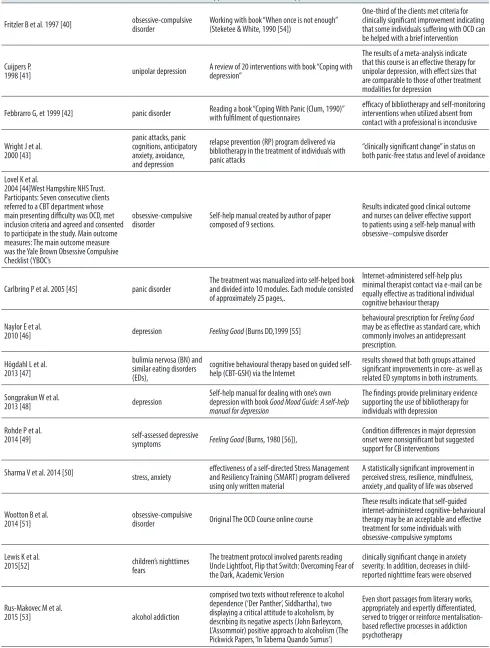
Results of clinical studies from 1997 to 2015 has given us evidences of high effectiveness of bibliotherapy in various kinds of mental disorders [40-56] (Table 1). Fear and aggressiveness are positively correlated with each other [57]. However, interpretations of the rela-tionship “frustration - aggression”, “fear – aggression”
Authors Mental disorder Applied form of bibliotherapy Result
Fritzler B et al. 1997 [40] obsessive-compulsive disorder Working with book “When once is not enough” (Steketee & White, 1990 [54])
One-third of the clients met criteria for clinically significant improvement indicating that some individuals suffering with OCD can be helped with a brief intervention
Cuijpers P.
1998 [41] unipolar depression A review of 20 interventions with book “Coping with depression”
The results of a meta-analysis indicate that this course is an effective therapy for unipolar depression, with effect sizes that are comparable to those of other treatment modalities for depression
Febbrarro G, et 1999 [42] panic disorder Reading a book “Coping With Panic (Clum, 1990)” with fulfilment of questionnaires efficacy of bibliotherapy and self-monitoring interventions when utilized absent from contact with a professional is inconclusive
Wright J et al. 2000 [43]
panic attacks, panic cognitions, anticipatory anxiety, avoidance, and depression
relapse prevention (RP) program delivered via bibliotherapy in the treatment of individuals with panic attacks
“clinically significant change” in status on both panic-free status and level of avoidance
Lovel K et al.
2004 [44]West Hampshire NHS Trust. Participants: Seven consecutive clients referred to a CBT department whose main presenting difficulty was OCD, met inclusion criteria and agreed and consented to participate in the study. Main outcome measures: The main outcome measure was the Yale Brown Obsessive Compulsive Checklist (YBOC’s
obsessive-compulsive
disorder Self-help manual created by author of paper composed of 9 sections.
Results indicated good clinical outcome and nurses can deliver effective support to patients using a self-help manual with obsessive–compulsive disorder
Carlbring P et al. 2005 [45] panic disorder The treatment was manualized into self-helped book and divided into 10 modules. Each module consisted of approximately 25 pages,.
Internet-administered self-help plus minimal therapist contact via e-mail can be equally effective as traditional individual cognitive behaviour therapy
Naylor E et al.
2010 [46] depression Feeling Good (Burns DD,1999 [55]
behavioural prescription for Feeling Good may be as effective as standard care, which commonly involves an antidepressant prescription.
Högdahl L et al. 2013 [47]
bulimia nervosa (BN) and similar eating disorders (EDs),
cognitive behavioural therapy based on guided self-help (CBT-GSH) via the Internet
results showed that both groups attained significant improvements in core- as well as related ED symptoms in both instruments.
Songprakun W et al.
2013 [48] depression
Self-help manual for dealing with one’s own depression with book Good Mood Guide: A self-help manual for depression
The findings provide preliminary evidence supporting the use of bibliotherapy for individuals with depression
Rohde P et al.
2014 [49] self-assessed depressive symptoms Feeling Good (Burns, 1980 [56]), Condition differences in major depression onset were nonsignificant but suggested support for CB interventions
Sharma V et al. 2014 [50] stress, anxiety effectiveness of a self-directed Stress Management and Resiliency Training (SMART) program delivered using only written material
A statistically significant improvement in perceived stress, resilience, mindfulness, anxiety ,and quality of life was observed
Wootton B et al.
2014 [51] obsessive-compulsive disorder Original The OCD Course online course
These results indicate that self-guided internet-administered cognitive-behavioural therapy may be an acceptable and effective treatment for some individuals with obsessive-compulsive symptoms
Lewis K et al.
2015[52] children’s nighttimes fears The treatment protocol involved parents reading Uncle Lightfoot, Flip that Switch: Overcoming Fear of the Dark, Academic Version
clinically significant change in anxiety severity. In addition, decreases in child-reported nighttime fears were observed
Rus-Makovec M et al.
2015 [53] alcohol addiction
comprised two texts without reference to alcohol dependence (‘Der Panther’, Siddhartha), two displaying a critical attitude to alcoholism, by describing its negative aspects (John Barleycorn, L’Assommoir) positive approach to alcoholism (The Pickwick Papers, ‘In Taberna Quando Sumus’)
Even short passages from literary works, appropriately and expertly differentiated, served to trigger or reinforce mentalisation-based reflective processes in addiction psychotherapy
are preferred in scientific publications [57, 58], which is believed to inform that frustration or fear often underlies aggression (aggressive act: verbal, physical or the combination of both).
We are, however, of the opinion that aggressiveness is a human trait which determines that a person reveals it in certain circumstances or the exacerbation of this trait is so high that a person searches for an opportu-nity to do aggressive act or acts. There is talk of “dis-charging aggression” and not about lack of ability to cope with one’s aggressiveness. This results in many misunderstandings of semantic nature but also cre-ates cognitive and behavioural barriers.
Finally, the directive therapeutic goal of bibliother-apy is to reduce aggressiveness. The preventive aim is to achieve such degree of patient’s (customer’s) self-control, so that he/she will be able to willingly abstain from any violence and aggression.
Perspectives and conclussions
Interdisciplinary of bibliotherapy (culture therapy) and its broad connections with medicine, psychia-try, pedagogy, mass culture etc., paradoxically could be one of the most effective means of catharsis for a men stunned by electronic media that shows virtual and real destructive fights, neo-gladiators games and aggressive competition in many sports. Meanwhile mass (global) education did not provide knowledge and there is lack of development of skills necessary to opposing effectively those highly destructive actions for human personality [59].
This situation may however be changed. When dur-ing final tournament of the Olympic Games in Tokyo (1964), a Dutchman Anton Geesing defeated Japanese champion Akio Kaminag, the world finally believed that judo is available for all in a sport sense. This is obvious. This is a feature of human nature, like the cognitive and behavioural possibilities. Therefore, judo is today one of the most popular combat sports, also among women.
However, judo as an education system and health related training basically has not been implemented only in Japan – along with kendo and sumo as Budo project [60]. Although invented by prominent Japanese – professor Jigoro Kano [61, 62] – judo is a motor and intellectual activity, available to every human being. As in the physical dimension, judo con-sists in the interplay of two people (during formal exercises kata and during randori – training and tour-nament fights), thus without mutual respect of ethical
norms, such ways of getting to know each other and the following partners and competitors would be impossible to realize. Exploring own corporeality and the one of somebody other as well as the nature is the highest value not only in judo. This principle may be extended to every martial art, where dignity and respect for the other person will be respected above all [11, 36, 63].
Here, we enter into the field of chivalry irrespective of culture and historical period [63-66]. Unfortunately, media (virtual) and actual model of contemporary warrior is the greatest obstacle, i.e. everyday shock-ing the viewer with bloody neo-gladiator fights [11]. This is the obstacle most difficult to overcome.
This is the gap to be filled by rational martial arts bibliotherapy. Competent promoters of humanistic dimension of all martial arts are necessary – both the-oreticians and practitioners.
In Poland, such ideal master is professor Stansław Tokarski. A graduate of oriental studies and phi-losophy. He won the first gold medal for Poland in the Academic Championship in Judo (Delft, The Netherlands, 1964) and at the same time continu-ously spread knowledge about philosophical and movement phenomenon of martial arts [67-69]. The booklet for the youth entitled “Power of Ernie” writ-ten by professor Tokarski [70] and published in 1990 is an example of adaptation of intellectual and eth-ical message of Jigoro Kano in the fields of martial arts about other ways of motor actions – mainly kicks. Such is a Korean taekwondo – the Olympic sport.
However, the author of first significant work in Poland which brought closer the philosophy of budo (it was not easy due to communist censorship, and therefore the title of the publication was narrowed down to the concept of “karate”) published in 1978 by Jan Harasymowicz [39]. Since today, work is fre-quently cited in scientific publications not only by experts in the science of martial arts. The author draws attention to certain similarities with the concept of budo with praxeology of Tadeusz Kotarbiński.
In terms of promoting modern vision of mar-tial arts as attractive, broadly understood meth-ods to strengthen all dimensions of health, Poland is a leader, at least on European level. Unique sci-ence about struggle – agonology was established by four Polish scientists [31]. The general theory of struggle (agonology) was established by Kotarbiński (1938 [71]). Konieczny developed a cybernetic theory
of struggle (1970 [72]). Rudniański created the theory of a non-armed struggle (1989 [73]). Kalina theory of defensive struggle (1991 [74]) and theory of com-bat sports (2000 [36]). This is an extensive place of bibiotherapy for most demanding users – intellectuals, heads of social life concerned about real threat to the quality of life, mental and social health due to esca-lation of hate speech, arrogance, violence and inter-personal aggression, and also escalation of violence in media. Furthermore, Leon Krzemieniecki has applied the theory of struggle into the interdisciplinary phe-nomena analyses of struggle, that are described in the belles-lettres [75, 76].
In Poland, unwavering popularity of martial arts is expressed in numerous scientific and popular science
publications, analysing this phenomenon from vari-ous perspectives: historical, sociological, psychologi-cal, cultural, religious, etc. Wojciech Cynarski is such example of a promoter of martial arts from broadly understood humanist perspective [77].
Polish scientists, partially in cooperation with foreign experts in the science of martial arts, create another original possibility of getting to know the phenome-non of education by friendly fight attractive for people regardless of age – fun forms of martial arts [78-80].
c
ompetIngInterestsAuthors declare no conflicts of interest.
1. Borecka I. Bibliotheraphy. Theory and practice. A guide. Polish Librarians Association. Wydawnictwo SBP. Warszawa 2001 [in Polish]
2. Szulc W. Kulturoterapia. Poznań 1988 [in Polish] 3. West R. The Return of the Soldier. The Century
Company. Print Hardback & Paperback; 1918 4. Solomon Z, Shklar R, Mikulincer M. Frontline
treatment of combat stress reaction: a 20-year lon-gitudinal evaluation study . The American Journal of Psychiatry 2005; 162 (12): 2309–2314
5. Bandura A. Aggression: A social learning analysis. Englewood Cliffs, NJ: Prentice-Hall; 1973 6. Zimbardo PG, Ruch FL. Psychology and life. Scott,
Foresman and Company, Glenview, Ilinois. United States af America; 1977
7. Aronson E. The Social Animals. W.H. Friman, New York, New York and Oxford; 1992
8. Geen R, Donnerstein E, editors. Human aggres-sion: Theories, research and implications for policy. San Diego, CA: Academic Press, 1998
9. Bushman BJ, Andersen CA. Media violence and the American public. American Psychologist 2001; 56: 477-489
10. Kalina RM, Klimczak J. Sport w profilaktyce i tera-pii agresywności młodzieży. Ministerstwo Sportu i Turystyki. Warszawa 2015 [in Polish]
11. Kalina RM, Barczyński BJ. Long way to the Czestochowa Declarations 2015: HMA against MMA. In: Kalina RM (ed.) Proceedings of the 1st World Congress on Health and Martial Arts in Interdisciplinary Approach, HMA 2015, 17–19 September 2015, Czestochowa, Poland.Warsaw: Archives of Budo; 2015: 1–11
12. Smith MD. Aggression in sport: Toward a role approach. Journal of the Canadian Association for Health, Physical Education and Recreation; 1971 371: 22-25
13. Smith MD. Aggression and the female athlete. In: Harri DV, editor. Women and Sport: A national research conference. University Park, PA: Penn State University, 1972: 91-114
14. Rowe CJ. Aggression and violence in sports. Psychiatric Annals 1998; 28: 265-269
15. Doherty A.Violence in Sports: A Comparison of Gladiatorial Games in Ancient Rome to the Sports of America. Honors Theses. Paper 9, 2001
of sport and violence, aggression and aggressiveness – prospects for education about non-aggression and reduction of aggressiveness, Arch Budo 2014; 10: 273-286
17. Bredemeier BJ, Weiss MR, Shields DL et al. The relationship of sport involvement with children’s moral reasoning and aggression tendencies. Journal of Sport Psychology 1986; 8: 304-318
18. Benson P, Roehlkepartain E. Youth violence in Middle America. Midwest Forum 1994; 3(1): 3-4 19. Bredemeier BJ. Children’s moral reasoning and
their assertive, aggressive and submissive tendenties in sport and daily life. Journal of Sport and Exercise Psychology 1994; 16: 1-14
20. Surzykiewicz J. Agresja i przemoc w szkole. Uwarunkowania socjoekologiczne. Centrum Metodyczne Pomocy Psychologiczno-Pedagogicznej. Warszawa; 2000 [in Polish]
21. Reynes E, Lorant J. Do competitive martial arts attract aggressive children? Perceptual and Motor Skills 2001; 93(2): 382-386
22. Barr P, Wubbels T. Machiavellianism in children in Dutch elementary Schools and sports clubs: Prevelence and stability According to context, sport Type, and Gender. The Sport Psychologist 2011; 25: 444-464
23. Salmivalli C, Peets K. Bullies, victims, and bully-vic-tim relationships in middle childhood and early ado-lescence. In: Rubin KH, Bukowski WM, Laursen B, editors. Handbook of peer interactions, relationships, and groups. New York: Guilford, 2009: 322-340 24. Sheard MH, Marini JL, Bridges CI, et al. The effect
of lithium on impulsive aggressive behavior in man. Am J Psychiatry 1976; 133: 1409-1413
25. Eron LR, Huesmann R. Adolescent aggression and television. Annales of the New York Academy of Sciences. 1980; 347: 319-331
26. Zimmer-Gembeck MJ, Geiger TC, Crick NR. Relational and physical aggression, prosocial behavior, and peer relations. The Journal of Early Adolescence 2005; 25: 421-452
27. Burton L, Hafelzi J, Henninger D. Gender differ-ences in relational and physical aggression. Journal of Social Behavior and Personality 2007; 35(1): 41-50 28. Green R, Quanty M. The catharsis of aggression: An
evaluation of an hypothesis. In: Berkowitz L, editor. Advances in experimental social psychology. New
29. Kalina RM (ed.) Proceedings of the 1st World Congress on Health and Martial Arts in Interdisciplinary Approach, HMA 2015,17–19 September 2015, Czestochowa, Poland. Warsaw: Archives of Budo; 2015
30. Rubin RJ. Bibliotherapy Sourecebook. London 1978 31. Kalina RM. Agonology as a deeply esoteric science
– an introduction to martial arts therapy on a global scale. Procedia Manufacturing 2015; 3: 1195-1202 32. Kalina RM. The profile of Sense of Positive Health
and Survival Abilities indices (subjective assessment) as a diagnostic tool used in health-related training. Arch Budo 2012; 8(3): 179-188
33. Jagiełło W, Sawczyn S, Jagiełło M. The subjective profile of positive health and survival abilities in women differing as to physical activity Arch Budo 2012; 8(4): 219-224
34. Bergier B. The diversity of the profiles involving the sense of positive health and survival abilities of Polish students of paramedical sciences. Arch Budo 2015; 11: 17-25
35. Bhagawadgita czyli Pieśn Pana. Biblioteka Narodowa. Akłąd Narodowy im. Osolińskich. Przekłąd z sanskrytu i przypisy. Sachse J. Wstęp Wałkówska H. Wrocław – Łódź; 1988 [in Polish] 36. Kalina RM. Teoria sportów walki. COS, Warszawa
2000 [in Polish]
37. Shishida F. Judo’s techniques performed from a dis-tance: The origin of Jigoro Kano’s concept and its actualization by Kenji Tomiki. Arch Budo 2010; 6(4): 165-171
38. Hrycyk K, editor. O potrzebie biblioterapii. Polskie Towarzystwo Biblioterapeutyczne. Państwow Pomaturalne Studium Kształcenia Animatorów Kultury i Bibliotekarzy. Wrocław; 2012
39. Harasymowicz J. Filozofia karate. Argumenty 1978; 50: 10 [in Polish]
40. Fritzler BK, Hecker JE, Losee MC. Self-directed treatment with minimal therapist contact: Preliminary findings for obsessive-compulsive dis-order. Behav Res Ther 1997; 35: 627-631
41. Cuijpers P. A psychoeducational approach to the treatment of depression: A meta- analysis of Lewinsohn’s “Coping With Depression” course. Behav Ther 1998; 29: 521-533
42. Febbraro G R, Clum G , Roodman A et al. The limits of bibliotherapy: A study of the differential
r
eferencesindividuals with panic attacks. Behav Ther 1999; 30: 209-222
43. Wright J, Clum G, Roodman A et al. A bibliotherapy approach to relapse prevention in individuals with panic attacks. J Anxiety Disord 2000; 14: 483–499 44. Lovell K, Ekers D, Fulford A et al. A pilot study of a
self-help manual with minimal therapist contact in the treatment of obsessive-compulsive disorder. Clin Eff Nurs 2004; 8: 122-127
45. Carlbring P, Nilsson-Ihrfelt E, Waara J et al. Treatment of panic disorder: live therapy vs. self-help via the Internet. Behav Res Ther 2005;43:1321-1333 46. Songprakun W, McCann TV. Using bibliother-apy to assist people to recover from depression in Thailand: Relationship between resilience, depres-sion and psychological distress. Int J Nurs Pract 2014; 2007: 716-724
47. Naylor EV, Antonuccio DO, Litt M et al. Bibliotherapy as a treatment for depression in pri-mary care. J Clin Psychol Med Settings 2010; 17: 258-271
48. Högdahl L, Birgegård A, Björck C. How effective is bibliotherapy-based self-help cognitive behav-ioral therapy with Internet support in clinical set-tings? Results from a pilot study. Eat Weight Disord 2013;18:37-44
49. Rohde P, Stice E, Shaw H et al. Cognitive-behavioral group depression prevention compared to bibliother-apy and brochure control: Nonsignificant effects in pilot effectiveness trial with college students. Behav Res Ther 2014; 55: 48-53
50. Sharma V, Sood A, Prasad K et al. Bibliotherapy to decrease stress and anxiety and increase resilience and mindfulness: A pilot trial. Explor J Sci Heal 2014; 10: 248-252
51. Wootton BM, Dear BF, Johnston L et al. Self-guided internet administered treatment for obsessive-com-pulsive disorder: Results from two open trials. J Obsessive Compuls Relat Disord 2014; 3: 102-108 52. Lewis KM, Amatya K, Coffman MF et al. Treating
nighttime fears in young children with bibliother-apy: Evaluating anxiety symptoms and monitoring behavior change. J Anxiety Disord 2015; 30: 103-112 53. Rus-Makovec M, Furlan M, Smolej T. Experts
on comparative literature and addiction specialists in cooperation: A bibliotherapy session in after-care group therapy for alcohol dependence. Arts Psychother 2015; 44: 25-34
54. Steketee G, White K. When Once is Not Enough:
Help for Obsessive-Compulsives Paperback – November, 1990 by . Paperback – November, 1990 55. Burns DD. Feeling Good: The New Mood Therapy.
Signet, New York 1999
56. Burns DD. Feeling Good: The New Mood Therapy (preface by Aaron T. Beck). New York: Wm. Morrow and Co (hardbound); New American Library; 1980
57. Apter A, von Praag HM, Plutnik R et al. Interrelationships among anxiety aggression, impul-sivity, and mood: serotonergically linked cluster? Psychiatry Res Feb 1997; 36(2) 237-9
58. Kulik J, Brown R. Frustration, attribution blade, and aggression. Journal of Experimental Social Psychology 1979; 15: 183-194
59. Klimczak J, Krzemieniecki LA, Mosler D et al. Martial arts bibliotherapy – the prospect of support of aggressiveness therapy based on cognitive-behav-ioural methods. In: Kalina RM (ed.) Proceedings of the 1st World Congress on Health and Martial Arts in Interdisciplinary Approach, HMA 2015, 17–19 September 2015, Czestochowa, Poland. Warsaw: Archives of Budo; 2015: 179–181
60. Budō: The Martial Ways of Japan. Nippon Budokan Foundation; 2009
61. Kano J. The Contribution of Judo to Education. Journal of Health and Physical Education, 58/3 (1932) 37–40 (originally a lecture given at the University of Southern California on the occasion of the 10th Olympiad)
62. Jigoro Kano and the Kodokan. An Innovative Response to Modernisation. Compile by the Kanō Sensei Biographic Editorial Committee. Edited and Translated by Alex Bennett. Kōdōkan Judo Institute; 2009
63. Sonstrom OR. A study of the Ethical Principles and Practices of Homeric Warfare. Philadelphia 1924 64. Homer. Iliada. Przekład K Jeżowska. Wstęp i przyp. J
Łanowski. Wyd. 14. Wrocław 1986 [in Polish] 65. Ossowska W. Ethos rycerski i jego odmiany. Wyd. 2.
Warszawa 1986 [In Polish]
66. Nitobe I. Bushido: The Soul of Japan. Bilingual Edition. Chong-A Printing co. Printed in Korea, 2008 67. Tokarski S. Sztuki Walki. Ruchowe formy ekspresji
filozofii Wschodu. Glob – Szczecin; 1989 [in Polish] 68. Tokarski S. Budo in transition – the challenge of
combat sports in the third millennium. Arch Budo 2006; 2: 35-39
69. Tokarski S. Kalaripayatt – the ancient indian art of self-defence. Arch Budo 2007; 3: 15-20
70. Tokarski S. Moc Erniego. Oficyna Wydawnicza “Akcent”. Komorów; 1990 [in Polish]
71. Kotarbiński T. Z zagadnień ogólnej teorii walki. Sekcja Psychologiczna Towarzystwa Wiedzy Wojskowe (From Problems of General Theory
of Struggle. Psychological Section of the Military Knowledge Association). Warszawa; 1938 [In Polish]
72. Konieczny J. Cybernetyka walki, PWN, Warszawa; 1970 [In Polish, summary in English and Russian] 73. Rudniański J. Kompromis i walka. Sprawność i
etyka kooperacji pozytywnej i negatywnej w gęstym otoczeniu społecznym. Instytut Wydawniczy Pax. Warszawa; 1989
74. Kalina RM. Przeciwdziałanie agresji. Wykorzystanie sportu do zmniejszania agresywności. PTHP, Warszawa; 1991[in Polish]
75. Krzemieniecki LA. Literacki agon w świetle teo-rii walki (E. Hemingway Stary człowiek i morze). Biblioterapeuta – Biuletyn Informacyjny Polskiego Towarzystwa Biblioterapeutycznego 2010; 3(52): 1-6 [in Polish]
76. Krzemieniecki LA, Kalina RM. Agon – a term con-necting the theory of struggle with belles-lettres. A perspective of inter-disciplinary research. Arch Budo 2011; 7(4): 255-265
77. Cynarski WJ. Teoria i praktyka dalekowschod-nich sztuk walki w perspektywie europejskiej. Wydawnictwa Uniwersytetu Rzeszowskiego. Rzeszów; 2004 [in Polish]
78. Kalina RM, Kruszewski A, Jagiełło W et al. Combat sports propedeutics – basics of judo. Wydawnictwa Akademii Wychowania Fizycznego. Warszawa 2003 79. Jagiełło W, Kalina RM, Klimczak J et al. Fun forms of martial arts in positive enhancement of alldi-mensions of health and survival abilities. In: Kalina RM (ed.) Proceedings of the 1st World Congress on Health and Martial Arts in Interdisciplinary Approach, HMA 2015, 17–19 September 2015, Czestochowa, Poland. Warsaw: Archives of Budo; 2015: 32-39
80. Pszczołowski T. Mała encyklopedia prakseolo-gii i teorii organizacji. Zakład Narodowy imienia Ossolińskich Wydawnictwo, Wroclaw-Gdansk; 1978 [in Polish]
Cite this article as: Klimczak J, Krzemieniecki LA, Mosler D. Martial arts bibliotherapy – the possibility of compensating the negative effects of the continuous
education for aggression by electronic media and the aggressive interpersonal relationship of children and adults. Arch Budo 2015; 11: 395-401