1. Introduction
The pairwise comparison method has been widely applied for representing judgments about criteria/alternatives in Multi-Criteria Decision Making (MCDM), especially in the Analytical Hierarchy Process (AHP). Such quantitative judgments are usually declared as Pairwise Comparison Matrices (PCM). The preference relations in the PCMs are filled in by the decision maker judgments and presented using different measurement scales such as the nine-point scale developed by Saaty and Vargas [17]. The judgments may be inconsistent and/or incomplete because of the limits of decision makers’ expertise and capabilities [14].
Human judgments tend to be inconsistent for decisions involving numerous criteria or alternatives. The Pairwise Comparison (PC) method is often used to elicit preferences for better decision making. In PC, a Decision Maker (DM) is asked to compare only two objects (criteria or alternatives) at a time, and a prioritization method is used to estimate the preference vector from a given set of judgments [19].
Although PC method tries to reduce the mental effort for DM when expressing his/her subjective preferences besides increasing the accuracy of estimating the intent of DM in the form of the preference
Corresponding author
E-mail address: [email protected] DOI: 10.22105/jarie.2019.169901.1078
An Efficient Nonlinear Programming Method for Eliciting
Preference Weights of Incomplete Comparisons
Mohamad Ali Movafaghpour
Department of Industrial Engineering, Faculty of Mechanical Engineering, Jundi-Shapur University of Technology, Dezful, Iran.
A B S T R A C T P A P E R I N F O
The Analytic Hierarchy Process (AHP) which was developed by Saaty is a decision analysis tool. It has been applied to many different decision fields. Acquiring Pairwise Comparison Matrices (PCM) is the main step in AHP and also is frequently used in other multi-criteria decision-making methods. In a real problem when the number of alternatives/criteria to be compared is increased, the number of Pairwise Comparisons (PC) often becomes overwhelming. Since the Decision Maker’s (DM) performance in representing the relative preferences tends to deteriorate in such cases, it is preferred to gather fewer data from each individual DM in the form of pairwise comparisons. Missing values in Pairwise Comparison Matrices (PCM) in AHP is a spreading problem in areas dealing with great or dynamic data. The aim of this paper is to present an efficient mathematical programming model for estimating preference vector of pairwise comparison matrices with missing entries.
Chronicle:
Received: 29 January 2019 Revised: 12 May 2019
Accepted:08 June 2019
Keywords:
Incomplete Pairwise Comparisons.
Analytic Hierarchy Process. Non-Linear Programming. Optimum Solution. Dynamic Data.
Journal of Applied Research on Industrial
Engineering
vector, but when the number of objects to be compared increases, the number of comparisons that DM has to make increases beyond the capabilities of human performance.
According to the principle of pairwise comparison of AHP proposed by Saaty and Vargas [17], if there are n objects, all pair-compared results are arranged in a matrix A =[aij]n*n where aij > 0, aii = 1, aij =
1/aji , and decision makers need to complete n(n - 1)/2 pairwise comparisons [10].
In some real-world situations, decision makers could not fill in all n(n - 1)/2 pairwise comparisons because of time pressure. Time pressure means that we prefer to have an instant solution based on a subset of present data which is dynamically fulfilled, instead of waiting for the completion of data gathering among a widespread group of experts. Other situations that force us to deal with incomplete PCM are unwillingness to make direct comparisons between alternatives, hesitancy or being unsure of some of the comparisons, incomplete information and limited expertise. Hence there are one or more pairs of missing entries in PCM. In such cases, PCM is called an incomplete or a PCM with missing values [17].
Dealing with incomplete information is an important problem in decision making [8]. In this paper, we present a new method for estimating preference vector without eliciting missing values of an incomplete PCM which is based on the maximization of consistency via a non-linear programming model. The problem of quantifying comparative judgments could be tackled by two main approaches. The first approach is known as multiplicative. In this framework, each entry aij in PCM estimates the relative
preference of the alternative i over j as wi/wj. The obtained multiplicative PCM A =[aij] is positive,
reciprocal (aji =1/aij ), with aii= 1, i = 1, 2, …, n [11]. In other words, a multiplicative PCM is called
consistent if and only if [11]:
, 1 , ,
ih hj ij
a a a i j hn (1)
In the second approach, also known as additive approach [11], the expert’s preferences are represented by a fuzzy preference relation r(i, j) [0, 1]. In this framework, r(i, j) indicates the preference degree of ith alternative over jth alternative as wi/(wi + wj[21]. For example, r = 0.5 indicates indifference
between ith and jth object and rij = 1 indicates that ith object is definitely preferred over jth one [1, 11].
In this paper, we focus on multiplicative PCM.
2. Problem Formulation
Suppose that there exists a preference vector W = (w1, w2, …, wn) such that wi represents the preference
intensity of ith object where i = 1, 2, …, n. The preference vector W is unknown to the DM and must be estimated trough answering to a set of pairwise comparisons. When the DM is perfectly consistent in his/her judgments, then the judgments aij have perfect values aij = wi/wj . In such a case, the PCM is said
to be (perfectly) consistent and can be represented as A = [ai j]n×n = [ wi / wj] n×n. In the case of inconsistent
PC judgments (i.e.aij ≠ aik × akjfor some i, j, k), the calculated preference vector approximates the
unknown preference vector intended by DM [19].
A well-known method proposed by Saaty and Vargas [17] uses the principal Eigenvector (EV) of a given PCM to be used as the estimate of the preference vector W [19].
max
ˆ ˆ
AW W , (2)
ˆ
where maxdenotes the maximal eigenvalue, also known as Perron eigenvalue of A and denotes the
right-hand side eigenvector of A corresponding tomax. Saaty and Vargas [17] defined the inconsistency
ratio as:
, (3)
where RInis average random consistency index for An×n [5].
In this paper we assume the erroneous judgment given by DM contains the error in the following
form:
i i j
j j i
w a
w
. (4)
The preference vector W could be calculated from the PC judgments using several mathematical techniques. In the case of error-free (consistent) judgments, all prioritization methods give the same results and the results are different when judgments are inconsistent. A summary of prioritization methods is given by Choo and Wedley [9], where 18 different methods are analyzed and numerically compared. Some of the well-known ones are reviewed here.
Harker [12] investigated an incomplete set of judgments, where DMs are allowed to respond with ‘‘do not know’’ or ‘‘not sure’’ to some judgments. It has been highlighted that the probability of acquiring incomplete PCs increases as n increases. In such cases, the AN, EV and GM methods cannot estimate preferences without applying an intermediate method to elicit the missing judgments. The GM and LLS approaches are both equivalents for complete PCs, however, only the LLS approach is applicable to incomplete PCs [19].
Harker [13] proposed a method for determining the weights for such incomplete PCMs. He replaced
the given incomplete PCM with modified matrix (called A ) in which the missing values were filled with a zero value and diagonal entries were changed; he assumed the largest eigenvalue of Aas the largest eigenvalue of the original incomplete PCM. Although this heuristic method had no proof for reaching the optimum minimum error, its main advantage was its capability to handle PCMs with several missing values. Shiraishi et al. [18] assumed a PCM with only one missing entry and developed a geometric mean to estimate the missing entry. This method then was generalized by Kwiesielewicz [15]. Kwiesielewicz [15] considered the Logarithmic Least Squares Method for incomplete matrices and proposed a weighting method based on the generalized pseudoinverse matrices. Wedley [20] proposed a consistency prediction method for incomplete PCMs.
Kou et al. [14] considered the PCM as an adjacency matrix of a graph and suggested to generate all possible spanning trees out of this graph. Since every spanning tree results in a unique preference vector
ˆ
W , in their proposed model, the mean of all preferences, and the variance were used to approximate the preference vector, and the inconsistency measurement, respectively. The main advantage of their proposed method is its capability for handling incomplete PCM’s.
Benitez et al. [2] developed an approach to complete, incomplete judgments by minimizing the Frobenius norm based matrix distance. Chen et al. [6] proved that the Connecting Path Method (CPM)
ˆ
W
max
1
n
n n CR
RI
ij
can guarantee minimal geometric consistency index, and proposed a PCM based method to estimate the missing judgments whilst improve the consistency for an incomplete PCM. Ergu et al. [10] proposed a revised geometric mean induced bias matrix to estimate the missing values for the incomplete decision matrix in the case of emergency management. The consistency ratio can be efficiently improved by the proposed model [14].
Geometric Mean Induced Bias Matrix (GMIBM) proposed by [14] is a generalization of GM, in which the missing values are filled with variables xi. Then, Geometric Mean (GM) of the rows of PCM is
assumed as wi. By estimating aij= wi/wj they establish an over-determined system of n2 equations. In
the case of perfect consistency, a single solution is obtained. Otherwise, the resulted system of non-linear equations has no solution. In such cases, the Least Absolute Error (LAE) or Least Square Method (LSM) solution is calculated as the estimate of preference vector. Since the non-linear programming models developed to find LAE and LSM solutions could not be solved exactly to the optimal solution, they reported feasible solutions for two numerical examples after some iterations.
Bozóki et al. [10] developed a Non-Linear Programming (NLP) model to minimizemax. Since they
could not provide an efficient algorithm to solve this NLP model, they proposed the iterative method of cyclic coordinates in which at each step only one variable is allowed to be optimized and the other variables are fixed to the initial values: the optimal solution is then computed by a univariate minimization algorithm. With reference to the local optimality of their proposed algorithm, there was no guaranty for reaching the global optimality of minimizing inconsistency ratio.
There are many other methods to estimate the preference vector from PC judgments. Different methods perform differently and no method outperform other methods in all situations [19]. Determining the best prioritization method entailing all aspects of efficiency remains an open problem [19]. However, Bozoki and Fulop [3] define the efficiency or Pareto optimality of a preference vector as no other preference vector is at least as good in approximating the elements of the pairwise comparison matrix. Based on this definition of an efficient preference vector, finding an efficient or Pareto optimal preference vector is equivalent to solve a multi-criteria decision problem. They define dominant and non-dominant preference vectors. They showed that the preference weights generated by the Eigenvector (EV) method are inefficient and therefore dominated solutions.
Table 1. The notation used in models.
Parameters
ai j Pairwise comparison parameter provided by the DM.
i
W A rough estimate for W as a preliminary value when formulating the model. ˆi Decision Variables
Error or deviation from the perfect judgment on relative preference between ith and jth alternative (ai j).
Maximum error or deviation from the perfect judgment for all pairwise comparisons ai j.
i
W Relative preference of ith alternative.
ˆ i
W The estimated value for the relative preference of ith alternative.
max
The maximal eigenvalue of PCM.
With the inconsistent case, the entry ai jof the given pairwise comparison matrix A is an estimation of
the ratio Wi/Wj . Since it is an estimation, when an error i j, is messing with the judgments, the relative
importance of ith object to jth one is assumed to be as: i i j j j i w a w
. (5)
In the above relation, i j, denotes the deviation of being an accurate judgment. Obviously, if i j, = 0,
then the aijwas perfectly estimated. Therefore we try to develop a mathematical model to minimize
such error ij when estimating values for relative preferences. As it was noted in Eq. (2), the estimated
values for relative preferences are calculated as:
max
ˆ ˆ .
AW W (6)
In case of perfect and error-free judgments max equals n, and for the imperfect case max is greater:
max n max n .
(7)
In order to minimize the error or deviation from the perfect judgment among all pairwise comparisons, inconsistency ratio CR is to be minimized:
max
( 1) 1
n
MinCR Min Min
RI n n
. (8)
Based on Eq. (6) we can write:
( )
max
i ,
i
A W w i . (9)
( )
( ) , .
i
i
A W n w i
(10)
,
. .
( )
1
, 0
i j i i
j i i i Minz S t
a w n w i
w w
(11)Above model assumes that DM makes all comparisons between alternatives and provides all parameters
ai j to the model. In case of incomplete PCM, model (11) is revised as follows:
, , ,
| 0 | 0
. .
1
1 (1 )
, 0, free in sign
i j i j
i i
i j j i i
j a j a
i i i
i i
Min s t
w
a w w i
w w i
w i
(12)3. Proposing a New Method for Incomplete Comparisons
In order to find preference weights Wibased on available incomplete PCM A, Non-linear Programming
model (12) is to be solved. In this model, two sets of parameters are required to formulate the problem: incomplete comparisons ai,j and set of rough estimates for Wicalled as Wi . When Eq. (12) is solved
based on a given estimate vector W , a better estimate vector W is found. Since this solution has less
error than the preliminary estimate W , the above optimization process should be executed again to improve the relative optimality. In other words, in each optimization iteration, the optimal solution of the preceding iteration is used as the preliminary estimate W to find a relatively dominant vector W. This iterating procedure is repeated until the convergence is achieved. It is worthy to be noted that in all experimentations, the convergence was achieved just by on iteration.
4. Numerical Example
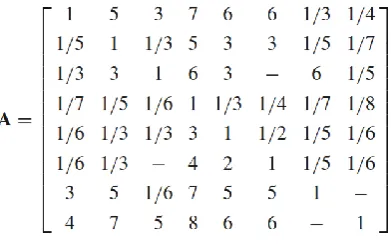
For example, consider the following PCM with missing values from Chen and Triantaphyllou [7]:
(13)
According to the procedure proposed by [12], the preference vector W is estimated as:
Table 2. Calculated preference weights based on two methods.
w1 w2 w3 w4 w5 w6 w7 w8
Harker [12] 0.259064 0.080198 0.287962 0.026216 0.046503 0.052187 0.247869 0.500041 Our Method 0.169920 0.052486 0.193687 0.017218 0.030507 0.034939 0.165256 0.335987
If the missing entries a3,6 and a7,8 are estimated as wi/wj based on two above methods, the resulting two
As it can be seen Table 3, the resulted maximal eigenvalue of the PCM completed by our method is less than [12]; also if we compare the eigenvector of both completed PCMs, it will be found that the preference vector calculated by our method has much less deviation from eigenvector.
Table 3. Comparing the results of two methods.
Harker [12] Our Method
Estimated a3,6 5.51785479 5.543587285
Estimated a7,8 0.495697065 0.491852196
λMax 9.678019348 9.677919907
Eigenvector
0.172705
0.053464
0.191969
0.017477
0.031001
0.034791
0.165241
0.333352
0.1726822
0.0534559
0.1919536
0.0174764
0.0309995
0.0347713
0.1650832
0.3335777
5. Conclusions
In this paper, we developed a novel method to extract the hidden preference weight vector in the incomplete judgments of experts. The main contribution of this research was to prepare an estimate with the least error with regard to a maximal eigenvalue. Our developed method gave results with less maximal eigenvalue for the solved instance when was compared with the well-known method in the literature. Although the absolute difference between preferences weights was found by our developed method with those that was found with the method in the literature was small, its main advantage was using the optimization approach instead of a heuristic methodology. Although our developed model is a nonlinear, but its solution time for solving into the global optimality by a well-known commercial optimization package LINGO is less than one minute in all cases observed. In our future research, we are seeking for overall optimality proofs for our provided methodology. Since the starting values are selected ad libitum, it is a core problem to select good starting values for proving the global optimality of the overall procedure.
References
[1] Alonso, S., Chiclana, F., Herrera, F., Herrera‐Viedma, E., Alcalá‐Fdez, J., & Porcel, C. (2008). A consistency‐based procedure to estimate missing pairwise preference values. International journal of
intelligent systems, 23(2), 155-175.
[2] Benítez, J., Carrión, L., Izquierdo, J., & Pérez-García, R. (2014). Characterization of consistent completion of reciprocal comparison matrices. Abstract and Applied Analysis. http://dx.doi.org/10.1155/2014/349729 [3] Bozóki, S., & Fülöp, J. (2018). Efficient weight vectors from pairwise comparison matrices. European
journal of operational research, 264(2), 419-427.
[4] Bozóki, S., Fülöp, J., & Koczkodaj, W. W. (2011). An LP-based inconsistency monitoring of pairwise comparison matrices. Mathematical and computer modelling, 54(1-2), 789-793.
[6] Chen, K., Kou, G., Tarn, J. M., & Song, Y. (2015). Bridging the gap between missing and inconsistent values in eliciting preference from pairwise comparison matrices. Annals of operations research, 235(1), 155-175.
[7] Chen, Q., & Triantaphyllou, E. (2001). Estimating data for multicriteria decision making problems: optimization techniques. Encyclopedia of optimization, 567-576.
[8] Chiclana, F., Herrera-Viedma, E., Alonso, S., & Herrera, F. (2008). A note on the estimation of missing pairwise preference values: a uninorm consistency based method. International journal of uncertainty,
fuzziness and knowledge-based systems, 16(supp02), 19-32.
[9] Choo, E. U., & Wedley, W. C. (2004). A common framework for deriving preference values from pairwise comparison matrices. Computers & operations research, 31(6), 893-908.
[10] Ergu, D., Kou, G., Peng, Y., & Zhang, M. (2016). Estimating the missing values for the incomplete decision matrix and consistency optimization in emergency management. Applied mathematical modelling, 40(1), 254-267.
[11] Fedrizzi, M., & Giove, S. (2007). Incomplete pairwise comparison and consistency optimization. European
journal of operational research, 183(1), 303-313.
[12] Harker, P. T. (1987). Alternative modes of questioning in the analytic hierarchy process. Mathematical
modelling, 9(3-5), 353-360.
[13] Harker, P. T. (1987). Incomplete pairwise comparisons in the analytic hierarchy process. Mathematical
modelling, 9(11), 837-848.
[14] Kou, G., Ergu, D., Lin, C., & Chen, Y. (2016). Pairwise comparison matrix in multiple criteria decision making. Technological and economic development of economy, 22(5), 738-765.
[15] Kwiesielewicz, M. (1996). The logarithmic least squares and the generalized pseudoinverse in estimating ratios. European journal of operational research, 93(3), 611-619.
[16] Oliva, G., Setola, R., & Scala, A. (2017). Sparse and distributed analytic hierarchy process. Automatica, 85, 211-220.
[17] Saaty, T. L., & Vargas, L. G. (2012). Models, methods, concepts & applications of the analytic hierarchy
process (Vol. 175). Springer Science & Business Media.
[18] Shiraishi, S., Obata, T., & Daigo, M. (1998). Properties of a positive reciprocal matrix and their application to AHP. Journal of the operations research society of japan, 41(3), 404-414.
[19] Siraj, S., Mikhailov, L., & Keane, J. A. (2012). Enumerating all spanning trees for pairwise comparisons. Computers & operations research, 39(2), 191-199.
[20] Wedley, W. C. (1993). Consistency prediction for incomplete AHP matrices. Mathematical and computer
modelling, 17(4-5), 151-161.