Journal of
Applied Research on Industrial Engineering
Journal of Applied Research on Industrial Engineering Vol. 2, No. 2 (2015) 97-110
Identifying Effective Criteria in Agile Project Management and Ranking
Projects Regarding the Employer and the Contractor’s Perception using
TOPSIS Method; The Case of Foolad Technique Co.
Hadi Shirouyehzad
1, Arash Shahin
2, Mina Dayani
3*1Department of Industrial Engineering, Najafabad Branch, Islamic Azad University, Najafabad, Iran
2 Department of Management,University of Isfahan, Isfahan, Iran ([email protected])
3Department of Industrial Engineering, Najafabad Branch, Islamic Azad University, Najafabad, Iran ([email protected])
A B S T R A C T A R T I C L E I N F O
To achieve the business goals, projects must be accurately done by project-based organizations. So, the aware of project performance is vital for this type of organizations. Given the projects play an important role in the development of any society, so the use of the best ways to implement, is very important. One of the most important methods employed is agile project management .method that the purpose of the application of this approach is delivering value to the employer. The employer in this project plays an important role. The contractor will also have an important role in the implementation of projects, knowledge of the perceptions of the employer and contractor project management agility standards play an important role in improving implementation of the projects. The purpose of this paper is that examine the criteria for agile project management, then compare it with the traditional method. Therefore, evaluates the projects in Foolad Technique according to perception of contractors and employer of the criteria for agile project management agility using MCDM. From 6 project which studying in Foolad Technique, project of Foundation equipment Abarkooh rolling Hall, received the highest level of priority based on perception of contractors and employers. The managers can increase and estimate the agility level of their organization through knowing and using these criteria.
Article history :
Received: 10 April 2015 Received in revised format: 15 May 2015
Accepted: 1 June 2015 Available online: 10 September 2015
Keywords :
Project Management, Agility, Agile Project Management, , Perception, Foolad Technique, Employer, Contractor, TOPSIS
1.
Introduction
98
attract innovation and creativity in development team. Since the customer is one of the most important elements of project management, it plays a crucial role in project managers’ decisions (Kenboy and Morgan, 2011). Because customer satisfaction by determining the customer's perception of quality, his expectations and preferences is determined (Horn and Rudolf 2011). It seems to measuring customers' perceptions of agile project management standards and focus on their needs can be achieved customer satisfaction and ultimately organizational agility.
APM principles, similar to Lean Thinking principles are based on flexibility and simplicity. They are developed by iterations and add value to customers by means of short-time deliverables (Chin2004; Highsmith 2004). In traditional projects, customer had a limited partnership with the project team members and the only requirements are estimated at the beginning and at the end of the project as well as feedback to the project team. In agile projects, customer collaboration is essential in all phases of the project, and is one of the important factors which leads to success in these types of projects (Hoda et al2011). Each project-oriented organizations consisting of several projects, therefore, awareness of organization’s performance is vital. In order to evaluate the performance of an organization in addition to well-known efficient projects to organization, provide this possibility for other projects inspired a major project to improve their processes and be able to achieve their desired position (Cao and Hoffman 2011).
Although the agility model has been proposed in recent years and some studies are carried in this area, there is no text directly related to the subject of this study. But some findings that somehow related to this subject are as follows:
Chow and Cao (2008) studied on the critical success factors of agile software development projects using quantitative approach. Based on existing literature, a preliminary list of potential critical success factors of agile projects were identified and compiled. These were Management Commitment, Organizational Environment, Team Environment, Team Capability, Customer Involvement, Project Management Process, Project Definition Process, Agile Software Techniques, Delivery Strategy, Project Nature, Project Type and Project Schedule. Subsequently, reliability analysis and factor analysis were conducted to consolidate this preliminary list into a final set of 12 possible critical success factors for each of the four project success categories – Quality, Scope, Time, and Cost. After that a survey was conducted among agile professionals. The results revealed that only three critical success factors for Agile software development projects: (a) Delivery Strategy, (b) Agile Software Engineering Techniques, and (c) Team Capability were supported.
Stankovic et al (2013) verified the classification of critical success factors previously described in study by Chow and Cao (2008). Their results match with the results from the previous study in suggesting that strong executive support and project type has no influence on the success of agile project. But they introduced Customer involvement, Project management process, agile software engineering techniques and Project nature as the effective factors in agile management.
99
Most literature on agile project management is in software industry, As well as studies on the perceptions of contractors and employers and ranking projects based on them have not been conducted, So the purpose of this article is to identify effective criteria in agile project management in non-software industry and then ranking project based on contractor & employer’s perceptions of effective criteria in agile project management with using Topsis method.
So in this research, at first, we study the available literature recognize agile project indicators affecting project management agility in the industry software. Then compare the agile and traditional project management. After introducing and measuring perceptions of contractors and employers. We will consider the project as options and perceptions as indicators, projects using the TOPSIS rated and then conclusions from the studies presented.
2.
Agile Project Management
Undoubtedly, project management is one of the most important and widely used branches of management over the past few decades. The fundamental principle of APM is, therefore, a shift from the traditional and prescriptive “plan-then execute” project paradigm (Leybourne 2009).
Agility instead of focusing on the process and methodology is focused on the behavior and environment.
Working practices of APM focus on frequent, sustainable iterative deliveries by multi-functional, intercommunicative teams. Agile processes and methods have led to worthwhile improvements in project management, organizational skills, productivity, quality, and business satisfaction (Shine 2003; Stapleton and Consortium 2003; Boehm and Turner 2004).
This method when create complex conditions with uncertainty requirements, gradual improvement and repeatable can lead to good results (Fernandez & Fernandez2009).
All practices and agile project management standards are based on a series of principles and values.
The official definition of Agile Software Development was contained in a form of ‘‘manifesto’’ in February 2001 by a group of 17 noted software process methodologists, who attended a summit meeting to advocate for a better way of developing software and then formed the Agile Alliance (Chow and Cao2008).
The ‘‘Manifesto for Agile Software Development’’ posted on the Agile Alliance website (http://www.agilemanifesto.org) read as follows:
Individuals and interactions over processes and tools Working software over comprehensive documentation Customer collaboration over contract negotiation Responding to change over following a plan
That is, while there is value in the items on the right, we value the items on the left more (Agile Manifesto, 2014).
100
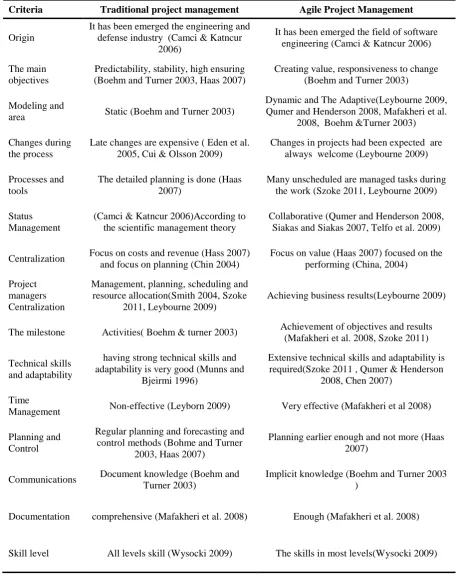
Table 1. Comparison between agile project management and Traditional project management
Criteria Traditional project management Agile Project Management
Origin
It has been emerged the engineering and defense industry (Camci & Katncur
2006)
It has been emerged the field of software engineering (Camci & Katncur 2006)
The main objectives
Predictability, stability, high ensuring (Boehm and Turner 2003, Haas 2007)
Creating value, responsiveness to change (Boehm and Turner 2003)
Modeling and
area Static (Boehm and Turner 2003)
Dynamic and The Adaptive(Leybourne 2009, Qumer and Henderson 2008, Mafakheri et al.
2008, Boehm &Turner 2003) Changes during
the process
Late changes are expensive ( Eden et al. 2005, Cui & Olsson 2009)
Changes in projects had been expected are always welcome (Leybourne 2009)
Processes and tools
The detailed planning is done (Haas 2007)
Many unscheduled are managed tasks during the work (Szoke 2011, Leybourne 2009)
Status Management
(Camci & Katncur 2006)According to the scientific management theory
Collaborative (Qumer and Henderson 2008, Siakas and Siakas 2007, Telfo et al. 2009)
Centralization Focus on costs and revenue (Hass 2007) and focus on planning (Chin 2004)
Focus on value (Haas 2007) focused on the performing (China, 2004)
Project managers Centralization
Management, planning, scheduling and resource allocation(Smith 2004, Szoke
2011, Leybourne 2009)
Achieving business results(Leybourne 2009)
The milestone Activities( Boehm & turner 2003) Achievement of objectives and results (Mafakheri et al. 2008, Szoke 2011)
Technical skills and adaptability
having strong technical skills and adaptability is very good (Munns and
Bjeirmi 1996)
Extensive technical skills and adaptability is required(Szoke 2011 , Qumer & Henderson
2008, Chen 2007) Time
Management Non-effective (Leyborn 2009) Very effective (Mafakheri et al 2008)
Planning and Control
Regular planning and forecasting and control methods (Bohme and Turner
2003, Haas 2007)
Planning earlier enough and not more (Haas 2007)
Communications Document knowledge (Boehm and Turner 2003)
Implicit knowledge (Boehm and Turner 2003 )
Documentation comprehensive (Mafakheri et al. 2008) Enough (Mafakheri et al. 2008)
Skill level All levels skill (Wysocki 2009) The skills in most levels(Wysocki 2009)
101
and 40% reduction in pre-, and post-release defect rates comparing to the industry average (Szoke 2011).
Using agile practices significantly reduced the risk of the project (Schatz and Abdelshafi, 2005), then the project delivery time will be reduced and ultimately lead to customer’s satisfaction (Chen2004).
4.
Multiple Criteria Decision Making (MCDM)
One of the most common methods of management and planning is the use of techniques that can help them achieve the best option. Some of these techniques can be noted that the multi-criteria decision-making and a kind of this is multiple indicators models including TOPSIS (Hobbs and Meier 1994).
This section describes the TOPSIS method to ranking criteria. Then in order to calculate the weighting of criteria Shannon entropy method is explained.
4.1.
TOPSIS Method
Decision-making process with multiple criteria is one of the most important techniques in project management because it can simultaneous considering qualitative and quantitative variables assess processes and analyze their complex problems, can also be combined individual weights and criteria provide everyone an acceptable result ( Zavadskas et al 2014).
With regard to the dependence of the final result to weight criteria, therefore, the benefit of expert opinion to prevent improper selection weight of criteria and create balance between limited resources and characteristics objectives are essential.
TOPSIS review a MADM problem with the m option as a geometric system with m points in n-dimensional space of the criteria. This method is based on the concept that the option chosen should be the least distance from the ideal solution (ie achieving the lowest gap in each criterion) and would have further distance from the anti-ideal solution (ie achieve maximum levels in each criterion). TOPSIS defines index that it is similar to ideal solution and avoid anti-ideal solution. Then this method selected option that is closest to the anti-ideal solution (Wang and Chang 2007).
In this case, the solution steps to TOPSIS method is as follows:
Step 1: D matrix must be normalized with using Norm method
𝑟𝑖𝑗= 𝑟𝑖𝑗 (∑𝑚 𝑟𝑖𝑗2
𝑖=1 )1/2
, (𝑖 = 1, … . , 𝑚) (1)
IT is called 𝑁𝐷 matrix.
Step 2: Normalize weight matrix is calculated as follows:
𝑉 = 𝑁𝐷× 𝑊𝑛×𝑛 (2)
In the equation (2) Wn×n & V represents the diagonal weight matrix and Normalize weight matrix.
102
Step 3: The positive ideal alternative A+, and the negative ideal alternative A-, can be defined
as:
𝐴+= {(max
𝑖 𝑣𝑖𝑗|𝑗 ∈ 𝐽1), {{min𝑖 𝑣𝑖𝑗|𝑗 ∈ 𝐽2} |𝑖 = 1,2, … . 𝑚}} (3)
𝐴−= {(m𝑖𝑛
𝑖 𝑣𝑖𝑗|𝑗 ∈ 𝐽1), {{max𝑖 𝑣𝑖𝑗|𝑗 ∈ 𝐽2} |𝑖 = 1,2, … . 𝑚}} (4)
𝐴𝑖+= (𝑣1+, 𝑣
2+, … , 𝑣𝑛+)
𝐴𝑖−= (𝑣1−, 𝑣2−, … , 𝑣𝑛−)
That:
𝐽
1=
{1,2, … , 𝑛| j associated with positive criteria}
𝐽
2= {1,2, … , 𝑛| j associated with negetive criteria}
Step 4: Calculating the separation measure of the positive and negative ideal alternatives, 𝑑𝑖+
and 𝑑𝑖− using Eq 5.
𝑑𝑖+= {∑(𝑣𝑖𝑗 − 𝑣𝑗+ )2 𝑛
𝑗=1
}
1/2
, (𝑖 = 1,2, … , 𝑚) (5)
𝑑𝑖−= {∑(𝑣
𝑖𝑗 − 𝑣𝑗− )2 𝑛
𝑗=1
}
1/2
, (𝑖 = 1,2, … , 𝑚)
Step 5: Calculating the relative closeness, Ci, to the positive ideal alternative is calculated using
Eq. (6).
𝐶𝑖+= 𝑑𝑖−
(𝑑𝑖−+ 𝑑 𝑖
+) , (𝑖 = 1,2, … , 𝑚) (6)
Where 0 < 𝐶𝑖+< 1 . The larger the criteria value is the better the evaluation of alternative will be.
4.2.
Entropy
If there was no standard for the measurement of indicators, the indicators can be weighted through Shannon Entropy calculated as follows.
Step 1:
Decision matrix quantization & normalization process the direct method
𝑛𝑖𝑗= 𝑎𝑖𝑗
∑ 𝑎𝑖𝑗 (7)
Step 2:
The entropy weight value and weights can be obtained directly by calculating the evaluation matrix. For the evaluation matrix, the entropy of the jth indicator is defined as follow:
𝐸𝑗 = −𝐾 ∑ 𝑛𝑖𝑗 𝐿𝑛 𝑛𝑖𝑗 𝑗 = 1, 𝑛 𝑘 = 1 𝐿𝑛 𝑚
𝑚
𝑖=1
(8)
103
Step 3: Then the 𝑑𝑗 (deviation degrees) is calculated.
𝑑𝑗= 1 − 𝐸𝑗 (9)
Step 4: The weight 𝑊𝑗 is calculated. After that, the best weight is selected:
𝑊𝑗=
𝑑𝑗
∑𝑛 𝑑𝑗
𝑗=1
(10)
5.
Methodology
This study plans to present a model by a 5 step process in order to priority projects based on their performance on measures of project management agility. The steps of the study are summarized as follows:
Fig 1. Research steps
Step 1.
By doing comparative studies between parameters obtained and all studies done, it seems that the study done by Chow and Cao in 2008 was more comprehensive than other studies, and its indicators encompasses all the criteria for project management agility. Therefore, a questionnaire was distributed among some project management agility topics. So effective criteria in agile project management found with distributing of a questionnaire includes all of criteria Chow & Cao study, among various projects managers and the persons which were familiar with agile project management method.
Step 2&3.
Agile project management effective role of employer is inevitable in such a way that all activities carried out in this area is to provide value to the employer. When the contractor is doing the project and is providing service to the employer, there are tangible and intangible criteria in fact; project agility and ultimately customer satisfaction will affected.
In all of these measures to assess the project agility is used, the employer must somehow be involved. Given the intangible nature of some measure of agility, it may be difficult to find an organization the employer what to expect from the agility and understanding of performance in relation to have agility, therefore, assessing this factor can be an important step to achieve the agility and the customer is satisfied. When the contractor found how the employer can evaluate their actions in terms of his desire to increase the agility match. Therefore, we must examine the
1. 1. Identification of effective criteria in project management agility
5. Ranking the projects with contractors' perceptions by Topsis method
1. 4. Ranking the projects with employers' perceptions by Topsis method
2. Study and measure employers' perceptions of project management agility criteria
104
perceptions of contractors and employers in project management are more crucial than ever. For this purpose two questionnaire distributed among contractors and employers.
Employer /contractor should rate the importance of these factors in project management agility, using a 5-point Likert scale. Here, the number related to each category and sub-category is obtained by calculating the arithmetic mean of the values of each category obtained by the projects of the organization. The result is a number between 1 and 5, and shows the employer's (contractor) perceptions in the related projects.
To assess the validity of the questionnaire, first the indicators in other research were used. Then on several occasions, the pilot questionnaire was distributed among the person which were familiar with agile project management. This resulted in correction, elimination and addition of some parameters based on the conditions and environment of the research. Finally, the questionnaire was designed in a way that reflects the indicators of project management agility. After doing the revision and verification of content and face validity, the questionnaire was distributed.
To assess the reliability of the questionnaire, Cronbach's alpha coefficient was used. To this end, a bilateral questionnaire was distributed among employers & contractor. Using the data obtained from the questionnaire, SPSS software and Cronbach's alpha coefficient, we were able to calculate the reliability for the whole questionnaire, each of the main categories, sub-categories and expectations and perceptions, separately. It should be noted that the Cronbach's alpha coefficient above 0.7 indicates high reliability, between 0.5 and 0.7 indicates acceptable reliability and less than 0.5 indicates poor reliability.
Step 4&5
TOPSIS method is a method of multi-criteria models. The purpose of using these models is select one option among other options under different parameters. In this study, according to various criteria is desired, the various projects of the organization as alternative and understand the employer/ contractor as criteria, is considered. In this case, a project known as the first place that has minimum distance from the highest perception, similarly, the rating of other projects is done.
In this way the different performance of projects against each other based on the perceptions of the criteria for project agility evaluated and for this purpose the TOPSIS model described can be solved.
In 2012 The Company, as a leading engineering company in the province which has lots of developmental plans, was recognized as one of the most advanced departments in quality control. Due to the sensitive nature of the projects, the need to present a method for improving the quality of projects is seen.
So, as example 6 project where the contractor is Foolad Technique Company and AbarKoh steel and Zobahan steel as the employer of the project have been selected.
105
To study the sample population, three types of questionnaires were distributed among project management experts, contractors (project managers of Foolad Technique Company) and Employers of Abarkooh steel projects and Zob Ahan steel projects.
The first questionnaire from the perspective of specific criteria resulted of Chow & Cao research in non-software industries, were distributed among 45 different managers.
The second questionnaire, were distributed among employers to know the employer's perception.
The third questionnaire, were distributed among contractors to know the contractor's perception.
6.
Findings
In the first stage of this study factors influencing project management agility was identified. In this regard, the distribution of a questionnaire from studies Chow & Cao (2008) among a number of project manager’s Foolad Technic project, making specific measures of agility for the organization of the project. In this case out of 5 dimension, 12 criteria and 39 sub-criteria studies Chow & Cao (2008) 4 key factor in the success of the project, 10 main criteria and 37 sub-criteria given in Table 2.
Table 2. Effective critical in agile project management
Dimension Variable
ORGANIZATIONAL FACTORS
Management Commitment Organizational Environment
Team Environment PEOPLE FACTORS Team Capability
Customer Involvement
PROCESS FACTORS
Project Management Process Project Definition Process
Project Schedule TECHNICAL FACTORS Agile Techniques Delivery Strategy
In the second and third step of study to evaluate the perceptions of contractors and employers in each of the six projects examined in Foolad Technic distributed a questionnaires.
Questionnaires measuring perceptions by study available literature and expert of project management and project-based organizations were designed. The questionnaire was designed based on Likert and its validity was confirmed by academic experts.
Cronbach's alpha coefficient was used to verify the reliability. Cronbach's alpha coefficients obtained from 0.901 for of employer’s perception and 0.922 for contractor’s perception indicate the reliability of the figures obtained from the questionnaire.
In the fourth and fifth stages of research should be based on information from the completed questionnaire, first ratings six projects in the Foolad Technic using TOPSIS be addressed.
In this case, in the fourth stage contractor’s perceptions index formed TOPSIS method and Foolad Technique research projects are using method options.
106
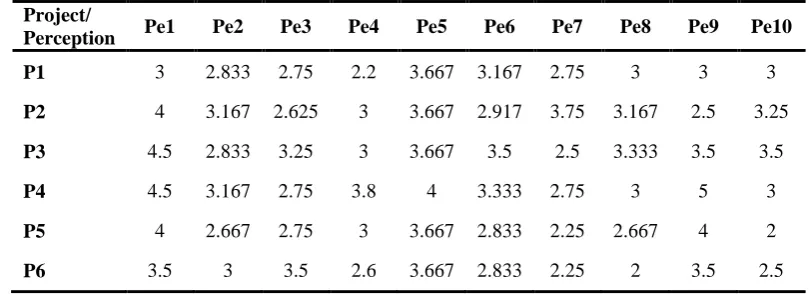
Table 3. Summary of Contractor's perception of the effective criteria in agile project management, according to 10 criteria in 6 projects
Project/
Perception Pe1 Pe2 Pe3 Pe4 Pe5 Pe6 Pe7 Pe8 Pe9 Pe10
P1 3 2.833 2.75 2.2 3.667 3.167 2.75 3 3 3
P2 4 3.167 2.625 3 3.667 2.917 3.75 3.167 2.5 3.25
P3 4.5 2.833 3.25 3 3.667 3.5 2.5 3.333 3.5 3.5
P4 4.5 3.167 2.75 3.8 4 3.333 2.75 3 5 3
P5 4 2.667 2.75 3 3.667 2.833 2.25 2.667 4 2
P6 3.5 3 3.5 2.6 3.667 2.833 2.25 2 3.5 2.5
Table 4 shows described symbols in Table 3.
Table 4. Introducing symbols
Projects Perceptions
P1: agglomeration and raw material stock in Zob Ahan Steel
Pe1: Employer's perception of management commitment
Pe6: Employer's perception of Project Management Process P2: Tavazon in Zob Ahan Steel Pe2: Employer's perception of
Organizational Environment
Pe7: Employer's perception of Project Definition Process p3: metal skeletons construction in
Abarkooh steel
Pe3: Employer's perception of Team Environment
Pe8: Employer's perception of Agile Techniques P4: foundation equipment rolling
Hall in Abarkooh steel
Pe4: Employer's perception of Team Capability
Pe9: Employer's perception of Delivery Strategy P5: the main hall engineering in
Abarkooh steel
Pe5: Employer's perception of Customer Involvement
Pe10: Employer's perception of Project Schedule P6: Roll Hall equipment foundation
engineering in Abarkooh steel
At this stage, the scale weight matrix should be formed, so the weight of criteria is achieved with using of entropy method. The results are shown in table 5.
Table 5. calculating the weight of criteria with Shannon’s entropy
Perception Pe1 Pe2 Pe3 Pe4 Pe5 Pe6 Pe7 Pe8 Pe9 Pe10
weight 0.093 0.022 0.058 0.131 0.008 0.035 0.159 0.119 0.225 0.149
And finally, the results are obtained with using the TOPSIS method. The results are shown in table 6.
Table 6. Rating of projects based on the contractor's perception
Projects P1 P2 P3 P4 P5 P6
d+ 1.056 1.177 1.212 1.265 1.049 1.049
d- 0.62 0.762 0.808 0.885 0.616 0.611
relative closeness 0.37 0.393 0.4 0.412 0.37 0.368
rating of projects 5 3 2 1 4 6
107
contractor's perception of the criteria is allocated to the project management agility. In the fifth step with regard to employer perceptions as measures and projects as options to rank projects considered. The results are shown in Table 7.
Table 7. Summary of the employer's perception of the effective criteria in agile project management, according to 10 criteria in 6 projects
projects/
perceptions Pe1 Pe2 Pe3 Pe4 Pe5 Pe6 Pe7 Pe8 Pe9 Pe10
P1 2.5 2.5 3 3.4 3.333 3.833 3.25 3.333 3 2.5
P2 3.5 3.167 3.25 3.2 4 3.833 3.75 4 3.5 3
P3 3.5 2.667 3.5 3.2 4.333 3.167 3.25 3.333 4 3
P4 3.5 3 3.25 4 4.667 3.667 3.75 3.667 3.5 3.5
P5 3.5 3.333 3.125 3.8 3.833 2.833 2.625 2.833 3.25 3.25
P6 3.5 3.5 3.625 3.5 3.833 3.25 3 3.333 3.75 3.75
At this stage scale weight matrix should be established, therefore, through entropy method the weight between perceptions is gained. The results are shown in table 8.
Table 8. calculating the weight of criteria with Shannon's entropy
Perceptions Pe1 Pe2 Pe3 Pe4 Pe5 Pe6 Pe7 Pe8 Pe9 Pe10 Weights 0.119 0.121 0.041 0.065 0.098 0.107 0.132 0.098 0.078 0.141
The model is solved and the results are showed in Table 9.
Table 9. Rating of projects based on the employer's perception
Projects P1 P2 P3 P4 P5 P6
d+ 1.023 1.19 1.141 1.233 1.09 1.189
d- 0.565 0.757 0.697 0.811 0.638 0.756
relative closeness 0.356 0.389 0.379 0.397 0.369 0.389
Rating of projects 5 2 3 1 4 2
As can be seen from Table 6 and 9 ranking projects based on the perception of the employer and the contractor is almost the same. It means that the employer and the contractor perception the same standards of agility within the organization.
Tables 3 and 7 can be seen that contractor in case of management commitment standard and employee in case of customer’s involvement standard has higher perception.
As can be seen from Table 9 project of foundation equipment Abarkooh rolling Hall has achieved the best ranking. This means that the project has been given the specific weight and the contractor's perception
of the criteria is allocated to the project management agility.
The potential of this project over other projects is to implement agile project management practices in the organization.
The contractor and employers has low perception of implementation standards of agility in Agglomeration and raw material stock project so that the lowest ranking among other projects allocated.
108
agility perception if the employer does not have such an understanding and proposed with meetings between employers and contractors works to eliminate the gap caused by the withdrawal deal and to improve project management and implementation criteria for deciding agility.
7.
Conclusion
Research aimed to study effective measures in project management agility as well as knowledge of the situation in organization on the criteria of agility and ranking projects based on the perceptions of employers and contractors of the criteria agility in 6 projects technic steel was performed. Effective standards in project management agility help project-oriented organizations to understand and implement measures to improve their processes and ultimately deliver value to the employer to achieve ultimate success.
The evaluation of an organization’s project based on the perceptions of employers and contractors to these organizations helps to identify agile projects to improve organizational performance.
The study was conducted in five stages. In the first step of this study was to identify characteristics of effective project management agility. In the second and third step measure the perceptions of contractors and employers and in the fourth and fifth steps considering the six project Foolad Technic as contractors and employers' perceptions and indicators used measure of agility as options to rank Foolad Technic projects based on TOPSIS method. After it has been proposed to assess the impact of each of the gaps in the ranking of the project was to analyze the sensitivity gaps so that proposals for improving the situation of each project submitted.
In this study, the agility of the six projects were evaluated in comparison to other, better projects and weakest projects determined, the situation was most critical measure of agility in project evaluation criteria was introduced.
Of the 6 projects reviewed, the project of foundation equipment Abarkooh rolling Hall has highest ranked project with a view to employer's and contractor's perceptions of the agile project management criteria. This means that the project has been given the specific weight is allocated to the highest entropy method. Also project 1 has earned the lowest rating.
The outcome of this research is to find ranking the projects so that the rating of projects, the priority projects that have the background necessary for the implementation of project management is agile, the other project information in order to identify weaknesses and eliminate them in order to achieve the agility.
Due to the lack of access to project-oriented organizations that are run as agile project management style this study in project-oriented organization administrate by traditional style is conducted, also in this study only examines the perceptions of contractors and employers have been investigated, so that it looks expectations of favorable conditions are also involved in the study, in addition, the design of the questionnaire was confirmed by the study data, in addition, the study of entropy weight for weighting to each of the criteria used.
In order to achieve better results, it is suggested that the proposed method is carried out in an agile project-driven organization. It is suggested to do further studies in the field of agility, perceptions and expectations more effectively considered.
109
8.
References
Boehm, B. and Turner, R. (2003). ” Using risk to balance agile and plan-driven methods”.
IEEEComputer, Vol. 36, No. 6, pp. 57–66.
Camci, A. and Katncur, T. (2006). “Technology Complexity in Projects: Does Classical Project Management Works?. PICMET.
Cao, Q. and Hoffman, J.J. (2011). ” A case study approach for developing a project performance evaluation system”. International Journal of Project Management. Vol.29, No.1, pp.155–164.
Cui, Y. and Olsson, N.O.E. (2009). “Project flexibility in practice: And empirical study of reduction lists in large governmental projects”. International Journal of Project
Management, Vol. 27, No. 5, pp. 447-455.
Chen, Q., Reichard,G. and Beliveau, G. (2007). ” Interface management_a facilitator of lean construction and agile project management”.Proceedings of the 15th International
Conference on Lean Construction Summit,16-22 July,Michigan,USA, pp. 57-66.
Chin,G. (2004). ”Agile Project Management: How to Succeed in the Face of Changing Project Requirements”. 1th edition, New York: Amacon.
Chow, T., and Cao, D. (2008). ” A survey study of critical success factors in agile software projects”. The Journal of Systems and Software.Vol. 81, No.1, pp. 961–971.
Eden,C., Ackermann,F. and Williams, T. (2005). “The amoebic growth of project costs”.
Project Management Journal, Vol. 36. No. 2, pp. 15-27.
Fernandez, D.and Fernandez, J. (2009). ”Agile project management agilism versus traditional approaches”.The Journal of Computer Information Systems,Vol. 49, No.2, p10.
Hallgren, M. and Olhager, J. (2009). ”Lean and agile manufacturing: External and internal drivers and performance outcomes”. International Journal of Operations and Production
Management, Vol. 29, No. 10, pp. 976–999.
Hass, K. (2007). ” The Blending of Traditional and Agile Project Management”. PM World
Today. Vol. 9, No. 5, pp. 18.
Highsmith, J. (2004a). Agile Project Management: Creating Innovative Products.4th
edition,Boston: Addison-Wesley.
Hobbs, B. F. and Meier, P. M. (1994). ”Multi criteria methods for resource planning: An experimental comparison”. IEEE Transactions on Power Systems, Vol. 9, No. 4, pp. 1811–1817.
Hoda, R., Noble, J. and Marshall.S. (2011). ” The impact of inadequate customer collaboration on self-organizing Agile teams. Information and Software Technology, Vol. 53, No. 1, pp. 521–534.
Horn, C. and Rudolf, M. (2011). ”Service quality in the private banking business”.Financial
Markets and Portfolio Management, Vol. 25, No. 2, pp. 173–195.
110
Mafakheri, F., Nasiri,F. and Mousavi, M. (2008). ”Project agility assessment: an integrated decision analysis approach”. Production Planning and Control, Vol.19, No.6, pp. 567-576.
Munns,A.k., and Bjeirmi, B.F. (1996). ” The role of project management in achieving project success”, International Journal of Project Management, Vol. 14, No. 2, pp. 81-87.
Narasimhan, R., Swink, M. and Kim, S. W. (2006). ”Disentangling leanness and agility:An empirical investigation”, Journal of Operations Management, Vol. 24, No. 5, pp. 440– 457.
Qumer, A. and Henderson-Sellers, B. )2008(. “An evaluation of the degree of agility in six agile methods and its applicability for method engineering”. Information and Software
Technology. Vol.50, No. 4, pp.280–295.
Schatz, B. and Abdelshafi, I. (2005). “Primavera gets agile: A successful transition to agile development”. IEEE Software . Vol. 22, No. 3, pp. 36–42.
Siakas,K. and Siakas,E. (2007). ”The agile professional culture: a source of agile quality”.Software Procees Improvement and Practice, Vol. 12, No. 1, pp. 597–610.
Stankovica,D., Nikolicb.V., Djordjevicc,M. and Caod,B. (2013). ” A survey study of critical success factors in agile software projects in former Yugoslavia IT companies”. The
Journal of Systems and Software, Vol. 86, No.1, pp. 1663– 1678.
Stare,A. (2014). ”Agile Project Management in Product Development Projects”. Proceedings of The 27th IPMA World Congress on IPMA, 19 March, Dubrovnik, Croatia, pp. 295–
304.
Szoke,A.(2011).” Conceptual scheduling model and optimized release scheduling for agile environments”. Information and Software Technology.Vol.53,No. 1, pp. 574–591.
Wang, T.C. and Chang, T.H. (2007). “Application of TOPSIS in evaluating initial training aircraft under a fuzzy environment”. Expert Systems with Applications, Vol. 33, No. 4, pp. 870-880.
Wysocki,R.K.(2009).”Effective Project Management”, 5th ed.,Indiana:Wiley publishing;InG.
Zandi, F. and Tavana, M. (2011). “A fuzzy group quality function deployment model for e-CRM framework assessment in agile manufacturing”. Computers and Industrial
Engineering. Vol. 61, No. 1, pp. 1–19.
Zavadskas, E.K., Vilutiene, T., Turskis, Z. and aparauskas, J. S. (2014). ”Multi-criteria analysis of Projects' performance in construction”, Archives of Civil and Mechanic al