MECHANOCHEMICAL PROCESSES IN THE FORMATION OF ENGINEERING
MATERIALS BASED ON POLYMERS
МЕХАНОХИМИЧЕСКИЕ ПРОЦЕССЫ ПРИ ФОРМИРОВАНИИ МАШИНОСТРОИТЕЛЬНЫХ
МАТЕРИАЛОВ НА ОСНОВЕ ПОЛИМЕРОВ
Eisymont Y.1, Assoc. Prof., Dr. Eng. Auchynnikau Y.1, Assoc. Prof., Dr. Eng. Avdeychik S.2, Ikramov A.3, Prof., Dr. Chem. Grigorieva T.4 Yanka Kupala State University of Grodno, Grodno, Belarus1, Molder LLC, Grodno, Belarus 2, Tashkent automobile and road construction institute, Tashkent, Uzbekistan 3, Institute of Solid State Chemistry and Mechanochemistry of the Siberian Branch of the Russian Academy
of Sciences, Novosibirsk, Russia 4
E-mail: [email protected], [email protected], [email protected], [email protected], [email protected]
Abstract
:
There were studied the mechanisms of interfacial processes when combining components of different composition, structure, and molecular weight in disintegrating type high-energy installations. The effects of formation of mechanochemical transformations products due to the flow of physical and chemical processes of interfacial interactions at the place of active centers of combined components were established. There were developed compositions and obtaining technology of composite materials and products containing mechanochemically combined components that cause the realization of synergies enhance the parameters of strength and tribological characteristics. The directions of the practical application of composites with mechanically activated components for the manufacture of tribological purpose products and coatings, which are used in metal-polymer constructions of vehicles and technological equipment.
KEYWORDS: MECHANOCHEMICAL COMBINATION, ACTIVE CENTERS, INTERFACIAL INTERACTION, MODIFYING EFFECT,
FUNCTIONAL COMPOSITES.
1.
Introduction
According to the classical concepts of materials science of polymer composites most important factor determining the parameters of strength and tribological characteristics of the product, is the intensity of the interfacial interactions at the components interface. By controlling the mechanisms and kinetics of interfacial interactions in the composite on the basis of thermoplastics of different composition, structure and molecular weight, it is possible to achieve the optimal value of the strength of the boundary layer, which provides a maximum modification effect [1-5].
For industrial application of new approaches to the management of interfacial interactions is necessary to develop simple technologies based on the use of the equipment, the widespread practice - mixers, crushers, dismembrators, injection molding machines etc.
An analysis of the literature on the problems of creating high wear-resistant composite materials based on thermoplastic matrices, shows promising approach based on the directional change in the energy state of the particles of the components that determine the intensity of their interaction with the formation of the boundary layer of a determined composition, structure and strength. However, the range of engineering composites obtained using special energy impacts on the components in the manufacture and processing of the materials is extremely limited, which does not allow their widespread practical use for the development and manufacture of component parts of automotive components and the process equipment of various purposes increased resource [1 2, 6-11]. A special perspective on the management of the energy state of engineering materials components are mechano-chemical technology to carry out the synthesis of new products, thermodynamically compatible with the matrix polymer directly in the process of preparing a composition [1, 2, 5, 8, 12-14].
The purpose of the work was to establish the mechanisms of formation of the energy state of components in different types of technological impacts for the optimal structure of interphase boundary layers in filled thermoplastic matrix, which defines the parameters of service characteristics.
2.
Methods of research
As binders for composites were used thermoplastic polymers - polyamide 6 (PA 6) and polyamide 11 (PA 11), high density polyethylene (HDPE), polypropylene (PP), polytetrafluoroethylene (PTFE) in the state of industrial supply (JSC "Grodno Azot" JSC
"Polymir", JSC "KhimvoloknoMogilev"). Some experiments were carried out with the regenerated thermoplastic (HDPE, PP, LDPE) obtained at JSC "Belvtorpolimer" in accordance with the existing standard documentation. To form the coatings used thermoplastics dispersed particles obtained by granular semifinished products cryogenically dispersing.
For the formation of multilayer coatings and components modifying with different kinds of technological impact used fluorides - solutions of fluorinated oligomers "Epilam" and "Foleoks" with a molecular weight of 1000 - 2000 units (manufacturer - Institute of Synthetic Rubber, St. Petersburg, Russia) and products thermogas dynamic synthesis polytetrafluoroethylene produced under the brand name "Forum" (Institute of Chemistry FEB RAS, Vladivostok, Russia).
In order to control the parameters of the energy state and dispersion of components used technological methods based on mechanical dispersion, mechanochemical combination, the impact of energy flows in the heat treatment, exposure to corona discharge, microwave, laser beam, using original cryogenic plants dispersion, rolling shear (Yanka Kupala State Universiry of Grodno), the installation of the planetary mixing AGO-2 (Institute of Solid State Chemistry and Mechanochemistry of the SB RAS) systems for the treatment of microwave radiation, laser QUANTUM-15, high-shredder dismembrator, installations for the electrostatic application of coatings (JSC "Grodno Mechanical Plant", JSC" Belcard", JSC "Lakokraska"). Selection of the type of energy impact and the conditions for the activation process has been driven by structural and chemical and dimensional parameters of components, the functionality of the coatings or products.
To obtain composite materials used highly dispersed, including nanoscale particles of carbonaceous (UDD, UDAG, nanotubes, colloidal graphite), siliceous (mica, clay, flint, shungite tripoli), fluorine (UPTFE) and metal-containing (oxides of Fe, Cu, Zn) compounds obtained by the original technology of manufacturer (JSC "Sinta", SSI "Lykov Institute of Heat and Mass Transfer", Institute of Chemistry FEB RAS), or as a result of special technological effects on the semi-finished product (mechanochemical dispersion, sublimation).
differ not only in composition, crystal-chemical structure, dimensions (dispersion), and energy state, which determines their activity during interphase interactions [1, 3, 6 9-11].
Energy state of the dispersed particles or substrate is a multi-value, depending on the magnitude of the surface energy, the formation mechanism of uncompensated charge, its relaxation time under the impact of various physical and chemical, electro-physical, thermal, and others processes.
When substantiated choice of functional materials and metal-polymer systems is necessary not only to provide a given level of
parameters on the morphology and the energy state of the dispersed particles and the coatings produced from natural and synthetic semi-finished products - clay, flint, schungite, tripoli, fragments of carbon fibers (CF), polyamide 6, polytetrafluoroethylene (PTFE) polyolefins (HDPE, PP, EVA), PET and other polyester.
Analysis of the morphology of the surface layer of single particles obtained by using various technological impacts and geochemical factors indicates the presence of nanoscale elements of spherical, whisker and plate habitus (figure 1).
a b c d e f
g h i j k l
m n o p q r
Figure 1 - The characteristic morphology of the dispersed polymer matrix modifiers: ultrafine polytetrafluoroethylene (a, b), carbon nanotubes (c, d), carbon fibers (e, f), clays (g, h), tripoli (i, j), glass (k, l), metallurgical products (m, n), shungite (o, p), cryogenic grinding
PA 6 (q, r)
The presence of such nanoscale elements in accordance with modern concepts of condensed matter physics and quantum physics determines the particular energy state of the surface layer, characterized by the concept of "nanostate" [15-18]. It is obvious that the kinetics and mechanisms of interfacial processes in the high-molecular matrix, the modified active particles depend on the parameters of the energy state and its impact on the structure of the boundary layer under the influence of technological factors in the formation of the composite.
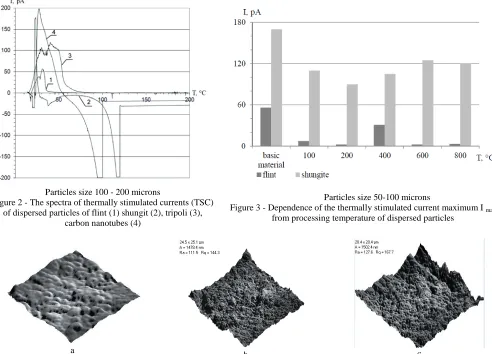
Analysis of the energy state of the dispersed particles of different composition, technological prehistory and structure under the criterion of thermally stimulated currents (TSC) indicates the presence of prerequisites of impact on the structure of the boundary layers, determined by temperature (figure 2), which manifests the effect of "nanostate" due to the presence of nanoscale elements on the modifier surface.
Another factor determining the activity of the particles, is the intensity of the impact energy (thermal, mechanical, laser, ionizing, etc.) to the semi-finished product or substrate, which defines mechanisms for desorption, dehydration, dehydroxylation,
Particles size 100 - 200 microns
Figure 2 - The spectra of thermally stimulated currents (TSC) of dispersed particles of flint (1) shungit (2), tripoli (3),
carbon nanotubes (4)
Particles size 50-100 microns
Figure 3 - Dependence of the thermally stimulated current maximum I max
from processing temperature of dispersed particles
а b c
Figure 4 - A typical morphology of the dispersed particles of flint (a), clay (b), shungite (c), subjected to heat treatment in the 250 - 450 °C temperature range
Exposure to concentrated stream of the laser radiation allows to obtain particles with a developed relief as when using the organic polymer (PTFE, HDPE, PET) and carbonaceous (CF, shungite, electrode graphite) and silicon (flint, glass) intermediates. It was established the influence of the type of power influence on the energy state of the dispersed particles. The energy parameters, characterized by value of thermally stimulated currents, while volumetric thermal impact are reduced (figure 3), while the concentrated (local) impact - increase. This factor indicates the need in the justification of technological modes of manufacture of composite materials and their processing into products accounting factor morphology and energy state to optimize the conditions of intense interfacial interaction of components at different structural levels. There were established general regularities of formation of the active state of the modifiers dispersed particles, which are caused by a combination of crystal-chemical premises and the morphology of the surface layer. The choice of the activating energy impact depends not only on the characteristics of the composition and structure of modifiers, but also on the existence of the most effective actions directly in the formation of a composite material (articles) for the given parameters of the impact of technological factors. Therefore, the optimal of modifying effect have components with developed morphology of the surface layer in which the energy parameters depend not only on the structure but also the geometry of the fragments, causing the possibility of implementing nanostate.
As previously noted, one of the most effective directions of realization of the energy factor to optimize the structure of polymer composites technology applies mechanochemical (tribochemical) effects, during which can be formed foods of interfacial interaction with the boundary layer formed by active fragments of the polymer matrix and modifier [1, 3-6, 8 12-14].
Properties of mechanical activation consists in the fact that regardless of the initial structure of the components, of their crystal structure and energy state, while exposure to a different type of mechanical stresses (compression, shear, torsion), conditions are created not only to change the morphology of the surface layer of both components to form the most developed layer but for the adsorption, including chemisorption, interaction of active fragments of various types and structures (quantum dots, radical products mechanodegradation, lattice defects, defects of the composition (impurities), etc.). At the same time in a joint mechanical activation becomes a secondary factor of stability of the active state stipulated by the presence of an electret charge, uncompensated electrons of the radical fragments of juvenile surfaces and other assumptions and the time of relaxation. Simultaneous exposure of different mechanical stresses on the components of the mixture allows for mechanisms of solid-phase interaction with the formation of non-stoichiometric products, which can not be formed by the reactions of the classical exchange and connection.
polymer and the active sites on the acidic nature of juvenile surfaces of kaolinite.
tribological coatings.
The polymer content in the mixture of 30 wt. % (1, 2) and 80 wt. % (3, 4) Figure 5 - The IR spectra of (a) and a diffraction pattern (b) mixtures of
kaolinite with PVP before (1, 3) and after MA for 4 minutes (2, 4)
The polymer content in the mixture of 30 wt. % (1, 2) and 80 wt. % (3, 4)
Figure 6 - The IR spectra of (a) and a diffraction pattern (b) mixtures of kaolinite with polyamide 6 before (1, 3) and
after MA for 4 minutes (2, 4)
As objects of research used powdered polyamide 6 with the size of the individual particles of 80-200 microns. Used for modifying the layered silicate – kaolinite Al2(Si2O5)(OH)4. The mechanical
activation was carried out in a planetary-type ball mill marks AGO-2 with water cooling.
In the process of mechanochemical combining components may flow interfacial processes leading to the formation of the boundary layer increased strength. Indeed, the IR spectra of the polyamide mixture (30 wt.% + kaolinite) after mechanical activation for 4 minutes, as in the case of pure mechanical activation kaolinite, decrease in intensity of bands and deformation vibrations of: ν, δ (Al)-OH; ν, δ Si-O-(Al), Si-O-Al respectively region 3800-3600 cm-1, 950-850 cm-1, 850-780 cm-1 with a maximum of 545 cm-1 (Figure 6, and ).
In a polymer composite diffractogram kaolinite reflexes persist only decreases their intensity: d1 = 7,17 (I/Is = 100), d2 = 3,57 (I/Is = 80)
and d3 = 3,37 (I/Is = 35). Polyamide reflexes imposed a series of
reflections of kaolinite in the d = 4,47-3,74, so we can not judge any change of polyamide reflexes settings (Figure 6b).
By increasing the content of the polyamide in the mixture, for example, up to 60%, the pattern of bands change the kaolinite and the polyamide in the IRS after mechanical activation for 4 minutes becomes completely different. After activation, fade bands corresponding to vibrations νas and νs Si-O-Si bonds of the silicon
tetrahedra frame region 1150-1050 cm-1 and with a maximum
685 cm-1. There is a decrease in the intensity and broadening of all bands of kaolinite. There has been no shift of the bands of the polymer, as well as the emergence of new bands. In this case there is, apparently, the gradual amorphization of kaolinite. However, in the presence of polymer failure of silicate structure occurs not so active. In the diffraction pattern of the sample are very weak but clear reflections from the basal planes of kaolinite: (001), d1 = 7,17
and (002) d2 = 3,57 (Figure 6b).
Polyamide reflexes broaden and merge into one with two peaks d1 =
4,4 and d2 = 3,7, indicating that certain changes in the structure of
the polymer.
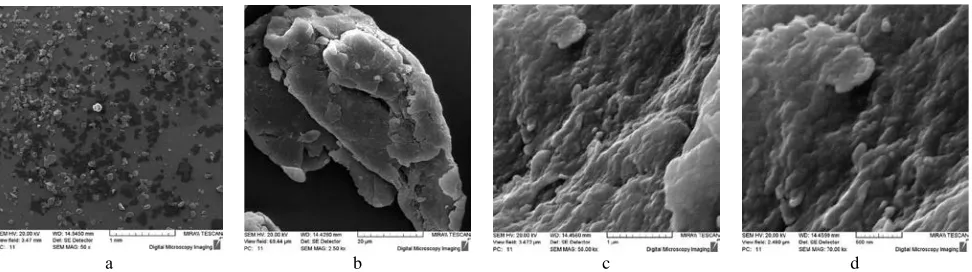
Mechanically activated particles of polyamide-kaolinite mixture are characterized by developed morphology that will likely be reflected in the activity of the system (Figure 7). Based obtained by scanning electron microscopy data is observed the presence of nanoscale fragments lateral size of 20-50 nm on the surface (Figure 7 c, d). The introduction of this mechanically activated mixture in a polyamide matrix should lead to a change in the parameters of physical and mechanical properties of the polymer matrix. This system has advantages over mechanically activated particles of metals, silicates, metal oxides, etc., as the presence of the boundary layer grafted to the silicate particles increases the thermodynamic compatibility with the base polyamide matrix.
а b c d
Figure 7 - The morphology of the particles of polyamide 6 and kaolinite: initial (a, b) and the mechanically activated for 4 min at 60g
Introduction to the polyamide matrix of mechanically activated particles leads to a change in the parameters of strength characteristics of the composite material. Table 1 shows the parameters of physical and mechanical properties of polyamide 6, modified by mechanically activated kaolinite-PA6 mixture.
Table 1 - Physical and mechanical properties of polyamide 6, modified mechanically activated particles "PA6-kaolinite"
The concentration of modifier Parameters
initial
material 0,5 % 2 % 5 %
Physical yield strength, MPa 30,6 49,5 28,3 16,2 Deformation under physical
stress limit,% 19,85 6,9 4,2 4,9 Strength at maximum force, MPa 48,6 77,6 30,2 37,6 Deformation at maximum
force,% 133,4 81,6 5,6 9,2
Strength at break, MPa 48,6 77,6 30,2 37,6 Strain at break,% 133,4 81,6 5,6 9,16
The obtained results allowed optimizing formulations of composite materials based on polyamide 6, modified by mechanically activated particles "polyamide-kaolinite" used for the application of tribological coatings.
Studies on the effect of the energy factor in the technology of functional composite materials based on thermoplastic matrices allowed us to develop formulations for use in the construction of machinery and technological equipment with high operational resources.
For the development of composite materials for the application of tribological coatings use polymer thermoplastic matrix produced tonnage, including domestic manufacturers – PA 6, HDPE, PP. Modifying the matrix polymers by functional components (tripoli, flint, kaolinite, UPTFE, HDPE) was performed by mechanochemical activation (MA), followed by grinding at cryogenic temperatures (-198 °C). The coatings are produced by fluidized bed. Comparative studies (Table 2) show that the developed compositions not only not inferior to imported analog PA 11 («Rilsan», France), but also significantly superior in its durability. This developed on the basis of the domestic polyamide 6 (JSC "Grodno Azot") compositions of composite materials have a value of 3 - 5 times lower than the imported counterpart. Compound of composites with mechanically activated components have been successfully tested in the construction of driveshafts trucks, lathe chucks, produced by JSC "Belcard" and JSC "BelTAPAZ".
Installed features of change of the energy state of the polymer particles and substrates subjected to various kinds of technological influences (thermal, laser), allowed to develop recommendations for their use as components of dietary supplements and bactericidal components of medical devices.
When using MA technology obtained layered composites in which natural silicate (talc) acts as a carrier and biologically active ingredient in the form of organic acids and salts (succinic acid, sodium succinate, chitosan succinate, sodium stearate, etc.) are chemically bound with bearer form. Compounds of mechanically activated components can be used in the preparation of
pharmaceuticals and dietary supplements of multifunctional actions using environmentally friendly way [14].
Table 2 - Characteristics of composite materials for tribological coatings
characteristics The parameter for the material PA 11
«Rilsan», France
PA 6, JSC "Grodno Azot"
Developed composition
Traction resistance, MPa, not less
43 50 67-78
The adhesion cm,
not less than 20 15 27-32
Brinell hardness,
MPa 90 100 89-94
friction coefficient 0,05-0,2 0,15-0,25 0,10-0,15
High-energy impact on the dispersion components (shungite) and plastic products (thermal or laser) provides formation of uncompensated charge with a long relaxation time, the presence of which prevents the development of pathogenic environment E. coli, Salm. enteridis, St. aureus. These results extend the range of processing methods to enhance microbicidal properties of articles made of polymeric materials based on particular components giving energy state, and can be used for the manufacture of composite materials used in medical practice.
Dispersed particles activity subjected to energy shocks, manifested in the developed morphology of the surface layer and the presence of uncompensated charge with a long relaxation time, allowed to develop effective compounds of lubricants and greases for heavy-duty friction units on the basis of industrial products. With the introduction of fine particles, activated by thermal, laser or mechanochemical action in the lubricating composition are formed charge clusters that improve the load-carrying capacity and thermal stability of the separating layer in the area of frictional contact. The compositions of lubricating oils, hydraulic fluids and greases for use in the construction of automotive components (brake chambers, driveshafts), lathe chucks for metalworking equipment and friction belt conveyors were developed. The compositions have been testing at the leading enterprises of the Grodno region (JSC "Belcard", JSC "BelTAPAZ") and recommended for implementation.
In the developed compounds of composite materials and lubricant medium developed regulatory and technical documentation, regulating their use in friction, automotive components and designs of belt conveyors.
4.
Conclusion
consists in the formation of the chemisorption bond in place of the active centers of polymer radicals and the surface layer of silicate particles (kaolinite, silica, flint). There was established possibility of mechanochemical interactions od dispersed particles of layered silicates, organic acids or their salts (succinic acid, benzoic acid, sodium benzoate, and stearates, etc.) during MA to form layered composites in which natural silicate is carrier of grafted an organic component. Expediency of mechanically activated components for obtaining of composite materials with enhanced service performance parameters is shown.
5.
Literature
1. Struk, V. Tribochemical concept of anti-friction material on the basis of tonnage produced polymer binders: diss. ... doctor. tehn. Science, Minsk, 1988, 323 p.
2. Goldade, V. Metal-wear inhibitors, Moscow, Chemistry, 1993, 240 p.
3. Ryskulov, A. Development of engineering materials based on mixtures metallopolymers: diss. ... cand. tehn. sciences, Gomel, 1990, 201 p.
4. Napreev, R. Laws fretting tribosystems and development of cutting technology environments, increasing their longevity: diss. ... cand. tehn. sciences, Gomel, 1990, 146 p.
5. Okhlopkova, A. Physico-chemical principles of tribological materials based on polymers and ceramics ultrafine: diss. .... dr. tehn. sciences, Yakutsk, 2000, 269 p.
10. Lipatov, Y. Physical chemistry of multicomponent polymer systems, Kiev: Naukova Dumka, 1986, 376 p.
11. Ryskulov, A. Metal-polymer nanocomposites: structural features, technology, application, Grodno, GGAU, 2010, 335 p. 12. Avdeychik, V. Tribochemical technology of functional composite materials: Part 1. Model ideas, Grodno, GGAU, 2008, 328 p.
13. Avdeychik, V. Tribochemical technology of functional composite materials: Part 2. The technology and application experience, Grodno, GGAU, 2008, 399 p.
14. Grigorieva, T. Mechanochemical synthesis of disperse composite laminates based on kaolinite and higher carboxylic acids - Reports of the Russian Academy of Sciences, 1995, V. 341, № 1. - p. 66-68.
15. Avdeychik, V. The nanocomposite and nanostructured materials engineering and technology for their production, Moscow, Publishing House "Spectrum", 2013, 224 p.
16. Vityaz, P. Prospective nanophase materials based on ultrafine diamonds. - Theoretical and technological foundations of strengthening and restoration of engineering products, Minsk: Tehnoprint, PSU, 2001, p. 4-8.
17. Stelmach, V. Low-dimensional systems: physical fundamentals of growing, diagnostics, operation and use of low-dimensional components and systems, Minsk: BSU, 2000, 98 p.