FORMULATIO AD DEVELOPMET OF SUSTAIED RELEASE MATRIX TABLETS COTAIIG METFORMI HYDROCHLORIDE
Deepak Gupta1, Shalini Sharma1, Sukhbir Lal Khokra1, Ram Kumar Sahu2
1. Manav Bharti University, Laddo, Solan-173229 (H.P.), India
2. Oriental College of Pharmacy, Raisen Road, Bhopal-462021 (M.P.), India. For e. mail correspondence: [email protected],
Summary
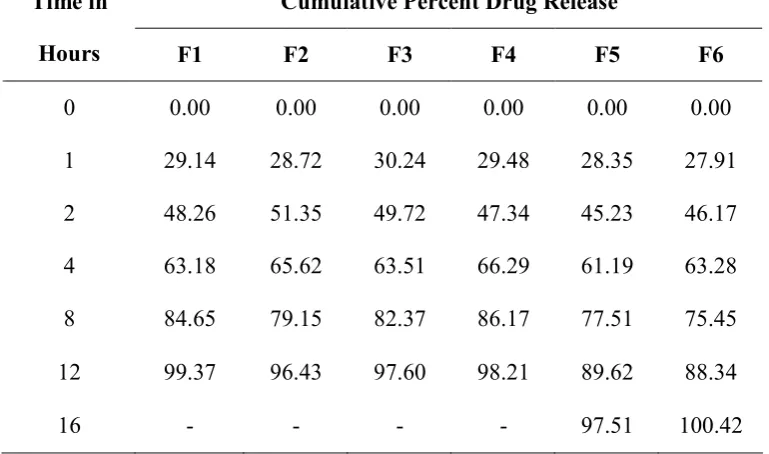
Sustained release formulation of Metformin HCl presents the formulator with significant challenges due to its poor inherent compressibility, high dose and high water solubility. The objective of the present study was to develop sustained release matrix tablets of Metformin HCl, an anti diabetic drug. The sustained release tablets were prepared by direct compression method and formulated using different drug and polymer ratios, formulations such as F1 to F6. Polymers like Sodium carboxymethyl cellulos (Sod. CMC), hydroxyl propyl methyl cellulose (HPMCK-100), Xanthan gum and HPMCK-4 were used. Tablets blends were evaluated for loose bulk density, tapped bulk density, compressibility index and angle of repose, shows satisfactory results. The compressed tablets were then evaluated for various physical tests like diameter, thickness, uniformity of weight, hardness, friability, and drug content. The results of all these tests were found to be satisfactory. The in vitro dissolution study was carried out for 16 hours using paddle method in phosphate buffer (pH 6.8) as dissolution media. Formulation F1 to F4 failed to sustain release beyond 12 hours. Among all the formulation, F6 shows 100.42% of drug release at the end of 16 hours. This finding reveals that above a particular concentration of Sod. CMC, HPMC K-100 and xanthan gum are capable of providing sustained drug release.
Key words Sod. CMC, HPMC K-100, Xanthan gum, Metformin HCl, matrix tablets
Introduction
Oral route is the most frequently preferred route for administration of drugs. Tablets are the most popular oral formulations available in the market and used by the patients and physicians alike. In long term therapy for the treatment of chronic disease conditions, conventional formulations are required to be administered in multiple doses, and therefore have several disadvantages. Sustained release tablet formulations are much desirable and preferred for such therapy because they offer better patient compliance, maintain uniform drug levels, reduce dose and side effects, and increase safety margin for high‐potency drugs[1,2].
antihyperglycemic agents. Metformin decreases hepatic glucose production, decreases intestinal absorption of glucose, and improves insulin sensitivity by increasing peripheral glucose uptake and utilization. Unlike sulfonylureas, metformin does not produce hypoglycemia in either patients with type 2 diabetes or normal subjects and does not cause hyperinsulinemia. With Metformin therapy, insulin secretion remains unchanged while fasting insulin levels and day long plasma insulin response may actually decrease[3, 6]. The half-life of Metformin HCl is also short (1.5 to 4hrs) which makes it suitable candidate for sustained release formulation, moreover it reducing side effects, decreasing frequency and improve patient compliance. Keeping these factors in view it was aimed to formulate and evaluate sustained release matrix tablets, to provide a controlled and predictable release of Metformin HCl.
Materials and methods
Materials: Metformin HCl, HPMC K-100, xanthan gum, HPMC K-4 and Sod. CMC were received as gift samples from Alkem Laboratories, Himachal Pradesh. Colloidal silicon dioxide, aerosil, magnesium stearate, was of AR Grade.
Methods
Preparation of matrix tablets: All ingredients was collected and weighed accurately. Sifted Metformin HCl and polymers through sieve no. 60# and then rinsed with remaining excipients. Sifted colloidal silicon dioxide (Aerosil-200) and magnesium stearate separately, through sieve no. 60#. Preblending of all ingredients (except lubricant magnesium stearate) in blended for 15 minutes. Blend then again blended for 5-6 min then added magnesium stearate blended 5 min. Lubricated powder was compressed by rotary machine having circular concave shaped and one side break line on upper punch, with pressure of 7-8 tons. Compressed tablets were examined as per official standards and unofficial tests. Prior to the compression the drug and polymers were evaluated for several tests.
Evaluation of tablet blends
Angle of repose: The angle of repose of tablet blends was determined by the funnel method. The blends were allowed to flow through the funnel freely onto the surface. The diameter of the powder cone was measured and angle of repose was calculated using the following equation.
Tan θ = h/r
Where ‘h’ and ‘r’ are the height and radius of the powder cone, respectively.
Bulk density: Apparent bulk density was determined by pouring a weighed quantity of tablet blends into graduated cylinder and measuring the volume and weight.
Tapped bulk density: It was determined by placing a graduated cylinder, containing a known mass of drug-excipient blend. The cylinder was allowed to fall under its own weight onto a hard surface from the height of 10 cm at 2 second intervals.
The tapping was continued until no further change in volume was noted. Tapped density = Weight of powder / Tapped volume of the powder
Carr’s index: Carr’s compressibility index CI (Carr, 1965) is defined as follows: CI = ρt - ρa / ρt = Va – Vt / Vt
Where ρt and ρa – tapped and poured bulk density; And Vt and Va – tapped and poured bulk volume respectively.
Hausner’s ratio: A similar index has been defined by Hausner[7-10]. Hausner’s ratio = Tapped density / Poured Density
Evaluation of Tablets
Thickness: The thicknesses of the tablets were determined using a Vernier caliper, 20 tablets from each batch were used and average values were calculated.
Uniformity of weight: Every individual tablet in a batch should be in uniform weight and weight variation in within permissible limits. The weights were determined to within ±1mg by using digital balance. Weight control is based on a sample of 20 tablets
Drug content: The estimation of drug content of Metformin HCl was done by UV analysis. Crushed 20 tablets and weighed equivalent to 100 mg(approx 130 mg of powered drug) of metformin HCl and dissolved in 100 ml distilled water (Solution – A) 10 ml of the solution – A was further diluted to 100 ml with distilled water. (Solution – B). From solution B, 10 ml of solution was again diluted to 100 ml (Solution – C) and read the absorbance at 233 nm with the help of UV spectrophotometer.
Hardness and friability: For each formulation, the hardness and friability of 20 tablets each were determined using the Pfizer hardness tester and Electro lab friabilator test apparatus, respectively.
Results and Discussions
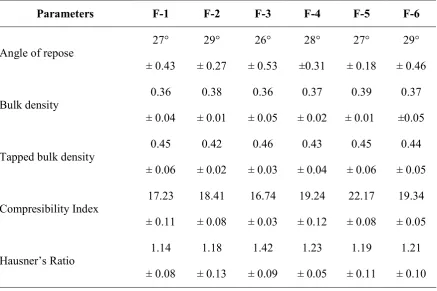
The present investigation was undertaken to design, formulate and evaluate Metformin HCL matrix tablets for sustained release dosage form. The blends of different formulations were evaluated for angle of repose, bulk density, tapped bulk density, compressibility index and hausner’s ratio. The results of bulk density, tapped bulk density, compressibility index and hausner’s ratio are mentioned in table 2. The bulk density of the tablet blend was in the range of 0.36± 0.04 to 0.39± 0.01 g/ml; the tapped density was in the range of 0.42± 0.02 to 0.46± 0.03 g/ml, which indicates that the powder was not bulky. The blend indicated good flow properties for all the formulation with the angle of repose values 27-29° according to fixed funnel and free standing cone method. The results of compressibility index lies between range from 16.74±0.03 to 22.17±0.08, while hausner’s ratio lies between 1.14±0.08 and 1.42±0.09 indicating good to excellent flow properties. The tablets of different batches formulated were evaluated for test such as hardness, friability, thickness, uniformity of weight and drug content. The results obtained from all formulations were within the range. The weight variation test indicates that all the tablets were uniform with low standard deviation values and hence all formulation passed the test for uniformity of weight. The tablets mean thickness values ranged from 7.2±0.14 mm to 7.2±0.45 mm. The hardness of all the tablets was
within the range of 12±0.05 to 14±0.06 kg/cm2. The loss in friability test was in a range of 0.07 to 0.12%. The percentage drug content for different tablet formulations were discrete from 97.12% to 99.71%, were found to be within range (table 3).
Table 1: Composition of Metformin HCl SR matrix tablet
S. o. Ingredient F1 F2 F3 F4 F5 F6
1. Metformin HCL 1000 1000 1000 1000 1000 1000
2. Sod. CMC 100 100 100 100 100 100
3. HPMCK-100 - - 200 150 200 150
4. Xanthan Gum 100 150 - - 50 100
5. HPMC K-4 50 50 - 50 - -
6. Aerosil 10 10 10 10 10 10
7. Magnesium Stearate 10 10 10 10 10 10
8. Theoretical Weight 1270 1320 1320 1320 1370 1370
Table 2: Physical characteristics of prepared blend of Metformin HCL
Parameters F-1 F-2 F-3 F-4 F-5 F-6
Angle of repose
27° ± 0.43 29° ± 0.27 26° ± 0.53 28° ±0.31 27° ± 0.18 29° ± 0.46 Bulk density 0.36 ± 0.04 0.38 ± 0.01 0.36 ± 0.05 0.37 ± 0.02 0.39 ± 0.01 0.37 ±0.05
Tapped bulk density
Table 3: Evaluation of Metformin HClsustained release matrix tablet
Parameters F-1 F-2 F-3 F-4 F-5 F-6
Uniformity of weight
(mg) 1270 ± 5 1350 ± 5 1350 ± 4 1350 ± 6 1370 ± 5 1370 ± 6
Thickness (mm) 7.2±0.27 7.2±0.34 7.2±0.14 7.2±0.21 7.2±0.45 7.2±0.16
Friability (%) 0.07 0.08 0.10 0.06 0.08 0.12
Tablet Hardness (Kp) 12±0.05 14±0.03 14±0.06 12±0.07 12±0.05 14±0.03
Assay (%) 97.12 99.42 96.26 98.54 99.71 99.35
Table 4: In vitro drug release data
Cumulative Percent Drug Release Time in
Hours F1 F2 F3 F4 F5 F6
0 0.00 0.00 0.00 0.00 0.00 0.00
1 29.14 28.72 30.24 29.48 28.35 27.91
2 48.26 51.35 49.72 47.34 45.23 46.17
4 63.18 65.62 63.51 66.29 61.19 63.28
8 84.65 79.15 82.37 86.17 77.51 75.45
12 99.37 96.43 97.60 98.21 89.62 88.34
16 - - - - 97.51 100.42
References
1. Samal HB, Sreenivas SA, Dey S, Sharma H. Formulation and evalution of sustained release zidovudine matrix tablets, Int J Pharm Pharm Sci, 2011; 3(2): 32-41.
3. Fuji KK, Pans M, Joyal S. Glycemic control in patients with type 2 diabetes mellitus switched from twice daily immediate release metformin to a once daily extended release formulation. Clin Ther. 2003; 25(2): 515-529.
4. Gulser G, Gorline J, Levy G, Zhang SZ, Weston IE, Naret D, Berner B. Pharmacokinetics of metformin gastric retentive tablets in healthy volunteers, Journal of Clinical Pharmacology. 2001; 41(6): 655-661.
5. Karttunen P, Uusitupa M, Lamminsivu U. Pharmacokinetics of metformin, a comparison of the properties of a rapid-release and a sustained-release preparation Int J Clin Pharmacol Ther Toxicol. 1983; 21(1): 31-36.
6. Caille G, Lacasse Y, Raymond M, Landriault H, Perrotta M, Picirilli G, Thiffault J, Spenard J. Bioavailability of metformin in tablet form using a new HPLC assay method. Biopharm Drug Dispos. 1993; 14(3): 257-263.
7. Meshali MM, El Sayed GM, Syed EL. Preparation and evaluation of theophylline sustained release tablets. Drug Develop Ind Pharm 1996; 22:373‐376.
8. Nath BS, Venkatesh, Hiremath D. Formulation and evaluation of sustained release dosage form of theophylline using a combined hydrophobic and hydrophilic matrix. Indian J Pharm Sci 2000; 62: 33‐36.
9. Hajare AA, More HN, Dsouza JI. Design and evaluation of sustained release tablets of diltiazem hydrochloride. Indian Drugs 2004; 41:175‐176.
10.Talukdar MM, Rommbaut P, Kinget R. Comparative study on xanthan gum and hydroxypropyl methylcellulose as matrices for controlled-release drug delivery. Int J Pharm. 1996; 129: 233-241.
11.Reza MS, Abdul Quadir M, Haider SS. Comparative evaluation of plastic, hydrophobic and hydrophilic polymers as matrices for controlled-release drug delivery. J Pharm Pharm Sci. 2003; 6: 282-291.
12.Pandey VP, Manavalan R, Rajan TS, Ganesh KS. Formulation and release characteristics of sustained release diltiazem hydrochloride tablet. Indian J Pharm Sci 2003; 65 (1): 44-48.
13.Sanghavi NM, Kamath PR, Amin DS. Sustained release tablets of theophylline. Drug Dev. Ind. Pharm. 1990; 16: 1843-1848.
14.Ceballos A, Cirri M, Maestrelli F, Corti G, Mura P. Influence of formulation and process variables on in vitro release of theophylline from directly-compressed Eudragit matrix tablets. IL Farmaco. 2005; 60: 913-918.
15.Brabander CD, Vervaet C and Remon JP. Development and Evaluation of sustained release matrix tablet. J. Controlled Release. 2002; 77(1): 245-254. 16.Raparla DV and Murthy TE. Formulation and evaluation of oral controlled release
Glimepiride matrix tablets. Adv. Phamacol. Toxical. 2007; 8(2): 59-62.