2809
A Case Study Of Developing Students’
Problem-Solving Skills Through Addressing Real-World
Problems Related To Fractions In Primary
Schools
Duong Huu Tong, Nguyen Phu Loc, Bui Phuong Uyen, Cao Le Truc
Abstract: The ability to solve problems is one of the necessary competencies of students. Therefore, forming and developing a problem-solving capacity for students is one of the crucial tasks in teaching in general and teaching mathematics in particular in elementary schools. This paper is aimed at developing elementary school problem-solving skills associated with the subject of fractions. The sample consisted of 42 fourth grade students who were taught by integrated activities to resolve real-word problems on the subject. A qualitative method was utilized to clarify students' problem-solving skills. The results were demonstrated that their performance of problem-solving skills improved significantly over level scales.
Index Terms: Fraction, problem-solving skill, mathematics education, real-world problem.
—————————— ——————————
1.
INTRODUCTION
Mathematics is one of the oldest sciences of humanity. Nevertheless, never before did mathematics flourish and have so many profound applications today. In our time, new inventions of mathematics occur every day; numerous new disciplines are born, a large number of old concepts are turned upside down. Nowadays mathematics is applied not only in astronomy, physics, mechanics but also in chemistry, biology and a lot of social sciences. In the domestic education industry, there have been many changes in educational methods, but the study still focuses on practising physical skills (calculating, memorising) and practising what is available. We agree that young children need to imitate adults in order to mature and adapt but being stereotyped wastes endless creativity in children. Even the application of children "problem -solving" in the form, from presentation to reasoning can lead to the situation of not understanding nature, applying the wrong knowledge learned in real life. As society becomes dynamic, learning does not stop at memorising and acquiring passive knowledge. However, it requires the skills of analysing and processing information, developing new ideas, making accurate decisions to solve the problem. Also, modern education is gradually shifting towards exploiting students' self-motivation [6], self-discovery and "dissecting" problems in scientific methods. Specifically, when teaching, the essential instrument is to support students in separating math knowledge from the complicated cover of the problem, recognise the applicability of calculations and mathematical relations; from there, resolve the problems posed. The ability to settle problems is one of the essential human capabilities that lots of advanced education countries around the world are aiming. Currently, the study is too focused on training skills, practising according to the available, so students are not
training this ability early. That has a significant influence on children's capability to learn, explore and think. Therefore, rehearsing for students to discover, pose and solve problems encountered in learning, in the lives of individuals, families and communities is not only meaningful in terms of teaching methods but also must be set as an educational and training goal. Capacity to resolve problems is the ability of an individual involved in the cognitive process to understand and deal with problematic situations; it includes the willingness to participate in similar situations to detect — The hidden competencies with constructive and thoughtful. While there are numerous definitions of problem-solving ability in learning, the opinions and conceptions all agree that problem-solving is standard capacity [7]. Thus, it demonstrates each person's ability to perceive, explore problematic situations in learning and life without a prior orientation of results, and find solutions to solve the problems posed in that situation, thereby demonstrating the ability to only, cooperate in selecting and deciding the optimal solution.
Mathematics has a significant position by that practical life, it is also an essential tool for other subjects and to help students become aware of the world around them in order to function effectively in practice. The ability to educate in numerous aspects of mathematics is enormous; it is capable of developing logical thinking, intellectual development. It has a significant role in training the thinking method, the inference method, the method of solving deductive problems, having comprehensive and accurate science, and has many effects of developing intelligence and privacy. Only creative independence, flexibility contribute to students’ patience, the mind to overcome difficulties [1], [14]. From the position and the critical task of mathematics, the problem posed for teachers is how to make math lessons highly effective, students are actively developed, actively creative in dominate mathematical knowledge. Regularly applying mathematics in practice will assist students in seeing mathematical aspects in ordinary situations in life, enhance the ability to settle problems in life with mathematical thinking [2], help to practice scientific work habits, raising the sense of optimisation in labour [4]. These are essential qualities for workers in today's society. In order to do this, students must be able to acquire scientific information from the initial real situation, convert ————————————————
Duong Huu Tong, Doctor, Can Tho University, Vietnam.
Email: [email protected].
Nguyen Phu Loc, Assoc.Pro. Doctor, Can Tho University, Vietnam.
Email: [email protected].
Bui Phuong Uyen, Doctor, Can Tho University, Vietnam. Email:
Cao Le Truc, Master, Ho Chi Minh City University of Education,
information between reality and mathematics, and establish mathematical models from real situations [20]. It is not easy work if not follow a specific sequence. Therefore, when teaching students to cope with practical problems, teachers should guide students to solve in steps [8]. According to author Le Van Tien [19], the real-word problem is the problem that the facts, variables, requirements, questions, relationships, contained in the problem are all elements of reality. Also, Le Van Tien [19] emphasises two purposes when teaching real-world problems to make students aware of the origin of mathematics. Although mathematics is a deductive science, most of the mathematical knowledge arises from reality, as a tool or means to solve problems of reality; emphasising the characteristics of mathematical science as well as the objectives of teaching mathematics: Mathematics is a scientific tool. Teaching mathematics is not merely teaching pure mathematical knowledge but also teaching how to apply this knowledge to resolve practical problems, thereby forming and developing in students' habits and ability to apply math to practice. A study of the effectiveness of a problem-solving approach in 8th-grade math teaching was carried out by Behlol, Rafaqat & Hafsa [3]. The study design consisted of 30 students of the experimental class and 30 others of the control class. Besides, the pre-test and post-test were used as a prerequisite for assessing the impact of the approach. The findings showed that there were significant differences in the mathematical achievement of the two classes. Correctly, students in the experimental class had shown more active participation, oriented learning and confidence than those in the control class. Also, an exciting revelation was noted that the excellent performance of students in the experimental class was also thanks to the support, guidance and facilitation of teachers. Similarly, the authors Simamora, Sidabutarb and Surya [18] used problem-based learning to promote students’ learning activity and problem-solving skills in junior schools. Their sample consisted of 30 students in Indonesia, and they took tests and were observed in the classroom. Their research followed a two-cycle action research model. The results noted that in the second cycle, the percentage of students' active participation and problem-solving skills increased compared to cycle 1. These numbers demonstrated that after being taught in this approach, there had been an increase in the active participation of students in the classroom as well as the ability to solve mathematical problems. The authors, Osman et al. [13], meanwhile, chose an alternative approach of using visual techniques through the bar model. An empirical study was carried out on 32 third year studies, and it was quantitative research. Research findings showed that there had been a significant difference in students’ achievement in problem-solving skills in mathematics. Besides, results from the interview were also reported that understanding the problem and the motivation for learning also contributed to their excellent performance. The study was also expected to assist teachers in promoting students' ability to solve mathematical problems. A study on the relationship between problem-posing and problem-solving skill was conducted on 72 senior students by Kar et al. [9]. Participants performed tests on the compilation and solving of problems on series and sequences topics. After the data was analysed, there was a close relationship for success between posing and solving the problems. Alternatively, there was a coherence between the number of problems compiled and the number of successes in solving the problem. These strategies were similarly
considered in Sayed's study [15]. Similarly, the relationship of the duo was also carefully investigated in Nursyahidah's study [11]. Gurat [5] conducted another study that also targeted prospective teachers. This study was a qualitative and quantitative one which incorporated an additional interview method. The outcomes were documented that participants used three main types of strategies in problem-solving such as cognition, metacognition and other strategies. Metacognitive strategies, for example, involved critical thinking and self-regulation. These strategies also appeared in the study of Özreçberoğlu and Çağanağa [12]. The two authors explored the views of 9th-grade mathematics teachers about problem-solving and classroom management strategies. The results revealed that they emphasised the importance of time and methods for solving problems in their class. They also stated that the limited time in class was also a difficulty for them to implement mathematical problems. Similarly, the study of the difficulty of solving students' word problems through interviews and observations of three teachers was executed by Salemeh and Etchells [14]. Teachers thought that necessary and critical skills made a significant contribution to their students' word problems, and they also provided an appropriate opportunity for students to work together. They also did not have specific instructions when performing these problems in class. As a result, they needed appropriate reinforcement to guide their students in critical reading and practical problem-solving. The difficulties that teachers faced may be the same students they met as in Mulyono and Hadiyanti's research [10].
2 PROBLEM-SOLVING SKILLS, FRACTIONS IN
CURRICULUM AND TEXTBOOKS IN VIETNAM
2.1 Problem-solving skills
2811 occupy domains of knowledge in the learning process.
Moreover, it helps them have the skills to deal with situations of life, adapt to changes in the movement of modern society. The components of problem-solving competence that are clarified in Vietnam's math curriculum are as follows:
(1) Identifying and discovering problems that need to be solved mathematically.
(2) Selecting and proposing solutions.
(3) Using compatible mathematical knowledge and skills (including tools and algorithms) to resolve problems.
(4) Evaluating the proposed solution and generalising the same problem.
As mentioned above, problem-solving capacity is made up of many smaller competencies; each component capacity has a large number of minute indicators to be able to assess accurately. For this reason, the more detailed the specific criteria table, the more accurate it will evaluate the ability of the learner while aiding the teacher in designing appropriate learning activities on and off the classroom. Furthermore, the evaluation methods also become involved, requiring careful and meticulous, time-consuming investment in the design of tools and implementation of the assessment. Teaching and assessing collaborative problem-solving competence are tied to the specific learning situations of the subject. These situations are designed to ensure the opportunity for learners to take steps, train and expose the component competencies in the collaborative process to complete the problem-solving tasks.
2.2 Fractions
Fraction knowledge is implicitly introduced from the second and third-grade programs through the lessons about unit fractions from one-halves to one-ninths. Students can use unit fractions as a tool to deal with real-world problems with the forms "Find equal portions of a number" and "What portion of the bigger number is, the smaller one?". By grade 4, students begin to learn about fractions explicitly in Semester 2. The fraction knowledge is focused on teaching in chapter 4 and additional review in chapter 1 in the 5th-grade math program. The main formula of fractions program in grade 4 math program is built according to the process: forming fractions, properties of fractions, comparing, ordering fractions, calculations with fractions. Some specific contents include the introduction of fractions, the relationship between fractions and division of natural numbers, equivalent fractions. The operation of fractions consists of simplifying fractions, making fractions have a common denominator, comparing two fractions, adding fractions, subtracting fractions, multiplying fractions, finding fractions of a number, dividing fractions. The formation of fractions knowledge through a simple, intuitive mathematical model demonstrates the part-based approach of the whole. With the illustrative model, students are instructed to divide operations into equal parts, colouring some of the whole parts to be divided, thereby forming a fraction smaller than one so that the part number is highlighted colour, the introduction of the numerator, denominator, fraction writing. However, the illustrative model for teaching the concept of fractions is a model that simulates objects and manipulations, not a situation that makes students wishing to explore knowledge to cope. Textbooks do not ask questions or make operational requirements for students, so it can be seen that the main activity subject in this activity is teachers, students play the role of receiving new knowledge. The series of
teaching knowledge in the lessons plays a vital role in equipping the skills for students to perform various types of tasks such as comparing fractions, reducing fractions, adding and subtracting other fractions of the denominator. Nevertheless, when standing alone at a specific lesson, superior knowledge is not associated with practical situations to apply that knowledge. For Vietnamese textbooks, the practice of problem-solving capacity attached to reality has not been clearly shown through the proposed activities. The activity of solving new written problems creates opportunities for students to demonstrate this ability at a simple level. As a consequence, strengthening this capacity training for students at a higher level, depends on the interest of the teachers, based on the activities specifically designed for the students of their class. Solving mathematics is a significant activity in learning mathematics at any level. The problems associated with the subject of fractions are an effective means for students to apply mathematical knowledge to live, thereby contributing to improving life skills through comprehension knowledge in primary school. The primary objective of this research is to enhance fourth-grade students' problem-solving skills in solving real-world problems associated with the fractional topic. Additionally, students' difficulties in solving mathematical problems are also expected to be clarified.
3 THEORETICAL FRAMEWORK
3.1 The teaching process according to developing students' problem-solving skills
Although many authors have come up with different procedures for solving a mathematical problem, in this section, there is also a process that is oriented to enhance learners' problem-solving capabilities.
Step 1: Create a problematic situation.
Step 2: Present the problem and set a settlement goal. Step 3: Solve the problem.
(1) Find a solution.
Analyse the problem: clarify the relationship between the known and the sought (based on the knowledge learned, related to the appropriate knowledge)
Instruct students to find problem-solving strategies by proposing and implementing problem-solving directions. Need to collect, organise data and mobilise knowledge; using methods, cognitive techniques, deduction and deduction as direction, strange rules of familiarity, specialisation, moving through cases of degeneration, anodisation, generalisation, consideration of relationships dependence, forward, backward, reverse. The proposed direction can be adjusted as needed. The result of proposing and implementing a problem-solving solution is to form a solution. Check the correctness of the solution: If the right solution ends immediately, if not correct, repeat from problem analysis until they find the right solution. Choose the right solution: Once students have found a solution, they can keep looking for other solutions, compare them to find the most suitable solution.
(2) Presenting the solution.
Students restate everything from problem statements to solutions. If the problem is a given topic, it may not be necessary to state the problem again.
Step 4: Conclude.
Check and evaluate solutions, results and ways to find solutions. It is institutionalising knowledge to acquire.
Find out what the application results are. Propose relevant new issues through similar review, generalisation, overturning issues and resolution if possible.
3.2 Criteria for evaluating students' ability to solve problems
To evaluate students' problem-solving ability, a proposed scale is graded from 0 to 4 or from 0 to 3 or from 0 to 2 according to the steps taken. In particular, level 0 is used to evaluate when students incorrectly perform as required. The remaining levels of evaluation according to each step of solving the situation are specified as follows:
(1) Building a mathematical problem + How to simplify practical factors: 1. Minimal reduction of actual factors; 2. Reduce 1 to 2 actual factors;
3. Reduce from 3 to most practical elements; 4. Ultimately reduce actual factors.
+ Writing assumptions:
1. Using verbatim most of the phrases that appear in the situation, very little use of personal vocabulary;
2. Using verbatim some phrases that appear in the situation, combining a bit of personal vocabulary;
3. Using verbatim some words that appear in the situation, using more personal vocabulary, initially converting common language into mathematical language;
4. More flexible use of words that appear in situations or personal vocabulary, transformed into the mathematical language to express problems.
+ How to write a question:
1. Use the full text of the question given in the situation. 2. Use most of the phrases mentioned in a combination of some words individuals to ask questions, expressions similar to those of situation.
3. Use some words mentioned in situations combined with personal vocabulary, initially transformed into the language of mathematics to ask questions.
4. Use mathematical language to re-express the same question as to how to ask a question in a text-based problem in textbooks.
(2) Math problem solving + Solution:
1. The number of necessary solutions has not been determined yet; the solution is incorrect;
2. Determining the number of necessary solutions to the problem and incorrect solutions;
3. Determining the number of necessary solutions to the problem, including both the correct and incorrect solutions, or unclear solutions;
4. Determine the number of solutions needed for the problem and explain the solution clearly.
+ Calculation:
1. Not determining the correct calculation;
2. Determining the calculation correctly but using the wrong data;
3. Determining the right calculation and right figures but calculating the wrong results;
4. Define correct calculations and correct calculations. + Unit:
1. Do not write units; 2. Write the wrong unit; 3. Write the right unit. + Answer:
1. Do not write the answer; 2. Write the answer. (3) Step to answer questions
1. Write down the answer to the problem in writing, without answering the situation;
2. Interpret the problem results into answers, not answers to the questions of the situation;
3. Based on the results to answer the question of the situation but the answer is not correct;
4. Based on the results, give the right answer to the situation.
4 METHODS
4.1 Participants
The experimental sample included 42 students from Son Cang primary school, Tan Binh District, Ho Chi Minh city. Most students calculated slowly, still confused the mathematical form when solving word problems. Students liked to participate in learning activities but not confident; teachers should be suggested to open, guide and model before doing.
4.2 Research design
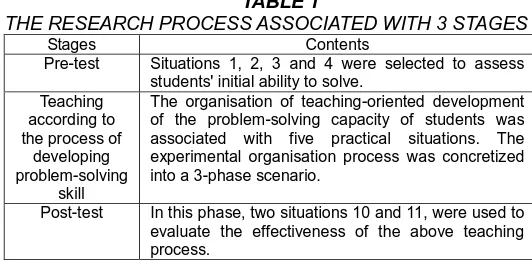
The research process was described in Table 1:
TABLE 1
THE RESEARCH PROCESS ASSOCIATED WITH 3 STAGES
Stages Contents
Pre-test Situations 1, 2, 3 and 4 were selected to assess students' initial ability to solve.
Teaching according to the process of
developing problem-solving
skill
The organisation of teaching-oriented development of the problem-solving capacity of students was associated with five practical situations. The experimental organisation process was concretized into a 3-phase scenario.
Post-test In this phase, two situations 10 and 11, were used to evaluate the effectiveness of the above teaching process.
Four situations 1, 2, 3 and 4 constituted a succession of situations. The problem in two situations revolved around the stories of drinking milk daily, making and sharing cakes in which were informal activities for most elementary school students. The situation was expressed in the form of a gentle conversation; the requirements of the situation were made clear, did not create tension, confusing for students when the first contact. The content of knowledge contained in this situation was the addition of fractions with various denominators, comparing fractions with 1. This topic was the knowledge students had learned and practised in class. The numbers that students had to manipulate calculations were insignificant, moderate fractions for students when in the early stages of learning to calculate with fractions. The situations from 5 to 9 were designed to be similar to the previous ones, that was, they were close to the students' daily life, and they also contained the content of fractions.
The empirical scenario consisted of 3 phases:
2813 situation into math problems, solving problems to address
situations, considering the rationality of how to solve situations. Phase 2: Students resolved experimental situations in the form of group 4 on the test paper prepared by teachers. Time: 10 minutes. The target of phase 2: Students were considered and commented on their work and their group. Thereby, students discussed and presented ideas to protect personal views or contribute to their work, absorbing the opinions of students in the group to build a complete group work. Phase 3: Legalization - the class still worked in groups of 4 to work together with teachers. Students started their groups' work; members of other groups gave comments. The groups conducted comments and criticisms to produce better results. The teacher was the final commenter, at the same time, giving additional guidance to students on approaches of reasoning and generalising practical problems into mathematical problems. Time: 15 to 20 minutes. The target of phase 3: Results of group work in phase 2 would be considered by themselves in phase 3, with the limited intervention of teachers. This stage was the legalisation phase of knowledge, helping students improve their problem-solving skills gradually. The feedback environment for students to be valid or unreasonable was their self-examination, comment and criticism. When given comments, criticisms, and contributions, students would remember knowledge and master skills than listening to one-way lecturers. The two situations, 10 and 11 revolved around a relatively familiar activity, suitable for students. Maths knowledge to use in two situations included finding fractions of a number, except for length measurements, adding natural numbers to fractions. Actual intertwining factors were not too complicated but may cause students to select incorrect data or expressed data redundancy.
4.3 Data analysis
Qualitative analysis methods were used to clarify the data collected. Correctly, the level of students' problem-solving skills in the above situations was analyzed on level scales given in the theoretical framework.
5 RESULTS AND DISCUSSION
5.1 Results related to pre-test
Analysis of student's work showed that in the step of simplifying practical factors in the situation to build the problem, the majority of students only reduced very little. The rate of students assessed from level 0 to level 2 was 71.42% for case 1 and 59.52% for case 2. The student did not identify the mathematical factors appearing in situations were one of the reasons that made children not realise the real mathematical appearance. Not only practical factors in the situation also lead to the students mechanically copying words from the situation to write mathematical problems. The rate of students being assessed from level 0 to level 2 in the writing step of the assumption section in case 1 was 64.28% and reached 61.90% in case 2. When students rewrote most ideas in the situation in the assumption section lead to the problem had many redundant views that affected the math problem, causing students to select incorrect data during the calculation. In the writing of the question, the student performed quite well when there were lots of students who knew how to use mathematical language to turn the situation questions into the questions of the problem with the essay, concise presentation, and acting easy to understand. The rate
of students assessed at level 4 in the questioning section was 57.14% for case 1, 59.52% for case 2. In the math solving step, the majority of students correctly identified the number of solution steps - evaluated from level 2 or higher - accounting for over 80% for both situations. When performing the calculation, the percentage of students performing the correct calculation and accurate calculation accounted for nearly 60% in case 1, over 40% in case 2. However, the percentage of students who determined the right calculation and used the data correctly but the wrong result was still quite high, accounting for nearly 10% in case 1 and nearly 20% in case 2. The percentage of students who did not implement the calculation was evaluated from level 0 to 2; still, quite a lot, accounting for over 30% for both situations. The main reason for the students not determining whether to calculate or use the wrong data when calculating was because the students had not yet determined the "half" equal to the fraction 1/2. About writing units and answers, most students wrote the right unit and wrote the correct answer as the answer form in the problem of a written problem. Still, some students did not write the unit or identify the wrong unit, accounting for about 10% for case 1 and over 20% for case 2. Maybe the students had not identified the unit since they were in the early stages of learning about fractions, it was also confusing to choose the unit behind a fraction. In general, in the math problem, most students showed the ability to present the correct solution to the problem with the written words. Regarding the skills to set answers and calculations, students still needed more training.
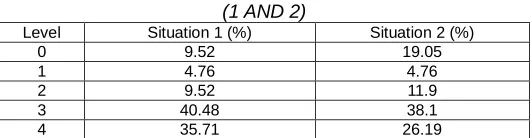
TABLE 2
STATISTICS OF SURVEY RESULTS OF THE FIRST PHASE OF STUDENTS IN THE STEP TO ANSWER THE QUESTION
(1 AND 2)
Level Situation 1 (%) Situation 2 (%)
0 9.52 19.05
1 4.76 4.76
2 9.52 11.9
3 40.48 38.1
4 35.71 26.19
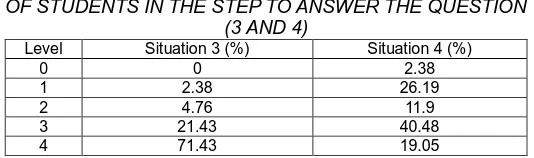
correctly. Part of the reason was probably as the figures were precise, the 1/4 + 3/4 calculation was quite easy compared to the students' ability at this stage. However, to situation 4, students were quite confused when performing the calculation since they still made the mistake of not recognising "half" equal to the fraction 1/2. At the same time, students still chose the incorrect calculation to lead to miscalculation. Regarding the writing of units and answers, the student's expression was relatively similar to the first survey. Most students chose the right unit and presented the correct answer according to the convention of solving problematic texts.
TABLE 3
STATISTICS OF SURVEY RESULTS OF THE FIRST PHASE OF STUDENTS IN THE STEP TO ANSWER THE QUESTION
(3 AND 4)
Level Situation 3 (%) Situation 4 (%)
0 0 2.38
1 2.38 26.19
2 4.76 11.9
3 21.43 40.48
4 71.43 19.05
Corresponding to the mathematical problem in situation 3, the better the student's rate, the higher the percentage of students who answered the appropriate question and vice versa. In general, most students knew how to express answers to situations based on the results of the work. However, in situation 4, it was possible that due to difficulty in solving the problem, a large number of students only wrote or interpreted the results of the problem without expressing the answer. In the retesting step, as with the first survey, most students had not done careful re-examination of the work to make necessary adjustments.
5.2 Results related to teaching according to the process of developing problem-solving skill
5.2.1 Results related to situation 5
From situation five onwards, students began to perform relatively more complex situations than the four surveyed situations. The difficulties encountered by students were clearly shown in the above experimental results when the number of students assessed well at the hypothetical writing step had not reached 15%. Some common mistakes students made when doing this situation were detected. Students did not mention the information of "there are two cakes" (there are 12 students make this mistake). Also, students used the term "3/2 cake" to "3/2 number of cakes", the illegal use of generally invisible terminology had distorted the meaning of the situation, confusing "1 and a half" with fraction 2/3. Besides, students also rewrote quite a lot of practical factors; some students determined the actual factors into mathematical factors, which lead to the incorrect mention of necessary data. Some students even asked the right questions, but they were wrong about the content of the situation. In particular, one student did not have the patience to exploit the situation, she just read the situation briefly and wrote an incomplete topic, her work was assessed at a level of 0 for all steps. It was seen that showing the independent individual's capacity would reveal the shortcomings of the skills of numerous students. In the problem-solving step, students still performed quite well when the percentage of students doing the correct solution and the calculation was over 70%. However, more than 20%
of students needed to practice the skills to set a solution as well as determine the exact calculation requirements. Especially for students assessed at levels 0 to 1 needed more attention and guidance. The number of students who performed well in answering questions for a situation reduced slightly, compared to the number of students performing well on the problem, as some students still did not know how to rely on the results of the solution to express the answer well. In phase 2, most of the groups had overcome the mistakes in individual work to perform better group work. Consequently, no group assignment had reached a level of 0 to 2. Only a few groups had not completely removed the actual factors while writing the assumption. For the problem writing part, all the groups implemented well. At the math solver, all 11 groups performed well. This finding reflected that the groups had initially worked more effectively in correcting the mistakes of individual assignments. However, there were still some members of group 1 and group 4, showing their dependence and dedication to making the lesson better for them in the group. Thus, some students still thought that when working in groups, they only needed to complete the comments to complete the tasks. Similar to solving math problems, groups had done well in answering questions for a situation. The groups showed much care, invested in answers that were appropriate to the situation, no more unfinished tasks, and explained the answers. In phase 3, the groups mainly gave their ideas to build a shorter and more concise problem. The groups took the initiative in commenting and building each other without the intervention of teachers.
5.2.2 Results related to situation 6
2815 incomplete answer: "In my opinion, Ha's friend is right because
of 45 times 1/3." It was commented that students were still quite negligent when not reviewing careful work to complete the answer they could get right. Up to this point, when operating in phase 3, the groups had actively implemented without teachers' invitation. The groups stood up to present their problems and ask: "Do you have any other comments for the group's problem?" "Is there any other solutions?". During the discussion, after all, a student had realised that the relationship between 45 × 1/3 multiplication could be made into 45: 3 division according to the knowledge of finding a part of a number that they had learned in grades 2 and 3.
5.2.3 Results related to situation 7
Compared to situation 6, the rate of students assessed at level 4 in the writing step of the problem increased slightly. However, the rate of students assessed from level 0 to 2 in simple operation practically did not decrease; students rated at level 1 increased more than 10%. The situation had a large number of details, and many numbers appeared, therefore, in the process of doing tests, students quickly identified the main elements of the problem. Sayings of two characters in the situation did not have a role in the problem, but the appearance of fractions which also dominated the students, so lots of children still mentioned the content of the characters' sentences into problems, resulting in the redundancy of details and data. The percentage of students who had not asked questions well had increased significantly. There were cases of questioning the heart of the situation. Students determined the wrong object to look for, which lead to them making mistakes in solving math problems. Corresponding to the mistake in the writing step, when students mentioned a high number of details and redundant data, they made mistakes in the math solving step. The percentage of students assessed from level 0 to 2 for the solution increased from 2.7% in situation 6 to 32.5% in situation 7. The number of students who could not determine the calculation or used the wrong calculation data increased by nearly 50%. Some of the cases where the students misidentified the calculations were such as performing 1/4 : 3 division because they only noticed AN divided by three friends without the inference “divide equally between himself and three friends”. It meant that AN had to divide into four equal parts. Alternatively, they used the fractions 1/4 and 1/8. For some students who asked the wrong question to find the remaining chocolate AN, they executed the subtraction. Alternatively, there were some calculations were not explain why they chose like 1/2: 1/8 or 1/2 × 1/8 or 1/8 + 1/4. In the step of applying the result of a problem to answer a question, only one student could not write the answer in time. All the remaining students, for students to address correctly, all of them gave the correct answer to the question of the situation, for students to find the wrong answer, they also knew how to express the correct answer by the question of the situation, only the data was wrong. For phase 2, after discussion and adjustment, the proportion of the groups that were evaluated well in the problem was utterly similar to situation 6. However, the remaining groups were mainly assessed at level 2 and level 1 for simplifying practical step, essential writing. Similar to the mistakes in the section of problem writing, the group writing problems were not advantageous; it was difficult in the problem-solving. There were still two groups, only reaching level 1 and 2 at the solution and calculation step. Through the results of phases 1
and 2 in the part of answering the question, it showed that students had shown stability in analysing the solution to answer the situation. They expressed the answer by the question of the situation, only the data mistake. Because this was a relatively tricky situation with numerous confounding factors and data, phase 3 activity was quite exciting. They gradually argued and adjusted the problems of the groups. In group 4, when making the problem statement, rewriting the statement on the situation "If you divide four people, each person will get 1/8 chocolate bar", then one student commented that there was no need to write that element in a math problem. Some students argued that they needed to find each chocolate how much chocolate bar each of friend and their answers in the situation was only predictable. "An's friends can predict a quarter, or an answer is 1/8 until I calculate it, I will determine which is right and wrong, not to use those sentences to write the topic”. A group performed the calculation 1/2 × 1/4 = 1/8. The group thought that the result was correct, and the calculation was still acceptable. However, one student commented: "This is An's friend divided evenly by 4, he must perform 1/2: 4 to be right" when the teacher asked: "So when can we do the calculation? 1/2 × 1/4? ”Then the student answered in succession:“ For example, when I asked Mr An to take 1/4 of a half of chocolate bar for each of me, I would do the same calculation. It was commented that the students were able to understand the situation somewhat, understand the meaning of the calculations and not merely the correct results.
5.2.4 Results related to situation 8
discussion, some students discovered a mistake of some friends in details "the number of blue bubbles is 1/3 of the number of pink bubbles", in that detail, some students only wrote the "number of bubbles blue ball is 1/3 "or" prepare 1/3 bubble ". They commented that these spellings were "unclear" and could easily cause confusion when calculating.
5.2.5 Results related to situation 9
Students had shown gradual progress through experiments. By the 9th situation, the ability to reduce the problem, remove practical factors to determine the correct assumption and build relationships of assumptions to write the problem had been more stable. More than 90% of students were assessed to be quite good at the math development step. For students who were evaluated at an appropriate level, most of them mentioned the lack of details "each of you gets a part" in the problem. Students also showed more stable math solving skills when the ratio of students setting solutions and choosing correct calculations in both situations 8 and 9 was achieved at nearly 80% to more than 90%. An insignificant number of students performed the calculation wrongly as they still felt awkward when setting up the division of 1/2: 4, so they did the opposite in 4: 1/2. The reason was that performing a division with a divisible number was a natural number that was familiar to students, so if they did not understand the problem, then it was easy for them to follow the choice that they feel was easy and familiar. Besides, in the second calculation step, finding the number of cakes of both friends can eat, students had the flexibility to use both 1/8 × 2 and 1/8 + 1/8 calculations. They stated that the meaning of the two calculations had the same meaning; any calculation could be done. Although the statement was simple, it had assessed the ability of students to understand the problem and the meaning of the calculation. Among 32 students who performed well all math problems, 31 students reached level 4 in the answer section. Similar to the previous situations, except that the students did not keep up with the data, the way of answering the question was appropriate for the problem raised in the situation. Students performed well in overcoming personal errors to build group problems. The assessment rate was mostly at level 4; only some groups were rated at level 3 since the use of words was not right when writing hypotheses. All groups operated well on maths. When working, the groups had also shown a positive attitude in analysing the irrational aspects of individual articles so that they could reach a satisfactory group post. The groups maintained a beneficial ability to express and answer the questions required by the situation. The work in groups was almost complete, so they were very confident in presenting their group papers as well as giving suggestions to support groups in writing problems more neatly. One student commented to group 1 that “Ha should not express 'Ha took 1/2 cake in the fridge into four parts' because it sounded unsatisfactory, but just put it briefly, 'Ha divided 1/2 pieces of cream cake into four equal parts 'was enough.' Another student suggested that “Ha should put 1/2 in the problem instead of the word 'half'”. The comments of students were recorded and exchanged; the procedure they worked was more comfortable and softer.
5.3 Results related to post-test
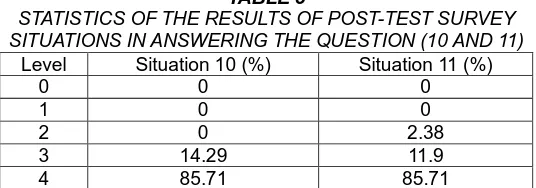
The majority of students had shown the relatively stable capacity to build problems through the last experimental situations and these two survey problems. Students were
assessed mainly at level 4 in all steps, achieving an average of over 80%. Some students were evaluated at other levels because they still had errors such as not being able to simplify all the actual factors; the question was not clear, using incorrect mathematical terms. After the experimental process, some students had shown encouraging progress. However, some students still had not performed well the steps to solve a real situation into a mathematical problem. Their ability to cope with mathematical problems had not shown stability while fulfilling the requirements. For these students, they still needed more support to improve gradually.
TABLE 4
STATISTICS OF THE RESULTS OF POST-TEST SURVEY SITUATIONS IN SOLVING PROBLEMS (10 AND 11) Level Situation 10 (%) Situation 11 (%)
The answer Calculation The answer
Calculation
0 0 0 0 0
1 2.38 9.52 4.76 9.52
2 0 0 2.38 2.38
3 11.9 0 4.76 0
4 85.71 90.48 88.1 88.1
Similarly, most students achieved excellent results in solving math problems, with an average of over 85% of students assessed at level 4 in all steps. Students were more sensitive at the steps; they knew how to set a more diverse solution when pointing to the same object instead of a mechanical solution. Computational skills were perfect, so when they determined the correct calculation, they produced the right result, no more students were assessed at level 3 in the calculation step, which means no children wrote the correct calculation but got the wrong result.
TABLE 5
STATISTICS OF THE RESULTS OF POST-TEST SURVEY SITUATIONS IN ANSWERING THE QUESTION (10 AND 11)
Level Situation 10 (%) Situation 11 (%)
0 0 0
1 0 0
2 0 2.38
3 14.29 11.9
4 85.71 85.71
There was still a student who had difficulty answering a question for a situation where he could only interpret the answer without giving a conclusion to the question. The rest, most of them were rated well above 85%. In general, the majority of students had made significant performance in the steps of solving a real-world problem.
6 CONCLUSION AND SUGGESTION
2817 experimental process, there were still some students who had
not made significant progress [2], [10]. For students who were slow to progress, teachers' demands had specific directions such as spending much time supporting them when carrying out activities, compiling separate situations suitable for them. Some of the difficulties as well as mistakes that students made when solving math problems are calculating, misunderstanding mathematical concepts and using wrong mathematical symbols [1], [14]. An implication is known that education is a process of turning human capacity into the power of every student. Thus, in the process of compiling textbooks, it is necessary to build students the ability to apply knowledge to solve real-world problems [19].
Suggestions for teachers
In the process of preparing lessons, the knowledge is related to practice; it is necessary to put practical problems in so that students can see the mathematics close to the breath of life. On that basis, teachers build appropriate question system, posing life situations for students to solve themselves [11], [15]. In the process of teaching, to build knowledge for students, teachers conduct activities in sequence: warm-up activities - knowledge-building activities - practice activities - exploration and expansion activities to assist students in absorbing lessons quickly. Teachers describe situations in life for students to approach and think. From there, solve together to clarify. Focusing on problem-solving methods to solve practical problems, creating a happy and comfortable classroom atmosphere; friendly, close to students bravely express their opinions on practical problems and creating interest in learning through games, storytelling, hands-on activities, and problems associated with real life. Teachers need to take time to guide students in applying mathematical knowledge to solve practical problems that are meaningful to everyday life. Strengthen differentiated teaching according to student competencies. In practice tests and semesters, some practical problems should be included to enrich and diversify the content. Thus, students can apply mathematical knowledge into practice following the innovative spirit of this textbook. Situations and activities that implement this paper are for reference only. In order to improve the problem-solving capacity for students, teachers need to compile situations suitable to the actual situation of the class and organise teaching according to this capacity-oriented training in a method more frequently. It may be conducted during revision periods, or once a week at a suitable time. The training of standard and professional competencies is one of the teaching goals of teachers. Therefore, teachers can learn more ways to support other competencies for students [15]. The process of exercising the possible competencies is mixed. For example, they are using problem-solving skills combined with other skills such as mathematical communication, teamwork, use of mathematical tools.
Suggestions for students
Students grasp basic knowledge correctly, systematically, understand, remember and apply mathematical knowledge so that when they encounter practical problems, they can be settled. Also, they need the ability to analyse, synthesise, abstract, generalise, concretise, induce and infer with practical problems [20]. Independent thinking is to see the problem on its discovery and find solutions when it comes to practical problems [2]. In order for students from smart to thinking skills
to solve problems and create ideas that are simple but turn out to be, it takes a scientific roadmap and method. In particular, the tests of mathematics play an important and effective role to train and cultivate students.
REFERENCES
[1] K. S. Angateeah, “An Investigation of Students’ Difficulties in Solving Non-Routine Word Problem at Lower Secondary,” International Journal of Learning and Teaching, vol. 3, no. 1, pp. 47-50, Mar. 2017.
[2] S. Baltaci, “ Examination Of Gifted Students’Probability Problem Solving Process In Terms Of Mathematical Thinking,” Malaysian Online Journal of Educational Technology, vol. 4, no. 4, pp. 18-35, 2016.
[3] M. G. Behlol, R. A. Akbar and H. Sehrish, “Effectiveness of Problem Solving Method in Teaching Mathematics at Elementary Level,” Bulletin of Education and Research, vol. 40, no. 1, pp. 231-244, Apr. 2018.
[4] E. Ersoy, “Problem Solving and Its Teaching in Mathematics,” The Online Journal of New Horizons in Education, vol. 6, no. 2, pp. 79-87, Apr. 2016.
[5] M. Guzman Gurat, “Mathematical Problem-solving Strategies among Student Teachers,” ERIES Journal, vol. 11, no. 3, pp. 53-64, Sep. 2018.
[6] J. Ervine, “Problem Solving as Motivation in Mathematics: Just in Time Teaching,” Journal of Mathematical Sciences, vol. 2, pp. 106-119, 2015.
[7] J. Jäder, J. Lithner and J. Sidenvall, “Mathematical problem-solving in textbooks from twelve countries,” International Journal of Mathematical Education in Science and Technology, 28 Apr. 2019, doi: 10.1080/0020739X.2019.1656826.
[8] A. S. Jaudinez, “Teaching Senior High School Mathematics: Problems and Interventions,” Pedagogical Research, vol. 2, no. 2, pp. 1-11, May. 2019, doi:10.2933/pr/5779.
[9] T. Kar, E. Özdemir, A. S. Ipek and M. Albayrak, “The Relation between the Problem Posing and Problem- Solving Skills of Prospective Elementary Mathematics Teachers,” Procedia Social and Behavioral Sciences, vol. 2, pp. 1577-1583, Jan. 2010.
[10] Mulyono and R .Hadiyanti, “Analysis of Mathematical Problem-solving Ability Based on Metacognition on Problem-based Learning,” Journal of Physics: Conference Series, vol. 983, pp. 1-6, 2018, doi:10.1088/1742-6596/983/1/012157.
[11] F. Nursyahidah, B. A. Saputro and M. R. Rubowo, “The Relation between the Problem Posing and Problem- Solving Skills of Prospective Elementary Mathematics Teachers,” Journal of Research and Advances in Mathematics Education, vol. 2, no. 1, pp. 13-24, Jan. 2018.
[12] N. Özreçberoğlu and Ç. K. Çağanağa, “Making It Count: Strategies for Improving Problem-Solving Skills in Mathematics for Students and Teachers’ Classroom Management,” EURASIA Journal of Mathematics, Science and Technology Education, vol. 14, no. 4, pp. 1253-1261, 2018.
Oct. 2018.
[14] Z. Salemeh and M. J. Etchells, “A Case Study: Sources of Difficulties in Solving Word Problems in an International Private School,” Electronic International Journal of Education, Arts, and Science, vol. 2, pp. 149-163, 2016. [15] R. A. E. Sayed, “Effectiveness of Problem Posing
Strategies on Prospective Mathematics Teachers Problem solving Performance,” Journal of Science and Mathematics Education in S.E.Asia, vol. 25, no. 1, pp. 56-69.
[16] S. Saygili, “Examining The Problem Solving Skills and The Strategies Used By High School Students in Solving Non-routine Problems,” E-International Journal of Educational Research, vol. 8, no. 2, pp. 91-114, Jul. 2017.
[17] R. E. Simamora, S. Saragih and Hasratuddin, “Improving Students’ Mathematical Problem-Solving Ability and Self-Efficacy through Guided Discovery Learning in Local Culture Context,” International Electronic Journal of Mathematics Education, vol. 14, no. 1, pp. 61-72, 2019, doi:10.12973/iejme/3966.
[18] R. E. Simamora, D. R. Sidabutar and E. Surya, “Improving Learning Activity and Students’ Problem-Solving Skill through Problem Based Learning (PBL) in Junior High School,” International Journal of Sciences: Basic and Applied Research, vol. 33, no. 2, pp. 321-331, 2017. [19] L. V. Tien, Methods of Teaching Mathematics in High
School.Ho Chi Minh City National University Publishing House, 2005.