INTERNATIONAL RESEARCH JOURNAL OF PHARMACY
www.irjponline.com
ISSN 2230 – 8407
Research Article
STUDY IN VITRO OF KETOPROFEN PATCH WITH TWEEN 80 AS ENHANCER
Soraya R Mita
1*, Ida Musfiroh
2, Insan SK
1, Dwi MF
11
Department of Pharmaceutics and Pharmaceutical Technology, Faculty of Pharmacy, Universitas Padjadjaran, Indonesia
2Department of Pharmaceutical Analysis and Medicinal Chemistry, Faculty of Pharmacy, Universitas Padjadjaran,
Indonesia
*Corresponding Author Email: [email protected]
Article Received on: 05/07/18 Approved for publication: 22/07/18
DOI: 10.7897/2230-8407.097134
ABSTRACT
Ketoprofen is an analgesic drug that can be made in transdermal patches based on its physical and chemical properties. Enhancer is used to increase drug permeation from patch to skin. Study was conducted on ketoprofen as transdermal patch using tween 80 as penetration enhancer. The formulas used were with variation of tween 80 concentration each 0%, 1%, 2%, and 3%. The patch was prepared by solvent evaporation method. Eudragit RS100 and PVP were used as polymer base and drug release controller. Evaluation of the preparation was done by in vitro permeation test using the Franz diffusion cell method with a shed snake of Phyton reticulatus as a membrane release membrane. The permeation test was carried out for 12 hours. The results showed increased permeation of ketoprofen which was comparable with the increasing concentration of tween 80. F4 formula containing 3% of tween 80 gave the largest percentage 60.14% of permeation in comparison to other formula F1, F2, and, F3. All formulas showed zero order kinetics.
Keywords: Ketoprofen, Transdermal, Tween 80, Eudragit RS100, Polyvinylpyrrolidone.
INTRODUCTION
Inflammation is a body's defense reaction to injuries arising from cell damage. The stimuli that cause this reaction include, among others, severe injuries, radiation (temperature, ultraviolet light, and radioactive), chemical compounds (which are skin burning and corrosive), microorganism attacks (viruses, bacteria, and parasites), and antibody reactions.1-2 Inflamed body parts have signs such as swelling, warming, pain, flushing, decreased motility, and possible organ or tissue dysfunction.3
Antipyretic analgesic drugs as well as nonsteroidal antiinflammatory drugs (AINS) are a group of drugs widely used with or without a prescription. One commonly used is ketoprofen. Ketoprofen is a nonsteroidal anti-inflammatory drug of the propionic acid group with analgesic and antipyretic effects. Ketoprofen works by inhibiting the activity of cyclooxygenase-2 enzyme (COX-2) in the synthesis of prostaglandins which is an inflammatory mediator.4
Ketoprofen is currently available is in the form of tablets, capsules, injections, suppository and topical preparations. However, this dosage form is considered less practical for patients. The form of tablets and capsules is less practical for patients who are usually difficult to take medication; injection form can not be used alone but must be with the help of experts; suppositories are considered less convenient because they are used through rectal; and topical dosage forms are used only for local rather than systemic treatment. In addition, ketoprofen has side effects and can irritate gastrointestinal.4 Therefore, as an alternative way of administration can be given as transdermal.
Transdermal is a drug delivery system through the skin as a place of drug penetration to the systemic circulation. Drug administration in this way is a good alternative because it is more convenient for patients.5 Transdermal preparations have several advantages: they are more convenient to use because they are non-invasive, easy for patients to use themselves, avoiding drugs from first-pass metabolism, can be an alternative to drugs that irritate gastrointestinal, enzyme-damaged drugs, and gastrointestinal pH, this delivery system may be designed for frequency of use once daily or less frequently (minimal dose repetition) in order to improve patient compliance.6-7 One way to increase the permeation of the active substance in a transdermal preparation is to use an enhancer. Tween 80 as a surfactant can be used as an enhancer.
MATERIAL AND METHODS
Formulation of Transdermal Preparations
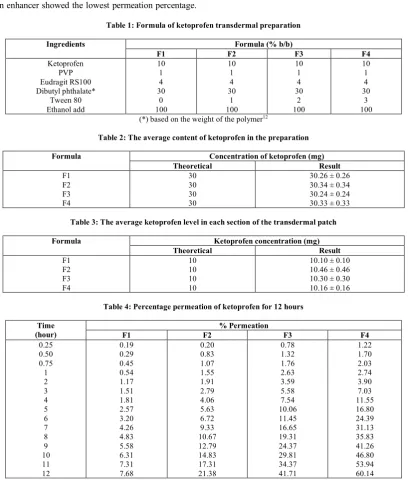
Transdermal dosage formulas with variation of tween 80 concentration as penetration enhancer can be seen in Table 1. The solution was prepared by mixing PVP, eudragit RS100, and dibutyl phthalate with 96% ethanol, stirred with a magnetic stirrer. After that added ketoprofen and tween 80, stirred again with a magnetic stirrer. The prepared solution was poured into a mold and dried in room temperature.
Determination of Ketoprofen Content in the Preparation
Standard curve of ketoprofen
A total of 5 mg of ketoprofen was weighed and then dissolved in 50 ml of ethanol in a measuring flask. This stock solution was diluted by taking as much as 0.4; 0.8; 1,2; 1.6; 2 and 2.4 ml with the volume pipettes and then dissolved in 20 ml of ethanol in a measuring flask. The concentration of standard solution obtained was 2, 4, 6, 8, 10, and 12 ppm. Absorbance was measured using a ultraviolet-visible spectrophotometer at a maximum wavelength of 256 nm.
The uniformity test of ketoprofen content in the preparation
Three patches were drawn randomly from each formula, then each patch was dissolved in ethanol completely. The solution was put into a 10 ml measuring flask, and the solvent was added to the limit. After that, the solution was diluted by taking 0.02 ml with the volume of pipettes and then dissolved in 10 ml of ethanol in a measuring flask. Absorbance was measured using a ultraviolet-visible spectrophotometer at a maximum wavelength of 256 nm.
Determination of Ketoprofen Content in Patch Preparation
One patch was drawn randomly from each formula, each patch is divided into three parts of the same size. Then each part was dissolved in ethanol completely. The solution was fed into a 10 ml measuring flask and added solvent to the boundary marker. After that, the solution was diluted by taking 0.02 ml with the volume of pipettes and then dissolved in 10 ml of ethanol in a measuring flask. Absorbance was measured using a ultraviolet-visible spectrophotometer at a maximum wavelength of 256 nm.
In vitro permeation study with Franz Diffusion
Stages of testing performed are as follows:
Material preparation
1. Phosphate buffer pH 7.4
In accordance with Indonesian Pharmacopoeia IV8, the preparation of phosphate buffer pH 7.4 was carried out by mixing 50 ml of 0.2 M KH2PO4 with 39.1 ml of NaOH 0.2N, and then adding CO2 free water up to 200 ml volume.
2. Shed snake skin release membrane
The membrane used was a retictulated python (dorsal) back. The snake skin discharge was washed and soaked with aquadest for 24 hours. The membrane was lifted and dried at room temperature. The membrane was placed on a filter paper to accelerate drying. The membrane was cut with a diameter of 2.5 cm and the membrane was ready for use.
Permeation study of ketoprofen preparation
The ketoprofen permeation test of the preparation was carried out by the Franz diffusion cell method and analyzed using a ultraviolet-visible spectrophotometer.
1. Preparation of standard curve of ketoprofen in phosphate buffer buffer pH 7.4
A total of 5 mg of ketoprofen was weighed and then dissolved in 50 ml phosphate buffer pH 7.4 in a measuring flask. This stock solution was diluted by taking as much as 0.4; 0.8; 1,2; 1.6 and 2 ml with the volume of pipette then dissolved in 20 ml phosphate buffer pH 7.4 in the measuring flask. The concentration of standard solution obtained was 2, 4, 6, 8, and 10 ppm. Absorbance was measured using a ultraviolet-visible spectrophotometer at a maximum wavelength of 261 nm.
2. Ketoprofen permeation test of the preparation
The ketoprofen permeation test was performed by the Franz diffusion cell method. The diffusion tool consists of diffusion cells, flow rate regulator, temperature regulator, stabilizer voltage, waterbath, magnetic stirrer, beaker, thermometer, and 5 mm diameter hose. The ketoprofen patch was cut with a diameter of 2 cm, weighed and then placed on top of the membrane. The receptor portion is filled with 100 ml phosphate buffer pH 7.4. The receptor portion containing phosphate buffer pH 7.4 was fed into a bead containing chemical aquadest and placed above a magnetic stirrer, the system temperature was maintained at 37 ± 0.5 °C with a flow rate of 7.6 ml / min. The test was conducted for 12 hours, sampling was done at 0.25 hours; 0.5; 0.75; 1; 2; 3; 4; 5; 6; 7; 8; 9; 10; 11 and 12. Samples were taken as much as 5 ml of receptor fluid and each uptake was always replaced with phosphate buffer pH 7.4 with the same volume. Absorbance was measured using a ultraviolet-visible spectrophotometer at a wavelength of 261 nm.
RESULTS
Formulation of Transdermal Preparations
After the process of praformulation and after obtaining the optimum conditions of making the printing solution, printing process, ketoprofen dose, and tween 80 concentration, the ketorofen transdermal formulation was prepared. The ketoprofen transdermal preparations were done with four variations of tween 80 concentrations.
The process of preparing the printing solution was carried out under closed conditions to prevent solvent evaporation. All the ingredients used were mixed well, which can be seen physically, that is, a homogeneous solution was formed. The print solution is poured into the mold and left for 24 hours for drying.
After obtaining transdermal patch, then performed organoleptic observation which includes observation of texture, color, and odor from the preparation. This organoleptic observation was performed on all formulas. The observation shows that the patch obtained a smooth texture and became little sticky due to presence of PVP, clear color, and odorless.
Determination of Ketoprofen Levels in the Preparation
Standard Curve of Ketoprofen
Performance measurements of ketoprofen absorbance in ethanol solvent at concentrations of 2, 4, 6, 8, 10 and 12 ppm were obtained to prepare the standard ketoprofen curve. From the measurement result can be obtained by equation of straight line y = 0.0621x + 0.0339 with R2 = 0.9927.
The Uniformity Test of Ketoprofen Content in the Preparation
The result of ketoprofen determination in transdermal patch preparation can be seen in Table 2. From the results of determining the levels, transdermal patch containing ketoprofen ranged from 30.24 - 30.34 mg.
The Homogeneity test of Ketoprofen Content in Preparations
10.46 mg. This indicated that the patch had homogeneous ketoprofen content in each section.
In vitro Permeation Study with Franz Diffusion
Standard Curve of Ketoprofen in Phosphate Buffer pH 7.4
Performance measurements of ketoprofen absorbance in phosphate buffer pH 7.4 at concentrations of 2, 4, 6, 8, and 10 ppm were used to obtain standard ketoprofen curves. From the measurement result can be obtained using equation of straight line y = 0.0876x + 0.0228 with R2 = 0.9998.
Permeation Study of Ketoprofen Preparation
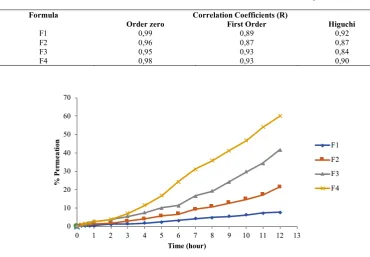
In vitro permeation test of ketoprofen transdermal preparation was performed on all four formulas F1, F2, F3, and F4. From the results of the permeation test it was found that F4 is the formula gave the highest percentage of ketoprofen permeation among other formulas. Formula F1 that does not contain tween 80 as penetration enhancer showed the lowest permeation percentage.
A percent increase in ketoprofen permeation is proportional to the increase in tween 80 concentrations. This proves that tween 80 may increase per cent of ketoprofen permeation. From the table 4 it can be seen that there is a percent increase of permeation which is proportional to the increase of tween 80 concentration.
From the value of correlation coefficient can be determined more dominant order of reaction in kinetics of drug release transdermal, which its correlation coefficient closest to 1. The correlation coefficient of each formula can be seen in Table 5.
From all the formula, the correlation coefficient value for the order of zero is greater than the first order and Higuchi and the value is closest to 1. This indicates that drug release follows zero-order kinetics, where there is drug release at constant velocity, drug release rate is independent of concentration . This release system is an ideal discharge system for sustained release preparations and transdermal systems.9-10
Table 1: Formula of ketoprofen transdermal preparation
Ingredients Formula (% b/b)
F1 F2 F3 F4
Ketoprofen PVP Eudragit RS100 Dibutyl phthalate* Tween 80 Ethanol add 10 1 4 30 0 100 10 1 4 30 1 100 10 1 4 30 2 100 10 1 4 30 3 100 (*) based on the weight of the polymer12
Table 2: The average content of ketoprofen in the preparation
Formula Concentration of ketoprofen (mg)
Theoretical Result
F1 F2 F3 F4 30 30 30 30
30.26 ± 0.26 30.34 ± 0.34 30.24 ± 0.24 30.33 ± 0.33
Table 3: The average ketoprofen level in each section of the transdermal patch
Formula Ketoprofen concentration (mg)
Theoretical Result
F1 F2 F3 F4 10 10 10 10
10.10 ± 0.10 10.46 ± 0.46 10.30 ± 0.30 10.16 ± 0.16
Table 4: Percentage permeation of ketoprofen for 12 hours
Time (hour)
% Permeation
F1 F2 F3 F4
Table 5: The value of correlation coefficients of zero order, first order, and Higuchi
Formula Correlation Coefficients (R)
Order zero First Order Higuchi
F1 0,99 0,89 0,92
F2 0,96 0,87 0,87
F3 0,95 0,93 0,84
F4 0,98 0,93 0,90
Figure 1: Profile of ketoprofen permeation of transdermal preparations
DISCUSSION
This transdermal preparation uses eudragit RS100: PVP as polymers former. Eudragit RS100 serves as a controller for drug release as well as a drug matrix while PVP serves as an adhesive so that the preparation can be attached to the skin. Transdermal preparations are made in patch form. To get a patch that is elastic and not easily broken, added plasticizer that is dibutyl phthalate. The penetration enhancer used is tween 80. Tween 80 is a non ionic surfactant that works by dissolving lipophilic compounds and dissolving lipid layers in the stratum corneum. Ethanol 96% is used as a solvent because of the nature of all the soluble ingredients in ethanol. The uniformity test of ketoprofen levels in the transdermal patch is performed to ensure that the resulting patch contains the same ketoprofen concentration as the formula. The test is performed by dissolving a 4 cm diameter patch into ethanol. Used ethanol solvent because all the ingredients in the patch are soluble in ethanol.
The increase in percent value of ketoprofen permeation is proportional to the increase in tween 80 concentrations. This suggests the influence of tween 80 concentration as a permeation enhancer in ketoprofen. In this study, concentration of tween 3% yields the highest percentage of permeation. Use of tween 80 at 3% limit is in accordance with the guidance of its use.
Tween 80 is a nonionic surfactant which penetrates into intercellular of stratum corneum. Its increase fluidity so that it can dissolve and extract lipid components. Secondly, the penetration followed by interaction and binding with keratin filaments may results in a disruption within the corneocyte. Tween 80 contains the ethylene oxide and a long hydrocarbon chain. This structure imparts both lipophilic and hydrophilic characteristics to the enhancer, allowing it to partition between lipophilic mortar substance and the hydrophilic protein domains. Tween 80 may interact with the polar head groups of the lipids and the modification of H-bonding and ionic forces may occur. The other
domains (keratinocytes). In this case, targets of the enhancer are the keratin fibrils and their associated water molecules. The disruption caused by the enhancer makes this area more aqueous. With high volumes could result as increase in the solubilizing ability of the aqueous and actually change the operational partition coefficient of this region of the skin.11
CONCLUSION
From the result of the research, it can be concluded that the formulation of ketoprofen transdermal preparation can be done by using eudragit polymer RS100 and PVP by solvent evaporation method. Increased penetration of tween 80 can increase percent of ketoprofen permeation. Increasing the concentration of tween 80 is proportional to the percent increase in ketoprofen permeation. Formula F4 containing 3% tween 80 gives the highest percentage of permeation that is 60.14%. All formulas followed the kinetics of drug release of zero order.
REFERENCES
1. Alfred, G.G., S.G. Louis and GA. The Pharmacological Basic of Therapeutics. Sixth Edit. Mac Millon Publishing; 1980. 234 p.
2. Bowman WC and MJR. Textbook of Pharmacology. Second Edi. Black Well Scientific Publication; 1980. 156 p. 3. Janeway, C.A., P. Travers, M. Walport and MS.
Immunobiology [Internet]. 2001. Available from: http://www.ncbi.nlm.nih.gov/bookshelf/
br.fcgi?book=imm&part=A1 61
4. Kantor T. Ketoprofen: A Review of Its Pharmacologic and Clinical Properties. Pharmacotherapy. 1986; 6 (3):93–103. https://doi.org/10.1002/j.1875-9114.1986.tb03459.x PMid:3526298
6. Walters K. Dermatological and Transdermal Formulation. New York: Marcel Dekker; 2004. 18, 25-26, 33, 103-105, 210, 337-338 p.
7. Robinson J. Sustained and Controlled Release Drug Delivery Systems. New York: Marcel Dekker; 1987. 234 p. https://doi.org/10.1201/b14193
8. Indonesia M of H of the R of. Indonesian Pharmacopoeia. 4th Editio. Jakarta: Ministry of Health of the Republic of Indonesia; 1995. 487 p.
9. Martin A. Farmasi Fisika. Jakarta: UI-Press; 1993. 374 p. 10.Dash, S., P.N. Murthy, L. Nath and PC. Kinetic Modeling on
Drug Release from Controlled Drug Delivery Systems. Acta Pol Pharm. 2010; 67 (3):219.
11.Rigg PC BB. Shed snake skin and hairless mouse skin as model membranes for human skin during permeation studies. J Invest Dermatol. 1990; 94:240. https://doi.org/ 10.1111/1523-1747.ep12874561
12.Rowe, R.C., J.P. Sheskey and Owen S. Handbook of Pharmaceutical Excipient. Fifth Edit. UK: Royal Pharmaceutical Society of Great Britain; 2006. 203-204, 462-468, 508-513 p.
Cite this article as:
Soraya R Mita et al. Study In vitro of ketoprofen patch with Tween 80 as enhancer. Int. Res. J. Pharm. 2018;9(7):111-115 http://dx.doi.org/10.7897/2230-8407.097134
Source of support: Nil, Conflict of interest: None Declared