IJEDR1702211 International Journal of Engineering Development and Research (www.ijedr.org) 1351
A Review on Risks Analysis towards the
Correctness of the Data in the Cloud
1
S. Annapoorani,
2G. A. Mylavathi,
3Dr.B. Srinivasan
1Assistant Professor, 2Assistant Professor, 3Associate Professor
Depart ment of Co mputer Science
Gob i Arts & Sc ience College, Gob ichettipalaya m, Ta mil Nadu, India
_________________________________________________________________________________________ _______________
Abstract — In recent years, cloud computing has been an emerging technology computing model in the IT industry.
Mac hines invol ve d in cloud c omputing deli ver ser vices in a scalable manner. It provi des efficient computing by centralizing stor age, me mory pr ocessing and bandwi dth. Adopting cl oud c omputing c an result in both positive and negati ve effects on data security. This paper presents a study about the security risk issues invol ve d in cl oud c omputing . It highlights the different types of risks and how their existence can affect the cl oud users. It also discusses the different circumstances in which the risks occur and the measures to be taken to avoi d the m. The paper also atte mpts to lay out me asures to be taken while using cloud c omputing to re duce negati ve effec ts on the outcome and maintain data integrity. (Abstract)
IndexTerms—Computing Model , IT Industry, Security Risk Issues. (k eywords)
________________________________________________________________________________________________________
I. INTRODUCTION
Cloud computing has served the ever growing storage and data processing needs, however it has also given rise to a number of risks. The risks arise due to the various factors such as the location of the data centres, data segregation, data integrity, infrastructure and lack of knowledge about the governing policies. In a cloud co mputing environment, the resources are used when required and this is expected to translate into reduced costs of ma intenance and elastic scalability. For e xa mp le, in or der to process a user request, the service provider decides upon the resources to be utilised for the particular task and when these resources needs to be released. Since the entire process is carried out by the service provider and not by the user, the secu rity and integrity of the user‟s data becomes a significant concern.
This paper analyses three major risks associated with cloud computing na mely, 1) Security risks 2) Privacy risks 3) Consumer risks. In section 2 c loud co mputing is e xplo red as a process along with its pros and cons. Section 3 foc uses on the risks involved and the need for risk analysis. It further dwe lls on specific risks involved in the arena of b io medica l informat ion sharing. Further, the privacy risks involved in the two ma in c loud structures and risks associated with the consu mers are a lso discussed. These risks are put into perspective by considering Google Docs as a background. A conclusion is established in Section 4 aft er reviewing through preceding sections covering the current cloud computing practices and risk mitigation measures being factored in the process.
II. WHAT IS CLOUD COMPUTING
Cloud computing is an internet-based model of computing, where the shared informat ion, software and resources are provided to computers and other devices upon demand. This enables the e nd user to access the cloud computing resources anytime fro m any platform such as a cell phone, mobile co mputing platform or the desktop. The data and the software applications required by the users are not stored on their own computers; instead they are s tored on remote servers which are under the control of other hosts. The users are not necessarily awa re about which server running on which host is providing t he service. The current ma jor c loud service providers are Microsoft, He wlett Packa rd, IBM , Sa lesforce, A ma zon and Google.
The two most significant components of the cloud computing architecture are the front end and the back end. The front end includes the client‟s computer and the application required to access the cloud computing system. All the clo ud computing systems do not provide the same user interface. Web services like e lectronic ma il progra ms control some e xisting web browsers such as Firefo x, Microsoft‟s internet explorer or safari. Other type of systems has some unique application which pro vides the network access to its clients. The back end of the cloud computing architecture consists of the various servers, computers an d the data storage devices, in other terms this network of interconnected devices constitute „the cloud‟.
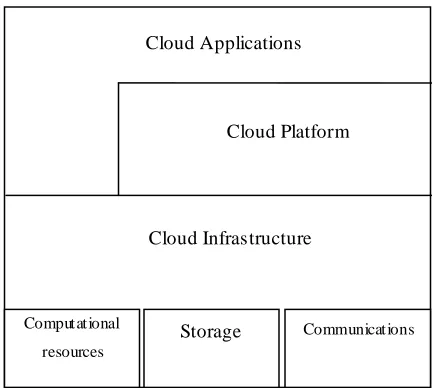
IJEDR1702211 International Journal of Engineering Development and Research (www.ijedr.org) 1352 Figure 1. The different cloud computing component s. The layered figure represents the inter-dependency between the different layers in the
cloud.
Advantages in Cl oud Computi ng
Reduced setup costs can be considered as a major advantage for cloud computing, since the costs involved in setting up a data centre are not very high.
In addition to the IT industry, even small scale businesses can adopt this environment (mode l).
Considering cloud computing fro m the aspect of power management, it serves as a virtual server wh ich is easier to imple ment in co mparis on to physical servers.
Hardwa re manage ment failure can also be localized and rectified with re lative ease.
Various data centres are spread throughout the country and thus it makes easy for the businesses to use preferred sites.
The assessment of data can be done any time and is highly benefic ial for the IT industry in reducing workloads.
The cloud computing environ ments are easily scalable.
Backup recovery is very easy in Infrastructure as a Service (IaaS) Providers, hence there is efficient incident respo nse whenever data needs to be recovered.
Disadvantages in Cloud Computing
A major d isadvantage in cloud computing is that it is under the maintenance and supervision of a third party. Hence the confidentiality and security measures are less secured.
In cloud environments the data is not specifically segregated. It is distributed throughout the cloud network and causes problems when specific data needs to be segregated.
Another major drawbac k is the dependence on network connectivity. Network fa ilures can result in loss to the company by causing extensive time delays.
The Service Lease Agreements (SLA) are the agreements made with the service providers controlling varied equipment in the cloud network. These agreements should be carefully verified before en tering into a contract of service.
The quality of service is a key determin ing factor in the effic iency of a cloud network. A re liable service provider providing desired quality of service may be difficult to source and the process set -up could turn out to be time consuming.
III. RIS K ANALYS IS
In order to create awareness among the users of cloud computing regarding the serious threats and vulnerabilities involved in cloud computing environments, a study on various risks is imperat ive. In the sections be low, we d iscuss the different risks.
Security Risks
The state of preventing a system fro m vulnerable attacks is considered as the system‟s security. Security risks involved with the governmental use of cloud computing have various risk factors. Seven important identity factors for risk in a clo ud computing model are : Access, Availability, Network load, Integrity, Data Security, Data Location and Data Segregation.
Access
Cloud Applications
Cloud Platform
Cloud Infrastructure
Computational
resources
IJEDR1702211 International Journal of Engineering Development and Research (www.ijedr.org) 1353 The data in a private organization allows only the authenticated users to access t he data. The access privilege must be provided only to the concerned customers and auditors in order to minimize such risks. When there is an access from an intern al to external source, the possibility of risk is more in case of sensitive data. Segregation of the data is very important in cloud computing as the data is distributed over a network of physical devices. Data corruption arises if appropriate segregation is not ma intained. Currently, there are no federa l polic ies addressing how government informa t ion is accessed.
Availability
Availability plays a ma jor ro le in cloud computing since the needs of the customers should be attended on time . A research from the University of Californ ia had tracked the availability and outages of four major cloud vendo rs. It was found that overload on the system caused programming errors resulting in system crashes and failures. Due to the lack of backup recovery Apple, Mobile, Google Gma il, Cit rix and Ama zon s3 reported periods of unavailability ranging fro m 2 to 14hrs in a span of just 60 days. This resulted in a loss of confidence among the customers and the vendors.
Natural disasters can also present significant risks. A lightening strike at one of Amazon.co m‟s facilities caused the service to go offline fo r appro ximately 4 hours. This component of the cloud was difficult to replace immediately and resulted in delays.
Network Load
Cloud network load can also prove to be detrimental to performance of the cloud computing system. If the capacity of the cloud is greater than 80%, then the computers can become unresponsive due to high volumes .The computers and the servers crash due to high volume motion of data between the disk and the computer me mory. The percentage of capacity threshold also poses a risk to the cloud users. When the threshold exceeds 80%, the vendors protect their services and pass the degradation on to customers. It has been indicated that in certain cases the outage of the system to the users are still not accessed.
Fle xib ility and scalability should be considered pivotal when designing and imp le menting a c loud infrastructure. Money and time also plays an important role in the design of the infrastructure. Customers will a lways have expectations on the durability and the efficiency of the system. Go ing forward the customers will also demand the need of interoperability, ability to switch providers and migration options. Another risk factor of cloud co mputing is the imp le mentation of the application programming interfaces (API).
Integrity
Data integrity affects the accuracy of informat ion ma intained in the system. In a cloud computing model data validity, quality and security affect‟s the system‟s operations and desired outcomes. The program efficiency and performance are addressed by the integrity. An apt exa mp le for this would be that of a mobile phone service provider who stored all t he customer‟s data including messages, contact lists etc in a Microsoft subsidiary. The Provider lost the data and the cloud was unavailable. The customers had to wait until they got the necessary information fro m the cloud and the data was restored.
Data Security
Another key criterion in a cloud is the data security. Data has to be appropriately secured from the outside world. This is necessary to ensure that data is protected and is less prone to corruption. With cloud computing becoming an upcoming trend, a number of vulnerabilit ies could arise when the data is being indiscriminately shared among the varied systems in cloud computing. Trust is an important factor which is missing in the present models as the service providers use diversified mechanis ms which do not have proper security measures.
Data Loc ati on
Data Location is another aspect in cloud computing where service providers are not concentrated in a single location but are distributed throughout the globe. It creates unawareness among the customers about the exact location of the c loud. This could hinder investigations within the cloud and is difficu lt to access the activity of the cloud, where the data is n ot stored in a particular data centre but in a distributed format. The users may not be familiar with the underlying environments of the varied compone nts in the cloud.
Data Segregation
IJEDR1702211 International Journal of Engineering Development and Research (www.ijedr.org) 1354 We exa mine how cloud co mputing is assessed in a bio medical laboratory which e xpe riences risks due to hackers. In a biomed ical laboratory, data is always exposed to threats both internal and external. Less separation is provided by the cloud in case of a separate server in a laboratory. The risks include the hacking of the hypervisor, where a shared CPU can be easily attacked. The data can be manipulated, de leted or destroyed as a result of the attack. Such attacks on biomed ical data can have serious implications to the end users. Thus the Data Base Manage System (DBMS) and web servers face vulnerability if the infrastructure of the cloud is not properly designed. There are certain non technical risks which arise due to outsourcing of informat ion. Encrypting the data from the technical aspect is important to ensure that the data is not hacked or attacked. St rong encryption is needed for sensitive data and this would mean increased costs.
Privac y Risks
Several co mp le x privacy and confidentiality issues are associated with c loud computing. In this section, we dwe ll on some of these different privacy risks involved in cloud computing environments. There are no laws that block a user fro m disclosing the informat ion to the cloud providers. This disclosure of information sometimes leads to serious consequences. Some business users may not be interested in sharing their information, but such information is sometimes placed in the cloud and this may lea d to adverse impacts on their business. For examp le, recently when Facebook changed it‟s terms of service, the customers were not informed about it. This made it possible to broadcast the information of the Facebook customers to others if the privacy options were not set accordingly. This a mplifies the importance of reading and understanding the Terms of Serv ice and the Privacy Policy of the c loud providers before plac ing any informat ion in the c loud. If it is not possible to understand the po licy or it doesn‟t satisfy the needs of a user, the user can and must always opt for a different cloud provider. Several organisations have analysed the issues of privacy and confidentiality in the cloud computing environment. These analyses have been published by a Privacy Co mmissioner, an industry association and a comme rcia l publisher.
Do mestic clouds and trans -border clouds are two distinct cloud structures. Certain privacy issues are specific to each cloud structure. In a do mestic c loud structure, the complete c loud is physically located within the sa me territory. This gives rise to fewer p rivacy issues such as whether the data is collected, used and stored in an appropriate manner and whether the data is disclosed to authorised recipients only. Another privacy issue in the domestic cloud structure is related to the rights possessed by the data owners to access their data. The circu mstances under which the data owner can access and correct the data should be defined clearly. The above privacy issues can also be extend ed to all other cloud computing environ ments in general.
Trans-border cloud structures have their cloud transferred across the borders. This gives rise to more privacy issues. The best exa mp le for a trans -border cloud operator is the Google Docs. People fro m d ifferent parts of the world store data in Google Docs. When data is transferred between diffe rent organisations located at different countries, serious privacy issues could o ccur.
The privacy principles regulating trans -border dataflow defined by the different countries should be given importance by the cloud providers. For examp le Australia‟s National Privacy Princip le 9 deals with trans -border data flows and is different from privacy regulations of other nations. Another exa mp le is where a health ca re provider uses a transborder cloud computing product to store and/or process patient data, they would have to ensure that the transfer is permitted under the relevant privacy la w .
We examined the Google Docs‟ Privacy Policy, which must be read in conjun ction with Google‟s general Privacy Policy. Severa l noteworthy provisions were observed in it.
For e xample,
“When you access Google services via a browser, application or other client our servers automatically record certain information. These server logs may include information such as your web request, your interaction with a service, Internet Protocol address, browser type, browser language, the date and time of your request and one or more cook ies that may uniquely identify your browser or your account.”
In the Privacy Policy, it is specified that „our servers automatically record certain info rmation‟. While there are details provided for some types of data being collected, it refers to „certain information‟ which is not clear whether the specified data are the only types of data collected.
If we consider Google Doc‟s Privacy Policy, it does not give a clear explanation about how a user‟s personal information will be used by Google and where it will be stored. A detailed analysis of Google‟s general Privacy Po licy brin gs out this discrepancy.
Consumer Risks
IJEDR1702211 International Journal of Engineering Development and Research (www.ijedr.org) 1355 In order to avoid both the privacy and consumer risks, the consumers need to familiarize with the cloud computing product the y will be using. For e xa mp le, when using Google Docs, one must read at least the following te rms;
Universal Te rms of Se rvice Additional Terms
Program Policies Privacy Policy
CopyRight Notices
By examining the above documents, several interesting features become apparent. First, to use any of Google‟s services, a consumer has to agree to be bound by a range of terms unilatera lly decided by Google and those terms may be unilaterally changed by Google without specific notification. Goog le also states that they will treat a consumer‟s use of their services a s an acceptance of the terms included in Google‟s contract. Further, it can be noted that, when Google disables access to a consumer‟s account, the consumer may be prevented fro m accessing content fro m their account. This is serious in re lation to Google Docs services.
It can be concluded that the Google Docs users, knowingly or unknowingly agree to the terms which may have serious consequences. The legality of some of the terms is questionable.
IV. CONCLUS IONS
With the increase in the growth of cloud computing, security needs to be analysed frequently. The Users should be aware of the risks and vulnerabilit ies present in the current cloud computing environment before being a part of the environment.
Fro m this study of current cloud computing practices and inherent risks involved, it is clear t hat at present there is a lack of risk analysis approaches in the cloud computing environments. A proper risk analysis approach will be of great help to both the service providers and the customers. With such an approach, the customers can be guaranteed da ta security and the service providers can win the trust of their customers. Also the cloud users can perform the risk analysis before placing the ir critica l data in a security sensitive cloud. Further additions to the matrix and inclusion of additional var iab les for assessment should be considered as cloud computing progresses to advanced levels where new risks could materia lize. We have discussed ma inly three majo r risks associated with cloud computing. With the rapid growth in this field of cloud computin g, several other risks can occur.
In this world where everyone is becoming a part of c loud computing, we be lieve that awa reness among the people regarding the existence of risk, security mechanis ms provided by the different cloud service providers to eliminate such risks and the introduction of new risk analysis approaches has significant importance and scope.
V. REFERENC ES
[1] Amit Sangorya, Saurabh ku mar, JaiDeep Dhok, and Vasudeva Varma. “Towards Analyzing Data Security Risks in Cloud Co mputing Environ ments”, International conference on Information systems, Technology, and Management, Thailand, March, 2010.
[2] R Gellman . “ Cloud Co mputing and Privacy”. Presented at the World Privacy Forum, 2009.
[3] Scott Paquette, Paul T.Jaegar, Susan C.Wilson. Identifying the security risks associated with governmental use of cloud computing, Journal of Government Information Quarterly 27, pages 245-253, April, 2010.
[4] Sagar B Patil, Pooja A Vhatkar, “Towards Secure and dependable storage devices in Cloud Comp uting” International Journal of Innovative Research in Advanced Engineering, Volu me 1 Issue 9, 2015
[5] Subra Ku maraswa my, Shahed Latif and Tim Mather. “Cloud Security and Privacy: An Enterprise Perspective on Risks and Co mpliance”. Published by O’Reilly, 1st