IJEDR1901002 International Journal of Engineering Development and Research (www.ijedr.org) 5
Mahatma Gandhi National Rural Employment
Guarantee Act [MGNREGA]: A Catalyst of Socio
Economic Development in Rural Area
Rangappa Yaraddi, Mrs. Poornima, Sharanabasava Mattur 1Faculty,2II year MBA student,3II year MBA student 1MBA (Rural Management/ Agribusiness Management),
1Karnataka State Rural Development and Panchayat Raj University, GADAG, INDIA
_____________________________________________________________________________________________________ Abstract - This study focuses around ramifications of MGNREGA (Mahatma Gandhi National Rural Employment Guarantee Act) program on positive changes on socio-economic aspects of rural unskilled workers. The motivation behind this investigation is to understand the effect of above said program in KARMUDI village of GADAG region in Karnataka State. The study was conducted in the month of November 2018. In MGNREGA program, Grama panchayat assumes a vital role in observing, executing and actualizing the plan according to rules issued by the administration of Karnataka State Government. Further Gram Panchayat conducts Gramasabha, readies the work plan, job card enlistment for the unskilled workers, issuing job card, creating awareness for work demand, apportioning work to job card holder, payment of wages and keeping up pertinent records. During the study, the standard questionnaire was utilized to gather the essential data from the respondents of the KARMUDI village in Gadag District. The respondents were the job card holders issued by Gram panchayat and have worked at least once under the MGNREGA program in the KARMUDI village panchayat. The investigation was concluded with the noteworthy effect of MGNREGA program on enhancement of financial status and positive influence on socio-economic development of unskilled workers in the village.
IndexTerms— MGNREGA, Socio-Economic Development, Impact of MGNREGA etc
_____________________________________________________________________________________________________
I.INTRODUCTION
The majority of the Indian population lives in rural area. Agriculture is fundamental occupation of the rural work force. Agriculture is seasonal in nature because of expansive measure of land subject to rain in India. People don't get work in all days of the year. The seasonal work in rural areas advances relocation of rural unskilled individuals to urban territories. To lessen movement among rural individuals to urban zones, Government of India has been actualizing MGNREGA program as act to give unskilled employment to the rural community. Thus MGNREGA is the government’s aspiring project for rural community. The principle target of the program is to enhance the quality of life by giving work to rural community and reinforce employments by making long term sustainable assets. This investigation is mainly concentrating on effect of MGNREGA program on socio-economic development of rural unskilled workers.
II.OBJECTIVE OF THE STUDY
To study the implications of MGNREGA on socio-economic development on rural unskilled workforce.
Hypothesis of the study
H0: MGNREGA program has a no significant positive influence on socio-economic development on rural unskilled worker. H1: MGNREGA program has a significant positive influence on socio-economic development on rural unskilled worker.
III.SCOPE OF THE STUDY
The study was undertaken in ‘KARMUDI’ village of GADAG district in Karnataka State. The scope of this study is limited to Grama Panchayat of KARMUDI village in GADAG district.
IV.METHODOLOGY AND DATA COLLECTION
In this empirical study the primary and secondary sources of data are collected from the different sources such as, questionnaire, books, journals and websites. Further Structured questioner was administered to collect the primary data. Primary Data: During the study primary data was collected by interaction with MGNERAG job card holders in KARMUDI village of GADAG district.
Secondary Data: Secondary data has been collected from the MGNERAG brochures, relevant articles, journals, websites and magazines.
IJEDR1901002 International Journal of Engineering Development and Research (www.ijedr.org) 6
Questionnaire: A questioner consisting of 11 items including the factors like ‘Improvement of socio-economic statuses, ‘Payment of wages on time’ etc was self administered and filled during the interaction with the respondents of the KARMUDI village.
Description of the tool:
Part I- Personal details of the respondents.
Part II- Improvement of socio-economic development.
Statistical Analysis: A data collected from the questionnaire was analyzed using SPSS tool. A simple statistical analysis tests such as Z-test and cumulative frequency etc has been used in this study.
V.ANALYSIS OF THE DATA
Table 1.1: Frequency distribution of the response for the statement “I have awareness about MGNREGA Programme/ Scheme?” (V1).
Responses Frequency Percent
%
Cumulative percent
Strongly Disagree 0 0 0
Disagree 0 0 0
Neutral 0 0 0
Agree 27 33.8 33.8
Strongly Agree 53 66.2 100
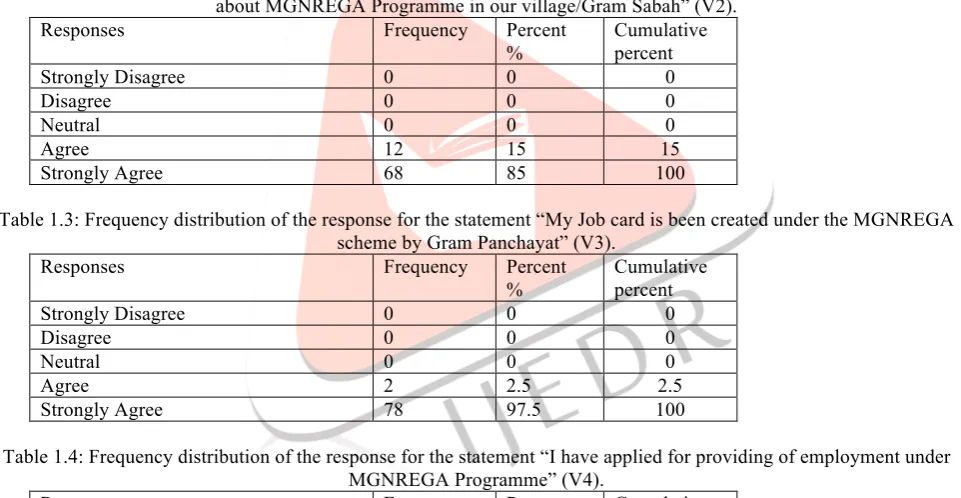
Table 1.2: Frequency distribution of the response for the statement “Concern officer/Official provided knowledge/ awareness about MGNREGA Programme in our village/Gram Sabah” (V2).
Responses Frequency Percent
%
Cumulative percent
Strongly Disagree 0 0 0
Disagree 0 0 0
Neutral 0 0 0
Agree 12 15 15
Strongly Agree 68 85 100
Table 1.3: Frequency distribution of the response for the statement “My Job card is been created under the MGNREGA scheme by Gram Panchayat” (V3).
Responses Frequency Percent
%
Cumulative percent
Strongly Disagree 0 0 0
Disagree 0 0 0
Neutral 0 0 0
Agree 2 2.5 2.5
Strongly Agree 78 97.5 100
Table 1.4: Frequency distribution of the response for the statement “I have applied for providing of employment under MGNREGA Programme” (V4).
Responses Frequency Percent
%
Cumulative percent
Strongly Disagree 0 0 0
Disagree 0 0 0
Neutral 0 0 0
Agree 2 2.5 2.5
Strongly Agree 78 97.5 100
Table 1.5: Frequency distribution of the response for the statement “I have got 100 days work under MGNREGA Programme” (V5).
Responses Frequency Percent
%
Cumulative percent
Strongly Disagree 0 0 0
Disagree 0 0 0
Neutral 0 0 0
Agree 3 3.8 3.8
IJEDR1901002 International Journal of Engineering Development and Research (www.ijedr.org) 7 Table 1.6: Frequency distribution of the response for the statement “I have got the wages for the work done under MGNREGA
Programme within two weeks” (V6).
Responses Frequency Percent
%
Cumulative percent
Strongly Disagree 0 0 0
Disagree 0 0 0
Neutral 0 0 0
Agree 56 70 70
Strongly Agree 24 30 100
Table 1.7: Frequency distribution of the response for the statement “Socio economic status of my family has improved after implementation of MGNREGA Programme.” (V7).
Responses Frequency Percent
%
Cumulative percent
Strongly Disagree 0 0 0
Disagree 0 0 0
Neutral 0 0 0
Agree 5 6.2 6.2
Strongly Agree 75 93.8 100
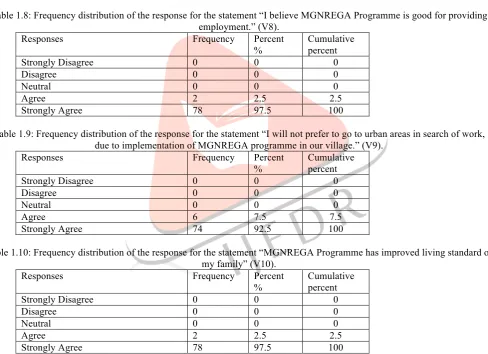
Table 1.8: Frequency distribution of the response for the statement “I believe MGNREGA Programme is good for providing employment.” (V8).
Responses Frequency Percent
%
Cumulative percent
Strongly Disagree 0 0 0
Disagree 0 0 0
Neutral 0 0 0
Agree 2 2.5 2.5
Strongly Agree 78 97.5 100
Table 1.9: Frequency distribution of the response for the statement “I will not prefer to go to urban areas in search of work, due to implementation of MGNREGA programme in our village.” (V9).
Responses Frequency Percent
%
Cumulative percent
Strongly Disagree 0 0 0
Disagree 0 0 0
Neutral 0 0 0
Agree 6 7.5 7.5
Strongly Agree 74 92.5 100
Table 1.10: Frequency distribution of the response for the statement “MGNREGA Programme has improved living standard of my family” (V10).
Responses Frequency Percent
%
Cumulative percent
Strongly Disagree 0 0 0
Disagree 0 0 0
Neutral 0 0 0
Agree 2 2.5 2.5
Strongly Agree 78 97.5 100
Table 1.11: Frequency distribution of the response for the statement “I will recommend MGNREGA Programme for other non skilled workers in my village” (V11).
Responses Frequency Percent
%
Cumulative percent
Strongly Disagree 0 0 0
Disagree 0 0 0
Neutral 1 1.2 1.2
Agree 3 3.8 5
Strongly Agree 76 95 100
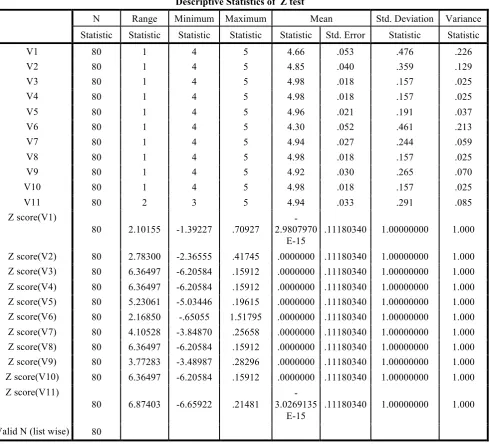
IJEDR1901002 International Journal of Engineering Development and Research (www.ijedr.org) 8 Hypothesis H0 testing is carried out as, if probability value Z-test is less than five percent level of significance then alternate hypothesis will be accepted. Otherwise null hypothesis can be accepted, that is population mean is equal to sample mean. The hypothesis tested in this study using Z- test as shown in the following table 1.1.
Table 1.1: Z-test for “Socio-economic development on rural unskilled worker.” .
Descriptive Statistics of Z test
N Range Minimum Maximum Mean Std. Deviation Variance
Statistic Statistic Statistic Statistic Statistic Std. Error Statistic Statistic
V1 80 1 4 5 4.66 .053 .476 .226
V2 80 1 4 5 4.85 .040 .359 .129
V3 80 1 4 5 4.98 .018 .157 .025
V4 80 1 4 5 4.98 .018 .157 .025
V5 80 1 4 5 4.96 .021 .191 .037
V6 80 1 4 5 4.30 .052 .461 .213
V7 80 1 4 5 4.94 .027 .244 .059
V8 80 1 4 5 4.98 .018 .157 .025
V9 80 1 4 5 4.92 .030 .265 .070
V10 80 1 4 5 4.98 .018 .157 .025
V11 80 2 3 5 4.94 .033 .291 .085
Z score(V1)
80 2.10155 -1.39227 .70927
-2.9807970
E-15
.11180340 1.00000000 1.000 Z score(V2) 80 2.78300 -2.36555 .41745 .0000000 .11180340 1.00000000 1.000 Z score(V3) 80 6.36497 -6.20584 .15912 .0000000 .11180340 1.00000000 1.000 Z score(V4) 80 6.36497 -6.20584 .15912 .0000000 .11180340 1.00000000 1.000 Z score(V5) 80 5.23061 -5.03446 .19615 .0000000 .11180340 1.00000000 1.000 Z score(V6) 80 2.16850 -.65055 1.51795 .0000000 .11180340 1.00000000 1.000 Z score(V7) 80 4.10528 -3.84870 .25658 .0000000 .11180340 1.00000000 1.000 Z score(V8) 80 6.36497 -6.20584 .15912 .0000000 .11180340 1.00000000 1.000 Z score(V9) 80 3.77283 -3.48987 .28296 .0000000 .11180340 1.00000000 1.000 Z score(V10) 80 6.36497 -6.20584 .15912 .0000000 .11180340 1.00000000 1.000 Z score(V11)
80 6.87403 -6.65922 .21481
-3.0269135
E-15
.11180340 1.00000000 1.000 Valid N (list wise) 80
From the above table 1.1 it is very clear that the population mean is different than the sample mean and is almost equal to zero in all Z score. Hence H0 (MGNREGA program has a no significant positive influence on socio-economic development on rural unskilled worker.) will be rejected and alternative hypothesis H1 will be accepted.
VI.FINDINGS
1. The findings revealed that there is a significant positive influence of MGNREGA program on socio-economic development in rural areas, that means MGNREGA program is providing good amount of work in rural area for un skilled workers.
2. Secondly the data provided the empirical evidence that MGNERAG Program has positive influence on Socio- Economic Development.
VII.FUTURE SCOPE OF RESEARCH
IJEDR1901002 International Journal of Engineering Development and Research (www.ijedr.org) 9 VIII. CONCLUSION
The study provided the empirical evidence that a significant positive influence of MGNERAG Program Improved Socio-Economic Status of the non skilled workers in KALMADI village in Gadag District their by showing the socio-economic development in the village.
ANNEXURE -1: Questioner used during data collection.
Abbreviations: SA-Strongly agree. A- Agree. N-Neutral. D-Disagree. SD-Strongly Disagree. Please mark your choice.
S.N SD D N A SA
1 I have awareness about MGNREGA Programme/ Scheme.
2 Concern officer/Official provided knowledge/ awareness about MGNREGA Programme in our village/Gram Sabah. 3 My Job card is been created under the MGNREGA scheme by Gram Panchayat.
4 I have applied for providing of employment under MGNREGA Programme.
5 I have got 100 days work under MGNREGA Programme.
6 I have got the wages for the work done under MGNREGA Programme within two weeks.
7 Socio economic status of my family has improved after implementation of MGNREGA Programme. 8 I believe MGNREGA Programme is good for providing employment.
9 I will not prefer to go to urban areas in search of work, due to implementation of MGNREGA programme in our village. 10 MGNREGA Programme has improved living standard of my family.
11 I will recommend MGNREGA Programme for other non skilled workers in my village.
ANNEXURE -2: Reliability analysis of the data collection tool used in the study Variable
Name Variable Description
Cronbach’s Alpha
V1 I have awareness about MGNREGA Programme/ Scheme. 0.737
V2 Concern officer/Official provided knowledge/ awareness about MGNREGA
Programme in our village/Gram Sabah. 0.680
V3 My Job card is been created under the MGNREGA scheme by Gram Panchayat. 0.699 V4 I have applied for providing of employment under MGNREGA Programme. 0.699
V5 I have got 100 days work under MGNREGA Programme. 0.704
V6 I have got the wages for the work done under MGNREGA Programme within two weeks. 0.759 V7 Socio economic status of my family has improved after implementation of
MGNREGA Programme. 0.692
IJEDR1901002 International Journal of Engineering Development and Research (www.ijedr.org) 10 IX.REFERENCES
[1] http://nrega.nic.in/netnrega/home.aspx
[2] Ajit Ghose, 2015. "Addressing the Employment Challenge: India's MGNREGA," Working Papers id:7469, eSocialSciences.