United Kingdom Vol. IV, Issue 12, December 2016
Licensed under Creative Common
http://ijecm.co.uk/
ISSN 2348 0386
THE INFLUENCES OF PRIMARY STAKEHOLDERS, FARMERS’
CAPACITY, AND COMPETITORS’ BEHAVIORS
ON BANK DYNAMIC CAPABILITY
EMPIRICAL STUDY OF BANK DYNAMIC CAPABILITY ON THE IMPLEMENTATION OF PUBLIC BUSINESS CREDIT OF AGRICULTURAL SECTOR IN BANK INDUSTRY IN INDONESIA
Kristina Lestariningsih
Doctoral Program in Management Faculty of Economics and Business, Padjadjaran University, Bandung, Indonesia
Yuyus Suryana
Doctoral Program in Management Faculty of Economics and Business, Padjadjaran University, Bandung, Indonesia
Sucherly
Doctoral Program in Management Faculty of Economics and Business, Padjadjaran University, Bandung, Indonesia
Erie Febrian
Doctoral Program in Management Faculty of Economics and Business, Padjadjaran University, Bandung, Indonesia
Abstract
KUR (Kredit Usaha Rakyat or Public Business Credit) in agricultural sector, originally in the
format of Food and Energy Credit, is a main financing program to support the important program
of national food security. KUR in agricultural sector is expected to increase the farmers'
business performance on both results and productivity of food crops, livestock, and fisheries in
order to achieve food self-sufficiency. KUR complex problems are affecting the declining of KUR
Licensed under Creative Common Page 298 Indonesia lands, with the Branch Managers as the observation units and Branch Offices of KUR
Executing Banks as the analytical units. The main purposes of the research are to give
knowledge contribution to strategic management domain, as well to provide recommendation for
improving the dynamic capability of executing Bank in KUR agricultural sector. The research
uses the qualitative and quantitative methods with SEM statistical test, reviewing the variables
of the primary stakeholders, the capacity of farmers, and the competitors’ behavior as the
antecedents of the dynamic capability of agricultural sector KUR executing banks. The results
reveal that primary stakeholders gives no direct impact to bank dynamic capability; while
competitors’ behavior has significant role on bank dynamic capability. Further results show that farmers’ capacity is proven to have the roles to improve bank dynamic capability.
Keywords: National food security, food self-sufficiency, KUR in agricultural sector, primary
stakeholders, farmer’s capacity, competitors’ behavior, bank dynamic capability
INTRODUCTION
Achieving food self-sufficiency in Indonesia can not be separated from the role and important contribution of Micro, Small, and Medium Enterprises (SMEs) that provide jobs for 97.2% of total employment, contributed approximately 56.5% to the establishment of the national Gross Domestic Product (GDP) in 2012. While the number of labor involved in SMEs reached 114.1 million people or 94% of the 121 million total workforce in Indonesia (Central Bureau of Statistics, 2013). Therefore, enhancing SMEs in the economy of Indonesia can not be separated from the supports and roles of the government in encouraging the credit lending to SMEs, such as PBC program.
Licensed under Creative Common Page 299 The increase in Non Performance Loan (NPL) of SMEs caused by various conditions such as the roles of Primary Stakeholders, the Farmers’ Capacity, the Bank Competitor Behaviors, and the development of Bank Dynamic Capability. The roles of Primary Stakeholders(including the parties directly involved in the operation such as officers of Ministry of Agriculture, extension workers, cooperatives, wholesalers, and other related parties) are still low indicated by technical instructions of PBC Program that have not been socialized intensively and yet still cannot accommodate the needs of farmers, lack of market access assistance by the collectors, as well as guidance and consultation assistance from the department of agriculture to the farmers.
The role of Field Agricultural Extension Officers, who originally helped farmers intensively, is also diminishing. Farmers’ Capacity related to technical ability are still low. Farmers as the debtors of PBC are often not prepared to have a sufficient business scale to meet their obligations to banks. Bank Competitor Behaviors in providing credit schemes, including non-formal financial institutions such as informal moneylenders (rentenir, loan-sharks)are providing convenience to the farmers in obtaining loans. PBC’s eligibility as licensing collateral is difficult to fulfill by farmers, plus the credit process at a formal financial institution such as a bank that takes a long time.
Bank Dynamic Capability are still weak as related to pre-screening potential creditors as no site visits for loan officers transferred the task to cooperatives, farmers' groups or other partners who provide references. Research results by Ritonga et al (2008) in North Sumatra province showed that most of the productivity of food farmers was still low and had the potential to be enhanced through the provision of agricultural intensification Credit Food and Energy, improving farmers' knowledge through the guidance of the relevant office. Beers, Beulens and van Dalan (2000) and Zhang (2011) suggest that the low growth of farmers' income in the countryside, causing the burden on farmers and worsening income gap between rural and urban increasingly sharp so we need a solution how to increase farmers' income growth in the long term.
Licensed under Creative Common Page 300 Problem Formulation
The problem in this study is whether the role of primary stakeholders, the capacity of farmers and competitors’ behavior will affect the dynamic capabilities of the PBC participating banks in agricultural sector. The focus of the problem formulation is the conceptualization of the dynamic capabilities of the bank based on the role of primary stakeholders, the capacity of farmers, and competitors’ behavior as antecedents.
Research Purposes
The research approach used is through the domain of strategic management based on how a program should be able to create value for all stakeholders. This research examines the aspects of the strategic roles of primary stakeholders, the capacity level of farmers, competitors’ behavior as the antecedent factors to the dynamic capabilities of the bank. The results of this research is expected to provide knowledge to contribute to the theories or concepts related to dynamic capabilities, stakeholder management, and the capacity of small entrepreneurs.
LITERATURE STUDY
Primary Stakeholders
The strategic role of stakeholders is based on stakeholder theory that suggests primary stakeholders are parties without active participation from them, then the company may not be able to operate (Johnson, 2012). This study focuses on the research by the OECD (2012) states that development and implementation of agricultural policies are significantly influenced by the role of agricultural ministries in the central government and local governments. Thiele et al. (2011) state that the runway at the eyes of the market chain in agriculture which includes traders, processors, shop owners, researchers, and others involved along with farmers and their associations to encourage the creation of new market opportunities. Martey et al. (2014) argue that stakeholders should provide education to small-scale entrepreneurs to improve communication and collaboration between farmers and stakeholders in the value chain.
Farmers’ Capacity
Licensed under Creative Common Page 301 supported by Ashby et al. (2009), who classify the skills that must be owned by farmers is group management skills, financial management, marketing, experimenting and innovating to access new technology, producing a sustainable and natural resource management.
Competitors’ Behaviors
Sinha and Martin (1998) in their research state that the addition of access to credit from microfinance institutions in Bangladesh cannot replace the informal lending sources that charge high interest rates. Ketchen, Snow and Hoover (2004) argue that the competitive dynamic is an intense rivalry among competitors involving actions and responses among competitors which have the same customers in a market. This is confirmed by Meyer (2002) who states in his research that the loan product on micro-financing institutions got an important competitor of the informal sector, especially for borrowers from poor families. But on the other hand, Collins and Mc Kay (2012) believe that there is no natural competition between the formal and informal financial products. Formal products such as credit, generally offer a large number, but the informal products can meet the needs of others such as flexibility, speed and relationships with the community.
Bank Capability Dynamic
The concept of bank dynamic capability in this research is based on contingency theory and dynamic capability view (DBV) as well as research conducted by Teece and Pisano (1997) who focus on the performance of companies that face business conditions with rapid technological change, changes in customer and competition is fierce. The majority of SMEs depend on bank loans or loans from suppliers at the beginning of the business opening due to the scarcity of venture capital and other capital sources. In developing countries, SMEs generally depend on the credit facilities, but Blumberg and Letterie (2008) argue that access to credit facilities for SMEs starters are very limited. According to Berger and Udell (2002), a commercial bank that handles SMEs beginner need to consider the financial report, credit scoring, assets based lending, relationship lending facility.Based on the research results by Fatoki (2014), one cause of failure is lack of access to credit information on credit Banking.
RESEARCH METHOD
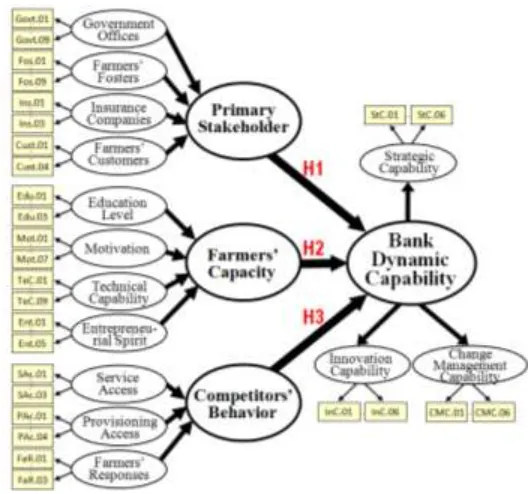
Licensed under Creative Common Page 302 that disbursed PBCin agricultural sector, as well as PBC executing channeling banks of other agricultural sectors. Quantitative methods use statistical test by Structural Equation Modelling (SEM). The operationalization of research variables is described in the following research model:
Figure 1. Research Model form of relationship between latent variables
Data Sources
PBC Executing banks include State-Owned Banks, Regional Development Banks (RDB), Private Banks, and Non-Bank Financial Institutions. Respondents from the agriculture sector PBC executing banks (such as Bank Rakyat Indonesia, Mandiri, Bank Negara Indonesia, RDB Central Java, RDB Maluku Utara, RDB South Sumsel-Babel).The observation unit for this research is the respondents from the Branch Bank of PBC Executing Agency, and as the unit of analysis is a branch office led by the Branch Manager as respondents.
Data Collection Techniques
Licensed under Creative Common Page 303 50 respondents, the respondents required in this study are not less than250 respondents. In this research, 317 bank branch managers as the respondents are those from six different banks covering the geographical area of 27 provinces out of the total 34 provinces in Indonesia.
Pre Testing Questionnaire
Pre testing of the questionnaire is carried out on approximately 10% of the total number of 300 respondents who are likely to be obtained in this research. The 30 Bank Branch Managers as pre testing respondents are taken outside of the 317 respondents. The data of pre testing are analyzed by using validity parameters, considering that the loading factor of less than 0.5 means that the parameter is invalid, so the sentence of questionnaire needs to be revised or the questionnaire to be eliminated. Out of the 87 parameters, only one is eliminated because less relevant, so that after pre testing this research is using 86 parameters.
Analysis of Measurement Model
Empirical data collected through the survey are analyzed by using multivariate through SEM Lisrel program. According Wijanto (2008) SEM includes the analysis and testing by using a two-stage approach that includes:
1. Measurement Model Analysis by using Confirmatory Factor Analysis.
2. Structured Analysis model to analyze the relationship between latent variable, calculated by using Goodness of Fit Index (GOFI). Furthermore, the value of the standardized solution of any latent variable to be counted, followed by a significant test by using the t value.
Analysis of model measurements to be done by ensuring that all indicators or measured variables can theoretically be defined hereinafter, categorized into latent variables as shown in the research model. The next step is to simplify the measurement model through systematic steps of data processing as follows:
1. Analyzing the entire model of the measurement as described in the research model 2. Calculating the value of the latent variable or latent variable score (LVS) of the latent
variables to simplify the model.
3. Analyzing the measurement model of the research model that has been simplified. Analysis of the measurement model includes three tests consisting of (1) test the suitability/compatibility with the data model of research, known as overalls model fit; (2) testing the validity; and (3) testing the reliability of the measurement model.
Licensed under Creative Common Page 304 the Goodness of Fit Indices (GOFI), the validity of which is measured by standardized factor loading (SFL), and reliability as measured by construct reliability (CR) and variance extracted (VE) of the measurement model variables.
Furthermore, the measurement model variables can be seen from the loading factor which is the amount of correlation between the indicators of the latent constructs. In most of the reference, loading factor of 0.5 or greater is considered to have validation that is strong enough to explain the latent constructs (Hair et al, 2007).
In this study there are four latent variable measurement models of research that will be analyzed as follows:
Latent Variables of Primary Stakeholders (PSH)
The PSHlatent variable is a Second Order Confirmatory Factor Analysis (2nd Order CFA), measured by four variables as the dimension or 1st Order CFAs. The dimensions are as follows: 1) Related Government Institutions (Govt); 2) Fosters (Fos); 3) Insurance Company (Ins); and 4) the Customer (Cust). Estimation Results of the PSH latent variable measurement model shown through the path diagram standardized solution and t-value, can be concluded that in general the PSH latent variable measurement model is valid and reliable.
In the 2nd Order CFA of PSH latent variables, Fos has the highest loading factor (LF) of 0.89, while the lowest is Ins with LF of 0.63. It shows that insurance firms have the least contribution to explain the latent constructs as compared to other indicators of stakeholders such as government offices (the department of agriculture, animal husbandry, fisheries department), the fosters (traders, cooperatives and the core enterprise) as well as customers.
Latent Variable of Farmers’ Capacity (FC)
The FC latent variable is a 2nd Order CFA, measured by four latent variables as the dimension or 1st Order CFAs. The dimensions are as follows: 1) Education (Edu); 2) Motivation (Mot); 3) Technical Capability (TeC); and 4) Entrepreneurship (Ent).
Estimation Results of the FC latent variable measurement model shown through the path diagram standardized solution and t-value, can be concluded that in general the FC latent variable measurement model is valid and reliable.
Licensed under Creative Common Page 305 Latent Variable of Competitors’ Behavior (CB)
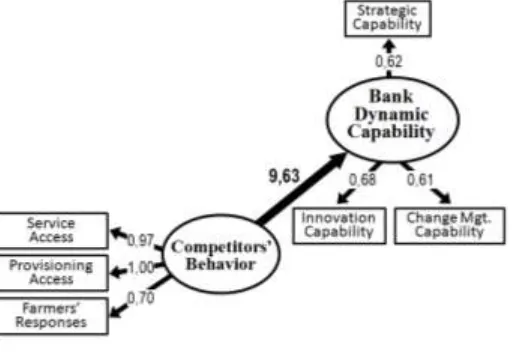
The CB latent variable is a 2nd Order CFA, measured by three latent variables as the dimension or 1st Order CFAs. The dimensions are as follows: 1)Service Accessibility (SAc); 2) Provisioning Access (PAc); and 3)Farmers’ Responses (FaR).Estimation Results of the CB latent variable measurement model shown through the path diagram standardized solution and t-value, can be concluded that in general the CB latent variable measurement model is valid and reliable.
In the 2nd Order CFA of CB latent variables, it appears that SP indicator has the highest LF of 1.00, while the indicators of SA and FR have the same LF of 0.82. It means that providing credit access and credit refund have the highest contribution in explaining the latent constructs of CB as the informal moneylenders.
Latent Variable of Bank Dynamic Capability (BDC)
The BDC latent variable is a 2nd Order CFA, measured by three latent variables as the dimension or 1st Order CFAs. The dimensions are as follows: 1)Strategic Capability (StC); 2) Innovation Capability (InC); and 3)Change Management Capability (CMC).Estimation Results of the BDC latent variable measurement model shown through the path diagram standardized solution and t-value, can be concluded that in general the BDC latent variable measurement model is valid and reliable.
Furthermore, in the 2nd Order CFA of CB latent variables, it appears that IC indicator has the highest LF of 0.99, while the indicators of SC has the lowest LF of 0.91. It clearly indicates that innovation capability has the highest contribution in explaining the latent constructs of BDC.
Measurement Model Simplification through Parcelling
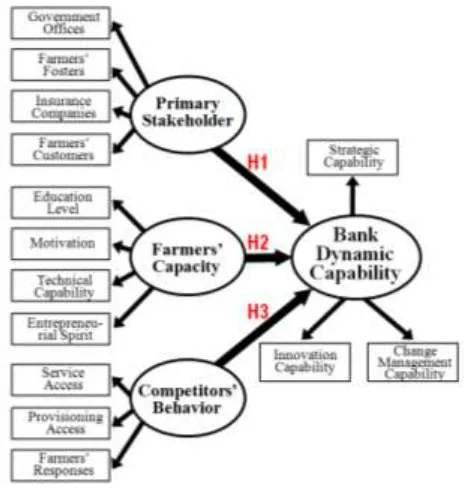
Having obtained the valid and reliable 2nd Order research latent variables, namely, PSH. FC, CB, and BDC, then the next step is to do parcelling through the calculation of latent variable score (LVS) of the dimensions of each latent variable.
Licensed under Creative Common Page 306 Transformation model of research latent variable measurement from 2nd Order to 1st Order is enabling simplification of the research model in Figure 1 into a model of research as shown by the path diagram in Figure 2.
Figure 2. Path diagram of research model after parcelling
Hypotheses
After parcelling process, the hypothesis testing of the structural model can be undergone. The hypotheses are tested based on the purposes of the study as follows:
Hypothesis 1
Is the role of Primary Stakeholders (x1) has the influence on the Bank dynamic capability (y). Hypothesis 2
Is the Farmers’ Capacity (x2) has the influence on the Bank dynamic capability (y). Hypothesis 3
Is Competitor’s Behavior (x3) has the influence on the Bank Dynamic Capability (y).
EMPIRICAL RESULTS
Licensed under Creative Common Page 307 appropriateness. From the printed output pictures of LISREL 8.8, it obtains the value for Goodness of GOFI showing the fit of the data to the model to a structural model of the research model, and can be seen in Table 1 below.
Table 1. Goodness of fit index (GOFI) of structural model research
GOFI Value Results Calculation
Default Values for
Good Compatibility Conclusion
RMSEA 0.01 < 0.08 Matches well
NNFI 1.02 > 0.90 Matches well
CFI 1.00 > 0.90 Matches well
IFI 1.01 > 0.90 Matches well
SRMR 0.06 < 0.05 Matches unfavorable
GFI 0.98 > 0.90 Matches well
Based on Table 1, it appears that although the value GOFI namely SRMR indicates a match less well, but the other five GOFI value indicates a good fit, so we can conclude the overall suitability of the model of the structural model is good.
Table 2. GOFI and test results of research model statistics Interpersonal Variable t-value* Coefficient Conclusion
PSHKDB 1.17 0.05 Not Significant
KP KDB 6.58 0.12 Positive Significant
PP KDB 9.63 0.61 Positive Significant
* t- value ≥ 1,96 Significant
The Effect of Primary Stakeholders, Farmers’ Capacity, and Competitors’ Behavior to
Bank Dynamic Capability
Based on the statistical test results in Table 2 and the hypothesis of the study, the research hypothesis testing has been done and the results are shown in the Table 3.
Table 3.Test results of research hypothesis Research Hypothesis Statistic Test Conclusion
H1: PSH (+) KDB Not Significant H1 rejected; the data do not support the model
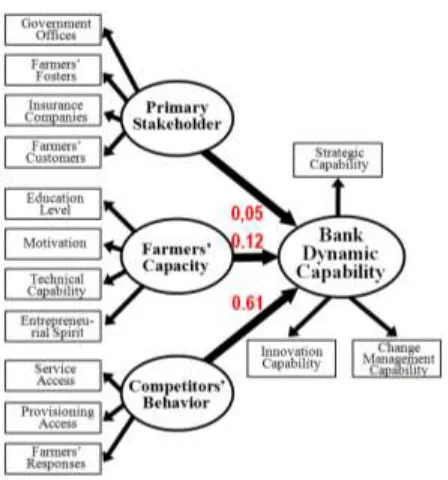
Licensed under Creative Common Page 308 Figure 3. Overall research model pathdiagram
From figure 3 above, it can be seen that Dynamic Capabilities of Banks disbursing the PBC in agricultural sector is significantly influenced by the Bank Competitors’ Behavior of informal money lenders as compared to Primary Stakeholder and Farmers’ Capacity. Moreover, the Primary Stakeholders can be said as has no significant influence since the t-value is only 1.17 which is smaller than t-table of 1.96. In short, the hypotheses of the study are to be discussed further below.
The Effect of Primary Stakeholders (PSH) to Bank Dynamic Capability (BDC)
Licensed under Creative Common Page 309 Based on the test results, the t-value of PSH variable (1.17) is smaller than the t-critical (1,96), or the t-value is smaller than t-table with a significant level α = 0.05, so the calculated t-value fell on the area of rejection. This indicates a rejection of of H1 and the acceptance H0, so that the effect of PSH is not significant on the BDC. The results of path coefficient value is positive at 0.05, but since t-value <t-table then the PSH has no effect on the BDC.
The results of the study concur with those results of the Faculty of Economics, University of North Sumatra (2008), mentioning that slow disbursement of FESC phenomenon is caused by the indication of asymmetric information of the banking system of the central government to local communities and to MSMEs.
On the other hand, this research is in contrary to Sucherly (2002) who suggests a chain of businesses affected by a number of parties comprising 7C, i.e. company (c1), customers (c2), competitors (c3), complementors (c4), channels (c5), center (c6) and changes (C7), which includes political, economic, social and technological.
Based on that of 7-C interrelated business chain, the Primary Stakeholders as the center to represent the government as a party to disseminate government policies, especially related to PBC to the farmers, have important role to the success of PBC governed by the Banks as the dealers which are serving the farmers as channels.
However, the results of the study show no significant effect of Primary Stakeholders on the Dynamic Capabilities of the agricultural sector PBC participating banks. This can be explained that the Primary Stakeholders in this research consist of four parties such as government agencies consisting of the department of agriculture, animal husbandry and fisheries department; fosters consisting of traders, cooperatives and enterprise core; insurance companies; and the customers.
The dimensions of Primary Stakeholders in this study are broader in scope as compared to those in the previous studies that only focus on the government side alone (the Ministry of SMEs and the Office of the Government), so that the effect of fostering institutions, insurance companies, and the customers have not been taken into account.
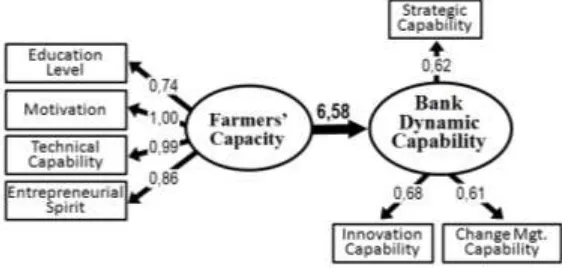
Licensed under Creative Common Page 310 The Effect of Farmers’ Capacity (FC) on Bank Dynamic Capability (BDC)
Figure 5. Path Diagram: the effect of Farmers’ Capacity to Bank Dynamic Capability
Based on the test results, the t-value of FC variable (6.58) is greater than the t-critical (1,96), or the t-value is greater than t-table with a significant level α = 0.05, so the calculated t-value fell on the area of rejection. This indicates an acceptance of H2 and the rejection of H0, so that the FC has a significant influence on BDC. In addition, the results of path coefficient value is positive at 0.12, meaning that Farmers’ Capacity can increase the Dynamic Capability of the Banks participating in PBC in agricultural sector by 12%.
The effect of Farmers’ Capacity to Bank Dynamic Capability is strongly related to farmers’ motivation in paying back the PBC in agriculture sector. This result is in accordance with Gellerman (1984) regarding need for achievement which is not only to cover the need of well performing but also some characteristics including performance achievement by self-efforts, favor the job by giving accurate and firmed responses, satisfaction with what have been done, good turn to skillful working partner represented by PBC governing banks that serve farmers well, accomplish the job with optimum results, as well high motivation for high achievement.
Licensed under Creative Common Page 311 Further, this research results are supported by Hisrich and Brush (2003) who find out that farmers with entrepreneurial spirit to bear the financial risk because they are obliged to pay back the funds from the bank. To be able to meet their obligations, farmers as the PBC debtors try to increase their capacity, so that they need direction and guidance of the PBC disbursing Bank. The study is also reinforced by Berger and Udell (2002), who suggests an open-and-trustable information-based lending facility relationship between farmers as the borrowers and disbursing banks as the lenders. Furthermore, the research by Ritonga et al (2008) supports the results of this study, confirming that farmers’ productivity has still been low, so that the roles of lending institutions are still needed by the farmers to increase productivity due to financial difficulties. Thus, the farmers with the capacity to meet their obligations as debtors will affect PBC disbursing banks which are trying to increase the dynamic capabilities in lending by considering the amount of borrowing needs, the business cash flow of the debtor candidates, as well as the communication with the debtors.
Effect of Behavior Competitors (PP) against Capability Dynamic Bank (KDB)
Figure 6. Path Diagram: the effect of Competitors’ Behavior to Bank Dynamic Capability
Licensed under Creative Common Page 312 The results of the study is reinforced by Collins and Kay (2012), arguing that although formal institutions can offer the credit products in a large amount of funds, but the informal money lenders can meet other requirements such as flexibility, speed, and social relationships with the community. Formal financial institutions, such as banks, offer low-income customers with more reliable service, but the behaviors of informal money lenders as the competitors will affect the formal institutions in this regard. So that the PBC participating banks need to improve their dynamic capability by reconfigure the current resources and capabilities in order to maintain competitive advantage, especially against informal money lenders.
Furthermore, the research results by Woller (2002) are also in line with the results of this study, confirming that poor people can not meet the requirements into account as the customers of formal microfinance institutions including savings products, consumer loans, as well as loans for urgent needs. Under this situation, the poor people end up their need on loan, relying on informal money lenders as the competitors of formal microfinance institutions. Descriptive research results also support this study whereas the respondents confirm that informal money lenders give faster service in provisioning the funds to PBC debtor farmers, as compared to the similar service by PBC disbursing banks. This condition provides the clear argument that disbursing banks of PBC in agricultural sector need to improve their loan provisioning service rate to PBC participating farmers, in order to be able to win the competition against informal money lenders.
DISCUSSION
Some considerable alternative solutions to improve the PBC performance of agricultural sector are as follows:
Farmer Capacity
Licensed under Creative Common Page 313 Prospective borrowers who do not yet understand will learn until they are ready to become the participants of PBC in agricultural sector. Entrepreneurial spirit of farmers must be brought to life through the provision of motivation that farmers had to change his fortunes to a better direction. Debtors that are ready to be certified by the Board of Farmers Training and Consultancy and certification can be used as main collateral for PBC in agricultural sector.
Strategic Role of Stakeholders
The role of government as policy maker and the rule of PBC in agricultural sector is very influential to improve the performance of the agricultural sector PBC. Credit scheme sets out in guidelines on the implementation PBC agricultural sector must be made detail so as not to give rise to multiple interpretations of the loan officer program. Setting supervisory system in the distribution and use of PBC agricultural sector must also be improved. Access marketing of the crop must also be corrected by the government to build a marketing distribution that can absorb even better yields. Products farmers produced to sell in the market can be done through a standard certification of products, so that consumers do not doubt the quality of the products of farmers and intend to purchase on an ongoing basis. The products are excess yields during harvest directed and nurtured through Training and Consulting Firm to be converted into products that are durable, so it can be sold on the occasion of the famine at a better price. Government to hold insurance farming and crop yields, provided the farmer has been certified and the resulting product yields have also been certified.
Bank Dynamic Capability
Banks disbursing PBC in agricultural sector must improve themselves in terms of credit management. Those banks’ loan officers are required to have the Accounts Officer (AO) and the Credit Department program dedicated specifically in handling PBC program especially in the agricultural sector, so that the distribution of PBC agricultural sector can be further improved and the credit quality can be maintained.
Supervision to PBC in agricultural sector requires effort and extra time because it involves a group consisting of members that are not small, remote locations, and spreads, as well as the lack of knowledge of members on the PBC in agricultural sector. With sufficient numbers of AO programs, they can be more focused and directed in governing PBC in agricultural sector.
Licensed under Creative Common Page 314 In accordance with the results of descriptive analysis and analysis of structural models that competitor behavior has the greatest impact i.e. 61% on bank dynamic capability as compared to primary stakeholders by 5% and the capacity of farmers by 12% on bank dynamic capability, disbursing bank on PBC need to implement competitive strategy in the form of selective strategy of growth through business expansion strategy based on market penetration, market development, and product development for credit management strategies of PBC in agricultural sector.
CONCLUSIONS AND SUGGESTIONS
Primary Stakeholders, consist of Government Offices, Fosters, Insurance Companies, and Customers of Farmers who get PBC in agricultural sector have no significant influence on the Dynamic Capability of Banks that disburse PBC in agricultural sector.
Farmers’ Capacity with the dimensions of Education, Motivation, Technical Capability, and Entrepreneurial Spirit have significant impact on the Dynamic Capability of Banks that disburse PBC in agricultural sector.
The Behaviors of Competitors (informal money lenders) related to Service Access, Provision Access, and Farmers’ Responses to informal money lenders give significant influence on the Dynamic Capability of Banks that disburse PBC in agricultural sector.
The dynamic capability of banks disbursing PBC in agricultural sector is more influenced by the behaviors of informal money lenders as the competitors than the capacity level of farmers. The moneylenders in the informal sector affect the formal institutions in this regard, so that PBC disbursing banks need to improve their dynamic capability by reconfiguring their current resources and capabilities in order to strengthen competitive advantage.
PBC participating banks must improve the system in terms of credit management. PBC participating banks are required to have AO and Credit Department program dedicated specifically to credit especially PBC program, so that the distribution can be improved and the credit service quality can be maintained.
Licensed under Creative Common Page 315 Since PBC is not only in agriculture sector, further research can be extended to the study of bank dynamic capability on PBC non-agricultural sector such as industry, man power, education , transportation, communication, etc.
The establishment of the training and consultation for prospective farmers to apply for PBC is an urgent matter to be met, so that farmers can improve their capacity better. The results of the training should be realized in the form of certification can be standardized so that the capacity of farmers to meet the criteria required in PBC.
Access marketing of the crop should be improved by the government to build a marketing distribution that can absorb even better yields. The farmers’ productions to sell in the market can be done through a standard certification of products, so that consumers have no doubt regarding the quality of the products of farmers and intend to purchase on an ongoing basis.
REFERENCES
Ashby et al. 2009. What farmers want: collective capacity for sustainable entrepreneurship. International Journal of Agricultural Sustainability. 7 (2): 130-146
Beers, G., Beulens, A., and van Dalan, J. 2000. Emerging Supply Chain Management Systems: Part. Berger, A., and Udell, G. 2002. The ability of banks to lend to informationally opaque small business. Journal of Banking and Finance, 25 (2): 2127-2167
Blumberg, B.F., and Letterie, W.A. 2008. Business staters and credit rationing in small business. Small Business Economic, 3 (1): 187 200.
Cicip, S. S. 2011. Distribution skim People's Business Credit and Credit Food and Energy.
Collins, D and McKay, C. 2012. Tailoring Formal Financial Products for the Poor. Consultative Group to Assist the Poor (CGAP).
Fatoki, Olawale. 2014. Factors Influencing the Financing of Business Start-ups by Commercial Banks in South Africa, Mediterranean Center for Social and Educational Research.
Firer, S., and Williams, B.C. 2003. Intellectual capital and traditional measures of corporate performance. J. Intellect. Capital 4 (3), 348-360.
Gellerman, S.W. 1984. Motivation and Productivity. Jakarta: Pustaka Binaman Pressindo. Hair et al. 2007. Multivariate Data Analysis. 6th Edition. Pearson International Edition.
Hisrich, R., and Brush, C. 1984. The Woman Entrepreneur Management Skills and Business Problems. Journal of Small Business Management. Vol 22, No. 1, pp. 30-37.
Johnson. 2012. "Achieving Successful Strategic Transformation" in: Susanto, AB. 2014. Comprehensive Strategic Management. Erland.
Kao, R.W. 1997. An Entrepreneurial Approach to Corporate Management. London: Prentice Hall.
Ketchen, D.J., Snow, S.C., Hoover, V.L. 2004. Research on Competitive Dynamics: Recent Accomplishments and Future Challenges. Journal of Management. 30 (6) 779-804.
Licensed under Creative Common Page 316 Martey et al. 2014. Factors influincing willingness to Participate in multi-stakeholder platforms by smallholder farmer in Northern Ghana: implication for research and development. Economic Journal of Agricultural and Food. 2: 11.
Mavridis, D. G., Kyrmizoglou, P. 2005. Intellectual capital performance drivers in the Greek Banking Sector. Manage. Res. News 28 (5), 43-622005
Mc Clelland, David. 1961. The Achieving Society. Princeton, NJ: Van Nostrand.
Meyer, Richard. 2002. The Demand For Products Flexible Microfinance: Lessons from Bangladesh. Journal of International Development, Vol 14, 351-368.
Organization for Economic Co-operation and Development (OECD). 2012. Review of Agricultural Policies Indonesia.
Ritonga, J.T et al. 2008. The role of the Bank in the Credit Support Food Security and Energy in North Sumatra. Bank Indonesia.
Sinha, S and Matin, I. 1998. Informal Credit Transaction of Micro-Credit Borrowers in Rural Bangladesh. Vol 29, Issue 4, pages 66-80.
Sucherly. 2002. Workshop Service Business Strategy, Leadership Courses PT Pos Indonesia.
Tanaka, J.S. 1987. "How Big Is Big Enough?": Sample Size and Goodness of Fit in Structural Equation Models with Latent Variables. Child Development, 58 (1), 134-146.
Teece, D.J. and Psano, G. 1997. The dynamic capabilities of enterprises; an introduction, industrial and corporate change, Vol. 3 (3) .P. 537-556
Thiele et al. 2011. Multi-stakeholder platforms for linking small farmers to value chain: evidence from the Andes. International Journal of Agricultural Sustainability, 9 (3): 423-433
Wijanto, SH 2008. Structural Equation Modelling (SEM) with LISREL 8.8: concepts and tutorials. Yogyakarta: Graha Science.
Woller, Gary. 2002. From Market Failure to Marketing Failure: Market Orientation as the Key to Deep Outreach in Microfinance. Journal of International Development. 14, 305-324.
Wongsansukcharoen, J., Trimetsoontorn, J., and Fongsuwan, W. 2013. A Structural Equation Modelling Development of Relationship Marketing Orientation and Business Banking Strategies Affecting Performance Effectiveness, International Journal of Arts and Sciences, 6 (2): 579-593.