U N I V E R S I T Y C O L L E G E L O N D O N
D O C T O R A L D E G R E E IN C L I N I C A L
R S Y C H O L O G Y
V O L U M E 1
R E S E A R C H T H E S I S
ProQuest Number: 10105651
All rights reserved
INFORMATION TO ALL USERS
The quality of this reproduction is dependent upon the quality of the copy submitted.
In the unlikely event that the author did not send a complete manuscript and there are missing pages, these will be noted. Also, if material had to be removed,
a note will indicate the deletion.
uest.
ProQuest 10105651
Published by ProQuest LLC(2016). Copyright of the Dissertation is held by the Author.
All rights reserved.
This work is protected against unauthorized copying under Title 17, United States Code. Microform Edition © ProQuest LLC.
ProQuest LLC
789 East Eisenhower Parkway P.O. Box 1346
C O N T E N T S
1. RESEARCH THESIS
"Do 'Transitional' social problem solving skills affect levels
of distress reported by adolescents with learning
disability"... p4
2. CASE REPORT 1: (Adult)
"Helping a Mother Come to Terms with Her Daughter's Diagnosis" ...p98
3. CASE REPORT 2: (Learning Disabilities)
"Working with a Woman with Autistic Behaviour and Learning Disabilities to Assess Her Understanding and Resolution of a Major Bereavement"...pll2
4. CASE REPORT 3: (Child)
"The problem of diagnosing specific learning disabilities in a child with low average cognitive functioning"... pl38
5. CASE REPORT 4: (Service Related Research, Long Term Needs)
"A Reminiscence Group in the Community for Older Adults with Long Term Psychiatric Problems"... pl55
6. CASE REPORT 5: (Specialist)
RESEARCH THESIS
” H o * T y r a n s ’ S o c i a l
Rirob I em Solvin.^ Ski 1 Is AI foot
I.o VO 1 s Of Dlstiross Ropo^rlod By
Ado losoonts Witln. Ho aiming
ABSTRACT
In the context of high prevalence of psychopathology amongst the
learning disabled population, the area of adolescent transition
was explored. Six transitional 'problem' scenarios were
constructed to provide a relevant measure of social problem
solving skills. These were correlated with reported measures of
depression, anxiety and stress. There was no evidence of a
relationship between mood and social problem solving skills in
this sample. Factors that may contribute to the existence of
jirs fT R O J D L J c rT iro rs r
A number of research studies have demonstrated levels of
psychopathology that are higher in the learning disabled
population than exist in the general population (for example
Rutter et al 1976, Gillberg et al 1986, Iverson & Fox 1989,
Enfield & Tonge 1996). Within these studies the incidence of
depression, psychosis and behaviourial disorders are noteworthy.
The presence of depression and low self esteem has concerned
clinicians and researchers alike for some time. In a study of the
prevalence of psychiatric disorders in a large residential
facility. Crews et al (1994) found over half of the people who
were diagnosed as mentally ill were found to be suffering from
depression, and this phenomena does not appear to be restricted
to adults. Stevenson & Romney (1984) found that the children in
their sample who showed the most depression also had the lowest
levels of self esteem. The lowest levels of self esteem in a
study by Szivos-Bach (1993) were found in students who perceived
the greatest stigma in relation to their learning disability.
Matikka (1996) found that feelings of stress were associated with
a lack of self esteem and awareness of disability in a study that
examined psychological factors and perceived quality of life of
In a review of the literature related to emotional and
behaviourial disturbances in young people with handicapping
conditions, Bryan & Herjanic (1980) suggested that those with
milder or less visible handicaps may be more at risk of poor
adjustment. There is some evidence to suggest that young people
with learning disability may be particularly vulnerable. Of a
group of young people who had suffered hydrocephalus as infants,
those who had learning disabilities were found to have the lowest
self-esteem (Fernell & Gillberg, 1992).
Adolescence can represent a difficult time for young people with
handicaps. A growing awareness of being permanently different
from peers, inability to fully participate in recreational
activities, and conflict and confusion about sexual maturity
(Bryan & Herjanic 1980) are just some of the challenging issues
that face these young people.
The formulation of Ideas for the project
This profile of low self esteem and mood is observable across
services for people with learning disabilities. For example,
during my contact with a secondary school for young people with
mild and moderate learning disabilities, this issue of low self
esteem and mood emerged again. The 15 and 16 year olds 1 visited
at the school had just completed a period of work experience
young people consistently presented as being low in mood and self
esteem, and appeared despondent about the future. When I
discussed these observations with teachers, clinical
psychologists and parents it became clear that they too viewed
these phenomena as areas of concern. This made me hypothesize
that if life feels this bad already, the prospects for adjusting
successfully to adult life were not good. That is, they could
potentially be at risk for the development of more severe mental
health problems.
If adolescence represented a critical period for young people
with learning disabilities, then the existence of low esteem
would undermine the young person's ability to cope during this
time. It may be that the transition to adulthood was for an
adolescent with learning disabilities much more troublesome than
for the non-disabled adolescent. Literature searches
(Psychlit/handsearch) revealed nothing that explored the
experience of young people with learning disabilities, or how
they were coping with this period in their lives. Paradoxically,
there was literature about the experience of their parents and
siblings during this time.
The project aims
In this project I attempted to establish how young people with
transitional issues with which they were faced
A core area of investigation was their social problem solving
skills. This was because of the hypothesized relationship between
social isolation and the under development of effective problem
solving skills (eg. Vygotsky 1978, 1987, Nezu et al 1991). A
common feature of life for people with learning disabilities is
social isolation.
If social isolation does lead to poor problem solving ability,
then young people with learning disabilities may be particularly
vulnerable during adolescence when many problem solving demands
exist. If problem solving ability is related to levels of
distress, (and distress is taken as a measure of not coping).
Then if a relationship between lower problem solving skills and
higher levels of distress could be demonstrated, this would
suggest that intervening in the area of problem solving could be
beneficial for these adolescents.
There was a dearth of research in this area. So a heuristic was
needed for exploring these issues. In order to look at areas
related to the adolescent transition to adulthood required the
incorporation of these issues into a relevant measure. This I did
by constructing 6 short stories. Vignettes, about issues that
disabilities (for more detail see Method below)
Structure of the literature review
The background information is structured as follows. I begin by
discussing terminology, diagnosis, subtypes and prevalence of
learning disability. I then introduce some theory about the
fundamental problem solving difficulties of people with learning
disability, and its more recent applications to problem solving
training that may be used in therapeutic interventions. This is
followed by a review of literature illustrating high levels of
psychopathology found in people with learning disability. Then
the factors that may contribute to the development of
psychopathology including more socially oriented explanations are
considered. Some research that has considered specific emotional
factors is described before a consideration of recent literature
regarding problem solving. Finally the area of adolescence and
the role of parents of children with learning disabilities is
discussed.
Terminology
The terms used to describe what is now subsumed under the generic
phrase of "learning disabilities" have changed many times over
the last two decades. This is unique and unparalleled in any
attempts to arrive at a description that is not considered
derogatory, but must also reflect the contentiousness of working
with this group of people if the associated professionals have
experienced such difficulties in arriving at an acceptable term
(Sinason 1992).
In the not so distant past expressions such as "feeble-minded",
"cretin", "educable" and "trainable" were used as formal
diagnostic categories. The term "Mental retardation" was popular
for sometime but fell out of favour in the UK (although is still
used in America), and was followed by "mental handicap". This too
has more recently become subsumed by the term "learning
disabilities", "learning disability" or "learning difficulties".
The rather unfortunate result of these changes is that many
people are still quite confused about what exactly these terms
mean.
It is, nevertheless, important to use a term that does not
connote derogatory and disrespectful associations which "Learning
disabilities" does, albeit at the risk of being unhelpfully
vague. For the purpose of this thesis I will specify that when
I use the phrase "Learning disabilities" or "learning disability"
I am referring to individuals who have a significant intellectual
impairment which impedes their ability to adapt functionally and
cope with the normal demands of life. I will use this phrase
Diagnosis
The Diagnostic and Statistical Manual of Mental Disorders IV
(1994) an American publication, still refers rather insensitively
(and unfashionably) to individuals with Mental Retardation. This
is considered a 'developmental disorder' which means it is
usually evident in childhood. A positive diagnosis is made on
the basis of the presence of three criteria
# significantly sub-average general intellectual functioning
# significant limitations in adaptive functioning
# onset before the age of 18 years old.
It is acknowledged that intellectual impairment can occur outside
the developmental period as a result of an illness or an accident
for example.
General intellectual functioning
Intellectual functioning is assessed by the administration of
standardized individually administered psychometric tests like
the Wechsler Intelligence Scale for Children-Revised (WISC-R) or
the Kaufman Assessment Battery for Children (K-ABC). These tests
yield an Intelligence Quotient (IQ) which has a mean of 100
points which is equivalent to the population average. Below
average intellectual functioning is defined as an IQ of two or
equivalent to an IQ of 70 points or less. People who fall into
this category are in first percentile, that is, the lowest 2.5%
of the IQ distribution. In practice, because of the limitations
of confidence levels in these tests, there is conventionally a
measurement error of around 5 points which means that an IQ of
75 would still fall into the category of 'subaverage intellectual
functioning' (DSM IV, 1994). Although IQs of between 70-80 are
often referred to as 'borderline' learning disabilities.
Adaptive functioning
Included in the realm of 'adaptive functioning' specified by DSM
IV (1994) is communication, use of community resources, self-
direction, social and interpersonal skills, self-care, work,
leisure, health and safety, home living, self-direction and
functional academic skills. DSM IV specifies the need for the
presence of significant limitations in at least two of these
areas of adaptive behaviour for fulfilment of the criteria.
Assessment can be carried out by using scales such as the
Vineland Maturity Scale. Less formally, this information can be
readily acquired from parents, nursery or school. In practice,
significant delays or problems in development generally may
precipitate the referral which leads to diagnosis. Zigler &
Hodapp (1986) note that the diagnosis of mild learning disability
Degrees and prevalence of intellectual impairment
The total prevalence of mental handicap represents about 2% of
the population (UK Office of Health Economics, 1978). In practice
the prevalence rate varies according to the criteria adopted for
classification. There is inconsistency about the use of IQ and
adaptive functioning. Some studies classify only by IQ and others
include ’borderline' individuals (Zigler & Hodapp 1986).
Intellectual impairment was divided into four subcategories
Mild, Moderate, Severe and Profound, by the World Health
Organization Expert Committee in 1968.
Mild intellectual impairment
I An IQ level of between 50 and approximately 70 is considered to
Î be mild. Approximately 80% fall within this category (DSM IV,
1994). This group usually develop social and communicative skills
in the pre-school years, and may not always be distinguishable
from their peers until some years later. Educationally they are
likely to be able to cope with the demands of mainstream school
until around the end of primary school. As adults, this group
usually acquire social and work skills sufficient for "minimal
self-support" (DSM-IV pg.41), but may require extra support at
times of stress. Their prospects for living successfully in the
community are good, and some individuals are able to live
Moderate intellectual impairment
The group considered to have moderate intellectual impairment
have IQs of around 35-40 to 50-55, and represent approximately
10% of the learning disabled population (DSM IV, 1994.) Children
in this group usually acquire communication skills in childhood
years and progress to an academic ceiling around the age
equivalent of 6-7 years. Potentially, this group of people may
be able to travel independently to familiar locations, and
attend to their personal care with some supervision.
Vocationally, as adults the majority will be able to carry out
unskilled or semi-skilled work perhaps in a sheltered workshop
or with support in the general work force. These individuals
tend to live in supervised settings.
Severe Mental Impairment
This group of people have IQs between 20 and 25 to 35-40, and
represent approximately 3% to 4% of the learning disabled
population (DSM IV, 1994) . They tend to acquire little or no
communicative speech in early childhood, but may do so during
their school years. They can be helped to acquire basic self-care
skills and "pre-academic" skills like basic counting, the
alphabet, and perhaps sight reading of crucial words. As adults
they are likely to be able to perform some simple tasks with
Profound Intellectual Impairment
Approximately 1% to 2% of the learning disabled population are
considered to have profound intellectual impairment, and this
would approximate to IQs of 20-25 or below (DSM IV, 1994).
People with this degree of handicap usually have some form of
neurological condition or organic pathology. They will often
have considerable sensori-motor impairment too. Some individuals
can be helped to acquire some communication and self-care skills
with intense support/supervision.
Co-morbidity and Etiology
There is a widespread assumption that 75% of people with learning
disability show no organic pathology, and that 25% show damage
due to pre-natal, peri-natal or post-natal insult (Tarjan et al,
1973). Indeed there are a number of identifiable conditions that
occur with developmental disability, such as Down's Syndrome,
Tuberous Sclerosis, Phenlyketeneuria, Epiola and Fragile X
syndrome and Autism. Peri-natal problems such as fetal
malnutrition, congenital maternal Rubella, premature birth, and
hypoxia are predisposing factors. Other associated conditions
are acquired such as infection (eg.meningitis), poisoning, anoxia
or trauma.
the ratio of organic to etiology-unknown cases, 55% of the cases
of mental handicap involved organic etiology and only 45% were
linked to unknown causes (Zigler & Hodapp, 1986). This suggests
that organic factors may be responsible far more often than was
once assumed.
The etiology of mental handicap in those who have no organicity
is uncertain. Factors such as a poor gene compliment for IQ
(Gottesman, 1963) and environmental influences like deprivation
of nurturance, lack of social and linguistic stimulation,
physical and psychological abuse and neglect are all considered
to be significant influences (Zigler & Hodapp, 1986.)
Reasoning: From Theories of Social Deprivation to Metacognition
The impact of a diminished social environment on the coping
skills of people with learning disabilities has been raised by
a number of different authors (see Zigler 1961, 1962, Vygotsky,
1978, 1987 and Nezu et al, 1994). It is considered a major
obstacle which undermines the opportunity for people with
learning disabilities to achieve their potential.
In the 1930s, Vygotsky, a Russian Psychologist, foreshadowed
later socio-cultural formulations of learning disability by
learning disabled by isolating them from mainstream society,
would compound their disability. Vygotsky (1987) argued that
learning to think in the abstract was crucial for children as
this capacity enhanced intellectual skills generally, and
specifically, improved the ability to think flexibly. He viewed
the practice of educating children with learning disabilities
outside the mainstream, with same ability peers, as fundamentally
flawed, because it isolated the child and deprived them of the
social experiences they needed for adequate social and cognitive
development• The result was ’rigidity' in thinking and lowered
motivation. Motivation for Vygotsky (1978) was a central issue;
it was, he believed, socially produced, socially internalized and
socially realized. Therefore deprivation of social experiences
in a very broad sense, prevented the child with learning
disabilities from achieving their intellectual potential. They
were denied the social experiences necessary for the development
of flexible thinking and the 'affective' motivation required.
Consequently, according to this hypothesis, the child with
learning disabilities becomes reliant on external cues
(predominantly other people) to guide and regulate their
behaviour, rather than developing this internally. Later, Luria
(1959) hypothesized that the internal mechanism mediating this
process was speech. He believed that the central problem for
people with learning disabilities was that their 'internal
speech' had never developed sufficiently to guide their own
young children increasingly use language to develop more complex
control over their behaviour. The language and it's impelling
qualities initially come from the child's caretaker, but
gradually become internalized, covert and taken over by the
child.
The failure to establish the internalization processes described
by Vygotsky and Luria would render the individual relatively
dependent on others, and limited in their ability to make sense
of themselves or their environments.
The ideas of Vygotsky and Luria could be considered to be
alluding to what we now refer to as "executive function", that
is, the brain's cognitive 'supervisor'. Indeed Luria (1966)
subsequently developed his ideas to argue that the brain's
frontal lobes contained a system for the programming, regulation
and verification of activity. (This argument was based on work
with patients who had frontal lobe disorders.) Shallice (1988)
calls this a Supervisory Attentional System (SAS), and describes
the explicit role the SAS plays in co-ordinating the sequences
of activity required to carry out tasks that are complex or
novel. Once a task has been repeated a number of times it becomes
relatively automatic, and may require little if any input from
the SAS. This phenomena could be conceptualized as being carried
out via an internalized Socratic dialogue (eg. "to achieve X,
P will Y work?")
To carry this process out effectively we need to have some
understanding of the fact that we can control what we do by
talking to ourselves, Williams & Jones (1996) refer to this
phenomena as having 'metacognition'.
Nezu et al (1991) suggest that the ability to solve problems is
characterized by a general coping strategy in which the
individual thinks of a range of possible ways in which to respond
to stressful or problematic situations. To come up with these
alternatives, the individual needs to be able to ask themself
appropriate questions. It is the absence of asking appropriate
questions that Williams & Jones (1997) suggest is responsible for
the poor transfer of skills usually found following the training
of someone with learning disabilities on a specific task. For
example Castles & Glass (1986) found social and interpersonal
problem solving training lead to improvements on role-play tests
of social skills in mild and moderately learning disabled adults.
The moderate group showed improvements on problem solving
measures relative to their control group. However these
treatment gains failed to generalize to an untrained role-play
situation (near transfer).
people with learning disability emphasize the learning of
specific instructions by verbal rehearsal, to enable the
cognitive control required to carry out a specific task. Learning
by this method was compared to a 'metacognitively' enhanced
programme where the participants were encouraged to discover
solutions via a problem solving method which encouraged
metacognitive processing (Williams, Ellis & Jones, 1996). The
task involved being trained to be effective speakers, who would
be able to tell a listener how to find a series of target
referents by making selective comparisons on a map (for example
"from the house to the tree, the evergreen not the apple tree”.)
In the metacognitive condition participants were engaged in an
active dialogue with an instructor who encouraged them to ask
questions of themselves rather than rehearse instructions as in
the SIT condition. A hierarchy of questions and statements were
used to guide the participants to 'discover' task demands,
appropriate strategic intent, then to implement the strategies
and monitor performance (rather like an externalized SAS). Only
the group who had received metacognitive training requested
selective comparison appropriately when asked to be listeners
(rather than speakers) on a new map reading task. That is, they
showed transfer of skills between topographically different tasks
- or evidence of 'far transfer' (Williams & Jones, 1997).
This approach potentially addresses the issue of agency for
people with learning disabilities, by helping them to re
"skilled" agents in this process. j
If the high rates of psychopathology in people with learning
disabilities (reported below), are connected with these issues
of poor problem solving, then this type of skills training could
have positive pay-offs in terms of lowering levels of associated
distress, and perhaps improve self esteem and adaptive
functioning, and potentially, the development or maintenance of
psychiatric disturbance. In a review of outpatient psychotherapy
research, Nezu & Nezu (1994) support approaches that emphasize
the role of self regulation, like metacognitive training, as one
of the most promising to date.
Rates of Psychopathology
The research literature shows evidence of relatively high rates
of psychopathology in children, adolescents and adults with
learning disabilities. The Isle of Wight Study (Rutter et al
1976) found that children with learning disabilities aged 9-11
years showed a rate of 30-40% compared to their non-disabled
peers of whom 6-7% displayed psychopathology . 57% of mildly
learning disabled adolescents aged 13-17 and 67% of those with
severe learning disabilities were found to show a 'handicapping
psychiatric condition' (Gillberg et al, 1986). Examples of these
were psychotic behaviour, depression, conduct disorder, emotional
of 38% in children with Downs Syndrome agçd 6-17, and a slightly
higher rate of 49% in a group of young people with no established
cause. Iverson and Fox (1989) found a 50% rate amongst young
people with Learning disabilities aged up 21 years old. More
recently, Einfeld and Tonge (1996) reported 40.7% of their sample
to show severe emotional and behaviourial disorders, and as their
cut-off for diagnosis was 'severe' this is likely to represent
only the more extreme examples of mental illness. So there is
clear evidence of high rates of psychopathology throughout the
age range of people with learning disabilities.
However, these reported rates may still be an underestimate.
Reiss et al (1982) showed that mental health professionals tended
to rate emotional problems lower on a scale of psychopathology
when the individual was known to have learning disabilities.
This suggests that mental health professionals may unwittingly
attribute emotional difficulties to the learning disability
rather than as evidence of the presence of psychopathology. If
this assumption is correct it suggests that the presence of
indications of psychopathology are not taken as seriously as they
should be. Consequently, psychiatric conditions may deteriorate
to the point where they are quite severe before they are
acknowledged and treated.
The existence of such high rates has important implications for
people with learning disabilities who are likely to require
assistance with their behaviourial/emotional difficulties is
considerable. The need to provide effective out-patient based
psychotherapies in the community is increasing (Nezu and Nezu,
1994) because the community is now the place where people with
learning disabilities are accommodated. Consequently the need for
the services of clinical psychologists, who are potentially the
most appropriately trained professionals to provide comprehensive
assessments is also rising. They can draw from a range of
therapeutic interventions, and tailor them around individual
problems and the context in which they take place.
In order to provide effective interventions however, there is a
need to establish some understanding of why the rates of
psychopathology amongst people with learning disabilities should
be so high.
Psychopathology and social experience
Matson and Sevin (1994) argue that the etiology of dual diagnosis
- the co-morbidity of mental health problems and learning
disability - has been a neglected area of research, and
hypothesize that a combination of biological and social factors
Bregman & Hodapp (1991) suggest that even those individuals with
mild or borderline IQs, who tend not to have an obvious cause for
their disability, may in fact have more chromosomal
abnormalities, nutritional deficiencies and rare genetic
conditions than normal. However, the sheer scale and scope of
negative social conditions that tend to surround people with
learning disabilities are likely to make a significant
contribution to the development of psychopathology. As Reiss &
Benson (1984) note, many of the emotional problems seen in these
individuals might quite reasonably be expected of people with no
disability, were they exposed to the same negative social
conditions for long periods of time. It is the more socially
oriented explanations that will now be considered.
Society's attitude towards people with learning disabilities (and
those with chronic mental illness) has traditionally been
stigmatizing and rejecting, and arguably enabled the practice of
caring for these people in large residential institutions located
outside towns and away from people in the first instance. The
philosophy of 'normalization' (Wolfensberger 1972) has rendered
such attitudes as explicitly unacceptable, and alongside
financial considerations, encouraged the move to accommodating
people with learning disabilities within the community. The
reality for people with learning disabilities is that their
opportunities for meaningful lives within the community are still
blighted by their continued low status in a society which
Indeed, Sinason (1992) argues that people with learning
disabilities have to endure the awareness of a 'death wish'
towards them from society. This is implicit in the practice of
offering pre-natal screening for fetal abnormalities and
termination of pregnancy if detected. There is no question that
giving birth to a child with learning disabilities will be
regarded as a negative and aversive experience by many.
Reiss & Benson (1984) described how many patients with mild
learning disabilities and emotional disturbance they worked with
were highly aware of their negative social conditions and were
extremely frustrated by them. For example, the very title of
mental retardation (still used in the USA) or mental handicap or
intellectually impaired, they argue, amounts to a permanent label
of incompetence in respect of managing their own affairs. The
tendency of families and others to treat People with Learning
Disability like children long after they had become adults, in
other words being infantalized, is another common problem.
Experiences of being rejected and ridiculed after making a
mistake or exhibiting 'different' behaviour, and victimization
(being subject to physical abuse, robbery and generally being
taken advantage of) are all unpleasant experiences that People
with Learning Disability are more vulnerable to and suffer more
Szivos and Travers (1988) explored the issue of how People with
Learning Disability come to terms with their condition and
awareness of the stigma with which it is regarded by society.
They argue that the emphasis on ’passing for normal’ often
implicit in the service based interpretation of normalization
theory, is quite unhelpful. Because while this philosophy
encourages an ’’existence as close to normal as possible” (Bank-
Mikkelsen, 1980) in reality this often amounts to trying to make
People with Learning Disability behave as if they were normal,
and in the process denies their real identities and difficulties.
When Szivos & Griffiths (1990) tried to run a group for People
with Learning Disability to help them come to terms with their
handicaps and identity, (with a view to developing a more
positive identity), they found the participants could barely
acknowledge the fact that they had a learning disability at all.
It was very difficult for the group to discuss this issue, and
some participants still insisted on referring to their problems
as ’shyness’ at the end of the intervention. Some participants
had become more "accepting of their difficulties", but the aim
of developing a more positive identity had not really been
achieved. Interestingly, the facilitators of this group also
found it very difficult to address the issue of the learning
disability initially and had to be prompted to do so. I have
experienced this phenomena too, that it feels extremely
difficult, almost cruel, to make explicit reference to the
Sinason (1992) argued that many of the young people with learning
disabilities she saw, often following a referral for challenging
behaviour' of some sort (a euphemism for violent, self injurious,
difficult to manage and distressing displays of behaviour) had
developed a 'secondary handicap'. By this she meant the
existence of a second layer of disability which had been
developed to protect themselves in response to traumatic
experiences. By adopting an identity with an even greater
handicap than they actually had, these individuals could
'cushion' themselves from a real awareness of the implications
of their difficulties, and from the demands other people made of
them. While Sinason (1986) postulated the secondary handicap
in relation to specific traumatic experiences like sexual and
physical abuse, this concept probably has much wider
applicability to the learning disabled population, and may help
to explain the phenomena of possible underachievement observed.
When the adverse conditions in which many people with learning
disability live are considered, it seems likely that some form
of defence would need to be adopted.
Research relating to emotional factors and problem solving
Reiss & Benson (1984) found evidence of a significant
relationship between low levels of social support and depression
emotional disturbance. Helsel and Matson (1988) found that
higher rates of depression shown by participants' self report,
and by informants, were correlated with lower levels of social
skills.
Benson & Ivins (1992) found that in a sample of 130 adults living
in the community, people who reported low levels of self concept
also reported higher levels of depression. Informant ratings of
self concept were negatively correlated with ratings of anger and
depression. Reiss & Rojahn (1993) looked at the relationship
between aggression and depression in adults, adolescents and
children with learning disabilities. They found that aggression
was strongly associated with levels of depression. These studies
suggest that low levels of social support, low self concept and
poor social skills are all associated with increased incidence
of depression.
In a study of self-reports by adolescents with and without
learning disability, on measures of depression, general
psychopathology and social skills, Manikam et al (1995) found
that adolescents with learning disability reported more
depression and general psychopathology symptoms. Higher levels
of depression and lower levels of verbal IQ were associated with
average and below average levels of adaptive behaviour. This
suggests that adaptive skills ameliorated the impact of lower
Smith (1986) compared the interpersonal problem solving skills
of a group of mildly learning disabled subjects (mean age 12.9
years), and two non-disabled groups, one matched for mental age
(MA) and the other for chronological age. A series of black and
white line drawing were used to depict the scenarios. The
learning disabled group and their MA controls showed similarities
both in the type and number of strategies used. The CA matched
group exhibited a wider range of problem solving strategies and
made greater use of them, which was thought to reflect higher
levels of social understanding. This suggests that the learning
disabled adolescents were operating at a developmentally less
mature stage.
Generally evidence suggests that people with learning
disabilities do not problem solve as effectively as their non
disabled peers. For example, Williams (1991) compared the
problem solving abilities of learning disabled and non learning
disabled students through presenting social problems in reading
text. Poorer problem solving was associated with a tendency to
make more importations (incorporating extraneous information) and
more implausible importations. Students with learning
disabilities were more prone to making these errors. Very poor
problem solving was connected with a tendency to confound the
textual problem with personal opinions and feelings.
interpersonal problem solving ability and self determination in
a group of people with learning disability (aged between 17 and
72). The authors hypothesized that self determination (measured
by a self-efficacy scale and self description question), and
interpersonal problem solving skills would be linked. The Means
End Problem Solving (MEPs) technique (Platt & Spivack, 1989) was
used. The MEPs are story items portraying situations where a need
is introduced at the beginning of the story and satisfied at the
end. The respondent is required to complete the story by filling
in the events that might have occurred to fulfil the need.
Weymeyer & Kelchner (1994) did not find evidence of a significant
relationship between the measures. The participants were
reported to have generated few relevant means and to employ
'limited' means (by which I assume the authors are making
reference to a lack of elaboration, although this is not clear.)
There does not appear to be any direct evidence of a causative
relationship between emotional distress and problem solving
skills. Nezu et al (1991) provide some indirect evidence through
work carried out with dually diagnosed adults. They found that
a combination of assertiveness and problem solving training led
to an improvement in levels of distress reported by the
participants, and by their carers ratings of adaptive
functioning. Healey & Masterpasqua (1992) however found that
interpersonal cognitive problem solving skills distinguished
between teacher ratings of mildly learning disabled children who
interpersonal problem solving measure (Share & Spivack, 1974) and
the Means End Problem Solving measures (described above).
Adjusted children generated a larger number of relevant solution
to common problems, and showed a higher ratio of aggressive
solutions.
Literature regarding levels of distress in non-learning disabled
adolescents also suggests a relationship. Frauenknecht et al
(1996) found in a population of non-learning disabled adolescents
that as problem solving skills increase, the intensity of
distress and frequency of personal problems decreases.
Significantly higher levels of depression and learned
helplessness were reported by Reynolds & Miller (1985) when they
compared the self reports of mildly learning disabled adolescents
and non-disabled adolescents. The authors suggested that the
learning disabled adolescents had endured repeated experiences
of failure in the classroom, which had led to the development of
assumptions about their failures being due to stable internal
characteristics being made. A combination of lower coping ability
and the additional stress of negative social conditions they
hypothesized, exacerbated the vulnerability of these young people
to learned helplessness and depression.
The theory of Learned Helplessness (Abrahamson, Seligman &
Teasdale, 1978) has its roots in the attributions people make to
experiences of failure that are attributed to causes outside the
individual's control lead to the development of learned
helplessness. People who evidence learned helplessness tend to
make attributions to internal, stable and global causes. Ability
is a good example, if one attributes failure at a task to
insufficient ability this is an internal and stable attribution
(ie. a permanent state) that would apply globally (ie. to
everything that required some ability). Consequently the argument
goes, there would be no point trying to succeed on a task
requiring ability for a person who makes these sort of
attributions, because they have learned that they are unable to
change this state of affairs. In this way learned helplessness
contributes to the development of depression (Peterson &
Seligman, 1984). This type of explanation would suggest that
people with learning disability would be vulnerable to develop
learned helplessness, by having less ability to cope and repeated
experiences of failure.
Social problem solving in non-disabled adolescents
The ability to manage social problems per se is affected by the
way the individual reasons about other people and social
situations. Resolving problematic social situations requires
interpersonal understanding and means-end problem solving ability
(Pelegrini 1985). The problem solving component is thought to
involve the ability to plan and co-ordinate a series of specific
obstacles and alternative means to the goal. Based on an object
relations premise. Crick & Dodge (1994) suggest that the
interpersonal understanding component is mediated by the child's
expectations of social experiences, based on an internal schema
of early relationship experiences.
There is some evidence for a developmental change in the type of
solutions favoured by children and young people in resolving
hypothetical social problems. Socially competent young children
tend to generate assertive verbal solutions (Rabiner et al 1990),
while adolescents accepted by their peers tend to generate
bargaining solutions. Adolescents with social difficulties tend
to generate assertive verbal solutions to hypothetical social
problems (Lochman et al 1993), suggesting that they may be
experiencing a developmental lag in their ability to resolve
interpersonal conflicts.
A number of studies have shown poor social problem solving skills
to be associated with maladjustment in adolescence. Lenhart &
Rabiner (1995) showed that young people with poorer social
problem solving skills reported more behaviourial problems, were
rated by their teachers as more aggressive and less competent in
behaviourial interactions. Adolescents who had attempted suicide
showed poorer problem solving skills in comparison to groups of
A Study by Davilla et al (1996) linked poorer problem solving
ability with lower levels of self worth in a group of young women
making the transition to adulthood. Marton et al (1993) found
depressed adolescents to have more negative self concepts and
less social confidence in comparison to a non-depressed and
psychiatric control group. So there is evidence of poorer social
problem solving skills being linked with social and behaviourial
difficulties, and a link between lower levels of self esteem and
depression.
Developmental theories of Adolescence
Adolescence represents a time of enormous change.
Psychologically there is much to accommodate and adjust to, the
physical changes typical of puberty, the impact of changing
hormone levels, increasing expectations from surrounding adults,
and the shift in emphasis from relationships within the family
to those with peers. Havinghurst (1972) described the following
adolescent developmental tasks, which if successfully achieved
lead to happiness and success in later tasks
* achieving new and more mature relations with peers of both sexes
* achieving a masculine or feminine role
* accepting one's physique and using the body effectively
* achieving emotional independence of parents and other adults
* preparing for an economic career
* developing an ideology (a set of values and an ethical system that guide behaviour)
* desiring and achieving socially responsible behaviour.
Erikson (1959) wrote an influential theory of psychosocial
development, in which he describes 8 stages. These span life
from infancy to old age. Each stage is characterized by a crisis
in which a core theme needs to be resolved for development to
continue successfully. Effective resolution leads to the
development of a new 'virtue'. Two stages of Erikson's theory,
the 4th and 5th are relevant here.
Between about the ages of 10-14 the stage is Industry versus
Inferiority. The child who successfully negotiates this stage
learns to use the physical and intellectual 'tools' of their
society. Being aware that one can learn these things (industry)
is a key theme. There is also a risk of the child developing a
sense of inadequacy and inferiority during this period if
previous conflicts have not been sufficiently resolved, or, if
the child is unable to learn the skills needed for effective
functioning in their society (Sugarman, 1986). The second
relevant stage is around the age of 14-20, Identity versus Role
Confusion. Erikson (1980) describes the period of adolescence
as 'psychological moratorium' where the young person has the very
significant task of 'finding' him or herself through
roles. This identify formation also involves the adolescent
engaging in a gradual emotional separation and detachment from
parents. The risk during this period is identity crisis and the
development of maladaptive behaviour patterns.
Adolescents with learning disability are unlikely to achieve many
of the developmental tasks described by Havinghurst (1972). They
may have been unable to successfully resolve the stages described
by Erikson (1980). They are unlikely to have learnt the specific
skills they need to function successfully in society described
in the industry vs inferiority stage. Their task of 'finding
themselves' in the identity vs role confusion stage may be
undermined by feelings of inadequacy, and limitations in the
roles and niches available to them. It is unclear how many of
these key developmental stages or tasks have been or could be
achieved by the adolescent with learning disability. It is also
uncertain how serious the ramifications of these limitations
would be, although both Havinghurst and Erikson suggest that
unhappiness and maladjustment could result.
For all young people the transitions of adolescence are
accompanied by wide variation in individual ability to adapt and
in parental attitudes. However, for young people with learning
disability only those with mild intellectual disability are
likely to have the potential to achieve the financial and
adolescents.
There is generally greater uncertainty about what the future
holds for these young people. This period could make
particularly onerous demands of young people with learning
disabilities who will have less skills to bring to bear, and less
vocational opportunities to select from.
Research has shown that this is a time when high levels of
anxiety may be experienced (Cohen 1986), which may be reflecting
concern about being able to cope with this transition and the
decisions involved. For example, Dollinger et al (1988) found
that young people with learning difficulties (mean age=17) had
significant rates of sleep disturbance. When analysed with the
responses of a fear questionnaire, anxiety about academic
performance, being alone and negative interpersonal experiences
were all significantly correlated with sleep problems.
The role of parents
Parental attitudes impact on their children and their futures.
This effect is likely to be more acute for young people with
learning disabilities because their parents will maintain more
control than is usually the case. The potential for
Dyson (1993) has shown that families of children with
disabilities generally experience greater levels of stress than
other families, and continue to experience periodic crises of
stress and sorrow, particularly in relation to temporal events
that normally signify maturation and development (Wickler et al
1981).
The parents of young people with learning disability are in the
difficult position of trying to evaluate what their children will
and won't be capable of. Some parents manage this phase
impressively and enable their children to manage exceedingly
well. For other families this process is less successful.
Parents or carers may become over-protective and restricting
rather than negotiate the anxiety provoking job of helping to
evaluate strengths and weaknesses, and allow the young person to
take trial and error risks. In the desire to protect their
children, the young people may be encouraged to stay dependent
by their parents or carers.
SUMMARY
High rates of psychopathology exist in the learning disabled
population as a whole. Biological factors may act as a
predisposing factor, but there are also major emotional, social
and cognitive influences and disadvantages that need to be taken
experiences of young people with learning disabilities, and
specifically their experiences of adolescence. As this
represents a potentially challenging time for all young people,
being able to identify those who are struggling to cope may
enable the prevention of serious difficulties. The period of
adolescence could represent a critical period for young people
with learning disabilities.
The Experimental Hypotheses
1. The purpose of this study is to establish if a relationship
exists between social problem solving ability in relation to
transitional issues, and mood in adolescents who have mild or
moderate learning disabilities.
2. If a relationship does exist, it is hypothesized that lower
problem solving skills will be associated with higher levels of
emotional distress.
METHOD
Design
The study used a cross-sectional method, obtaining measures from
each participant on one occasion only. The data provided by the
seven measures utilized was designed to provide both descriptive
solving skills, and to provide data to enable analysis of the
associations (correlations and covariance) between the measures.
Inclusion criteria
Participants were male and female aged between 16 and 24 years
of age who had learning disabilities (mental handicap). This
relatively mature adolescent range was included due to the
assumption of extension in the adolescent period in young people
with learning disability. They were required to be able to use
a minimum of 3 or 4 word sentences in English. People with mild
sensory or physical impairments were included.
Exclusion criteria
The presence of severe and enduring mental health problems, for
example psychotic symptoms or severe depression.
Participants
18 young women and 24 young men participated in the study, making
a total of 42. Their ages ranged over an eight year span, from
16 to 24 years. The mean age was 17.7 years and Standard
74% (31) subjects attended school full-time, the remaining 26%
(11) had left school. Of those who had left school 7% (3) were
attending college courses and 19% (8) were unemployed. 67% (28)
attended a secondary school for young people with mild or
moderate learning disabilities located in a London suburb, and
7% (3) a school for severe learning disabilities. Of the three
participants who were at college, two attended a life skills
course within a mainstream environment in central London, and one
a residential educational unit for people with epilepsy.
Concurrent diagnoses
One participant was known to be Autistic, one had experienced a
psychiatric breakdown but had recovered, and a third had severe
epilepsy and attentional difficulties.
Recruitment
People were recruited initially from registers kept in three
London boroughs for the purpose of planning and researching
services for people with learning disabilities. In order to
maintain confidentiality, potential subjects from this list were
approached through the post. The number who indicated their
willingness to participate from this approach was extremely low.
This necessitated widening the sources of recruitment and
disabilities.
Consequently a number of other sources were approached for
example local MENCAP groups, community teams and local schools
and colleges. Accessing the organizations required dealing with
considerable bureaucracy, and despite attending many meetings,
response rates continued to be very poor. These contacts in total
yielded 14 participants out of a possible 70 who were suitable.
The most fruitful sources of participants were two schools whose
headteachers were sympathetic about the research. One school
(for children with Severe Learning Disabilities) were able to
provide three children with sufficient language to participate.
The other school catered for children with mild and moderate
learning disabilities. This school produced 28 suitable
participants. (The reasons that may lie behind the problems of
recruitment are considered in the discussion.)
MATERIALS
The Transitional Social Problem Vignettes
Finding appropriate scales for people with learning disability
The increasing interest in the experience of life for people with
that relatively little is known about their emotional lives
(Benson & Ivins 1992). One contributory factor to this gap in
knowledge is the lack of appropriate instruments to measure the
emotional states of this population, particularly from self
report. Existing questionnaires generally use a vocabulary that
is too complex, and response formats that yield low reliability
(see Lindsay & Michie, 1988 below). Items within conventional
measures tend to refer to situations which simply do not arise
in the day to day lives of people with learning disabilities
(Bramston & Bostock 1994), and require a familiarity with
concepts (like degrees of anxiety) that make it impossible to use
many existing instruments. When scales are adapted to take into
account these difficulties, people with learning disabilities can
report on their emotions in a consistent way. For example, a
group of adults with mild and moderate learning disabilities were
found to report on their emotions in a manner which indicated
statistically significant convergent validity (Lindsay et al
1994) using the following measures. The adapted Zung Anxiety
Scale (see below), an adapted version of the Zung Depression
Inventory, the General Health Questionnaire and the Eysenck-
Withers Personality Test).
Construction of the scale
As a measure of social problem solving in relation to adolescent
issues was not available, one needed to be constructed. Existing
solving skills could have been used but would not have addressed
the issues of adolescent transition. Constructing such a measure
also meant that the way these issues affect young people with
learning disabilities differently from their non-disabled peers
could potentially be evaluated. This meant that the tendency of
the existing scales to incorporate items that have little
relevance to the lives of people with learning disabilities could
be avoided. To illustrate this difference, one of the resulting
Vignettes concerned a 19 year old whose parents objected to her
travelling alone (see Appendix A). This scenario would be
unlikely to exist in a traditional British family because, by 19,
non-disabled young people usually travel independently.
The development of the Vignettes
A 'pool' of stories were constructed in an attempt to identify
and focus on key areas in the transition from adolescence to
adulthood. The ideas for the stories came from a variety of
sources. Some were based on observations of issues that arose
for young people with learning disabilities during the clinical
placements. The issue of parents objecting to independent travel
for example was identified by teachers of young people with
learning disability as a source of difficulty for some pupils.
Other ideas were based on areas of transition that all young
people have to make. Modifications were then made to incorporate
the kind of complications that could exist for a young person
The subjects of the stories were given ages which would
conventionally indicate that they were above the average age when
these issues might be confronted. The stories were deliberately
phrased in the second person to prevent the participants from
feeling inhibited about responding. As phrasing in the first
person could have been experienced as being 'put on the spot' and
over-personal. In order to check that the responses participants
made were not completely different from the way they would
problem solve in the hypothetical situations, after responding
to the Vignettes, the participants were asked if they would do
the same sort of thing they had advised people in the stories to
do. (The vast majority said yes).
Refinement of the pool of stories came from two Clinical
Psychologists, (one of whom specialized in work with people with
learning disabilities). Teachers and Social Workers who
specialized in working with people with learning disabilities
were also consulted and asked for their views on the relevance
of the now 6 shortlisted stories. Everyone agreed that these six
Vignettes represented areas that were, or might be, problematic
for adolescents with learning disabilities. The areas that were
addressed in the final version of the stories
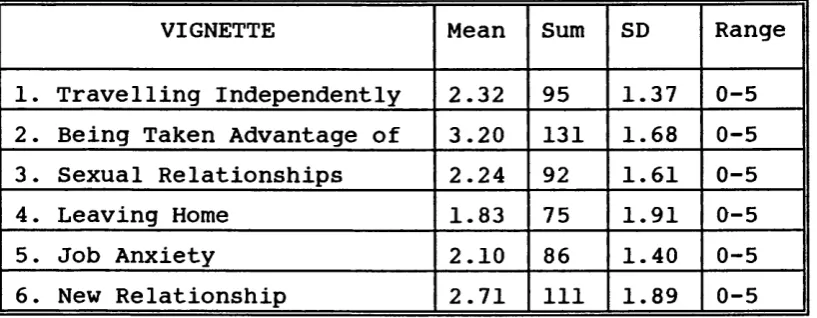
were:-* ability to act independently in the face of parental over
protection (vignette 1)
* dealing with ambivalent situations (wanting to do something
and feeling anxious about it) (vignette 5)
* developing relationships (vignette 6)
* sexual relationships (vignette 3)
* leaving home (vignette 4)
The Vignettes used can be found at Appendix A.
Modification of the responses required
Originally, after each Vignette had been read the participant was
to be asked the following set of questions : "what is the
problem"; "think of as many ideas to solve the problem as you
can"; "what are the positive and negative consequences of each
idea"; "which idea do you thinks will solve the problem" (taken
from Nezu et al 1991). This procedure was too demanding for some
participants (who did not appear to fully understand what
positive and negative consequences were for example). It was
laborious to administer, potentially protracting each vignette
response to 5-10 minutes (within an already long battery of
tests), and appeared to annoy some participants who became
dysphoric (fed-up) as the questions went on. As this much detail
was not particularly important the post-Vignette probing was
modified. Instead each participant was asked "What should (the
subject of the story)..do?", "any other ideas?"^ "what is the
problem in the story". If the participant had generated more
idea". This procedure worked much better.
The question "What is the problem in that story" was included as
a comprehension check. However it proved rather unreliable. Some
participants were able to identify the problem correctly and
give reasonable solutions, but other were unable to verbalize the
problem, sometimes despite having given a sensible solution to
the vignette.
Devising a Scoring method for the vignettes
An 'Ideal' age appropriate solution to each transitional problem
was constructed. Each vignette had 5 points potentially
available, with higher scores reflecting more proficient problem
solving skills. Some points were made available if part of the
problem had been resolved. For example, for Vignette one (see
appendix A ) , 2 points were scored if a solution to get to the
pictures was specified, but the full 5 points were only allocated
if the participant also resolved the issue of travelling
independently, rather than acquiescing and travelling with
someone else.
Where a participant verbalized a number of possible solutions,
If they had produced the ideal solution but had not specified it
as their best idea they still earned points for it. Participants'
responses were deemed acceptable if they answered in the first
person rather than using the name of the subject of the story.
The raters who scored the Vignettes were asked to disregard any
response from a participant following a prompt from the
interviewer that sounded remotely directive. (Some prompting had
been required to keep participants on task).
Transcription
The responses of the participants who had consented to being
audio-taped were transcribed word-for-word, (as were the
interviewer's). The responses of participants who had objected
to being audio-taped were written by hand as accurately as
possible, as were any comments made by the interviewer.
Inter-rater agreement
Two raters initially scored all the participants responses. A
third rater then scored the responses to check for reliability.
At first the initial level of agreement between the first two and
third rater was unacceptably low necessitating a re-assessment
of the scoring by the original criteria. This was re-specified
in considerable detail (details can be found at Appendix B). All
more rigorous and consistent criteria and resulted in a much
improved rate of agreement of 93% between the first two and the
third rater, and represents an acceptable level of inter-rater
reliability (Barker et al 1994). The source of remaining
disagreement was in connection with participants responses to
vignette 5. The raters had managed to achieve to 100% agreement
on the other 5 vignettes.
Cognitive Functioning
To obtain an indication of each participant's level of cognitive
functioning a verbal and non-verbal measure was taken. This was
to enable the variability of IQs to be taken into account
statistically.
Ravens Matrices
Ravens Coloured Progressive Matrices (1976) a well established
measure was used to estimate non-verbal intelligence. It assesses
the subject's ability to match designs analogically on a
progressively difficult scale. The Matrices come in the form of
a book. The individual items are presented as a patterned
rectangle with a piece cut out. The respondent is required to
indicate which of the six displayed alternatives is the correct
piece to fit the missing part (by pointing, or by naming the