IJSRR, 8(2) April. – June., 2019 Page 862
Research article Available online www.ijsrr.org
ISSN: 2279–0543
International Journal of Scientific Research and Reviews
Polyimide Based Polymer Electrolyte Membrane For Direct Methanol
Fuel Cell Applications
K. Sainul Abidin*
a,b, R. Kannan
aand S. Porchelvi
ca
Dept. of Physics, University College of Engg., Anna University, Dindigul-624622.
b
Dept. of Physics, MES Kalladi College, Mannarkad College Post, Palakkad-678583.
c
Dept. of Physics, Sri Subramanya College of Engg. and Tech., Palani-624615.
Email: *[email protected]
ABSTRACT
Polymer electrolyte composite membranes comprised of the polyimide (PI) with α
-cyclodextrin (α-CD) were developed by solution cast technique. The proton conductivity of the blend membrane has been investigated by means of impedance spectroscopy. The thermal and mechanical properties of membranes were investigated by TGA and tensile strength test, respectively. The composite membranes perform a variety of advantages, such as good thermal stability, outstanding mechanical performance and the composite membranes have superior water uptake. The proton conductivity of PI- α-CD 20% was 1.08×10⁻¹ S cm-1 at 70 °C under 100% RH. The obtained results demonstrate that developed composite blend membrane shows good prospect for direct methanol fuel cell applications.
KEYWORDS:
Polymer electrolyte membranes, Proton conductivity, Polyimide, α-cyclodextrin*Corresponding author:
K. Sainul Abidin
Dept. of Physics,
University College of Engg., Anna University,
IJSRR, 8(2) April. – June., 2019 Page 863
1.
INTRODUCTION
The growing awareness on environmental issues and energy crisis due to depletion of fossil fuels pressing researchers in finding alternative source of energy with almost zero emissions. The development of polymer electrolyte membrane (PEM) with higher ionic conductivity is the main objective in recent research. PEM have been studied for their application in batteries, fuel cells and sensors. Fuel cells are excellent electrochemical energy conversion devices that directly convert the chemical energy of the fuel into electric energy with almost zero emission of unwanted gas 1. Proton exchange membrane is the most vital part of a fuel cell as it separates the fuel from oxidant and conducts electrons to external load. Among the sulfonated aromatic polymers (SAP), Polyimide (PI) is the most promising proton exchange membrane (PEM) for fuel cell application2,3. PI has outstanding chemical, mechanical and thermal resistance properties. Incorporation of the polyimide
(PI) with α-cyclodextrin (α-CD) introduces hydrophilic properties to this Polymer electrolyte composite membrane. Blending of one polymer with another is an effective way of achieving good qualities of both the polymers 4.
This paper investigates the influence of the α-cyclodextrin compositions on the PEM. It becomes important to understand the ion transport mechanism along with polymer segmental relaxation processes in polymer electrolytes. Electrochemical Impedance Spectroscopy (EIS) is used to study the protonic conductivity properties of PEM to provide information on both of the membranes structure and electrical properties.
2.
MATERIALS AND METHODS
PI (Otto Chemie), α-cyclodextrin (α-CD) (Alfa Aesar) were the chemicals (AR grade) used in this study. The PI/ α-CD polymer electrolyte membranes were prepared by solution casting technique. The solvent, m-Cresol (>99%), was supplied by Merck. An appropriate amount of PI was dissolved in m-Cresol solvent at a constant rate of stirring (500 rpm) at 100 °C for 6 hours and α-CD were dissolved separately in m-Cresol and the solutions were mixed together and casted in Petri dish then dried to form a blend membrane.
IJSRR, 8(2) April. – June., 2019 Page 864
10mm/min and proton conductivity measurements were made in form of Nyquist plots using CH Instruments 600D series electrochemical analyzer with the applied amplitude of 10 mV from 1 KHz to 10 MHz.
3.
RESULTS AND DISCUSSION
3.1 Ft-Ir Analysis
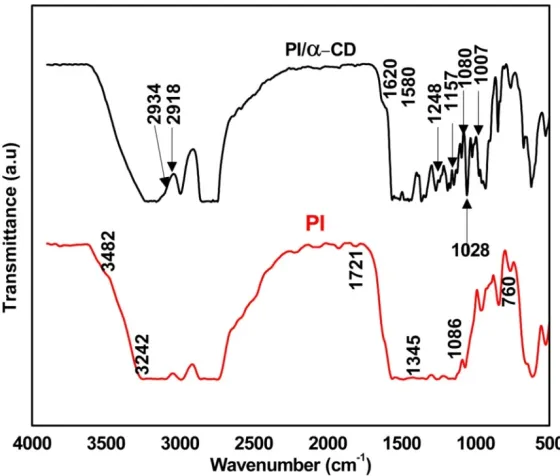
Figure 1 shows FT-IR spectra of the polyimide and PI/ α-CD polymer composite membranes. The characteristic absorption peaks of imide groups present around 1721, 1780, and 1345 cm-1, represent an imide group, indicate a cyclic five-membered ring which confirms imide formation and attributes to the C–N–C bond respectively [5,6,7]. The absorption peaks at 3242 and 3482 cm-1 seen in the 3200–3800 cm-1 region reveal the stretching vibrations of hydroxyl groups [8].
Fig-1 FTIR spectra of PI and PI/ α-CD Membranes
3.2 STRUCTURAL ANALYSIS
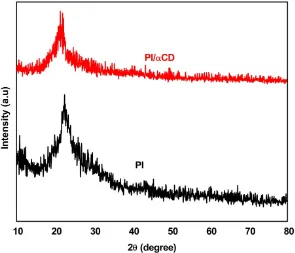
Figure 2 depicts the X-Ray diffraction patterns of the PI and PI/ α-CD membranes. The
IJSRR, 8(2) April. – June., 2019 Page 865
Fig-2 XRD spectra of PI and PI/ α-CD Membranes
3.3 ION EXCHANGE CAPACITY, WATER UPTAKE, METHANOL UPTAKE &
SWELLING
Table 1 indicates the number of exchangeable proton sites within the membrane as well as the proton conducting ability of the membrane. Generally, a polymer membrane with higher IEC tends to have higher water uptake capacity 11,12. With the addition of α-CD, the IEC values of all the membranes were higher than that of pure PI membrane. This indicates a clear proton exchange process. A higher IEC value of 2.08 meq g-1 in the PAC3 membrane when compared to other membranes reveal the presence of more ion exchangeable sites.
Table 1 Ion exchange capacity, water uptake, dimensional change and methanol uptake of polymer electrolyte membranes
Membrane IEC (meq. g-1) Water Uptake (%) Swelling (%) Methanol Uptake
(%)
PAC0 0.79 8.71 8.2 20.00
PAC1 1.58 10.00 9.4 21.4
PAC2 1.88 13.04 11.6 25.00
PAC3 2.08 15.79 17.8 33.33
IJSRR, 8(2) April. – June., 2019 Page 866
operation of fuel cells 13. Physically adsorbed water acts as a proton-carrying medium that follows vehicle mechanism, while chemically adsorbed water obeys Grotthuss mechanism by establishing hydrogen bonds 14. The water uptake and methanol uptake values of the PI membranes with various amounts of α-CD are listed in Table 1. Methanol uptake measurement was carried out under the same procedure. Among the various membranes, membrane PAC3 exhibited the highest water uptake and the modest methanol uptake value. The large dimensional change was exhibited by the PI composite membranes in the thickness direction15. Variation in swelling of PI composite membranes listed in Table 1. The swelling percentage of polymer membrane lowers with lesser concentration of
α-CD. However, this swelling behavior plays a significant role in mass transfer, ion exchange and ionic interaction.
3.4 Thermal Analysis
The TGA results for different membranes demonstrated in Figure 3 reveal the thermal stability of the PEM material that is to be used in electrochemical applications. The pure PI membrane exhibits two steps of thermal degradation; the first step appears in the 90 - 180°C range and the second in the 350 - 500 °C range. The weight loss in the first region is about 4 – 6 % which may be due to the loss of residual solvents and water molecules 5, 16. The weight loss in the second region is about 84 –88 % and this can be attributed to the decomposition of imide functional groups from the polyimide matrix17. Similar trends were observed in all prepared PI/ α-CD composite membranes.
IJSRR, 8(2) April. – June., 2019 Page 867
3.5 Mechanical Stability
Sufficient mechanical strength is essential for the preparation of MEA and to increase the durability of MEA endurance of PEM in fuel cells. The tensile strength is used to characterize the mechanical strength of PI and PI-α-CD composite membranes. A general trend was observed, and as
expected, the α-CD incorporated composite membranes showed better mechanical stability with higher maximum stress, with longer maximum strain shown in Figure 4. The maximum stress and
strain of the synthesized PI/ α-CD composite PEMs were 28.5 MPa and 0.2%, respectively. The
tensile strength of the prepared PI/α-CD composite membranes (28.5 MPa) is much higher than that of pure PI membranes (18.9 MPa). Compared to pure PI, the composite membranes exhibit higher tensile strength, indicating that they meet the mechanical requirements of a PEM in fuel cells. This is attributed to the existence of the reinforcing effect of the PI matrix and also due to its higher molecular chain rigidity.
Fig-4 Stress versus strain curves of PI and PI/ α-CD composite membranes
3.6 Proton Conductivity
Proton conductivity of the membrane depends on various features like IEC, water uptake and microstructure of the membrane. It is clear that the existence of water molecules and proton exchange sites is essential for desirable proton conduction through PEMs.
IJSRR, 8(2) April. – June., 2019 Page 868
the highest proton conductivity value of 1.08×10⁻¹ S cm-1. Figure 5 illustrates the dependence of the membrane conductivity as a function of α-CD concentration. It is observed that an increase in temperature increases the proton conductivity values, thus following the Arrhenius relationship. The increase in temperature favors both the dynamics involved in proton transfer and structural reorganization, which are required for fast proton conductivity.
Fig-5 Proton Conductivity of PI and PI/ α-CD Membranes
4.
CONCLUSION
The proton conductivity of polymer membranes were investigated and of all the prepared composite membranes PAC3 shows maximum proton conductivity of 1.08×10⁻¹ S cm-1 at a temperature of 70 °C and 100% RH. By looking at the water uptake and the proton conductivity results, it can be seen that water uptake results correlate with the conductivity of the composite membranes. The membrane having higher conductivity has also higher mechanical stability; from these results suggest that the developed composite membranes offer great promise for DMFC applications and are well suited for polymer electrolyte membranes.
5.
REFERENCES
IJSRR, 8(2) April. – June., 2019 Page 869
2. Adisak Pokpraserta & Suwabun Chirachanchaia ‘Polymer Electrolyte Membrane with Heterocyclic terminated Poly(ethylene glycol) Brushes: An Approach to Decorate Proton Conductive Species on Membrane Surface’, Journal of Membrane Science, 2017; 524: 550-556.
3. Amani Al-Othman, André Y Tremblay, Wendy Pell, Sadok Letaief, Tara J Burchell, Brant A Peppley & Marten Ternan ‘Zirconium phosphate as the proton conducting material in direct hydrocarbon polymer electrolyte membrane fuel cells operating above the boiling point of water’, Journal of Power Sources, 2010; 195: 2520-2525.
4. K. SAINUL ABIDIN, P. BAHAVAN PALANI, R. KANNAN, S. RAJASHABALA, Role of structural modifications of montmorillonite, electrical properties effect, physical behavior of nanocomposite proton conducting membranes for direct methanol fuel cell applications, Materials Science-Poland, DOI: 10.1515/msp-2017-0112
5. Zhongying Wu, Shujiang Zhang, Hui Li, Yu Liang, Zhigang Qi, Yixuan Xu, Yiyao Tang & Chenliang Gong, ‘Linear sulfonated polyimides containing polyhedral oligomeric silsesquioxane (POSS) in main chain for proton exchange membranes’, Journal of Power Sources, 2015; 290: 42-52.
6. Li-Bin Zhang, Jin-Qing Wang, Hong-Gang Wang, Ye Xu, Zhao-Feng Wang, Zhang-Peng Li, Yong-Juan Mi & Sheng-Rong Yang ‘Preparation, mechanical and thermal properties of functionalized graphene/ polyimide nanocomposites’, Composites: Part A 2012; 43: 1537-1545.
7. Taesung Lee, Sung Soo Park, Yuin Jung, Sewon Han, Donghee Han, Il Kim & Chang-Sik Ha ‘Preparation and characterization of polyimide/ mesoporous silica hybrid nanocomposites based on water-soluble poly (amic acid) ammonium salt’, European Polymer Journal, 2009; 45: 19-29.
8. Yun Yu, Shengli Qi, Jiayu Zhan, Zhanpeng Wu, Xiaoping Yang & Dezhen Wu ‘Polyimide/sepiolite nanocomposite films: Preparation, morphology and properties’, Materials Research Bulletin, 2011; 46:1593-1599.
9. Mansor Bin Ahmad, Yadollah Gharayebi, Mohd. Sapuan Salit, Mohd. Zobir Hussein, Saeideh Ebrahimiasl & Arash Dehzangi, ‘Preparation, Characterization and Thermal Degradation of Polyimide (4-APS/BTDA)/ SiO2 Composite Films’, International Journal of
Molecular Sciences, 2012; 13: 4860-4872.
IJSRR, 8(2) April. – June., 2019 Page 870
Dianhydride/ Diamine’, International Journal of Scientific & Engineering Research, 2012;3:1-6.
11.Jianhua Fang, Xiaoxia Guo, Satoshi Harada, Tatsuya Watari, Kazuhiro Tanaka, Hidetoshi Kita & Ken-ichi Okamoto, ‘Novel Sulfonated Polyimides as Polyelectrolytes for Fuel Cell Application. 1.Synthesis, Proton Conductivity, and Water Stability of Polyimides from 4,4’-Diaminodiphenyl Ether-2,2’-disulfonic Acid’, Macromolecules, 2002; 35: 9022-9028.
12.Brian R Einsla, Yu Seung Kim, Michael A Hickner, Young-Taik Hong, Melinda L Hill, Bryan S Pivovar & James E McGrath ‘Sulfonated naphthalene dianhydride based polyimide copolymers for proton-exchange membrane fuel cells II- Membrane properties and fuel cell performance’, Journal of Membrane Science, 2005; 255: 141-148.
13. Jongchul Seo, Wonbong Jang, Seokkyu Lee & Haksoo Han ‘The stability of semi-interpenetrating polymer networks based on sulfonated polyimide and poly(ethylene glycol) diacrylate for fuel cell applications’, Polymer Degradation and Stability, 2008; 93: 298-304. 14. Sung-Gwan Park, Kyu-Jung Chae & Mooseok Lee ‘A sulfonated poly (arylene ether
sulfone)/polyimide nanofiber composite proton exchange membrane for microbial electrolysis cell application under the coexistence of diverse competitive cations and protons’, Journal of Membrane Science, 2017; 540: 165-173.
15. Yu-Huei Su, Ying-Ling Liu, Yi-Ming Sun, Juin-Yih Lai, Da-Ming Wang, Yan Gao, Baijun Liu & Michael D. Guiver ‘Proton exchange membranes modified with sulfonated silica nanoparticles for direct methanol fuel cells’, Journal of Membrane Science, 2007; 296: 21-28.
16. Chatzidaki, EK, Favvas, EP, Papageorgiou, SK, Kanellopoulos, NK & Theophilou, NV ‘New polyimide-polyaniline hollow fibers: Synthesis, characterization and behavior in gas separation’, European Polymer Journal, 2007; 43: 5010-5016.