652
The Development Of Learning Tools Of Strategy
Learning Subject Through Content And Language
Integrated Learning (Clil) For Bilingual Classroom
Of Pgsd Fip Unnes
Novi Setyasto Putri Yanuarita Sutikno Nuraeni Abbas
Abstract: Based on the observations, the implementation of PGSD's Bilingual class still faces several obstacles that are very urgent to be solved. During the learning process, in general, lecturers still use lesson plan and teaching materials written in Indonesian. The lecturers also find difficulty to integrate English with course material. Likewise, for learning strategy subject still use learning tools in Indonesian. These things require the development of learning tools with CLIL approach. The purpose of this study is to produce learning tools with a CLIL approach that is valid, effective, and practical so that students' learning activities and outcomes increase. This research is a R&D based on 4-D model from Thiagarajan. The subjects were 25 PGSD students in Bilingual Class 2018/2019. Data collection techniques used tests, observations, questionnaires, interviews, and documentation. Data analysis techniques used qualitative and quantitative descriptive analysis. The results of the validation of three experts on the learning tools have met the valid criteria. Learning tools were effective to improve student learning outcomes as indicated by the results of N-gain test which obtained <g> of 0.57 in the medium category and an increase in the average score of learning outcomes from 51 (pretest) to 79 (posttest). The observation of student activities showed an increase in the average score from 19.7 to 27.1 in the very high category. The practicality of the learning tools could be seen from the very positive response given by students. Based on these results, the learning tools have fulfilled valid, effective and practical criteria.
keywords: Learning tools, Learning Strategy, CLIL.
————————————————————
1
BACKGROUND
Higher Education aims to produce graduates who master the branches of science and/ or technology to meet national interests and increase national competitiveness (Indonesian Republic Law No. 12 on Higher Education). In an effort to realize these goals, Universitas Negeri Semarang (UNNES) has a vision of becoming a conservation-based and International-Reputated University. One of the concrete manifestations of the realization of this vision is the holding of international classes in study programs at UNNES based on UNNES Rector's Regulation No. 52 of 2017 concerning on Guidelines for Organizing International Classes at UNNES. Furthermore, the PGSD FIP UNNES Study Program has also tried to participate in the internationalization effort, namely PGSD Bilingual Classes. PGSD FIP UNNES has started to hold a Bilingual Class since the 2017/2018 academic year with 37 students. In the academic year 2018/2019 then a reflection was carried out which had an impact on reducing the number of Bilingual class students to a maximum of 25 students. Bilingual education involves teaching academic content in two languages, in a native and secondary language with varying amounts of each language used in accordance with the program model. Bilingual education refers to the utilization of two languages as means of instruction for students and considered part of or the entire school curriculum (asdc.org, 2018).
Students of the PGSD FIP bilingual class are given learning by using two introductory languages namely English and Indonesian. The PGSD Bilingual Class aims to produce graduates of internationally reputable elementary teacher candidates in the hope that they are ready to teach not only in public elementary schools but also in elementary schools that apply the international curriculum. However, in reality based on the results of my observations and experiences as one of the lecturers, the implementation of PGSD's Bilingual class still faces several obstacles and problems that are very urgent to be solved immediately. During the implementation of bilingual classes in the academic year 2017/2018 and 2018/2019, in general lecturers are still using RPS and teaching materials written in the same Indonesian language as regular classes. The percentage of lecturers in using English is only around 15-25%.In general, they still have difficulty in using English in the learning process so they usually use English in preliminary activities and closing activities while the core activities are still dominated by the use of Indonesian. The lecturers also find it difficult to integrate English material with course material. Likewise, for learning strategy courses still use lesson plan and teaching materials in Indonesian so that the improvement of English language skills of bilingual class students is not yet effective because they are still confused with the material and different ways of delivering lecturers still tend to use Indonesian tools and languages. These things require the development of learning tools with Content and Language Integrated Learning (CLIL) approach. CLIL is an approach for learning content through an additional language (foreign or second), thus teaching both the subject and the language (BBC, 2019; Thompson & McKinley, 2018). Content and Language Integrated Learning (CLIL) is regarded as an innovative form of education in response to the demands and expectations of the modern age (Kwangsawad, T, 2018). CLIL is a learning approach that is centered on the content as well as the introductory language used in learning. CLIL learning focuses ___________________________________
Novi Setyasto Faculty of Education, Universitas Negeri Semarang, Indonesia [email protected]
Putri Yanuarita Sutikno Faculty of Education, Universitas Negeri Semarang, Indonesia [email protected]
653 on two things, namely additional language used to learn and
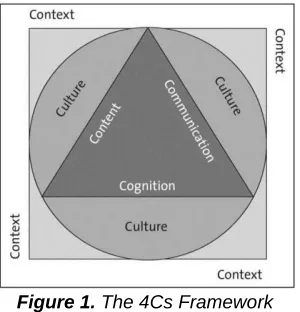
teach material as well as language with the aim of encouraging mastery of the material and language to certain levels. So, CLIL is very appropriate to be used as a learning approach in bilingual classes, which uses a foreign language as the language of instruction in learning (Papaja & Swiatek, 2016). According to Lorenzo et al. (2011), Cenoz, Gennessee & Gorter (2014), CLIL can improve foreign language skills, prepare students for the world of globalization, increase motivation to learn foreign languages, enrich vocabulary in foreign languages, increase student confidence, and increase the competency of the material being studied. CLIL is more beneficial when compared to traditional foreign language learning. The application of the CLIL approach has several advantages, including those found in the Cambridge University Handbook (2010), namely: (1) Develop students’ confidence; (2) Improve students' communication skills; (3) Encourage understanding between cultures and students' human values; (4) Increase students 'sensitivity to vocabulary, and (5) Increase students' foreign language skills which include listening, speaking, reading and writing. Coyle, Hood and Marsh (2010) developed a framework for integrating content and language called "The 4Cs Framework" as shown in Figure 1.
Figure 1. The 4Cs Framework
Figure 1 shows the 4 main principles of CLIL, namely 4Cs which include Content, Cognition, Communication and Culture. The four components in learning are explained as follows: 1) Content in this case is to increase knowledge and understanding of the material. Submission of material is done by the teacher when explaining the material and when evaluating the results of practicum and Running dictation; 2) Communication in this case is to improve students' skills in using language to communicate. Students' communication skills are sharpened when discussing the results of practicum and Running dictation; 3) Cognition in this case is developing students' thinking skills. Students' thinking skills are developed through practicum activities, group discussions, and Running dictation. Practical activities include ordering (writing data) and dividing (dividing classes into small groups). Group discussions include evaluating (giving opinions). Running directions include defining (translating) and remembering (spelling, conveying and recalling). 4) Culture in this case is to increase students' understanding of themselves and others so that they appear caring and responsible. CLIL is an approach that integrates 4 elements, namely content, communication, cognition, and culture in symbiosis with one another. Based on The 4Cs Framework above it can be seen
that CLIL is centered on students and lecturers more likely to be facilitators and motivators. CLIL can be applied systematically to improve the ability of students to learn the subject matter of learning strategies and also master English language skills in PGSD. Students increase knowledge, skills and understanding of learning strategy material, engage in cognitive thinking processes, interact with related material, and develop appropriate English language skills. Thus, the development of learning tools with the Integrated Learning Content and Language Approach (CLIL) for International Class Pioneering PGSD FIP UNNES can be a solution for lecturers and students to answer existing problems. The purpose of this study is to produce a learning strategy learning kit with a Content, Language Integrated Learning (CLIL) approach that is valid, effective, and practical (applicable) and in accordance with the SNP so that the activities and student learning outcomes increase.
2 METHODOLOGY
This research is a development research that refers to the 4-D model (Four D model) from Thiagarajan, Semmel and Semmel (define, design, develop, and disseminate) but is limited to the develop stage. The subject of the trial was a bilingual class student (international class pilot) PGSD FIP UNNES Class of 2018/2019. This study involved 37 students (12 students in limited trial classes and 25 students in real teaching trial classes). Data collection techniques using tests, observations, questionnaires, interviews, and documentation. Data analysis techniques using qualitative and quantitative descriptive analysis. The device trial design uses the One Group Pretest-Postest Design experimental design.
3 RESULTS AND DISCUSSION
A. Learning Tools Characteristic
Characteristics of the developed learning tools are in accordance with Permenristekdikti No. 44 of 2015 concerning national higher education standards, curriculum based on the Indonesian National Qualifications Framework (KKNI), UNNES Conservation, referring to the Curriculum for Primary School Teacher Education Study Program (PGSD), and UNNES Rector Regulation No. 52 of 2017 concerning Guidelines for Organizing International Classes at Semarang State University by applying the Content Language Integrated Learning (CLIL) approach. Lecture devices developed include semester learning plans (RPS), teaching materials, and learning outcomes assessment tools (PPHB).
B. Learning Tools Validity
The validity of the learning tools using the Content Language Integrated Learning (CLIL) approach is determined based on the judgment and opinion of 3 expert judgments. The learning device is said to be valid if the final score of an average of 3 validators meets the criteria for the achievement of a minimum score of valid categories. The results of the recapitulation of the validity of learning tools can be seen in Table 1.
Table 1. Learning Tools Validity
No Tools Minmum
Criteria
Final Score
(Sa)
Categoty
1. RPS Sa ≥ 31 44.3 very
654 2. Learning
Materials Sa ≥ 15 21
very valid 3. PPHB
a. Cognitive
test Sa ≥ 11 14.3
very valid
b. LPAM Sa ≥ 15 21.6 very valid
The results of the validation of the semester lecture plan (RPS) show that the average final score (Sa) of the three validators is 44.3 with a very valid category which means that it has met the criteria for achieving the validity of the RPS namely Sa ≥ 31. Obtaining a final score (Sa) the average validation of teaching materials is 21 which is included in the category of very valid so that it meets the criteria for the achievement of the validity of teaching materials namely Sa ≥ 15. The assessment of three validators of cognitive learning achievement test kits results in a final score of 14.3 with a very valid category so that the positive learning outcomes test has fulfilled the achievement criteria, namely Sa ≥ 11. Student activity observation sheet (LPAM) was assessed by three expert validators and obtained a final score (Sa) of 21.6 with a very valid category so that it met the LPAPD validity achievement criteria, namely Sa ≥ 15. Based on the validation results by three experts on teaching learning strategies using the CLIL approach already meet valid criteria.
C. Learning tools Effectiveness
The effectiveness of the learning tools in this study is seen from the achievement of the results of the posttest which is better than the results of the pretest, and the results of observations of student activities in lectures in the real teaching trial class by applying the learning strategy lecture tools with the CLIL approach.
1) Cognitive Learning Outcomes
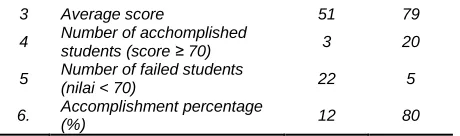
Mastery learning is calculated from the number of students who get a post-test score greater than KKM, which is 70 or with the complete category. Learning tools are said to be effective for improving learning outcomes if there are ≥ 75% of students who score above the KKM or there are at least 19 students who score ≥ 70. Learning outcomes are obtained from the pretest and posttest data. The cognitive learning outcomes of students are obtained from the results of the pretest and posttest in the form of multiple choice questions totaling 30 items with four answer choices. Pretest is given to students before getting learning using the learning strategy lecture using the CLIL approach, with the aim of getting an overview of the students' initial abilities. Posttest is given to students after learning through the learning strategy lecture using the CLIL approach, with the aim of comparing it with the results of the pretest so that the description is obtained whether or not there is an increase in student learning outcomes. Student cognitive learning outcomes are said to increase if the posttest results are better than the pretest results. Recapitulation of the results of the pretest and posttest 25 bilingual class students in the real teaching trial class can be seen in Table 2.
Table 2 Pretests dan Posttes in Real Teaching Class
No Variable Score
Pretest Posttest
1 The lowest score 27 53
2 The highest scrore 70 100
3 Average score 51 79
4 Number of acchomplished students (score ≥ 70) 3 20
5 Number of failed students
(nilai < 70) 22 5
6. Accomplishment percentage
(%) 12 80
The lowest value of the pretest results is 27 and the lowest value of the posttest results is 53. The highest value of the pretest results is 70 while the highest value of the posttest results is 100. The average pretest value is 51 while the average posttest score is 79. The number of students who completed KKM in when the pretest was only 3 people, while 22 others were incomplete, while the results of the posttest showed 20 students had completed KKM and only 5 students were still incomplete. The percentage of classical completeness at pretest is 12% while the percentage of classical completeness at posttest is 80%. The results of the N-gain calculation also show an increase in the learning outcomes of 25 students in the real teaching class which is 0.57 which is included in the medium category because it is located in the range of 0.30-0.70 so that it can be seen the application of the learning strategy lecture CLIL approach is effective for improving student cognitive learning outcomes. This result is in accordance with Lorenzo et al. (2011), which states that CLIL can improve the competency of the material being studied while increasing the ability of foreign languages. Coyle, Hood and Marsh (2010) also stated that the application of the CLIL approach can improve students 'knowledge and understanding of content through learning content, and at the same time improve students' thinking skills through group discussion activities and running dictations such as translating, spelling, conveying, delivering, and remembering.
2) Students’ Activities
655 observations of students' activities in the 9th lecture activities
showed that 6 students received activity scores in the very high category, 13 students received activity scores in the high category, 6 other students received activity scores in the low category, and the average score of student activities at the meeting 9th is 23.1 which is included in the high category. The observations in the 15th lecture activity show an increase in the number of students who get high activity score scores, namely 11 students, and the remaining 14 get high activity score scores, and there are no students with low category activities. The observation of student activities in the 9th and 15th lecture meetings showed the number of students who received activity scores in the very high and high categories had met the criteria of research success for student activities namely the final score (Sa) of at least 19 out of 25 students showed a high category. The recap result showed an increase in the average score of student activity, namely in the 2nd lecture the score was 19.7 with a low category, in the 9th lecture it increased to 23.1 with a high category, which means an increase of 3.6 points compared to score on the second lecture. In the 15th lecture, the average student activity increased again to 27.1 with a very high category, which means there was an increase of 4 points compared to the 9th recovery so that it can be seen that the lecture set of learning strategies using the CLIL approach, is effective for increasing student activity. At the 2nd lecture meeting, the average score of student activity showed a low category with an average score of 19.7. Having identified this is due to the fact that students get the CLIL approach for the first time. In activities related to Content, most students still feel confused in understanding instructions from lecturers who use English in giving instructions, they still often ask for repetition of instructions delivered by lecturers and sometimes students still misinterpret the intent of sentences/ instructions delivered by lecturer. Students are also still unfamiliar with instructional learning materials provided in English and in general they still translate word words so that the resulting meaning is sometimes still ambiguous. Furthermore, for the element of communication activities (communication), students in general are still not confident to speak in English, they are afraid to make mistakes, especially grammar problems. Most students still find it difficult to apply tenses in speaking, spelling or pronunciation of words / phrases. They are also still confused to say the sentence using simple tense. Most students are also still confused in writing, especially in making compound or complex sentences. In general, they tend to write sentences with simple sentences and sometimes they are still confused about verb, adverb, and adjective. As for the ability to think (cognition), only a few students who have taken English courses before have better abilities and they are active in learning, they ask questions and still dominate in the process of discussion and presentation. Furthermore, in terms of cultural activities, most students have shown polite and responsible attitudes to the tasks assigned, but some of them are still too late to collect assignments related to the use of English. In the 9th lecture there was an increase of 3.6 points on the average student activity to 23.1 with a high category. This is because students begin to get used to the elements of the CLIL approach in learning, namely: content, communication, cognition, and culture. In terms of content, students have begun to understand the instructions or explanations given by the lecturer in English because they are used to listening to the sentences given by the lecturer. They
656 questions or contributing opinions in group discussions.
Furthermore, in terms of cultural activities, all students have shown polite attitude such as listening to other people when talking, respecting students or groups who excel and they show a sense of responsibility for the given task, no one is late to collect assignments. These results indicate that the lecture set of learning strategies with CLIL approach is effective for increasing student activities (content, communication, cognition, and culture). This result is in line with Lorenzo et al. (2011), which states that CLIL can improve foreign language skills, prepare students for the world of globalization, increase motivation to learn foreign languages, enrich vocabulary in foreign languages, increase student confidence, and increase the competency of the material being studied. Furthermore, Coyle, Hood and Marsh (2010) concluded that CLIL can improve knowledge and understanding of content (content), improve students' skills in using language to communicate, develop students' thinking skills (cognition), and improve students' understanding of themselves and other people so that they appear caring and responsible (culture). While Papaja & Swiatek (2016) stated that learning with CLIL is centered on two things namely additional language used to learn and teach material as well as language with the aim of encouraging mastery of the material and language to certain levels. So, CLIL is very appropriate to be used as a learning approach in bilingual classes, which uses a foreign language as the language of instruction in learning.
D. Practicality of Learning Tools
The practicality of the learning tools is determined based on the results of students' responses to the developed learning tools. The results of student responses were obtained from filling in the student response questionnaire sheets, which consisted of five indicators, namely: 1) students' preference for the learning strategy course, 2) the significance of the application of the CLIL approach to the learning strategy course, 3) media use, 4) legibility of teaching material, and 5) Readability of PPHB. The five indicators are further elaborated in 14 statements. 21 students who responded very positively to the set of learning strategies using CLIL approach that have been used in PGSD bilingual classes, with a total score of response between> 45.5 to 56. The number of students who responded positively to the set of lectures is 4 people with a number of response scores between> 35 to 45.5 so that there are no students who respond negatively. In general, students respond that they like learning strategies because they teach them to design, manage, and evaluate learning in elementary schools that is good and fun. Furthermore, they also responded very positively that the application of the CLIL approach in lecturing learning strategies can make them more confident to speak (speaking) using English, learning with the CLIL approach is very fun because they can learn learning strategy materials while increasing their speaking, listening, reading skills, and writing in English. This shows the fulfillment of the success criteria for students' responses, namely Sa (a minimum of 19 out of 25 students in the real teaching test class) shows a positive. Category. The average response score of all students is 50.2 which is included in the very positive category so that it can be seen that the lecture set of learning strategies using the CLIL approach that has been used has met the practical criteria because it has been
responded very positively by students in the PGSD bilingual class.
4 CONCLUSION
Characteristics of the developed learning tools are in accordance with Permenristekdikti No. 44 of 2015 concerning national standards of tertiary education, curriculum based on the Indonesian National Qualifications Framework (KKNI), with the nature of UNNES Conservation, referring to the Curriculum of Primary School Teacher Education Study Program (PGSD) by applying the Content Language Integrated Learning (CLIL) approach. Lecture tools developed include semester learning plans (RPS), teaching materials, and learning outcomes assessment tools (PPHB). The validity of learning tools is determined based on the assessment and opinions of 3 experts (judgment expert). Based on the results of the validation by three experts on the learning strategy learning tools using the CLIL approach, it fulfills valid criteria. The learning tools developed are effective for improving students' cognitive learning outcomes as seen from the post-test results which show that 20 out of 25 students complete KKM. N-gain test results also showed a gain value <g> of 0.57 in the medium category. Recapitulation The observations also showed an increase in the average score of student activities, namely in the 2nd lecture the score was 19.7 in the low category, in the 9th lecture it increased to 23.1 in the high category, and again increased to 27.1 with a very high category at the 15th lecture meeting so that the lecture tools are effective for increasing student activity. The practicality of the learning device can be seen from the results of the average score of 50.2 student responses which included in the very positive category. Based on these results, it is known that the set of learning strategies using CLIL approach have fulfilled valid, effective, and practical criteria.
5 REFFERENCE
[1] ASCD. 2018. "Bilingual Education: Effective Programming for Language-Minority Students". ascd.org. Retrieved June 13, 2018.
[2] BBC, 2019. British Council BBC Teaching English: CLIL. https://www.teachingenglish.org.uk/article/clil. [3] Cenoz, Gennessee & Gorter (2014). "Critical analysis
of CLIL: Taking stock and looking forward". Applied Linguistics. 35 (3): 243–262.
[4] Coyle, D., Hood, P. & Marsh, D. (2010). CLIL. Cambridge: C.U.P.
[5] Dalton-Puffer, Llinares, Lorenzo & Nikula (2014). ""You can stand under my umbrella": Immersion, clil and bilingual education. A response to Cenoz, Genesee & Gorter (2013)". Applied Linguistics. 35 (2): 213–218.
[6] Djamarah, S. B. 2008. Psikologi Belajar. Jakarta: PT Rineka Karya.
[7] Flynn AE, Klein JD. 2001. The influence of discussion groups in a case-based learning environment. Educ Technol Res Dev 49(3):71–86. [8] Kwangsawad, T, 2018, TRAINING EFL
PRE-SERVICE TEACHERS FOR CLIL. Journal. European Journal of Education Studies Vol 4 Issue 1 2018. Doi: 10.5281/zenodo.1158755.
657 [10] Mulyasa, E. 2011. Menjadi Guru Profesional.
Bandung: Remaja Rosdakarya.
[11] Papaja, K. (2014). A qualitative evaluation of Content and Language Integrated Learning (CLIL) in Polish secondary education. Newcastle: Cambridge Scholars Publishing.
[12] Papaja, K. (2013). The role of a teacher in a CLIL classroom. Glottodidactica Xl/1 (2013) Adam Mickiewicz University Press Poznań: Retrieved from https://www.unifg.it/sites/default/files/allegatiparagraf o/06-
[13] Papaja, K. & Swiatek, A. (eds.). (2016). Modernizing educational practice: Perspective in Content and Language Integrated Learning (CLIL). Newcastle: Cambridge Scholars Publishing.
[14] Permenristekdikti No. 44 Tahun 2015 tentang Standar Nasional Pendidikan Tinggi.
[15] Permenristekdikti No. 55 Tahun 2017 tentang Standar Pendidikan Guru.
[16] Peraturan Rektor UNNES No. 52 Tahun 2017 tentang Panduan Penyelenggaraan Kelas Internasional Unvirsitas Negeri Semarang.
[17] Peraturan Rektor UNNES No. 10 Tahun 2018 tentang Reputasi Mahasiswa Tahun Internasionalisasi Universitas Negeri Semarang. [18] Sugiyono. 2013. Metode Penelitian Pendidikan:
Pendekatan Kuantitatif, kualitatif, dan R&D. Bandung: Alfabeta.
[19] Thiagarajan, S., Semmel, D.S., & Semmel, M.I. 1974. Instructional Development for Teachers of Exceptional Children. Minneapolis, Minnesota: Leadership Training Institute/Special Education, University of Minnesota.
[20] Thobroni, M. 2011. Belajar dan Pembelajaran. Jogjakarta: Ar-Ruzzmedia.
[21] Thompson & McKinley (February 2018). "Integration of content and language learning" (PDF). TESOL Encyclopedia of English Language Teaching. 1. Retrieved 10 January 2018.
[22] Undang-undang Republik Indonesia No. 12 Tahun 2012 tentang Pendidikan Tinggi.