Enhancing Science Learning Outcomes Through
Moodle-Based E-Learning In Elementary Schools
Freddy Widya Ariesta, Suwarno, Olifia Rombot
Abstract — This study aims to determine the effectiveness of the application of e-learning media in science lessons on the learning outcomes of fourth-grade students in elementary school. Experimental research was conducted for four weeks with learning using e-learning media as an experimental group (n = 32) and using book-based learning as a control group (n = 30). This study used a quasi-experimental method with a pretest and posttest control group design. The research instrument was taken from observations and scores on student learning outcomes. The data were analyzed using a quantitative statistical method. Based on data, the researchers know that a teacher plays an essential role in developing student learning media through ICT based learning design. Also, the results of the study based on Mann-Whitney N-gain score of students’ comprehension ability obtained a significance value of 0.00 less than α = 0.05 so that H0 was rejected. This result shows that the ability of students to understand science using e-learning media is significantly better than students who get book-based learning.
Index Terms — E-learning, Learning Outcomes, Natural Science, Elementary School
—————————— ——————————
1 I
NTRODUCTION Science is a science that deals with the symptoms of nature and systematic material that are arranged regularly in the form of a collection of observations and experiments [1]. Science is a systematic effort to create, build, and organize knowledge about natural phenomena. This effort originated from human nature full of curiosity. This curiosity is then followed up with investigations to find the simplest but accurate and consistent explanation to explain and predict natural symptoms. Science Learning integrates scientific work (scientific approach) which includes observing, formulating problems, formulating hypotheses, designing experiments, collecting data, analyzing, and concluding and reporting the results of experiments both orally and in writing [2][18].Today, we are in the era of the 21st century, which is characterized by rapid technological developments, so that Science and technology are one of the essential foundations in nation-building. Science learning is expected to deliver students to fulfil their abilities in the 21st-century era. The following are the skills needed by teachers to answer the challenges in the 21st century [2][19]. Namely learning and innovation skills that include critical thinking and being able to solve problems, creative and innovative, and able to communicate and collaborate; skilled to use media, technology, information and communication (ICT); the ability to live life and career, including the ability to adapt, take the initiative, be able to develop themselves, have social and cultural skills, be productive, trustworthy, have leadership, and responsibility.
Information and Communication Technology (ICT) based learning requires teachers to be able to compensate for changes and technological developments that occur in society. Teachers are required to be creative in developing learning methods and the media used. One of them is the use of
e-learning as a e-learning media for Science which is expected to make teaching and learning activities more interesting, interactive and fun so that they can be useful in improving the learning outcomes of elementary school students.
In the past decade, the world of education in Indonesia has experienced significant development. This development can be seen from the increasingly diverse learning models used by teachers, namely by utilizing various media to improve the quality of learning outcomes. The development of various learning media is in line with the rapidly advancing technology. The current technological dynamics have achieved tremendous acceleration. In the digital era, teachers are required to plan and create learning that is suitable for the needs of students as generation natives. Emphasize the importance of finding a new formula that can answer the needs of 21st-century students [3][17]. The new method will determine the way of acquiring knowledge of students living in a world characterized by very rapid technological development.
Currently the need for an information technology-based teaching and learning mechanism (education) becomes inevitable [4]. Teachers are challenged to carry out reforms in two ways, namely in terms of methodology and aspects of learning content [5]. The method in question is a methodology that takes students to active learning (student-centred). The learning content is a subject matter that is better presented, more efficient, more interesting and can be more readily accepted and understood by students.
Technology or learning media as scientific applications of the learning process in humans in the practical task of teaching and learning [6]. E-learning is the basis and logical consequence of the development of information and communication technology [20]. Teaching material can be virtualized in various formats so that it is more exciting and more dynamic and able to motivate students to reach the learning process further. Through e-learning, students not only listen to the material description from the instructor but also actively observe, analyze, perform, and demonstrate [7][20][21].
This statement is in line with the understanding of the concept of learning Science in Elementary schools, which implies that teachers are expected to facilitate students to carry
————————————————
Primary Teacher Education Department, Faculty of Humanities, Bina
Nusantara University, Jakarta, Indonesia 11480. E-mail:
Primary Teacher Education Department, Faculty of Humanities, Bina Nusantara University, Jakarta, Indonesia 11480. E-mail: [email protected]
Primary Teacher Education Department, Faculty of Humanities, Bina
Nusantara University, Jakarta, Indonesia 11480. E-mail:
2184 out learning activities through a scientific approach which
includes observing, asking, gathering information, associating or analyzing, and communicating. For this reason, teachers can utilize information technology in designing various learning resources in the form of e-learning to enrich student learning and strengthen mastery of Science competencies. The learning process by using information and communication technology is guidance from the instructor to facilitate effective student learning [8]. The use of e-learning as a learning media for Science is expected to make teaching and learning activities more interactive and fun so that they can be useful in improving student learning outcomes. In this study, the researchers wanted to test how much the effectiveness of learning using e-learning media combined with classroom learning on the results of learning Science in Elementary schools.
Because the learning process is a communication process and takes place in a system, the learning media occupies a reasonably necessary position as one component of the learning system. Following is the scheme of media functions in the learning process:
Fig. 1. The function of Media Education Scheme
So, the media functions to generate new desires and interests, arouse learning motivation and stimulate activities in the teaching and learning process. The use of media will significantly help the effectiveness of the learning process, the delivery of messages, and the content of the lesson at that time and can help improve understanding, present data with interest, facilitate the interpretation of data and compact information.
At present, we are in the era of the 21st century, which is characterized by rapid technological developments so that Science and technology are one of the essential foundations in nation-building. Science learning is expected to deliver students to fulfil their abilities in the 21st-century era. The learning plan is a picture of some activities and actions that will be carried out during the learning process. It can be concluded, the e-learning based learning planning application contains a plan, and an overview of learning activities by utilizing computer networks, both intranet and internet. The scope of learning planning includes four main components, namely objectives, teaching materials or materials, teaching and learning activities, and evaluation [9].
E-learning have characteristics, including (1) interactivity; (2) independence; (3) accessibility; (4) enrichment. E-learning can be defined as the transformation of the learning process in information technology applied in the field of education in the
form of digital (cyberspace) [10]. Learning outcomes achieved by students are influenced by two main factors, namely: (a) factors from within students, namely: the ability they have, learning motivation, interest and attention, attitudes and learning habits, perseverance, social economy, physical and psychological factors, (b) factors that come from outside the student, namely: environmental factors, and the quality of teaching [11]. One of the most dominant learning environment factors influencing student learning outcomes in schools is the quality of teaching. The quality of teaching is the high or low or the effectiveness of the teaching and learning process in achieving teaching goals. Based on the factors that influence the learning outcomes above, researchers use external factors in the form of the use of media e-learning Science and classroom learning to improve the learning outcomes of primary school students.
The effectiveness of learning programs is characterized by the following characteristics: (a) Successfully delivering students to achieve the specified instructional goals, (b) Providing an attractive learning experience, actively involving students as to support achievement instructional objectives, and (c) Having facilities that support the teaching and learning process [12].
The development of information technology has an impact on the increasingly effective learning process. The development of information technology is evident in ICT-based learning, such as e-learning. The use of e-learning as a medium that contains the content of learning materials using online network technology is a means and medium of interactive communication for students. The way to learn online learning system provides an opportunity for students to access their material or learning material presented by the teacher or facilitator.
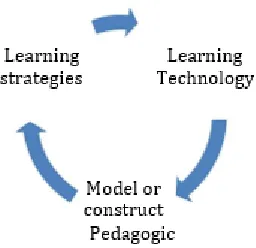
Online learning is an open and distributed learning environment that uses pedagogical tools, enabled by the internet and web-based technologies, to facilitate learning and knowledge building through meaningful action and interaction [13]. Schematically the relationship of these components is presented in the following figure.
Fig. 2. Scheme Relations Meaningful Interaction Component
transferable knowledge and skills related to the performance of the organization or to help individuals achieve their personal learning goals effectively.
2 M
ETHODSThis research was conducted on elementary school students in West Jakarta using quasi-experimental with pre-test and post-test control group design. There were two groups randomly selected. In this study, the sample divided into two classes with different learning. The first group was given e-learning based learning, while the second group was given treatment with conventional learning as a control class. Both groups were given a pre-test to determine the initial state whether there were differences between the experimental group and the control group [14]. Students are given a pre-test before treatment and posttest after treatment [15]. The results of the effectiveness of science learning outcomes were analyzed using quantitative statistical tests.
The research subjects were 62 fourth grade students of the elementary school consisting of the experimental group (n = 32) and the control group (n = 30). Students are divided into groups consisting of 4-5 members. Researchers developed e-learning media in science material that can be accessed by all teachers and fourth grade students of primary school, researchers also developed evaluation instruments in the form of pretest and posttest questions to measure students' scientific abilities after using e-learning media, then researchers also developed observation sheets to observe student behaviour that appears during the lesson. Each observation sheet has four indicators that observers must observe. Research data collection techniques, researchers use several techniques and procedures that are tailored to the characteristics of the data collected and respondents' research. Data collection techniques are carried out using literature studies, observations, and test questions instruments made and developed.
The researcher arranges, encodes, reviews and analyzes the observation sheet. Data were analyzed using quantitative Mann Whitney statistical tests. Also, the researcher obtained data on improving the learning outcomes of primary school fourth-grade students who were analyzed by N-gain test to get more information about improvement [15][16].
3 R
ESULT ANDD
ISCUSSIONThe purpose of this study was to determine the effectiveness of the use of e-learning media in science learning on the learning outcomes of fourth-grade students in primary school. The question of this study is "Are there differences or increases between the scores of student learning outcomes in the experimental group taught using e-learning media and students in the control group who are only taught using public methods based on a book-based curriculum?"
Before the learning process, students were given about the pretest to determine students' initial abilities of the material energy and its amendments. Also, the pre-test results can be used to determine the experimental class, and the control class
can start the same or different. Normality and homogeneity tests are carried out first before conducting a hypothesis test of two means. The Kolmogorov-Smirnov One-Sample statistical test calculates the normality test of the pretest score. The hypothesis is formulated as follows:
H0: Pretest scores are normally distributed H1: Pretest scores are not normally distributed
The results of the normality test of the experimental and control class are shown in the table below.
TABLE1
NORMALITY TEST RESULTS OF PRETEST SCORE
Pretest Experimental
Group
Control Group
N 31 30
Kolmogorov-Smirnov Z 0.202 0.227
Asymp. Sig. (2-tailed) 0.002 0.000
(with Kolmogorov-Smirnov test,α = 0.05)
Based on Table 1, the pretest score of the control class students has the Asymp. Sign (2-tailed) score < α = 0.05 so that H0 is rejected. Whereas, the pretest score of the experimental class students has the Asymp. Sign (2-tailed) score < α = 0.05 so that H0 is rejected. This result shows that the pretest score of the control and the experimental class are not normally distributed.
Furthermore, after the pretest score of the control and the experimental class is known to be not normally distributed, non-parametric tests are conducted. Non-parametric tests are used to test the hypothesis of two means because the two samples do not meet the assumptions of normality.
The statistical test used was the Mann-Whitney test. The hypothesis is formulated as follows:
H0: µ1 ≤ µ2, the average pretest score of the experimental class, is less than the control class.
H1: µ1
>
µ2, the average pretest score of the experimental class, is more than the control class.The results of the hypothesis test of the two means of pretest scores in the control and the experimental class are shown in the table below.
TABLE2
HYPOTHESIS TEST RESULTS OF TWO MEANS
Nilai
Mann-Whitney U 433.000
Wilcoxon W 929.000
Z-Score -0.475
Asymp. Sig. (2-tailed) 0.635
2186 that there is enough evidence at the 5% significance level to
state that the average pretest score of the experimental class is less than the control class.
Furthermore, the gain value is used to determine the increase in student learning outcomes. The statistical test used is the hypothesis test of two means to determine the differences in improving student learning outcomes of the experimental and the control class. Normality and homogeneity tests are carried out first before conducting a hypothesis test of two means.
The normality test of the N-gain score is calculated by the Kolmogorov-Smirnov statistical test. The hypothesis is formulated as follows:
H0: The N-gain scores are normally distributed H1: The N-gain scores are not normally distributed
The normality test result of the N-gain score of the experimental and the control class are shown in Table 3.
TABLE3
HYPOTHESIS TEST RESULTS OF TWO MEANS
N-gain Experimental
Group
Control Group
N 31 30
Kolmogorov-Smirnov Z 0.293 0.207
Asymp. Sig. (2-tailed) 0.000 0.020
(with Kolmogorov-Smirnov test, α = 0.05)
Based on Table 2, the N-gain score of the experimental class has the Asymp. Sign (2-tailed) < α = 0.05 so that H0 is rejected dan N-gain score of the control class has the Asymp. Sign (2-tailed) < α = 0.05 so that H0 is rejected. This result shows that the N-gain scores of the control and the experimental class are not normally distributed.
Furthermore, after the N-gain score does not meet the normality assumption, a non-parametric test is performed. The non-parametric test used is the Mann-Whitney test. The formulation of the hypothesis is formulated as follows:
H0: µ1 ≤ µ2, the mean of N-gain score of the experimental class, is less than the control class.
H1: µ1
>
µ2, the mean of N-gain score of the experimental class, is more than the control class.The results of the hypothesis test of the two means of N-gain scores in the control and the experimental class are shown in the table below.
TABLE4
HYPOTHESIS TEST RESULT OF TWO MEANS
Nilai
Mann-Whitney U 174.000
Wilcoxon W 639.000
Z-Score -4.233
Asymp. Sig. (2-tailed) 0.000
Based on the Mann-Whitney test, a significance value of 0.000 was less than the α = 0.05, so H0 was rejected. These results indicate that the significance level of α = 0.05, the mean of N-gain score that learning using e-learning is significantly better than students who get conventional learning.
This study found that teachers play an essential role in classroom learning through the development of learning media. Like developing and implementing e-learning media that facilitates the learning styles of children in primary school. Statistical test analysis shows that there are differences in students' understanding abilities in the experimental group that are better and higher when using e-learning media than students who use book-based learning. Based on student and teacher response, questionnaires also obtained practicality scores of e-learning media in the category of "practical or good". Students can achieve optimal learning achievement if they like learning because the teacher builds students' interests [17]. When teachers provide learning assignments, students also report the positive impact of technology utilization and skills improvement obtained by applying problem taking based on the issue. School staff is an essential element for developing a good student community, especially at the primary school level [17].
E-learning media can help students to learn independently and be responsible for learning. They must have constructivism thinking ways that can spur themselves to do things without having to be supervised directly by the teacher. E-learning media encourages students to accept the task of learning science learning materials and doing it themselves at home. The task of learning by using e-learning looks complex and not just reading learning material via a web browser. However, students need to take various special steps to complete the learning tasks contained in e-learning.
Students are required to be independent and creative, carrying out some various steps themselves. Guides that have been prepared by the teacher must be clear so that students do not have difficulty in solving problems and taking steps to achieve maximum results.
E-learning provides opportunities for students to be creative in understanding learning material. Students are motivated to experiment and even carry out unique steps by the stimulus generated from the e-learning media used. Imagine what happens when a student is considered successful, but it turns out that success is produced not from his work and creativity. For example, the task on e-learning media turns out to be done by someone else, for example, a parent. Very good if parents can be involved in completing student assignments but not taking over the function.
4 C
ONCLUSIONBased on the positive results of the teaching process, the researchers concluded that media e-learning applied to science learning influenced the understanding of fourth-grade students in primary school. Also, there is an increase in the results of higher scores and different scores obtained by the learning outcomes in the experimental group rather than the control group. Positive results also indicate that there is an increase in students' critical thinking skills and the ability to use technology in learning in elementary schools.
There are several recommendations that the researchers submitted related to this study, including learning using e-learning media can be used as an alternative for teachers in developing science learning in energy materials in elementary schools, but it should be noted that students' initial scientific abilities.
If the initial ability of science is still low, it must be given an action so that there are no obstacles in learning that cause student learning outcomes to be inferior; teaching materials are beneficial for students in taking lessons. However, the teacher's role is indispensable in directing students to achieve the learning objectives; The results of the study which showed an increase in student learning outcomes were still in the middle classification, for researchers then it was recommended to examine the material and other levels; For other researchers, it is recommended to examine the effect of using e-learning media on energy material with student motivation.
5 A
CKNOWLEDGEMENTSThis research was supported by Bina Nusantara University. We thank you for our colleagues who provided insight and expertise that greatly assisted the research, although they may not agree with all interpretations or conclusions of this paper. We are grateful for the help of the students, teachers, administrators, and field staff who participated in the study. The author thanks, for all support at completing this article to be published.
R
EFERENCES[1] Samatowa, Usman. 2006. Pembelajaran IPA di Sekolah
Dasar. Jakarta: Indeks.
[2] Permendikbud 021. 2016. Tentang Standar Isi Kurikulum
2013. Jakarta: disalin oleh Biro Kementrian Pendidikan dan Kebudayaan Tinggi Depdiknas.
[3] Goda, W.W.L., Bay, S., & Chen, V.H.H. 2017. Young school children’s use of digital devices and parental rules. [4] Whitten, Jeffrey L, et al. 2014. Metode Desain & Analisis
Sistem, Edisi 6, Edisi International. Yogyakarta: Mc GrawHill, ANDI.
[5] Prensky, Marc. 2001. Digital Game-Based Learning,
Chapter 5: Fun, Play and Games: What Makes Games Engaging. McGraw-Hill.
[6] Buckingham, D. 2013. Media education: Literacy,
Learning and Contemporary Culture. John Wiley & Sons.
[7] Clark, Ruth., E. Mayer, Richard. 2008. E-learning –
second edition. New York: Pfeiffer.
[8] Munir. 2009. Mata Pelajaran Berbasis Teknologi Informasi
dan Komunikasi. Bandung: CV. Alfabeta.
[9] Sisco, Ashley. 2010. Nations First for elearning of
effectiveness the Optimizing. Ottawa: The Telematics and Informatics, 32, 787-795.
[10]Rusman, dkk. 2011. Pembelajaran Berbasis Teknologi
Informasi dan Komunikasi. Jakarta: Rajawali Pers.
[11]Sudjana, N. 2009. Penilaian Hasil Belajar Mengajar.
Bandung: Remaja Rosdakarya
[12][12] Burgess, J. R., & Russell, J. E. 2003. The Effectiveness of Distance Learning Initiatives in Organizations. Journal of Vocational Behavior, 63(2), 289-303.
[13]Dabbah, N. H., Jonassen, D. H., Yueh, H. P. & Samouilova, M. 2000. Assessing a Problem-Based Learning Approach to an Introductory Instructional Design Course: A case study. Performance Improvement
Quarterly, 13(3), 60-83. DOI=
10.1111/j.1937-8327.2000.tb00176.x.
[14]Cohen, L., Manion, L. ve Morrison, K. 2005. Research Methods in Education (5th Edition). London, NewYork: Routledge Falmer. Conference Board of Canada.
[15]Sukmadinata, Nana Syaodih. 2005. Metode Penelitian
Pendidikan. Bandung: Rosdakarya.
[16]Hake, R, R. 1999. Analyzing Change/Gain Scores.
AREA-D American Education Research Association’s
Devision.D, Measurement and Reasearch Methodology. [17]Railsback, J. 2002. Project-based Instruction: Creating
Excitement for Learning. Northwest Regional
Educational Laboratory, Oregon.
http://educationnorthwest.org/sites/default/files/projectb ased.pdf.
[18]Susanto, A. B. 2007. Corporate Social Responsibility. Jakarta: The Jakarta Consulting Group.
[19]Benninga, J.S., Berkowitz, M.W., Kuehn, P. & Smith, K. (2006). Character and Academics: What Good Schools Do. Phi Delta Kappan 87(6), 448–452.
[20]Chu, S., Chow, K., Tse, S.K., Kuhlthau, C.C. 2008. Grade
Four Students’ Development of Research Skills through Inquiry-Based Learning Projects. Hongkong: School Libraries Worldwide 14(1), 10–37.
[21]Dabbagh, N. & Bannan-Ritland, B. 2005. Online
Learning. Concept, Strategies, and Application. Upper Saddle Rive, NJ: Pearson Education, Inc.
[22]Hmelo-Silver, C. 2004. Problem-Based Learning: What and
How do Students Learn? Educational Psychology Review,
6, 235-266. DOI=