1876
Mathematical Representations: A Study in Solving
Mathematical Word Problems at Grade 5 -
Vietnam
Nguyen Phu Loc, Ngo Truc Phuong
Abstract: The paper aims to: (1) present the types of representations in solving mathematical problems;(2) to find out the types of representation used in solving word problems in textbook “Toan 5” (Mathematics 5) of Vietnam; and (3) report the results of a survey on using representations of Grade 5 students in solving non-routine mathematical problems. The study results revealed that the students faced many difficulties and had errors sin using visual and symbolic representation.
Index Terms: non-routine problem, mathematical representation, multi-representation, solving word mathematical problem, word mathematical problem ————————————————————
1
I
NTRODUCTIONRepresentation plays a very important role in the process of
learning mathematics, not only in understanding mathematical concepts but also in solving problems. Vietnam's new general education program has seen mathematical representation as one of the three components of mathematical communication and fundamental manifestation of mathematical modeling competence. At the same time, students must learn how to use mathematical representation to establish and express mathematical ideas in order to develop mathematical competencies (Ministry of Education and Training -Vietnam, 2018) [2]. At the primary education level of Vietnam today, from the author's initial notes, when teaching word mathematical problem solving, teachers focus on putting the problem into known typical forms rather than encouraging students to use visual representation to find solving strategies. Meanwhile, the problem of solving math problems in the familiar form will become a barrier when students encounter an unfamiliar situation, when they meet obstacles, they have no habit of creating a link between the data with diagrams, figures, photos, tables, ... Another issue of concern is the fact that the last grade classes of primary school, in Math textbooks, the use of summary charts, illustrations to represent the problem is less required in mathematical word problem solving. Facing the renovation requirements of the general education program oriented to develop learners' competencies at the present time in Vietnam, it is necessary to have in-depth studies on the connection between mathematical representations in solving elementary mathematics, mathematics in general, mathematical word problem in particular.
Through this article, from the results of a survey on understanding the degree of application of the types of representation in solving math problems (a typical form) of grade 5 students, the author hopes to bring a practical basis for
the study of teaching word mathematical problem associated with the types of mathematical representation in the primary mathematics program of Vietnam.
2
L
ITERATURE REVIEW2.1 The conception of mathematical representation
Encyclopedia of mathematics education [8] was defined
mathematical representation as follows.
As most commonly interpreted in education, mathematical representations are visible or tangible productions – such as diagrams, number lines, graphs, arrangements of concrete objects or manipulative, physical models, mathematical expressions, formulas and equations, or depictions on the screen of a computer or calculator – that encode, stand for, or embody mathematical ideas or relationships. Such a production is sometimes called an inscription when the intent is to focus on a particular instance without referring, even tacitly, to any interpretation. To call something a representation thus includes reference to some meaning or signification it is taken to have. Such representations are called external – i.e., they are external to the individual who produced them, and accessible to others for observation, discussion, interpretation, and/or manipulation.
2.2 Types of representation in mathematics
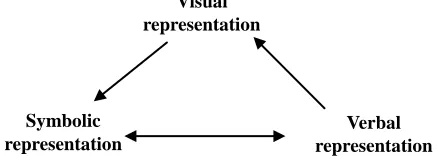
According to the American Mathematical Teachers Association (NCTM) [5], there are five types of interconnected mathematical representation as shown in Figure 01.
Visual representation: illustrate, show or work with mathematical ideas using diagrams, images, numbers, graphs, and other drawings.
Symbolic representation (symbolic): memorize or work with mathematical ideas using numbers, variables, tables and other symbols.
Verbal representation (verbal): use words or phrases to explain, debate, identify or describe mathematical ideas; creating bridges of formal and non-formal mathematical languages.
Contextual representation (contextual): describe situations of mathematical ideas in real life or in imagination.
Physical representation (physical): use real objects to
————————————————
Nguyen Phu Loc., Assoc. Prof. Doctor in Mathematics Education, Can Tho University , Vietnam.
E-mail: [email protected]
1877
indicate, perform, act or manipulate (such as a cube, counting stick, paper tape, etc.).
Nurrahmawatiet and co-authors [6] argues that multiple representations are important for understanding mathematical concepts and solving problems, especially word mathematics problems. The authors presented 5 types of representation: (1) representation of numerical forms; (2) graph representation; (3) verbal representation; (4) representation by symbols, including equations, expressions, algebraic formulas; (5) dual representation, consisting of two types of representation in the previous four forms. Effective teaching is to involve students in creating a connection between mathematical representations to understand mathematical concepts and principles, and to have a tool for solving problems (NCTM, 2014, p.24).
2.3 The role of representation in solving word mathematical problem
Solving math problems is a complex process for students, solvers need effective tactics, one of which is to use mathematical representation. Some students often rely on keywords or numbers in a math problem, but for complex math problems, this strategy no longer works; in this case, it is helpful to make use of positive relationship between efficient representation and successful problem solving (Sajadi et al, 2013) [7]. Students who succeed in mathematics learning cannot ignore the role of mathematical representation. In the step of understanding a problem, representation is a means to understand the given information and connect this information, from the relationship between them to find out a solution strategy. Symbolic and verbal representations can be used effectively in the problem understanding step (Anwar & Radmawiti, 2017) [1]. Visual representation plays an important role in solving problems, helping students easily understand mathematical concepts and principles, the rationality of mathematical knowledge and mathematical reasoning. Visualization will effectively support math problems when students consider the relationship between quantities based on diagrams, tables and graphs. In addition, it also supports the argument of students in the solution because the diagram or drawing will leave a trace showing the solving process (NCTM, 2014, p.25). Thus, mathematical representation is
indispensable in the steps of solving problems, expressed in the stages of understanding the problem (summarizing the problem), finding the resolution strategy (hiding, setting up tables, diagrams, ...). Switching between representational types will show the relationship between the given and the desired quantities. In solving mathematical word problem, with typical problems, the difficulties only appears when students are first contacting. a situation called containing problem occurs when the solver faces a situation that does not know how to solve it directly to achieve the desired result; to solve this problem requires the solver to understand the problem, to have creative thinking and know how to apply different tactics to find solving strategies(Kolovou, 2011, p. 22)[4] . With the step of understanding the problem of typical problems, the conversion of representational types with the data given and needed to find in the problem is indispensable.
3
T
HE OBJECTIVE OF THE STUDYIn order to learn status of mathematics representation in teaching word mathematical problem in Mathematics 5 – Vietnam, we conducted the study with two research questions as follows:
Research question 1: What types of mathematical representation is used in “Mathematics 5” current textbook of Vietnam?
Research question 2: In the mathematical word problem solving,
a. Can students choose a right representation suitable for the problem?
b. Which types of representation will students use to represent a given mathematical word problem?
4
M
ETHODOLOGY4.1 Content analysis
(to find out the answers to the research question 1) In Vietnam, there is only one set of textbooks shared by all primary schools across the country, the same has been applied for Mathematics 5 which is used to analyzed in this study. Based on the content in Mathematics 5, we will show the types of mathematical representation shown in the textbook; from them, the transformation activities between them will be identified.
4.2 Student survey
(to find out the answers to the research question 2): Subjects of the survey are 30 students in Grade 5/1 Phung Ngoc Liem Primary School, Bac Lieu City - Vietnam. This is a high quality class; students are given advanced problems in the afternoon study program.
4.3 Time of implementation: in May 2019. 4.4 Instruments of survey
Students perform as required by 3 problems in 45 minutes (individual activities), including:
1878
aim of understanding the activities of converting verbal representation to visual representation (Problem 1 and 2); they were served for the research question 2a.
- 1 problem that requires summarizing and solving the problem in order to clearly see the activities of representation and solving (Problem 3); it was for the research question 2b.
Problem 1: (see Appendix)
This problem is to learn the activity of changing from verbal representation to visual representation (using diagrams or pictures) of students. Diagrams 1 and 2 show the time based on the ratio relationship of the two velocities and the ratio of velocity to time. Diagram 3 uses drawings similar to textbooks, which cannot lead to finding strategy strategies. Diagram 4 is quite strange for students when using rectangles with an edge denoting velocity, the other side indicates the time that requires students to think higher in terms of expressing distance is the product of velocity with time equal to rectangular area.
Problem 2: (see Appendix)
The problem is also to understand the activity of moving from life verbal representation to visual representation (using straight line segment diagrams to represent prices). In all four diagrams, the number 226000 is not shown. Diagram 1 examines the possibility that students may be confused with the form of "Finding two numbers when knowing total and ratio" very familiar in grade 4 students, where the ratio is 3/5 and the sum is 1414000. Diagram 2 shows only the straight line segments representing the number of tables and chairs. Diagrams 3 and 4 suggest a temporary hypothesis (assuming that the 8 purchased are both tables and chairs). However, diagram 4 has non - continuous line segment showing the missing part with the intention to see if students can grasp the meaning of continuous line segments or non - continuous line segment in the straight line segment diagram.
Problem 3: “Bottle A contains 10% syrup water; bottle B contains 30% syrup water. Two bottles have equal volume. If we mix two bottles, what percentage of syrup water can we get? Purpose: Students are required to summarize and solve the above problem in the absence of a 10x10 square representation tool. At that time, student understands correctly the percentage of two numbers, using the percentage representation to decimals or not.
5
R
ESULTS AND DISCUSSION5.1 Types of mathematical representation and converting activities
Types of mathematical representations in Math Textbook 5 - Vietnam
In Mathematics textbook 5, there are 5 typical types of problem, including: (1) Mathematics involving 4 operations
with decimal numbers, (2) Mathematics for proportional quantities, inverse proportions, (3) Mathematics for percent ratios, (4) Mathematics on regular motion, (5) Mathematics with geometric content. For these problems, based on the classification according to NCTM (2014), there are 3 types of representations used by textbook of Mathematics 5 - Vietnam: visual representation, symbolic representation, verbal representation.
- Visual representation includes straight line segment diagram, 10x10 grids square, straight line segment of the object's movement, etc. Straight line segment diagrams are used very commonly in summarizing problems and to find strategies for solving problems. .
- Symbolic representation includes enumerations, numerical
symbols and operations, numeric forms. Numeric tables are used in scale problems. Textbook focuses on representing numbers into different types: fractions - mixed numbers, decimal fractions, percentages.
- Regarding verbal representation, textbook often gives problems and use verbal abstracts (see Figure 02).
Conversion activities between types of representations
In the mathematical process there are 5 conversion activities between types of representation.
Activity 1: Turn verbal representation into visual representation.
In this case, the given data and the relationships in the problem are converted to a straight line segment diagram (see Figure 03) or illustrative images (see Figure 04).
Figure 03. Illustration of converting verbal into visual
1879
Activity 2: Convert the visual representation into symbolic representation.
This is the next activity after transforming verbal representation into visual representation. Based on the diagram, students find the corresponding operation (see Figure 03).
Activity 3: Change the verbal representation to represent symbolic representation
This activity is very common in solving familiar problems, without too many calculation steps and without "traps." From the data given in words, students "translate" into numbers and
corresponding operations.
Activity 4: Change the symbolic representation into verbal representation
This activity requires students to state the relationship between the two quantities based on the data in the table (see Figure 05).
Activity 5: Convert in digital representation
Numerical analysis for use in each context of the problem is essential. For example, in the problem of proportional
quantities, students need to analyze the number given for the achievement of two numbers to see the ratio to find (see Figure 02). It is also usually done in math of percentages, finding the time in a uniform motion problem.
Comment:
- The conversion activities of representation in Math 5 textbook can be summarized by the following diagram (see
Figure 6)
Thus, the two activities do not appear to be shifting from visual representation to verbal one. In the first grade, these activities often appear in the form of: stating a problem in verbal according to a diagram, stating a problem in verbal according to a given calculation.
- The textbook presents 2 common types of abstracts that are verbal and straight line segment diagrams. The method of withdrawing units and ratios is recommended to use in solving math problems in elementary schools, so the straight
line segment diagram is often used to help students form relevant calculations in the problem.
- The square of 10 x 10 grids is used in the percentage ratio but also very modest (only 1 single image illustrates 25%). Lack of visual image of these squares, students will not understand the nature of percentage. In addition, for each form of percentage, the textbook only introduces a solution that will limit the student in converting percentage to decimals or fractions.
- In the motion problem, the drawings have not helped students to exploit the solution strategy; straight line segment diagram does not appear in the summary of these forms of mathematics.
5.2 The result of student survey and discussion
For Problem 1: According to the Table 01, most students chose diagram 3 as a familiar image in textbooks to illustrate in motion problems. Students also paid attention to the ratio of speed to and from but do not paid attention to the inverse proportion of velocity and time so it leads to the mistake of choosing Diagram 1. No students chose Diagram 4, maybe it was strange compared to the known solutions of students. Only 6 students chose Diagram 2.
Table 01. Statistics of students' performance in Problem 1
Diagram
1 Diagram 2 Diagram 3 Diagram 4 The number
of students
chose 4 6 20 0
(%) 13.3 20.0 66.7 0.
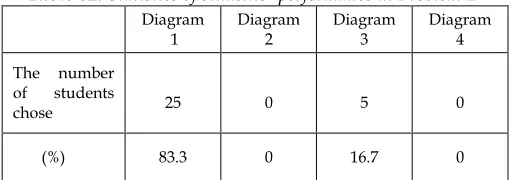
For Problem 2: The Table 02 showed that, Up to 25/30 students chose Diagram 1, this showed that they were
Figure 05. Illustration of changing symbols into language (verbal) (Source: Math 5, page 20)
Figure 04. The picture of converting verbal into images (Source: Math 5, page 145)
Visual representation
Symbolic representation
Verbal representation
1880
confused with the problem of find two numbers when knowing the sum and ratio. Only 5/30 students chose Diagram 3. No students chose Diagrams 2 and 4. Thus, students knew straight line segment diagrams need to lead to solving strategies and also identify broken lines or solid lines in diagrams a straight line has an effect on the quantity.
Table 02. Statistics of students' performance in Problem 2
Diagram
1 Diagram 2 Diagram 3 Diagram 4
The number of students
chose 25 0 5 0
(%) 83.3 0 16.7 0
For Problem 3: In summary in the Table 03, most students summarized with words, 5 students drew a line straight line segment diagram but it was not right. Although not drawing the diagram in the summary, but still 8/30 students gave the correct answers. However, their argument is not convincing, numerical representation is not appropriate in the division of 40%: 200%, students did not convert the percentage into decimal but omit the % symbol in percentage to find the percentage of 40 and 200. There are 15 students who solved the problem because they could not see it and find the ratio of 40%: 200%, they only performed the addition of 10% + 30% to produce the result. Performance results of students are listed in the following Table 03.
Table 03. Statistics of students' performance in Problem 3
Correct solution Incorrect solution or
incomplete No solution
Total
Summarizing by Visual 1 4 0 5
Summarizing by Verbal 5 10 3 18
Not summarizing 3 1 3 7
Total 9 15 6 30
A few comments from the survey
Although students often summarized the problem by straight line segment diagram but still encountered difficulties in solving mathematical word problems. Students had few tools to convert problems, mostly just straight line segment diagrams, did not use other visual images; It led to failure to understand mathematical concepts by visualization, also limit their ability to visualize math problems. When converting verbal and visual representations, students focused on expressing what is given on the diagram, but did not pay attention to the relationship between quantities and use diagrams to guide the solution. When meeting an unfamiliar problem, students will try to find a familiar form to transfer. In addition, summarizing the word problem has not been effective; there must be a combination of visual representation or symbol.
6
C
ONCLUSIONResults from the survey show that, in solving mathematical word problems, students also face many difficulties and mistakes in the activities of switching between mathematical representations, especially visual representation and symbolic representation. Meanwhile, Mathematics 5 textbook of Vietnam lacks images as well as diagrams and tables in concept learning and problem solving activities. With the benefits of transforming activities represented in word mathematical problems, there should have more studies on multi-representation in solving mathematical word problems in particular and elementary mathematics in general in order to enhance the mathematical competences of students in schools.
R
EFERENCES[1] Anwar, R. B., & Rahmawati, D. (2017). Symbolic and verbal representation process of student in solving Mathematics problem based Polya’s stages. International Education Studies, 10 (10), 20-28. [2] Bộ Giáo dục và Đào tạo. (2018). Chương trình giáo
dục phổ thông môn Toán. Hà Nội.
[3] Đỗ Đình Hoan (Chủ biên), Nguyễn Áng, Đặng Tự
Ân, Vũ Quốc Chung, và Vũ Dương Thụy. (2014). Toán 5, Nhà xuất bản Giáo dục Việt Nam. Hà Nội. [4] Kolovou, A. (2011). Mathematical problem solving in
primary school. Doctor thesis. Utrecht University. Netherlands.
[5] National Council of Teachers of Mathematics. (2014). Principles to Actions: Ensuring Mathematical success for all. Reston. VA: NCTM.
[6] Nurrahmawati, Sa’dijah, C., Sudirman, Muksar M., As’ari A. R., & Nusantara, T. (2018). Pre-service mathematics teachers’ preferences in using multiple representation of word problem solving. International Journal of Insight for Mathematics Teaching, 01(2), October 2018, 141-150.
[7] Sajadi, M., Amiripour, P., & Maikhalifeh, M. R. (2013). The examining mathematical word problems solving ability under efficient representation aspect. Mathematics Education Trends and Research, 2013(2013), 1-11.