ISOMIA - A WORLDWIDE PROBLEM I A CHAGIG WORLD
Kiran B Kotade*
1,
Sarika S. Sonawane
1, Vinayak M Gaware
2, Ramdas T Dolas
3,
Kiran B Dhamak
2, Sachin B Somwanshi
3, Vikrant K Nikam
3, Atul N Khadse
21.
Department of Pharmacology, College of Pharmacy Chincholi, Sinnar, Nashik,
M.S, 422101
2.
Department of Pharmaceutical Chemistry, College of Pharmacy Chincholi,
Sinnar, Nashik, M.S, 422101.
3.
Department of Pharmaceutics, College of Pharmacy Chincholi, Sinnar, Nashik,
M.S, 422101.
Corresponding author*:
Kiran B Kotade
Lecturer, Department of Pharmacology,
College of Pharmacy, Chincholi, Sinnar, ashik, M.S (422101)
E-mail: [email protected]
Summary
Insomnia is a disorder characterized by inability to sleep or total lack of sleep, prevalence of which ranges from 10 to15% among the general population with increased rates seen among older ages, female gender, white population and presence of medical or psychiatric illness. This sleep disorder that frequently occurs in its acute form and occurs at a rate of approximately 10 per cent in its chronic form in many countries. Yet this condition is still under-recognized, under diagnosed and under treated. The aetiology and pathophysiology of insomnia is such that several factors may predispose individuals for or precipitate and/or perpetuate the condition. There are several strategies to manage insomnia. To initiate treatment, it is necessary to define it and differentiate it from other co-morbid psychiatric disorders. Non-pharmacological strategies such as stimulus control therapy, relaxation, cognitive therapy, cognitive behavior therapy and reconditioning therapies have best effect sizes followed by sleep restriction, sleep hygiene education which have modest to less than modest effect sizes. Among pharmacotherapeutic agents, non-benzodiazepine hypnotics are the first line of management followed by benzodiazepines, amitryptiline and antihistaminic. However, adequate trials of combined behavior therapy and pharmacotherapy as the best course of management. Additional research is also needed to examine the efficacy of alternative–complementary therapies, such as bright light therapy, exercise and massage.
Introduction
The word” insomnia” originates from the Latin “in” (no) and “somnus” (sleep). It is a disorder characterized by inability to sleep or a total lack of sleep. Being the first psychosomatic disorder to be described by Johann Heinroth in 1818, insomnia clinically presents as a subjective perception of dissatisfaction with the amount and/or quality of sleep1. Insomnia is said to be present when an individual
complains of inability to fall or stay a sleep, of reduction in the total sleep period, of sleep disturbed by nightmares or of sleep that does not refresh2. It may last for days, weeks, months, or years and can take a
large toll. Individuals with insomnia report symptoms that include fatigue, decreased alertness, irritability, depressed mood, impaired memory and poor concentration, as well as problems with their health, work and social life. Loss of sleep can affect safety in the workplace, at home and on the road, putting society in danger3. Transient ( no more than three nights ) and short term ( acute ) insomnia (less than about 3
weeks ) may occur in the absence of disease and is then due to stresses caused by reactions to life changes such as environmental factors , grief , job requirements, travelling through time zones etc . Other than this, acute insomnia may be due to physical discomfort such as pain, dyspnoea, fever, nocturnal myoclonus or psychiatric causes such as anxiety. It may occasionally be induced by drugs, ex. CNS stimulants (ephedrine, amphetamine, methylphenidate, caffeine, nicotine), Anorexiants, Nasal decongestants, Buproprion, MAO inhibitors, SSRI, Levodopa, amantadine, Chloroquine, Metronidazole, Fluoroquinolones, Diuretic, Systemic glucocorticoid. Insomnia is a sleep disorder that may occur acutely and dissipate or may become a vexing chronic disorder which lasts for more than 3 weeks. Although difficulty in initiating and/or maintaining sleep is a fairly straight forward complaint, a thorough assessment of the presenting insomnia is well worth the upfront effort before formulating and delivering a specific intervention strategy. The pathophysiology of insomnia can actually be somewhat complex (or at least multi-factorial) because of the many inputs to the sleep-wake system in general and the additional specific behaviours and cognitions which an individual layers on top of the physiologic substrates. Chronic insomnia has a surprising number of individual and societal consequences, which far exceed being a nuisance. In fact, there is considerable morbidity associated with chronic insomnia and even a degree of mortality. Fortunately, there are a number of safe and effective treatments for insomnia4.
PREVALECE
5, 6• About 30 percent of adults have symptoms of insomnia.
• About 10 percent of adults have insomnia that is severe enough to cause daytime consequences • Less than 10 percent of adults are likely to have chronic insomnia.
TYPES
7Adjustment insomnia This is also called acute insomnia or short-term insomnia. It is usually caused by a source of stress and tends to last for only a few days or weeks. Epidemiologic studies indicate that the one-year prevalence of adjustment insomnia among adults is likely to be in the range of 15-20%. Adjustment insomnia can occur at any age, although establishing a relationship between a particular stress and sleep disturbance may be difficult in infants. Adjustment insomnia is more common in women than men and in older adults than younger adults and children.
Behavioral insomnia of childhood
enforced bedtime limits. Approximately 10-30% of children are affected by this condition
Idiopathic insomnia An insomnia that begins in childhood and is lifelong, it cannot be explained by other causes. Information suggests that this condition is present in approximately .7% of adolescents and 1.0% of very young adults
Inadequate sleep hygiene This form of insomnia is caused by bad sleep habits that keep you awake or bring disorder to your sleep schedule. This condition is present in 1-2% of adolescents and young adults. This condition affected 5-10% of sleep-clinic populations.
Insomnia due to drug or substance,medical condition,or mental disorder
Symptoms of insomnia often result from one of these causes. Insomnia is associated more often with a psychiatric disorder, such as depression, than with any other medical condition. Surveys suggest approximately 3% of the population has insomnia symptoms that are caused by a medical or psychiatric condition. Among adolescents and young adults, the prevalence of this form of insomnia is slightly lower. 2% of the general population is affected by this type of insomnia. Approximately 3.5% of all sleep-center patients are affected by this condition.
Paradoxical insomnia A complaint of severe insomnia occurs even though there is no objective
evidence of a sleep disturbance. The prevalence in the general population is not known. Among clinical populations, this condition is typically found in less than 5% of patients with insomnia. It is thought to be most common in young and middle-aged adults.
Psychophysiological insomnia
A complaint of insomnia occurs along with an excessive amount of anxiety and worry regarding sleep and sleeplessness. This condition is found in 1-2% of the general population and 12-15% of all patients seen at sleep centers. It is more frequent in women than in men. It rarely occurs in young children but is more common in adolescents and all adult age groups,
Table 1: Types of Insomnia
RISK GROUPS
8A high rate of insomnia is seen in middle-aged and older adults. Although your individual sleep need does not change as you age, physical problems can make it more difficult to sleep well.
• Women are more likely than men to develop insomnia.
• People, who have a medical or psychiatric illness, including depression, are at risk for insomnia.
•
People who use medications may experience insomnia as a side-effect.SYMPTOMS
9Fatigue Moodiness Anxiety about sleep Lack of
concentration
Irritability or anger Daytime sleepiness Poor Memory
Poor quality performance at school or work
Lack of motivation or energy Headaches or tension
Upset stomach Mistakes/accidents at work or
while driving
CAUSES
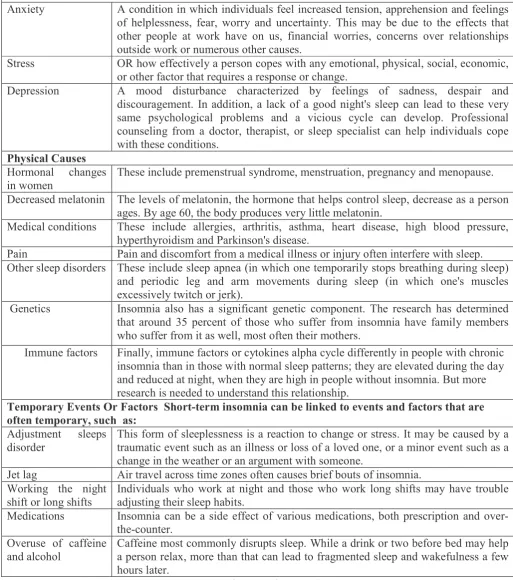
10 Psychological CausesAnxiety A condition in which individuals feel increased tension, apprehension and feelings of helplessness, fear, worry and uncertainty. This may be due to the effects that other people at work have on us, financial worries, concerns over relationships outside work or numerous other causes.
Stress OR how effectively a person copes with any emotional, physical, social, economic, or other factor that requires a response or change.
Depression A mood disturbance characterized by feelings of sadness, despair and discouragement. In addition, a lack of a good night's sleep can lead to these very same psychological problems and a vicious cycle can develop. Professional counseling from a doctor, therapist, or sleep specialist can help individuals cope with these conditions.
Physical Causes Hormonal changes in women
These include premenstrual syndrome, menstruation, pregnancy and menopause.
Decreased melatonin The levels of melatonin, the hormone that helps control sleep, decrease as a person ages. By age 60, the body produces very little melatonin.
Medical conditions These include allergies, arthritis, asthma, heart disease, high blood pressure, hyperthyroidism and Parkinson's disease.
Pain Pain and discomfort from a medical illness or injury often interfere with sleep. Other sleep disorders These include sleep apnea (in which one temporarily stops breathing during sleep)
and periodic leg and arm movements during sleep (in which one's muscles excessively twitch or jerk).
Genetics Insomnia also has a significant genetic component. The research has determined that around 35 percent of those who suffer from insomnia have family members who suffer from it as well, most often their mothers.
Immune factors Finally, immune factors or cytokines alpha cycle differently in people with chronic insomnia than in those with normal sleep patterns; they are elevated during the day and reduced at night, when they are high in people without insomnia. But more research is needed to understand this relationship.
Temporary Events Or Factors Short-term insomnia can be linked to events and factors that are often temporary, such as:
Adjustment sleeps disorder
This form of sleeplessness is a reaction to change or stress. It may be caused by a traumatic event such as an illness or loss of a loved one, or a minor event such as a change in the weather or an argument with someone.
Jet lag Air travel across time zones often causes brief bouts of insomnia. Working the night
shift or long shifts
Individuals who work at night and those who work long shifts may have trouble adjusting their sleep habits.
Medications Insomnia can be a side effect of various medications, both prescription and over-the-counter.
Overuse of caffeine and alcohol
Caffeine most commonly disrupts sleep. While a drink or two before bed may help a person relax, more than that can lead to fragmented sleep and wakefulness a few hours later.
PHARMACOLOGICAL TREATMETS
11, 12, 13Benzodiazepines The most commonly used class of hypnotics prescribed for insomnia are the benzodiazepines. Benzodiazepines all bind unselectively to the GABAA receptor.
But certain benzodiazepines (hypnotic benzodiazepines) have significantly higher activity at the α1 subunit of the GABAA receptor compared to other
benzodiazepines (for example, triazolam and temazepam have significantly higher activity at the α1 subunit compared to alprazolam and diazepam, making them
superior sedative-hypnotics - alprazolam and diazepam in turn have higher activity at the α2 subunit compared to triazolam and temazepam, making them superior
anxiolytic agents). Modulation of the α1 subunit is associated with sedation,
motor-impairment, respiratory depression, amnesia, ataxia and reinforcing behavior (drug-seeking behavior). Modulation of the α2 subunit is associated with anxiolytic
activity and disinhibition. For this reason, certain benzodiazepines are better suited to treat insomnia than others. Hypnotic benzodiazepines include drugs such as temazepam, flunitrazepam, triazolam, flurazepam, midazolam, nitrazepam and quazepam.
Non-benzodiazepines
Nonbenzodiazepine sedative-hypnotic drugs, such as zolpidem, zaleplon, zopiclone and eszopiclone, are a newer classification of hypnotic medications indicated for
mild to moderate insomnia. They work on the benzodiazepine site on the GABAA
receptor complex similarly to the benzodiazepine class of drugs. Some but not all of the nonbenzodiazepines are selective for the α1 subunit on GABAA receptors, which
is responsible for inducing sleep and may therefore have a cleaner side-effect profile than the older benzodiazepines.
Alcohol Alcohol is often used as a form of self-treatment of insomnia to induce sleep. However, alcohol use to induce sleep can be a cause of insomnia. Long-term use of alcohol is associated with a decrease in NREM stage 3 and 4 sleep as well as suppression of REM sleep and REM sleep fragmentation.
Opioids Opioid medications such as hydrocodone, oxycodone and morphine are used for insomnia that is associated with pain due to their analgesic properties and hypnotic effects. Opioids can fragment sleep and decrease REM and stage 2 sleep. By producing analgesia and sedation, opioids may be appropriate in carefully selected patients with pain-associated insomnia.
Melatonin and melatonin agonists
The hormone melatonin, sold as a "dietary supplement" in some countries, is effective in several types of insomnia. Melatonin has demonstrated effectiveness equivalent to the prescription sleeping tablet zopiclone in inducing sleep and regulating the sleep/waking cycle. One particular benefit of melatonin is that it can treat insomnia without altering the sleep pattern, which is altered by many prescription sleeping tablets. Another benefit is it does not impair performance related skills. Melatonin agonists, including ramelteon (Rozerem) and tasimelteon, seem to lack the potential for misuse and dependence. Natural substances such as 5-HTP and L-Tryptophan have been said to fortify the serotonin-melatonin pathway.
Antihistamines The antihistamine diphenhydramine is widely used in nonprescription sleep aids such as Benadryl. The antihistamine doxylamine is used in nonprescription sleep aids. It is the most effective over-the-counter sedative currently available and is more sedating than some prescription hypnotics. Cyproheptadine is a useful alternative to benzodiazepine hypnotics in the treatment of insomnia. Cyproheptadine may be superior to benzodiazepines in the treatment of insomnia because cyproheptadine enhances sleep quality and quantity, whereas benzodiazepines tend to decrease sleep quality.
Atypical antipsychotics
Low doses of certain atypical antipsychotics such as quetiapine, olanzapine and risperidone are also prescribed for their sedative effect, but the danger of neurological, metabolic and cognitive side-effects makes these drugs a poor choice to treat insomnia. Eplivanserin is an investigational drug with a mechanism similar to antipsychotics.
Other substances Some insomniacs use herbs such as valerian, chamomile, lavender, hops and passion-flower. A healthy diet containing magnesium can help to improve sleep in individuals without an adequate intake of magnesium. L-Arginine L-aspartate, S-adenosyl-L-homocysteine and Delta sleep-inducing peptide (DSIP) may be also helpful in alleviating insomnia. There is some evidence showing that 3 grams of L-Glycine before bedtime improves sleep quality.Almorexant is an orexin antagonist currently in clinical trials.
Table 4: Pharmacological Treatments of Insomnia
OPHARMACOLOGICAL TREATMET
14, 15, 16, 17The treatment of insomnia with CBT-I
Stimulus control therapy
Stimulus control therapy is considered to be the first line behavioural treatment for chronic primary insomnia and therefore should be prioritized accordingly. Stimulus control instructions limit the amount of time patients spend awake in bed or the bedroom and are designed to decondition pre-sleep arousal. Typical instructions include: (i) keep a fixed wake time 7 days/wk, irrespective of how much sleep you get during the night; (ii) avoid any behavior in the bed or bedroom other than sleep or sexual activity; (iii) sleep only in the bedroom; (iv) leave the bedroom when awake for approximately 10 to 15 min; and (v) return to bed only when sleepy. The combination of these instructions re-establishes the bed and bedroom as strong cues for sleep and entrains the circadian sleep-wake cycle to the desired phase.
Sleep restriction Sleep restriction therapy (SRT) requires patients to limit the amount of time they spend in bed to an amount equal to their average total sleep time and proceeds as outlined in. Sleep restriction is contraindicated in patients with histories of bipolar disorder, seizures, or untreated hypersomnolence as it may aggravate these conditions.
Sleep hygiene This requires that the clinician and patient review a set of instructions which are geared toward helping the patient maintain good sleep habits such as keeping an environment and routine conducive to sleep, maintaining a regular bed and wake time and avoiding tobacco, alcohol, large meals and vigorous exercise for several hours prior to bed. It should be noted that sleep hygiene instructions are not helpful when provided as a monotherapy. Simply providing patients with a “handout” is likely to lead to noncompliance, a loss of confidence in the provider and a sense that there may be nothing other than these ‘sleep tips’ to help with insomnia.
Cognitive therapy Several forms of cognitive therapy for insomnia have been developed and often overlap. Some have a more didactic focus , others use paradoxical intention, cognitive restructuring and focus on safety behaviours and attentional biases . While the approaches differ in procedure, all are based on the observation that
patients with insomnia have negative thoughts and beliefsabout their condition and its consequences. Helping patients to challenge the veracity and usefulness of these beliefs is the basis of cognitive therapy and is thought to decrease the anxiety and arousal associated with insomnia.
Relaxation training A variety of relaxation techniques are available and any of these may be used as part of the CBT-I package. These include progressive muscle relaxation,
diaphragmatic breathing, biofeedback, and more formal meditative
Phototherapy Bright light has antidepressant and sleep-promoting effects and may be useful for patients who have pronounced shifts in their circadian rhythms. If the patient's insomnia has a phase delay component (i.e., the patient prefers to go to bed late and wake up late), waking early by alarm and exposure to morning bright light is indicated. If the patient’s insomnia has a phase advance component (i.e., the patient prefers to go to bed early and wakes up early), exposure to evening bright light is indicated. There are unwanted side effects of phototherapy including insomnia, hypomania, agitation, visual blurring, eye strain and headaches. Patients with or at risk for eye- related problems, such as patients with diabetes, should consult an eye care specialist prior to initiating light therapy. Bright light can also trigger mania in patients not previously diagnosed with bipolar mood disorder and is contraindicated in anyone known to have a bipolar disorder.
Reconditioning Another treatment that may help some people with insomnia is to recondition them to associate the bed and bedtime with sleep. For most people, this means not using their beds for any activities other than sleep and sex. As part of the reconditioning process, the person is usually advised to go to bed only when sleepy. If unable to fall asleep, the person is told to get up, stay up until sleepy and then return to bed. Throughout this process, the person should avoid naps and wake up and go to bed at the same time each day. Eventually the person’s body will be conditioned to associate the bed and bedtime with sleep.
Take a Warm Bath It's a great way to relax your body. Don't overdo it, however. You merely want
to relax your body, not exhaust it. Too long in hot water and your body is drained of vitality. Use bath salts, or throw in Epsom salts and baking soda—one cup of each. These will relax you and also help remove toxins from your body. Get a Massage Have your spouse (or whoever) give you a massage just before going to sleep. If
you can convince them to give you a full body massage, great. If not, even a short backrub and/or a face and scalp massage can be a big help. Have them make the massage strokes slow, gentle, yet firm, to work the tension out of your muscles and soothe you to sleep.
Listen to Music or Other Audio
Play some soft, soothing music that will lull you to sleep. There are many CDs designed for that very purpose. Some are specially composed music; others simply have sounds of waves rhythmically breaking, or the steady pattern of a heartbeat. Some will lead you to sleep with a combination of music, voice and other soothing sounds. We found one particular system that generates endless combinations of sounds tailored to your specifications.
Drink Warm Milk A glass of warm milk 15 minutes before going to bed will soothe your nervous
system. Milk contains calcium, which works directly on jagged nerves to make them (and you) relax.
Drink Herb Tea If you don't like milk—or are avoiding dairy products—try a cup of hot camomile, catnip and anise or fennel tea. All contain natural ingredients which will help you sleep. Most health food stores will also have special blends of herb tea designed to soothe you and help you get to sleep.
Table 5: on Pharmacological Treatments of Insomnia
BASIC TIPS FOR PEOPLE WHO SUFFER FROM ISOMIA
18• Go to bed when you feel sleepy to facilitate falling asleep quickly
• Awaken at the same time each morning
• If you can’t fall sleep, or awaken during the night and can’t fall back asleep, don’t lie in bed twisting and turning; get out of bed, go to another room and keep the light dim, engage in a relaxing activity. Return to bed when you are sleepy.
• Wednesday, March 30 is designated as insomnia awareness day.
Conclusion
Ultimately, the benefits of treating insomnia far outweigh the risks. The goal, however, is not just to diagnose or treat insomnia, but to improve sleep over the long term. Improving sleep improves health, work productivity and reduces health care costs. If implemented, the Plan of Action outlined in the executive summary would be a big step in improving sleep. Sleep is something we cannot afford to ignore.
References
1. Mellinger GD, Balter MB, Uhlenhuth EH. Insomnia and its treatments,Prevalence and correlates, Arch Gen Psychiatry 1985; 42:225-32.
2. Chiara Baglioni, Kai Spiegelhalder, Caterina Lombardo , Dieter Riemann. Sleep and emotions: A
focus on insomnia. Sleep Medicine Reviews 14, 2010, 227–238.
3. Ohayon MM. Epidemiology of insomnia: what we know and what we still need to learn. Sleep Med
Rev 2002; 6:97-111.
4. Young TB. Natural history of chronic insomnia. J Clin Sleep Med 2005; 1: 466-7.
5. Mendelson WB. Long-term follow-up of chronic insomnia. Sleep 1995; 18: 698-701.
6. Roth T, The relationship between psychiatric diseases and insomnia. Int J Clin Practical Suppl. 2001(116): 3-8.
7. Drake C.L, Roechrs T, Roth T. Insomnia causes, consequences and therapeutics:an overview.
Depres Anxiety 2003; 18(4): 163-76
8. Ohayon MM, Caulet M, Lemoine P. Comorbidity of mental and insomnia disorders in the general
population. Comp Psychiatry 1998; 39: 185-97.
9. Malhowald, M.W., Kader, G. and Schenck, C.H.. Clinical categories of sleep disorders I. Continuum
1997; 3(4), 35-65.
10. Vgontzas AN, Chrousos GP. Sleep, the hypothalamic- pituitary-adrenal axis and cytokines: multiple
interactions and disturbances in sleep disorders. Endocrinol Metab Clin North Am. 2002; 31:15-36.
11. Kirkwood CK. "Management of insomnia". J Am Pharm Assoc 1999; 39 (5): 688–96;
12. Tsoi, Wf. "Insomnia: drug treatment.". Annals of the Academy of Medicine, Singapore1991; 20 (2): 269–72.
13. Dieter Riemann, Michael L. Perlis. The treatments of chronic insomnia: A review of benzodiazepine
receptor agonists and psychological and behavioral therapies. Sleep Medicine Reviews 13 (2009) 205–214. 14. Kierlin L. "Sleeping without a pill: nonpharmacologic treatments for insomnia". J Psychiatr Prac
2008; 14 (6): 403–7.
15. Nofzinger EA, Buysse DJ, Germain A, Price JC, Miewald JM, Kupfer DJ. Functional neuroimaging
evidence for hyperarousal in insomnia. Am J Psychiatry 2004; 161: 2126-9.
16. Charles M. Morin, Ronique Mimeault and Anouk Gagne. Nonpharmacological treatment of late-life
insomnia. Journal of psychosomatic research, vol. 46, no. 2, pp. 103–116, 1999.
17. Jack D. EdingerT, Melanie K. Means. Cognitive–behavioral therapy for primary insomnia. Clinical
Psychology Review 25 (2005) 539–558.