Systematic Review On Massive Open Online
Courses Based On Primary/Meta-Analysis
Ahmed Ibrahim Safana, Muesser C. Nat
Abstract: The research conducted a systematic review on peer reviewed literature of Massive Open Online courses that encapsulated the finding of more than 40 articles, by employing the procedure of meta-analysis and primary-analysis in the bid of addressing the research question, is MOOCs a way out to African Institutions? An open code context method was applied to validate the articles for the sake of comparisons. The validation result shows a certain level of overlapping based on the Open Code Context procedure on the reviewed literature researched, which led to meta-analysis that minimized the overlap. The primary data collected have been analyzed using the primary-analysis procedure. Even though, the size of the random effect means was as minimum as 0.23, hence, a significant difference from zero statistically. A heterogeneous distribution of fixed effect model was applied to the primary- analysis and the mean effect size was 0.21 and 0.22 using the random effect model. The result, the gaps, the implication and the prospect future of the research was particularized and discussed.
Index Terms: MOOCs, cMOOCs, xMOOCs, Massively Open Online Courses, Massive Open Online Courses, MOOCs in Africa, Higher Education, MOOCs in Higher Education, Meta – Analysis, Systematic Review
————————————————————
1
I
NTRODUCTIONThe yearning for the open access to higher educatıon becomes inevitable, which was exclusive to Africa, prior to the spread of online teaching [1], yet difficult to enroll due to the inadequate access to the required equipment. The emergence of Massive Online Courses (MOOCs) put a smile to the faces of African educators for the fact that, MOOCs is designed to be suitable to African, despite the limited resources at their disposal. The speed at which the institution of higher learning in the developed countries embrace MOOCs, indicate that the institutions recognizes its potentiality of delivering qualitative education around the world [1]. In May 2013, Coursera introduced courses for K-12 teachers, team up with text book publisher to provide participants with digital course material for the courses offered and around the same time Udacity partner with AT&T to offer Master‘s Degree online. In June 2013, edX makes available its learning code as open source, WorldWideEd express her intention of being on the open education platform, edX join up with Indian Institute of Technology (IIT) Bombay and partner with International Monetary Fund (IMF) in training participants using the MOOCs‘ platform. In July 2013, Coursesra broadcast the raising of funds worth millions of Dollars from a financial corporation, which led to teaming up with seven (7) institution of technology from India to offer MOOCs, and in August, 2013 Coursera announced the partnering with over 3 universities, and at that point, the President of the United State declare the interest on MOOCs (Allison L et al., 2016). In September 2013, the University of California, Irvine (UCIrivin) shows the intention of offering a MOOC through a zombies screen popularly known as ―Walking Dead‖, and at the same time Udacity announced a partnership with many companies [2]. By October 2013, ministry of Higher Education of France announce the adoption of edX and the Brazilian company Veduca launches its Open Online MBA [1],[3].
Moreover, Coursera and edX extended their partnership to China‘s company and universities and also iversity (European online education platform) was launched by German Online Education. In November 2013, Coursera in conjunction with Willerer and John Ciancutti developed movie recommendation system for Netflix, and at the same time a Jordan University annouced the lunch of an Arabic language portal named Edraak and edX and Udacity launched ―Data Science and Big Data Track‖. By December 2013, MOOCs expanded in terms of partnering as well as the number of participants‘ enrollment and that is how the trend went on and on [3]. Tharindu [6] expressed the initiatives of MOOCs as beneficial to institutions of higher education, because, the access to higher education becomes easy for many learners. MOOCs are regarded as the means of educational democratization and makes universities to have prestige [4]. According to Pedro [6], MOOCs avoid re-inventing the wheel in educational environment and they are potential tool in Open Educational Resources (OER), and also provide universities with the opportunity of marketing themselves to eligible students. University professors express their pleasure of teaching larger classes online via the MOOCs pedagogy which increases their visibility amongst their peers, [5] as well as the general public. Students who have the ability of learning online (MOOCs) are having the potentiality of becoming independent learners and good time mangers [6]. More so, some additional skills which can transform the student to have the opportunity of taking instruction and provide a result with little or no hand-holding [7]. Enrolling into MOOCs provides the student with a greater discipline of peer learning, scheduling the appropriate time to learn and undertakes assignment on or before the due date [8]. The constant navigation of tools and various online programs by the participants provides a technological-know-how or set of new-skills capable of operating any computer or mobile devices [9]. The skills gained through the process of learning MOOC alone, are capable of providing the online business oriented companies with a valuable resource persons [10]. According to Lawton (2013) MOOCs are great advancement of higher education considering the hope expressed by the elite educational institution, and is regarded as a new ―Gold Rush‖ in education, for it provide the educational opportunity of massive learning with no tuition required [11]. The pedagogy of MOOCs, provides learners with a positive impact considering the self-driving-mastery of the course, hence, ____________________
Ahmed Ibrahim Safana is currently pursuing PhD degree program in Management Information System in Cyprus International University, Cyprus. E-mail: [email protected]
213 freedom of studying variety of wider choice [12]. The traditional
method of teaching required the students to attend the classes in the university at a particle time for the academic activities, contrary to MOOCs that is at the student‘s opinion [13]. According to Kim (2013), most of the challenges faced by MOOCs are related to credibility, student‘s completion and the business model, among the problems of MOOCs which is its nature of impersonal in teaching and learning processes [14]. Learners find it difficult to handle their studies when the feedback is missing [14]. A report from an online survey by
Babson (2014, p53) cited a professor saying; ―There is no business model for MOOCs that makes sense, Elaine Allen,‖ and also Oyo (2014, p4) was cited saying; ―Currently there‘s no way to earn a degree by taking MOOCs‖ he further explain the reason for his statement saying many MOOCs providers are not in any way ready to award credit for the enrolled MOOC courses. Kelly (2014) discussed from the perspective of the instructors saying, MOOCs consume more time compared to face-to-face teaching and expressed his ordeal over the developing, teaching and the uploading the course materials without any incentive. MOOCs are categorically classified into two (Tharindu, Andrew, & Shirley, 2013): xMOOCs and cMOOCs. According to Rodriguez (2012) xMOOCs are based on the concept of behaviorist which is more of artificial intelligence, and it uses automatic testing in evaluating the students understanding. cMOOCs use the idea of Connectives in which the learning is carried out online through the web and provide the users with the opportunity of contributing their ideas. According to Daniel (2012), cMOOCs and xMOOCs are the divergence of MOOCs without further clarification. Siemen (2012), consider cMOOCs as a model that encourages learning through social network and evaluate them as autonomous that provide means of creativity. The author explain xMOOCs as model closer to the traditional mode of teaching that provides videos, presentations and quizzes. In a short form, cMOOCs is more on generation and creation of knowledge, while xMOOCs is just like duplication of knowledge (Siemens, 2013). Considering the challenges faced by African institution of crowded lectures theaters, lack of electricity, outdate curriculum, limited number of computer for students, pirated software and lack of technical knowhow, MOOCs have the potentiality of excelling in Africa with all the mentioned problem by applying the maturity of mobile technology such as cellphones [15].
2
MOOC
s
in Africa
According to Amenyedzi (2011), poverty play a significant role in preventing many African students access to higher education, MOOCs with the aims of mass enrollment with no tuition required, which makes it more appealing to Africa than any other continent [23]. The case for MOOCs in Africa depends on the readiness, the readiness did not lies only on the participants, but the infrastructure as well. Considering the demography of MOOCs participants presented by many research articles, very little number of students participates from Africa [16]. Some of the major issues concerning the poor participation of African MOOCs include;
Awareness: According to Benedict and Billy [37] the African elite, stakeholders and politician did not even have the idea of MOOCs, its believed that if African student would understand and have the idea of MOOCs, the number of participant will increase within a short time [17].
Access to computers: Jordan (2014) says many of the African students have no access to a computer sets which is the main problem before the knowledge of how to operate the system. According to Brabham (2013), computer training that include the teaching of programming, computer operation, databases, desktop publishing and many more, are conducted using white/black board in many higher institutions of learning in Nigerian and many African countries. Which is related to problem of either the students outnumber the available computers or the number of computers that are properly working cannot handle the training.
Language barrier: participants from African countries find it very difficult to understand the medium of communication used, not the language precisely, but the dialect or the grammar [18]. With the zeal of learning from the MOOCs, after a number of trail the participant used to give up [19].
Course Content: Course Content: some of the courses or the content offered by MOOCs providers do not reflect the need of African student for some reasons such as, the contents richness, unsuitability to the African needs or environment and many more [20].
Image Resolution: the images or videos posted on MOOCs used to have very high resolution, which makes it difficult for a system with a low processing power to upload easily, and some documents need a special software to open, some MOOCs documents cannot be access via smartphone and many issues of that kind [21].
Poor Bandwidth: Even though, there are many internet service providers (ISPs) in Africa ranging from private, community, commercial to mobile networks that provide domain name and internet access through share or dedicated bandwidth. But very little meet the required upload/download megabits per second (mbps) agreed during the contract. Which is usually a scam between the agents and the service providers in Africa that cripple the internet usage [21], [22].
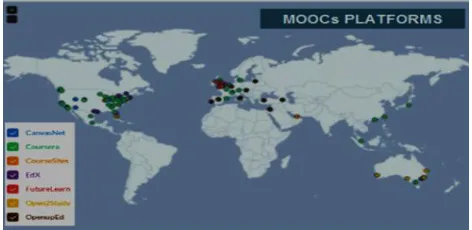
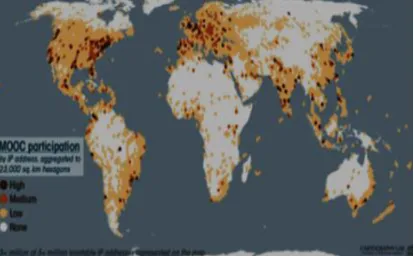
Electric Power Supply: acute power failure is one of the reason why many African cannot be able to participate in MOOCs, because it requires the use of an electronic gadget for enrollment. The problems discussed above enlighten the issues deflating MOOC presence in Africa [23]. The figure 1 and 2 illustrated the level of MOOCs in Africa in terms or enrollment and participation.
Figure 1. Major MOOCs Platform and MOOCs in Africa
Figure 2. Poor MOOCs participation in in Africa
The above figure illustrates the poor level of MOOCs participants from Africa compared to the other continents.
3 MOOCs Strategy in Africa (Nigeria)
Event though, there are a lot of improvements in some African countries, such as Nigeria, concerning the challenges that may hinder the implementation of MOOCs in higher education [24]. Some of the improvements include the increase in electric power supply, intervention from Tertiary Education Trust Fund (Tedfund) and other government and non-government organization. Tedfund provide Nigerian higher institution with the required number of computers and also, Nigerian Communication Commission (NCC) annually donates hundreds of laptop computers to higher education institutions. The provision of cheap internet bandwidth by major mobile networks operators in Nigeria has also contribute immensely. The mass access to smartphone by individuals and technical-know-how on how to surf the net (facebook, whatapps, online-new) and also widen among Nigerians [25]. Despite the recent findings that shows some improvement regarding the shortcomings in countries like Nigeria, there are a lot of problems that pose a threat to achieving a complete MOOCs in Africa [26]. The problems has to do with the Government policies governing the conduct of higher education in Africa institution, which include accreditation and the validity of the earn certificate [26]. The National University Commission (NUC) of Nigeria has no recognition on online certificates for many reasons which include scam and impersonation [26]. For African countries to benefit from the MOOCs and shying away from the piles of problems as the time, blended MOOCs are the ways out [27]. ―Blended learning will be the norm. It‘s not a matter of ‗if‘. We just have to decide ‗how‘.‖ (Laura, 2013, p). Blended learning is seen as the only alternative of implementing MOOCs in Nigeria [27]. For the blended method of learning to be implemented there are lot of activities to be performed by the institutions, tutors and the policy makers of the African higher educators. The table below itemized the activities and the responsible bodies [28].
TABLE1
STRATEGYFORIMPLEMENTINGMOOCSINAFRICA
Activities Responsible Bodies
MOOCs curriculum development Academic staff MOOCs accreditation Policy makers Conversion of the curriculum into digital
form Academic Staff
Offline/Online learning platform MOOCs providers
Central MOOCs access center (HUB) Education Ministry/ Higher Education unit
Creation of MOOCs coordination Centre Education Ministry/ Higher Education unit
With the above table, there is a need for the analysis of the cost implication in implementing the MOOCs, which will provide government the idea of choosing the best way of implementation or phasing by starting from the most required region. Even though, MOOCs provide Africa with golding opportunities, there are a number of challenges ranging from commitment of the instructors, lack of adequate funding, limited resources currently causing mayhem on the traditional face-to-face method, problems faced by policy maker in introducing new policy to government, and the issues of privatization [29].
4 Method
The approach used in conducting the research involved the steady meta-analysis of articles followed by open code context analysis or primary- analysis on the primary data generated. The guidelines found in enhancing the processes that satisfied the objectives of the research [30].
4.1 Inclusion and exclusion strategy:
Ellis and Haugan [33] discussed on a number of techniques adopted by researchers in identifying articles to be used for a literature review, which involved the inclusion and exclusion criteria that helps in (a) provide scope of the review so as to determine the possible population involved (b) to strategized and apply the most adequate design and (c) to control the bias involved in meta-analysis during the inclusion processes. For the primary data inclusion in this research, an article was included if it:
Addressed the initiatives, readiness, application, survey and enrollment of MOOCs in African institution and African countries ranging from the beginning of the MOOCs to date.
Focuses on the African institution enrolled into any of the MOOCs or are partnering with any of the popular or unpopular MOOCs providers.
Focuses on the percentages of students enrolled into MOOCs and the percentages of completion rate, reason for not completing, reasons for poor participation and the possible suggestions.
215
4.2 Search Strategies
The research set the following variables for the criteria of obtaining relevant articles for the purpose of review:
MOOCs
Massively Open Online Courses
Massive Open Online Courses
MOOCs in Africa
MOOC in higher education
Higher education in Africa
Online learning in Africa
The range of years for literature review serves as a constrain for the research, which is between the year 2012 when MOOC started to become popular to 2015, though the previous years (2008) can never be ignored but it is believed that some of the literature within the review period made references from the previous ones [33]. The following search tools were used;
1. Electronic databases such as; Science Direct, IEEExplor, EBSCOhost, Scientific research, ZINC, MEROPs, EcoCyc, Academic Journals and Scopus. 2. Search using Google scholar, Google and Bing. 3. Snowballing reference list major popular articles and
literature reviews
4. Web search on prominent Journal such as; Computer and education, Computer in Human Behavior, Social and Behavioral Science, Social Networks, Journal of Online Learning, and Distance Education.
The classification of the collected articles was carried out using the approach of Glaser (1956) (Constant Comparative Espoused) many Journal articles were also gathered from international journals. The research did not only consider the published articles found on the journals, it went ahead to search more information from blogs, white paper, reports from many websites similar to Tharindu et al (2013) study.
4.3 The Fusions of Meta-Analyses
Rana, Elaborates meta-analysis as a procedure of synthesizing the quantitative findings made from various literatures (Systematic literature) addressing nearly similar research question. The methodologies used can either be the same or may be absolutely different. Meanwhile, many authors discussed the synthesis of meta-analysis in various publications even though, in different disciplines. Such publications includes that of; Lipsey and Wilson (1993 & 2001) dealing with educational treatment and psychology.
4.4 Selecting Meta-Analysis and Review
Among the isolated articles from the validating processes reviewed by the researchers, 40 articles were selected to carry out the review. Among the document, 33 articles were chosen through full-text review with Cohen‘s k =. 81 and the interrater agreement was 87.2%. In order to ascertain the reliable coding for the full-text review, the document where distributed amongst the researchers in which two or more researchers review the same documents independently, with the agreement resulting to interrater of 91.5% and Cohen‘s k =.85. Where the agreement felt to reach consensus, the need for the third party reviewer was employed. Based on the discussion amongst the researchers, some four (4) articles were further disqualified on the argument of meeting the absolute inclusion principles stated earlier on.
4.5 Effect Size and Standard Errors
The aggregate between the means of the meta-analysis and the control measures are regarded as effect size. This give a way of converting the effect size to percentile between the analysis and control measures for easy representations and provide a means of cutting down the problems analysis between samples being large or small. The standard error is said to occur when the variability found in the sample differs significantly from the population of the used data.
5. RESULT
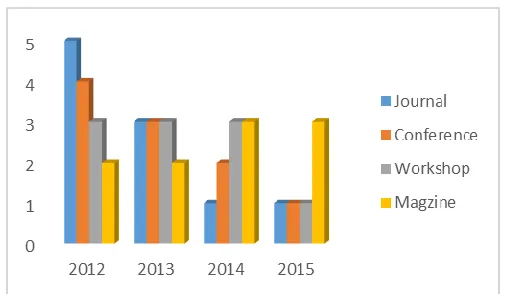
In the entire practice, 43 relevant articles have been studied. They provide the result of the achievement made from the comparisons of the MOOCs article classified under the same category. The employment of meta-analysis provides a synergy between various technological approached used by many authors in driving the literature from their sources. The figure below show the separation of articles (relevant) by type and the year of publications, it is noticeable that the publication about MOOCs heat the bar or reaches the peak by the years 2012 to 2013 and the number of publications as well as the discussions decline from 2014 to 2015 and may be in the 2016 which is likely to be the secrete behind the uncertainty about the phenomena [34].
Figure 3. Articles classification by type and year of publication
Even though, the selected articles discussed much about MOOCs such as how it was coined, a little history and trend about the concept, but the research discover that most of the discussion is directed towards one of the following themes;
XMOOCs
CMOOCs
Pedagogies
Business Model
Instructor/Learners (Participants) Experience
Technology
Dropout rate
TABLE2
DESCRIPTION OF THEMES’ BREAKDOWN Attributes Description
Abstract Summarizes the research Introduction A brief history of the MOOCs
Review Discussion about the MOOCs enrollments
Educational History
The issues usually about the relationship with MOOCs and OER
Technology Details on the pedagogy and the platforms of MOOCs providers
Dropout rate
Explanation about the number of participants that completed the course
Learners experience
Details about the possible benefit despite the lack of credibility
The provider Explain the experience of the tutors or the affiliated body
The table below shows some of the selected articles and the categories the fall into
TABLE3 SELECTED ARTICLES
Author/date Article Category
Afric as’ view Gerard
Escher et. al (2014)
Booting higher in Africa
through shear MOOCs Pedagogy Yes
Benedict O., Billy K., (2015)
MOOCs for African by
Africans Technology Yes
Liyanagunaw ardena et al., (2013)
The Rise of MOOCs Pedagogy Yes
Ahmed et al., (2014)
What drive successful
MOOCs Technology Yes
Elena et
al.,(2014) Language MOOCs Pedagogy No
Khe and Wing(2014)
Student and instructors use of MOOC: motive and challenges
Participants‘ experience No
Anoush M., Manuela B. & Allison L., (2015)
Instructional Quality of
MOOCs Pedagogy No
Catalina U. & Anca N., (2015)
MOOCs in our Universities:
Hope and Worries Technology No
Khaled M., Hang F., & Andrew P., (2015)
Understanding the MOOCs continuous: the role of Openness & repetition
Technology No
Mingming Z., (2016)
Chinese Universities‘ acceptance of MOOCs: A self-determination perspectives
Pedagogy No
Nina H., Allison L., &Colin M., (2015)
Context Counts: how learners influence learning in a MOOCs
Particpants experiance No
Duy V., Philippa P., & Garry R., (2015)
Relational event Models for
Social Learning in MOOCs. Technology No
Pedro J. et al., (2015)
Precise Effectiveness Strategy for analyzing the effectiveness of students with Educational Resources and Activities in MOOCs.
Dropout
rate No
Tayeb B., Learning outside the Pedagogy No
Akila S., (2015):
Classroom through MOOCs.
Layla Z., Sebastian R., & Jerry D., (2015)
Semantically Enriched Massive Open-Online Courses (MOOCs) Platform.
Technology No
Oscar L., (2015)
A Factorization Approach to Evaluate Open Response Assignment in MOOCs using Preference learning on Peer Assessment.
Pedagogy No
Allison L et al., (2016)
Learning in MOOCs: Motivation & Self-Regulated
Pedagogy No
Willi B et al., (2013)
The MOOCs Business Model
Business
Model No
Meltem H., (2015)
An Overview of the World
MOOCs. Pedagogy Yes
Mehmet K., Hakam A., (2015)
A Theoretical Analysis of MOOCs type from a Perspective of Learners
Particpants experiance No
Fatiha B., Henda C., (2015).
MOOC Rec: A case Based Recommender System for MOOC
Technology No
Ahmed M., et al., (2014)
What Drive a Successful MOOCs? An Empirical Examination of Criteria to Assure Design Quality of MOOC.
Technology No
Radu V., Diana A., (2014)
OER and MOOCs – The Romanian Experience.
xMOOC/cM
OOC No
Parag C., Asoke N., (2014)
MOOCs in Education: A Case Study in India Context and Vision to Ubiquitous Learning
Pedagogy No
Anant V., Pooja C., (2014)
Ramifications of MOOCs for Increasing User Engagement.
Droupout
rate No
Prashast et al., (2014)
MOOC: the Paradigm-Shift
in Indian Education. Technology No
Jun X., et al., (2014)
The Usability Research of Learning Resources Designing.
Technology No
Antonia B., et al., (2015)
Comparing MOOCs In M-Learning and e-M-Learning settings.
xMooc/cMo
oc No
Wenal S., (2014)
MOOCs, MOOE, and MOOR in China.
xMooc/cMo
oc No
Doraisamy G., Deepak G (2015)
Impact of Learning Motivation on MOOCs Performance: Transfer Vs. Made MOOCs.
Technology No
6 LIMITATION
Even though, a lot of unpublished reports and Blog post have been studied in this research to enhance the quality of the research by providing additional information about the topic, the research is limited the systematic review on Journals article, Conference papers, published reports and magazines because of the difficulties in ascertaining the credibility of the post, perhaps, MOOCS articles found in another language contrary to English Language are also ignored [33].
7 THE DISCUSSION
217 (example, the feeling that your input is needed, rode comment,
counter comment and discussions of irrelevant topics and so on.), view from the facilitator related to the learners and to the institution, the background and the cultural differences existed between the learners, which provide a wide gap in the literature of MOOCs. Most of the studies that uses data generated from MOOCs experience, limited their findings on social Medias such as Facebook, blogs, Tweeter and the traditional LMS discussions which is not considered as peer reviewed and led to the west of rich data capable of providing a reasonable information about many perspectives of MOOCs. More finding also indicates that not only LMS is holding rich data of MOOCs but other external communication Medias that support learning in distance learning, blended learning, traditional and online learning that can also lead to a research avenue. The ethical aspect of using data generated from MOOC‘s forums has also very little or no publications which is believed to be due to the limited awareness or guidance of how to extract and require the legal protection on how to use such data. Likewise the views of the facilitators and the learners concerning their data generated through the teaching and learning processes of MOOCs for research purposes, need to also be investigated and publicized. Another observation made from the study on the MOOCs literature, based on the demography of the participants indicates that most of the MOOCs participants were from Euro and America, very few from Asia and Africa if there is any. Even though, many did not consider this to be an issues due to the barricades existed between the contents that led to the issues of ―digital divide‖ as well as the technological readiness and language differences. Though many articles talk most about the rate of dropout in MOOCs, but there is not any available data that say much about the rate of completion and the comparison between the rates that completed the MOOCs and the regular students of the Universities. Catching-up with the current issues regarding the discussion on MOOCs is very difficult because of the massive number of the participant that generate large volume of data within a limited time, but sightseeing the strategies applied by the constant or active participants could provide a better way of dealing with information or data overload. Also most of the active participants in one MOOCs or the other are found to be part of the active participant in another. People that are usually found in a particular MOOCs community, are a part of the other MOOCs communities. MOOCs has many record of dropout/withdraw but there is no comprehensive record of the completion rate and from all indications, the knowledge of the MOOCs completion rate has little attention compared to the information concerning the dropout, and this is another research area. There is also the need to engage the participant that dropout the courses to find out their motives and determine the differences that exist between one courses to another. Another most important aspect of MOOCs is regarding the certificate recognition and even is the accreditation, because some organisation charge fee to provide a certificate at the end of the program, but can that certificated be accepted into labour market? Yet many collaborating institutions that provide MOOCs insisted on the no college credit because of the problems of how to undertake assessment of many student that are not physically viable. The area of accreditation and certificate recognition is an interesting research avenue that need to be explored.
8 CONCLUSION
Whenever the acronym ―MOOCs‖ is typed on a search engine, a lot of articles flips, but when analyzed carefully, it would be discovered that research focuses mainly on limited issues concerning MOOCs which are mostly the business model and the rate of dropout including some but few. Some important aspect of MOOCs such as the Ethical behavior of the participant, blended MOOCS, MOOCs in Africa and many interesting research areas are ignored. To this end, a lot has been discussed and discovered about MOOC concerning Africa which shows that MOOCs are facing big challenges in the developed countries that have been providing enrolled into the system. MOOC needed more than just ‗prove‘ because of the policies and the shortcomings therein Africa. The only way out to African countries as of this time, are blended MOOCs which also need many activities before they take shape, but the easier in achieving the objectives of this research.
R
EFERENCES[1] Oscar L., (2015) A Factorization Approach to Evaluate Open Response Assignment in MOOCs using Preference learning on Peer Assessment. Knowledge Based System P. 322 -328.
[2] Mingming Z., (2016) Chinese Universities‘ acceptance of MOOCs: A self-determination perspectives. Computer and Education P. 194 – 203
[3] Nina H., Allison L., &Colin M., (2015) Context Counts: how learners influence learning in a MOOCs. Computer and Education P. 83 - 91
[4] Milligan, C., Margaryan, A., & Littlejohn, A. (2013). Patterns of engagement in massive open online courses. Journal of Online Learning with Technology (Special Issue on MOOCs) – Under Review.
[5] Oyo, B., & Williams, D. (2014). Towards universal higher education in Uganda using MOOCs. Paper presented at the 9th International eLearning Africa Conference, May 28-30 2014, Kampala, Uganda.
[6] Pedro J. et al., (2015) Precise Effectiveness Strategy for analyzing the effectiveness of students with Educational Resources and Activities in MOOCs. Computer in Human Behavior P. 108 - 118
[7] Ahmed M., et al., (2014) What Drive a Successful MOOCs: An Empirical Examination of Criteria to Assure Design Quality of MOOC. IEEE 14th International Conference on Advanced Learning Technologies
[8] Aebischer, P. and G. Escher (2013) ‗Can the IT revolution lead to a rebirth of world-class European universities?‘ in Weber, L. E. and J. J. Duderstadt (eds.) Preparing Universities for an Era of Change, Glion Colloquium Series No. 8 (London: Economica).
[9] Bacon, J. (2013) ‗MOOCs: Hyped, Humbled, Hardy‘,
Bacon‘s Rebellion, 11 December,
[10] Boga, S., & McGreal, R. (2014). Introducing MOOCs to Africa: New economy skills for Africa Program – ICT. Commonwealth of Learning, Canada.
[11] Christensen, G., A. Steinmetz, B. Alcorn, A. Bennett, D. Woods and E. J. Emanuel (2013) the MOOC Phenomenon: Who Takes Massive Open Online Courses and Why? (Rochester, NY: Social Science Research Network),
[12] Escher, Gérard, Dimitrios Noukakis, and Patrick Aebischer (2014) "Boosting Higher Education in Africa through Shared Massive Open Online Courses (MOOCs)" in Education, Learning, Training : Critical Issues for Development, International Development Policy series No.5, Geneva: Graduate Institute Publications, Boston: Brill-Nijhoff, pp. 195–214
[13] Tharindu, R., L., Andrew, A., A., & Shirley, A., (2013). MOOCs: A Systematic Study of Published Literature. The International Review of Research in Open and Distributed Learning.
[14] Parag C., Asoke N., (2014) MOOCs in Education: A Case Study in India Context and Vision to Ubiquitous Learning. IEEE InternationalConference on MOOC, Innovationand Technologyin Education (MITE)
[15] Rana et al (2011). What a forty years of research says about the impact of technology on learning: A Second-Order Meta-Analysis and validation Review of Educational Research
[16] Rodriguez, C. O. (2012). MOOCs and the AI-Stanford like courses: Two successful and distinct course formats for massive open online courses. European Journal of Open, Distance and E-Learning. Retrieved from
http://www.eurodl.org/?p=Special&sp=init2&article=516
[17] Schrire, S., & Levy, D. (2012). Troubleshooting MOOCs: The case of a massive open online course at a college of education. In World Conference on Educational Multimedia, Hypermedia and Telecommunications, 2012(1), 761-766.
[18] Sadigh, D., Seshia, S. A., & Gupta, M. (2012). Automating exercise generation: A step towards meeting the MOOC challenge for embedded systems. In Proceedings of the Workshop on Embedded Systems Education (WESE).
Retrieved from
http://www.eecs.berkeley.edu/~dsadigh/WESE12.pdf
[19] Radu V., Diana A., (2014) OER and MOOCs – The Romanian Experience. IEEE 14th International Conference on Advanced Learning Technologies
[20] Mehmet K., Hakam A., (2015) A Theoretical Analysis of MOOCs type from a Perspective of Learners. Procedia, Social and Behavioral Science P.15 – 19
[21] Prashast et al., (2014) MOOC: the Paradigm-Shift in Indian Education. IEEE InternationalConference on MOOC, Innovation and Technology in Education (MITE )
[22] Allison L et al., (2016) Learning in MOOCs: Motivation & Self-Regulated Learning in MOOCs. Internet and Higher Education.
[23] Anant V., Pooja C., (2014) Ramifications of MOOCs for Increasing User Engagement. IEEE InternationalConference on MOOC, Innovationand Technologyin Education (MITE)
[24] Brabham, D.C. (2013) Higher Education and Economic Development in Africa (Washington, D.C.: World Bank). Crowdsourcing (Cambridge: The MIT Press).
[25] Catalina U. & Anca N., (2015) MOOCs in our Universities: Hope and Worries The 6th International Conference Edu World 2014 ―Education Facing Contemporary World Issues‖, 7th - 9th November 2014
[26] Doraisamy G., Deepak G (2015) Impact of Learning Motivation on MOOCs Performance: Transfer Vs. Made MOOCs. IEEE/ACIS ICIS 2014.
[27] Jordan, K. (2014). Initial trends in enrolment and completion of massive open online courses. International Review of Research in Open and Distance Learning, 15(1), 130-160.
[28] Jun X., et al., (2014) The Usability Research of Learning Resources Designing. International Conference of Teaching, Assessment and Learning (TALE)
[29] Khe and Wing(2014) Student and instructors use of MOOC: motive and challenges: Educational Research Review P. 45 - 58
[30] Lane, A. (2013) ‗The Potential of MOOCs to Widen Access to, and Success in, Higher Education Study‘, The Open and Flexible Higher Education Conference 2013 (Paris: EADTU), pp. 189–203.
[31] Khaled M., Hang F., & Andrew P., (2015) Understanding the MOOCs continuous: the role of Openness & repetition. Computer and Education P. 28-38
[32] Liyanagunawardena, T., S. Williams and A. Adams (2013) ‗The Impact and Reach of MOOCs: A Developing Countries‘ Perspective‘, Elearning Papers (33), pp. 1–8,
http://centaur.reading.ac.uk/32452/1/In-depth_33_1.pdf
(accessed on 1 February 2014).
[33] Layla Z., Sebastian R., & Jerry D., (2015) Semantically Enriched Massive Open-Online Courses (MOOCs) Platform. Computer in Human Behavior P. %76 - 593
[34] Anderson, T., & McGreal, R. (2012). Disruptive pedagogies and technologies in universities. Education, Technology and Society, 15(4), 380-389. Retrieved from http://www.ifets.info/journals/15_4/32.pdf.
[35] Anoush M., Manuela B. & Allison L., (2015) Instructional Quality of MOOCs Computer and Education P. 77 – 83
M-219 Learning and e-Learning settings. International
Conference of Teaching, Assessment and Learning (TALE)
[37] Benedict, O., & Billy, M., K. (2014). Massive Open Online Courses for African by African. Scaling up learning for sustained impact. Springer.
[38] Harvard Magazine (2013) ‗What Modularity Means for MOOCs‘, Havard Magazine, 12 May,
http://harvardmagazine.com/2013/12/harvard-mit-online-education-views-changing (accessed on 10 February
2014).
[39] Bonino, R (2012). International student mobility: Status, trends and possible impact of e-learning and social media, media applications for business, learning and society. VCOBAM Conference Proceedings, 3(1), 81-91
[40] Eke, H. N. (2010) the perspective of e-learning and libraries in Africa: Challenges and opportunities. Library Review, 59(4), 274–290.
[41] Economides, T. (2013, October). The state of the art in educational technology. Paper presented at the IEEE Global Humanitarian Technology Conference, October 20-23, California, and USA.
[42] Gaebel, M. (2014). An update of European University Association‘s first paper on MOOCs. EUA Occasional
Papers. Retrieved from
http://www.eua.be/Libraries/Publication/MOOCs_Update_ January_2015.sflb.ashx
[43] Laurillard, D. (2014) ‗Five Myths about MOOCs‘, Times
Higher Education, 16 January,
http://www.timeshighereducation.co.uk/comment/opinion/fi ve-myths-about-moocs/2010480.article (accessed on 31 January 2014).
[44] Rodriguez, O. (2013). The concept of openness behind c and x-moocs (massive open online courses). Open Praxis, 5(1).
[45] Wenal S., (2014) MOOCs, MOOE, and MOOR in China. IEEE/ACIS ICIS 2014.
[46] Willi B et al., (2013) The MOOCs Business Model. Procedia, Social and Behavioral Science P. 2931 - 2957
[47] Elena et al.,(2014) Language MOOCs System p 149- 155
[48] Fatiha B., Henda C., (2015) MOOC Rec: A case Based Recommender System for MOOC. Procedia, Social and Behavioral Science P.1813 – 1822
[49] Kelly, R. (2014) ‗Inside the First Year Data from MITx and HarvardX‘, Campus Technology, 27 January,
http://campustechnology.com/articles/2014/01/27/inside-the-first-year-data-from-mitx-and-harvardx.aspx (accessed