Direct Methanol Fuel Cells
RECENT DEVELOPMENTS IN THE SEARCH
FOR IMPROVED
PERFORMANCE
By
D.
S.
Cameron,
G. A.
Hards,
B.
Harrison and
R. J.
Potter
Johnson Matthey Technology CentreUnlike other fuel cell types, the direct methanol fuel cell does not require a separate hydrogen generation system and therefore has greater com- mercial potential, particularly for powering portable appliances. However, the limiting factor for the cost-egective pegormance of such systems is the catalytic activity of the electrodes, i n particular the anode.
The single most active anode material is platinum, which is usually
dispersed on a high sugace area carbon support. It has been found that
the addition of small amounts of metals such as lead, rhenium,
ruthenium and tin to the platinum produces a significant increase in ac- tivity. The best of these bimetallic systems is based on a mixture of platinum and ruthenium. However, further worthwhile improvements in anode activity could result from a more fundamental understanding of the methanol decomposition reaction. In recognition of this, the Commis- sion of the European Communities has initiated a research programme which involves collaboration between universities and industry in four
member states. This article is based largely upon a paper given at the
CEC-ltalian Fuel Cell Workshop in Taormina, Sicily, in June 1987.
Fuel cells convert chemical energy to direct current electrical energy without intermediate steps (I). Most fuel cells are powered by hydro- gen and oxygen (air) which on combining give water as a by-product. However, the direct methanol fuel cell (DMFC) functions by oxidis- ing the liquid fuel to carbon dioxide and water. This removes the need for an external hydrogen fuel supply and offers the prospect of pro- ducing compact systems ranging in size from a few watts up to several kilowatts. The potential market for DMFCs is both as an alternative to storage batteries and also as an independent power generator where higher output is re- quired. Probable applications include use in video cameras and recorders, and in boats and caravans, where in many cases batteries can on- ly be used for short operating periods before recharging is required, whereas fuel cells are capable of continuous operation provided that they are supplied with fuel. DMFCs have the
double advantage of using a relatively safe liquid fuel at a low operating temperature, and in the longer term they could find application as alternative power sources for vehicle pro- pulsion.
The possibility of using fuels such as alcohols and aldehydes in fuel cells was first recognised by Kordesch in 1951 (2), although serious investigations did not commence until the early
1960s. Methanol has attracted most interest as a fuel because it is inexpensive, widely available and can be handled and distributed to the con- sumer very easily. The DFMC can operate using either acid or alkaline electrolytes, and both of these systems have been studied exten- sively over the last 25 years, notably by Shell and Esso. In the period 1960 to 1970 Esso Research and Engineering worked under con- tract to the
U.S.
Army (3) to develop a 100 wattsystem for use in military equipment, in response to a requirement for a lightweight
power source for use in communications equip- ment. The initial unit developed by Esso gave 55 mA/cm2 at 0.4V, using noble metal electro- catalysts, but durability was limited. Shell pro- duced a prototype 40 cell, 300 watt stack in
1963 (4), and later extended their studies to develop the DMFC for automotive power applications (5-9). Shell studied methanol oxi- dation (anode) catalysts extensively and found that a platinum/ruthenium system was among the most active of the ones tested, although it did not meet their activity target. Both Shell and Esso terminated this research and develop- ment in the late 1970s~ because the catalytic activity which had been developed for methanol oxidation was insufficient for effective com- mercialisation. Other DMFC systems have been investigated by Cathro and Weeks (IO),
Brown Boveri (I I), the U.S. Army for military communication systems (12-14) and the Royal Institute of Technology, Stockholm, for elec- tric wheelchairs (IS, 16).
More recently, Hitachi has reopened in- vestigations into acid electrolyte DMFCs (17)
and interest in these power sources has been rekindled. Hitachi foresee the applications as
being mainly in the leisure and domestic markets, initially as lightweight hybrid systems
Fig. 1 Many of the potential applications of direct methanol fuel cells are in domestic and
leisure markets. Hitachi have constructed a golf cart with a direct methanol fuel cell in a hybrid system alongside a lead acid battery
used in conjunction with lead acid batteries, for example in golf carts, as shown in Figure I (I 8). In their systems, Hitachi have generally used platinum as the cathode catalyst and a combina- tion of platinum and ruthenium in the anode. As noted earlier, direct methanol fuel cells can be designed to operate either in acid or alkaline electrolyte. Ideally, a good electrolyte should have high ionic conductivity, produce no corrosion of the cell or catalyst materials and cause no poisoning effects or detrimental side reactions. In this context, alkaline electrolytes offer superior electrochemical performance and improved fuel cell output, compared to acid systems. However, the seemingly intractable problem of carbonate build-up in cells with alkaline electrolyte, due to the reaction:
has so far precluded their commercialisation. Consequently most research has focused on acid electrolyte systems.
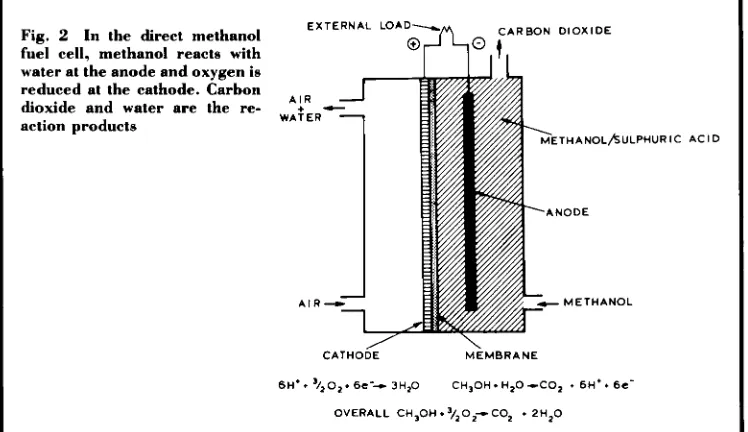
A schematic representation of an acid electro- lyte DMFC, together with the principal re- actions involved, is shown in Figure 2. A methanol molecule reacts with a water molecule at the anode liberating carbon dioxide, 6 pro- tons and 6 electrons-a very high electron yield. The carbon dioxide produced in the reaction is
CO,
+
OH- = HC0,-R B O N D I O X I D E E X T E R N A L LOA
Fig. 2 In the direct methanol fuel cell, methanol reacts with water at the anode and oxygen is reduced at the cathode. Carbon
A I
dioxide and water are the re- +
action products WATER
THANOL/C;ULPHUR I C A C I D
M E T H A N O L A I R
C A T H O D E M E M B R A N E
6 H ’ r 3 / 1 0 2 . 6 e i 3 H I 0 C H 3 0 H r H 2 0 - C O p * 6H’. 6e-
O V E R A L L CH,OH .1/202-C02 + 2 H 2 0
rejected by the acid electrolyte. Oxygen is reduced at the cathode, producing water, which is removed by the air flowing through the cathode compartment. The maximum voltage attainable from the overall reaction in the methanol-air cell is in theory 1.186 V, but in practice this is not achieved. There are several reasons for this reduced voltage:
[a1 The reversible methanol oxidation poten- tial is not observed due to the occurrence of additional reactions involving formal- dehyde and formic acid species, and a mixed potential results.
[bl The overpotential required to achieve useful currents is very high due to poison- ing of the catalyst.
[cl The oxygen reduction electrode also has a mixed reversible potential due to perox- ide formation, and suffers from a high overpotential, although not as severe as the methanol electrode.
The main problem still to be overcome with the DMFC is primarily electrocatalytic and is associated with the need to reduce substantially the overpotential at the anode. To explain the nature of the problem it is necessary to look at the generally accepted reaction mechanism for
the oxidation of methanol on a platinum elec- trode. This is reviewed in detail in the literature (7, IS), but a brief outline is given here.
Several views have emerged over the past decade concerning the details of the electro- oxidation mechanism. One of the most widely accepted theories has been put forward by Breiter ( 2 0 ) . He proposed a “parallel paths” reaction scheme, one path going by way of for- maldehyde and formic acid to carbon dioxide, and the other by adsorption and dehydrogena- tion of the methanol molecule on the platinum catalyst followed by further oxidation of the tenaciously held dehydrogenated organic frag- ment to carbon dioxide:
COH d C 0 ,
4
CH,OH -
CH, 0 -w HCOOH --C CO,
Traces of formaldehyde and formic acid have indeed been identified in solution, but it is the simultaneous build up of the dehydrogenated -COH residue that is thought to be respons- ible for the rapid diminution of the current. Much work has been carried out to investigate the nature of the adsorbed poison (7, 19) and
most evidence points to the reaction occurring by a stepwise removal of the hydrogens from the methanol molecule to leave a fragment of composition - COH strongly chemisorbed to the platinum, as follows:
OH
I
/ I
\
CH,OH
+
3Pt-+ C+
3Ht+
3e- (i)P t P t P t
However, recent workers have used in-situ spectroscopic studies to show that the adsorbed species is likely to be CO single bonded to a platinum atom (21,22). The next stage involves the reaction of the “poison” with adsorbed H , 0 or OH to form CO,
.
High potentials are required for the adsorption of such oxygen- containing species and thus this reaction only proceeds at potentials substantially anodic to the methanol reversible potential. There is again some argument as to the nature of this oxygen-containing species since catalyst activity is observed at potentials lower than that at which the electrosorption of water to produce adsorbed OH species is expected. Wieckowski has suggested that the oxidation proceeds via an adsorbed (possibly strained and therefore reactive) water molecule (23). However, the generally accepted scheme involves the reaction of the - COH species with OH species adsorb- ed on platinum as follows:3Pt
+
3H,O 4 3Pt-OH+
3H++
3e- (ii)OH Pt
C
+
Pt-OH-C=O+
H,O (iii)I
I
I
Pt
/ I
\
I
I
P t P t P t
Pt
C=O
+
Pt-OH Pt-COOH (iv)Pt
Pt-COOH
+
Pt-OH --t 2Pt+
CO,+
H,O (v)This mechanism assumes that the catalyst must be dual functional, that is to say it must electrosorb methanol and water in the same
potential region. Several workers have measured initial currents which were 10,000 to
100,000 times higher than the so-called steady state current which was found after a few minutes on an anode test (24). The reason for the rapid deactivation is thought to be build-up of the -COH residue on the catalyst surface, since, while platinum effectively adsorbs methanol at low potentials, it does not perform so well in the adsorption of water, and for this reason is not a particularly effective catalyst.
The activity of a methanol oxidation elec- trode depends on several factors including catalyst formulation, the catalyst support, the electrode structure and the operating con- ditions selected. Most work has concentrated on examining the effect of changing the catalyst formulation. Platinum group metal-containing catalysts are the only systems to date to show any activity for methanol oxidation at low potentials. Many workers have made bimetallic and trimetallic catalysts with platinum in the hope that poisoning by the methanolic residue would be significantly reduced or eliminated. Most of the d block elements have been tried as well as germanium, tin, lead, arsenic, antimony, bismuth, sulphur, selenium, tel- lurium and lithium. Various theories have been put forward to explain the promoting effect of the additional elements and this area remains controversial (25, 26). The best element com- binations reported are platinum/ruthenium, platinumhin, platinum/rhenium, platinum/ titanium, platinum/osmium, platinum/ rutheniumhin and platinum/ruthenium/gold.
Although it is not certain by which method these elements enhance activity, increases of up to 40 times have been recorded. Platinum/ ruthenium is often reported to be the most active combination, and Shell, Esso and more recently, Hitachi, have favoured this system.
A
European Research Programme
The Commission of the European Com- munities (CEC) has recently initiated work on direct methanol fuel cells as part of the ‘“on Nuclear Energy Research and Development Programme”. The direct methanol fuel cell
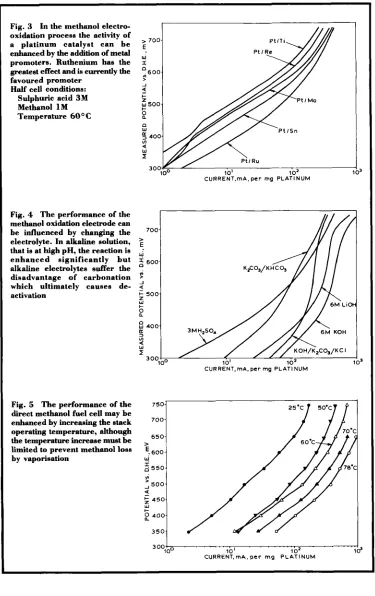
Fig. 3 In the methanol electro- oxidation process the activity of a platinum catalyst can be enhanced by the addition of metal promoters. Ruthenium has the greatest effect and is currently the favoured promoter
Half cell conditions: Sulphuric acid 3 M
Methanol 1 M
Temperature 60' C
3
2
I
Fig. 4 The performance of the methanol oxidation electrode can be iduenced by changing the electrolyte. In alkaline solution, that is at high pH, the reaction is enhanced significantly but alkaline electrolytes suffer the disadvantage of carbonation which ultimately causes de- activation
Fig. 5 The performance of the direct methanol fuel cell may be enhanced by increasing the stack operating temperature, although the temperature. increase muat be limited to prevent methanol loss by vaporisation
> 700
E
W
I
O 6 0 0
>
A
I- 5
F
5 0 02
0
5
4 0 Cv)
4
W
I
3 0 C
700
>
E
2
600w
Y)
J I- 5 0 0
w
&
r!
:
75v-
7 0 0 -
6 5 0 -
€.600-
I
d 5 5 0 -
>
4
L . l
;
soo-i
5 4 5 0 -
w
I-
2
400.3 5 0 .
"10' ' ' 1 0 2 . . '
CURRENT.rnA. p e r mg P L A T I N U M
Platinum Metals Rev., 1987, 31, (4) 177
I
Commission of the European Communities Fuel Cell ProgrammeParticipant
Johnson Matthey
I
Technology Centre (U.K.)University of Oxford (U.K.)
University of Southampton (U.K.)
C.N.R.S. (France)
I
Universitb de Poitiers(France)
Universitat Bonn (Germany)
Siemens A.G. (Germany)
University of Cork (Eire)
Subject of Study
Noblelbase metal catalysts for methanol oxidation, half cell and full cell studies
Fundamental studies of the anode reaction on noble metal and base oxide materials in collaboration with Johnson Matthey Technology Centre
Ultra high vacuum studies of electrochemical behaviour of methanol oxidation on platinum single crystals
Electrochemical characterisation of methanol oxidation on
platinum single crystal surfaces
Liquid chromatographic and infrared reflectance spectroscopic studies of methanol electro-oxidation on polycrystalline platinum surfaces
Investigation of co-catalysts for methanol electro-oxidation on platinum
Investigation of catalytic materials for methanol electro- oxidation-in collaboration with Bonn University
Development of low-level noble metal cathodes for the reduction of oxygen
programme is due for completion in the Autumn of 1989 and has the following targets for performance: power density 5omW/cm2, noble metal loading <Img/cm*, temperature <65OC. The participants in the DMFC section are given above in the Table.
Recent Developments
Previous research has shown that under the operating conditions commonly employed ( IM methanol, 3M sulphuric acid, 6oOC) the acti- vity of a pure platinum catalyst for methanol electro-oxidation can be enhanced by the addi- tion of metal promotors, with ruthenium show- ing by far the greatest effect. Figure 3 compares the activity of a number of Johnson Matthey catalysts utilising platinum and a small per- centage of a second metal component, dis- persed on carbon. The current-potential curves (and all subsequent data) are shown un- corrected for solution resistance which was typically <0.2 ohms for the cell employed.
The platinum/ruthenium system has been
studied in detail at the Johnson Matthey Technology Centre and an optimum catalyst formulation has been identified. Electro- chemical half cell measurements have indicated that the activity of pure platinum can be increased from 5-6 mA/mg
Pt
at 4mmV versus dynamic hydrogen electrode (D.H.E.) to 40-45 mA/mgPt
with the optimum platinum/ruthenium formulation. Due to economic constraints a compromise loading of10% platinum on the catalyst has thus been identified. Subsequent data shown in the Figures refer to this catalyst unless specified otherwise.
The variation in performance for the anode reaction as a function of electrolyte is shown in Figure 4. From these results it is not possible to attribute the more favourable electrode kinetics directly to an increase in pH since the electrolyte composition changes. With porous electrodes, changes in electrolyte composition may result in subtle effects such as an alteration in the surface tension or the conductivity,
2 7 2 8 2 9 3 0 3 1 3 2 3 3 3 4 1 I T. K x 1 o - ~
Fig. 6 An Arrhenius plot for platinum and platinum/mthenium catalysts indicates that ruthenium promotes the activity of platinum but does not change the mechanism of the anode reaction
which may not be apparent on planar electrode surfaces.
Thus the interpretation of Figure 4 requires some caution. However, from thermodynamic considerations the open-circuit potentials of the anode and cathode reaction are predicted to shift to more negative values as the p H of the electrolyte increases.
In addition, the activity of the oxidation catalyst has been found to be very dependent on operating conditions; the effect of increasing temperature on catalytic activity being shown in Figure 5. It is evident that, at temperatures as low as 8ooC, activities in excess of 100
mA/mg
Pt
can be obtained. Figure 6 shows the Arrhenius plots for platinum and platinum/ ruthenium catalysts with apparent activation energies of 36 kJ/mol and 49 kJ/mol, respec- tively, although the margin of error makes precise interpretation difficult. These results suggest that ruthenium promotes the activity of platinum but does not change the mechanism of the anode reaction. At temperatures above the boiling point of methanol (65OC) loss of fuel due to evaporation must be considered, while operation at higher pressures (>I atm) would necessitate separation of methanol from the car- bon dioxide and water vapour exhaust gases.The effect of sulphuric acid concentration on activity is shown in Figure 7, where it can be seen that activity increases as the acid concen- tration is decreased.
This
can be rationalised most easily in terms of competition between the electrolyte ions and methanol/water for catalystFig. 7 The activity of an acid direct methanol fuel cell is in- creased as the concentration of the electrolyte is lowered. In practice, a compromise between anode and cathode activity and electrolyte conductivity must be achieved
7 5 0
700
650
600
>
E
$550 ? 0
? 500
_I
4
4 5 0
W
k-
P
4003 5 0
300
0.5M H2SO. A 1 . O M H z S 0 4 A 2.OM HZSO4
0 3 . O M H2S0,
0 5.OM H2S04
10’
CURRENT, rnA. per rng PLAT1 N U M
I
Platinum Metals Rev., 1987, 31, (4) 179
P t l R u C a t a l y s t
sites. A decrease in acid strength appears desirable in terms of catalyst activity and also in terms of electrode stability since many poten- tially useful catalyst materials dissolve in highly acidic media. However the conductivity of the system must be kept as high as possible in order to avoid resistive losses and this will place con- siderable constrains on the choice of electrolyte. The performance of a variety of fuels during electro-oxidation in 3M sulphuric acid on a platinumhthenium catalyst is illustrated in Figure 8. The best activities are obtained with formic acid despite the fact that this molecule only liberates 2 electrons during oxidation com-
pared with methanol which liberates 6 elec- trons. Unfortunately the aggressive chemical nature of formic acid precludes its use in com- mercial systems.
Conclusions
The development of advanced anodes for the direct methanol fuel cell has been limited not only by the complexity of the electrode re- actions but also by the difficulties inherent in studying porous electrodes. Clearly, any attempt to improve the performance of a real,
that is to say a porous electrode must take the structure of the electrode into account. In this respect the improvements obtained with bi- metallic catalysts need careful interpretation as the addition of a second metal in the catalyst dispersion may change both the physical as well as the chemical nature of the active site (26). However, further refinement of the platinum/ ruthenium bimetallic catalyst prepared on tra- ditional carbon dispersions is unlikely to yield an order of magnitude improvement in anode activity.
What is needed is a far greater understanding of the chemistry of the overall catalytic process coupled with a knowledge of how to reproduce the desired “molecular scale” properties in a practical electrode.
The majority of research has centred around the identification of the precise nature of the poisoning species formed on platinum. This is obviously a very important aspect and recent developments in the use of spectroscopic techniques to probe the electrochemical inter- face in-situ promise to finally resolve the issue. In addition, there are a number of other aspects of the electro-oxidation reaction that require
6 5 0 E t h y l e n e glycol
,
6 0 0 .E
ui
r ’ 5 5 0 -
“7 >
J 5 0 0 -
5
I-
F 4 5 0 -
?
4ooy//H
F o r G i c a c i d
3 5 0 Sodium f o r m a t e
I /
I& l b 3 C U R R E N T . m A . p e r mg P L A T I N U M
Fig. 8 Other fuel cells may be oxidised directly in a fuel cell, although none is as attractive as methanol in terms of electron yield, cost, availability and case of handling
attention as a matter of urgency. These are: Research Programme in tackling the problems The function of co-catalysts (such as outlined above will lead to the development of bimetallic catalysts) more cost-effective direct methanol fuel cells. Exploration of alternative electrolytes
Optimisation of porous electrode structure.
approach taken by the participants of the CEC
Acknowledgement
Communities for their support of part of this work. In conclusion, it is h o d that the broad We wish to thank the Commission of the European
References I D. S. Cameron, Platinurn Metals Rev., 1978, 22,
2 K. Kordesch and A. Marko, Oesterr. Chem. Ztg.,
3 G. Ciprios, J. Batzold and M. Lieberman, (I), I
14 J. E. Wynn, Power Source Symp. Proc., 1970,
1 5
c.
Sylwm, Energv Convers., 1977, 17, (2/3), 67 16 C. L. Sylwan, Energy Convers. Manage., 1980,20,17 K. Tamura, New Muter. New Processes, 1983, 2,
18 J. Yamaguchi, Automot. Eng., 1983, 91, (4), 65 19 B. D. McNicol, in “Studies in Electrical and
Electronic Engineering 11-Power Sources for Electric Vehicles’’, (3. 8, ed. B. D. McNicol and
20 M. W. Breiter, “Electrochemical Processes in
21 B. Beden,
c.
Lamy, A. Bewick and K. Kunimat-9 B. D. McNicol, Roc. of the Workshop on 22 K. Kunimatsu,
3.
Electron Spectrosc. Relat.Electrocatalysis of Fuel Cell Reactions, Electro-
&em. Sot., 1979, 79, 93 23 A. Wieckowski, J. Sobrowski and A. Jablonska,
10 K. J. Cathro and C. H. Weeks, Energy Convers.,
1971, 11, I43 24 T. Biegler and D. F. A. Koch, J. Electrochem. 11 W. Vielstich, Fourth Int. Symp. Batteries, SOC., 1967, 1143 904
Brighton, England, 1964, Pergamon, p. 271 25 B. Beden, F. Kadirgan, C. Lamy and J . M. 1 2 S. S. Kurpit, Intersoc. Energy Convers. Eng.
kW,3.
Eleczroanal. Chem., 1981, 127, (1-3), 75Conf., 1975, 222 26 K. J . Cathro,J. Electrochem. SOC., 1969,116,1608 1 3 J . Perry, Power Source Symp. Proc., 1974, 26, 27 J. T. Glass, G. L. Cahen, G. E. Stoner and E. J.
171 Taylor,
3.
Electrochem. Soc., 1987, 134, ( I ) , 58(2), 38 24, 198
19519 52, 125
“Advances in Energy Conversion Engineering”,
4 K. R. Williams and D. P. Gregory,
3.
Electro-5 R. W. Glazebrook,3. Power Sources, 1982,7, 215
6 R. W. Glazebrook, Electr. Veh. Dev., 1982, 7, 18
~ ~ ~
3.
power i ~sources, ~ 1979, 4, (D, l , 191 R. T. Short, 3. Chem. Tech. Biotechnol., 1984,A.S.M.E., 1967, 357-364 317
chem. SOC., 1963, 110, 209
7 N. A. Hampson, M. J. Wfilars and B. D. D* A.
J.
Rand, Amsterdam> Ig84 8 p, A. A t t w d , A. G. D i o n , A. C. Houston and ce11s”3 Springer Verlag> ‘969su,
3.
Elecrroanal. Chem., 1981, 121, 343PhenOm.3 1983, 3% 215
3.
Electroanal. Chem., 1974, 5 5 , 3833 4 , (I), 10
Fabricating Platinum Disc Microelectrodes
A variety of electrochemical studies depend upon the use of microelectrodes, and if an elec- trode disc of sub-micron proportions is used ohmic distortion is virtually eliminated. Disc microelectrodes have been produced by encap- sulating a fine Wollaston wire in glass and also
by vapour deposition, but an easier method has now been reported by K. Itaya, T. Abe and I. Uchida of Tohoku University, Japan
u.
Elec-trochem.
soc.,
1987, 134, (5), 1191-1193).Anodic electropolishing is used widely to prepare sharp points on needle-like metal specimens that are to be examined by field ion microscopy, and this technique has been adapted to produce microelectrodes. The smoothest surface was obtained using a molten salt of sodium nitrate and sodium chloride (4 to
I, by weight) held at a temperature of
32o+1o0C; this being contained in a platinum crucible which served as a counter electrode while a platinum wire with a diameter of 65pm was dipped in the melt and anodically polarised by a periodic square wave, the amplitude of which affected both the shape of the pointed tip and the smoothness of the surface.
Tapered platinum wires with radii 10onm have been produced relatively easily; such tips are then encapsulated in epoxy resin, or a similar sealing material, and the electrode sur- face exposed by cutting through the composite with a diamond knife attached to an ultramicrotome. It is suggested that this method could be extended to iridium and gold, and even to carbon, using an alkali solution.