Hydrogen Diffusion Technology
COMMERCIAL APPLICATIONS OF PALLADIUM MEMBRANES
By
J. E.
Philpott
Johnson Matthey Equipment Limited. Wembley
The technology for extracting pure hydrogen .from hydrogen-rich gas mixtures by dijjusion is now well established. The success 0.f the process and the demand for the product has led to the formalion of Johnson Matthey Equipment, a company devoted to the supply 0.f equipment based upon the properties 0.f the platinum group metals, principally hydrogen puri.fication and generation equipment.
The original work on the diffusion of hydrogen through palladium was carried out by Thomas Graham in I 866, when he was Master of the Royal Mint, in London (I). However, for many years the commercial use of palladium as a hydrogen diffusion membrane was seriously inhibited by the fact that at relatively low temperatures the adsorption of hydrogen into palladium induces an (r
- p
phase transforma- tion, which consequently changes the atom spacing in the metal lattice. This dimensional change is large enough to distort the palladium membrane to such an extent that after only 30 hydrogenation-dehydrogenation cycles very little of the original structure remains. As a con- sequence of this, purification of hydrogen using a palladium membrane was only possible if the mzmbrane was kept above a critical temperature of about 3ooOC throughout its working life, a requirement that did not favour its commercial use.It was nearly a century after Graham’s discovery that Dr. J. B. Hunter, while working on the diffusion of hydrogen through palladium alloys, found that the maximum rate of hydrogen diffusion through silver-palladium alloys occurred at a composition close to the maximum solubility of silver in palladium (2). Unexpectedly the alloy was found to be stable when thermally cycled through the t r -
p
phase transition temperature in the presence of hydrogen. Furthermore the addition of silver made metal fabrication easier as well as reduc- ing the intrinsic value of the alloy. This was amajor step forward and led to the development of a range of commercial diffusion cells.
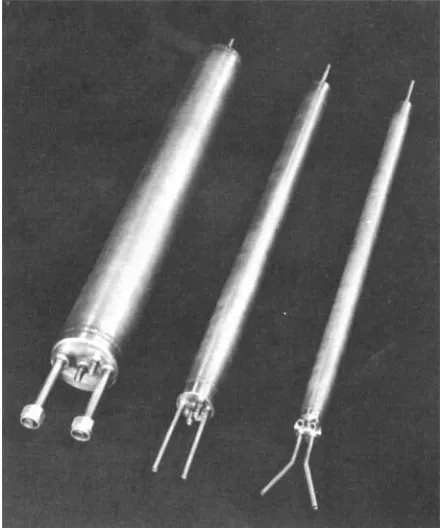
Early hydrogen diffusion equipment was of a simple design. Fabricators of the platinum group metals rarely make a complete product. Generally they are involved in supplying com- ponents which are often intricate and complex in design, but which comprise only a part of the complete product. Thus when fabrication of hydrogen diffusion equipment commenced only the diffusion cells were made; market indica- tions suggesting that potential purchasers would want to construct diffusion plants to their own design, or to incorporate diffusion cells into existing plant. The diffusion cells were of robust construction and had an output of I to 500 standard cubic feet per hour (approx. 0.03 m’/h to 14m3/h). They were designed to operate at temperatures of 500OC and pressures of 500
psi (3); years later some are still in everyday use. Three early models are shown in Figure I . The actual diffusion membrane consists of a number of silver-palladium tubes, which are contained within the cylindrical cell.
Although the supply of diffusion cell com- ponents met the needs of a certain market it soon became apparent that this approach did not satisfy all demands and that there was a requirement for complete purification units. In response to this a series of small laboratory diffusion u n i t s were designed and manufactured. Since modified in design, such units still provide the purest form of hydrogen in a great many laboratories.
Fig. 1 From left to right, early model A71, A 3 1 and A l l diffusion cells, the hydrogen outputs in standard cubic feet per h o u r were the same as their reference numbers. The cells were strongly made, and wi~hstood pressures higher than were
experienced in even abnormal usage. Pure hydrogen was provided from a single outlet at the far end of each
cell. Much the same arrangement of silver-palladium tube membranes is in use in modern hydrogen diffusion equipment
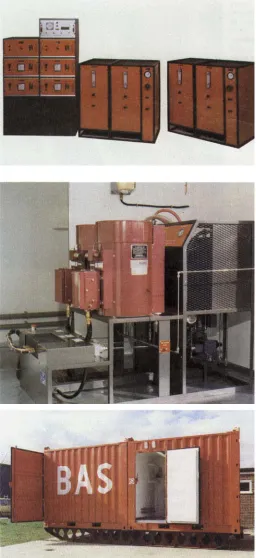
To provide a considerably higher rate of hydrogen output (286 cubic metres of hydrogen per hour) a very few much larger diffusion units were built up from standard difhsion cells but the safeguards against contaminating impurities were less than adequate and these early units did not have satisfactory lifetimes. The expansion of the electronics industry, which uses hydrogen during the manufacture of silicon chips, resulted in a rapid increase in the demand for hydrogen of a suitable quality. The hydrogen is used to carry doping elements onto the surface of the silicon wafer, and the gas must be of the highest purity. In this high technology industry a reliable supply of high purity gas is regarded as an essential everyday service, and new designs of palladium alloy diffusion units were required to satisfy this demand for hydrogen of near absolute purity. In practice it was found that a moisture meter installed in the gas stream served to monitor the purity of the hydrogen, and once in service dew points below -7oOC are steadily recorded in diffusion units. Two typical purification units
which use silver-palladium diffusion mem- branes are shown in Figure 2 .
Many electronics factories are located long distances from traditional sources of com- mercial cylinder hydrogen, making them vul- nerable to delivery delays caused by unusual weather or tr&c conditions. A need for hydrogen self-sufficiency was recognised and led to the development of simple generators for on-site hydrogen production (4). These are fuelled by a methanoywater mixture which is cracked over a catalyst, the resulting hydrogen being extracted by diffusion through a palladium alloy membrane ( 5 ) . The methanoywater mixture and its constituents are cheap and internationally available.
The use of this fuel effectively allows hydrogen to be stored as a liquid, moreover as a liquid which can be contained in thin walled vessels at atmospheric pressure, so providing a safer method of hydrogen storage than when the gas is kept under compression in high pres- sure cylinders.
The first methanoywater hydrogen generator
Platinum Metals Rev., 1985,29, (1)
Fig. 2 T w o H M 2 d i f f u s i o n u n i t s are shown here prior t o despatch. I n this range the u n i t s a r e s u p p l i e d as t w o separate cabinets, one h o u s i n g t h e gas p u r i f y i n g system a n d the o t h e r the electrical c o n t r o l s w h i c h therefore c a n b e sited w e l l away from the h y d r o g e n gas system. These u n i t s p r o v i d e a s i m p l e a n d economic means of u p g r a d - ing c o m m e r c i a l l y available h y d r o g e n from a variety of
gas sources to the u l t r a high
p u r i t y r e q u i r e d during the m a n u f a c t u r e of semi- c o n d u c t o r devices
Fig. 3 T h i s containerised m e t h a n o l / w a t e r h y d r o g e n generator has been m a d e for t h e B r i t i s h A n t a r c t i c Survey w h o w i l l use the h y d r o g e n to f i l l the b a l - l o o n s that l i f t sensitive meteorological i n s t r u m e n t s i n t o the high atmosphere. T h e caboose i s sledge m o u n t e d s o that the whole self-contained unit c a n hi. m o v e d r e g u l a r l y . I t is h o p e d that this w i l l prevent
loss of the e q u i p m e n t b y b u r i a l in heavy snowfalls a n d subsequent i n c o r p o r a - t i o n into the ice c a p
Fig. 4 T h e G 3 0 ( M a r k I I ) h y d r o g e n generator i n s t a l l a t i o n a t the E. 1.
Company Ltd., Shannon,
Eire. T h e t h r e e G I 0
modules each show t h e i r
vertical heat exchangers
m o u n t e d b e h i n d a m e t a l
grid a n d s m a l l gas c o n t r o l panel. T h e u n i t s a r e housed i n a building w i t h louvered walls, visible here a t t h e f a r end. T h e h y d r o g e n is used
in the m a n u f a c t u r e of
electronic p r o d u c t s a n d for
the p r o d u c t i o n of television tubes. T h i s was the most e c o n o m i r a n d r e l i a b l e solu- t i o n t o t h e h y d r o g e n re- q u i r e m e n t s of E.I.
built by Johnson Matthey was successfully used under many years’ accumulated snowfalls, and in the Antarctic by the British Antarctic a third replacement unit has been supplied. The Survey, who in 1975 installed it in a simple new G2 generator, capable of producing up to shelter built out of its own packing case. This 2 cubic metres of hydrogen per hour at atmos- shelter is now buried deep in the Antarctic ice, pheric pressure, is installed in one section of a
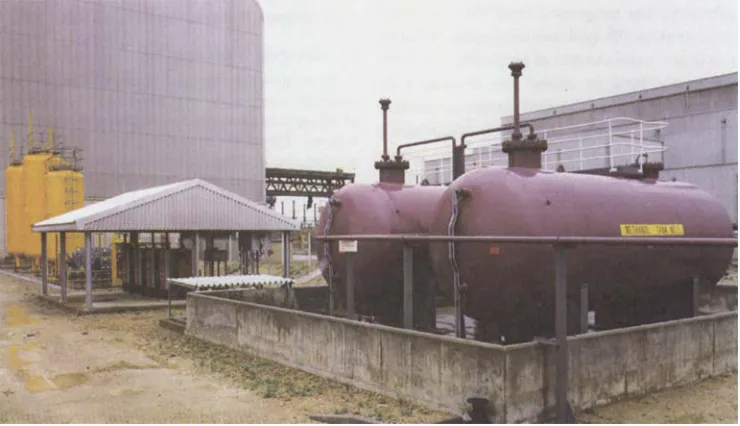
Fig. 5 A G 4 0 ( M a r k I) generator i n s t a l l e d a t the C e n t r a l E l e c t r i c i t y Generating B o a r d p o w e r station, I s l e of Grain, K e n t . T h e D u t c h B a r n shelter provides adequate p r o t e c t i o n for [lie f o u r
G 1 0 modules. I n the f o r e g r o u n d a r e the m e t h a n o l tanks w h i c h hold six months’ supply of fuel. T h e yellow v e r t i c a l pressure vessels a r e for s t o r i n g h y d r o g e n w h i c h i s used for rooling t h r a l t r r - nators. T h i s a p p l i c a t i o n is a m a j o r outlet f o r m e t h a n o l - f u e l l e d hydrogcsn ycnrrntors; the- wlf-
sufficiency they p r o v i d r to r e m o t e p o w e r stations has already p r o v e d t o hr of c.qx.rinl v a l ~ ~ c .
caboose (Figure 3) where the electrical controls are also housed. However, the low pressure hydrogen store is located in an adjacent section. The whole caboose is sledge mounted and it is hoped that by frequently moving this around burial in the snow will be prevented.
Johnson
Matthey
Equipment
The steady growth in business based upon the palladium diffusion process led first to the formation of a small business group and more recently to the founding of a commercial company-Johnson Matthey Equipment Limited-whose main business is in on-site hydrogen generators. However, activities include the supply of small laboratory purifica- tion equipment with hydrogen outputs ranging from 28 litres per hour through to modules with outputs up to 56 cubic metres per hour. These may be linked together to form a much larger piece of purification equipment, but generally the modules are installed separately, just prior to the work station in order to reduce the risk of the pure gas becoming contaminated. The development of on-site hydrogen generators has progressed from the first small units used to fill civil meteorological balloons to military units capable of producing 4.2 cubic metres per hour in almost any climatic con- dition. The market for civil on-site generators has grown steadily and many G I O units (10m3/h) and a smaller number of the newer G25 units (25m3/h) operate in industries as diverse as electronic device manufacture, alternator cooling in power stations, tungsten heat treatment, and in many others where merchant hydrogen has proved too expensive or where the supply is uncertain. Additionally a G5o module (50m3/h) is to be introduced in the near future.
The commercial success of these generators depends largely upon their low operating costs, which enables hydrogen to be produced at a cost significantly below that of gas delivered in cylinders; this accounts for the short payback times for these generators. Compact size and near automatic operation are additional benefits while the purity of the hydrogen produced, at
99.9999 per cent, is a further bonus. Typical installations are shown in Figures 4 and 5.
Extending
the
Product
Range
Following on the successful use of silver- palladium alloy for hydrogen production and purification, the manufacture of a range of equipment using a palladium on alumina catalyst has been started. This equipment removes oxygen from hydrogen gas streams that contain oxygen, or hydrogen from oxygen gas streams. The “Oxygone” range of equip- ment, as these units are called, represents a further broadening in the range of products offered by this new company, which is dedicated to the promotion of equipment utilis- ing the remarkable physical and chemical properties of the platinum group metals.
References
T. Graham, Phil. Trans., 1866, 156, 399; see D.
McDonald and L. B. Hunt, “A History of
Platinum and its Allied Metals”, Johnson Matthey, London, 1982, p.266
I.
B. Hunter, Platinum Metals Rev., I 9 6 0 ~ 4 , (4), I 30H. Connor, Platinum Metals Rev., 1 9 6 2 ~ 6 , (4), 130
M. J. Cole, Platinum Metals Rev., 1981, 25, ( I ) , 1 2 J.E.Philpott, PlarinumMetalsRev., 1976,20,(4), I 1 0
Hydrogen
Storage
forVehicles
Hydrogen may be used as the fuel in suitable internal combustion engines and the possibility of using it to power motor vehicles is being con- sidered. However, a major problem is that of storing the hydrogen in a compact, convenient form. A solution may be to use hydrogen to hydrogenate benzene to cyclohexane, which can be distributed in much the same way as petroleum products. The motorist would fill the tank of his vehicle with hydrogenated hydride, from which hydrogen would be released by an onboard catalytic dehydrogenation reactor.Success could depend upon the dehydrogena- tion step, an endothermic reaction which is reversible. A report of a simulation study for a palladium on alumina catalyst indicates that a dehydrogenation reactor for cyclohexane is feasible, at least in theory (A. Touzani, D. Klvana and G. BClanger, Inr. J . Hydrogen Energv, 1984, 9, ( I I), 929-936). Heat normally dissipated by the cooling system could be transferred to the reactor by a system of heat pipes, and would compensate for the endother- micity of the dehydrogenation reaction.