United Kingdom Vol. VI, Issue 11, November 2018
Licensed under Creative Common Page 125
http://ijecm.co.uk/
ISSN 2348 0386
JOB SATISFACTION AND WORK ENGAGEMENT
MODERATED BY TRUST
Adel Ali Yassin Alzyoud
College of Administrative Sciences Applied Science University, Kingdom of Bahrain
Abstract
The primary aim of this study was to empirically examine the effect of job satisfaction and trust
on work engagement. The study population consisted of randomly selected academic staff
working in public universities, to which questionnaire survey was distributed for the collection of
primary data. A total of 700 questionnaires were distributed to 4 public universities staff. Based
on the study findings obtained, job satisfaction statistical and significantly affected work
engagement, and trust significantly moderated such relationship. The study findings confirmed
that work engagement among academic staff in public universities contributes towards the
accomplishment of the vision and mission of the universities to ultimately become centers of
excellence. The study will be a significant contribution to the existing literature and will
particularly help the institutions such as universities in terms of admiring job satisfaction and
trust as well work engagement. The study’s findings and subsequent recommendations will be
useful of job satisfaction and trust can work towards bringing about work engagement among
academicians
Keywords: Work engagement, job satisfaction, trust, academic staff, higher education, social
exchange theory, attribution theory
INTRODUCTION
Licensed under Creative Common Page 126 employee engagement in their organizations as modern organizations require a workforce that is engaged (Chughtai & Buckley, 2011).
In today's dynamic environment, organizations are struggling to keep their talented employees. There are several researches that correlate job satisfaction with employment, a more in-depth examination is needed to understand the satisfaction in the workplace, which increases work engagement (Garg, Dar & Mishra, 2018).
In the context of academics, professionals are core to the functioning of any university (Pienaar, 2008). The lack of well-qualified and committed academic staff will lead to the failure of sustained performance and quality in the long-term. Moreover, in higher education, institutions are more dependent on intellectual, creative abilities and commitment of the academic staff compared to other institutions and organizations. This makes it crucial to have staff that is fully engaged in their work.
Prior studies have evidenced the connection between an engaged workforce and performance. More specifically, in Wah’s (1999) study, he employed a survey involving 656
executive officers from different countries and found engaging employees to be the fourth-most significant management challenge following the creation of customer loyalty, mergers and alliances management and costs reduction. This is compounded by the results reported by the Gallup Organization that found approximately 20% of the employees in the U.S. were disengaged from their work while 54% were neutral towards it as explained in Fleming, Coffman & Harter (2005). According to the authors, disengaged employees cost the U.S. over $300 billion annually for productivity loss. Another research from the Gallup and Towers Perrin cited by Momal (2003) and Seijts and Crim (2006), indicated that employee disengagement is as problematic in other various countries. Another study revealed that merely 14% of over 85,000 employees throughout 16 countries displayed work engagement (Aselstine & Alletson, 2006).
More importantly, both job satisfaction and work engagement play a major role in retaining staff and this has garnered significant attention from authors in management literature. They found job satisfaction to predict absenteeism, burnout, and turnover as well as quit intention (Shields & Ward, 2001; Lu, While & Barriball, 2005; Gupta & Shaheen, 2017). Added to this, work engagement, job satisfaction, job performance and retention were evidenced to be significantly related (Harter, Schmidt & Hayes, 2002; Schaufeli & Bakker, 2004; Laschinger & Leiter, 2006; Simpson, 2009; Lu, Lu, Gursoy, and Neale, 2016).
Licensed under Creative Common Page 127
LITERATURE REVIEW Work Engagement
The first attempt to apply the concept of work engagement has been often attributed to Kahn (1990; 1992). According to him, employees differ in the long-run in terms of their perception as to their level of expressing their preferred selves in their workplace.
Work engagement is the antithesis of job burnout, with the latter referring to the erosion of engagement (Maslach & Leiter, 1997). Burnout can be defined using three dimensions namely, exhaustion, cynicism, and inefficiency, with engagement characterized as the opposite of these dimensions. In other words, energy is replaced by emotional exhaustion, involvement replaces cynicism, and efficacy replaces lack of professional achievement. On the basis of Maslach and Leiter’s (1997) assumption, job engagement can be gauged through the inverse
scores of the Maslach Burnout Inventory (MBI) scale. But based on other prior studies like Schaufeli, Salanova, Gonzalez-Roma and Bakker (2002), engagement and burnout are two distinct states that should be measured independently by two different instruments.
Additionally, Schaufeli et al. (2002) viewed work engagement as a distinct phenomenon that comprises of positive antipode of workplace burnout. They contended that burnout and engagement are independent but negatively correlated mind states rather than the two poles of a continuum. As a consequence, they referred to work engagement as a positive, fulfilling, work-related mind state, whose characteristics include vigor, dedication and absorption (p.24).
Prior studies dedicated to work engagement concept revealed that employees who are engaged have a greater tendency to go above and beyond for their organizations and that it has a positive impact on performance in multiple contexts (e.g., Rothmann & Jordaan, 2006; Schaufeli, Bakker & Van Rhenen, 2009; Xanthopoulou, Bakker, Demerouti & Schaufeli, 2007).
Owing to its importance in employee performance and retention, engagement has garnered increasing attention in the past ten years among academicians. The concept however is still relatively new in the context of universities (Saks, 2006), particularly in Jordan. The notion of engagement has progressed in answer to its contributions to enhancing the effectiveness of employees in the workplace.
Job Satisfaction
Licensed under Creative Common Page 128 and close the definition provided by Locke (1976, p.1300) that described it as a pleasurable emotional state that stems from the appraisal of the experiences on the job.
Prior job satisfaction studies indicated its significant effect on the understanding of the influences of several other variables – in this regard, job satisfaction studies were analyzed based on its relationship to work attitudes, like commitment (e.g., Huang & Hsiao, 2007), performance (e.g., Ashill, Carruthers & Krisjanous, 2006) and organizational culture (Chen, 2004). Moreover, job satisfaction was also examined in various contexts like construction (e.g., Dabko, Salem, Genaidy & Daraiseh, 2008), tertiary education (e.g., Oshagbemi, 2003; Castillo, Cocklin & Cano, 1999; Mertler, 2002; Sweeny, Hohenshil & Fortune, 2002; Testa & Mueller, 2009), healthcare (Rad & Yarmohammadin, 2006) and institutions of higher learning in various nations (Lacy & Sheehan, 1997; Oshagbemi, 2000).
To begin with, Srivastava (2013) examined the relationship between job satisfaction and organizational commitment in his study involving 247 middle level managers working for private organizations. The findings revealed the positive relationship of job satisfaction with organizational commitment. On the other hand, Oshagbemi (2000) focused on the effects of gender on job satisfaction in the case of UK academics, using 554 faculties, but found no direct effects of gender on job satisfaction. His findings however indicated an interaction effect that revealed female academics of higher ranks to be more satisfied with their jobs compared to their male counterparts. Higher ranking academics are more satisfied with their jobs, with age and gender having minimal to no effects. Generally, research on university academic staff is still scarce.
In a related study, Baotham (2011) found a positive relationship between job satisfaction and job performance among Thai employees working in Rajamangala University of Technology, Thanyaburi. On the basis of the reviewed literature, research examining the job satisfaction-work engagement relationship is still few and far between. Based on the above review, the following hypothesis is proposed:
H1:Job satisfaction is positively related to work engagement
Trust
Licensed under Creative Common Page 129 of trust was named as dispositional trust by Kramer (1999) and trust propensity by Mayer, Davis and Schoorman (1995).
With regards to its definition, trust has been defined in various ways in literature, with some authors relating the concept to a personality trait/disposition of the trustor that affects the level to which he trusts the trustee. Pioneering dvocates of this notion include Rotter (1967) who explained trust as a personality form in that it is an expectancy where others’ words and actions
could be depended upon. This personality-based aspect of trust was referred to by Kramer (1999) as dispositional trust and by Mayer, Davis and Schoorman (1995) as trust propensity. The latter defined it as the inclination of an individual to leave himself vulnerable to the actions of another on the basis of his expectations such other will conduct a specific action that is important to him, regardless of whether or not he can oversee or control him (p.712).
Majority of the authors are of the consensus that trust is a major factor that could enhance firm’s competitive advantage and organizational effectiveness competing for human
talents, long-term stability and the organizational well-being (Cook & Wall, 1980; Huff & Kelley, 2003; Shockley-Zalabak, Ellis & Winograd, 2000; Laschinger, Finegan & Shamian, 2001). In relation to this Gilbert and Tang (1998) explained that trust influenced the perceptions and confidence of employees in their organizations and their beliefs regarding whether or not their organizations’ actions are to their own best interests.
In related studies, O’Brien (2001) and Reina and Reina (1999) related that trust can
encourage creativity and critical thinking among employees because when leaders facilitate an environment conducive to trust, employees perceive more freedom to express themselves, in terms of their ideas, and hence, they perform beyond the organization’s expectations. Along a similar line of argument, Shockley-Zalabak, Ellis and Winograd (2000) revealed that higher levels of trust in organizations led to success and innovation.
In some other related studies, Chugtai and Buckley (2011) tested trust influence on the work engagement among employees and found a positive relationship between the two. They specifically tested trust in supervisors and propensity to trust the same on the employees’ work engagement, in their study involving 168 research scientists working in 6 Irish science research centers. Also, Hassan and Ahmed (2011) reported that interpersonal trust is a predictor of work engagement of employees in their study that involved 395 Malaysian bank employees.
Licensed under Creative Common Page 130 commitment and work engagement among employees (e.g., Dirks & Ferrin, 2002; Tanner, 2007).
Aside from looking into the direct relationships of trust, studies also examined its moderating role; for instance, Alfes, Shantz and Truss (2012) looked into the moderating role of trust on the HRM practices-performance and well-being relationship of 613 employees and line management in U.K. service sector. Their findings indicated the moderating effect of trust on such relationship. Otken and Cenkci (2011) also found the moderating effect of trust on the relationship between paternalistic leadership and ethical climate, in their study that involved 227 Turkish employees.
In the context of Israel, Vigoda-Gadot and Talmud (2010) studied the relationship between organizational politics and organizational commitment among 142 academicians in one of Israel’s major research universities and found trust to moderate the relationship. Similarly, in Taiwan, trust was found to moderate the relationship between justice and commitment among 450 Taiwanese teachers (Ting, 2013). Despite the existence of studies that examined trust’s
moderating role, only a few studies have determined whether or not it moderates the relationship between job satisfaction and work engagement, particularly in the context of academicians. Hence, the present study tests the moderating role of trust in the job satisfaction–work engagement relationship in Jordanian academics working in public universities. On the basis of the above reviewed literature, the following hypothesis is proposed to be tested;
H2: Trust moderates the relationship between job satisfaction and work engagement
Research Framework
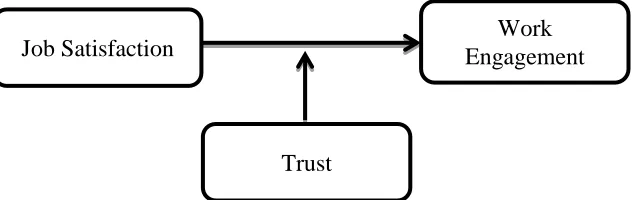
This study’s research framework is developed on the basis of Social Exchange Theory by Blau (1964) and Emerson (1976), and the Attribution Theory by Haider (1958) and the reviewed literature (see Figure 1).
Licensed under Creative Common Page 131 Moving on the attribution theory proposed by Haider (1958), it explains trust’s moderating effect on the relationship between satisfaction and engagement. According to Weiner (1995), the attribution theory is able to explain a trust-relevant phenomenon. The prediction is such that in an environment characterized by low trust, academics tend to be more likely to relate negative outcomes to situational causes, and not as likely to attribute positive ones to external causes. On the other hand, in an environment characterized by high trust, academics tend to be more likely to relate positive outcomes to situational causes and to attribute positive experiences to external causes.
Moreover, it is important to understand job satisfaction consequences as they have a significant impact on job performance, organizational commitment, turnover intentions and they have potential to influence human resource policies and practices as evidenced in prior studies (e.g., Rayton, 2006; Armutlulu & Noyan, 2011). Several justifications have been proposed as to the reason behind the increasing attention towards job satisfaction among scholars. First, the attitudes and perceptions of workers towards their jobs are important to organizations and as such, job satisfaction has a significant effect on workers’ behavior in various ways, particularly in
relation to productivity and absenteeism. To this end, satisfied employees are not as likely to leave their jobs and look for alternative ones (Ambrose, Huston & Norman, 2005; Rosser, 2004).
In the higher education, the changing role of governance and the loss of trust in the self-steering ability of academics, instead of strategic decision making, accountability and assessments, is shifting the balance between the relationship of management and external stakeholders (Kalpazidou & Langberg, 2007). The current claim states that higher education is losing trust of the society at large, and this is advocated by those that want higher education accountability to the state and the latter’s power over the institutions. In this regard, trust is extensively viewed as a critical aspect that leads to successful personal and business relationships. In fact, trust offers the partner organizations the chance to form the education direction and develop a lasting legacy for the sustainability of the universities’ long-term plans.
Licensed under Creative Common Page 132 Figure 1: Proposed Research Model
METHODOLOGY Study Participants
The participants were academic staff from four Jordanian higher education universities (N = 532). 430 male and 102 respondents participated in this study. The average age was 51. In addition, the majority of the respondents (459) were married, followed by unmarried respondents, which were 73. 223 of the respondents had below $2000, while 286 of them had a salary amid $2001-$3000, but only 23 had from $3001-$4000. A majority of the respondents 295 respondents worked with university from 1-3 years. In addition, most of the respondents 226 were in present position from 1-3 years. All respondents were PhD degree.
Measuring instrument
Work engagement was measured by 17 items developed by Schaufeli and Baker (2003). Job satisfaction was measured by using 22 items developed by Weiss, Dawis, England and Lofquist (1967). In this study, trust is the moderating variable. Trust is operationalized as individuals’ confidence and expectation about the actions of their organizations (Tyler, 2003). Trust was measured by using 7 items developed by Tyler (2003). In this study, participants was asked to rate their degree of agreement for each of the items statement based on five-point scale whereby, 1 = strongly disagree, and 5 = strongly agree.
ANALYSIS AND RESULTS
Job Satisfaction and Work Engagement
Results in Table 1 shows that 28.6% (R2 = .286, F = 212.45, p < .01) of the variance in work engagement was significantly explained by job satisfaction. In the model, job satisfaction (β = 0.535, p<0.01) was found positively related to work engagement. Therefore, Hypothesis 1 was supported. The results demonstrate that academics who are satisfied with their job are more engaged in what they do.
Job Satisfaction
Trust
Licensed under Creative Common Page 133 Table 1: Model Summary of Job Satisfaction and Work Engagement
Independent variables Dependent variable
Work Engagement
Std Beta
t Sig. Tolerance VIF
Job satisfaction .535** 14.57 .000 1.00 1.00
R² .286
Adj.R² .285
F change 212.45
Sig F change .000
Durbin-Watson 1.78
Trust Moderating Job Satisfaction and Work Engagement
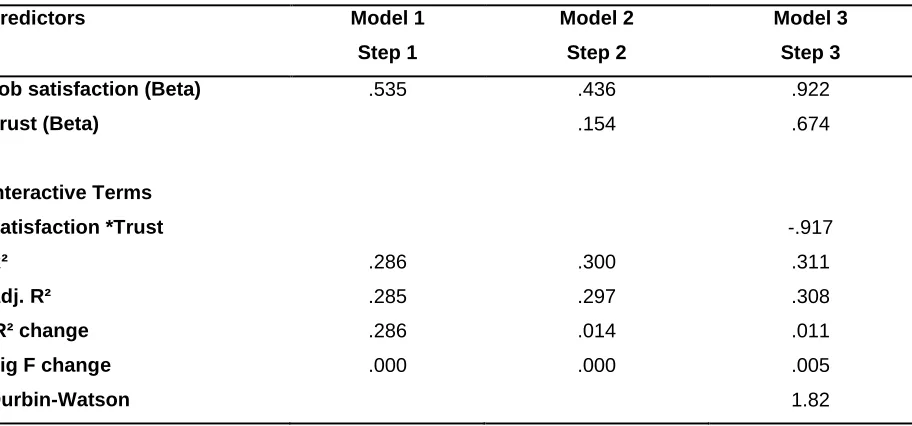
To test Hypothesis 2, hierarchical multiple regression analysis is performed. As shown in Table 2, job satisfaction variable was entered in Step 1 and explained around 28.6% of the work engagement variance. The result showed that the job satisfaction has a significant influence on work engagement (β = .535; t = 14.576; p < .001). The result when the moderator is entered at Step 2 and explained around 30.0% of the variance in trust and job satisfaction to work engagement (β = .436; t = 9.187; p < .001).
When the interaction item is entered at Step 3, R-Square has increased by 1.1% and explained around 31.1% of the work engagement variance (β = .922; t = 5.383; p < .001). Thus, Hypothesis 2 is partially supported.
Table 2: Hierarchical Regression Result for Moderating Effect of the Trust
Predictors Model 1
Step 1
Model 2
Step 2
Model 3
Step 3
Job satisfaction (Beta) .535 .436 .922
Trust (Beta) .154 .674
Interactive Terms
Satisfaction *Trust -.917
R² .286 .300 .311
Adj. R² .285 .297 .308
R² change .286 .014 .011
Sig F change .000 .000 .005
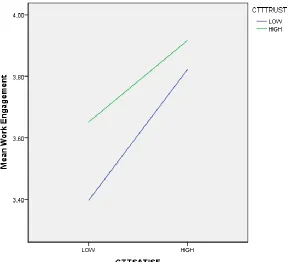
Licensed under Creative Common Page 134 The moderating effect of trust on the relationship between job satisfaction and work engagement is shown in Figure 2. The results demonstrate that academics who worked in a low trust environment tend to be less engaged with their work as compared to those who worked in a high trust environment, even when both had high job satisfaction. However, the gap in work engagement in a low and high trust environment is smaller between those who had high job satisfaction as compared those with low job satisfaction.
Figure 2: Interaction of Job Satisfaction and Trust in Predicting Work Engagement
DISCUSSION
Licensed under Creative Common Page 135 showed their satisfaction concerning the feedback of the Dean, job opportunities, friendly work environment, their autonomy, and their participation in decision making. Such satisfying feeling leads them to display work-engagement.
Regardless of the lack of hypothesis testing concerning the relationship between tenure and satisfaction, it is notable that the finding in this study indicated that feeling of satisfaction with work does not hinge on the number of working years but more on the treatment of employees. It has long been argued that the longer the employee tenure, the higher they will feel satisfied as they have already adapted to the work environment but the findings in this study proved otherwise.
This study tested the moderating role of trust between job satisfaction and work engagement, and the findings indicated that work engagement among academicians in a low-trust environment is lower compared to those in high low-trust environment although both displayed high job satisfaction. This finding may be attributed to the fact that the Jordanian academic staff still requires transparency in decision-making when it comes to their jobs and career development. For instance, the management should be transparent in their decisions concerning staff promotion as this would encourage confidence of staff on management and in turn, staff will be satisfied with the decision reached, and will ultimately show positive attitude in the universities. This perception suggests that universities should create a balance of relationship between top management of universities and academics.
More importantly, the presence of trust and transparency in universities working environment pave the way for academic staff to garner information on the universities’ planning
and direction. This will in turn, increase their positive regard for management, particularly when management focuses on relevant issues such as complaints on management style, facilities provided, and equal opportunities for career development. In other words the flow of information throughout the Jordanian universities’ environment will bring about the academics’ job
satisfaction and work engagement.
CONCLUSION, FURTHER RESEARCH AND RECOMMENDATIONS
Licensed under Creative Common Page 136 will determine the discrete level relationships between satisfaction and work engagement. Empirical studies are also recommended to be conducted to test this study’s model to determine
the mutual reinforcing trust-work engagement relationship.
The current findings have indicated that job satisfaction was perceived by the academics to contribute to their engagement towards work. Since there was a direct relationship between job satisfaction and academics’ work engagement, it is suggested that the university’s
management to consider providing positive working environment, involving the academics in decision making, rewarding and recognizing contribution made by the academics and giving more control and flexibility to the academics in terms of planning and carrying out their work as way to enhance the academics’ job satisfaction. In terms of the role of trust, the findings of the
present study have demonstrated that trust had some influence in academics work engagement and job satisfaction.
Therefore, to create a culture of trust in the academic setting, the university’s
management must ensure that they have a good quality of leadership especially among the top university management, encourage more academics to be involved the university’s decision
making, treat the academics with fairness regardless of position or personal characteristics, learn how to delegate tasks and empower the academics, act and speaks consistently, be approachable and often interact with the academics, and always ask for feedback. Apart from that, the university’s management also needs to consider the role of job satisfaction and trust when planning for enhancing academics’ work engagement.
REFERENCES
Alfes, K., Shantz, A., & Truss, C. (2012) . The link between perceived HRM practices, performance and wellbeing: The moderating effect of trust in the employer. Human Resource Management Journal, 22(4), 409-427.
Ambrose, S., Huston, T., & Norman, M. (2005). A qualitative method for assessing faculty satisfaction. Research in higher Education, 46,803-830.
Armutlulu, I.H. & Noyan, F. (2011). A multilevel of organizational commitment. Procedia Social and Behavioral Sciences, 30,2139-2143.
Aselstine, K., & Alletson, K. (2006). A new deal for the 21st century workplace. Ivey Business Journal, 70(4), 1-9. Ashill, N. J., Carruthers, J., & Krisjanous, J. (2006). The effect of management commitment to service quality on front line employees’ affective and performance outcomes: an empirical investigation of the New Zealand public healthcare sector. International Journal of Nonprofit and Voluntary Sector Marketing, 11 (4), 271-287
Bakker, A.B., & Leiter, M.P. (Eds.). (2010). Work engagement: A handbook of essential theory and research. New York, NY: Psychology Press.
Blau, P (1964), Exchange and Power in Social Life, Transaction Publishers,, New Brunswick, New York.
Butler, J. K. 1999. Trust expectations, information sharing, climate of trust, and negotiation effectiveness and efficiency. Group & Organization Management, 24(2), 217-239.
Licensed under Creative Common Page 137 Chen, Y. L. (2004). Examining the effect of organization culture and leadership behaviours on organizational commitment, job satisfaction and job performance at small and middle firms of Taiwan. The Journal of American Academy of Business, 5(2-2), 432-438.
Chughtai A. A., Buckley F. (2011). Work engagement: Antecedents, the mediating role of learning goal orientation and job performance. Career Development International, 16, 684-705.
Chughtai, A. A., & Buckley, F. (2008) Work Engagement and its Relationship with State and Trait Trust: A Conceptual Analysis. Journal of Behavioural and Applied Management. 10(1), 47-71.
Collins, J.C., & Porras, J.I. (1997). Built to last: Successful habits of visionary companies. New York: Harper Business.
Colquitt, J. A., Scott, B. A., & LePine, J. A. (2007). Trust, trustworthiness, and trust propensity: A meta-analytic test of their unique relationships with risk taking and job performance. Journal of Applied Psychology, 92(4), 909-927. Cummings, L. L., & Bromiley, P. (1996). The organizational trust inventory (OTI): Development and validation. In R. M. Kramer & T. R. Tyler (Eds.), Trust in organizations: Frontiers of theory and research (pp. 302-330). Thousand Oaks: Sage.
Dabke, S., Salem, O., Genaidy, A., and Daraiseh, N. (2008). ”Job Satisfaction of Women in Construction Trades. Journal of Construction Engineering and Management. 134(3), 205-216.
Danaee Fard, H., Rajabzadeh, A. and Hasiri, A. (2010). “Organizational Trust in Public Sector: Explaining the Role of Managers’ Managerial Competency”. European Journal of Economics, Finance and Administrative Sciences, 25, 29-43.
Dirks, K. T., & Ferrin, D. L. 2001. The role of trust in organizational settings. Organization Science, 12, 450-467. Dirks, K. T., & Ferrin, D. L. 2002. Trust in leadership: Meta-analytic finding and implications for research and practice. Journal of Applied Psychology, 87, 611-628.
Doney, Patricia M. and Joseph P. Cannon (1997), “An Examination of the Nature of Trust in Buyer-Seller Relationships. Journal of Marketing 61(21), 35-51.
Emerson, R. M. (1976). Social exchange theory. Annual Review of Sociology, 2, 335-362.
Farndale, E., Hope Hailey, V., & Kelliher, C. (2011). "High commitment performance management: the roles of justice and trust. Personnel Review, 40(1), 5-23.
Feinstein, A.H. (2002). A study of relationships between job satisfaction and organizational commitment among restaurant employees. Journal of Managerial Psychology, 23(7), 33-57.
Festinger, L. (1957). A theory of cognitive dissonance. Standford, California: Stanford University Press.
Fleming, J. H., Coffman, C., & Harter, J. K. (2005). Manage your human sigma. Harvard Business Review, 83(7/8), 106-114.
Garg, K., Dar, I. A., & Mishra, M. (2018). Job Satisfaction and Work Engagement: A Study Using Private Sector Bank Managers. Advances in Developing Human Resources, 20(1), 58-71.
Ghosh, A., Whipple, T.W. and Bryan, G.A., (2001), Student trust and its antecedents in higher education. Journal of Higher Education, 72(3), 322-340.
Gupta, M., & Shaheen, M. (2017). Impact of work engagement on turnover intention: Moderation by psychological capital in India. Business: Theory and Practice, 18, 136-143.
Hargreaves, A. (2002). Teaching and betrayal. Teachers and Teaching: theory and practice, 8(3), 393-407.
Harter J. K., Schmidt F. L., Hayes T. L. (2002). Business-unit-level relationship between employee satisfaction, employee engagement, and business outcomes. A meta-analysis. Journal of Applied Psychology, 87, 268-279. Hassan, A., & Ahmed, F. (2011). Authentic leadership, trust and work engagement. International Journal of Human and Social Sciences, 6(3), 164-171.
Heider, F. (1958). The psychology of interpersonal relations. New York: Wiley.
Huang, T.C. and Hsiao, W.J. (2007) The Causal relationship between job satisfaction and organizational commitment. Social Behavior and Personality, 35, 1265-1276
Licensed under Creative Common Page 138 Iqbal M. (2012). Impact of Job Satisfaction and Job Control on Organizational Commitment: A Case Study of Air Traffic Controllers of Pakistan Civil Aviation Authority. Journal of Managerial Sciences. 6, 2, 139-154.
Jap, S. D., Manolis, C., & Weitz, B. A. (1999). Relationship quality and buyer–seller interactions in channels of distribution. Journal of Business Research, 46(3), 303-313.
Kahn, W., A. (1990). Psychological conditions of personal engagement and disengagement at work, Academy of Management Journal. 33, (4) 692-724.
Kahn, W.A. (1992). To be fully there; psychological presence at work. Human Relations, 45, 321-49.
Kee, H. W., & Knox, R. E. (1970). Conceptual and methodological considerations in the study of trust. Journal of Conflict Resolution. 14, 357-366.
Kowalski, C.J., & Cangemi, J.P. (2005). Developing trust-and distrust-in higher education. In J.P. Cangemi, C.J. Kowalski, R.L. Miller, & T.W. Hollopteter, (Eds.), Developing Trust in Organizations. Boston, MA: McGraw-Hill. Kramer, R., & Tyler, T. (1996). Trust in organizations. Thousand Oaks, CA: Sage.
Lacy, F. J., & Sheehan, B. A. (1997). Job satisfaction among academic staff: An international perspective. Higher Education, 34, 305-322.
Laschinger H.K.S. & Leiter M.P. (2006). The impact of nursing work environments on patient safety outcomes: the mediating role of burnout/engagement. Journal of Nursing Administration, 36, 259-267.
Lee, T. (1988). How job Dissatisfaction leads to employee turnover. Journal of Business and Psychology, (2), 263-271.
Locke, E. A. (1976). The nature and causes of job satisfaction. Handbook of Industrial and Organizational Psychology, Chicago: Rand McNally, 1319-1328.
Locke, E. A., & Henne, D. (1986). Work motivation theories. In C. K. Cooper & I. Robertson (Eds.), International review of industrial and organizational psychology. New York: Wiley.
Lofquist, L. H., & Dawis, R. V. (1969). Adjustment to work. Appleton-Century-Crofts New York.
Lu H, While A.E., & Barriball L. (2005). Job satisfaction among nurses: a literature review. International Journal of Nursing Studies, (42) 211–227.
Lu, L., Lu, A. C. C., Gursoy, D., & Neale, N. R. (2016). Work engagement, job satisfaction, and turnover intentions: A comparison between supervisors and line-level employees. International Journal of Contemporary Hospitality Management, 28, 737-761.
Maslach, C., & Leiter, M. P. (1997). The truth about burnout. California: Jossy-Bass.
Mayer, R. C., Davis, J. H., & Schoorman, F. D. (1995). An integrative model of organizational trust. Academy of Management Review, 20, 709-734.
McAllister, D.J. (1995). Affect and cognition based trust as foundations for interpersonal cooperation in organizations. Academy of Management Review. 38 (1), 24-59.
Mertler, C.A. (2002). Job satisfaction and perception of motivation among middle and high school teachers. American Secondary Education, 31, 43-53.
Momal, F. (2003). France’s disengaged workforce. Gallup Management Journal Online, 1-4. Oshagbemi, T. (2000), Satisfaction with co-workers’ behavior. Employee Relations, 22, 88-106.
Oshagbemi, T. (2003). Personal correlates of job satisfaction: empirical evidence from UK universities. International Journal of Social Economics, 30 (12), 1210 – 1232.
Pienaar, C., & Bester, C.L. (2008). Retention of Academics in the Early Career Phase. Journal of Human Resource Management, 6 (2), 32-41.
Rad, A.M.M. & Yarmohammadian, M.H. (2006). A study of relationship between managers’ leadership style and employees’ job satisfaction. Leadership in Health Service, 19(2) 11-28.
Rayton, B.A. (2006). Examining the interconnection of job satisfaction and organizational commitment: An application of the bivariate probit model. International Journal of Human Resource Management, 17(1), 139-154.
Licensed under Creative Common Page 139 Rothmann, S., & Jordaan, G. (2006). Job demands, job resources and work engagement of academic staff in South African higher education institutions. Journal of Industrial Psychology, 32 (4), 87-96.
Rotter, J. B. 1967. A new scale for the measurement of interpersonal trust. Journal of Personality, 35, 651-665. Rotter, J.B. (1980). Interpersonal trust, trustworthiness and gullibility. American Psychologist, 35, 1-7.
Rousseau, D. M., Sitkin, S. B., Burt, R. S., & Camerer, C. 1998. Not so different after all: A cross-discipline view of trust. Academy of Management Review, 23, 393-404.
Saks, A.M. (2006). Antecedents and consequences of employee engagement. Journal of Managerial Psychology, 21, 600-619.
Schaufeli, W. B., & Bakker, A. B. (2004). Job demands, job resources, and their relationship with burnout and engagement: A multi‐sample study. Journal of Organizational Behavior, 25(3), 293-315.
Schaufeli, W. B., Bakker, A. B., & Van Rhenen, W. (2009). How changes in job demands and resources predict burnout, work engagement, and sickness absenteeism. Journal of Organizational Behavior, 30(7), 893-917.
Schaufeli, W. B., Salanova, M., Gonzalellez-Roma, V. & Bakker, A., B. (2002). The measurement of engagement and burnout: A two sample confirmatory factor analytic approach. Journal of Happiness Studies, 3 (3), 71-92.
Schermerhorn, J. R., Hunt, J. G. dan Osborn, R. N. (2005). Organizational Behavior. 9th ed. United States of America: John Wiley & Sons, Inc.
Seijts, G. H., & Crim, D. (2006). What engages employees the most or, the ten C’s of employee engagement. Ivey Business Journal, 70 (4), 1–5
Simpson M. R. (2009). Engagement at work: A review of the literature. International Journal of Nursing Studies, 46, 1012-1024.
Spreitzer, G.M., & Mishra, A.K. (1999). Giving up control without losing control: Trust and its substitutes’ effects on managers’ involving employees in decision making. Group & Organization Management, 24(2), 155-187.
Srivastava S. (2013). Job Satisfaction and Organizational Commitment Relationship: Effect of Personality Variables. The Journal of Business Perspective. 17(2) 159-167.
Steers, R.M., & Mowday, R.T. (1977). The Motivational properties of tasks. Paper presented at Annual Conference of the Mid Academy of Management, St Louis, USA.
Sweeney, A. P. Hohenshil, T. H., & Fortune, J. C. (2002). Job satisfaction among employee assistance professionals: A national study. Journal of Employment Counseling, 39(2), 50-60.
Tanner, B. M. Jr., (2007). An analysis of the relationships among job satisfaction, organizational trust, and organizational commitment in an acute care hospital. (PhD. Dissertation). Saybrook Graduate School and Research Center, San Francisco, California, United State.
Testa M., R. & Mueller, S., L. (2009). Demographic and cultural predictors of international service worker job satisfaction. Managing Service Quality, 19(2), 195-210.
Torres, E. N. (2014). Deconstructing service quality and customer satisfaction: Challenges and directions for future research. Journal of Hospitality Marketing & Management, 23, 652-677.
Tzafrir, S. S., & Dolan, L. S. (2004). Trust ME: A scale for measuring employee manager Trust. Journal of Management Research, 2(2), 117-134.
Wah, L. (1999). Engaging employees a big challenge. Management Review, 88 (9), 10
Wang D. & Hsieh, C. (2013). The effect of authentic leadership on employee trust and employee engagement. Social Behavior and Personality, 41(4), 613-624.
Weiner, B. (1995). Judgments of responsibility: A foundation for a theory of social conduct. New York: Guilford. Xanthopoulou, D., Bakker, A. B., Demerouti, E., & Schaufeli, W. B. (2007). The role of personal resources in the job demands-resources model. International Journal of Stress Management, 14, 121-141.
Zaheer, Akbar, Bill McEvily, and Vincenzo Perrone (1998). Does Trust Matter? Exploring the Effects of Interorganizational and Interpersonal Trust on Performance. Organization Science, 9(2), 141-159.
Zaltman, Gerald and Christine Moorman (1988). The management and use of advertising research. Journal of Advertising Research, 28(6), 11-18.