R E S E A R C H A R T I C L E
Open Access
Orthodontic apps at fingertips
Mayuresh Jagannath Baheti
*and Nandlal Toshniwal
Abstract
Background:Smartphone usage has spread to many settings including that of healthcare and dentistry with numerous potential and realized benefits. The ability to download custom-built software applications (apps) has created new opportunities for orthodontists to integrate technology into clinical practice and patients to collect the information about orthodontics and help them during their treatment. The purpose of this study is to provide a summary of the orthodontic apps currently available for orthodontic patients as well as‘practicing clinicians’.
Method:Three smartphones and two tablets were used to search three operating systems (Android, Apple, and Windows) using the keywords‘braces’,‘orthodontist’,‘model analysis’, and‘orthodontics’.
Results:Android and Apple operating systems accumulate all of the apps that are thought to be related to orthodontic clinicians and patients. Clinician's apps (17) are those related to orthodontic news (2), publication (4), products (3), and diagnosis (4) and practice management (3) while patient apps (17) are those related to
orthodontic education (4), simulator (5), related to reminding patients about elastic wear (3), progress tracker of treatment (4), and orthodontic products (1).
Conclusion:In the generation of technology, the use of smartphones and tablets has made life simple. The use of these technologies can be a boon both for the orthodontist and the patients as it aids both in treatment planning and progress in enhancing the treatment outcome.
Keywords:Smartphone; Applications; Orthodontics
Background
The latest generations of smartphones are increasingly viewed as handheld computers rather than as phones, due to their powerful onboard computing capability, capacious memories, large screens, and open operating systems that encourage application development [1]. Smartphones are now providing routine access to information in ways that were previously not possible, and this includes the area of medical education.
Once upon a time, phones were used exclusively for conversing with other peopleviatelephone calls and text messages. They have a number of per-loaded software programs. But, the development of smartphones has cre-ated new opportunities to integrate mobile technology into daily clinical practice. A smartphone is a cellular tele-phone with an integrated computer that is capable of per-forming a broad array of tasks, including running various downloadable applications (apps) that typically are not
associated with a cellular phone. The existence of smart-phones can be traced as early as 1992 [2], then in 1993, IBM launched the Simon, a touch screen phone with inte-grated email, fax, calendar, and notepad; it was not until nearly 10 years later development of the Palm and Black-berry in 2001 and 2002, respectively, that consumers began to use mobile devices capable of wireless informa-tion services and web browsing. Release of the iPhone in 2007 included features not found on previous devices and led the way for developers to create a library of apps avail-able to consumers [2].
An app is typically a small specialized program down-loaded on to a mobile device [3]. An app is accessed using a smartphone that connects,viaan internet portal, to a library of apps. The users can browse the library and search for specific apps that serve their needs [4]. Owing to their portability, ability to update, speed, and simplicity, smartphone apps are an ideal tool for quick reference or when accessing a desktop computer would not be feasible [5]. As a result, smartphones can serve as quick reference tools for train enquiry, flight enquiry, ticket booking, daily expense monitoring, check their bank balance, etc. * Correspondence:[email protected]
Department of Orthodontics and Dentofacial Orthopedics, Rural Dental College, Loni 413736, Maharashtra, India
Despite the widespread prevalence of smartphones and apps available for general utilities, even there are some apps specifically designed for medical and dental field [6]. As medical and dental apps have been one of the fastest growing categories of programs and include various programs designed specifically for orthodontics. For ortho-dontics, there is now a wealth of information available, much of which can be freely accessed by our patients.
With smartphone use becoming more widespread, the medical community has embraced this technology with a number of apps already available to patients assisting them in smoking cessation [7] and for pain management [8] as two examples. Applications for clinicians in ortho-pedic surgery [2], ophthalmology [9,10], and radiology [11] have already been reported as well as apps for stu-dents in medical education [6].
This article provides a summary of the orthodontic apps currently available for orthodontic patients as well as practicing clinicians.
Method
Three smartphones and two tablets were used to access their respective app stores till 4th December 2013. A Samsung galaxy S4 with android OS v 4.2.2 (Jelly Bean) and a Samsung Galaxy tab 2 10.1 with android OS v 4.0 (Ice Cream sandwich) were used to search the Google play store. An iPhone 4 with iOS 6 and Apple ipad Mini MD528LL with iOS 6 were used to search Apple App Store. Finally, A Nokia Lumia 800 with OS windows phone 7.5 was used to search the windows phone marketplace.
Search was carried out using four keywords: ‘braces’,
‘orthodontist’, ‘model analysis’, and ‘orthodontics’. The play store includes a brief description of the apps that has been provided by the developer. Information of each app was recorded including the cost of the app and brief information about the app.
Apps that featured lite and full versions were also counted. Non-health, general dental, and medical apps were excluded. Only apps directly relating to the field of orthodontics were examined.
Results
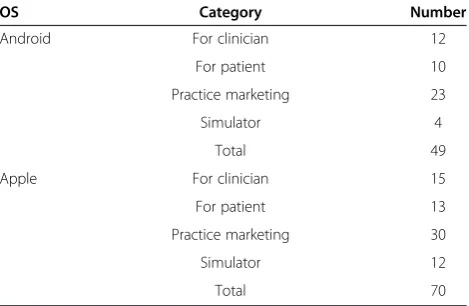
The results of the search, with the aid of the three operat-ing systems, usoperat-ing the four keywords were so many apps in which some are related to entertainment and utility; dental apps included those marketing dental practices, guides for dental assisting, and even dental game. Apps in the above were excluded and orthodontic-related apps were divided into two main categories: (1) apps for ortho-dontic clinicians and (2) apps for orthoortho-dontic patients. These two categories were further divided into different categories according to their ability of function. The total number of apps for all search words together and directly relevant to orthodontics are shown in Table 1.
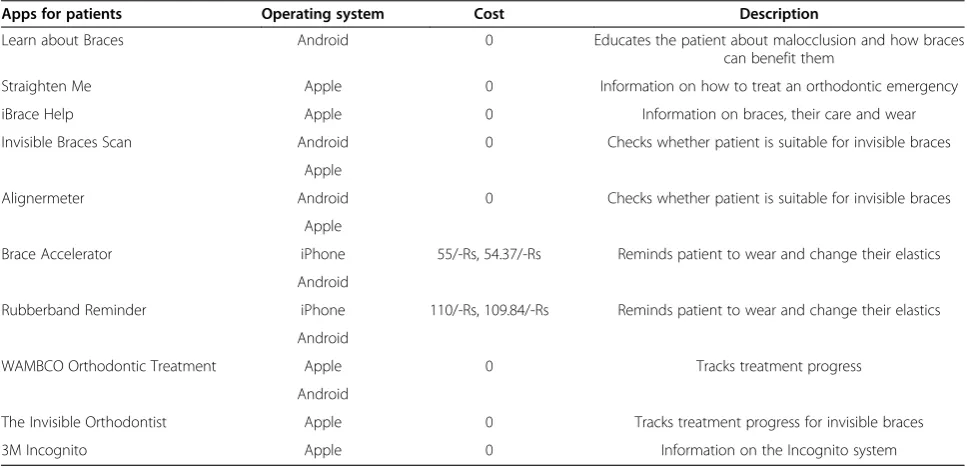
No orthodontic apps were found for windows phone. Apps related to orthodontic clinicians and patients are summarized in Tables 2 and 3, respectively.
Apps for orthodontic clinicians
Out of 15 apps considered to be designed for orthodontic clinicians, two are related to orthodontic news. Through the Orthotown app, we can post new topics, respond to threads, check out the active topics and cases of the day and access Orthotown magazine. The Orthodontic exam proapp is the perfect app for those who want face exams worldwide or take up P.G. Exams like MS Ortho or MOrth RCS. Four apps were used to access publications. The appAmerican Journal of Orthodontics & Dentofacial
Orthopedics, AJO-DO provides access to AJO-DO, a
monthly clinical journal published by AJO-DO. The app Dental press provides access to the Journal of Orthodon-tics and Maxillary Orthopedics with the objective to pub-lish not only scientific studies, but also other text of interest for clinical orthodontics. The appIntl Asso for Or-thodontics provides access to the International Journal of Orthodontics, a quarterly peer- reviewed clinical journal. TheOrthodontic Productsapp is a print and digital publi-cation covering topics such as efficient treatment, staff management, and marketing methods.
Three apps for orthodontic products were found.
Dentaurum Dental Products app offers the current
Dentaurum Group catalogues for the field of orthodontics and other fields.Wired Orthodonticsis produced by Wired Orthodontics Ltd. for the information and reference.Carriere Ortho 3Dapp provides animation of the Carriere Distaliser and assists in patient education about Carriere products.
Four apps were related to diagnosis. SimplyCeph al-lows you to maintain patient records with cephalometric analysis, photographic analysis, and 3D model analysis.
SmileCeph International app only does cephalometric
analysis. iModel Analysis performs several model ana-lysis such as Bolton anaana-lysis, Howes anaana-lysis, Pont and Linder-Harth analyses, etc. Bolton Calc app allows you Table 1 Orthodontically relevant app
OS Category Number
Android For clinician 12
For patient 10
Practice marketing 23
Simulator 4
Total 49
Apple For clinician 15
For patient 13
Practice marketing 30
Simulator 12
to enter the dimensions of teeth and then calculates if tooth-size discrepancy exists. Two practice management apps were also found;Dental Appoint Managerapp allows you to save information of the patient, easily book ap-pointment, and reminds to send mail to patient. Share-Smilezapp integrates with your social media accounts and makes it easy for patients to become your fan during their office visit.
Apps for orthodontic patients
Four orthodontic education apps for patients were found. Learn about Braces app educates the patient about mal-occlusion and the condition that can cause some discom-fort and pain and one can see how braces can benefit them.
Straighten Meuses decision trees which take users to the most appropriate slideshow video with information on how to treat their orthodontic emergency. iBrace Helpis an informative app for people wearing braces or those who are interested in getting orthodontic work done.
Straighten Me and iBrace Help apps are available for
iPhones only. Five simulator apps were available. Out of these, three required the user to pay a charge to download the app. The two other apps that do not charge for down-load are Invisible Braces Scanapp which lets you take a scan of your teeth to check whether the patient is suitable for invisible braces and Alignermeter app which deter-mines if a patient is a candidate for invisible braces in a quick and easy process.
Table 2 Apps relevant to orthodontic clinician
Apps for clinician Operating system Cost Description
Orthotown iPhone 0 New and active topics and cases of the day
Android
Orthodontic Exam Pro Android 2,000.00/-Rs For those who want face exams and take exams
American Journal of Orthodontics & Dentofacial Orthopedics
iPad 0 American Journal of Orthodontics and Dentofacial Orthopedics
Dental Press Apple 0 Dental Press Orthodontics and Facial Orthopedics Journal
Wired Orthodontics Apple 0 Orthodontic laboratory and manufacturer app
Orthodontic Products Apple 0 Orthodontic product news and techniques magazine
SimplyCeph iPad 44,900/-Rs Cephalometric analyzer
SmileCeph International iPad 27,900/-Rs Cephalometric analyzer
iModel Analysis Android 0 Orthodontic model analyzer
Bolton Calc Android 68.99/-Rs Tooth-width ratio analyzer
ShareSmilez Apple 0 Integrates with your social media with patients
Table 3 Apps relevant to orthodontic patients
Apps for patients Operating system Cost Description
Learn about Braces Android 0 Educates the patient about malocclusion and how braces
can benefit them
Straighten Me Apple 0 Information on how to treat an orthodontic emergency
iBrace Help Apple 0 Information on braces, their care and wear
Invisible Braces Scan Android 0 Checks whether patient is suitable for invisible braces
Apple
Alignermeter Android 0 Checks whether patient is suitable for invisible braces
Apple
Brace Accelerator iPhone 55/-Rs, 54.37/-Rs Reminds patient to wear and change their elastics
Android
Rubberband Reminder iPhone 110/-Rs, 109.84/-Rs Reminds patient to wear and change their elastics
Android
WAMBCO Orthodontic Treatment Apple 0 Tracks treatment progress
Android
The Invisible Orthodontist Apple 0 Tracks treatment progress for invisible braces
Three of the patient apps were reminders.Brace Accel-eratorandRubberband Remindersend alerts that remind patients to wear their orthodontic elastics. But, both are paid apps.Align On Timeapp allows patient and clinicians to generate aligner change schedules. Four apps were found for patient progress tracking of treatment. Out of these, one is a paid app. WAMBCO Orthodontic Treat-mentapp is developed by Orthodontist. In this app, the patient will need to enter some of information based on their treatment, to estimate how long the process should take. The patient will probably also need the assistance of their orthodontist to estimate how much of the treatment has been completed (Figures 1 and 2). The Invisible Orthodontist app assists patients with their progress through their treatment plan for invisible braces. Sorri-soOrthois the first app created with the sole objective to enhance the orthodontic experience. The main feature of this app is the ability to customize the app for each
orthodontic office. 3M Incognito was the only one app found targeting patients about their appliance system. This was the app found for iPhone only.
Discussion
Searches for orthodontic apps yield results only for Apple iPhone, iPad, Android smartphone, and tab. This is per-haps a reflection of market impact of these two operating systems.
It was considered that the four keywords ‘braces’,
‘orthodontist’, ‘model analysis’, and ‘orthodontics’ should source most of the orthodontic apps. However, this keyword search gives a large proportion of apps not related to those orthodontic apps. This applied 100% for the Windows apps. Android and Apple oper-ating systems produce 49 and 70 orthodontic related apps, respectively.
Figure 1Example of WAMBCO Orthodontic Treatment app: treatment progress.
A number of apps were found to be useful for orthodon-tic clinicians and could be downloaded without cost. The orthodontic journals might allow access to their publi-cationsviaapps, particularly as online journals become more prevalent. Apps to assist in performing diagnosis may also be useful, both for those in orthodontic train-ing and for practictrain-ing clinicians. These apps are those which assist in performing cephalometry and calculating tooth-size discrepancy. Apps linked to commercial com-panies such as Wired Orthodontics and Carrier Ortho 3D give information related to their company products. Some apps related to practice management gives a clin-ician paperless work in this paper-free world in an easy way to manage patients efficiently.
The apps considered suitable for patients regarding orthodontic education gives information about malocclu-sion and the condition regarding it and how braces can benefit them. The apps suitable for patients utilizing alerts for elastic and aligner wear could be useful for our pa-tients to complete treatment early. Orthodontic treatment time can be reduced and managed better if patients are able to access information on appliance care and treat-ment progress.
Since apps are often small specialized programs, the depth of information available to the clinician and patient can often be limited. Clinician apps such as those for tracing lateral cephalogram (SimplyCeph), calculating tooth size discrepancies (iModel analysis), and staying in touch with patients (Sharesmilez) do as their titles suggest.
Similarly, patient apps were often limited to few func-tions. Rubberband Reminder is a sophisticated alarm re-minder for changing the rubber and Align On Time reminds patients to change their aligners. WAMBCO Orthodontic Treatment app is developed by Orthodontist and it keeps the treatment progress and tells the patient how much time is still required.
It should be considered that by the time of publi-cation, some apps will have been added, while others will have been removed. The further study can be done to know how many clinicians and patients ac-cess smartphones and are willing to download ortho-dontic apps.
Conclusion
In the generation of technology, the use of smartphones and tablets has made life simple. The use of these tech-nologies can be a boon both for the orthodontist and the patients as it aids both in treatment planning and progress in enhancing the treatment outcome.
Competing interests
The authors declare that they have no competing interests.
Authors’contributions
MJB contributed the Concepts, Design, Literature search, Data acquisition, Manuscript preparation, Manuscript editing, Guarantor. NT contributed the Data acquisition, Manuscript editing, Manuscript review and Guarantor. Both authors read and approved the final manuscript.
Received: 24 December 2013 Accepted: 9 April 2014
References
1. Kamel Boulous MN, Steve W, Carlos T, Ray J.How smartphones are changing the face of mobile and participatory healthcare: an overview, with examples from eCAALYX.Biomed Eng Online.2011;10:24. 2. Ol F.Smartphone apps for orthopaedic surgeons.Clin Orthop Relat Res.
2011;469(7):2042–48.
3. Pavan Kumar M, Praveen Kumar N, Vasu Murthy S.Model analysis on a smartphone.JCO.2012;46(06):256–58.
4. Singh P.Orthodontic apps for smartphones.J Orthod.2013;40:249–55. 5. Tom N.A smarter way to practice.BMJ.2011;342:d1124. 268.
6. Errol O, Ark O, Neera A.The smartphone in medicine: a review of current and potential use among physicians and students.J Med Internet Res.
2012;14(5):e 128.
7. Abroms LC, Padmanabhan N, Thawathai, Phillips T.iPhone apps for smoking cessation: a content analysis.Am J Prev Med.2011;40(3):279–85. 8. Rosser BA, Eccleston C.Smartphone application for pain management.J
Telemed Telecare.2011;17(6):308–12.
9. Stanzel BV, Meyer CH.Smartphones in ophthalmology: relief or toys for physicians?Opthalmologe.2012;109(1):8–20.
10. Tahiri Joutei Hassani R, El Sanharawi M, Dupont-Monod S, Boudouin C. Smartphones in opthalmology.J Fr Opthalmol.2013;36(6):499–525. 11. Radrigues MA, Visvanathan A, Murchison JT, Brady RR.Radiology
smartphone applications; current provision and cautions.Insights Imaging.2013;4(5):555–62.
doi:10.1186/s40510-014-0036-y
Cite this article as:Baheti and Toshniwal:Orthodontic apps at fingertips.
Progress in Orthodontics201415:36.
Submit your manuscript to a
journal and benefi t from:
7 Convenient online submission 7 Rigorous peer review
7 Immediate publication on acceptance 7 Open access: articles freely available online 7 High visibility within the fi eld
7 Retaining the copyright to your article