R E S E A R C H
Open Access
Modified systemic inflammatory response
syndrome and provider gestalt predicting
adverse outcomes in children under 5 years
presenting to an urban emergency
department of a tertiary hospital in
Tanzania
Meera R. Nariadhara
1,2*, Hendry R. Sawe
1,2, Michael S. Runyon
3, Victor Mwafongo
1,2and Brittany L. Murray
1,2,4Abstract
Background:Modified systemic inflammatory response syndrome (mSIRS) criteria for the pediatric population together with the provider gestalt have the potential to predict clinical outcomes. However, this has not been studied in low-income countries. We investigated the ability of mSIRS and provider gestalt to predict mortality and morbidity among children presenting to the ED of a tertiary level hospital in Tanzania.
Methods: This prospective observational study enrolled a convenience sample of children under 5 years old, presenting to the Emergency Medicine Department of Muhimbili National Hospital from September 2015 to April 2016. Trained researchers used a structured case report form to record patient demographics, clinical presentation, initial provider gestalt of severity of illness, and the mSIRS criteria. Primary outcomes were 24-h mortality and overall in-hospital mortality. Data was analyzed using simple descriptive statistics, Kruskal-Wallis, Mann-Whitney U, and chi-squared tests.
Results: We enrolled 1350 patients, median age 17 months (interquartile range 8–32 months), and 58% were male. Provider gestalt estimates of illness severity were recorded for all patients and 1030 (76.3%) had complete data for mSIRS categorization. Provider gestalt classified 97 (7.2%) patients as healthy, 546 (40.4%) as mildly ill, 457 (33.9%) as moderately ill, and 250 (18.5%) as severely ill. Of the patients, classifiable by mSIRS, 411/1030 (39.9%) had ≥2 mSIRS criteria. In predicting 24-h mortality, the ≥2 mSIRS and gestalt “severely ill” had sensitivities of 82% and 81%, respectively, and specificity of 61% and 84%, respectively. In predicting overall in-hospital mortality, the≥2 mSIRS and gestalt“severely ill”had sensitivities of 66% and 70% with a specificity of 62% and 86% respectively.
Conclusion:Both the mSIRS and provider gestalt were highly specific for predicting 24-h and overall in-hospital mortality in our patient population. The clinical utility of these assessment methods is limited by the low positive predictive value.
Keywords:mSIRS, Sepsis, Pediatrics, Africa, Emergency medicine, Tanzania
* Correspondence:[email protected]
1
Emergency Medicine Department, Muhimbili University of Health and Allied Sciences, P.O. Box 65001, Dar Es Salaam, Tanzania
2Emergency Medicine Department, Muhimbili National Hospital, Dar Es
Salaam, Tanzania
Full list of author information is available at the end of the article
Background
Rapid early evaluation and treatment of critically ill children has the potential to decrease mortality in resource-limited healthcare facilities [1–4]. Although Tanzania has reduced under-five mortality from 165 to 49 deaths per 1000 live births from 1990 to 2015, the burden still exists [5, 6]. Currently, top causes of under-five mortality in Tanzania are from acute illnesses like pneumonia, malaria, and diar-rhoeal diseases, conditions that are responsive to rapid identification and appropriate timely interventions [7, 8]. The modified systemic inflammatory response syndrome (mSIRS) criteria and provider gestalt are recognized assess-ment tools providing critical information to guide early, lifesaving interventions [9–15].
The mSIRS criteria and provider gestalt are widely used to predict the severity of illnesses in patients across the globe [16]. Where some countries utilize the predictive value of the mSIRS criteria for severity of illness and out-come in patients, some utilize provider gestalt to a greater degree, yet others use them in combination to predict the severity of illness and make management decisions in pediatric patients. Multiple studies documented in the past have established the significance of the mSIRS criteria and/ or provider gestalt in better predicting the severity of illness in patients seen at emergency departments (EDs) [17].
In high-income countries, several studies have been published on the role of mSIRS criteria and provider gestalt to predict various outcomes but none so specifically docu-ments which defined clinical outcome has been elaborately associated with a defined vital signs and/or clinicians’gestalt and to what degree of severity of illness. The gap still exists to demonstrate and explore further on the accuracy of the mSIRS criteria and providers’ gestalt on the severity of illness and pediatric patient outcome. However, there is a lack of data on the accuracy and utility of mSIRS and pro-vider gestalt in low-income countries to risk stratify these pediatric patients.
In Tanzania, the opening of the Emergency Medicine Department (EMD) at Muhimbili National Hospital (MNH) provided an opportunity for an improved care of critically ill children; however, as in most of developing countries, the role of mSIRS criteria and providers’gestalt in the assess-ment of severity of illness in pediatric patients under the age of five presenting to the department had never been studied. We aimed to describe the predictive value of the mSIRS criteria and providers’gestalt with regards to the severity of illness in children under the age of 5 years presenting to an urban emergency department of a tertiary hospital in Tanzania.
Methods Study design
We conducted a prospective descriptive study of pediatric patients, 28 days to 5 years of age presenting to an urban
tertiary EMD at MNH in Tanzania between September 2015 and April 2016. Children less than 28 days old were not included as they are seen at the pediatric neonatal ward and are not cared for in our EMD.
Study setting and population
MNH is a 1500-bed tertiary academic hospital. The EMD acts as an entry point for most patients admitted. Clinical care at EMD is under the supervision of locally trained emergency physician who staff the EMD 24 h every day and oversee care provided by intern doctors (new graduates from medical school training), medical officers (completed 1 year of internship), and emergency medicine residents (formally masters of medicine training after 1–2 years of practice as medical officer). The nursing care is under the supervision of critical care trained nurses, who oversee nursing care provided by degree and diploma trained nurses. Approximately 200 patients a day are seen at the EMD out of which 25% are pediatric patients. There is no pediatric intensive care unit (ICU) at the MNH. Pediatric patients who are critically ill may be admitted to the Acute Pediatric Care Unit (APCU) which only has six beds. EMD policy is to have a pediatric consult for such critically ill children to be able to be admitted to the APCU, and in the event that the APCU is fully occupied, these critically ill children are sent to the general wards for care. Therefore, in this study, we considered the provider obtaining a pediatric consult as a surrogate to the provider believ-ing the child required a higher level of care.
Patients under the age of 5 years were enrolled con-secutively during specified data collection times that were purposefully selected to represent all times of the night and day as well as weekends and weekdays. All patients under the age of 5 years presenting during data collection times were screened for inclusion in the study. Written informed consent was requested from patients’ parents/guardians. Patients whose parents/guardians de-nied consent, those who were deemed dead on arrival, and those who had trauma were excluded.
Patients were then followed up at 24 h and daily until discharge, death in the hospital, or reaching a length of stay (LOS) of 30 days.
Key outcome measures
The primary outcomes were 24-h and overall in-hospital mortality. Secondary outcomes were the need for a higher level of care as represented by admission to the APCU/need for pediatric consult in the ED, EMD mortality, and hospital LOS.
Data analysis
Data were summarized with descriptive statistics, including the counts and percentages and medians and interquartile ranges (IQR). Ninety-five percent confidence intervals (CI) are presented where appropriate. The chi-square test or Fisher’s exact test were used to compare categorical vari-ables, while the Mann-WhitneyUtest was used to compare continuous variables. Outcomes were analyzed comparing the ≥2 mSIRS and < 2 mSIRS categories and comparing between the healthy, mild, and moderate and severe gestalt categories. Loss to follow-up at 24 h were considered as lost to follow-up as there was no way to know if the patient was not registered in the ward, died, or discharged. However, patients lost to follow-up between 24 h and 30 days were considered alive because we could not find them in the mortality data records.
The diagnostic test characteristics and area under the receiver operating characteristic (ROC) curve were calcu-lated for the mSIRS and provider gestalt categories using Microsoft Excel 2016 (Microsoft Corporation, Redmond, WA, USA) and StatsDirect (version 3.0.167, StatsDirect Ltd., Cheshire, UK).
Results
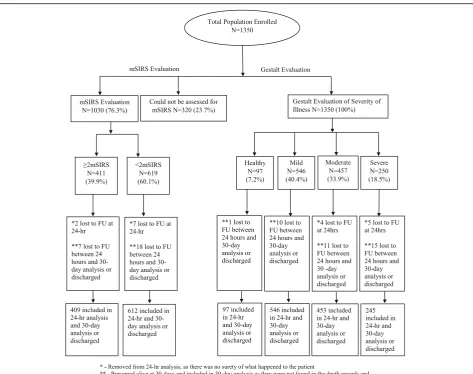
We enrolled 1350 pediatric patients, 320 (23.70%) could not be categorized as per the mSIRS criteria due to the lack of white blood cell counts. Out of the total 1030 (76.30%) children that had available data to determine the mSIRS criteria, 411 (39.90%) had ≥2 mSIRS criteria and 619 (60.10%) had < 2 mSIRS. All patients were evalu-ated by provider gestalt, with 97 (7.19%) patients catego-rized as healthy, 546 (40.44%) as mildly ill, 457 (33.85%) as moderately ill, and 250 (18.52%) as severely ill. Overall, 9 (0.67%) patients were lost to follow-up at 24 h and 37 (2.74%) were lost to follow-up at 30-day analysis or upon being discharged from hospital (Fig.1).
Baseline demographic characteristics of the study population
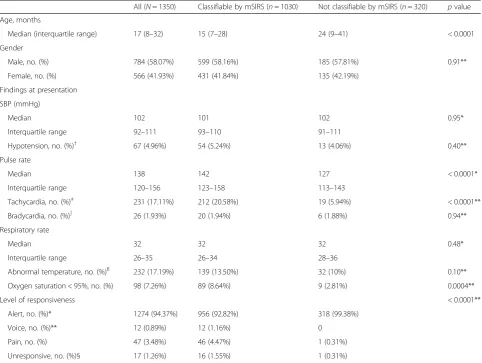
The median age of our population was 17 months (IQR 8– 32 months) with a male predominance (784/1350, 58.07%). Children categorized into being assessable by the mSIRS criteria were found to be younger than those who could
not be categorized by the mSIRS criteria (p< 0.0001) and were more likely to present with hypoxia (Table1).
Children classified into the severely ill category were more likely to be younger, have altered mental status, and be febrile when compared to all other gestalt categories (allp< 0.05). Patients in the severe gestalt category were also more likely to be hypotensive than those in the healthy category (p= 0.0462) (Additional file1: Table S1).
Primary and secondary outcomes
Patients with the ≥2 mSIRS criteria were more likely to have adverse events than those with < 2 mSIRS criteria: 24-h mortality in the≥2 mSIRS group was 27/409 (6.60%, 95% CI 4.19 to 9.01%) versus 6/612 (0.98%, 95% CI 0.20 to 1.80%) in the < 2 mSIRS group (p< 0.0001), and overall in-hospital mortality analyzed at 30 days in the≥2 mSIRS group was 65/409 (15.90%, 95% CI 12.30 to 19.40%) versus 33/612 (5.39%, 95% CI 3.60 to 7.20%) in the < 2 mSIRS group (p= < 0.0001). ED mortality in the≥2 mSIRS group was 9/411 (2.19%, 95% CI 0.78 to 3.60) versus in the < 2 mSIRS group 1/619 (0.16%, 95% CI−0.15 to 0.47%) (p= 0.0012). There were no significant differences between children with ≥2 mSIRS and < 2 mSIRS in relation to need for pediatric consultation in the ED/APCU admis-sion or hospital LOS (Table2).
Primary and secondary outcomes by provider gestalt category
All 12 children who died in the ED were categorized into the severe provider gestalt category. All patients catego-rized as healthy survived throughout the study period. At 24-h follow-up, 2/546 (0.37%, 95% CI−0.14 to 0.88%) pa-tients categorized as mildly ill died, compared with 5/453 (1.10%, 95% CI 0.14 to 2.06%) patients in the moderately ill category and 30/245 (12.24%, 95% CI 8.14 to 16.34%) patients in the severely ill category (p= < 0.0001).
Overall in-hospital mortality was 10/546 (1.83%, 95% CI 0.70 to 3.0%) in the mildly ill category, 22/453 (4.86%, 95% CI 2.90 to 6.80%) in the moderately ill category, and 75/245 (30.61%, 95% CI 24.80 to 36.40%) in the se-verely ill category (p< 0.0001).
The need for pediatric consult in the ED or APCU admission was significantly higher in the severe gestalt category versus all other gestalt categories (allp< 0.0001). LOS was significantly different between all provider gestalt categories and it increased with increasing severity of ge-stalt categorization (p< 0.0001) (Table3).
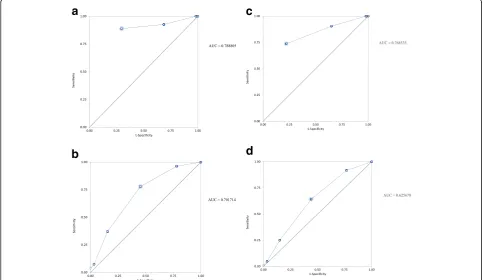
For 24-h mortality, the severe gestalt category had a sen-sitivity of 81%, a specificity of 84%, a PPV of 12%, a LR+ of 4.90, and a LR− of 0.23 when compared to all other categories combined. For overall in-hospital mortality, the severe gestalt category had a sensitivity of 70%, a specifi-city of 86%, a PPV of 30%, a LR+ of 5.00, and a LR−of 0.35 when compared to all other categories combined. The area under the receiver operating characteristic (ROC) curve for 24-h mortality in the≥2 mSIRS was 0.70 (95% CI 0.61 to 0.79), and for severe provider, gestalt was 0.79 (95% CI 0.71 to 0.86). The area under the ROC curve for overall in-hospital mortality in the ≥2 mSIRS was 0.63 (95% CI 0.57 to 0.68), and for severe provider, gestalt was 0.77 (95% CI 0.72 to 0.82) (Fig. 2 a–d).
Discussion
The high level of acuity seen in our population of under-fives was consistent with that found in other acute care and in-hospital settings in sub-Saharan Africa [5, 19–24].
Various other studies in sub-Saharan Africa demonstrated a large burden of critically ill children of under-fives with vary-ing mortality and case fatality rates that are similar to the overall mortality of 7.78% found in our study [5,22,25,26]. These under-five acuity levels, mortality, and admission rates are much higher than those reported from hospitals in high-resource settings [5,6]. This combination of acuity in the under-five population and lack of resources dedi-cated to acute care in sub-Saharan Africa exemplifies why a mechanism to stratify children that are acutely ill into categories that may help providers triage and prioritize them more reliably is necessary [24,27,28]. In this study, we attempted to do this using the mSIRS and provider gestalt.
Table 1Baseline demographic characteristics of the study population
All (N= 1350) Classifiable by mSIRS (n= 1030) Not classifiable by mSIRS (n= 320) pvalue
Age, months
Median (interquartile range) 17 (8–32) 15 (7–28) 24 (9–41) < 0.0001
Gender
Male, no. (%) 784 (58.07%) 599 (58.16%) 185 (57.81%) 0.91**
Female, no. (%) 566 (41.93%) 431 (41.84%) 135 (42.19%)
Findings at presentation
SBP (mmHg)
Median 102 101 102 0.95*
Interquartile range 92–111 93–110 91–111
Hypotension, no. (%)† 67 (4.96%) 54 (5.24%) 13 (4.06%) 0.40**
Pulse rate
Median 138 142 127 < 0.0001*
Interquartile range 120–156 123–158 113–143
Tachycardia, no. (%)‡ 231 (17.11%) 212 (20.58%) 19 (5.94%) < 0.0001**
Bradycardia, no. (%)∫ 26 (1.93%) 20 (1.94%) 6 (1.88%) 0.94**
Respiratory rate
Median 32 32 32 0.48*
Interquartile range 26–35 26–34 28–36
Abnormal temperature, no. (%)ǁ 232 (17.19%) 139 (13.50%) 32 (10%) 0.10**
Oxygen saturation < 95%, no. (%) 98 (7.26%) 89 (8.64%) 9 (2.81%) 0.0004**
Level of responsiveness < 0.0001**
Alert, no. (%)* 1274 (94.37%) 956 (92.82%) 318 (99.38%)
Voice, no. (%)** 12 (0.89%) 12 (1.16%) 0
Pain, no. (%) 47 (3.48%) 46 (4.47%) 1 (0.31%)
Unresponsive, no. (%)§ 17 (1.26%) 16 (1.55%) 1 (0.31%)
a
Hypotension was defined as systolic blood pressure of less than 75 mmHg in children aged 1 month to more than 5 years and less than 74 mmHg in children aged 2 to 5 years
‡Tachycardia was a heart rate of more than 180 beats per minute in children aged 1 month to less than 2 years and more than 140 bpm in children aged
2 to 5 years
∫Bradycardia was defined as less than 90 bpm in children aged 1 month to less than 2 years, and it was not applicable to children aged 2 to 5 years
ǁTemperate was defined as measuring at the axilla, either less than 35.4 °C or more than 37.9 °C
*Alertness in a child was defined as the child being active
**Responding to voice was defined as the child responded when called his/her name by the parent/guardian in children aged less than 1 year and child responding by making sound or words in children aged more than 1 year
Painful stimulus in a child was defined as when the child was touched or inflicted pain, cried, or grimaced
§
Unresponsiveness was defined as the child not responding to any external stimulus
Table 2Primary and secondary outcomes in the≥2 mSIRS and < 2 mSIRS categories
Category ≥2 mSIRS < 2 mSIRS pvalue
Primary outcomes N= 411 N= 619
n % 95% CI n % 95% CI
24-h mortality 27 6.6 4.2–9.0 6 0.98 0.2–1.8 < 0.0001
Mortality (in hospital) 65 15.9 12.5–19.8 33 5.4 3.6–7.2 < 0.0001
Secondary outcomes N= 411 N= 619
APCU admission/pediatric consult 22 5.4 3.2–7.6 20 3.2 1.8–4.6 0.09
ED mortality 9 2.2 0.8–3.6 1 0.2 0.15–0.55 0.001
to be assessed by the mSIRS criteria due to lack of WBC. Furthermore, a third (n= 411/1350) of our study population was categorized to have≥2 mSIRS criteria and that means these ill children should be immediately attended to with a higher level of care. The limited resources make it difficult to cater for this large percentage of population identified as possibly critically ill in a timely manner. In countries with more resources and lower burden of critically ill children, the mSIRS criteria have been successfully used to identify children who require immediate care; however, this is
possible only because there are more resources avail-able and a lower percentage of patients classified to have the≥2 mSIRS criteria [14,31–33].
On the contrary, in line with our findings, research conducted in other areas of sub-Saharan Africa on the utilization of the mSIRS criteria has identified a high percentage of children with≥2 mSIRS with a low sensi-tivity for having adverse outcomes which poses a chal-lenge for health care providers to appropriately prioritize patients for timely treatment [30, 34–36]. Therefore,
Table 3Primary and secondary outcomes by provider gestalt category
Outcome Healthy Mild Moderate Severe pvalue
Primary outcomes
N= 97 N= 546 N= 453 N= 245
24-h mortality 0 2 (0.4%, 95% CI−0.13 to 0.93%) 5 (1.1%, 95% CI 0.14–2.06%) 30 (12.2%, 95% CI 8.10–16.30%) < 0.0001
In-hospital mortality
0 10 (1.8%, 95% CI 0.70–3.00%) 22 (4.9%, 95% CI 2.90–6.80%) 75(30.6%,95%CI 24.80–36.40%) < 0.0001
Secondary outcomes
N= 97 N = 546 N= 457 N= 250
APCU admission/ pediatric consult
2 (2.1%, 95% CI −0.75 to 4.95%)
6 (1.1%, 95% CI 0.23–1.97%) 14 (3.1%, 95% CI 1.51–4.69%) 24 (9.6%, 95% CI 5.95–13.25%) < 0.0001
ED mortality 0 0 0 12 (4.8%, 95% CI 2.15–7.45%) < 0.0001
LOS 0 IQR 0–0 0 IQR 0–4 3 IQR 0–7.8 6.5 IQR 2–13 < 0.0001
*Removed from the 24-h analysis, as there was no surety of what happened to the patient
**Presumed alive at 30 days and included in the 30-day analysis as they were not found in the death records and hence included in 30-analysis
a
b
d
c
there is a need for criteria that can be utilized in low resource settings, which providers can use to appropri-ately triage and care for these patients.
Subjective methods of identifying critically ill children have also shown to be an effective way to prioritize and treat in high resource settings. Provider gestalt is one such subjective method that has shown utility in high-income countries [13, 15]. However, the sensitivity of provider ge-stalt has been variable, from being superior to established clinical decision rules to being inadequate or equipotent in predicting adverse outcomes [13,15,37–42]. In our study, the provider gestalt better predicted the adverse outcomes when compared to the mSIRS criteria; however, individu-ally, neither had a high enough positive predictive value to be of clinical utility. Although provider gestalt predicted the adverse events better than did the≥2 mSIRS criteria, they both classified too many children in the critically ill category.
Considering the above findings, we feel ≥2 mSIRS cri-teria and provider gestalt do not have high enough positive predictive value to allow the classification and rapid treat-ment of critically ill children in resource-limited settings because they simply identify too many children as fitting the most severe categories. We found that both mSIRS and gestalt miss an average of 1 out of 5 children who die within 24 h, which is relatively high given the severity of the outcome observed. We suggest that research to determine more objective ways to stratify these large critically ill child populations presenting to resource-limited settings that could provide timely and appropriate interventions to them. Furthermore, we considered patients identified by provider gestalt as having severe illness, who did not die, to be false positives; it is possible that some who might have died had clinicians not intervened after identifying them as being high risk.
In a limited resource setting, a tool with a slightly lower specificity and a higher sensitivity may be appropri-ate as it may allow more critically ill children to be treappropri-ated in a timely manner with a trade-off not identifying some critically ill children. This tool would need to be carefully designed to do the best for most critically ill children and maximize the use of the available resources in these set-tings. The realization of this would improve care and re-duce morbidity and mortality in resource-limited settings in pediatric population.
Limitations
This study was limited by the fact that we utilized convenience sampling. We purposefully included re-search shifts on holidays, weekends, and all times of the day and night to represent actual population as best as possible.
Another limitation was that we chose to utilize the mSIRS criteria to categorize patients without further
specific evaluation for infection that would have classified them as possible sepsis. We chose this as children without infection may also have inflammation resulting in the ≥2 mSIRS criteria, but it did make it difficult to compare our population to the existing literature that focuses on sepsis. It is also possible that the providers may have instinctively incorporated the knowledge of the mSIRS criteria into re-spective gestalt classification, so the researchers felt this classification may not have been independent of each other. Finally, this was a single-center study performed at a national hospital; this may limit the generalizability of the study results at other levels in the health care system. However, it is our hope that MNH, being a tertiary level referral hospital, that receives patients from the entire country, will be reflective of the highest level of care in the nation.
Conclusion
The mSIRS criteria and provider gestalt both predict adverse outcomes in children presenting with acute crit-ical illness at EMD, MNH. Provider gestalt has a better positive predictive value in predicting adverse outcomes; however, neither the mSIRS criteria nor provider gestalt had a high enough positive predictive value to be useful in resource-limited settings. There remains a clear need for better pediatric illness categorization tools purposefully designed for resource-limited settings.
Additional files
Additional file 1:Table S1.Baseline Demographics of children
evaluating Gestalt. (DOCX 18 kb)
Abbreviations
APCU:Acute Pediatric Care Unit; ED: Emergency department; EMD: Emergency Medicine Department; IQR: Interquartile range; LOS: Length of stay; MNH: Muhimbili National Hospital; mSIRS: Modified systemic inflammatory response syndrome; MUHAS: Muhimbili University of Health and Allied Sciences; SIRS: Systemic inflammatory response syndrome; WHO: World Health Organization
Acknowledgements
Thank you Dr. Juma Mfinanga and Stacy Salerno for their kind support throughout the study period.
Funding
This was a non-funded project; the principal investigators used their own funds to support the data collection and logistics.
Availability of data and materials
The dataset supporting the conclusion of this article is available from the authors on request.
Authors’contributions
the proposal and manuscript. BM was involved in the conception and design of the study, analyzed and interpreted data, critically reviewed the manuscript, and assisted in the writing of the manuscript. All authors read and approved the final manuscript.
Ethics approval and consent to participate
Ethical clearance was obtained from the Institution Review Board, Research and Publication Committee of the Muhimbili University of Health and Allied Sciences (MUHAS) and the Director of Medical Services of MNH. We obtained written informed consent from participants’guardian or parents prior to participation into the study.
Consent for publication
Not applicable.
Competing interests
The authors declare that they have no competing interests.
Publisher’s Note
Springer Nature remains neutral with regard to jurisdictional claims in published maps and institutional affiliations.
Author details
1
Emergency Medicine Department, Muhimbili University of Health and Allied Sciences, P.O. Box 65001, Dar Es Salaam, Tanzania.2Emergency Medicine
Department, Muhimbili National Hospital, Dar Es Salaam, Tanzania.
3Deparment of Emergency Medicine, Carolinas Medical Centre, Charlotte, NC,
USA.4Department of Emergency Medicine, Division of Pediatric Emergency Medicine, Emory University School of Medicine, Atlanta, GA, USA.
Received: 24 September 2018 Accepted: 14 January 2019
References
1. Turner EL, Nielsen KR, Jamal SM, von Saint André-von Arnim A, Musa NL. A review of pediatric critical care in resource-limited settings: a look at past, present, and future directions. Front Pediatr. 2016 [cited 2016 Nov 27];4 Available from:http://www.ncbi.nlm.nih.gov/pmc/articles/PMC4757646/. 2. Mpimbaza A, Sears D, Sserwanga A, Kigozi R, Rubahika D, Nadler A, et al. Admission risk score to predict inpatient pediatric mortality at four public hospitals in Uganda. PLoS One. 2015;10(7):e0133950.
3. Mugeni C, Levine AC, Munyaneza RM, Mulindahabi E, Cockrell HC, Glavis-Bloom J, et al. Nationwide implementation of integrated community case management of childhood illness in Rwanda. Glob Health Sci Pract. 2014;2(3):328–41.
4. Cheema B, Stephen C, Westwood A. Paediatric triage in South Africa. South Afr J Child Health. 2013;7(2):43–5.
5. WHO | Under-five mortality [Internet]. WHO. [cited 2016 Aug 21]. Available from:http://www.who.int/gho/child_health/mortality/mortality_ under_five_text/en/
6. Mortality rate, under-5 (per 1,000 live births) | Data [Internet]. [cited 2016 Aug 21]. Available from:http://data.worldbank.org/indicator/SH.DYN.MORT 7. WHO | Tanzania [Internet]. WHO. [cited 2016 Jul 27]. Available from:
http://www.who.int/pmnch/activities/countries/tanzania/en/index1.html 8. WHO | United Republic of Tanzania [Internet]. WHO. [cited 2016 Aug 10].
Available from:http://www.who.int/countries/tza/en/
9. Pavare J, Grope I, Gardovska D. Prevalence of systemic inflammatory response syndrome (SIRS) in hospitalized children: a point prevalence study. BMC Pediatr. 2009;9:25.
10. Taniguchi LU, Pires EMC, Jr V, Mauro J, de Azevedo LCP, Taniguchi LU, et al. Systemic inflammatory response syndrome criteria and the prediction of hospital mortality in critically ill patients: a retrospective cohort study. Rev Bras Ter Intensiva. 2017;29(3):317–24.
11. Walsh P, Thornton J, Asato J, Walker N, McCoy G, Baal J, et al. Approaches to describing inter-rater reliability of the overall clinical appearance of febrile infants and toddlers in the emergency department. PeerJ. 2014;2:e651. 12. Frazier SB, Sepanski R, Mangum C, Bovat C, Zaritsky A, Godambe S. Association
of systemic inflammatory response syndrome with clinical outcomes of pediatric patients with pneumonia. South Med J. 2015;108(11):665–9. 13. Penaloza A, Verschuren F, Meyer G, Quentin-Georget S, Soulie C, Thys F, et
al. Comparison of the unstructured clinician gestalt, the wells score, and the
revised Geneva score to estimate pretest probability for suspected pulmonary embolism. Ann Emerg Med. 2013;62(2):117–124.e2. 14. MacCallum NS, Finney SJ, Gordon SE, Quinlan GJ, Evans TW. Modified
criteria for the systemic inflammatory response syndrome improves their utility following cardiac surgery. Chest. 2014;145(6):1197–203.
15. Kabrhel C, Camargo CA, Goldhaber SZ. Clinical gestalt and the diagnosis of pulmonary embolism: does experience matter? Chest. 2005;127(5):1627–30. 16. Gestalt therapy. In: Wikipedia, the free encyclopedia [Internet]. 2014 [cited
2014 Dec 27]. Available from:http://en.wikipedia.org/w/index.php?title= Gestalt_therapy&oldid=638344485
17. Manual Vital Signs Reliably Predict Need for Life-Saving Int.: Journal of Trauma and Acute Care Surgery [Internet]. LWW. [cited 2014 Dec 25]. Available from:http://journals.lww.com/jtrauma/Fulltext/2005/10000/ Manual_Vital_Signs_Reliably_Predict_Need_for.3.aspx
18. Bone RC, Balk RA, Cerra FB, Dellinger RP, Fein AM, Knaus WA, et al. Definitions for sepsis and organ failure and guidelines for the use of innovative therapies in sepsis. The ACCP/SCCM Consensus Conference Committee. American College of Chest Physicians/Society of Critical Care Medicine. Chest. 1992;101(6):1644–55.
19. Maitland K, Kiguli S, Opoka RO, Engoru C, Olupot-Olupot P, Akech SO, et al. Mortality after fluid bolus in African children with severe infection. N Engl J Med. 2011;364(26):2483–95.
20. Wamani H, Åstrøm AN, Peterson S, Tumwine JK, Tylleskär T. Boys are more stunted than girls in sub-Saharan Africa: a meta-analysis of 16 demographic and health surveys. BMC Pediatr. 2007;7:17.
21. Rice B, Periyanayagam U, Chamberlain S, Dreifuss B, Hammerstedt H, Nelson S, et al. Mortality in children under five receiving nonphysician clinician emergency care in Uganda. Pediatrics. 2016;137(3):e20153201.
22. Menge I, Esamai F, Van Reken D, Anabwani G. Paediatric morbidity and mortality at the Eldoret District Hospital, Kenya. East Afr Med J. 1995;72(3):165–9. 23. Ayieko P, Okiro EA, Edwards T, Nyamai R, English M. Variations in mortality
in children admitted with pneumonia to Kenyan hospitals. PLoS One. 2012;7(11):e47622.
24. Robertson M, Molyneux E. Triage in the developing world—can it be done? Arch Dis Child. 2001;85(3):208–13.
25. English M, Esamai F, Wasunna A, Were F, Ogutu B, Wamae A, et al. Assessment of inpatient paediatric care in first referral level hospitals in 13 districts in Kenya. Lancet. 2004;363(9425):1948–53.
26. Berkley JA, Lowe BS, Mwangi I, Williams T, Bauni E, Mwarumba S, et al. Bacteremia among children admitted to a rural Hospital in Kenya. N Engl J Med. 2005;352(1):39–47.
27. Maldonado T, Avner JR. Triage of the pediatric patient in the emergency department: are we all in agreement? Pediatrics. 2004;114(2):356–60. 28. WHO | Paediatric emergency triage, assessment and treatment: care of
critically-ill children [Internet]. WHO. [cited 2017 Dec 26]. Available from: http://www.who.int/maternal_child_adolescent/documents/paediatric-emergency-triage-update/en/
29. Horeczko T, Green JP. Emergency department presentation of the pediatric systemic inflammatory response syndrome. Pediatr Emerg Care. 2013 Nov;29(11):1153–8. 30. Weiss SL, Fitzgerald JC, Pappachan J, Wheeler D, Jaramillo-Bustamante JC,
Salloo A, et al. Global epidemiology of pediatric severe sepsis: the sepsis prevalence, outcomes, and therapies study. Am J Respir Crit Care Med. 2015 May 15;191(10):1147–57.
31. Back to Basics: Validation of the Admission Systemic Inflamm.: Journal of Trauma and Acute Care Surgery [Internet]. LWW. [cited 2016 Aug 21]. Available from:http://journals.lww.com/jtrauma/Fulltext/2001/09000/Back_ to_Basics__Validation_of_the_Admission.6.aspx
32. Systemic Inflammatory Response Syndrome Score at Admission I.: Journal of Trauma and Acute Care Surgery [Internet]. LWW. [cited 2016 Aug 21]. Available from:http://journals.lww.com/jtrauma/Fulltext/2000/10000/ Systemic_Inflammatory_Response_Syndrome_Score_at.11.aspx
33. Norwood MGA, Bown MJ, Lloyd G, Bell PRF, Sayers RD. The clinical value of the systemic inflammatory response syndrome (SIRS) in abdominal aortic aneurysm repair. Eur J Vasc Endovasc Surg. 2004;27(3):292–8.
34. Murthy S, Leligdowicz A, Adhikari NKJ. Intensive care unit capacity in low-income countries: a systematic review. PLoS One. 2015;10(1):e0116949. 35. Kwizera A, Dünser M, Nakibuuka J. National intensive care unit bed capacity and ICU
patient characteristics in a low income country. BMC Res Notes. 2012;5:475. 36. Austin S, Murthy S, Wunsch H, Adhikari NKJ, Karir V, Rowan K, et al. Access
37. Kroenke K, Wyrwich KW, Tierney WM, Babu AN, Wolinsky FD. Physician-estimated disease severity in patients with chronic heart or lung disease: a cross-sectional analysis. Health Qual Life Outcomes. 2006;4:60.
38. Sawe HR, Mfinanga JA, Mwafongo V, Reynolds TA, Runyon MS. The test characteristics of physician clinical gestalt for determining the presence and severity of anaemia in patients seen at the emergency department of a tertiary referral hospital in Tanzania. Emerg Med J. 2015;33(5):338–44. 39. Mehra MR. Review: clinical gestalt strategies and clinical prediction rules
have similar discriminate pretest probabilities of pulmonary embolism. Evid Based Med. 2004;9(5):155.
40. Tulaimat A, Gueret RM, Wisniewski MF, Samuel J. Association between rating of respiratory distress and vital signs, severity of illness, intubation, and mortality in acutely ill subjects. Respir Care. 2014;59(9):1338–44. 41. Can emergency physicians“rule in”and“rule out”acute myocardial
infarction with clinical judgement? - PubMed - NCBI [Internet]. [cited 2016 Jul 18]. Available from:http://www.ncbi.nlm.nih.gov/pubmed/25016388. 42. Thompson DD, Murray GD, Sudlow CLM, Dennis M, Whiteley WN.