R E V I E W
Open Access
Image-based camera localization: an
overview
Yihong Wu
*, Fulin Tang and Heping Li
Abstract
Virtual reality, augmented reality, robotics, and autonomous driving, have recently attracted much attention from
both academic and industrial communities, in which image-based camera localization is a key task. However, there
has not been a complete review on image-based camera localization. It is urgent to map this topic to enable
individuals enter the field quickly. In this paper, an overview of image-based camera localization is presented. A
new and complete classification of image-based camera localization approaches is provided and the related
techniques are introduced. Trends for future development are also discussed. This will be useful not only to
researchers, but also to engineers and other individuals interested in this field.
Keywords:
PnP problem, SLAM, Camera localization, Camera pose determination
Background
Recently, virtual reality, augmented reality, robotics,
au-tonomous driving etc., in which image-based camera
localization is a key task, have attracted much attention
from both academic and industrial community. It is
ur-gent to provide an overview of image-based camera
localization.
The sensors used for image-based camera localization
are cameras. Many types of three-dimensional (3D)
cam-eras have been developed recently. This study considers
two-dimensional (2D) cameras. The typically used tool
for outdoor localization is GPS, which cannot be used
indoors. There are many indoor localization tools
in-cluding Lidar, Ultra Wide Band (UWB), Wireless Fidelity
(WiFi), etc.; among these, using cameras for localization
is the most flexible and low cost approach. Autonomous
localization and navigation is necessary for a moving
robot. To augment reality in images, camera pose
deter-mination or localization is needed. To view virtual
envi-ronments, the corresponding viewing angle is necessary
to be computed. Furthermore, cameras are ubiquitous
and people carry mobile phones that have cameras every
day. Therefore, image-based camera localization has
great and widespread applications.
The image features of points, lines, conics, spheres,
and angles are used in image-based camera localization;
of these, points are most widely used. This study focuses
on points.
Image-based camera localization is a broad topic. We
attempt to cover related works and give a complete
classification for image-based camera localization
ap-proaches. However, it is not possible to cover all related
works in this paper due to length constraints. Moreover,
we cannot provide deep criticism for each cited paper
due to space limit for such an extensive topic. Further
deep reviews on some active important aspects of
image-based camera localization will be given in the
fu-ture or people interested go to read already existing
sur-veys. There have been excellent reviews on some aspects
of image-based camera localization. The most recent
ones include the following. Khan and Adnan [
1
] gave an
overview of ego motion estimation, where ego motion
requires time intervals between two continuous images
to be small enough. Cadena et al. [
2
] surveyed the current
state of simultaneous localization and mapping (SLAM)
and considered future directions, in which they reviewed
related works including robustness and scalability in
long-term mapping, metric and semantic representations
for mapping, theoretical performance guarantees, active
SLAM, and exploration. Younes et al. [
3
] specially
reviewed keyframe-based monocular SLAM. Piasco et al.
[
4
] provided a survey on visual-based localization from
* Correspondence:[email protected]
National Laboratory of Pattern Recognition, Institute of Automation, Chinese Academy of Sciences, Beijing, China, University of Chinese Academy of Sciences, Beijing, China
heterogeneous data, where only known environment is
considered.
Unlike these studies, this study is unique in that it first
maps the whole image-based camera localization and
pro-vides a complete classification for the topic.
“
Overview
”
section presents an overview of image-based camera
localization and is mapped as a tree structure.
“
Reviews on
image-based camera localization
”
section introduces each
aspect of the classification.
“
Discussion
”
section presents
discussions and analyzes trends of future developments
“
Conclusion
”
section makes a conclusion of the paper.
Overview
What is image-based camera localization? Image-based
camera localization is to compute camera poses under a
world coordinate system from images or videos captured
by the cameras. Based on whether the environment is
known beforehand or not, image-based camera localization
can be classified into two categories: one with known
envir-onment and the other with unknown envirenvir-onment.
Let
n
be the number of points used. The approach
with known environments consists of methods with 3
≤
n
< 6 and methods with
n
≥
6. These are PnP problems.
In general, the problems with 3
≤
n
< 6 are nonlinear and
those with
n
≥
6 are linear.
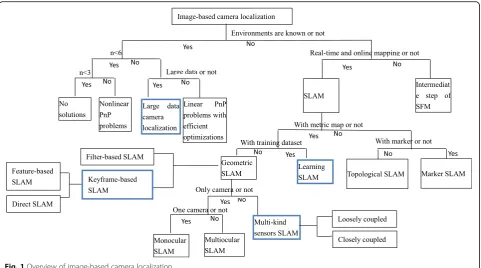
The approach with unknown environments can be
di-vided into methods with online and real-time
environ-ment mapping and those without online and real-time
environment mapping. The former is the commonly
known Simultaneous Localization and Mapping (SLAM)
and the latter is an intermediate procedure of the
com-monly known structure from motion (SFM). According to
different map generations, SLAM is divided into four
parts: geometric metric SLAM, learning SLAM,
topo-logical SLAM, and marker SLAM. Learning SLAM is a
new research direction recently. We think it is different
from geometric metric SLAM and topological SLAM by a
single category. Learning SLAM can obtain camera pose
and 3D map but needs a prior dataset to train the
net-work. The performance of learning SLAM depends on the
used dataset to a great extent and it has low generalization
capability. Therefore, learning SLAM is not as flexible as
geometric metric SLAM and its obtained 3D map outside
the used dataset is not as accurate as geometric metric
SLAM most of the time. However, simultaneously,
learning SLAM has a 3D map other than topology
repre-sentations. Marker SLAM computes camera poses from
known structured markers without knowing the complete
environment. Geometric metric SLAM consists of
mon-ocular SLAM, multimon-ocular SLAM, and multi-kind sensor
SLAM. Moreover, geometric metric SLAM can be
classi-fied into filter-based SLAM and keyframe-based SLAM.
Keyframe-based SLAM can be further divided into
feature-based SLAM and direct SLAM. Multi-kind sensors
SLAM can be divided into loosely coupled SLAM and
closely coupled SLAM. These classifications of image-based
camera localization methods are visualized as a logical tree
structure, as shown in Fig.
1
, where current active topics are
indicated with bold borders. We think that these topics are
camera localization from large data, learning SLAM,
keyframe-based SLAM, and multi-kind sensors SLAM.
Reviews on image-based camera localization
Known environments
Camera pose determination from known 3D space
points is called the perspective-n-point problem, namely,
the PnP problem. When
n
= 1,2, there are no solutions
for PnP problems because they are under constraints.
When
n
≥
6, PnP problems are linear. When
n
= 3, 4, 5,
the original equations of PnP problems are usually
non-linear. The PnP problem dated from 1841 to 1903.
Grunert [
5
], Finsterwalder to Scheufele [
6
] concluded that
the P3P problem has at most four solutions and the P4P
problem has a unique solution in general. The PnP
prob-lem is also the key relocalization for SLAM.
PnP problems with n = 3, 4, 5
The methods to solve PnP problems with
n
= 3, 4, 5
focus on two aspects. One aspect studies the solution
numbers or multisolution geometric configuration of the
nonlinear problems. The other aspect studies
elimina-tions or other solving methods for camera poses.
studied the multisolution probabilities of the equilateral P3P
problem.
The methods that focus on the second aspect of PnP
problems with
n
= 3, 4, 5 are as follows. Horaud et al.
[
13
] described an elimination method for the P4P
prob-lem to obtain a unitary quartic equation. Haralick et al.
[
14
] reviewed six methods for the P3P problem, which
are [
5
–
7
,
15
–
17
]. Dementhon and Davis [
18
] presented
a solution of the P3P problem by an inquiry table of
quasi-perspective imaging. Quan and Lan [
19
] linearly
solved the P4P and P5P problems. Gao et al. [
20
] used
Wu
’
s elimination method to obtain complete solutions
of the P3P problem. Wu and Hu [
10
] introduced a
depth-ratio-based approach to represent the solutions of
the complete PnP problem. Josephson and Byrod [
21
]
used Grobner bases method to solve the P4P problem
for radial distortion of camera with unknown focal
length. Hesch et al. [
22
] studied nonlinear square
solu-tions of PnP with
n
>= 3. Kneip et al. [
23
] directly solved
the rotation and translation solutions of the P3P
prob-lem. Kneip et al. [
24
] presented a unified PnP solution
that can deal with generalized cameras and
multisolu-tions with global optimizamultisolu-tions and linear complexity.
Kuang and Astrom [
25
] studied the PnP problem with
unknown focal length using points and lines. Z.
Kuke-lova et al. [
26
] studied the PnP problem with unknown
focal length for images with radial distortion. Ventura
et al. [
27
] presented a minimal solution to the
general-ized pose-and-scale problem. Zheng et al. [
28
]
intro-duced an angle constraint and derived a compact
bivariate polynomial equation for each P3P and then
proposed a general method for the PnP problem with
unknown focal length using iterations. Later, Zheng and
Kneip [
29
] improved their work without requiring point
order and iterations. Wu [
30
] studied PnP solutions with
unknown focal length and
n
= 3.5. Albl et al. [
31
] studied
the pose solution of a rolling shutter camera and
im-proved the result later in 2016.
PnP problems with n
≥
6
When
n
> = 6, PnP problems are linear and studies on
them focus on two aspects. One aspect studies efficient
optimizations for camera poses from smaller number of
points. The other aspect studies fast camera localization
from large data.
accurate localization and pose estimation for large 3D
models considering gravitational direction. Ozyesil et al.
[
41
] provided robust camera location estimation by
convex programming. Brachmann et al. [
42
] showed
uncertainty-driven 6D pose estimation of objects and
scenes from a single RGB image. Feng et al. [
43
]
pro-posed a hand-eye calibration-free strategy to actively
relocate a camera in the same 6D pose by sequentially
correcting relative 3D rotation and translation. Nakano
[
44
] solved three kinds of PnP problems by the Grobner
method: PnP problem for calibrated camera, PnPf
prob-lem for cameras with unknown focal length, PnPfr
problem for cameras with unknown focal length and
unknown radial distortions.
The studies on the second aspect that focus on fast
cam-era localization from large data are as follows. Arth et al.
[
45
,
46
] presented real-time camera localizations for mobile
phones. Sattler et al. [
47
] derived a direct matching
frame-work based on visual vocabulary quantization and a
priori-tized correspondence search with known large-scale 3D
models of urban scenes. Later, they improved the method
by active correspondence search in [
48
]. Li et al. [
49
]
de-vised an adaptive, prioritized algorithm for matching a
rep-resentative set of SIFT features covering a large scene to a
query image for efficient localization. Later Li et al. [
50
]
provided a full 6-DOF-plus-intrinsic camera pose with
re-spect to a large geo-registered 3D point cloud. Lei et al.
[
51
] studied efficient camera localization from street views
using PCA-based point grouping. Bansal and Daniilidis [
52
]
proposed a purely geometric correspondence-free approach
to urban geo-localization using 3D point-ray features
ex-tracted from the digital elevation map of an urban
environ-ment. Kendall et al. [
53
] presented a robust and real-time
monocular 6-DOF relocalization system by training a
con-volutional neural network (CNN) to regress the 6-DOF
camera pose from a single RGB image in an end-to-end
manner. Wang et al. [
54
] proposed a novel approach to
localization in very large indoor spaces that takes a single
image and a floor plan of the environment as input. Zeisl
et al. [
55
] proposed a voting-based pose estimation strategy
that exhibits O(n) complexity in terms of the number of
matches and thus facilitates considering more number of
matches. Lu et al. [
56
] used a 3D model reconstructed by a
short video as the query to realize 3D-to-3D localization
under a multi-task point retrieval framework. Valentin et al.
[
57
] trained a regression forest to predict mixtures of
anisotropic 3D Gaussians and showed how the predicted
uncertainties can be taken into account for
continu-ous pose optimization. Straub et al. [
58
] proposed a
relocalization system that enables real-time, 6D pose
recov-ery for wide baselines by using binary feature descriptors
and nearest-neighbor search of locality sensitive hashing.
Feng et al. [
59
] achieved fast localization in large-scale
environments by using supervised indexing of binary
features, where randomized trees were constructed in a
su-pervised training process by exploiting the label
informa-tion derived from multiple features that correspond to a
common 3D point. Ventura and Höllerer [
60
] proposed a
system of arbitrary wide-area environments for real-time
tracking with a handheld device. The combination of a
keyframe-based monocular SLAM system and a global
localization method was presented in [
61
]. A book of
large-scale visual geo-localization was published in [
62
]. Liu
et al. [
63
] showed efficient global 2D-3D matching for
cam-era localization in a large-scale 3D map. Campbell [
64
]
pre-sented
a
method
for
globally
optimal
inlier
set
maximization for simultaneous camera pose and feature
correspondence. Real-time SLAM relocalization with
online learning of binary feature indexing was proposed by
[
65
]. Wu et al. [
66
] proposed CNNs for camera
relocaliza-tion. Kendall and Cipolla [
67
] explored a number of novel
loss functions for learning camera poses, which are based
on geometry and scene reprojection error. Qin et al. [
68
]
developed a method of relocalization for monocular
visual-inertial SLAM. Piasco et al. [
4
] presented a survey on
visual-based localization from heterogeneous data. A
geometry-based point cloud reduction method for mobile
augmented reality system was presented in [
69
].
From above the studies for known environments, we
see that fast camera localization from large data has
attracted more and more attention. This is because there
are many applications of camera localization for large
data, for example, location-based services, relocalization
of SLAM for all types of robots, and AR navigations.
Unknown environments
Unknown environments can be reconstructed from
vid-eos in real time and online. Simultaneously, camera
poses are computed in real time and online. These are
the commonly known SLAM technologies. If unknown
environments are reconstructed from multiview images
without requiring speed and online computation, it is
the known SFM, in which solving for the camera pose is
an intermediate step and not the final aim; therefore, we
only mention few studies on SFM, and do not provide
an in-depth overview in the following. Studies on SLAM
will be introduced in detail.
SLAM
SLAM, and marker SLAM. Due to its accurate
compu-tations, geometric metric SLAM has attracted increasing
attention. Learning SLAM is a new topic gaining
atten-tion due to the development of deep learning. Studies
on pure topological SLAM are decreasing. Marker
SLAM is more accurate and stable. There is a study in
[
2
] that reviews recent advances of SLAM covering a
broad set of topics including robustness and scalability
in long-term mapping, metric and semantic
representa-tions for mapping, theoretical performance guarantees,
active SLAM, and exploration. In the following, we
introduce geometric metric SLAM, learning SLAM,
topological SLAM, and marker SLAM.
A. Geometric metric SLAM
Geometric metric SLAM computes 3D maps with
accurate mathematical equations. Based on the
different sensors used, geometric metric SLAM is
divided into monocular SLAM, multiocular SLAM,
and multi-kind sensors SLAM. Based on the different
techniques used, geometric metric SLAM is divided
into filter-based SLAM and keyframe-based SLAM
and also, there is another class of SLAM: grid-based
SLAM, of which minority deal with images and most
deal with laser data. Recently, there was a review on
keyframe-based monocular SLAM, which provided
in-depth analyses [
3
].
A.1) Monocular SLAM
A.1.1) Filter-based SLAM
One part of monocular SLAM is the
filter-based methods. The first one is the
Mono-SLAM proposed by Davison [
72
] based on
extended Kalman filter (EKF). Later, the work
was developed by them further in [
73
,
74
].
Montemerlo
and
Thrun
[
75
]
proposed
monocular SLAM based on a particle filter.
Strasdat et al. [
76
,
77
] discussed why
based SLAM is used by comparing
filter-based and keyframe-filter-based methods. The
conference paper in ICRA 2010 by [
76
]
received the best paper award, where they
pointed out that keyframe-based SLAM can
provide more accurate results. Nuchter et al.
[
78
] used a particle filter for SLAM to map
large 3D outdoor environments. Huang et al.
[
79
] addressed two key limitations of the
un-scented Kalman filter (UKF) when applied to
the SLAM problem: the cubic computational
complexity in the number of states and the
inconsistency of the state estimates. They
introduced a new sampling strategy for the
UKF, which has constant computational
complexity, and proposed a new algorithm to
ensure that the unobservable subspace of the
UKF
’
s linear-regression-based system model
has the same dimension as that of the
nonlin-ear SLAM system. Younes et al. [
3
] also stated
that filter-based SLAM was common before
2010 and most solutions thereafter designed
their systems around a non-filter,
keyframe-based architecture.
A.1.2) Keyframe-based SLAM
The second part of monocular SLAM is the
keyframe-based methods. Keyframe-based SLAM
can be further categorized into: feature-based
methods and direct methods. a) Feature-based
SLAM: The first keyframe-based feature SLAM was
PTAM proposed in [
80
]. Later the method was
ex-tended to combine edges in [
81
] and extended to a
mobile phone platform by them in [
82
]. The
key-frame selections were studied in [
83
,
84
]. SLAM++
with loop detection and object recognition was
proposed in [
85
]. Dynamic scene detection and
adapting RANSAC was studied by [
86
]. Regarding
dynamic objects, Feng et al. [
87
] proposed a
3D-aided optical flow SLAM. ORB SLAM [
88
] can
deal with loop detection, dynamic scene detection,
monocular, binocular, and deep images. The
method of [
89
] can run in a large-scale
environ-ment using submap and linear program to remove
outlier. b) Direct SLAM: The second part of
mon-ocular SLAM is the direct method. Newcombe
et al. [
90
] proposed DTAM, the first direct SLAM,
where detailed textured dense depth maps, at
se-lected keyframes, are produced and meanwhile
camera pose is tracked at frame rate by entire
image alignment against the dense textured model.
A semi-dense visual odometry (VO) was proposed
in [
91
]. LSD SLAM by [
92
] provided a dense
SLAM suitable for large-scale environments. Pascoe
et al. [
93
] proposed a direct dense SLAM for road
environments for LIDAR and cameras. A semi VO
on a mobile phone was performed by [
94
].
A.2) Multiocular SLAM
Multiocular SLAM uses multiple cameras to
compute camera poses and 3D maps. Most of
the studies focus on binocular vision. They are
also the bases of multiocular vision.
novel large-scale direct SLAM algorithm for
ste-reo cameras. Pire et al. [
99
] proposed a stereo
SLAM system called S-PTAM that can compute
the real scale of a map and overcome the
limita-tion of PTAM for robot navigalimita-tion. Moreno
et al. [
100
] proposed a novel approach called
sparser relative bundle adjustment (SRBA) for a
stereo SLAM system. Artal and Tardos [
101
]
pre-sented ORB-SLAM2 which is a complete SLAM
system for monocular, stereo, and RGB-D cameras,
with map reuse, loop closing, and relocalization
capabilities. Zhang et al. [
102
] presented a
graph-based stereo SLAM system using straight lines as
features. Gomez-Ojeda et al. [
103
] proposed
PL-SLAM, a stereo visual SLAM system that
com-bines both points and line segments to work
ro-bustly in a wider variety of scenarios, particularly
in those where point features are scarce or not
well-distributed in an image. A novel direct
visual-inertial odometry method for stereo cameras was
proposed in [
104
]. Wang et al. [
105
] proposed
ste-reo direct sparse odometry (Steste-reo DSO) for highly
accurate real-time visual odometry estimation of
large-scale environments from stereo cameras.
Semi-direct visual odometry (SVO) for monocular
and multi-camera systems was proposed in [
106
].
Sun et al. [
107
] proposed a stereo multi-state
con-straint Kalman filter (S-MSCKF). Compared with
multi-state constraint Kalman filter (MSCKF),
S-MSCKF exhibits significantly greater robustness.
Multiocular SLAM has higher reliability than
monocular SLAM. In general, multiocular SLAM
is preferred if hardware platforms are allowed.
A.3) Multi-kind sensors SLAM
Here, multi-kind sensors are limited to vision and
inertial measurement unit (IMU); other sensors are
not introduced here. This is because, recently,
vision and IMU fusion has attracted more attention
than others.
In robotics, there are many studies on SLAM that
combine cameras and IMU. It is common for
mobile devices to be equipped with a camera and
an inertial unit. Cameras can provide rich
information of a scene. IMU can provide
self-motion information and also provide accurate
short-term motion estimates at high frequency.
Cameras and IMU have been thought to be
com-plementary of each other. Because of universality
and complementarity of visual-inertial sensors,
visual-inertial fusion has been a very active research
topic in recent years. The main research approaches
on visual-inertial fusion can be divided into two
cat-egories, namely, loosely coupled and tightly coupled
approaches.
A.3.1) Loosely coupled SLAM
In loosely coupled systems, all sensor states
are independently estimated and optimized.
Integrated IMU data are incorporated as
independent measurements in stereo vision
optimization in [
108
]. Vision-only pose
estimates are used to update an EKF so that
IMU propagation can be performed [
109
].
An evaluation of different direct methods for
computing frame-to-frame motion estimates
of a moving sensor rig composed of an
RGB-D camera and an inertial measurement
unit is given and the pose from visual
odometry is added to the IMU optimization
frame directly in [
110
].
A.3.2) Tightly coupled SLAM
In tightly coupled systems, all sensor states
are jointly estimated and optimized. There
are two approaches for this, namely,
filter-based and keyframe nonlinear
optimization-based approaches.
A.3.2.a) Filter-based approach
innovation term, the tracking of multilevel
patch features is closely coupled to the
underlying EKF during the update step.
A.3.2.b) Keyframe nonlinear
optimization-based approach
The nonlinear optimization-based
ap-proach uses keyframe-based nonlinear
optimization,
which
may
potentially
achieve higher accuracy due to the
cap-ability
to
limit
linearization
errors
through repeated linearization of the
in-herently
nonlinear
problem.
Forster
et al. [
117
] presented a preintegration
theory that appropriately addresses the
manifold
structure
of
the
rotation
group. Moreover, it is shown that the
preintegration IMU model can be
seam-lessly integrated into a visual-inertial
pipeline under the unifying framework
of factor graphs. The method is short
for GTSAM. Leutenegger et al. [
118
]
presented a novel approach, OKVIS, to
tightly integrate visual measurements
with IMU measurements, where a joint
nonlinear cost function that integrates
an IMU error term with the landmark
reprojection error in a fully probabilistic
manner is optimized. Moreover, to
ensure real-time operation, old states
are marginalized to maintain a
bounded-sized optimization window. Li et al. [
119
]
proposed tightly coupled,
optimization-based,
monocular
visual-inertial
state
estimation for camera localization in
complex environments. This method can
run on mobile devices with a lightweight
loop closure. Following ORB monocular
SLAM [
88
], a tightly coupled visual-inertial
slam system was proposed in [
120
].
In loosely coupled systems, it is easy to
process frame and IMU data. However,
in tightly coupled systems, to optimize
all sensor states jointly, it is difficult to
process frame and IMU data. In terms of
estimation accuracy, tightly coupled
methods are more accurate and robust
than loosely coupled methods. Tightly
coupled methods have become
increasingly popular and have attracted
great attention by researchers.
B. Learning SLAM
Learning SLAM is a new topic that gained attention
recently due to the development of deep learning.
We think it is different from geometric metric
SLAM and topological SLAM by a single category.
Learning SLAM can obtain camera pose and 3D
map but needs a prior dataset to train the network.
The performance of learning SLAM depends on the
used dataset greatly and it has low generalization
ability. Therefore, learning SLAM is not as flexible
as geometric metric SLAM and the geometric map
obtained outside the used dataset is not as accurate
as geometric metric SLAM most of the time.
However, simultaneously, learning SLAM has a 3D
map other than 2D graph representations.
Tateno et al. [
121
] used CNNs to predict dense
depth maps and then used keyframe-based 3D
metric direct SLAM to compute camera poses.
Ummenhofer et al. [
122
] trained multiple stacked
encoder-decoder networks to compute depth and
camera motion from successive, unconstrained
image pairs. Vijayanarasimhan et al. [
123
] proposed
a geometry-aware neural network for motion
estimation in videos. Zhou et al. [
124
] presented an
unsupervised learning framework for estimating
monocular depth and camera motion from video
sequences. Li et al. [
125
] proposed a monocular
vis-ual odometry system using unsupervised deep
learn-ing; they used stereo image pairs to recover the scales.
Clark et al. [
126
] presented an on-manifold
sequence-to-sequence learning approach for motion estimation
using visual and inertial sensors. Detone et al. [
127
]
presented a point tracking system powered by two
deep CNNs, MagicPoint and MagicWarp. Gao and
Zhang [
128
] presented a method for loop closure
de-tection based on the stacked denoising auto-encoder.
Araujo et al. [
129
] proposed a recurrent CNN-based
visual odometry approach for endoscopic capsule
robots.
Learning SLAM increases gradually these years.
However, due to lower speed and generalization
capabilities
of
the
learning
methods,
using
geometric methods is still centered for practical
applications.
C. Topological SLAM
localize the robot on a partially constructed map
and the topology of the environment was encoded
in a generalized Voronoi graph. Kuipers et al. [
133
]
described how a local perceptual map can be
analyzed to identify a local topology description and
abstracted to a topological place. Chang et al. [
134
]
presented a prediction-based SLAM algorithm to
predict the structure inside an unexplored region.
Blanco et al. [
135
] used Bayesian filtering to provide
a probabilistic estimation based on the reconstruction
of a robot path in a hybrid discrete-continuous state
space. Blanco et al. [
136
] presented spectral graph
partitioning techniques for the automatic generation
of sub-maps. Kawewong et al. [
137
] proposed
dictionary management to eliminate redundant
search for indoor loop-closure detection based on
PIRF extraction. Sünderhauf and Protzel [
138
]
presented a back-end formulation for SLAM using
switchable constraints to recognize and reject outliers
during loop-closure detection by making the topology
of the underlying factor graph representation. Latif
et al. [
139
] described a consensus-based approach for
robust place recognition to detect and remove past
incorrect loop closures to deal with the problem of
corrupt map estimates. Latif et al. [
140
] presented a
comparative analysis for graph SLAM, where graph
nodes are camera poses connected by odometry or
place recognition. Vallvé et al. [
141
] proposed two
simple algorithms for SLAM sparsification, factor
descent and non-cyclic factor descent.
As shown in some above mentioned works,
topological SLAM has been modified into metric
SLAM as loop detection these years. Studies on
pure topological SLAM are reducing.
D. Marker SLAM
We introduced studies on image-based camera
localization for both known and unknown
environ-ments above. In addition, there are some studies to
localize cameras using some prior environment
knowledge, but not a 3D map such as markers.
These works are considered to be with semi-known
environments.
In 1991, Gatrell et al. [
142
] designed a concentric
circular marker, which was modified with additional
color
and
scale
information
in
[
143
].
Ring
information was considered in the marker by [
144
].
Kato and Billinghurst [
145
] presented the first
augmented reality system based on fiducial markers
known as the ARToolkit, where the marker used is
a black enclosed rectangle with simple graphics or
text. Naimark and Foxlin [
146
] developed a more
general marker generation method, which encodes
a bar code into a black circular region to produce
more markers. A square marker was presented by
[
147
]. Four circles at the corners of a square were
proposed by [
148
]. A black rectangle enclosed with
black and white blocks known as the ARTag was
proposed by [
149
,
150
]. From four marker points,
Maidi et al. [
151
] developed a hybrid approach that
combines an iterative method based on the EKF
and an analytical method with direct resolution of
pose parameter computation. Recently, Bergamasco
et al. [
152
] provided a set of circular high-contrast
dots arranged in concentric layers. DeGol et al.
[
153
] introduced a fiducial marker, ChromaTag, and
a detection algorithm to use opponent colors to
limit and reject initial false detections and grayscale.
Munoz-Salinas et al. [
154
] proposed to detect key
points for the problem of mapping and localization
from a large set of squared planar markers. Eade
and Drummond [
155
] proposed real-time global
graph SLAM for sequences with several hundreds
of landmarks. Wu [
156
] studied a new marker for
camera localization that does not need matching.
SFM
In SFM, camera pose computation is only an intermediate
step. Therefore, in the following, we give a brief
introduc-tion of camera localizaintroduc-tion SFM.
In the early stages of SFM development, there were more
studies on relative pose solving. One of the useful studies is
the algorithm for five-point relative pose problem in [
157
],
which has less degeneracies than other relative pose solvers.
Lee et al. [
158
] studied relative pose estimation for a
multi-camera system with known vertical direction. Kneip
and Li [
159
] presented a novel solution to compute the
rela-tive pose of a generalized camera. Chatterjee and Govindu
[
160
] presented efficient and robust large-scale averaging of
relative 3D rotations. Ventura et al. [
161
] proposed an
effi-cient method for estimating the relative motion of a
multi-camera rig from a minimal set of feature
correspon-dences. Fredriksson et al. [
162
] estimated the relative
transla-tion between two cameras and simultaneously maximized
the number of inlier correspondences.
Global pose studies are as follows. Park et al. [
163
]
esti-mated the camera direction of a geotagged image using
reference images. Carlone et al. [
164
] surveyed techniques
for 3D rotation estimation. Jiang et al. [
165
] presented a
global linear method for camera pose registration. Later,
the method was improved by [
166
] and [
167
].
Recently, hybrid incremental and global SFM have
been developed. Cui et al. [
168
,
169
], estimated rotations
by a global method and translations by an incremental
method and proposed community-based SFM. Zhu et al.
[
170
] presented parallel SFM from local increment to
global averaging.
a single image. From binoculars, usually disparity maps
are learnt. Please refer to the related works ranked in
the website of KITTI dataset.
Discussion
From the above techniques, we can see that currently there
are less and less studies on the PnP problem in a small-scale
environment. Similarly, there are few studies on SFM using
traditional geometric methods. However, for SLAM, both
traditional geometric and learning methods are still popular.
Studies that use deep learning for image-based camera
localization are increasing gradually. However, in
prac-tical applications, using geometric methods is still
cen-tered. Deep learning methods can provide efficient
image features and compensate for geometric methods.
The PnP problem or relocalization of SLAM in a
large-scale environment has not been solved well and
de-serves further research. For reliability and low cost practical
applications, multi low cost sensor fusion for localization
but vision sensor centered is an effective way.
In addition, some works study the pose problem of
other camera sensors, such as the epipolar geometry of a
rolling shutter camera in [
172
,
173
] and radial-distorted
rolling-shutter direct SLAM in [
174
]. Gallego et al.
[
175
], Vidal et al. [
176
], Rebecq et al. [
177
] studied event
camera SLAM.
With the increasing development of SLAM, maybe it
starts the age of embedded SLAM algorithms as shown
by [
178
]. We think integrating the merits of all kinds of
techniques is a trend for a practical SLAM system, such
as geometric and learning fusion, multi-sensor fusion,
multi-feature fusion, feature based and direct approaches
fusion. Integration of these techniques may solve the
current challenging difficulties such as poorly textured
scenes, large illumination changes, repetitive textures,
and highly dynamic motions.
Conclusion
Image-based camera localization has important
applica-tions in fields such as virtual reality, augmented reality,
robots.
With
the
rapid
development
of
artificial
intelligence, these fields have become high-growth
mar-kets, and are attracting much attention from both
aca-demic and industrial communities.
We presented an overview of image-based camera
localization, in which a complete classification is
pro-vided. Each classification is further divided into
categor-ies and the related works are presented along with some
analyses. Simultaneously, the overview is described in a
tree structure, as shown in Fig.
1
. In the tree structure,
the current popular topics are denoted with bold blue
borders.
These
topics
include large
data
camera
localization, learning SLAM, multi-kind sensors SLAM,
and keyframe-based SLAM. Future developments were
also discussed in the
Discussion
section.
Acknowledgements
This work was supported by the National Natural Science Foundation of China under Grant No. 61421004, 61572499, 61632003.
Authors’contributions
All authors read and approved the final manuscript.
Competing interests
The authors declare that they have no competing interests.
Publisher
’
s Note
Springer Nature remains neutral with regard to jurisdictional claims in published maps and institutional affiliations.
Received: 3 April 2018 Accepted: 6 July 2018
References
1. Khan NH, Adnan A. Ego-motion estimation concepts, algorithms and challenges: an overview. Multimed Tools Appl. 2017;76:16581–603. 2. Cadena C, Carlone L, Carrillo H, Latif Y, Scaramuzza D, Neira J, et al. Past,
present, and future of simultaneous localization and mapping: toward the robust-perception age. IEEE Trans Robot. 2016;32:1309–32.
3. Younes G, Asmar D, Shammas E, Zelek J. Keyframe-based monocular SLAM: design, survey, and future directions. Rob Auton Syst. 2017;98:67–88. 4. Piasco N, Sidibé D, Demonceaux C, Gouet-Brunet V. A survey on
visual-based localization: on the benefit of heterogeneous data. Pattern Recogn. 2018;74:90–109.
5. Grunert JA. Das pothenotische problem in erweiterter gestalt nebst bemerkungen über seine anwendung in der Geodäsie. In: Archiv der mathematik und physik, Band 1. Greifswald; 1841. p. 238–48. 6. Finsterwalder S, Scheufele W. In: Finsterwalder zum S, editor. Das
ruckwartseinschneiden im raum, vol. 75; 1937. p. 86–100.
7. Fischler MA, Bolles RC. Random sample consensus: a paradigm for model fitting with applications to image analysis and automated cartography. Commun ACM. 1981;24:381–95.
8. Wolfe WJ, Mathis D, Sklair CW, Magee M. The perspective view of three points. IEEE Trans Pattern Anal Mach Intell. 1991;13:66–73.
9. Hu ZY, Wu FC. A note on the number of solutions of the noncoplanar P4P problem. IEEE Trans Pattern Anal Mach Intell. 2002;24:550–5.
10. Zhang CX, Hu ZY. A general sufficient condition of four positive solutions of the P3P problem. J Comput Sci Technol. 2005;20:836–42.
11. Wu YH, Hu ZY. PnP problem revisited. J Math Imaging Vis. 2006;24:131–41. 12. Vynnycky M, Kanev K. Mathematical analysis of the multisolution
phenomenon in the P3P problem. J Math Imaging Vis. 2015;51:326–37. 13. Horaud R, Conio B, Leboulleux O, Lacolle B. An analytic solution for the
perspective 4-point problem. Comput Vis Graph Image Process. 1989;47:33–44. 14. Haralick RM, Lee CN, Ottenburg K, Nölle M. Analysis and solutions of the
three point perspective pose estimation problem. In: Proceedings of 1991 IEEE computer society conference on computer vision and pattern recognition. Maui: IEEE; 1991. p. 592–8.
15. Merritt EL. Explicity three-point resection in space. Photogramm Eng. 1949; 15:649–55.
16. Linnainmaa S, Harwood D, Davis LS. Pose determination of a three-dimensional object using triangle pairs. IEEE Trans Pattern Anal Mach Intell. 1988;10:634–47.
17. Grafarend EW, Lohse P, Schaffrin B. Dreidimensionaler ruckwartsschnitt, teil I: die projektiven Gleichungen. In: Zeitschrift für vermessungswesen. Stuttgart: Geodätisches Institut, Universität; 1989. p. 172–5. 18. DeMenthon D, Davis LS. Exact and approximate solutions of the
perspective-three-point problem. IEEE Trans Pattern Anal Mach Intell. 1992; 14:1100–5.
19. Quan L, Lan ZD. Linear n-point camera pose determination. IEEE Trans Pattern Anal Mach Intell. 1999;21:774–80.
21. Josephson K, Byrod M. Pose estimation with radial distortion and unknown focal length. In: Proceedings of 2009 IEEE conference on computer vision and pattern recognition. Miami: IEEE; 2009. p. 2419–26.
22. Hesch JA, Roumeliotis SI. A direct least-squares (DLS) method for PnP. In: Proceedings of 2011 international conference on computer vision. Barcelona: IEEE; 2012. p. 383–90.
23. Kneip L, Scaramuzza D, Siegwart R. A novel parametrization of the perspective-three-point problem for a direct computation of absolute camera position and orientation. In: CVPR 2011. Providence: IEEE; 2011. p. 2969–76.
24. Kneip L, Li HD, Seo Y. UPnP: an optimal O(n) solution to the absolute pose problem with universal applicability. In: Fleet D, Pajdla T, Schiele B, Tuytelaars T, editors. Computer vision–ECCV 2014. Cham: Springer; 2014. p. 127–42.
25. Kuang YB, Åström K. Pose estimation with unknown focal length using points, directions and lines. In: Proceedings of 2013 IEEE international conference on computer vision. Sydney: IEEE; 2013. p. 529–36. 26. Kukelova Z, Bujnak M, Pajdla T. Real-time solution to the absolute pose
problem with unknown radial distortion and focal length. In: Proceedings of 2013 IEEE international conference on computer vision. Sydney: IEEE; 2014. p. 2816–23.
27. Ventura J, Arth C, Reitmayr G, Schmalstieg D. A minimal solution to the generalized pose-and-scale problem. In: Proceedings of 2014 IEEE conference on computer vision and pattern recognition. Columbus: IEEE; 2014. p. 422–9.
28. Zheng YQ, Sugimoto S, Sato I, Okutomi M. A general and simple method for camera pose and focal length determination. In: Proceedings of 2014 IEEE conference on computer vision and pattern recognition. Columbus: IEEE; 2014. p. 430–7.
29. Zheng YQ, Kneip L. A direct least-squares solution to the PnP problem with unknown focal length. In: Proceedings of 2016 IEEE conference on computer vision and pattern recognition. Las Vegas: IEEE; 2016. p. 1790–8. 30. Wu CC. P3.5P: pose estimation with unknown focal length. In: Proceedings
of 2015 IEEE conference on computer vision and pattern recognition. Boston: IEEE; 2015. p. 2440–8.
31. Albl C, Kukelova Z, Pajdla T. R6P - rolling shutter absolute pose problem. In: Proceedings of 2015 IEEE conference on computer vision and pattern recognition. Boston: IEEE; 2015. p. 2292–300.
32. Lu CP, Hager GD, Mjolsness E. Fast and globally convergent pose estimation from video images. IEEE Trans Pattern Anal Mach Intell. 2000;22:610–22. 33. Schweighofer G, Pinz A. Robust pose estimation from a planar target. IEEE
Trans Pattern Anal Mach Intell. 2006;28:2024–30.
34. Wu YH, Li YF, Hu ZY. Detecting and handling unreliable points for camera parameter estimation. Int J Comput Vis. 2008;79:209–23.
35. Lepetit V, Moreno-Noguer F, Fua P. EPnP: an accurate O(n) solution to the PnP problem. Int J Comput Vis. 2009;81:155–66.
36. Hedborg J, Forssén PE, Felsberg M, Ringaby E. Rolling shutter bundle adjustment. In: Proceedings of 2012 IEEE conference on computer vision and pattern recognition. Providence: IEEE; 2012. p. 1434–41.
37. Oth L, Furgale P, Kneip L, Siegwart R. Rolling shutter camera calibration. In: Proceedings of 2013 IEEE conference on computer vision and pattern recognition. Portland: IEEE; 2013. p. 1360–7.
38. Zheng YQ, Kuang YB, Sugimoto S, Åström K, Okutomi M. Revisiting the PnP problem: a fast, general and optimal solution. In: Proceedings of 2013 IEEE international conference on computer vision. Sydney: IEEE; 2013. p. 2344–51. 39. Ferraz L, Binefa X, Moreno-Noguer F. Very fast solution to the PnP problem
with algebraic outlier rejection. In: Proceedings of 2014 IEEE conference on computer vision and pattern recognition. Columbus: IEEE; 2014. p. 501–8. 40. Svärm L, Enqvist O, Oskarsson M, Kahl F. Accurate localization and pose
estimation for large 3D models. In: Proceedings of 2014 IEEE conference on computer vision and pattern recognition. Columbus: IEEE; 2014. p. 532–9. 41. Özyesil O, Singer A. Robust camera location estimation by convex
programming. In: Proceedings of 2015 IEEE conference on computer vision and pattern recognition. Boston: IEEE; 2015. p. 2674–83.
42. Brachmann E, Michel F, Krull A, Yang MY, Gumhold S, Rother C. Uncertainty-driven 6D pose estimation of objects and scenes from a single RGB image. In: Proceedings of 2016 IEEE conference on computer vision and pattern recognition. Las Vegas: IEEE; 2016. p. 3364–72.
43. Feng W, Tian FP, Zhang Q, Sun JZ. 6D dynamic camera relocalization from single reference image. In: Proceedings of 2016 IEEE conference on computer vision and pattern recognition. Las Vegas: IEEE; 2016. p. 4049–57.
44. Nakano G. A versatile approach for solving PnP, PnPf, and PnPfr problems. In: Leibe B, Matas J, Sebe N, Welling M, editors. Computer vision–ECCV 2016. Cham: Springer; 2016. p. 338–52.
45. Arth C, Wagner D, Klopschitz M, Irschara A, Schmalstieg D. Wide area localization on mobile phones. In: Proceedings of the 8th IEEE international symposium on mixed and augmented reality. Orlando: IEEE; 2009. p. 73–82. 46. Arth C, Klopschitz M, Reitmayr G, Schmalstieg D. Real-time self-localization
from panoramic images on mobile devices. In: Proceedings of the 10th IEEE international symposium on mixed and augmented reality. Basel: IEEE; 2011. p. 37–46.
47. Sattler T, Leibe B, Kobbelt L. Fast image-based localization using direct 2D-to-3D matching. In: Proceedings of 2011 international conference on computer vision. Barcelona: IEEE; 2011. p. 667–74.
48. Sattler T, Leibe B, Kobbelt L. Improving image-based localization by active correspondence search. In: Fitzgibbon A, Lazebnik S, Perona P, Sato Y, Schmid C, editors. Computer vision–ECCV 2012. Berlin, Heidelberg: Springer; 2012. p. 752–65.
49. Li YP, Snavely N, Huttenlocher DP. Location recognition using prioritized feature matching. In: Daniilidis K, Maragos P, Paragios N, editors. Computer vision–ECCV 2010. Berlin, Heidelberg: Springer; 2010. p. 791–804. 50. Li YP, Snavely N, Huttenlocher D, Fua P. Worldwide pose estimation using 3D
point clouds. In: Fitzgibbon A, Lazebnik S, Perona P, Sato Y, Schmid C, editors. Computer vision–ECCV 2012. Berlin, Heidelberg: Springer; 2012. p. 15–29. 51. Lei J, Wang ZH, Wu YH, Fan LX. Efficient pose tracking on mobile phones
with 3D points grouping. In: Proceedings of 2014 IEEE international conference on multimedia and expo. Chengdu: IEEE; 2014. p. 1–6. 52. Bansal M, Daniilidis K. Geometric urban geo-localization. In: Proceedings of
2014 IEEE conference on computer vision and pattern recognition. Columbus: IEEE; 2014. p. 3978–85.
53. Kendall A, Grimes M, Cipolla R. PoseNet: a convolutional network for real-time 6-DOF camera relocalization. In: Proceedings of 2015 IEEE international conference on computer vision. Santiago: IEEE; 2015. p. 2938–46.
54. Wang SL, Fidler S, Urtasun R. Lost shopping! Monocular localization in large indoor spaces. In: Proceedings of 2015 IEEE international conference on computer vision. Santiago: IEEE; 2015. p. 2695–703.
55. Zeisl B, Sattler T, Pollefeys M. Camera pose voting for large-scale image-based localization. In: Proceedings of 2015 IEEE international conference on computer vision. Santiago: IEEE; 2015. p. 2704–12.
56. Lu GY, Yan Y, Ren L, Song JK, Sebe N, Kambhamettu C. Localize me anywhere, anytime: a multi-task point-retrieval approach. In: Proceedings of 2015 IEEE international conference on computer vision. Santiago: IEEE; 2015. p. 2434–42. 57. Valentin J, Nießner M, Shotton J, Fitzgibbon A, Izadi S, Torr P. Exploiting
uncertainty in regression forests for accurate camera relocalization. In: Proceedings of 2015 IEEE conference on computer vision and pattern recognition. Boston: IEEE; 2015. p. 4400–8.
58. Straub J, Hilsenbeck S, Schroth G, Huitl R, Möller A, Steinbach E. Fast relocalization for visual odometry using binary features. In: Proceedings of 2013 IEEE international conference on image processing. Melbourne: IEEE; 2013. p. 2548–52.
59. Feng YJ, Fan LX, Wu YH. Fast localization in large-scale environments using supervised indexing of binary features. IEEE Trans Image Process. 2016;25:343–58. 60. Ventura J, Höllerer T. Wide-area scene mapping for mobile visual tracking.
In: Proceedings of 2012 IEEE international symposium on mixed and augmented reality. Atlanta: IEEE; 2012. p. 3–12.
61. Ventura J, Arth C, Reitmayr G, Schmalstieg D. Global localization from monocular SLAM on a mobile phone. IEEE Trans Vis Comput Graph. 2014; 20:531–9.
62. Zamir AR, Hakeem A, Van Gool L, Shah M, Szeliski R. Large-scale visual geo-localization. Cham: Springer; 2016.
63. Liu L, Li HD, Dai YC. Efficient global 2D-3D matching for camera localization in a large-scale 3D map. In: Proceedings of 2017 IEEE international conference on computer vision. Venice: IEEE; 2017.
64. Campbell D, Petersson L, Kneip L, Li HD. Globally-optimal inlier set maximisation for simultaneous camera pose and feature correspondence. In: Proceedings of 2017 IEEE international conference on computer vision. Venice: IEEE; 2017.
65. Feng YJ, Wu YH, Fan LX. Real-time SLAM relocalization with online learning of binary feature indexing. Mach Vis Appl. 2017;28:953–63.
67. Kendall A, Cipolla R. Geometric loss functions for camera pose regression with deep learning. In: Proceedings of 2017 IEEE conference on computer vision and pattern recognition. Honolulu: IEEE; 2017.
68. Qin T, Li P, Shen S. Relocalization, global optimization and map merging for monocular visual-inertial SLAM. In: Proceedings of IEEE international conference on robotics and automation. Brisbane: HKUST; 2018. 69. Wang H, Lei J, Li A, Wu Y. A geometry-based point cloud reduction method for
mobile augmented reality system. Accepted by J Compu Sci Technol. 2018. 70. Smith RC, Cheeseman P. On the representation and estimation of spatial
uncertainty. Int J Robot Res. 1986;5:56–68.
71. Durrant-Whyte H, Rye D, Nebot E. Localization of autonomous guided vehicles. In: Hollerbach JM, Koditschek DE, editors. Robotics research. London: Springer; 1996. p. 613–25.
72. Davison AJ. SLAM with a single camera. In: Proceedings of workshop on concurrent mapping and localization for autonomous mobile robots in conjunction with ICRA. Washington, DC: CiNii; 2002.
73. Davison AJ. Real-time simultaneous localisation and mapping with a single camera. In: Proceedings of the 9th IEEE international conference on computer vision. Nice: IEEE; 2003. p. 1403–10.
74. Davison AJ, Reid ID, Molton ND, Stasse O. MonoSLAM: real-time single camera SLAM. IEEE Trans Pattern Anal Mach Intell. 2007;29:1052–67. 75. Montemerlo M, Thrun S. Simultaneous localization and mapping with unknown
data association using FastSLAM. In: Proceedings of 2003 IEEE international conference on robotics and automation. Taipei: IEEE; 2003. p. 1985–91. 76. Strasdat H, Montiel JMM, Davison AJ. Real-time monocular SLAM: why filter?
In: Proceedings of 2010 IEEE international conference on robotics and automation. Anchorage: IEEE; 2010. p. 2657–64.
77. Strasdat H, Montiel JMM, Davison AJ. Visual SLAM: why filter? Image Vis Comput. 2012;30:65–77.
78. Nüchter A, Lingemann K, Hertzberg J, Surmann H. 6D SLAM—3D mapping outdoor environments. J Field Robot. 2007;24:699–722.
79. Huang GP, Mourikis AI, Roumeliotis SI. A quadratic-complexity observability-constrained unscented Kalman filter for SLAM. IEEE Trans Robot. 2013;29:1226–43. 80. Klein G, Murray D. Parallel tracking and mapping for small AR workspaces.
In: Proceedings of the 6th IEEE and ACM international symposium on mixed and augmented reality. Nara: IEEE; 2007. p. 225–34.
81. Klein G, Murray D. Improving the agility of keyframe-based SLAM. In: Forsyth D, Torr P, Zisserman A, editors. Computer vision–ECCV 2008. Berlin, Heidelberg: Springer; 2008. p. 802–15.
82. Klein G, Murray D. Parallel tracking and mapping on a camera phone. In: Proceedings of the 8th IEEE international symposium on mixed and augmented reality. Orlando: IEEE; 2009. p. 83–6.
83. Dong ZL, Zhang GF, Jia JY, Bao HJ. Keyframe-based real-time camera tracking. In: Proceedings of the 12th international conference on computer vision. Kyoto: IEEE; 2009. p. 1538–45.
84. Dong ZL, Zhang GF, Jia JY, Bao HJ. Efficient keyframe-based real-time camera tracking. Comput Vis Image Underst. 2014;118:97–110.
85. Salas-Moreno RF, Newcombe RA, Strasdat H, Kelly PHJ, Davison AJ. SLAM++: simultaneous localisation and mapping at the level of objects. In: Proceedings of 2013 IEEE conference on computer vision and pattern recognition. Portland: IEEE; 2013. p. 1352–9.
86. Tan W, Liu HM, Dong ZL, Zhang GF, Bao HJ. Robust monocular SLAM in dynamic environments. In: Proceedings of 2013 IEEE international symposium on mixed and augmented reality. Adelaide: IEEE; 2013. p. 209–18.
87. Feng YJ, Wu YH, Fan LX. On-line object reconstruction and tracking for 3D interaction. In: Proceedings of 2012 IEEE international conference on multimedia and expo. Melbourne: IEEE; 2012. p. 711–6.
88. Mur-Artal R, Montiel JMM, Tardos JD. ORB-SLAM: a versatile and accurate monocular SLAM system. IEEE Trans Robot. 2015;31:1147–63.
89. Bourmaud G, Mégret R. Robust large scale monocular visual SLAM. In: Proceedings of 2015 IEEE conference on computer vision and pattern recognition. Boston: IEEE; 2015. p. 1638–47.
90. Newcombe RA, Lovegrove SJ, Davison AJ. DTAM: dense tracking and mapping in real-time. In: Proceedings of 2011 international conference on computer vision. Barcelona: IEEE; 2011. p. 2320–7.
91. Engel J, Sturm J, Cremers D. Semi-dense visual odometry for a monocular camera. In: Proceedings of 2013 IEEE international conference on computer vision. Sydney: IEEE; 2013. p. 1449–56.
92. Engel J, Schöps T, Cremers D. LSD-SLAM: large-scale direct monocular SLAM. In: Fleet D, Pajdla T, Schiele B, Tuytelaars T, editors. Computer vision– ECCV 2014. Cham: Springer; 2014. p. 834–49.
93. Pascoe G, Maddern W, Newman P. Direct visual localisation and calibration for road vehicles in changing city environments. In: Proceedings of 2015 IEEE international conference on computer vision workshop. Santiago: IEEE; 2015. p. 98–105. 94. Schöps T, Engel J, Cremers D. Semi-dense visual odometry for AR on a
smartphone. In: Proceedings of 2014 IEEE international symposium on mixed and augmented reality. Munich: IEEE; 2014. p. 145–50.
95. Konolige K, Agrawal M. FrameSLAM: from bundle adjustment to real-time visual mapping. IEEE Trans Robot. 2008;24:1066–77.
96. Mei C, Sibley G, Cummins M, Newman P, Reid I. A constant time efficient stereo SLAM system. In: Cavallaro A, Prince S, Alexander D, editors. Proceedings of the British machine vision conference. Nottingham: BMVA; 2009. p. 54.1–54.11.
97. Zou DP, Tan P. COSLAM: collaborative visual slam in dynamic environments. IEEE Trans Pattern Anal Mach Intell. 2013;35:354–66.
98. Engel J, Stückler J, Cremers D. Large-scale direct SLAM with stereo cameras. In: Proceedings of 2015 IEEE/RSJ international conference on intelligent robots and systems. Hamburg: IEEE; 2015. p. 1935–42.
99. Pire T, Fischer T, Civera J, De Cristóforis P, Berlles JJ. Stereo parallel tracking and mapping for robot localization. In: Proceedings of 2015 IEEE/RSJ international conference on intelligent robots and systems. Hamburg: IEEE; 2015. p. 1373–8.
100. Moreno FA, Blanco JL, Gonzalez-Jimenez J. A constant-time SLAM back-end in the continuum between global mapping and submapping: application to visual stereo SLAM. Int J Robot Res. 2016;35:1036–56.
101. Mur-Artal R, Tardós JD. ORB-SLAM2: an open-source SLAM system for monocular, stereo, and RGB-D cameras. IEEE Trans Robot. 2017;33:1255–62. 102. Zhang GX, Lee JH, Lim J, Suh IH. Building a 3-D line-based map using
stereo SLAM. IEEE Trans Robot. 2015;31:1364–77.
103. Gomez-Ojeda R, Zuñiga-Noël D, Moreno FA, Scaramuzza D, Gonzalez-Jimenez J. PL-SLAM: a stereo SLAM system through the combination of points and line segments. arXiv: 1705.09479, 2017.
104. Usenko V, Engel J, Stückler J, Cremers D. Direct visual-inertial odometry with stereo cameras. In: Proceedings of 2016 IEEE international conference on robotics and automation. Stockholm: IEEE; 2016. p. 1885–92.
105. Wang R, Schwörer M, Cremers D. Stereo DSO: large-scale direct sparse visual odometry with stereo cameras. In: Proceedings of 2017 IEEE international conference on computer vision. Venice: IEEE; 2017.
106. Forster C, Zhang ZC, Gassner M, Werlberger M, Scaramuzza D. SVO: semidirect visual odometry for monocular and multicamera systems. IEEE Trans Robot. 2017;33:249–65.
107. Sun K, Mohta K, Pfrommer B, Watterson M, Liu SK, Mulgaonkar Y, et al. Robust stereo visual inertial odometry for fast autonomous flight. arXiv: 1712.00036, 2017.
108. Konolige K, Agrawal M, Solà J. Large-scale visual odometry for rough terrain. In: Kaneko M, Nakamura Y, editors. Robotics research. Berlin, Heidelberg: Springer; 2010. p. 201–2.
109. Weiss S, Achtelik MW, Lynen S, Chli M, Siegwart R. Real-time onboard visual-inertial state estimation and self-calibration of MAVs in unknown environments. In: Proceedings of 2012 IEEE international conference on robotics and automation. Saint Paul: IEEE; 2012. p. 957–64.
110. Falquez JM, Kasper M, Sibley G. Inertial aided dense & semi-dense methods for robust direct visual odometry. In: Proceedings of 2016 IEEE/RSJ international conference on intelligent robots and systems. Daejeon: IEEE; 2016. p. 3601–7. 111. Mourikis AI, Roumeliotis SI. A multi-state constraint Kalman filter for
vision-aided inertial navigation. In: Proceedings of 2007 IEEE international conference on robotics and automation. Roma: IEEE; 2007. p. 3565–72. 112. Li MY, Mourikis AI. High-precision, consistent EKF-based visual-inertial
odometry. Int J Robot Res. 2013;32:690–711.
113. Li MY, Kim BH, Mourikis AI. Real-time motion tracking on a cellphone using inertial sensing and a rolling-shutter camera. In: Proceedings of 2013 IEEE international conference on robotics and automation. Karlsruhe: IEEE; 2013. p. 4712–9. 114. Li MY, Mourikis AI. Vision-aided inertial navigation with rolling-shutter
cameras. Int J Robot Res. 2014;33:1490–507.
115. Clement LE, Peretroukhin V, Lambert J, Kelly J. The battle for filter supremacy: a comparative study of the multi-state constraint Kalman filter and the sliding window filter. In: Proceedings of the 12th conference on computer and robot vision. Halifax: IEEE; 2015. p. 23–30.
117. Forster C, Carlone L, Dellaert F, Scaramuzza D. On-manifold preintegration for real-time visual-inertial odometry. IEEE Trans Robot. 2017;33:1–21. 118. Leutenegger S, Lynen S, Bosse M, Siegwart R, Furgale P. Keyframe-based
visual–inertial odometry using nonlinear optimization. Int J Robot Res. 2015; 34:314–34.
119. Li PL, Qin T, Hu BT, Zhu FY, Shen SJ. Monocular visual-inertial state estimation for mobile augmented reality. In: Proceedings of 2017 IEEE international symposium on mixed and augmented reality. Nantes: IEEE; 2017. p. 11–21.
120. Mur-Artal R, Tardós JD. Visual-inertial monocular SLAM with map reuse. IEEE Robot Autom Lett. 2017;2:796–803.
121. Tateno K, Tombari F, Laina I, Navab N. CNN-SLAM: real-time dense monocular SLAM with learned depth prediction. In: Proceedings of 2017 IEEE conference on computer vision and pattern recognition. Honolulu: IEEE; 2017.
122. Ummenhofer B, Zhou HZ, Uhrig J, Mayer N, Ilg E, Dosovitskiy A, et al. DeMoN: depth and motion network for learning monocular stereo. In: Proceedings of 2017 IEEE conference on computer vision and pattern recognition. Honolulu: IEEE; 2017.
123. Vijayanarasimhan S, Ricco S, Schmid C, Sukthankar R, Fragkiadaki K. SfM-Net: learning of structure and motion from video arXiv: 1704.07804, 2017. 124. Zhou TH, Brown M, Snavely N, Lowe DG. Unsupervised learning of depth
and ego-motion from video. In: Proceedings of 2017 IEEE conference on computer vision and pattern recognition. Honolulu: IEEE; 2017. 125. Li RH, Wang S, Long ZQ, Gu DB. UnDeepVO: monocular visual odometry
through unsupervised deep learning. arXiv: 1709.06841, 2017. 126. Clark R, Wang S, Wen HK, Markham A, Trigoni N. VINet: visual-inertial
odometry as a sequence-to-sequence learning problem. In: Proceedings of 31st AAAI conference on artificial intelligence. San Francisco: AAAI; 2017. p. 3995–4001.
127. DeTone D, Malisiewicz T, Rabinovich A. Toward geometric deep SLAM. arXiv:1707.07410, 2017.
128. Gao X, Zhang T. Unsupervised learning to detect loops using deep neural networks for visual SLAM system. Auton Robot. 2017;41:1–18.
129. Turan M, Almalioglu Y, Araujo H, Konukoglu E, Sitti M. Deep EndoVO: a recurrent convolutional neural network (RCNN) based visual odometry approach for endoscopic capsule robots. Neurocomputing. 2018;275:1861–70. 130. Kuipers B, Byun YT. A robot exploration and mapping strategy based on a
semantic hierarchy of spatial representations. Rob Auton Syst. 1991;8:47–63. 131. Ulrich I, Nourbakhsh I. Appearance-based place recognition for topological
localization. In: Proceedings of 2000 ICRA. Millennium conference. IEEE international conference on robotics and automation. Symposia proceedings. San Francisco: IEEE; 2000. p. 1023–9.
132. Choset H, Nagatani K. Topological simultaneous localization and mapping (SLAM): toward exact localization without explicit localization. IEEE Trans Robot Autom. 2001;17:125–37.
133. Kuipers B, Modayil J, Beeson P, MacMahon M, Savelli F. Local metrical and global topological maps in the hybrid spatial semantic hierarchy. In: Proceedings of 2004 IEEE international conference on robotics and automation. New Orleans: IEEE; 2004. p. 4845–51.
134. Chang HJ, Lee CSG, Lu YH, Hu YC. P-SLAM: simultaneous localization and mapping with environmental-structure prediction. IEEE Trans Robot. 2007; 23:281–93.
135. Blanco JL, FernÁndez-Madrigal JA, GonzÁlez J. Toward a unified Bayesian approach to hybrid metric-topological SLAM. IEEE Trans Robot. 2008;24:259–70. 136. Blanco JL, González J, Fernández-Madrigal JA. Subjective local maps for
hybrid metric-topological SLAM. Rob Auton Syst. 2009;57:64–74. 137. Kawewong A, Tongprasit N, Hasegawa O. PIRF-Nav 2.0: fast and online
incremental appearance-based loop-closure detection in an indoor environment. Rob Auton Syst. 2011;59:727–39.
138. Sünderhauf N, Protzel P. Switchable constraints for robust pose graph SLAM. In: Proceedings of 2012 IEEE/RSJ international conference on intelligent robots and systems. Vilamoura: IEEE; 2012. p. 1879–84. 139. Latif Y, Cadena C, Neira J. Robust loop closing over time for pose graph
SLAM. Int J Robot Res. 2013;32:1611–26.
140. Latif Y, Cadena C, Neira J. Robust graph SLAM back-ends: a comparative analysis. In: Proceedings of 2014 IEEE/RSJ international conference on intelligent robots and systems. Chicago: IEEE; 2014. p. 2683–90.
141. Vallvé J, Solà J, Andrade-Cetto J. Graph SLAM sparsification with populated topologies using factor descent optimization. IEEE Robot Autom Lett. 2018; 3:1322–9.
142. Gatrell LB, Hoff WA, Sklair CW. Robust image features: concentric contrasting circles and their image extraction. In: Proceedings of SPIE volume 1612, cooperative intelligent robotics in space II, vol. 1612. Boston: SPIE; 1992. p. 235–45. 143. Cho YK, Lee J, Neumann U. A multi-ring color fiducial system and a
rule-based detection method for scalable fiducial-tracking augmented reality. In: Proceedings of international workshop on augmented reality. Atlanta: International Workshop on Augmented Reality; 1998.
144. Knyaz VA, Head of Group, Sibiryakov RV. The development of new coded targets for automated point identification and non-contact surface measurements. In: 3D surface measurements, international archives of photogrammetry and remote sensing; 1998.
145. Kato H, Billinghurst M. Marker tracking and HMD calibration for a video-based augmented reality conferencing system. In: Proceedings of the 2nd IEEE and ACM international workshop on augmented reality. San Francisco: IEEE; 1999. p. 85–94.
146. Naimark L, Foxlin E. Circular data matrix fiducial system and robust image processing for a wearable vision-inertial self-tracker. In: International symposium on mixed and augmented reality. Darmstadt: IEEE; 2002. p. 27–36. 147. Ababsa FE, Mallem M. Robust camera pose estimation using 2d fiducials
tracking for real-time augmented reality systems. In: Proceedings of ACM SIGGRAPH international conference on virtual reality continuum and its applications in industry. Singapore: ACM; 2004. p. 431–5.
148. Claus D, Fitzgibbon AW. Reliable automatic calibration of a marker-based position tracking system. In: Proceedings of the 7th IEEE workshops on applications of computer vision. Breckenridge: IEEE; 2005. p. 300–5. 149. Fiala M. ARTag, a fiducial marker system using digital techniques. In:
Proceedings of 2005 IEEE computer society conference on computer vision and pattern recognition. San Diego: IEEE; 2005. p. 590–6.
150. Fiala M. Designing highly reliable fiducial markers. IEEE Trans Pattern Anal Mach Intell. 2010;32:1317–24.
151. Maidi M, Didier JY, Ababsa F, Mallem M. A performance study for camera pose estimation using visual marker based tracking. Mach Vis Appl. 2010;21:365–76. 152. Bergamasco F, Albarelli A, Cosmo L, Rodola E, Torsello A. An accurate and
robust artificial marker based on cyclic codes. IEEE Trans Pattern Anal Mach Intell. 2016;38:2359–73.
153. DeGol J, Bretl T, Hoiem D. ChromaTag: a colored marker and fast detection algorithm. In: Proceedings of 2017 IEEE international conference on computer vision. Venice: IEEE; 2017.
154. Muñoz-Salinas R, Marín-Jimenez MJ, Yeguas-Bolivar E, Medina-Carnicer R. Mapping and localization from planar markers. Pattern Recogn. 2018;73:158–71. 155. Eade E, Drummond T. Monocular SLAM as a graph of coalesced
observations. In: Proceedings of the 11th international conference on computer vision. Rio de Janeiro: IEEE; 2007. p. 1–8.
156. Wu Y. Design and lightweight method of a real time and online camera localization from circles: CN, 201810118800.1. 2018.
157. Nister D. An efficient solution to the five-point relative pose problem. IEEE Trans Pattern Anal Mach Intell. 2004;26:756–70.
158. Lee GH, Pollefeys M, Fraundorfer F. Relative pose estimation for a multi-camera system with known vertical direction. In: Proceedings of 2014 IEEE conference on computer vision and pattern recognition. Columbus: IEEE; 2014. p. 540–7. 159. Kneip L, Li HD. Efficient computation of relative pose for multi-camera
systems. In: Proceedings of 2014 IEEE conference on computer vision and pattern recognition. Columbus: IEEE; 2014. p. 446–53.
160. Chatterjee A, Govindu VM. Efficient and robust large-scale rotation averaging. In: Proceedings of 2013 IEEE international conference on computer vision. Sydney: IEEE; 2013. p. 521–8.
161. Ventura J, Arth C, Lepetit V. An efficient minimal solution for multi-camera motion. In: Proceedings of 2015 IEEE international conference on computer vision. Santiago: IEEE; 2015. p. 747–55.
162. Fredriksson J, Larsson V, Olsson C. Practical robust two-view translation estimation. In: Proceedings of 2015 IEEE conference on computer vision and pattern recognition. Boston: IEEE; 2015. p. 2684–90.
163. Park M, Luo JB, Collins RT, Liu YX. Estimating the camera direction of a geotagged image using reference images. Pattern Recogn. 2014;47:2880–93.
164. Carlone L, Tron R, Daniilidis K, Dellaert F. Initialization techniques for 3D SLAM: a survey on rotation estimation and its use in pose graph optimization. In: Proceedings of 2015 IEEE international conference on robotics and automation. Seattle: IEEE; 2015. p. 4597–604.
166. Cui ZP, Tan P. Global structure-from-motion by similarity averaging. In: Proceedings of 2015 IEEE international conference on computer vision. Santiago: IEEE; 2015. p. 864–72.
167. Cui ZP, Jiang NJ, Tang CZ, Tan P. Linear global translation estimation with feature tracks. In: Xie XH, Jones MW, Tam GKL, editors. Proceedings of the 26th British machine vision conference. Nottingham: BMVA; 2015. p. 46.1–46.13. 168. Cui HN, Gao X, Shen SH, Hu ZY. HSfM: hybrid structure-from-motion. In: Proceedings of 2017 IEEE conference on computer vision and pattern recognition. Honolulu: IEEE; 2017. p. 2393–402.
169. Cui HN, Shen SH, Gao X, Hu ZY. CSFM: community-based structure from motion. In: Proceedings of 2017 IEEE international conference on image processing. Beijing: IEEE; 2017. p. 4517–21.
170. Zhu SY, Shen TW, Zhou L, Zhang RZ, Wang JL, Fang T, et al. Parallel structure from motion from local increment to global averaging. arXiv: 1702.08601, 2017.
171. Ozyesil O, Voroninski V, Basri R, Singer A. A survey on structure from motion. arXiv: 1701.08493, 2017.
172. Dai YC, Li HD, Kneip L. Rolling shutter camera relative pose: generalized epipolar geometry. In: Proceedings of 2016 IEEE conference on computer vision and pattern recognition. Las Vegas: IEEE; 2016. p. 4132–40. 173. Albl C, Kukelova Z, Pajdla T. Rolling shutter absolute pose problem with
known vertical direction. In: Proceedings of 2016 IEEE conference on computer vision and pattern recognition. Las Vegas: IEEE; 2016. p. 3355–63. 174. Kim JH, Latif Y, Reid I. RRD-SLAM: radial-distorted rolling-shutter direct
SLAM. In: IEEE international conference on robotics and automatio