R E S E A R C H
Open Access
Publishing and discovering
context-dependent services
Naseem Ibrahim
1*, Mubarak Mohammad
2and Vangalur Alagar
2*Correspondence:
[email protected] 1Department of Mathematics and Computer Science, Albany State University, Georgia, USA Full list of author information is available at the end of the article
Abstract
In service oriented computing, service providers and service requesters are main interacting entities. A service providerpublishesthe services it wishes to make public using service registries. A service requester initiates adiscoveryprocess to find the service that meets its requirements using the service registries. Current approaches for the publication and discovery do not realize the essential relationship between the service contract and the conditions in which the service can guarantee its contract. Moreover, they do not use any formal methods for specifying services, contracts, and compositions. Without a formal basis it is not possible to justify through a rigorous verification the correctness conditions for service compositions and the satisfaction of contractual obligations in service provisions. In our recent works, we have identified the role of contextual information, trustworthiness information and legal rules in service provision. This paper focuses on the publication and discovery of trustworthy
context-dependent services as supported by the novel frameworkFrSeC. It introduces a novel ranking algorithm that ranks trustworthy context-dependent services according to the degree they match service requesters requirements. Finally, this paper
introduces a prototype implementation for the matching and ranking of services as supported byFrSeC.
Keywords: Service publication, Service discovery, Service ranking, Context-awareness, Trustworthy service provision
Introduction
In traditional Service-oriented Architecture (SOA) interactions, the three main interact-ing elements are theservice provider, theservice requesterand theservice registry. The service provider defines a service and publishes it through the service registry. The ser-vice registry acts as a data center that holds the serser-vices published by the different serser-vice providers. The service requester accesses the registry to get information about avail-able services. It will then use this information to select a specific service that meets its requirements and will interact with the service provider of the selected service.
Hence, the main activities in SOA are service publication, service discoveryand ser-vice provision.Service publicationrefers to the process of defining service contracts by service providers and publishing them through available service registries.Service discov-eryis the process of finding services that have been previously published and that meet the requirements of a service requester [1]. Typically, service discovery includesservice
Ibrahimet al. Human-centric Computing and Information Sciences2013,3:1 Page 2 of 22 http://www.hcis-journal.com/content/3/1/1
query, service matching, and service ranking. Service requesters define their require-ments as service queries. Service matching refers to the process of matching the service requester requirements, as defined in the service query, with the published services. Ser-vice ranking is the process of ordering the matched serSer-vices according to the degree they meet the requester requirements. The ranking will enable the service requester to select a specific or a most relevant service from the list of candidate services. Ser-vice provisionrefers to the process of executing a selected service. The execution may include some form of an interaction between the service requester and the service provider.
In practice, before publishing services a service provider defines the contract that can be guaranteed by a service. This contract includes the functionalities and quality of services guarantees that the provider can make. But such guarantees are not absolute. A service cannot guarantee its contract in all situations. It can only guarantee its contract in a predefined set of conditions. These conditions are usually related to thecontextof the service provider and requester. Context information has been defined as any infor-mation used to characterize the situation of an entity, such as location, time and purpose [2]. Legal rules also play a crucial role in constraining the publication and discovery of services. For example, a wireless phone provider may include in the service contract a guarantee of excellent quality, but this guarantee is not absolute. It may have a constrain-ing condition statconstrain-ing that in order to ensure excellent quality, the consumer should be located within 1000 meters from cell phone stations. This constraint is related to the con-textual information of the service consumer. In addition, local legal rules may black-out wireless service in secure-critical locations. Such legal rules should be an essential part of every contract.
It is necessary to distinguish between legal rules and nonfunctional requirements. If a nonfunctional property is “a soft” requirement it may be ignored. However ignoring a legal rule is equivalent to a “legal violation”, which might land in legal disputes and even lead to loss of entire business. In essence, not enforcing a legal rule prevents the execution of a contract. Almost all current approaches use only functional and nonfunctional prop-erties to enable the publication, discovery and provision of services. In [3], no distinction is made between legal rules and nonfunctional properties. Failure to include contextual information and legal rules will only mislead the consumer to believe in the advertised excellent quality of wireless service, regardless of where the consumer is domiciled which is not true.
Motivation and contribution
In FrSeC, we have introduced contextual information, trustworthiness properties and legal rules as first class elements in both service publication and discovery. The intro-duction of contextual information and legal rules in service contracts introduces many challenges in service adaptation during service rediscovery process. The main goal of this paper is to address these challenges, and offer novel approaches for service publica-tion, discovery and ranking, taking into consideration contextual information and legal rules.
This paper is structured as follows. First, we provide an overview of our formal frame-work for providing context dependent servicesFrSeC[4-6].FrSeCsupports the provision of services with context dependent services. Second, we focus on the publication and discovery of context-dependent services. We provide a novel formal notation for service publication. The three issues that we emphasize arecontext,legal rules, and adaptabil-ity. InFrSeC, service providers publish onlyConfiguredServicesin the service registry. A ConfiguredServiceis a structure that bundles together service functionality, service con-tract, and provision context. Service requesters query the service registry to find available ConfiguredServices. Often there is a semantic gap between the service query and the ser-vices in the registry. To deal with this, we introduced in the third part of this paper three novel query types for service discovery, and a ranking algorithm. Fourth, we discuses adaptability inFrSeC. Fifth, we introduce a prototype implementation of the ranking and matching supported byFrSeC. Finally, we briefly compare our work with the related work and provide concluding remarks.
An overview of FrSeC
This section briefly introduce the formal framework for providing context-dependent ser-vicesFrSeC. The introduction of the main elements ofFrSeCis essential to understand the contribution of this paper, namely the publication, discovery and ranking of services supported byFrSeC.
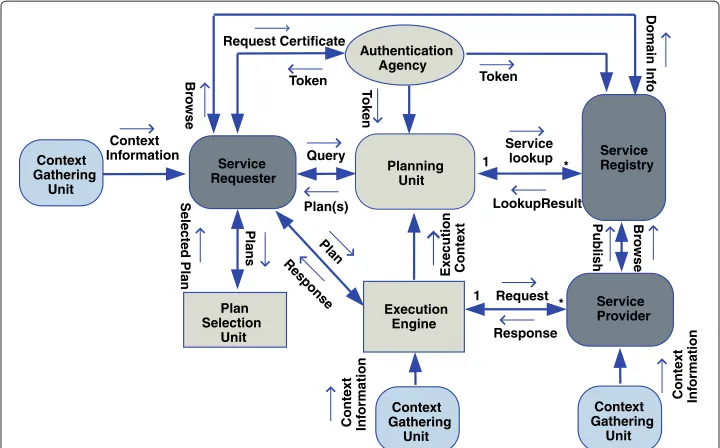
FrSeCwas motivated by the need for a framework that supports the publication, dis-covery and provision of services with context-dependent contracts. The main elements ofFrSeCare shown in Figure 1. A complete formal definition ofFrSeCis presented in the two recent papers [4,6]. Below is a brief summary ofFrSeCelements.
Service Provider (SP)
It is the entity that provides an implementation of a service specification. The service specification is published by the SP using SRe.
Service Registry (SRe)
It is a central repository for services, in which Service Providers publish their services and PU discovers services. It includes semantic definitions for domain specific concepts.
Context Gathering Unit (CGU)
Ibrahimet al. Human-centric Computing and Information Sciences2013,3:1 Page 4 of 22 http://www.hcis-journal.com/content/3/1/1 Service Requester Service Provider Execution Engine Service Registry * 1 1 * Query Service lookup
LookupResult Pub lish Plan(s) Response Response Request Planning Unit Plans Selected Plan Plan Selection Unit Context Information Br o w se Br o wse Domain Inf o Authentication Agency Token Token T o ken Request Certificate Conte xt Inf ormation Context Gathering Unit Conte xt Inf o rmation Ex ecution Conte xt Context Gathering Unit Context Gathering Unit Plan
Figure 1FrSeCArchitecture.A presentation of the architectural components of the FrSeC architecture and the interactions between those components.
PU in dynamic planning activities. A central context manager may be added to monitor and trigger the adaptive context-aware behavior of the framework.
Service Requester (SR)
It is the entity requiring a certain functionality to be satisfied. It represents the client side of the interaction. It can be an application or another service. SR defines its requirements in a service query.
The Authentication Agency (AU)
It is the entity responsible for ensuring trustworthy access to SRe. It provides requesters with certificates (tokens) that allow them to access SRe. The certificate type depends on the legal and contextual information of the requester.
Planning Unit (PU)
It is responsible for managing the service discovery process by interacting with SR, SRe and AU. It also defines service composition. The composition includes defining theplans that can satisfy a query requirement. A plan defines the execution logic of a service or multiple services that collectively achieve the functional, nonfunctional and trustworthi-ness requirements of the requester. A complete formal composition theory is defined in [5]. This theory considers the functional, nonfunctional, legal and contextual parts of the service when defining the composition result.
Plan Selection Unit (PSU)
Execution Unit (EU)
It is responsible for managing the provision of services. It executes the selected plan. The execution process will include communicating with the service providers involved in the plan by sending servicerequestsand obtaining serviceresponses.
Service publication
Service providers publish service contracts through the Service Registry (introduced above) in order to make them available for discovery. In current approaches (discussed in the Related Work Section), the service contract includes only the functional and nonfunc-tional requirements together with any semantic information the service provider wishes to make public. But inFrSeC the service definition is much richer. It includes the ser-vice contract together with the related contextual conditions. Hence, we introduced the concept ConfiguredService, which is a structure in which service functionality, service contract, and service provision context are bundled together. SP publishes the two main elements, namely thecontractandcontext, in theConfiguredService.
The contract includesfunction,nonfunctional propertiesandlegal issues. The context part of theConfiguredServiceincludes the main partscontext infoandcontext rules. The context infodefines the contextual information of theConfiguredService. Thecontext rules define the contextual information related to SR that should be true for SP to guarantee its ConfiguredServicecontract.
Example 1. Table 1 shows a ConfiguredService of a Car Repair Shop. The repair shop charges 60$ per hour and requires a deposit of 300$ with the condition that the car owner is a member of theCanadian Automotive Association (CAA).
In [5], we introduced the novel service modelConfiguredService.ConfiguredServiceis formally defined using a model-based approach. The formal model is built from set theory and logic. Below is a formal presentation ofConfiguredService.
Constraints
A constraint is a logical expression, defined over data parameters and attributes in first order predicate logic. IfCdenotes the set of all such logical expressions, X ∈ Cis a constraint. The following notation is used in our definition:
• Tdenotes the set of all data types, including abstract data types andDt∈TmeansDt is a datatype.
• v:Dtdenotes thatv is either constant or variable of type Dt. • Xvis a constraint onv. If v is a constant thenXvis true. • Vqdenotes the set of values of data typeq.
• x:denotes a logical expressionx∈Cdefined over the set of parameters.
Parameters
Ibrahim
et
al.
H
uman-centric
C
omputing
and
Information
Sciences
2013,
3
:1
Page
6
o
f
2
2
http://www.hcis-journal.com/content/3/1/1
Table 1 RepairShopConfiguredServicedescription
ConfiguredService Function NonFunctional Legal ContextRule ContextInfo
RepairShop Name:ReserveRS
Pre:CarBroken==T
Post:HasAppointment==T
Address:XXX
InputParameters: CarBroken:bool deposit:double CarType:string failureType:string
ResultName:ResultRS
OutputParameters: HasAppointment:bool numberOfHours:int
Price=60$/h deposit=300$
PriceCondition: CarType=toyota
membership==CAA (location,montreal)
Attributes
An attribute has a name and type, and is used to define some semantic information associated with the name. The set of attributes isα= {(Dt,vα)|Dt∈T,vα :Dt}.
Context
A context is formalized as a 2-tupleβ =r,c, wherer ∈ C, built over the contextual informationc. Context information is formalized using the notation in [7]: Letτ :DIM →I, whereDIM={X1,X2,. . .,Xn}is a finite set of dimensions andI= {a1,a2,. . .,an}is a set of types. The functionτassociates a dimension to a type. Letτ (Xi)=ai,ai ∈I. We writecas an aggregation of ordered pairs (Xj,vj), whereXj∈DIM, andvj∈τ (Xj).
Example 2. Using the context notation, the contextual information of ConfiguredSer-vice RepairShop(rs) presented in Table 1, is written as βrs = rrs,crs, where rrs = {(membership == caa)} is the context rule and crs = {(Location,Montreal)} is the contextual information of the service provider.
Contract
A contract is a 3-tupleσ=f,κ,l, where the service functionf, the set of nonfunctional propertiesκand the setlof legal issues that bind the service contract are defined below.
Example 3. Using this formalism the RepairShop contract presented in Table 1, is written asσrs = frs,κrs,lrs.
• Service function:A service function is a 4-tuplef = g,i,pr,po, whereg is the function signature,i is the function result, pr is the precondition, and po is the postcondition. A signature is a 3-tupleg= n,d,u, wheren is the function
identification name,d is the set of function parameters and u is the function address, the physical address on a network that can be used to call a function. The result is defined asi= m,q, wherem is the result identification name and q is the set of parameters resulting from executing theConfiguredService. The precondition pr and the postconditionpo are data constraints.
Example 4. The RepairShop contract functionality presented in Table 1, is formally written as frs = grs,irs,prrs,pors, where
– grs=nrs,drs,urs, wherenrs=(ReserveRS),drs=
{(CarBroken,bool),(deposit,double),(CarType,string),(failureType,string)}, andurs =(XXX).
– irs=mrs,qrs, wheremrs=(ResultRS)and
qrs= {(HasAppointment,bool),(numberOfHours,int)}.
– prrs= {(CarBroken==true)}andpors= {(HasAppointment==true)}.
Ibrahimet al. Human-centric Computing and Information Sciences2013,3:1 Page 8 of 22 http://www.hcis-journal.com/content/3/1/1
between failures. The availability guaranteeηrefers to the guaranteed maximum time for repairs. The price is defined as a 3-tuplep= a,cu,un, wherea is the price amount defined as a non negative double,cu is currency tied to a currency type cType, and un is the pricing unit. Provider Trust is defined as a 3-tuple
tr= ce,pg,re. Lowest price guaranteepg is represented by a Boolean flag that is true when aConfiguredService can guarantee its price to be lower than the price of any otherConfiguredService providing the same functionality. Client
recommendationsce and recommendations from independent organizations re can be defined as sets of ordered pairs representing the clients or organization and associated recommendation.
Example 5. The nonfunctional property in the RepairShop contract presented in Table 1, is formalized asκrs = prs, prs= ars,curs,unrs, where ars=(60)is the cost, curs=(dollar)is the currency, and unrs=(hour)is the pricing unit.
• Legal issues:A legal issue is a rule, expressed as a logical expression inC. A rule may imply another rule, however no two rules may conflict each other. We write
l= {y|y∈C}to represent the set of legal rules. The legal aspect of the RepairShop contract presented in Table 1, is formally written as
lrs= {(deposit=300),(CarType==toyota)}.
Putting the above definitions together we arrive at a formal definition for ConfiguredSer-vice.
Definition 1. A ConfiguredService is a 4-tuple s = ,α,β,σ, where is a set of parameters,αis a set of attributes,βis a context, andσis a contract.
Service discovery
To be able to select and invoke a service that meets its requirements, a service requester should initiate a discovery process. The discovery process includes service query, ser-vice matching, and service ranking. First, SR defines his requirements in the service query. Second, the query is matched with availableConfiguredServicesby PU. Third, PU ranks available candidate ConfiguredServices. Fourth, SR with the help of PSU, selects aConfiguredServicefrom the set of rankedConfiguredServices. The novelty of the dis-covery process supported by FrSeC is two-fold. First, the discovery process takes into consideration legal requirements and context conditions together with functional and nonfunctional requirements. Second, depending on the requirements of the service requester,FrSeCsupports the two types of queriestraditional styleandbuffet style. The rest of this section discusses service query and matching. Service ranking is discussed separately in the next section.
Traditional style
In traditional style discovery, the requester has a clear idea about the requirements. But, the semantic information necessary to define the query is missing. Hence, SR accesses SRe to get the domain knowledge which will help in defining the query. The query process can be defined in the following steps:
1. SR sends a request to the AU for a certificate to access SRe.
3. SR, with the help of the certificate, browses SRe to gain domain knowledge. 4. SRe provides SR with domain knowledge, such as available domains and their
associated functionalities.
5. SR uses this domain knowledge to construct the query and sends it to PU. 6. PU defines and sends service lookups to SRe.
7. The service lookup result is then used by PU to perform matching between the query and available services.
8. PU defines the query result (plan) and sends it to SR with any feedback if necessary.
Traditional style discovery can be either exact-match discovery or weighted-match discovery as discussed below.
Exact-match
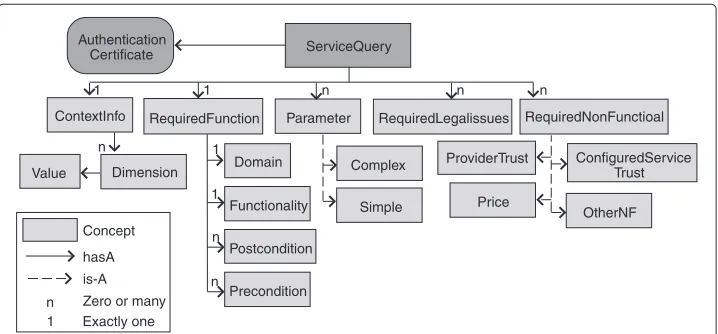
In exact-match discovery, the requester requires an exact match to the requirements. The candidateConfiguredServicesshould be able to guarantee all the requirements. The exact-match query, as shown in Figure 2, consists of the five main partsrequired function, required nonfunctional properties, required legal issues, consumer contextual informa-tion,andauthentication certificate. The query also contains the set of parameters that it can understand. This set is a subset of the parameters associated with the functional-ity it chose when accessing SRe. The required nonfunctional properties are a subset of the nonfunctional properties associated with the functionality defined in SRe. The three following definitions formalize an exact-match query.
Definition 2. An exact-match query qeis defined as qe=ˆf,κˆ,c,ˆ ˆl,E,ˆ, wheref is a queryˆ required function,κˆis the nonfunctional requirement,ˆl is the legal rules requirements,c isˆ the contextual information of the service consumer, E is the authentication certificate and
ˆ
is the set of parameters SR can provide or understand. The formal definitions of context information, legal rules and parameters are identical to the definitions in the previous section.
Definition 3. The required function is defined asfˆ = ˆpr,po,ˆ D,ˆ SFˆ, wherepr is the setˆ of preconditions of the required function,po is the set of postconditions of the requiredˆ
ServiceQuery
ContextInfo
Dimension
RequiredLegalissues RequiredNonFunctioal RequiredFunction
Functionality
Precondition Postcondition
Parameter
Complex
Simple
ConfiguredService Trust
OtherNF
hasA is-A
n
1 n
n 1
n Zero or many Concept
1 Exactly one
Domain
Price ProviderTrust n
1
1
n n Authentication Certificate
Value
Ibrahimet al. Human-centric Computing and Information Sciences2013,3:1 Page 10 of 22 http://www.hcis-journal.com/content/3/1/1
function,Dˆ = (x : x|string) is the associated domain as defined in SRe andSFˆ = (x : x|string)is the functionality as defined in SRe. The formal definition of precondition and postcondition is identical to the one in the previous section.
Definition 4. The required nonfunctional property is defined asκˆ = ˆρ,ˆ,ψˆ,ηˆ,p,ˆ trˆ, whereρˆ is the required safety guarantee,ˆ is the required security guarantee, ψˆ is the required availability guarantee,ηˆis required the reliability guarantee,p is the maximumˆ price required andtr is the required provider trust guarantee. The formal definition of eachˆ of those nonfunctional properties is identical to the definition in the previous section.
Example 6. If a service requester is attempting an exact-match query for the repair shop functionality defined in Table 1, the query could be defined as qe = ˆf,κˆ,ˆc,ˆl,E,ˆ where:
• ˆf = ˆpr,po,ˆ D,ˆ SFˆ , whereprˆ = {(CarBroken==true)}, ˆ
po= {(HasAppointment==true)},Dˆ =(CarDomain), and ˆ
SF=(RepairShopFunctionality).
• ˆκ= ˆp, wherepˆ = ˆa,cu,ˆ unˆ,aˆ=(50),cuˆ =(dollar)andunˆ =(hour). • ˆl= {(deposit=500)}.
• ˆc= {(membership==caa)}.
• ˆ= {(CarBroken,bool),(deposit,double),(CarType,string),(failureType,string)}
After receiving the lookup result from SRe, PU will match availableConfiguredServices with the service query. In exact-match the matching process will result in aServiceType which is a list of candidateConfiguredServices. AllConfiguredServicesin theServiceType provide the exact match to all the requirements defined in the service query. For each ConfiguredServicein the lookup result the matching will:
1. compare the query functionality with theConfiguredService functionality, 2. compare the query nonfunctional requirements with theConfiguredService
nonfunctional properties,
3. compare the query legal issues with theConfiguredService legal rules, and 4. use the query contextual information to make sure theConfiguredService context
rules are met.
Weighted-match
can be either the service be delivered at home or at office. Each contextual information will be assigned a weight to indicate the preference of the requester. In our further discus-sion we assume that the assigned weights belong to the set{Low, BelowAverage, Average, AboveAverage, High, Exact}, in which the values are listed in strictly decreasing order of priority.
Definition 5. A weighted-match query is defined as qw = ˆf,κˆ,ˆc,ˆl,E,ˆ,, where ˆ
f , κˆ, ˆl, ˆc, E and ˆ are defined as in the traditional query, and : (x ∈ {Low, BelowAverage,Average,AboveAverage,High,Exact})→ (y∈ { ˆpr,po,ˆ ρˆ,ˆ,ψˆ,ηˆ,p,ˆ tr,ˆ ˆl,ˆc}is a function that assign weights to the elements of the weighted-match query.
Example 7. Adding weights to the query defined in Example 6 the weighted-match style query will be defined as qw = ˆf,κˆ,c,ˆ ˆl,E,ˆ, wheref ,ˆ κˆ, ˆc,ˆl, E andˆ are defined as in Example 6, and = {((CarBroken == true),Exact),((HasAppointment = = true),Exact),(p,ˆ High),((deposit=500),Average)}.
The matching process in weighted-match discovery considers all possible Configured-Serviceseven if some properties are not satisfied. All candidateConfiguredServiceswill be included in the matching resultServiceType, with the exception of theConfiguredServices that do not provide a match for a requirement withExactweight.
Buffet style
The main difference between traditional style and buffet style is that in traditional style the requester is more or less clear about the requirements in order to be able to define the query in terms of these requirements, whereas in buffet style the requester is not at all clear about the requirements. Hence, the SRe is browsed for availableConfiguredServices and a query is defined only in terms of existingConfiguredServices. The buffet style query process can be defined in the following steps:
1. SR sends a request to the AU for a certificate to access SRe.
2. AU provides the certificate depending on the legal and contextual information of SR.
3. SR, with the help of the certificate, browses SRe for availableConfiguredServices. 4. SRe provides SR with high level information about the set of available
ConfiguredServices.
5. SR defines the query in terms of specificConfiguredServices and sends it to PU. 6. PU will access the SRe to get the complete information about the required
ConfiguredServices.
7. SRe will verify that SR has the required authentication to use the required ConfiguredServices.
8. PU defines the query result (plan) to include the completeConfiguredServices information and sends it to SR with any feedback if necessary.
Ibrahimet al. Human-centric Computing and Information Sciences2013,3:1 Page 12 of 22 http://www.hcis-journal.com/content/3/1/1
ServiceQuery
ContextInfo
Dimension
RequiredConfiguredService
Parameter
Complex
Simple
1
n
n
1
Authentication
Certificate
Value
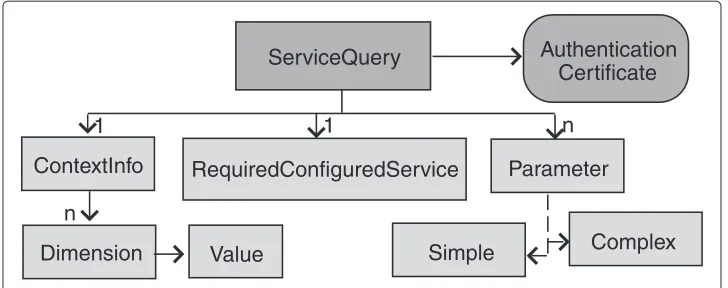
Figure 3 Buffet style query.The content of a buffet style query.
contextual information, and authentication certificate. The following two definitions formalize a buffet style query.
Definition 6. A buffet style query is defined as qb= ˆcs,ˆc,E,ˆ, wherecs is the requiredˆ ConfiguredService defined as in Section 2,c is the contextual information of the serviceˆ consumer defined as in Section 2, E is the authentication certificate andˆ is the set of parameters SR can provide or understand, all defined as in Section 2.
Example 8. If SR is attempting a buffet style query for the Configured-Service RepairShop defined in Table 1, the query will be defined as qb = ˆcs,ˆc,E,ˆ, where csˆ = srs. ˆc = {(membership == caa)}, and ˆ = {(CarBroken,bool),(deposit,double),(CarType,string),(failureType,string)}.
Service ranking
In buffet-style the service requester queries for a concreteConfiguredService, and hence no ranking is necessary. Service ranking is necessary for weighted-match service queries, for the following reasons. In exact matching, the only difference between the Configured-Servicesin theServiceTypeis theorderthey were discovered. AConfiguredService Athat was discovered beforeConfiguredService Bwill precede it in theServiceTypelist. This is because all services provide an exact match to the requirements, which isnotthe case in weighted-match. For a weighted-match, the position of a service in aServiceTypeshould indicate the degree to which the requester requirements are met. That is, in weighted-match search a service that appears first in aServiceTypeshould have the best match with the stated requirements than a service that appears later in theServiceTypelist. These considerations have motivated us to discover a ranking method.
In FrSeC, the ranking process is performed by PU. The process takes as inputs the weighted-match query and theServiceType, and generates as output an ordered Service-Type. The ranking process can be defined in the following 3 steps.
Form weight vector
propertyias defined by the service requester. Propertyican be a precondition, a postcon-dition, a nonfunctional requirement or a legal requirement. The number of propertiesn depends on the weighted-match query defined by the service requester.
Qw=[w1,w2,w3, ..,wn] (1)
We have mentioned earlier that the weight can be{Low, BelowAverage, Average, AboveAv-erage, High, Exact}.ConfiguredServicesthat do not satisfyExactvalues are filtered when doing the weighted-match matching. So the possible weight values are{Low, BelowAver-age, AverBelowAver-age, AboveAverBelowAver-age, High}. We assume in further discussion that weight values are whole numbers in the range 1. . .5, where 1 denotesLowand 5 denotesHigh.
Construct weight matrix
By using the weight vectors constructed in Step 1, the weight matrix for the Config-uredServicesin theServiceTypeis constructed. This is shown in Equation 2, wherenis the number of properties defined in Equation 1 andmis the number of ConfiguredSer-vicesin theServiceType. Each column represents the weights of the properties in a single ConfiguredService. Each row represents the weights of a single property in the different ConfiguredServices.
CSw= ⎡ ⎢ ⎢ ⎢ ⎣
w1,1 w2,1 .. wm,1 w1,2 w2,2 .. wm,2
.. .. .. ..
w1,n w2,n .. wm,n ⎤ ⎥ ⎥ ⎥
⎦ (2)
The value of theConfiguredServiceproperty weight depends on the property type. If a propertyjis a precondition, postcondition, legal rule (without values) or a security prop-erty, a weightwi,jis equal to 1, ifConfiguredService isatisfies propertyjand is equal to 0 otherwise. If propertyjis price, legal rule (with values), availability or time-safety,wi,jis calculated according to Equation 3, wherezis the required property value as defined in the weighted-match query andxis the actual property value specified inConfiguredService.
wi,j= ⎧ ⎪ ⎪ ⎨ ⎪ ⎪ ⎩
1 ifx≤z
1−2zx−−zz=2− xz ifz<x<2z
0 ifx≥2z
(3)
Equation 3 assumes that actual value that is more than double the required value will be given a weight of 0. Anything that is less than the required value will be given 1. And an actual value between the required value and double the required value will be given a weight that depends on how close the actual value is to the required value. For example, if the required price as defined in the service query is 50, an actualConfiguredServiceprice of 55 should be given a better weight than a price of 80.
If property j is reliability, wi,j is calculated according to Equation 4, where z is the required reliability value as defined in the weighted-match query andxis the Configured-Serviceactual reliability value.
wi,j= ⎧ ⎪ ⎪ ⎨ ⎪ ⎪ ⎩
1 ifx≥z
1−zz−−xz 2
= 2x
z −1 ifz2<x<z
0 ifx≤ z2
Ibrahimet al. Human-centric Computing and Information Sciences2013,3:1 Page 14 of 22 http://www.hcis-journal.com/content/3/1/1
Equation 4 assumes that actual values that is less than half the required value will be given a weight of 0. A value that is more than the required value will be given a weight of 1. And an actual value between the required value and half the required value will be given a weight that depends on how close the actual value is to the required value. The main difference between reliability and other properties is that reliability values represent a minimum while other properties represent a maximum.
Calculate weights for ranking
A single weight value for eachConfiguredServiceis computed, and the services are ranked based on these weights. Equation 5 uses the results of steps one and two to calculate the raking weight vector.
W =Qw×CSw (5)
The ranking weight vectorW contains the weights of the differentConfiguredServices. These weights are used to rank theConfiguredServices. TheConfiguredServicewith the highest weight value is placed first in theServiceType. TheConfiguredServicewith the second highest weight value is placed second in theServiceTypeand so on for the rest of theConfiguredServices.
Example 9. Two ConfiguredServices RepairShopA and ReapirShopB provide the func-tionality required in Example 7. They don’t provide an exact match to the nonfunc-tional and legal requirements, but rather a partial match. The list of properties will include: {RequiredPrecondition, RequiredPostcondition, RequiredPrice, RequiredDeposit}. The RequiredPrecondition and the RequiredPostcondition will be filtered out because they require an exact match. So we are left with RequiredPrice and RequiredDeposit. Hence, the weighted-match query weight vector is Qw =
High Average . In numbers, Qw =
5 3 . ConfiguredService RepairShopA(rsA)has a cost of rsAc = 40$/hour and requires a deposit of rsAd = 600$. ConfiguredService RepairShopB(rsB)has a cost of rsBc=70$/hour and requires a deposit of rsBd =400$. Hence, the ConfiguredServices weight matrix is defined, using Equations 2 and 3, as:
CSw=
wrsA,c wrsB,c wrsA,d wrsB,d
where, wrsA,c=1, wrsB,d =1and:
wrsA,d=2− 600 500 =0.8
wrsB,c=2− 70 50 =0.6
The ranking weight vector will then be defined using Equation 5 as:
W =5 3 1 0.6
0.8 1
=7.4 6
FrSeCadaptability
One of the main features ofFrSeCis its ability to adapt to situations that trigger a need for a rediscovery or re-ranking process. Below is a discussion of the most important triggers and how they are handled inFrSeC.
Context change
The discovery process uses the contextual information of the service requester at service discovery time. But during service execution, the contextual information of the service requester might have changed. As a consequence, the contextual rules of the discovered service(s) might be violated, other services may be more suitable. In order to deal with the dynamic change in context we introduce an adaptable discovery mechanism. InFrSeC, this mechanism includes the following steps:
1. CGU senses the new context information and informs SR. 2. SR generates a new query with the new context information.
3. The context change may result in a change to the security level. So SR contacts AU with the new context information.
4. AU sends a new token to SR.
5. SR sends the new query to the PU which will initiate a new discovery process. 6. PU will send a new plan with the set of new orderedConfiguredServices. 7. EU will migrate from the oldConfiguredService to the new ConfiguredService.
Failure in service availability
During service execution, the executing service might fail or become unavailable. For example, the wireless router might fail.FrSeC is designed to adapt to service failures. In our design, PU usesServiceType, and not specificConfiguredServiceswhen defining query result. The listServiceTypecontains orderedConfiguredServicesthat can meet the requirements of a specific query. TheseServiceTypeswill be part of the plan sent to EU. During run time, if aConfiguredServicefails or becomes unavailable, the EU will select the nextConfiguredServicein theServiceType. The worst case is that an equivalence class has only oneConfiguredServiceand it fails. The feedback loop inFrSeC will restart the discovery process in this case.
New alternative services
Service executions may be performed over days, or even months. But service selection and binding are usually performed only the first time the requester uses the service. This might not be practical because new services might be available during this long execution time. The new alternative services might be new services or old services with new modi-fied contracts. A new contract might include a lower price or a better quality. For example, a wireless provider with cheaper price and same quality guarantees might become avail-able. In order to adapt to new alternative services during run time, SR registers with PU. This registration will guarantee that PU will inform SR in case of a new ConfiguredSer-vicethat provides the requester the required functionality becomes available. Thus, SR can initiate a new discovery process.
New contract rules
Ibrahimet al. Human-centric Computing and Information Sciences2013,3:1 Page 16 of 22 http://www.hcis-journal.com/content/3/1/1
timeline. In a flexible contract, there is no life-time specification, which allows providers to change the contract terms at any point of time. For example, the service provider might increase the price of his wireless Internet connection. Providers might not be aware of the identity of their clients. This design decision was made to enshrine privacy issues. In FrSeC, providers inform EU of changes to service contract. At the time of service delivery, EU informs SR of changes to the contract and delivers the service only upon receiving the acceptance of new contract terms from SR. In order not to deny service, requesters are allowed to initiate a rediscovery process in accordance with the new contract terms.
New requester requirements
Some service executions might be too long and during this service time the require-ments of the requester might change. To deal with new requirerequire-ments, the requester has the choice of a rediscovery process or a re-ranking process. In the rediscovery process the requester will define a new query and go through all steps of service discovery. In a re-ranking process, the requester will ask PU to re-rank theConfiguredServicesin the ServiceTypetaking into consideration the new assigned weights to the elements in the modified query.
Evaluation and experiments
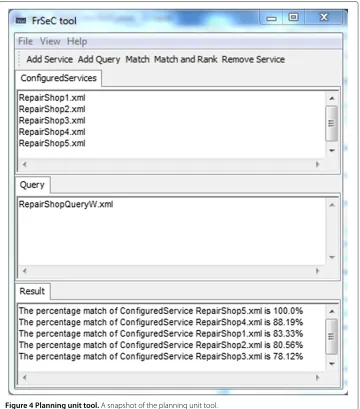
To evaluate the contributions presented in this paper, a Java based application has been implemented to represent the Planning Unit. This application takes as input the set of ConfiguredServicethat provide a specific functionality as returned from the Service Reg-istry, and the service query. The application will then match between the service query and the candidateConfiguredServicestaking into consideration the functional, nonfunc-tional, legal, and contextual information. Two types of matching has been implemented 1) exact match and 2) weighted-match. The ranking algorithm has also been implemented. Figure 4 shows a snap shot of the Planning Unit application.
The application was tested on a standard PC using an Intel Centrino processor with 4GB of memory and running Windows 7 Professional. The average matching and ranking time was in in milliseconds for eachConfiguredServicewhich eliminate the concerns of scalability issues.
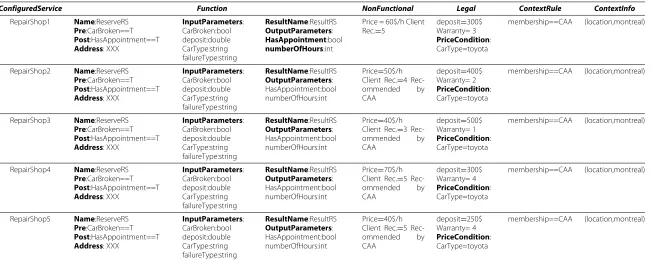
The tool was tested on multiple case studies including the Automotive Emergency Case Study. Table 2 shows the set ofConfiguredServicesthat are matched and ranked according to the service requester query presented in Table 3. The matching and ranking result of theseConfiguredServicesare:
• ConfiguredService RepairShop5 is matched by 100.0% • ConfiguredService RepairShop4 is matched by 88.19% • ConfiguredService RepairShop1 is matched by 83.33% • ConfiguredService RepairShop2 is matched by 80.56% • ConfiguredService RepairShop3 is matched by 78.12%
Related work
Figure 4 Planning unit tool.A snapshot of the planning unit tool.
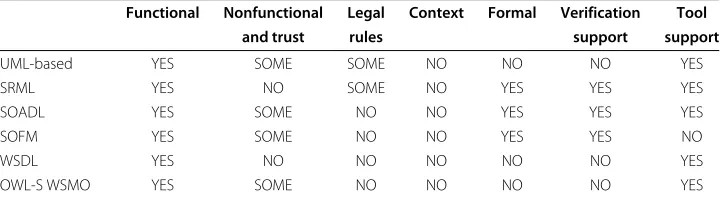
The most notable publication approaches are UML-based such as [8,9], WSDL [10], OWL-S [11], WSMO [12], SOADL [13], SRML [14], and (SOFM) [15]. These approaches are compared and the result of comparison is presented in Table 4. It is clear that all approaches support the modeling of the functional behavior. Nonfunctional and trust-worthiness properties are only supported in a simple manner by few approaches. Con-textual information is not represented by any approach, hence the relationship between contract and context is totally ignored. A couple of approaches, which have ignored the modeling of nonfunctional and trustworthiness properties, have used formal methods and conducted formal verification. Except for UML and Web services languages most of the approaches provide a minimum amount of tools to support the modeling using their service models.
Ibrahim et al. H uman-centric C omputing and Information Sciences 2013, 3 :1 Page 18 of 22 http://www.hcis-journal.com/content/3/1/1
Table 2 Multiple RepairShopConfiguredServicesdescriptions
ConfiguredService Function NonFunctional Legal ContextRule ContextInfo
RepairShop1 Name:ReserveRS
Pre:CarBroken==T
Post:HasAppointment==T
Address: XXX
InputParameters: CarBroken:bool deposit:double CarType:string failureType:string ResultName:ResultRS OutputParameters: HasAppointment:bool numberOfHours:int
Price = 60$/h Client Rec.=5
deposit=300$ Warranty= 3
PriceCondition: CarType=toyota
membership==CAA (location,montreal)
RepairShop2 Name:ReserveRS
Pre:CarBroken==T
Post:HasAppointment==T
Address: XXX
InputParameters: CarBroken:bool deposit:double CarType:string failureType:string ResultName:ResultRS OutputParameters: HasAppointment:bool numberOfHours:int
Price=50$/h Client Rec.=4 Rec-ommended by CAA
deposit=400$ Warranty= 2
PriceCondition: CarType=toyota
membership==CAA (location,montreal)
RepairShop3 Name:ReserveRS
Pre:CarBroken==T
Post:HasAppointment==T
Address: XXX
InputParameters: CarBroken:bool deposit:double CarType:string failureType:string ResultName:ResultRS OutputParameters: HasAppointment:bool numberOfHours:int
Price=40$/h Client Rec.=3 Rec-ommended by CAA
deposit=500$ Warranty= 1
PriceCondition: CarType=toyota
membership==CAA (location,montreal)
RepairShop4 Name:ReserveRS
Pre:CarBroken==T
Post:HasAppointment==T
Address: XXX
InputParameters: CarBroken:bool deposit:double CarType:string failureType:string ResultName:ResultRS OutputParameters: HasAppointment:bool numberOfHours:int
Price=70$/h Client Rec.=5 Rec-ommended by CAA
deposit=300$ Warranty= 4
PriceCondition: CarType=toyota
membership==CAA (location,montreal)
RepairShop5 Name:ReserveRS
Pre:CarBroken==T
Post:HasAppointment==T
Address: XXX
InputParameters: CarBroken:bool deposit:double CarType:string failureType:string ResultName:ResultRS OutputParameters: HasAppointment:bool numberOfHours:int
Price=40$/h Client Rec.=5 Rec-ommended by CAA
deposit=250$ Warranty= 4
PriceCondition: CarType=toyota
membership==CAA (location,montreal)
Table 3 Service query description
Service query
Function NonFunctional Legal ContextInfo
Repair Shop Query
RequiredPre: CarBroken==T Weight=6
RequiredPost: HasAppointment==T Weight =6
Parameters: CarBroken:bool deposit:double CarType:string failure Type:string
Price = 45$/h Weight = 3 Client Rec. = 4 Weight = 3 Recommended by CAA Weight = 3
deposit = 280$ Weight = 4 Warranty= 3 Weight = 5
PriceConditione: CarType=toyota Weight = 6
membership==CAA (location,montreal)
A description of the service query content.
• Dynamic selection: The service provision framework should be designed to allow service requesters specify the requirements with the full knowledge that some service bindings may occur only at run time.
• Dynamic composition: With the increased number of services and the increased composition complexity, it is difficult to have all service compositions predefined in a static manner.
• Context support: Contextual information is essential at service publication, service query, service selection and planting, and service execution.
• Semantic support: Semantic information is essential at service specification, service query, and service composition.
• Formal: Formalism is necessary to 1) verify the interaction between services by making sure there are no incompatible behaviors between services in a composition, 2) achieve correct automatic composition by verifying that the composition satisfies the requirements of the requester, and 3) check the conformance of requester requirements and the contracts of the services being provided.
• Negotiation support: Each service requester has his own set of requirements. In many cases, none of the available services may fully match these requirements. The service provision framework should provide a mechanism to support the negotiation between service requesters and providers.
• Nonfunctional and trust: The consideration of nonfunctional and trustworthiness properties in service publication, discovery and ranking is essential.
• Replanning support: At run time, the contextual information of the service consumer and requester might change. The service provision framework should support a replanning process to generate a new plan that best satisfies the requirements in the new context.
• Fault-tolerance: If a service fails or becomes unavailable at run time, the service provision framework should recover from this failure by selecting alternative services.
Table 4 Related service publication
Functional Nonfunctional Legal Context Formal Verification Tool
and trust rules support support
UML-based YES SOME SOME NO NO NO YES
SRML YES NO SOME NO YES YES YES
SOADL YES SOME NO NO YES YES YES
SOFM YES SOME NO NO YES YES NO
WSDL YES NO NO NO NO NO YES
OWL-S WSMO YES SOME NO NO NO NO YES
Ibrahim
et
al.
H
uman-centric
C
omputing
and
Information
Sciences
2013,
3
:1
Page
20
of
22
http://www.hcis-journal.com/content/3/1/1
Table 5 Related service discovery
Dynamic Dynamic Context Semantic Formal Negotiation Nonfunctional Replanning
Fault-selection composition support support support & trust support tolerance
SeGSeC YES YES YES YES NO NO NO YES YES
eflow YES No NO SOME NO NO NO NO YES
Self-serv YES NO NO NO NO NO NO NO NO
SHOP2 YES YES SOME YES NO NO NO NO NO
SWORD NO YES NO SOME NO NO NO NO NO
Argos NO YES YES YES NO NO NO NO
-Composer YES NO YES YES NO NO SOME NO
-FUSION YES YES NO NO NO NO NO YES
-Protus YES YES NO NO NO NO SOME YES YES
SPACE YES NO NO NO YES NO NO YES YES
StarWSCop YES YES NO YES NO NO YES NO YES
Meteor-s YES NO NO YES NO NO YES YES
-SeCSE YES NO NO NO NO NO YES YES YES
DynamiCos YES YES NO YES YES NO NO NO NO
TSCN YES NO NO NO YES NO NO NO NO
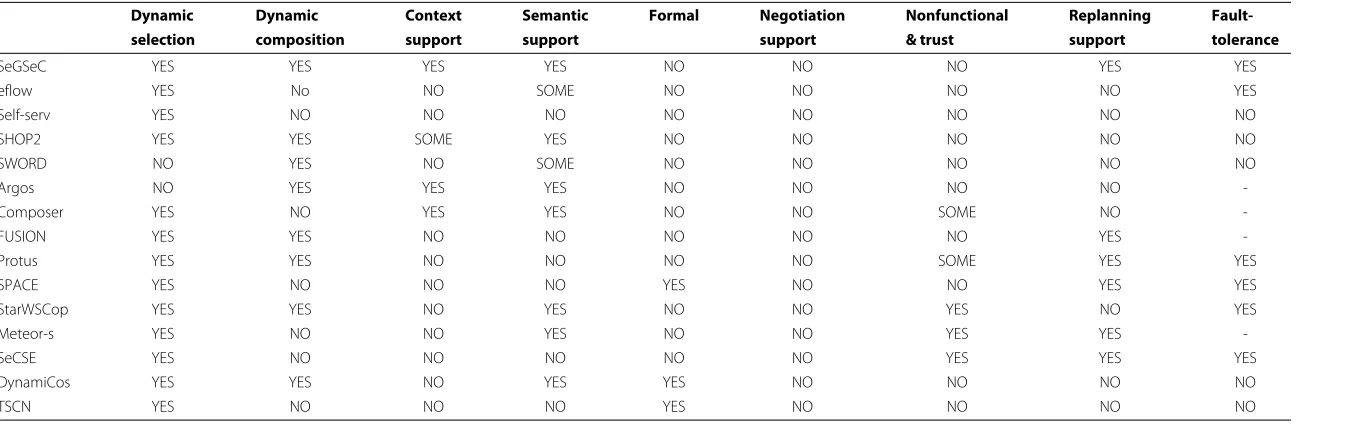
The result of this comparison is presented in Table 5 and it shows the following:
1. With the exception of SWORD and Argos, all approaches support dynamic selection. 2. Dynamic composition is considered by almost half of the approaches. In most of
these approaches AI planning techniques are used.
3. Contextual information is used by very few approaches. In these approaches, context is used to filter the services, but not to constrain the service contract. Hence, the relationship between the contract and context is not considered. 4. Semantic information using ontology is supported by almost half of the
approaches. The use of ontology restrains the semantic support due to the complexity and difficulty of composing ontologies.
5. With the exception of three approaches, all remaining approaches are not formally based. This will limit their verification support.
6. None of the investigated approaches supports negotiation.
7. The support of nonfunctional and trustworthiness properties is very simple and limited.
8. Replanning is supported by almost half of the approaches. With the exception of protus, approaches that support replanning do not support dynamic composition and hence the replanning is manually performed.
9. Fault-tolerance is supported by only few approaches. A number of approaches such as Argos, Composer, FUSION and Meteor-s do not mention fault-tolerance. Hence, by default we consider that they do not support fault tolerance.
Conclusion and future work
We have presentedFrSeCthat supports the publication, discovery, and provision of ser-vices with context-dependent contracts.FrSeCis formally based and considers legal rules and contextual conditions during service provision. It also supports an adaptive rediscov-ery and reranking operations. We are currently working on a detailed service architecture extended with flexible contracts and trustworthiness guarantees. We are developing a set of tools and a process model in order to provide a platform in which service-oriented applications within the confines ofFrSeCcan be developed.
Competing interests
The authors declare that they have no competing interests.
Authors’ contributions
The main contributions of NI are defining theConfiguredServicestructure for service publication, defining the query structures for service discovery, and defining the service ranking algorithm. The major contribution of MM includes defining a service oriented architecture which influenced the formal frameworkFrSeC. VA has contributed to the formalization of the framework and issues related to adaptability. All authors participated in drafting and approving the paper manuscript.
Author details
1Department of Mathematics and Computer Science, Albany State University, Georgia, USA.2Department of Computer Science and Software Engineering, Concordia University, Montreal, Canada.
Received: 6 January 2012 Accepted: 28 December 2012 Published: 17 January 2013
References
1. Papazoglou MP (2008) Web services: principles and technology, First edition. Prentice Hall, England, UK 2. Dey AK (2001) Understanding and using context. Perso Ubiquitous Comput 5: 4–7
Ibrahimet al. Human-centric Computing and Information Sciences2013,3:1 Page 22 of 22 http://www.hcis-journal.com/content/3/1/1
4. Ibrahim N, Alagar VS, Mohammad M (2011) Managing and Delivering Trustworthy Context-Dependent Services. In: proceedings of the 2011 IEEE 8th International Conference on e-Business Engineering (ICEBE), Beijing China, pp 358–363
5. Ibrahim N, Alagar V, Mohammad M (2011) Specification and verification of context-dependent services. In: Kovács L, Pugliese R, Tiezzi F (eds) Proceedings of the 7th International Workshop on Automated Specification and Verification of Web Systems, Reykjavik Iceland. Volume 61 of EPTCS, pp 17–33
6. Ibrahim N, Mohammad M, Alagar V (2011) An architecture for managing and delivering trustworthy context-dependent services. In: Proceeding of the 8th IEEE International Conference on Services Computing, Washington, DC, USA, pp 737–738
7. Wan K (2006) Lucx: Lucid enriched with context. Phd thesis, Concordia University, Montreal, Canada
8. Mayer P, Schroeder A, Koch N (2008) MDD4SOA: Model-Driven Service Orchestration. In: EDOC ’08: Proceedings of the 2008 12th International IEEE Enterprise Distributed Object Computing Conference. IEEE Computer Society 2008, Washington, DC, USA, pp 203–212
9. Service oriented architecture Modeling Language (SOAML) (2008) Specification for the UML Profile and Metamodel for Services (UPMS). OMG Submission document: ad/2008-11-01. Available at http://www.omgwiki.org/SoaML/ doku.php?id=specification
10. WSDL (2001) Web Services Description Language 1.1. W3C Note. March, http://www.w3.org/TR/wsdl
11. Martin D, Paolucci M, McIlraith S, Mark McDermott D, McGuinness D, Parsia B, Payne T, Sabou M, Solanki M, Srinivasan N, Sycara K (2004) Bringing Semantics to Web Services: The OWL-S Approach. In: First International Workshop on Semantic Web Services and Web Process Composition (SWSWPC 2004), San Diego, California, USA, pp 243–277 12. Zaremba M, kerrigan M, Mocan A, Moran M (2006) Web services modeling ontology. In: Cardoso J, Sheth AP(eds)
Semantic Web Services, Processes and Applications. Springer, pp 63–87
13. Jia X, Ying S, Zhang T, Cao H, Xie D (2007) A new architecture description language for service-oriented architecture. In: Sixth International Conference on Grid and Cooperative Computing (GCC 2007), Urumchi, Xinjiang, China, pp 96–103
14. Marino J, Rowley M (2009) Understanding SCA (Service Component Architecture). Person Education, Inc., Boston, MA, USA
15. Cao XX, Miao HK, Xu QG (2008) Modeling and refining the service-oriented requirement. In: TASE ’08: Proceedings of the 2008 2nd IFIP/IEEE International Symposium on Theoretical Aspects of Software Engineering. IEEE Computer Society, Washington, DC, USA, pp 159–165
16. Fujii K, Suda T (2009) Semantics-based context-aware dynamic service composition. ACM Trans Autonomous Adaptive Syst 4(2): 1–31
17. Casati F, Ilnicki S, Jin Lj, Krishnamoorthy V, Shan MC (2000) Adaptive and dynamic service composition in eFlow. In: Proceedings of the 12th Int’l Conference on Advanced Info. Systems Engineering. Springer-Verlag, pp 13–31 18. Sheng QZ, Benatallah B, Dumas M, Mak EOY (2002) SELF-SERV: a platform for rapid composition of web services in a
peer-to-peer environment. In: Proceedings of the 28th international conference on Very Large Data Bases, VLDB Endowment, Hong Kong, China, pp 1051–1054
19. Wu D, Parsia B, Sirin E, Hendler J, Nau D, Nau D (2003) Automating DAML-S web services composition using SHOP2. In: Proceedings of 2nd International Semantic Web Conference, Sanibel Island, Florida, USA, pp 195–210 20. Ponnekanti SR, Fox A (2002) SWORD: A developer toolkit for web service composition. In: Proceedings of the 11th
International WWW Conference, Honolulu, Hawaii, USA. http://www2002.org/CDROM/alternate/786/index.html 21. Ambite JL, Weathers M (2005) Automatic composition of aggregation workflows for transportation modeling. In:
Proceedings of the 2005 national conference on Digital government research, Digital Government Society of North America, Atlanta, GA, USA, pp 41–49
22. VanderMeer D, Datta A, Dutta K, Thomas H, Ramamritham K, Navathe SB (2003) FUSION: A system allowing dynamic web service composition and automatic execution. In: Proceedings of the IEEE Int. Conference on E-Commerce Technology, IEEE Computer Society, p 399
23. Ghandeharizadeh S, Knoblock C, Papadopoulos C, Shahabi C, Alwagait E, Ambite JL, Cai M, Chen CC, Pol P, Schmidt R, Song S, Thakkar S, Zhou R (2003) Proteus: A system for dynamically composing and intelligently executing web services. In: Proceedings of the 1st International Conference on Web Services, Las Vegas, NV, USA, pp 17–21 24. Jin C, Wu M, Ying J (2009) A Structure-based approach for dynamic services composition. J Software 4(8): 891–898 25. Sun H, Wang X, Zhou B, Zou1 P (2003) Research and implementation of dynamic web services composition. In:
Zhou X, Jahnichen S, Xu M, Cao J (eds) Advanced Parallel Processing Technologies, 5th International Workshop, APPT 2003, Volume 2834 of Lecture Notes in Computer Science. Springer-Verlag, pp 457–466
26. Verma K, Gomadam K, Sheth AP, Miller JA, Wu Z (2005) The METEOR-S Approach for configuring and executing dynamic web processes. Technical report, LSDIS Lab, University of Georgia, Athens, Georgia
27. Penta MD, Bastida L, Sillitti A, Baresi L, Maiden N, Melideo M, Tilly M, Spanoudakis G, Cruz JG, Hutchinson J, Ripa G (2009) SeCSE–Service centric system engineering: An overview. In: Nitto ED, Sassen AM, Traverso P, Zwegers A (eds) At Your Service: Service-Oriented Computing from an EU Perspective. The MIT Press, Cambridge, Massachusetts, USA, pp 241–272
28. Silva E, Pires LF, van Sinderen M (2009) Supporting dynamic service composition at runtime based on end-user requirements. In: Proceedings of the 1st Workshop on User-generated Services (UGS2009) at the 7th International Joint Conference on Service Oriented Computing, (ICSOC 2009), Stockholm, Sweden, pp 20–30
29. Fan G, Yu H, Chen L, Liu D (2009) An approach to analyzing dynamic trustworthy service composition. In: Gómez-Pérez A, Yu Y, Ding Y (eds) The Semantic Web, Fourth Asian Conference, ASWC 2009, Shanghai, China, December 6-9, 2009. Proceedings, Volume 5926 of Lecture Notes in Computer Science. Springer, pp 261–275
doi:10.1186/2192-1962-3-1