R E S E A R C H
Open Access
A service oriented broker-based approach for
dynamic resource discovery in virtual networks
Sleiman Rabah
1, May El Barachi
2*, Nadjia Kara
3, Rachida Dssouli
4and Joey Paquet
5Abstract
In the past few years, the concept of network virtualization has received significant attention from industry and research fora. This concept applies virtualization to networking infrastructures by enabling the dynamic creation of several co-existing logical network instances (or virtual networks) over a shared physical network infrastructure (or substrate network). Due to the potential it offers in terms of diversifying existing networks and ensuring the co-existence of heterogeneous network architectures on top of shared substrates, network virtualization is often considered as an enabler of a polymorphic Internet and a cornerstone of the future Internet architecture. One of the challenges associated with the network virtualization concept is the description, publication, and discovery of virtual resources that can be composed to form virtual networks. To achieve those tasks, there is a need for an expressive information model facilitating information representation and sharing, as well as an efficient resource publication and discovery framework. In this paper, we propose a service oriented, broker-based framework for virtual resource description, publication, and discovery. This framework relies on a novel service-oriented hierarchical business model and an expressive information model for resources/services description. The detailed framework’s architecture is presented, and its operation is illustrated using a REST-based content distribution scenario. Furthermore, a proof-of-concept prototype implementation realized using various technologies/tools (e.g. Jersey, JAXB, PostgreSQL, and Xen cloud platform) is presented along with a detailed performance analysis of the system. When compared to existing virtual resource discovery frameworks, our broker-based virtual resource discovery framework offers signification performance improvements of the virtual resources’discovery operation, in terms of response time (92.8% improvement) and incurred network load (77.3% improvement), when dealing with multiple resource providers. Furthermore, relying on a broker as intermediary role simplifies the resources’discovery and selection operations, and improves the overall efficiency of the virtual network embedding process.
Keywords:Network virtualization; Dynamic resource discovery; Information modeling; REST; Xen cloud
Introduction
Network virtualization is an emerging concept that ap-plies virtualization to networking infrastructures and promotes a“network-as-a-service”model, in which a dy-namic pool of virtualized networking resources can be leased and released on demand. The basic idea behind network virtualization consists in the dynamic creation of several co-existing logical network instances (or virtual networks) over a shared physical network infrastructure (or substrate network) [1]. Offering full administrative control and customization capabilities, virtual networks
can be built according to different design criteria and op-erated as service-tailored networks [2].
Recently, network virtualization has received a lot of attention from industry and research fora, as it repre-sents a promising way to diversify existing networks and ensure the co-existence of heterogeneous network archi-tectures on top of shared substrates [3-5]. In addition, network virtualization enables the emergence of new ac-tors and business roles to offer on-demand virtual net-works (VNs), customized for particular service and user requirements.
In the Internet domain, network virtualization is con-sidered as a promising solution for the“Internet ossifica-tion”problem–A condition by which the sheer size and scope of the Internet architecture renders the introduction * Correspondence:[email protected]
2
College of Technological Innovation, Zayed University, Khalifa City B, P.O. Box 144534, Abu Dhabi, United Arab Emirates
Full list of author information is available at the end of the article
and deployment of new technologies very difficult due to the high cost of migration and the difficulty of achieving wide consensus among the many involved stakeholders [6]. By enabling a logical segmentation of the physical Internet infrastructure and the co-existence of heteroge-neous virtual networking architectures on top of it, net-work virtualization is often seen as a cornerstone of the future Internet architecture [3,6].
In order to provide a clean separation of services and infrastructures, the network virtualization concept decou-ples the traditional Internet Service Provider (ISP) role into two main roles: the Infrastructure Provider (InP) role own-ing/managing the physical infrastructure and partitioning its resources into isolated slices using some virtualization technology; and the Service Provider (SP) role relying on the infrastructure to offer end-user services. Furthermore, the Virtual Network Provider (VNP) is introduced as a third intermediary role responsible for discovering and ag-gregating virtual resources from one or multiple InPs in order to instantiate virtual networks (VNs) satisfying cus-tomers’requests [1].
Forming the initial steps in the virtual network embed-ding process, resource description, publication, and dis-covery are critical phases that aim at assisting the VNP in identifying potential InPs that possess the resources/ services needed to satisfy a certain VN request (request coming from a client to instantiate a VN). While re-source description focuses on the representation of the functional (i.e. static) and non-functional (i.e. dynamic) attributes of resources/services offered by different pro-viders; resource publication enables the advertisement of this information; and resource discovery enables the searching and finding of resource candidates that com-ply with the requirements specified in the VN request.
Despite their importance in the VN embedding (or composition) process, little work has been done on re-source description, publication, and discovery in virtual networking environments. The solutions proposed so far [7-10] rely on coarse-grained inexpressive information models, and require the interaction between a VNP and a potentially large number of candidate resource providers to gather the necessary information needed for resource selection. In a large scale virtual networking environment in which many InPs offer virtualized resources for lease, such solutions may introduce complexity and result in excessive delays and communication overhead between a VNP and a large number of potential InP candidates – thus impacting the overall efficiency of the VN embedding process. Furthermore, none of the proposed architectures has been fully implemented.
In this work, we propose a service-oriented broker-based framework for resource description, publication, and discovery in virtual networking environments. Our framework promotes the idea of “network-as-a-service”
by defining different levels of services to which network-ing resources are mapped. It relies on a novel service-oriented hierarchical business model [11] that introduces the broker as intermediary role, and proposes the concept of vertical hierarchy between VNPs, as well as the concept of service building block and service reuse and compos-ition. At the heart of the framework lies an expressive information model [12] enabling the representation of physical/virtual resources and services, as well as the map-ping between them, in addition to modeling the relations between multiple business roles and their association to resources and services offered. Unlike other approaches, our proposed framework aims at offering an efficient dy-namic resource discovery solution enabling the seamless interaction and collaboration between various roles, while coping with the complexity of managing and organizing large numbers of virtualized resources/services.
The rest of the paper is organized as follows: Section 2 gives an overview of the network virtualization concept and presents a review of related work. In Section 3, our proposed approach for virtual resources’description and discovery is discussed in detail, including the business and information models on which it relies, the architec-tural framework design, the architecarchitec-tural components and interfaces, as well as a REST-based secure content distri-bution scenario illustrating the system’s operation. This is followed by a presentation of the prototype implementa-tion and performance measurements, in Secimplementa-tion 4. The last section ends the paper with our conclusions.
Background and related work The network virtualization concept
A virtual networking environment can be seen as a dy-namic and collaborative environment, in which a large pool of virtualized networking resources can be offered and leased on demand. In such an environment, a number of logical network instances (virtual networks) co-exist over a shared physical network infrastructure. A virtual network essentially consists of a set of virtual nodes con-nected by virtual links, and forming a virtual topology. In this topology, each virtual node (guest) is hosted on a cer-tain physical node (host) and each virtual link is established over a physical path. In this environment, each virtual net-work is managed/operated by a single entity, and virtual networks are logically isolated from each other.
From an architectural perspective, network virtualization promotes several design goals [1], the most prominent ones being: the coexistence of multiple VNs (operated by different providers) within the same environment;
recur-sion and inheritance between VNs allowing the nesting/
manageabilityallowing a provider to have full administra-tive control over a VN;isolation between co-existing VNs to improve fault-tolerance, security and privacy; and het-erogeneityof VNs as well as the physical infrastructures on which they rely.
Three main business models were proposed for Net-work Virtualization Environments (NVEs) [5,11-13]. The initial model proposed in [13] decouples the traditional Internet Service Provider role into two roles: the role of infrastructure provider (InP) managing the physical infra-structure; and the role of service provider (SP) creating VNs by aggregating resources from multiple infrastructure providers and offering end-to-end services. The second model, which has been proposed in the 4Ward project [5], refines the first model by defining four roles: physical in-frastructure provider (corresponding to the role of infra-structure provider in the first model); VNP responsible of finding and composing an adequate set of virtual re-sources from one or more infrastructure providers into an empty virtual topology; virtual network operator (VNO) that deploys different protocols over the VN topology and is responsible for the control and management of the VN; and service provider using the VN to offer end-to-end ser-vices. The third model was proposed by us in [11], as a re-finement to the previous two models. In this model, we put the emphasis on the notion of services by defining different levels of services that could be offered by net-working resources, and introduced the broker role as an additional role needed to enable the collaboration between various entities for service provisioning. Furthermore, we introduced the notion of hierarchy between VNs and vir-tual infrastructure providers, as well as the idea of service building blocks and service composition.
The virtual network embedding process
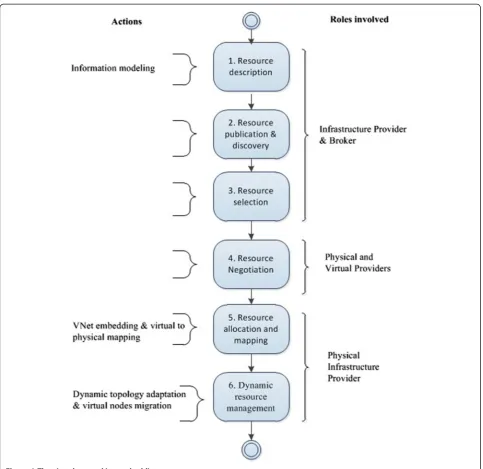
As shown in Figure 1, the virtual network embedding process consists of multiple phases and involves the col-laboration between different roles. We describe the dif-ferent phases as follows:
Resource Description:Prior to any VN provisioning operation, physical/virtual infrastructure providers need to describe their available resources. This step relies on information models that enable the description of the functional attributes (i.e. static parameters such as node/link type, OS) and the non-functional attributes (i.e. dynamic parameters such as available capacity/bandwidth) of available resources and services.
Resource Publication and Discovery:Once resources are described, their related information is advertised and dynamically discovered by different entities wishing to make use of those resources. According to the literature, the description of the
resources may be registered in public discovery frameworks, or repositories, so that they can be discovered by VN requestors. As for the discovery process, it consists of searching and finding resource candidates that comply with the requirements specified in the VN request. In [14], two aspects of resource discovery have been identified: resource matching and resource splitting. The matching mechanism identifies resources that meet a set of functional and non-functional attributes using clustering techniques and similarity based matching algorithms [15,16]. The splitting mechanism divides virtual network requests into sub-requests that can be handled by different physical resource providers.
Resource Selection:Taking as input the list of resource candidates identified by the resource discovery process, the resource selection process aims at selecting the best candidates that satisfy the requirements specified in the VN request.
Depending on the sophistication of the selection approach, multiple operations may be used to obtain the best resources candidates, including filtering, aggregating, ranking and multi-objective-based selection [17]. The selection of the best resources while maximizing the number of allocated virtual networks over a shared physical infrastructure is recognized as an NP-hard problem [18]. Therefore, several approaches have been proposed to tackle this issue, including: exact formulation [19]; heuristics-based [20]; and economic-based models [21].
Resource Negotiation:Resource negotiation is considered as an important process that enables a service provider to negotiate with multiple
infrastructure providers (offering similar resources), in order to select the best one. This involves the negotiation of the resources’cost, allocated
capabilities over the Service Level Agreement (SLA) period, and the related quality of service scheme.
Resource Allocation and Mapping:Resource allocation or resource provisioning [14] is the process of mapping/binding virtual resources to physical resources (such as nodes and links). Resource allocation is performed by a physical infrastructure provider, and mainly consists of virtual nodes and virtual links creation, configuration and setup, thus resulting in virtual topologies instantiation.
Resource description and discovery in virtual networking environments
In a federated virtual networking environment (where similar resources could be offered by many providers), resource description and discovery are critical processes that aim at assisting the VNP in identifying potential InPs that possess the resources/services needed to satisfy a certain VN request. Despite their importance in the VN embedding process, little work has been done on re-source description and discovery in virtual networking environments.
In [7], a virtual resource description and discovery framework has been proposed for the 4WARD model.
As part of this framework, a UML-based information model is proposed to describe resources. In this model, the network element is considered as the basic building component having functional and non-functional attri-butes. Furthermore, this framework uses a conceptual clus-tering technique to arrange resources’information into a tree structure (dendrogram) that facilitates the matching and selection processes. In this case, only resources’ functional attributes are advertised and stored in exter-nal repositories to be used for discovery purposes, whereas non-functional attributes are updated and kept in local repositories to be used during selection and binding phases. A distributed peer-to-peer architecture
is proposed for the realization of the proposed resource discovery framework.
Building on the solution proposed in [7], the authors in [8] propose a similar framework that relies on a hierarchical clustering architecture for virtual resource organization and discovery. In this architecture, local management nodes are used to store static (functional) attributes and arranging them into conceptual clusters called Micro Clusters (MiCs) at the InP level. The Clus-ter Index Server groups/organizes the MiCs of multiple InPs having the same root attribute, thus resulting in a Macro Cluster (MaC). Time variant attributes such as the residual capacity of a substrate link is stored in the management node. This framework aims at reducing the search range and cost as well as enhancing the efficiency of the resource discovery process.
To benefit from WSDL’s support for dynamic update services, authors in [9] proposed a WSDL-based VN re-source provisioning framework. With the help of local agents deployed on local substrate networks, WSDL documents containing resource description are dynamic-ally generated and published to UDDI registries. For a VNP to select the candidate resources, a search in all the UDDI registries is required. In this framework, the UDDI registries parse the information contained in WSDL and use the greedy and shortest path algorithms to retrieve the necessary information.
Aiming at enhancing the efficiency of the selection process by considering dynamic attributes during the discovery phase, the Aggregation-based Discovery for Virtual Network Environments (ADVNE) is proposed in [10]. In order to minimize the continuous monitoring overhead of dynamic attributes, the authors propose to calculate aggregated values of the monitored attributes instead. In this approach, each InP has a monitoring agent that monitors and calculates the aggregated values of two dynamic attributes (nodes’available CPU and links’ available bandwidth). Furthermore, InPs publish their re-sources’ static attributes in VNPs managed repositories. Later on, a VNP wishing to perform resource discovery will use its discovery module to retrieve the needed static attributes (from the VNP’s repository) and dynamic attri-butes (from monitoring agents at InPs level). This infor-mation will be used to conduct an initial filtering of candidate InPs and provide the resulting list as input to the selection and binding processes.
Despite the merits of the solutions proposed, they all suffer from some drawbacks. In terms of virtual resources’ description, the main information model proposed in [7] and adopted in [8,10] provides minimal description of static/dynamic attributes, and lacks the expressiveness needed to describe other important aspects, such as de-scribing a virtual network as a whole, virtual-to-physical mapping, network services description, and modeling of
the relationships between roles and resources/services. This lack of expressiveness and coarse-grained approach will limit the ability to accurately describe VN requests and virtual resources/services, thus impacting the selec-tion likelihood and the VN embedding efficiency.
In terms of resource discovery architecture, all the so-lutions proposed follow the 4WARD business model, which does not define a broker role acting as intermedi-ary between the other roles. As a result, a VNP must gather information from multiple InPs (either through communication with local monitoring agents [10], or distributed repositories [7,9], or cluster heads [8]) before initiating the resource selection process. In a large scale virtual networking environment in which many InPs offer virtualized resources for lease, such approach may intro-duce complexity and result in excessive delays and com-munication overhead between a VNP and a large number of potential InP candidates – thus impacting the overall efficiency of the VN embedding process. Furthermore, none of the proposed architectures has been fully imple-mented - the validation focusing mainly on evaluating the performance of the matching and selection algorithms.
In the coming section, we propose a service-oriented broker based framework for virtual resource description and discovery in virtual networking environments. Our framework relies on a novel service-oriented hierarchical business model as well as an expressive information model enabling the representation of physical/virtual re-sources and services.
Virtual resources’description and discovery approach
In this section, we first give an overview of the virtual net-working business model [11] and the information model [12] that form the basis of this work. Then, we present a novel architecture for the publication and dynamic discov-ery of resources (PDDR) in network virtualization envir-onment (NVE). Throughout this paper, we use the term resource to refer to a computational/network resource (physical or virtual), network service or role information.
Proposed virtual networking business model
Figure 2 depicts the business model we proposed in [11] for virtualized networking environments. Four levels of service are defined as part of our model, namely:
Essen-tial services constituting mandatory services needed for
the basic operation of the network (i.e. routing/transport services); Service enablers consisting of the common functions needed to support the operation of end-user services (e.g. session/subscription management, charging, security, and QoS management); Service building blocks
control); and End user services constituting the value-added services offered to users.
Unlike the current Internet business model that is based on a single role (the Internet Service Provider - ISP), our model distributes the functionalities of the traditional ISP and introduces five business roles, namely: 1)The Physical
Infrastructure Provider (PIP) that owns and manages a
physical network infrastructure and can partition its re-sources using some virtualization technology. The services offered by the PIP are essential bearer services. 2)The
Ser-vice Provider (SP)that has a business agreement with the
subscriber and offers value added services, which could be simple or composite (i.e. formed by combining service building blocks); 3) The Virtual Infrastructure Provider (VIP) that finds, negotiates, leases, and aggregates virtual resources from one or more PIPs, deploys any protocols/ technologies in the instantiated VN, and operates it as a native network. The VIP supports SPs or other VIPs with service enablers and service building blocks and has no direct business agreement with consumers; 4)The
Con-sumer who acts as the subscriber and the end user of
value-added services; and 5)The Services and Resources
Registry (SRR) acting as resource broker by providing
information to find other parties and the services/re-sources they offer.
It is important to mention that while the VIP plays a resource brokerage role to SPs by finding and aggregat-ing virtual resources to form virtual topologies, this role is not to be confused with the information brokerage role played by the SRR. This last focuses on providing information about the existing pool of virtual resources, to facilitate the resources’ discovery and selection process.
Integrated hierarchical information model
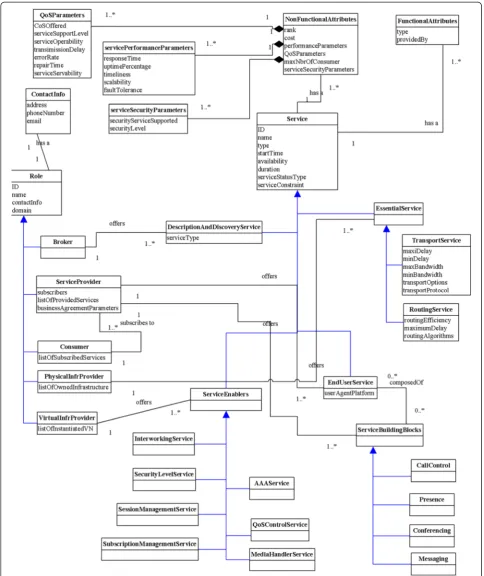
Figures 3 and 4 show a high level view of our integrated information model, which was presented in [12]. As depicted in Figure 3, our information model revolves around three main concepts and their relationships:roles;
services; and resources. Roles are entities that collaborate to offer/consume resources and services and exchange in-formation related to these resources/services. A role can act as resource provider offering and managing virtualized resources, or as a resource consumer accessing virtualized resources. In addition, a role can act as service provider offering and managing network services, or as a service consumer subscribing to network services. In our model, network resources are mapped onto network services (i.e. network resources are considered as low-level net-work services). Furthermore, roles are considered to be distributed and loosely coupled entities interacting via programmable interfaces. Finally, just like web services, various levels of network services can be published, dy-namically discovered, composed, and used, in our model.
In Figure 4, we model the different roles and their relationships to physical/virtual topologies and various levels of services. We consider aTargetedNetworkto be the base entity as well as the root element of all instanti-ated description documents. ATargetedNetwork can be composed of one or many virtual networks and one or many physical networks. APhysicalNetworkhas a
Physi-calNetworkTopologyand is composed of a set of physical
nodes connected by physical links. AVirtualNetworkhas aVirtualNetworkTopology, which is a subset of the under-lying physical topology. A virtual network topology can be composed of one or multiple virtual ones, thus forming a hierarchy. A virtual network is composed of a set of
Vir-tualNodes, each node having one or many
VirtualInter-faces and being connected to another virtual node by a
VirtualLink. Virtual nodes that are instantiated on the
same physical device are grouped in aVirtualNodeGroup
that is mapped to a physical node. Although we are not concerned about modeling physical networks related en-tities, we only model a physical network as a set of
Physi-calNodeswhere a given group of virtual nodes is mapped.
The different roles and their interactions with different entities are modeled as follows: (1) APhysicalInfrProvider
(PIP) owns and operates a PhysicalNetwork; offers
EssentialServices; and instantiates one or multiple
Vir-tualNetworks; (2) AVirtualInfrProvider (VIP) manages
and operates VirtualNetworks and offers
ServiceEna-blers; (3) A ServiceProvider (SP) manages and operates
VirtualNetworks and offers ServiceBuildingBlocks and
EndUserServices. An end-user service can be created by
combining one or more service building block; and (4) Considered as end-user, a Consumersubscribes to/uses one or multiple EndUserServicesthat are accessible via
PhysicalNetworksandVirtualNetworks.
Figure 3Main concepts of the integrated hierarchical information model.
To further detail our model, Figures 5 and 6 respectively show the resource-level view and the service-level view.
In the resource-level view, we consider as the basic build-ing component of a virtual network, a NetworkElement
(NE) that can be aNode,Link,Interface, or Path. A NE has a name, availability, start time that specifies when the resource is available, and a period that determines for how long the resource is available. Thestatus attri-butes represent NE’s state (available, allocated, etc.). A NE belongs to a NetworkDomain, which in turn has an
AdministrativeDomain.
A Node can be either a PhysicalNodeor VirtualNode. Represented in the classNode, a node has aGeoLocation
and encompasses common attributes needed for describ-ing a network node, namely, a network stack, a type (i.e. virtual switch, virtual router, virtual machine, etc.) and an IP address. Besides attributes such as the vendor, model, and substrate node group, a physical node may aggregate virtual nodes and interfaces, whereas a
Vir-tualNode (VN) is uniquely identified; and has an initial
and maximum capacity in terms of computational cap-abilities. Each VN aggregates one or multiple virtual interfaces. AnInterfacerepresents a physical/virtual net-work interface controller (NIC); and has a type (i.e. Ethernet, radio), rate and MAC address. Depending on its capacity, a physical link can be divided into slices using virtualization techniques (i.e. ATM, MPLS) to sup-port one or multiple virtual links. ALinkhas characteris-tics such as minimal delay, type, bandwidth, throughput, good-put and type of connectivity; and anend pointthat determines the source node and destination node. Each
VirtualLinkhas a tag, and initial and maximum allocated
bandwidth. Virtual interfaces are connected by a virtual link. A physicalLink has a limited number of supported virtual links and an additional attribute for defining avail-able bandwidth. APath represents a set of links. A path starts atbeginNodeand ends atendNode.
To represent nodes’ functional and non-functional characteristics, a node has an association with the fol-lowing two entities: (1) Node Functional Parameters: consists of characteristics/properties related to the func-tioning of anodesuch as operating system type, software version, and the type of the network management sys-tem. It is composed of: (a) Storage parameters which determine the available disk space, storage type, and number of storage units; (b) memory parameters which represent the size, capacity, and type of the available memory; and (c) CPU parameters which represent the information about the available processing unit(s). (2)Node Non-Functional Parameters: this class defines constraints, QoS scheme, and desired criteria that should be met when selecting a resource, namely: cost, rank, and percentage of failure. In turn, non-functional attributes are composed of the following: (a) Performance parameters representing
node performance properties such as response time, up-time, capacity, and reliability level. (b)Security level param-etersdefining security properties that a node supports like hashing techniques (i.e. Checksums, cryptographic hash functions), encryption methods (i.e. symmetric, asym-metric) and security properties (i.e. confidentiality, in-tegrity). (c) QoS parameters representing QoS related characteristics including the average packet loss, jitter, delay, and bit rate.
We model network topology as physical/virtual top-ology. In general, anetwork topologyhas name, type (i.e. bus, ring), path list, and is composed of a set of nodes. Representing the topology of a virtual network, avirtual
topology is a subset of a physical one and can be
hier-archical so that a virtual topologycan be instantiated on top of one or multiple virtual topologies. Thus, this leads to hierarchical associations among VNs. Besides, it con-tains attributes related to availability, start time, period, and a reference to its operator.
In the service-level view shown in Figure 6, arole rep-resents an organization, identified by a name or id and
has contact information. Different roles are modeled as
follows: (1) broker represents the SRR; (2) Service
pro-vider represents a SP; (3) consumer represents an
end-user which subscribes to services offered by a SP; (4)
Physical infrastructure providerrepresents a PIP; (5)
Vir-tual infrastructure provider represents a VIP. Each role
is associated with a service entity which indicates the type of service he offers.
Just like NE, aservicerepresents the base class for de-scribing services. A service has the following sub-classes:
(1) description and discovery serviceoffered by the
bro-ker and representing services needed for publishing and discovering resources/services; (2) Essential service are
transport serviceandrouting service; (3)End-user service
representing services destined to end-users and com-posed of one or manyservice building blocksfor example
call control, presence, conferencing, and messaging; and (4)Service enablersdefining the support functions needed for the operation of end user services. Examples of service enablers include:Interworking,security level,session
man-agement, subscription management, AAA service, QoS
control, media handler. Each service is associated with
functional attributes as well as non-functional attributes.
Broker-based framework for virtual resource publication and discovery
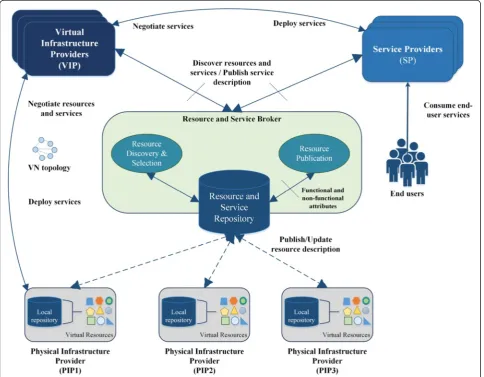
Figure 7 illustrates the system architecture of the pro-posed framework.
We selected a broker-based approach aiming at resolv-ing the issue of resources/services’publication and discov-ery in network virtualization environments. The main objective of our work is to find an efficient solution that enables seamless interaction and collaboration between various roles. Within this framework, Physical Infrastruc-ture Providers are network-related resource suppliers who advertise (i.e. publish) the description of the resources of-fered into the Broker’s service and resource repository. Virtual Infrastructure Providers are virtual resource pro-viders that discover the resources needed to instantiate a virtual network, and negotiate these resources with the selected potential PIPs. Moreover, VIPs request PIPs to in-stantiate VNs on which they deploy network services. In turn, Service Providers are end-to-end service providers who require and discover virtual networks on top of
which they deploy the services they offer. Additionally, they negotiate the selected services with the appropriate VIPs. A more detailed description of the functions of this framework is presented in the following sub-sections.
Overall architecture
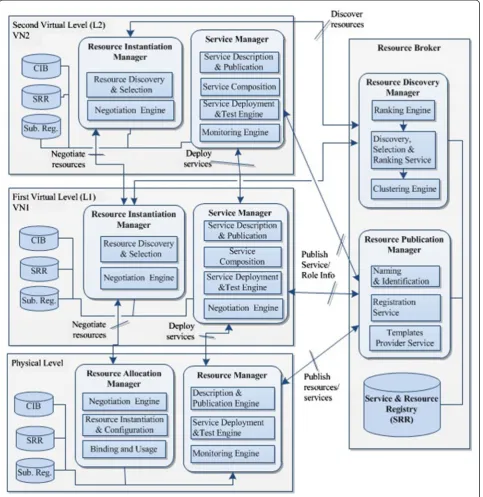
Figure 8 gives a detailed view of the proposed framework architecture that is broker-based, multi-level (layered), and composed of a set of loosely coupled components. The PIP is represented at the Physical level. In turn, the VIP is represented at the first virtual level, and the SP at the second virtual level. Consequently, roles depend on each other to perform the virtual network provisioning process. We selected a resource-broker approach to cope with the complexity of managing and organizing resources [22]. We introduce a resource and service broker that serves as mediator while coordinating the communication between various roles.
The resource broker allows roles to publish their re-sources and discover other roles’ resources, in addition
to providing the ability to find the most appropriate re-source based on particular characteristics and constraints. Thus, it manages the inventory of federated resources in the SRR, which holds well-defined static and dynamic resource properties. Both functional and non-functional attributes are advertised and stored in the SRR. Addition-ally, many providers (VIP, SP) can discover other roles and the resources/services they offer through the broker’s services. Upon receiving a resource discovery request, the broker selects the most appropriate resources that comply
with the requirements as formulated in the request, and returns to the requestor the list of candidate resources. Requestors, in turn, can perform another selection stage in order to refine the list based on some local preferences (such as QoS, cost). Prior to resource allocation, and to reach an agreement on the selected resources, requestors negotiate resources’ related parameters (such as price, availabilities, QoS-related parameters) with resource pro-viders. At each level, we find local information sources (repositories) that the respective role uses to manage
information about resources. However, only the informa-tion about resources that are intended to be offered is published into the resource broker. In this architecture, communication between layers is bidirectional and can be performed through standardized public interfaces (e.g. web services).
Components’description As part of the resource
bro-ker’s design, we distinguish two key services involved in the resource publication and discovery process: (a) The
Registration Service enabling the registration, updating,
and deletion of information about resources; (b) The
Discovery Selection and Ranking Service receiving as
in-put a request containing the description/requirements of resources of interest along with constraints. While taking into consideration the resources’ rank and the specified constraints (i.e. QoS, cost, etc.), it selects the most appro-priate resources that satisfy the request, and returns, as a result, the list of matching resources.
Supporting the resource publication/discovery process, we find four support modules. 1) The Ranking Engine
evaluates the popularity among similar resources and at-tributes a rank to each resource each time it is selected. This rank could be based on their usage, functional and non-functional characteristics (such as availability, up-time, cost and QoS, etc.). 2) To facilitate resource selec-tion, the Clustering Engine arranges information about resources contained in the SRR into clusters (grouping re-sources having similarities). 3) Following a well-defined naming scheme, the Identification and Naming serviceis responsible for dynamically instantiating a name (unique identifier) for each resource registered in the SRR. Because in a federated virtual resources environment, many pro-viders could offer the same resource; a unique identifier is needed to distinguish one resource from another. 4)
The Templates Service provides the different roles with
an up-to-date template for describing resources or net-work services.
Communicating with the broker, the first layer of the hierarchy (L1) provides components for describing, pub-lishing, and instantiating virtualized networking resources as well as negotiating resources with other roles. The second and the top-level layer’s components are respon-sible for describing, deploying, and publishing network services. L1 contains components grouped into the fol-lowing sub-systems:
The Resource Manager (RM)handles the management
and publication of resources and encompasses three com-ponents: 1) The Description and Publication Engine con-sisting of a key enabler of the resource publication process; it enables a PIP to describe the resources he offers using an instance of the information model and validates the gener-ated instances to ensure data consistency and their con-formance with the information model. Furthermore, it
interacts with the broker (detailed below) in order to pub-lish, update, or delete information about resources. 2)The
Service deployment and Test Engineenables the PIP to
de-ploy and test essential services such as routing or transport services. 3) The monitoring Enginemonitors the status of the allocated resources, and the links connecting the virtual nodes. Additionally, it continuously collects in-formation about resources’ dynamic properties for sta-tistics purposes.
The Resource Allocation Manager (RAM)
coordi-nates all the steps involved in the resource allocation process (i.e. negotiation, instantiation, allocation, and binding) and consists of the following components: 1)The
Resource Negotiation modulehandles and coordinates the
resource negotiation process with a given virtual layer.2)
The Resource Instantiation and Configuration module is
responsible for the “slicing”of physical resources. It han-dles the instantiation request and enables the creation and configuration of virtual resources. 3) The Binding and
Usage module maps a virtual resource to a physical one
(i.e. maps resources to requests), reserves the allocated re-sources, and triggers the monitoring process for dynamic resource management purposes.
Since in a NVE, multiple virtual layers can be built on top of physical one, we designed similar components to be used at each virtual layer. However, the type of re-source/services being offered is different. At the first and second virtual layers, the Service Description and
Publi-cation Engine (SDPE) is responsible for describing
net-work services and publishing their information to the broker. In order to get the list of resources of interest,
the Resource Discovery and Selection module interacts
with the broker on a request-response basis, and performs another stage of resource selection involving some local criteria/constraints. The Service Composition module en-ables the combination of two or more services into a com-posite service. The Service Deployment and Testmodule coordinates the steps involved in service deployment and performs some tests to validate the virtual-to-physical mapping. The Service Monitoring module monitors the status of deployed services to ensure QoS. Finally, the
Negotiation Engine module conducts the negotiation of
resources with one or more PIPs.
Interfaces In an open virtualization environment, the
representation of resources in a variety of formats (e.g. XML, JSON, etc.). Furthermore, as opposed to SOAP-based Web Services, RESTful Web Services are simple, lightweight, and easy to develop.
In terms of design concept, REST is not an architecture but rather an architectural style that revolves around the notion of resources and follows the client–server architec-ture. As per REST’s design principles, a resource is any-thing that can be exposed to the world (i.e. the Web) and be made available/accessible through a uniform interface (URI) just like a web page. Therefore, REST Services are URI-based, and each resource is addressed through a URI but could have many data representations (XML, JSON, binary, etc.) - which facilitate information sharing and interoperability/integration with existing systems. Using the same URI, but different HTTP methods (i.e. POST, GET, and UPDATE), resources can be created, read, up-dated, and deleted in “CRUD” style. As opposed to Big Web services, RESTful services are not published in a ser-vice registry (UDDI) to be later discovered. They are ra-ther made available at uniform paths (or root URIs) that are handed to the requester beforehand. In most cases, services’URIs are provided with the API documentation. A well-defined URI template should be used to identity entities and illustrate their relationships.
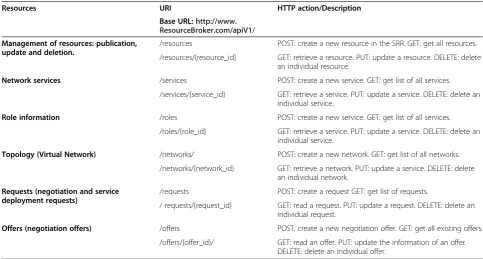
In our architecture, the SRR is an information store that holds information about resources, which are ar-ranged in a directory-like structure from a logical point of view. We name the base URL of the services after the fol-lowing pattern: http://{hostname}/api/{apiVersion}/. Fur-thermore, we identify the entities on which the services operate using the following URIs: /resources, /services, /networks, /roles, /requests, /offers. Binding one of these URIs to the base URL leads to a service’path, e.g. a “ser-vice” resource is available at http://broker.com/api/v1.0/ services/{service_id}. We notice the base URL has an API version that is used for maintenance proposes. In addition, it allows the web service clients to bind to a specific ver-sion of the API. Although putting the API verver-sion in the URI is against REST approach, however, putting it in the resource representation itself is not supported by all the formats (MIME types).
Table 1 summarizes the uniform interfaces that are used to create, control, and manage resources. The resources being managed are listed in the first column, while the second column lists their URIs. We find in the last column the HTTP methods applied on the corresponding URI.
Illustrative scenario Figure 9 illustrates the usage of
our proposed information model and architecture for dy-namic resource discovery and selection, in a secure con-tent distribution scenario.
In this scenario, we find the following roles: a PIP managing the infrastructure offering communication
capabilities; a VIP instantiating VN1 to offer security, QoS, and content-based routing as service enablers; and a SP instantiating VN2 to offer the secure content distribu-tion value-added service to consumers. In our scenario, the interactions between the different entities are REST-based, and the following interactions are depicted: resource/ser-vice publication, discovery, selection, negotiation, and vir-tual networks’instantiation. It should be noted that service invocation and usage phase, which includes the security and the content distribution related interactions are out of the scope of this paper, which is focusing on the virtual network instantiation process rather than the end-user ser-vice invocation and usage process.
(resulting in the creation of VN1), the SDT initiates a request for service deployment and test along with the required service information and their constraints, and gets a confirmation message. Finally, SDPE describes the newly created service and publishes its information in the broker (steps 15 to 17).
The steps involved in the process of instantiating the topology of VN2, and the deployment of the content dis-tribution end user service offered by the SP are some-what similar to the steps performed to instantiate VN1. However, the negotiation process takes place between the SP and the VIP (steps 19 to 38). Furthermore, the content of the message parameters, which determines the type of the services being offered, and the con-straints related to each service are different. Thus, after successfully deploying and testing the end-user service, the SDPE sends its description to the broker to be pub-lished. Finally, consumers (end-users) who wish to con-sume end-user services, send a request to the broker for discovering the services of interest. The broker pro-cesses the request, selects, and ranks the services that match the initial discovery request (steps 39 to 42). Afterwards, the consumer submits a bind and invoke service request to the chosen SP, which in response sends an acknowledgment and grants access to the con-sumer. The latter then carries the rest of the interac-tions related to the end user service invocation and usage (those interactions are not shown in the figure).
Proof-of-concept prototype Prototype architecture
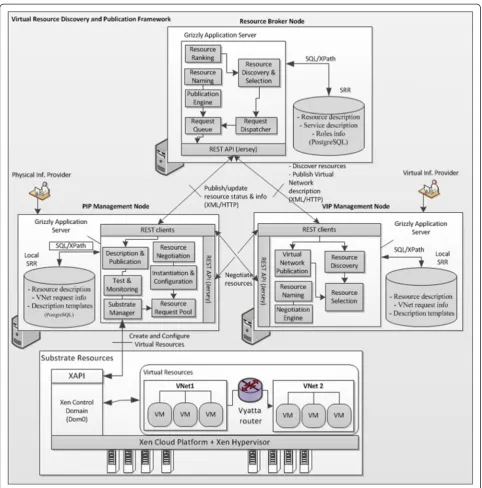
Figure 10 depicts the software architecture of the imple-mented prototype and the technologies. Only a subset of the components proposed in section 3.3.1.1 was im-plemented. For simplicity reasons, we combine the VIP and SP roles.
Our implementation consists of three management nodes, namely: the PIP Management Node (PMN); the
VIP Management Node (VMN); and the Broker Node
(BN). Each node holds a repository that contains
re-source information and hosts the application logic that realizes the functionalities of the corresponding roles (e.g. PIP, VIP, and Broker). This application logic is a set of software modules written in the Java programming language and provides JFC/Swing-based user interfaces for the administrators.
We use XML to describe the resources and formulate the various requests (e.g. discover and negotiation re-quests), and XSD (XML-Schema Definitions) to define the structure of the data models and specify constraints on the data contained in the XML documents. Each document exchanged between two roles is a data model (an instance of our proposed information model).
We selected Jersey [24], an open source JAX-RS (JSR 311) reference implementation, to implement the REST interfaces, and Grizzly web server [25] to deploy the web services. Moreover, we used JAXB 2 [26] for marshaling Table 1 Broker web services’APIs
Resources URI HTTP action/Description
Base URL:http://www.
ResourceBroker.com/apiV1/
Management of resources: publication, update and deletion.
/resources POST: create a new resource in the SRR. GET: get all resources.
/resources/{resource_id} GET: retrieve a resource. PUT: update a resource. DELETE: delete an individual resource.
Network services /services POST: create a new service. GET: get list of all services.
/services/{service_id} GET: retrieve a service. PUT: update a service. DELETE: delete an individual service.
Role information /roles POST: create a new service. GET: get list of all services.
/roles/{role_id} GET: retrieve a service. PUT: update a service. DELETE: delete an individual service.
Topology (Virtual Network) /networks/ POST: create a new network. GET: get list of all networks.
/networks/{network_id} GET: retrieve a network. PUT: update a service. DELETE: delete an individual network.
Requests (negotiation and service deployment requests)
/requests POST: create a request GET: get list of requests.
/ requests/{request_id} GET: read a request. PUT: update a request. DELETE: delete an individual request.
Offers (negotiation offers) /offers POST: create a new negotiation offer. GET: get all existing offers.
and un-marshaling the XML data contained in REST messages’body.
In this implementation, the BN is the key node encom-passing a resource naming/identification module, as well
as ranking and clustering engines, which are involved in the resource publication and discovery processes. In our approach, we store resource properties such as node type (e.g. VM, vRouter), operating system type, and
virtualization environment, in separate columns in the database. The document containing the resource de-scription is stored in XML format in the same database. When received, resource publication and discovery re-quests are first stored in the Request Queue and later forwarded by the Request Dispatcher to the appropriate module. We use a 32 digits-based identification scheme to identify each advertised resource. The issued identi-fier consists of three parts: the first set of three digits identifies the provider (PIP, VIP or SP), the second set of 13 digits determine information such as the resource
type, the virtualization environment being used and the remaining set of 16 digits are GUID-based (automatic-ally generated).
In this work, the discovery request contains two parts: the first part is selection parameters such as OS type, node type, virtualization environment and the second part is a set of selection constraints that could be applied on functional attributes such as CPU and memory. To select the optimal resources, the Resource Discovery and Selection Engine (RDS) queries the repository to get a set of resources having similarities in their description.
In such a query, the selection parameters described in the discovery request are taken into consideration, which helps in filtering the resources that do not match part of the request. Afterwards, the RDS processes the returned set of resources to evaluate their functional attributes if they correspond to the selection constraints specified in the discovery request. For instance, a constraint on the desired CPU’s processing speed could be defined as a range between two values (minimum and maximum).
The PMN sends resource publication requests to the BN, and processes virtual network instantiation and re-source negotiation requests for the PIP. It uses a local database to store and manage resource information and description templates. Furthermore, the PMN monitors allocated resources and updates their status information in the broker. In addition to other components, the PMN architecture includes a Resource Instantiation and Config-uration engine that handles virtual resource instantiation, configuration, and testing. This engine allows for man-aging and controlling the substrate resources (detailed later in this section).
Finally, in addition to discovering the resources needed to deploy end-user services, the VMN interacts with the PMN to negotiate resources. To build the locals and the broker databases, we first selected eXist-db [27] - a native XML database. However, we conducted some perform-ance and scalability experiments to evaluate eXist-db’s ability of processing and storing a large number of re-sources. Those experiments demonstrated that a native XML database is not suitable for our prototype due to the lack of flexibility in using the tools exposed to store and retrieve information in it. Consequently, we selected the open source RDBMS PostgreSQL [28] that offers native XML support for storing XML documents, SQL/XML publishing/querying functions, full-text search, as well as full-text indexing and XPath support. Furthermore, Post-greSQL stores an XML document in its text representa-tion, which results in fast information retrieval and adds flexibility in terms of resources’description by eliminating the need to change tables’ schema whenever additional information is added to the document. Upon receiving a resource publication request, the publication engine vali-dates and parses the resource description, and stores the received document in its XML text format in the database. Resources are indexed based on their identifier that is stored in a separate column. This enhances the selection process by eliminating unnecessary parsing of an XML document, since the resource identifier contains infor-mation about the type of resource. We used Xen Cloud Platform (XCP) [29] that includes the Xen Hypervisor as well as Xen API (Xen Management API or XAPI) for virtualizing substrate nodes. Based on para-virtualization principles, Xen has demonstrated to be the virtualization platform of choice due to its capabilities in terms of
performance, features, and isolation level among virtual machines. XAPI provides programmatic access to, and re-mote administration of, Xen-enabled virtual resources through XML-RPC services.
We implemented the Substrate Manager (SM) using XenServer’s SDK that is provided by Citrix. The SM is responsible for automatically instantiating a virtual top-ology as described in the VN request. We automated the resource provisioning process by eliminating the human intervention needed to create the requested virtual re-sources and configure their network settings. For this mat-ter, we prepared a set of virtual machine templates on which we deployed Shell scripts that enable the addition or removal of Ethernet interface(s), changing a VM’s IP address, as well as setting/removing a static route between two nodes (in case of a virtual router). In order to execute such scripts, the SM uses an SSH connection to the tar-geted virtual machine. In addition to creating and config-uring virtual resources, the SM monitors the status of the running resources and displays their dynamic attributes on the PIP’s interface. In this implementation, we selected Vyatta [30] virtual router as shown in Figure 10 to con-nect two or more virtual networks.
Prototype setup and test scenarios
As shown in Figure 11, the experimental setup consisted of two management nodes (one PMN and one VMN), one broker node, and four nodes that represent substrate re-sources. The PMN and VMN and the substrate nodes are DELL Precision 390 machines equally equipped with Intel Core™Duo E6550, 2.33GHz processor and 4GB of RAM, 10000 RPM HDD, and 100MBPS link. Since the Broker node is expected to process all the incoming publication and discovery requests, we used an HP Z210 Workstation machine. It is equipped with Quad Core™ i5 processor, 4GB of RAM (1333 MHz DDR3), 7200 RPM HDD, and 100MBPS link. All the nodes are interconnected with Ethernet links through a Cisco Catalyst 2950 series Switch forming a LAN.
We installed Linux operating system (Ubuntu 12.04 LTS) and the required tools and frameworks on the man-agement and the broker nodes. On the remaining four machines, we installed XCP and prepared a set of virtual machines templates configured with 1CPU, 512MB of RAM, 20GB of disk space, and 5Mbps links. In this setup, we run two to four VMs on the same node.
Prior to running the experiments, we generated a set of resource description XML documents containing all the possible resources description to be used during the evaluation process. Such documents were published into the broker using a PUT REST message in order to popu-late its repository with the required data.
First, the PMN published the description of the virtual ma-chines and Vyatta routers that we installed on the substrate resources to the broker. Then, the VMN sent a discovery request to the broker. Afterwards, the broker node re-trieved the information needed as described in the request from its resource repository and selected the resource can-didates. After receiving the selected resources, the VMN triggered a negotiation process by sending a request to the PMN, which when detected, a notification message was displayed on the PIP’s console. The negotiation process went through two phases: First, the PMN rejected the offer and sent back the request to the VMN; then the VMN sent another request which was accepted by the PMN. Upon reaching an agreement, the PMN instantiated the virtual topology and started the virtual resources (using XAPI cli-ent). When the requested resources started successfully, the PMN updated their published information in the bro-ker. Figures 12, 13 and 14 illustrate three the screen shots of our prototype’s operation – namely the VIP resource discovery view, the PIP resource publication view, and the PIP virtual topology management view.
Basic performance evaluation
To assess the basic performance of the prototype, we used the setup described in the previous section and evaluated the interactions related to resource publication (between the PMN and the BN), resource discovery (between the VMN and the BN), resource negotiation (between the
VMN and PMN), and resource instantiation (between the PMN and the machines representing substrate resources). We used JMeter [31] to evaluate the REST APIs’ per-formance, and we modified the application logic that is deployed on the management nodes to add support for measuring internal operations’processing times.
Table 2 shows the evaluation results. Each result repre-sents the mean value calculated over 40 trials, in addition to some statistical distribution related results (such as the standard deviation and the confidence level) giving indica-tions about the variability of the mean values presented.
In the table, the response time for resource publication is calculated at the PMN as the difference between the time when the PMN’s publication module sends a publi-cation request and the time it receives a response from the BN. The time for publishing a resource includes the time taken to extract description of resources from the REST message’s body and the time to store it in the bro-ker’s repository. The results shown in the table are the average measurements over 40 trials. For each trial, we sent one resource publication request containing a docu-ment describing 2 virtual resources. On average, it took 204.25 ms to process this publication request, which gen-erated 25.89 Kbytes of network load–values that we con-sider as reasonable. However, as we increased the number of publication requests, the response time and network load measurements increased. This is due to the request processing overhead and the concurrent access to the
resources’database. The load and stress testing results will be presented in the next sub-section.
The resource discovery response time, which gives an indication about the performance of the selection algo-rithm, is calculated from the moment the VMN’s discov-ery module sends a discovdiscov-ery request until it receives a response with the selected resources. This includes the time used for the execution of the selection algorithm and the database query time to get the list of potential resources. To perform the resource discovery experi-ments, we populated the resources’repository with the de-scriptions of 5000 different resources. The results shown in the table are related to the tests done with one resource discovery request of two virtual resources and 50 proc-essed resources during the selection process. On average, it took 181.1 ms and 23.61 KB of generated network load to process such a request. Additional tests show that as the number of discovered resources increases, the re-sponse time and the network load increase as well, due to the increased number of resources that are taken into ac-count by the selection algorithm and the increase in size of the list of matched resources that is sent back.
The resource negotiation response time, measured at the VMN level, is calculated from the moment the VMN’s ne-gotiation module sends a nene-gotiation request until the
response is received from the PIP. On average, it took 186.4 ms and 34.16 KB of generated load to process a re-source negotiation request related to two virtual rere-sources.
Finally, for virtual topology instantiation, the response time is measured at the PMN level from the moment a VNet instantiation request is received until the booting of the virtual machines and the configuration of their virtual interfaces (through the XAPI client) is completed. In our test scenario, the virtual topology consisted of four Vyatta virtual routers connected by three links, as shown in Figure 13. On average, it takes one minute and 10 seconds to create and configure a Vyatta virtual ma-chine, while it takes 5 minutes 58 seconds to create and configure a virtual topology consisting of four Vyatta vir-tual routers and three virvir-tual links.
Analyzing those results, we conclude that the system yields an acceptable performance for the recurring oper-ations (i.e. resource publication, discovery, and negoti-ation)–The response time for those operations ranging from 181 ms to 204 ms, while the generated network load ranged between 24 Kbytes and 34 Kbytes. As for the virtual topology instantiation operation, it does result in a significant response time due to its nature that re-quires the creation and configuration of virtual machines and their connection to form the requested topology.
However, this operation is only required once, when the VNet is created. Furthermore, the automation of virtual resources configuration using SSH and shell scripts eases and speeds up the virtual topology instantiation process.
Load testing
In order to evaluate the behavior of the system under variable loading conditions, we conducted some load tests using the test setup shown in Figure 11. Figures 15, 16 and 17 show the load testing results for the resource publication, discovery, and negotiation operations.
The resources’ publication operation involves the fol-lowing steps: 1) at the PIP side–loading of the resources description document from the local DB, its validation, and the creation of a REST PUT message containing the description document and its sending to the broker; and 2) at the Broker side–extraction of the resources docu-ment from the received PUT message, it’s processing and validation, its storage in the DB, and the sending of an HTTP 201 response message to the PIP. As shown in Figure 15, the resources’ publication operation shows a
polynomial (quadratic) growth pattern in terms of re-sponse time, which ranged from 204 ms for 1 publication request to 1 minute and 50 seconds for a 1000 publication requests. This polynomial response time growth pattern can be attributed to three time consuming steps related to resources’ publication, namely: the concurrent access to the broker’s DB for storage of different resource descrip-tion documents; the publicadescrip-tion messages’processing; and the marshaling and un-marshaling of XML documents. As for the generated network load, it showed a logarith-mic growth pattern with values ranging from 26 KB for 1 publication request to 240 KB for a 1000 publication re-quests. The network load’s slow growth pattern can be ex-plained by the fact that the publication requests generated in this test all carried a small XML payload (description document of 2 virtual resources), thus not imposing a high overhead on the network.
As for the resources’discovery and selection operation, it involves the following steps: 1) at the VIP’s side - loading and validation of the XML documents containing the de-scription of the resources requested, as well as creation
and sending of a GET REST request with the loaded resource discovery document to the broker; and 2) at the Broker’s side - extraction of the resource discovery document from the received discovery request and its pro-cessing/validation, execution of the resource selection al-gorithm to select the resources that comply with the request, and sending of the list of matched resources to the VIP Node. As shown in Figure 16, the resources’ dis-covery and selection operation shows a polynomial (quad-ratic) growth pattern in terms of both response time and generated network load. The quadratic trend line for the response time gives insights about the performance of the broker’s selection algorithm. As shown in the figure, the response time shows a faster increase as the number of re-sources processed during selection increases–with values ranging from 181 ms for 2 discovered resources/50 proc-essed resources during selection, to 17 seconds for a 1000 discovered resources/5000 processed resources during se-lection. As for the network load’s quadratic trend line, it is associated with the number of resources discovered, with values ranging from 23 KB (for 2 discovered resources) to
1.37 MB (for a 1000 discovered resources). As the number of discovered resources increases, so does the size of the XML payload carried by the response message sent back by the broker.
Finally, the resources’negotiation operation consists in the following steps: 1) at the VIP side–generation of re-source negotiation document, creation and sending of REST PUT request containing the negotiation docu-ment, to the PIP node; and 2) at the PIP side - extrac-tion/processing of the negotiation document embedded in the received negotiation request, checking the avail-ability of resources, changing the status of the request to
processed and marking the negotiation document as
ac-cepted, and embedding the accepted negotiation
docu-ment in a REST PUT message that is sent back to the VIP node. As shown in Figure 17, the response time for the negotiation operation follows a quadratic growth pattern, while the network load follows a logarithmic growth pattern. The response time’s quadratic growth pattern can be explained by the delays caused by concur-rent access to the PIP’s local repository for updating the
negotiated resources’ status and the negotiation mes-sages’ processing. As for the network load’s slow loga-rithmic growth pattern, it can be explained by the small payload carried in resource negotiation messages.
Stress testing
In order to evaluate the behavior of the system under heavy load conditions, we conducted some stress tests, focusing on the publication and discovery related interac-tions. As test setup, we built a LAN consisting of 5 ma-chines connected by a Cisco Catalyst 2950 series switch. One of those machines (HP Z210 workstation) acted as the Broker, while the other four machines (DELL 390) acted as either a PMN or a VMN (depending on the test scenario). Different test scenarios in which the nodes’ roles and the number of generated requests were varied were conducted. Figures 18 and 19 show the stress test-ing results for the resource publication and discovery operations.
Analyzing the stress testing results, we notice that Grizzly is a suitable application server for the hosting of the broker node, due to its robustness and ability to han-dle a very large number of simultaneous requests (up to 2000 requests/sec can be supported). Due to those cap-ability, our broker was able to handle very high traffic loads, without crashing. In fact, the system was tested
for up to 15,000 publication requests (describing up to 120,000 resources) without failure. As the number of publi-cation request increased, the response time to process the requests increased in a quadratic fashion, while the net-work load increased in a logarithmic fashion, when two PIP nodes were used as message generators. However, this pattern changed to a cubic growth pattern (for both net-work load and response time) when four PIPs were used to generate publication requests simultaneously, thus doub-ling the number of requests generated and the number of resources published. This polynomial (cubic) increase in response time and network load is due to several factors such as database overhead caused by reading/writing re-cords, resource description marshaling and un-marshaling, HTTP requests processing overhead, and increase in the number of requests exchanged.
As for the discovery operation, the broker was success-fully tested for up to 12,000 discovered resources (as shown in Figure 19), and the response time and network load both showed polynomial (quadratic) growth pat-terns with respect to the number of discovered re-sources, for both Two nodes and Four nodes setups. For 12,000 resources, the response time reached 23.7 mi-nutes, and the generated network load reached 44.2 MB, due to the resource property information that is embed-ded in the response message.
Table 2 Network load and response time measurements
Operations Interactions Response
Time–Mean
value (ms)
Response Time–
Statistics
Network
Load–Mean
value (KB)
Network Load–
Statistics
Resource Publication [1 request/2 virtual resources published]
PMN–BN 204.25 Standard Deviation 11.39656 25.89 Standard Deviation 1.371093 Confidence Level
(95.0%)
5.333754 Confidence Level (95.0%)
0.641691
Minimum 189 Minimum 23.6
Maximum 231 Maximum 28.3
Resource Discovery [1 request/2 virtual resources discovered/ 50 resources processed during selection]
VMN–BN 181.1 Standard Deviation 11.0305795 23.61 Standard Deviation 0.9623983 Confidence Level
(95.0%)
5.162470119 Confidence Level (95.0%)
0.4504162
Minimum 156 Minimum 22.1
Maximum 197 Maximum 25.3
Resource negotiation [1 request/2 virtual resources negotiated]
VMN–PMN 186.4 Standard Deviation 6.23572053 34.16 Standard Deviation 0.9275888 Confidence Level
(95.0%)
2.91840704 Confidence Level (95.0%)
0.4341249
Minimum 174 Minimum 32.4
Maximum 198 Maximum 35.8
Virtual Topology instantiation [4 virtual routers, 3 virtual links]
PMN–substrate nodes
358445.9 Standard Deviation 3956.246 143.465 Standard Deviation 0.9051170
Confidence Level (95.0%)
1851.58 Confidence Level
(95.0%)
0.4236078
Minimum 351670 Minimum 141.8
Figure 15Load testing results for resources’publication operation.
Comparative performance analysis
As discussed in Section 2.3, existing virtual resource dis-covery approaches [7-10] do not rely on an intermediary resources’broker role, and follow a distributed approach in which a VIP must gather information directly from multiple PIPs, before initiating the resources’ selection process. In order to compare the performance of our centralized, broker-based architecture with the perform-ance of the distributed, broker-less architectures pro-posed in the literature, we modified our prototype to operate in a decentralized fashion. This was achieved by removing the broker node and modifying the PMN be-havior so that the PIP publishes it resources’description information to a local repository/broker (instead of the centralized BN). As for the VMN, it was modified to en-able direct communication between the VIP and the PIP for the discovery of resources’ information. Further-more, the resource selection algorithm, which was ori-ginally executed by the centralized BN when it received a resource discovery request, was ported to the VIP node, which now takes care of resource selection follow-ing the discovery of candidate resources. Figures 20 and 21 illustrate the centralized and the distributed test bed setups used to collect the comparative performance measurements, while Figures 22 and 23 depict the col-lected results.
As shown in Figure 22, both the centralized and the distributed architectures achieve similar response times
for the resource discovery operation, when the VIP is communicating with one PIP. However, as the number of PIPs increases, the broker-based centralized architecture shows a significant improvement in terms of response time, when compared to the distributed architecture. In-deed, in the centralized architecture, as the number of PIPs increases, the time it takes to discover resources in-creases in a slow rising linear fashion, while the distrib-uted architecture exhibits a more rapid, quadratic growth curve. While it took 6846.2 ms to discover information re-lated to 10 PIPs in the distributed broker-less architecture, it took 487 ms to discover the same information in the centralized broker-based architecture (i.e. a 92.8% per-formance improvement).This is due to the fact that in the distributed architecture, the VIP had to communicate with the 10 PIPs to gather their resources related information, then perform the selection locally, while in the broker-based architecture, the VIP communicates only with one node (the resources’ broker) that categorizes, matches, and selects the most suitable resources (based on (non) functional parameters) to be returned to the VIP node. It should be noted that, in the distributed architecture, prior to the resources’discovery phase, the VIP should discover the contact information of the PIPs (via a public reposi-tory) in order to be able to communicate with them.
As for the network load’s comparative performance measurements, we observed linear growth patterns for both the centralized and the distributed architectures,