
Open Access
Review
Hypersensitivity pneumonitis
Yves Lacasse* and Yvon Cormier
Address: Centre de Pneumologie, Université Laval, Hôpital Laval, 2725 Chemin Ste-Foy, Ste-Foy, Quebec, G1V 4G5, Canada
Email: Yves Lacasse* - [email protected]; Yvon Cormier - [email protected] * Corresponding author
Abstract
Hypersensitivity pneumonitis (HP) is a pulmonary disease with symptoms of dyspnea and cough resulting from the inhalation of an antigen to which the subject has been previously sensitized. The incidence of HP is unknown. A population-based study estimated the annual incidence of interstitial lung diseases as 30:100,000 and HP accounted for less than 2% of these cases. The diagnosis of HP can often be made or rejected with confidence, especially in areas of high or low prevalence respectively, using simple diagnostic criteria. Chest X-rays may be normal in active HP; High Resolution Computed Tomography is sensitive but not specific for the diagnosis of HP. The primary use of pulmonary function tests is to determine the physiologic abnormalities and the associated impairment. Despite the pitfalls of false positive and false negatives, antigen-specific IgG antibodies analysis can be useful as supportive evidence for HP. Bronchoalveolar lavage plays an important role in the investigation of patients suspected of having HP. A normal number of lymphocytes rules out all but residual disease. Surgical lung biopsy should be reserved for rare cases with puzzling clinical presentation or for verification the clinical diagnosis when the clinical course or response to therapy is unusual. Being an immune reaction in the lung, the most obvious treatment of HP is avoidance of contact with the offending antigen. Systemic corticosteroids represent the only reliable pharmacologic treatment of HP but do not alter the long-term outcome. The use of inhaled steroids is anecdotal. Treatment of chronic or residual disease is supportive.
Disease name and synonyms
Hypersensitivity pneumonitis – Extrinsic allergic alveolitis
Definition
Hypersensitivity pneumonitis (HP) is a pulmonary dis-ease with symptoms of dyspnea and cough resulting from the inhalation of an antigen to which the subject has been previously sensitized. Acute and subacute HP represent the most active forms of the disease which may become chronic while remaining progressive. HP may also evolve to end-stage lung [1]. The diagnosis of HP has most often relied on an array of nonspecific clinical symptoms and signs developed in an appropriate setting [2], with the
demonstration of interstitial markings on chest radio-graphs, serum antibodies against offending antigens, a lymphocytic alveolitis on bronchoalveolar lavage (BAL), and/or a granulomatous reaction on lung biopsies.
Etiology
A wide spectrum of antigens may trigger the disease. These antigens have often led to a graphic and most descriptive nomenclature detailed in several case reports. A complete review of these antigens is beyond the scope of this article. The offending antigens can be classified in five broad cat-egories represented by disease prototypes (Table 1). Published: 03 July 2006
Orphanet Journal of Rare Diseases 2006, 1:25 doi:10.1186/1750-1172-1-25
Received: 15 June 2006 Accepted: 03 July 2006
This article is available from: http://www.OJRD.com/content/1/1/25
© 2006 Lacasse and Cormier; licensee BioMed Central Ltd.
Epidemiology
Like most interstitial lung diseases, HP is a rare disease. In a population-based study, the estimated annual incidence of interstitial lung disease was reported as 30 per 100,000 [3]. In that study, HP accounted for less than 2% of the incident cases. The study was conducted in New Mexico, a dry environment that is not propitious to the develop-ment of many forms of HP. In the HP Study [4], 30% of the 661 patients included in this prospective multi-center cohort had HP. This cohort study included consecutive adult patients presenting with a pulmonary syndrome for which active HP was considered in the differential diagno-sis.
Over the last two or three decades, the difficulties in stud-ying the epidemiology of HP have been illustrated by studies of the incidence or prevalence of farmer's lung. Definite conclusions have been elusive because of meth-odological issues including study design and the defini-tion of farmer's lung [5-7]. Most studies used cross-sectional surveys in order to determine the prevalence of farmer's lung or that of associated conditions such as the presence of precipitating antibodies against offending antigens. Few, if any, real cohort studies have been pub-lished on the incidence of the disease [8-10]. An even more important factor has been the lack of a consistent definition of farmer's lung. Epidemiological reports based on cases admitted to a hospital where a definite diagnosis can be made using chest radiographs, computed tomogra-phy, BAL and/or lung biopsies are likely to identify the most severe cases only and thus underestimate the true prevalence of the disease. In addition, important differ-ences have been observed in the classification of respira-tory diseases among farmers by clinicians from different European countries [11]. In a survey of final diagnostic classifications on hospital discharge, 73% of cases of HP were erroneously classified [12]. Finally, fluctuations in the prevalence of farmer's lung have been related to a greater diagnostic suspicion attributable to ongoing epi-demiological surveys [13]. Despite these methodological limitations, several studies gave consistent results allow-ing the prevalence of farmer's lung in exposed farmers to be estimated at between 0,5 and 3% [14-19].
The difficulties in establishing the incidence and preva-lence of HP are further complicated by geographic varia-bles, including climatic conditions and, in the case of farmer's lung, farming practices. Sex differences for both HP and seropositivity are likely to represent differences in exposure to offending antigens [20-22]. Genetic markers have generally failed to confirm hereditary risk factors for HP [23-33].
Diagnostic criteria/Clinical presentation
A number of diagnostic criteria recommendations for HP have been published [34-37] (Table 2). The most widely used are those from Richerson and colleagues [35]. None of these sets of criteria have been validated. Their diagnos-tic accuracy is therefore unknown. They correspond in effect to definitions of the disease.
Others have developed prediction rules (i.e., clinical tools that quantify the contribution of various components of the history, physical examination and basic laboratory results to the diagnosis in an individual patient [38]) for periodic surveillance in high-risk workers or case finding in outbreaks of HP [39-41]. Although these rules are meant to be sensitive (i.e., able to detect most cases of work-related HP), it is likely that their specificity is limited in work environments with a high prevalence of other res-piratory diseases. Little information is provided for their accuracy.
The HP study
We recently addressed the issue of the clinical diagnostic criteria of HP in a prospective multi-centre cohort study [4]. Its objective was to develop a clinical prediction rule for the diagnosis of active HP. Such a rule aims at helping clinicians to arrive at a more accurate estimate of proba-bility of HP and decide whether further investigation is needed to either rule in or rule out HP.
Consecutive adult patients presenting with a pulmonary syndrome for which active HP was considered in the dif-ferential diagnosis were included in this study. This cohort thus included a wide range of patients presenting for the investigation of a suspected interstitial lung disease, including patients with HP (the «cases») and patients
Table 1: Prototypes of hypersensitivity pneumonitis according to major classes of antigens Class of antigens Specific antigen Disease
Bacteria Saccharopolyspora rectivirgula Farmer's lung Fungus Trichosporon cutaneum Summer-type HP Mycobacteria Mycobacterium avium intracellulare Hot-tub lung
without HP (the «controls»). Regression analyses identi-fied six significant predictors of active HP (Table 3).
The clinical prediction model produced an equation expressing the probability of HP as a function of the sta-tistically significant variables. From this equation, we con-structed a table of probability for combinations of predictors (Table 4). In clinical practice, the best diagnos-tic strategy will depend on the probability of HP deter-mined from Table 4.
For instance, in a farmer presenting with recurrent epi-sodes of respiratory symptoms, inspiratory crackles and testing positive for the corresponding precipitating anti-bodies, the probability of HP would be 81% (Table 4). Another patient presenting with progressive dyspnea and inspiratory crackles as the unique criteria of HP would have a probability of HP of less than 1%. Further investi-gation would be mandated only in the former. Typical findings of an alveolar lymphocytosis and/or bilateral ground-glass opacities on HRCT in the former patient would secure the diagnosis of HP, without resorting to surgical lung biopsy. HP would be confidently ruled out in the latter and the investigation oriented towards another diagnosis.
Classification of HP
Much confusion still surrounds the classification of HP. Its clinical presentations have classically been defined as acute, subacute and chronic [35]. In the acute form, influ-enza-like symptoms often predominate, consisting of chills, fever, sweating, myalgias, lassitude, headache, and nausea that begin 2 to 9 hours after exposure, peak typi-cally during 6 and 24 hours, and last from hours to days. Respiratory symptoms such as cough and dyspnea are common but not universal. The subacute form may appear gradually over several days to weeks, is marked by cough and dyspnea, and may progress to severe dyspnea and cyanosis, leading to urgent hospitalization. The chronic form has an insidious onset over a period of months, with increasing cough and exertional dyspnea. Fatigue and weight loss may be prominent symptoms.
The distinction between the stages of HP is often difficult as they likely represent different manifestations of a single disease that may be related more to the pattern of antigen exposure than to the offending antigen itself. This state-ment is supported by the finding of considerable overlap in the clinical manifestations of patients with farmer's lung (usually considered as the prototype of acute HP) and those with pigeon breeder's or bird fancier's diseases (the prototypes of subacute and chronic HP, respectively) [42]. Also, chronic HP may still be active and progressive. Others have suggested a classification that takes into
Table 2: Proposed diagnostic criteria for hypersensitivity pneumonitis for clinical purposes Author Major criteria Minor criteria
Terho [10] 1. exposure to offending antigens (revealed by history aerobiological or microbiological investigations of the environment, or measurements of antigen-specific IgG antibodies)
2. symptoms compatible with HP present and appearing or worsening some hours after antigen exposure;
3. lung infiltrations compatible with HP visible on chest X-ray
1. basal crepitant rales
2. impairment of the diffusing capacity
3. oxygen tension (or saturation) of the arterial blood either decreased at rest, or normal at rest but decreased during exercise
4. restrictive ventilation defect in the spirometry 5. histological changes compatible with HP
6. positive provocation test whether by work exposure or by controlled inhalation challenge
Richerson et al. [35] 1. the history and physical findings and pulmonary function tests indicate an interstitial lung disease
2. the X-ray film is consistent
3. there is exposure to a recognized cause 4. there is antibody to that antigen Cormier et al. [36] 1. appropriate exposure
2. inspiratory crackles
3. lymphocytic alveolitis (if BAL is done) 4. dyspnea
5. infiltrates on chest radiographs or High Resolution Computed Tomography (HRCT)
1. recurrent febrile episodes
2. decreased Diffusing Capacity Test (DLCO) 3. precipitating antibodies to HP antigens
4. granulomas on lung biopsy (usually not required) 5. improvement with contact avoidance or appropriate treatment
Schuyler et al. [37] 1. symptoms compatible with HP
2. evidence of exposure to appropriate antigen by history or detection in serum and/or BAL fluid antibody
3. findings compatible with HP on chest radiograph or HRCT 4. BAL fluid lymphocytosis
5. pulmonary histologic changes compatible with HP 6. positive «natural challenge»
1. bibasilar rales 2. decreased DLCO
account the progression of the disease (acute intermittent, acute progressive, chronic progressive, chronic nonpro-gressive) that can only be assessed retrospectively [1,5]. For practical purposes, we have already suggested to con-sider HP patients as having either active or residual dis-ease, the latter representing late emphysematous or fibrotic sequelae of the disease in which the typical alveo-lar lymphocytosis of active HP has disappeared [4].
Chest radiology
• Chest X-ray: Chest radiography is often the initial step in the investigation of a patient presenting with a pulmonary syndrome suggestive of HP. The first objective of chest X-rays is not to rule in HP but rather to rule out other dis-eases for the patient's illness. In acute HP, one expects to find groundglass infiltrates, nodular and/or striated
patchy opacities [43,44]. The distribution of these infil-trates is usually diffuse but often sparing the bases in the subacute form [45]. A variety of different distributions have been described [46,47]. None of these findings are specific to HP. Up to 20% of individuals with acute HP have normal chest X-rays [48].
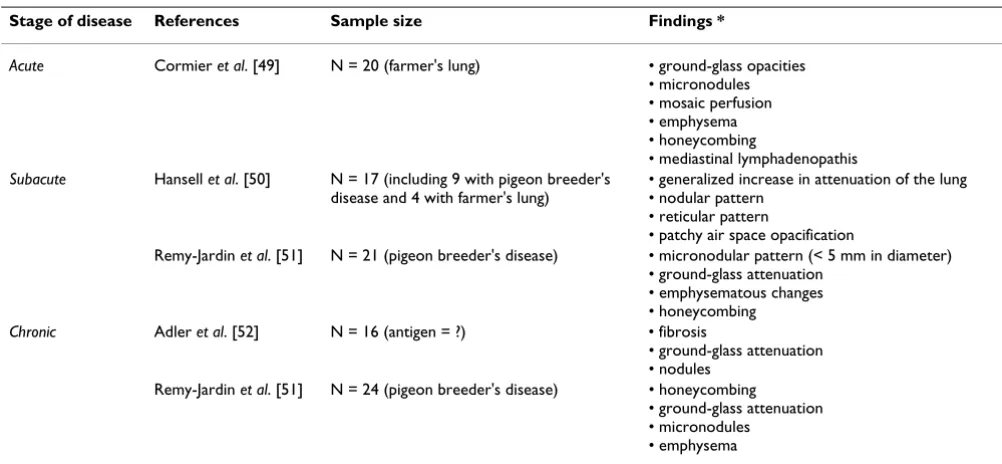
• CT scanning: Our ability to judge the usefulness of High Resolution Computed Tomography (HRCT) in HP is lim-ited by the small number of cases studied. Table 5 summa-rizes selected reports of HRCT findings according to the phase of disease. The described patterns are not specific but suggest that HP may be considered in the differential diagnosis when present. For instance, groundglass opaci-ties can be seen in a variety of other diseases including desquamative interstitial pneumonitis, Pneumocystis
cari-Table 4: Probability (%) of having hypersensitivity pneumonitis*
Exposure to a known offending
antigen
Recurrent episodes of
symptoms
Symptoms 4–8 hours after
exposure
Weight loss Crackles
+
-Serum precipitins Serum precipitins
+ - +
-+ + + + 98% 92% 93% 72%
+ + + - 97% 85% 87% 56%
+ + - + 90% 62% 66% 27%
+ + - - 81% 45% 49% 15%
+ - + + 95% 78% 81% 44%
+ - + - 90% 64% 68% 28%
+ - - + 73% 33% 37% 10%
+ - - - 57% 20% 22% 5%
- + + + 62% 23% 26% 6%
- + + - 45% 13% 15% 3%
- + - + 18% 4% 5% 1%
- + - - 10% 2% 2% 0%
- - + + 33% 8% 10% 2%
- - + - 20% 4% 5% 1%
- - - + 6% 1% 1% 0%
- - - - 3% 1% 1% 0%
* All the predictors are dichotomous variables; - indicates absent; +, present; from Lacasse et al. [4], with permission.
Table 3: Significant predictors of hypersensitivity pneumonitis*
Variables Odds ratio Confidence interval (95%)
Exposure to a known offending antigen 38.8 11.6 – 129.6 Positive precipitating antibodies 5.3 2.7 – 10.4 Recurrent episodes of symptoms 3.3 1.5 – 7.5 Inspiratory crackles 4.5 1.8 – 11.7 Symptoms 4–8 hours after exposure 7.2 1.8 – 28.6
Weight loss 2.0 1.0 – 3.9
nii pneumonia, bronchiolitis obliterans with organizing pneumonia, bronchoalveolar carcinoma, alveolar protei-nosis, and alveolar hemorrhage. Conversely, when groundglass opacities are associated with poorly defined, centrilobular micronodules and mosaic attenuation or expiratory air trapping, the diagnosis of HP is further sup-ported, but such an association is rare.
Pulmonary function tests
The primary use of pulmonary function tests is to deter-mine the physiologic abnormalities and the associated impairment. The results of pulmonary function tests may also guide therapy by helping the clinician to select those for whom a treatment with corticosteroids may be justi-fied. Pulmonary function tests have no discriminative properties in differentiating HP from other interstitial lung diseases [4].
The typical physiological profile of acute HP is a restrictive pattern with low DLCO [53]. In chronic disease, the pat-tern can be restrictive, but at least in farmer's lung, the most frequent profile is an obstructive defect resulting from emphysema [54]. The currently held belief is that a decreased DLCO is always present in HP [55]. Neverthe-less, in the HP Study, 39 of the 177 patients (22%) in whom DLCO could be measured had normal results (defined as a DLCO 80% predicted) at the time of diagno-sis [HP Study Group, unpublished data].
Specific antibodies
The usefulness of most reports on the sensitivity and spe-cificity of serum specific antibodies is limited by the
inclu-sion of inappropriate controls, often healthy subjects. HP cannot be ruled in solely on the basis of positive antibod-ies or ruled out on the basis of negative antibodantibod-ies. Many asymptomatic farmers (10%) and pigeon breeders (40%) have positive results [5,23,56] and many HP patients are negative for specific antibodies [57]. It is unclear if HP can occur in the absence of specific antibodies to the respon-sible allergen. False negatives could result from testing for inappropriate antigens.
Despite the pitfalls discussed above, specific antibodies analysis can be useful as supportive evidence. The results of the HP Study demonstrate that positive serum antibod-ies are a significant predictor of HP (odds ratio: 5.3; 95% CI: 2.7 – 10.4) [4]. Antigens available for testing in most centers included pigeon and parakeet sera, dove feather antigen, Aspergillus sp, Penicillium, Saccharopolyspora recti-virgula, and Thermoactinomyces viridans. These antigens cover most cases of HP including pigeon breeder's disease, bird fancier's lung, farmer's lung, and humidifier lung. The antigen Trichosporon cutaneum is also available in Japan for cases of summer-type HP [58]. The selection of antigens to be tested often needs to be determined locally according to the prevalent antigens [4,59]. In Eastern France, by using a panel of antigens really responsible for farmer's lung and not a classical standardized panel, sero-logical tests showed a high rate of sensitivity and specifi-city [60].
Several methods for determination of precipitins or total IgG antibodies (immunodiffusion, immunoelectrophore-sis, enzyme-linked immunosorbant assays [ELISA]) and
Table 5: High-resolution computed tomography findings in hypersensitivity pneumonitis Stage of disease References Sample size Findings *
Acute Cormier et al. [49] N = 20 (farmer's lung) • ground-glass opacities • micronodules • mosaic perfusion • emphysema • honeycombing
• mediastinal lymphadenopathis Subacute Hansell et al. [50] N = 17 (including 9 with pigeon breeder's
disease and 4 with farmer's lung)
• generalized increase in attenuation of the lung • nodular pattern
• reticular pattern
• patchy air space opacification
Remy-Jardin et al. [51] N = 21 (pigeon breeder's disease) • micronodular pattern (< 5 mm in diameter) • ground-glass attenuation
• emphysematous changes • honeycombing
Chronic Adler et al. [52] N = 16 (antigen = ?) • fibrosis
• ground-glass attenuation • nodules
Remy-Jardin et al. [51] N = 24 (pigeon breeder's disease) • honeycombing
• ground-glass attenuation • micronodules
• emphysema
different antigen preparations have been described [61,62]. ELISA is usually the preferred method. Unfortu-nately, even the ELISA technique lacks standardization [63].
Inhalation challenge
Inhalation challenges to suspected environments, usually at the workplace, as well as specific provocation tests in controlled conditions have been described [64]. These tests lack standardization both in the inhalation protocols and in the criteria defining a positive response. Further studies are needed before recommending inhalation chal-lenges in the diagnosis of HP.
Bronchoalveolar lavage
BAL plays an important role in the investigation of patients suspected of having HP [65]. BAL can provide
useful, supportive elements in the diagnosis of HP. A nor-mal number of lymphocytes rules out all but residual dis-ease [66]. However, the presence of an alveolar lymphocytosis does not, by any means, establish the diag-nosis because asymptomatic, exposed individuals can also have increased numbers of lymphocytes in their BAL [67]. These individuals do not have subclinical HP, as con-firmed by a 20-year follow-up [68]. Also many other dis-eases (including sarcoidosis, interstitial pneumonia associated with collagen vascular disease, silicosis, bron-chiolitis obliterans with organizing pneumonia, HIV-associated pneumonitis and drug-induced pneumonitis) are characterized by an alveolar lymphocytosis [65]. Posi-tive BAL findings (specially if the observed lymphocytosis is marked) [67,68] in a patient with interstitial lung dis-ease of unknown origin should direct the clinician towards the possible diagnosis of HP [65].
Table 6: Distribution of diagnoses in the HP Study [4]
Diagnosis Number of patients
Hypersensitivity pneumonitis 199
Pigeon breeder's/bird fancier's disease 132
Farmer's lung 38
Humidifier lung 3
Suberosis 2
Summer type HP 2
Various exposures to fungi 19
HP of unknown origin 3
Controls 462
Idiopathic interstitial pneumonia * 226
Sarcoidosis 52
Interstitial disease associated with collagen vascular disease 35 Drug induced pulmonary disease 26 Bronchiolitis obliterans (with our without organizing pneumonia) 25 Unspecified interstitial lung disease † 26 Infectious pneumonia 11
Histiocytosis X 10
Asthma 6
Silicosis 5
Eosinophilic pneumonia 5
Normal lung 4
Bronchoalveolar carcinoma/carcinomatous lymphangitis 4
Residual HP ‡ 3
Residual HP ‡ 3
Organic dust toxic syndrome 3 Lymphocytic interstitial pneumonia 2 Pulmonary edema (heart failure) 2 Radiation pneumonitis 2
Miscellaneous § 13
TOTAL 661
* includes patients with the clinical diagnosis of idiopathic pulmonary fibrosis, and those with the pathological diagnoses of usual, desquamative, respiratory bronchiolitis, acute and non-specific interstitial pneumonia;
† includes patients in whom no specific diagnosis could be reached but in whom HP was excluded on the basis of BAL;
As in the case of serum precipitins and inhalation chal-lenge, the BAL technique lacks standardization. Lym-phocyte subsets, especially the CD4/CD8 ratio and activation were previously thought to be helpful in differ-entiating HP from sarcoidosis. This is now challenged since the CD4/CD8 ratio in HP can be as high as that seen in sarcoidosis [71-73]. A low ratio would however support HP over sarcoidosis.
Lung biopsy
The histopathology of HP has been well described [74-76]. In the acute stages, reports on open lung biopsies revealed features of interstitial lymphocytes infiltrates and fibrosis, edema, noncaseating granulomas, and bronchi-olitis obliterans. Macrophages with foamy cytoplasm are also found within the alveolar space. In chronic stages, widespread fibrotic reaction is a prominent feature, often without predominant involvement of upper lobes with contraction. Even though emphysema was found at necropsy in chronic HP, it is only recently that emphy-sema has been recognized as a long-term complication of HP [54].
• Transbronchial biopsy: Hematoxylin-eosin-stained transbronchial biopsy is of limited usefulness for the diag-nosis of farmer's lung [77].
• Surgical lung biopsy: The utility of surgical lung biopsy has most often been reported in terms of "diagnostic yield", i.e., the proportion of specific diagnoses obtained from the procedure. Whether the procedure alters the clin-ical management represents an important outcome. Sev-eral retrospective studies addressing these issues in series of patients with a variety of diffuse parenchymal diseases are available [78-89]. In selected reports, the results have been very heterogeneous: the diagnostic yield ranged from 34% to 100%; therapy was altered in 46% to 75% of the cases. This heterogeneity may stem from several fac-tors, including the selection of candidates to open lung biopsy, the timing of the procedure along the course of the disease, as well as the expertise of the attending pathologist. The decision to submit a patient to open lung biopsy must be balanced against the associated morbidity. If HP is suspected, it has been our recommendation to reserve surgical lung biopsy for rare cases with puzzling clinical presentation or for verification the clinical diagno-sis when the clinical course or response to therapy is unu-sual [36]. This recommendation is not based on evidence but emphasizes the limitations of surgical lung biopsy and the necessity of a thorough clinical investigation that comprises a high index of suspicion and a careful expo-sure history.
Differential diagnosis
The differential diagnosis of HP is wide. The results of the HP Study illustrate this situation [4]. In this cohort study, consecutive adult patients presenting with a pulmonary syndrome for which active HP was considered in the dif-ferential diagnosis were included. The investigators had to classify each patient as HP or non-HP (i.e., control). The control group may be regarded as a set of lung diseases that must be distinguished from HP (Table 6).
Management
TreatmentAs HP is a hyper immune reaction of the lung, the most obvious treatment is avoidance of contact with the anti-gen. Systemic corticosteroids represent the only recog-nised pharmacologic treatment for HP. The best available evidence comes from a unique randomized placebo-con-trolled trial [90]. In this trial, 36 patients with acute farmer's lung were randomized to receive either 40 mg of Prednisolone tapering over 8 weeks or placebo. All patients were instructed to avoid contact with the farm during the drug trial. After one month of treatment, there was no difference in FEV1, FVC and pO2 between the two groups. However, a small but significant difference in DLCO was observed. Corticosteroids had no beneficial effect on the long-term (5-year) prognosis however. The results of that trial confirmed other observations from controlled but non-randomized trials [91,92] and case series: corticosteroids hasten the recovery from the acute stage of HP, but have no beneficial effect on long-term prognosis. The decision to treat with corticosteroids may be guided by the severity of symptoms and physiologic abnormalities [93]. The use of inhaled steroids is anecdo-tal [94]. The treatment of chronic or residual disease is supportive.
Prevention
In high-risk environments (such as farming activities), education may prevent respiratory problems [95]. Ideally, all farmers should be informed of the hazards of exposure to barn dust and encouraged to use adequate preventive measures. For practical purposes, however, major pretive measures (such as mask wearing, increasing barn ven-tilation, avoiding the barn when the animals are feeding) cannot be recommended for primary prevention and are usually reserved for individuals with past history of HP [96].
Unresolved questions
occur-rence and natural history; (3) the validation of biomark-ers of both exposure and disease; (4) the definition of its natural history; (5) the development of a battery of stand-ardized antigens known to cause HP that should be avail-able to clinicians and researchers for use in both the diagnosis and investigations of pathogenesis.
References
1. Selman M: Hypersensitivity pneumonitis. In Interstitial lung disease
Edited by: Schwarz MI, King TE Jr. Hamilton BC: Decker Inc; 1998:393-422.
2. Schatz M, Patterson R: Hypersensitivity pneumonitis-general considerations. Clin Rev Allergy 1983, 1:451-467.
3. Coultas DB, Zumwalt RE, Black WC, Sobonya RE: The epidemiol-ogy of interstitial lung diseases. Am J Respir Crit Care Med 1994,
150:967-972.
4. Lacasse Y, Selman M, Costabel U, Dalphin JC, Ando M, Morell F, Erkinjuntti-Pekkanen R, Muller N, Colby TV, Schuyler M, Cormier Y, HP Study Group: Clinical diagnosis of hypersensitivity pneu-monitis. Am J Respir Crit Care Med 2003, 168:952-958.
5. Fink JN: Epidemiologic aspects of hypersensitivity pneumoni-tis. Monogr Allergy 1987, 21:59-69.
6. Grant IWB, Blyth W, Wardrop VE, Gordon RM, Pearson JCG, Mair A: Prevalence of farmer's lung in Scotland: a pilot survey. BMJ
1972, 1:530-534.
7. Bourke SJ, Dalphin JC, Boyd G, McSharry C, Baldwin CI, Calvert JE:
Hypersensitivity pneumonitis: current concepts. Eur Respir J
2001, 18:81S-92S.
8. Terho EO, Heinonen OP, Lammi S: Incidence of farmer's lung leading to hospitalization and its relation to meteorological observations in Finland. Acta Med Scand 1983, 213:295-298. 9. Boyd DHA: The incidence of farmer's lung in Caithness. Scot
Med J 1971, 16:261-262.
10. Terho EO: Diagnostic criteria for farmer's lung disease. Am J Ind Med 1986, 10:329.
11. Farebrother MJ, Kelson MC, Heller RF: Death certification of farmer's lung and chronic airway diseases in different coun-tries of the EEC. Br J Dis Chest 1985, 79:352-360.
12. Kipen HM, Tepper A, Rosenman K, Weinrib D: Limitations of hos-pital discharge diagnoses for surveillance of extrinsic allergic alveolitis. Am J Ind Med 1990, 17:701-709.
13. Smyth JT, Adkins GE, Margaret L, Moore B, McWhite E: Farmer's lung in Devon. Thorax 1975, 30:197-203.
14. Babbott FL Jr, Gump DW, Sylwester DL, MacPherson BV, Holly RC:
Respiratory symptoms and lung function in a sample of Ver-mont dairymen and industrial workers. Am J Public Health 1980,
70:241-245.
15. Stanford CF, Connolly JH, Ellis WA, Smyth ET, Coyle PV, Mont-gomery WI, et al.: Zoonotic infections in Northern Ireland farmers. Epidemiol Infect 1990, 105:565-570.
16. Marcer G, Simioni L, Saia B, Saladino G, Gemignani C, Mastrangelo G:
Study of immunological parameters in farmer's lung. Clin Allergy 1983, 13:443-449.
17. Depierre A, Dalphin JC, Pernet D, Dubiez A, Faucompre C, Breton JL: Epidemiological study of farmer's lung in five districts of the French Doubs province. Thorax 1988, 43:429-435. 18. Dalphin JC, Debieuvre D, Pernet D, Maheu MF, Polio JC, Toson B, et
al.: Prevalence and risk factors for chronic bronchitis and farmer's lung in French dairy farmers. Br J Ind Med 1993,
50:941-944.
19. Ferri F, Ruggieri MP, Guidetti G, Azzarone G, Giammartini P, Capanni S, Mantovani P, Bertani M: Prevalence of extrinsic allergic alve-olitis in cattle breeders from the province of Reggio Emilia.
Med Lav 2003, 94:380-390.
20. Terho EO, Husman K, Vohlonen I: Prevalence and incidence of chronic bronchitis and farmer's lung with respect to age, sex, atopy, and smoking. Eur J Respir Dis Suppl 1987, 152:19-28. 21. Cormier Y, Belanger J: Long-term physiologic outcome after
acute farmer's lung. Chest 1985, 87:796-800.
22. Terho EO, Husman K, Vohlonen I, Mantyjarvi RA: Serum precip-itins against microbes in mouldy hay with respect to age, sex, atopy, and smoking of farmers. Eur J Respir Dis Suppl 1987,
152:115-121.
23. Cormier Y, Belanger J, Durand P: Factors influencing the devel-opment of serum precipitins to farmer's lung antigen in Que-bec dairy farmers. Thorax 1985, 40:138-142.
24. Terry G, Murray K: Familial farmer's lung. Lancet 1971, 1:1022. 25. Allen DH, Basten A, Williams GV, Woolcock AJ: Familial
hyper-sensitivity pneumonitis. Am J Med 1975, 59:505-514.
26. Flaherty DK, Braun SR, Marx JJ, Blank JL, Emanuel DA, Rankin J: Sero-logically detectable HLA-A, B, and C loci antigens in farmer's lung disease. Am Rev Respir Dis 1980, 122:437-443. 27. McDevitt HO: The HLA system and its relation to disease.
Hosp Pract (Off Ed) 1985, 20:57-72.
28. Flaherty DK, Iha T, Chmelik R, Dickie H, Reed CE: HL-A 8 in farmer's lung. Lancet 1975, 2:507.
29. O'Connell EJ, Zora JA, Gillespie DN, Rosenow EC 3rd: Childhood hypersensitivity pneumonitis (farmer's lung): four cases in siblings with long-term follow-up. J Pediatr 1989, 114:995-997. 30. Ridder GD, Berrens L: Family study of farmer's lung (letter).
Lancet 1979, 1:832-833.
31. Terho EO, Koshimies OP, Heinonen OP, Mantyjarvi R: HLA and farmer's lung. Eur J Respir Dis 1981, 63:361-362.
32. Terho EO, Heinonen OP, Mantyjarvi RA, Vohlonen I: Familial aggregation of symptoms of farmer's lung. Scand J Work Environ Health 1984, 10:57-58.
33. Terho EO, Mantijarvi RA, Heinonen OP, Ojanen TH, Vohlonen I, Tukiainen H: Familial aggregation of IgG antibody response to antigens associated with farmer's lung. Int J Epidemiol 1985,
14:589-593.
34. Terho EO, Heinonen OP, Lammi S: Incidence of clinically con-firmed farmer's lung disease in Finland. Am J Ind Med 1986,
10:330.
35. Richerson HB, Bernstein IL, Fink JN, Hunninghake GW, Novey HS, Reed CE, et al.: Guidelines for the clinical evaluation of hyper-sensitivity pneumonitis. Report of the Subcommittee on Hypersensitivity Pneumonitis. J Allergy Clin Immunol 1989,
84:839-844.
36. Cormier Y, Lacasse Y: Keys to the diagnosis of hypersensitivity pneumonitis: the role of serum precipitins, lung biopsy, and high-resolution computed tomography. Clin Pulm Med 1996,
3:72-77.
37. Schuyler M, Cormier Y: The diagnosis of hypersensitivity pneu-monitis. Chest 1997, 111:534-536.
38. Laupacis A, Sekar N, Stiell IG: Clinical prediction rules. A review and suggested modifications of methodological standards.
JAMA 1997, 277:488-494.
39. Sullivan PA, Odencrantz JR, Petsonk EL, Fox JL, Trout D: Develop-ment and validation of ahypersensitivity pneumonitis sur-veillance questionnaire. Am J Respir Crit Care Med 1997,
155:A946.
40. Fox J, Anderson H, Moen T, Gruetzmacher G, Hanrahan L, Fink J:
Metal working fluid-associated hypersensitivity pneumonitis: an outbreak investigation and case-control study. Am J Ind Med 1999, 35:58-67.
41. Dangman KH, Cole SR, Hodgson MJ, Kuhn C, Metersky ML, Schenck P, Storey E: The hypersensitivity pneumonitis diagnostic index: use of non-invasive testing to diagnose hypersensitiv-ity pneumonitis in metalworkers. Am J Ind Med 2002,
42:150-162.
42. Lacasse Y, Selman M, Costabel U, Dalphin JC, Morell F, Ando M, et al.:
Clinical manifestations of hypersensitivity pneumonitis from various origins. Am J Respir Crit Care Med 2003, 167:A359. 43. Monkare S, Ikonen M, Haahtela T: Radiologic findings in farmer's
lung. Prognosis and correlation to lung function. Chest 1985,
87:460-466.
44. Seal RME, Thomas GO, Griffiths JJ: Farmer's lung. Proc R Soc Med
1963, 56:271-273.
45. Cook PG, Wells IP, McGavin CR: The distribution of pulmonary shadowing in farmer's lung. Clin Radiol 1988, 39:21-27. 46. Mindell HJ: Roentgen findings in farmer's lung. Radiology 1970,
97:341-346.
47. Emanuel DA, Kryda MJ: Farmer's lung disease. Clin Rev Allergy
1983, 1:509-532.
49. Cormier Y, Brown M, Worthy S, Racine G, Muller NL: High-resolu-tion computed tomographic characteristics in acute farmer's lung and in its follow-up. Eur Respir J 2000, 16:56-60. 50. Hansell DM, Moskovic E: High-resolution computed
tomogra-phy in extrinsic allergic alveolitis. Clin Radiol 1991, 43:8-12. 51. Remy-Jardin M, Remy J, Wallaert B, Muller NL: Subacute and
chronic bird breeder hypersensitivity pneumonitis: sequen-tial evaluation with CT and correlation with lung function tests and bronchoalveolar lavage. Radiology 1993, 189:111-118. 52. Adler BD, Padley SP, Muller NL, Remy-Jardin M, Remy J: Chronic hypersensitivity pneumonitis: high-resolution CT and radio-graphic features in 16 patients. Radiology 1992, 185:91-95. 53. Hapke EJ, Seal RM, Thomas GO, Hayes M, Meek JC: Farmer's lung.
A clinical, radiographic, functional, and serological correla-tion of acute and chronic stages. Thorax 1968, 23:451-468. 54. Lalancette M, Carrier G, Laviolette M, Ferland S, Rodrique J, Begin R,
Cantin A, Cormier Y: Farmer's lung. Long-term outcome and lack of predictive value of bronchoalveolar lavage fibrosing factors. Am Rev Respir Dis 1993, 148:216-221.
55. Cormier Y, Belanger J, Tardif A, LeBlanc P, Laviolette M: Relation-ships between radiographic change, pulmonary function, and bronchoalveolar lavage fluid lymphocytes in farmer's lung disease. Thorax 1986, 41:28-33.
56. Dalphin JC, Toson B, Monnet E, Pernet D, Dubiez A, Laplante JJ, Aia-che JM, Depierre A: Farmer's lung precipitins in Doubs (a department of France): prevalence and diagnostic value.
Allergy 1994, 49:744-750.
57. Burrel P, Bylander R: A critical review of the role of precipitins in hypersensitivity pneumonitis. Eur J Respir Dis 1981,
62:332-343.
58. Kawai T, Tamura M, Murao M: Summer-type hypersensitivity pneumonitis. A unique disease in Japan. Chest 1984,
85:311-317.
59. Ojanen T: Class specific antibodies in serodiagnosis of farmer's lung. Br J Ind Med 1992, 49:332-336.
60. Reboux G, Piarroux R, Mauny F, Madroszyk A, Millon L, Bardonnet K,
et al.: Role of molds in farmer's lung disease in Eastern France. Am J Respir Crit Care Med 2001, 163:1534-1539.
61. Reynaud C, Slosman DO, Polla BS: Precipitins in bird breeder's disease: how useful are they? Eur Respir J 1990, 3:1155-1161. 62. Reboux G, Dalphin JC: Hypersensitivity pneumonitis: a
techni-cal note on precipitins. Rev Mal Respir 2003, 20:140-143. 63. Aberer W, Woltsche M, Woltsche-Kahr I, Kranke B: IgG
antibod-ies typical for extrinsic allergic alveolitis – an inter-labora-tory quality assessment. Eur J Med Res 2001, 6:498-504. 64. Edwards JH, Davies BH: Inhalation challenge and skin testing in
farmer's lung. J Allergy Clin Immunol 1981, 68:58-64.
65. Semenzato G, Bjermer L, Costabel U, Haslam PL, Olivieri D: Clinical guidelines and indications for bronchoalveolar lavage (BAL): extrinsic allergic alveolitis. Eur Respir J 1990, 3:945-949. 66. Cormier Y, Belanger J, LeBlanc P, Laviolette M: Bronchoalveolar
lavage in farmers' lung disease: diagnostic and physiological significance. Br J Ind Med 1986, 43:401-405.
67. Cormier Y, Belanger J, Laviolette M: Persistent bronchoalveolar lymphocytosis in asymptomatic farmers. Am Rev Respir Dis
1986, 133:843-847.
68. Cormier Y, Letourneau L, Racine G: Significance of precipitins and asymptomatic lymphocytic alveolitis: a 20-yr follow-up.
Eur Respir J 2004, 23:523-525.
69. Godard P, Clot J, Jonquet O, Bousquet J, Michel FB: Lymphocyte subpopulations in bronchoalveolar lavages of patients with sarcoidosis and hypersensitivity pneumonitis. Chest 1981,
80:447-452.
70. Valenti S, Scordamaglia A, Crimi P, Mereu C: Bronchoalveolar lav-age and transbronchial lung biopsy in sarcoidosis and extrin-sic allergic alveolitis. Eur J Respir Dis 1982, 63:564-569.
71. Soler P, Nioche S, Valeyre D, Basset F, Benveniste J, Burtin C, Battesti JP, Georges R, Hance AJ: Role of mast cells in the pathogenesis of hypersensitivity pneumonitis. Thorax 1987, 42:565-572. 72. Ando M, Konishi K, Yoneda R, Tamura M: Difference in the
phe-notypes of bronchoalveolar lavage lymphocytes in patients with summer-type hypersensitivity pneumonitis, farmer's lung, ventilation pneumonitis, and bird fancier's lung: report of a nationwide epidemiologic study in Japan. J Allergy Clin Immunol 1991, 87:1002-1009.
73. Wahlstrom J, Berlin M, Lundgren R, Olerup O, Wigzell H, Eklund A, Grunewald J: Lung and blood T-cell receptor repertoire in extrinsic allergic alveolitis. Eur Respir J 1997, 10:772-779. 74. Reyes CN, Wenzel FJ, Lawton BR, Emanuel DA: The pulmonary
pathology of farmer's lung disease. Chest 1982, 81:142-146. 75. Kawanami O, Basset F, Barrios R, Lacronique JG, Ferrans VJ, Crystal
RG: Hypersensitivity pneumonitis in man. Light- and elec-tron-microscopic studies of 18 lung biopsies. Am J Pathol 1983,
110:275-289.
76. Coleman A, Colby TV: Histologic diagnosis of extrinsic allergic alveolitis. Am J Surg Pathol 1988, 12:514-518.
77. Lacasse Y, Fraser RS, Fournier M, Cormier Y: Diagnostic accuracy of transbronchial biopsy in acute farmer's lung disease. Chest
1997, 112:1459-1465.
78. Qureshi RA, Ahmed TA, Grayson AD, Soorae AS, Drakeley MJ, Page RD: Does lung biopsy help patients with interstitial lung dis-ease? Eur J Cardiothorac Surg 2002, 21:621-626.
79. Rena O, Casadio C, Leo F, Giobbe R, Cianci R, Baldi S, Rapellino M, Maggi G: Videothoracoscopic lung biopsy in the diagnosis of interstitial lung disease. Eur J Cardiothorac Surg 1999, 16:624-627. 80. Temes RT, Joste NE, Qualls CR, Allen NL, Crowell RE, Dox HA, Wernly JA: Lung biopsy: is it necessary? J Thorac Cardiovasc Surg
1999, 118:1097-1100.
81. Kramer MR, Berkman N, Mintz B, Godfrey S, Saute M, Amir G: The role of open lung biopsy in the management and outcome of patients with diffuse lung disease. Ann Thorac Surg 1998,
65:198-202.
82. Neuhaus SJ, Matar KS: The efficacy of open lung biopsy. Aust N Z J Surg 1997, 67:181-184.
83. Lachapelle KJ, Morin JE: Benefit of open lung biopsy in patients with respiratory failure. Can J Surg 1995, 38:316-321.
84. Bove P, Ranger W, Pursel S, Glover J, Bove K, Bendick P: Evaluation of outcome following open lung biopsy. Am Surg 1994,
60:564-570.
85. Shah SS, Tsang V, Goldstraw P: Open lung biopsy: a safe, reliable and accurate method for diagnosis in diffuse lung disease.
Respiration 1992, 59:243-246.
86. Wagner JD, Stahler C, Knox S, Brinton M, Knecht B: Clinical utility of open lung biopsy for undiagnosed pulmonary infiltrates.
Am J Surg 1992, 164:104-107.
87. Walker WA, Cole FH Jr, Khandekar A, Mahfood SS, Watson DC:
Does open lung biopsy affect treatment in patients with dif-fuse pulmonary infiltrates? J Thorac Cardiovasc Surg 1989,
97:534-540.
88. Warner DO, Warner MA, Divertie MB: Open lung biopsy in patients with diffuse pulmonary infiltrates and acute respira-tory failure. Am Rev Respir Dis 1988, 137:90-94.
89. Venn GE, Kay PH, Midwood CJ, Goldstraw P: Open lung biopsy in patients with diffuse pulmonary shadowing. Thorax 1985,
40:931-935.
90. Kokkarinen JI, Tukiainen HO, Terho EO: Effect of corticosteroid treatment on the recovery of pulmonary function in farmer's lung. Am Rev Respir Dis 1992, 145:3-5.
91. Cormier Y, Desmeules M: Treatment of hypersensitivity pneu-monitis (HP): comparison between contact avoidance and corticosteroids. Can Respir J 1994, 1:223-228.
92. Monkare S: Influence of corticosteroid treatment on the course of farmer's lung. Eur J Respir Dis 1983, 64:283-293. 93. Kokkarinen JI, Tukiainen HO, Terho EO: Recovery of pulmonary
function in farmer's lung. A five-year follow-up study. Am Rev Respir Dis 1993, 147:793-796.
94. Carlsen KH, Leegaard J, Lund OD, Skjaervik H: Allergic alveolitis in a 12-year-old boy: treatment with budesonide nebulizing solution. Pediatr Pulmonol 1992, 12:257-259.
95. Hoglund S: Prevention of respiratory problems in agriculture.
Am J Ind Med 1986, 10:245-247.
96. American Thoracic Society: Respiratory health hazards in agri-culture. Am J Respir Crit Care Med 1998, 158:S1-S76.



![Table 6: Distribution of diagnoses in the HP Study [4]](https://thumb-us.123doks.com/thumbv2/123dok_us/763505.1573221/6.612.60.558.98.439/table-distribution-diagnoses-hp-study.webp)
