Open Access
Review
Leopard syndrome
Anna Sarkozy*
1, Maria Cristina Digilio
2and Bruno Dallapiccola
1,3Address: 1IRCCS-CSS, San Giovanni Rotondo and CSS-Mendel Institute, Viale Regina Elena 261, 00198, Rome, Italy, 2Medical Genetics, Bambino
Gesù Hospital, Piazza San't Onofrio 4, 00165 Rome, Italy and 3Department of Experimental Medicine and Pathology, University "La Sapienza",
Viale Regina Elena 261, 00198, Rome, Italy
Email: Anna Sarkozy* - [email protected]; Maria Cristina Digilio - [email protected]; Bruno Dallapiccola - [email protected] * Corresponding author
Abstract
LEOPARD syndrome (LS, OMIM 151100) is a rare multiple congenital anomalies condition, mainly characterized by skin, facial and cardiac anomalies. LEOPARD is an acronym for the major features of this disorder, including multiple Lentigines, ECG conduction abnormalities, Ocular hypertelorism, Pulmonic stenosis, Abnormal genitalia, Retardation of growth, and sensorineural Deafness. About 200 patients have been reported worldwide but the real incidence of LS has not been assessed. Facial dysmorphism includes ocular hypertelorism, palpebral ptosis and low-set ears. Stature is usually below the 25th centile. Cardiac defects, in particular hypertrophic cardiomyopathy
mostly involving the left ventricle, and ECG anomalies are common. The lentigines may be congenital, although more frequently manifest by the age of 4–5 years and increase throughout puberty. Additional common features are café-au-lait spots (CLS), chest anomalies, cryptorchidism, delayed puberty, hypotonia, mild developmental delay, sensorineural deafness and learning difficulties. In about 85% of the cases, a heterozygous missense mutation is detected in exons 7, 12 or 13 of the PTPN11 gene. Recently, missense mutations in the RAF1 gene have been found in two out of six PTPN11-negative LS patients. Mutation analysis can be carried out on blood, chorionic villi and amniotic fluid samples. LS is largely overlapping Noonan syndrome and, during childhood, Neurofibromatosis type 1-Noonan syndrome. Diagnostic clues of LS are multiple lentigines and CLS, hypertrophic cardiomyopathy and deafness. Mutation-based differential diagnosis in patients with borderline clinical manifestations is warranted. LS is an autosomal dominant condition, with full penetrance and variable expressivity. If one parent is affected, a 50% recurrence risk is appropriate. LS should be suspected in foetuses with severe cardiac hypertrophy and prenatal DNA test may be performed. Clinical management should address growth and motor development and congenital anomalies, in particular cardiac defects that should be monitored annually. Hypertrophic cardiomyopathy needs careful risk assessment and prophylaxis against sudden death in patients at risk. Hearing should be evaluated annually until adulthood. With the only exception of ventricular hypertrophy, adults with LS do not require special medical care and long-term prognosis is favourable.
Published: 27 May 2008
Orphanet Journal of Rare Diseases 2008, 3:13 doi:10.1186/1750-1172-3-13
Received: 6 January 2008 Accepted: 27 May 2008
This article is available from: http://www.ojrd.com/content/3/1/13
© 2008 Sarkozy et al; licensee BioMed Central Ltd.
Disease name and synonyms
Leopard syndrome (LS, OMIM 151100) is named based on an acronym, mnemonic for the major features of this disorder: multiple Lentigines, ECG conduction abnormal-ities, Ocular hypertelorism, Pulmonic stenosis, Abnormal genitalia, Retardation of growth, and sensorineural D eaf-ness [1,2]. This disease was also known as Multiple Lentig-ines syndrome, Cardio-cutaneous syndrome, Moynahan syndrome, Lentiginosis profusa and Progressive Cardio-myopathic Lentiginosis.
Historical notes
LS was first reported by Zeisler and Becker in 1936, in a 24-year-old woman presenting with multiple lentigines, increasing in number from birth to puberty, pectus carina-tum, hypertelorism and prognathism [3]. A few decades later, Gorlin et al. reviewed this disorder and coined the LEOPARD acronym supporting the concept of a more generalised condition [1].
Epidemiology
LS is a rare condition, but the exact birth prevalence is unknown. Not less than 200 patients have been reported and two reviews published [1,4]. Within the group of the so called 'neuro-cardio-facial-cutaneous' (NCFC) syn-dromes, LS is probably the second most common disorder after Noonan syndrome (NS) [5]. However, LS is likely underdiagnosed or misdiagnosed as many of its features are mild and the correct diagnosis might be missed in the absence of lentiginosis.
Clinical description
LS is characterised by the presence of multiple lentigines, although these patients are showing a wide spectrum of features with marked variation in expression [1,2,4,6]. As mnemonically suggested by the acronym, the main fea-tures include multiple lentigines, facial dysmorphisms, cardiac anomalies, electrocardiographic (ECG) conduc-tion abnormalities, retardaconduc-tion of growth, abnormal gen-italia and sensorineural deafness.
Facies
Facial dysmorphisms are characteristic and change con-siderably with age, being less striking at birth and in the first infancy, with the most characteristic features becom-ing evident durbecom-ing childhood (Figure 1). Dysmorphic fea-tures can occur or be only mildly expressed in the newborns and infants [7]. Hypertelorism is virtually present in all cases, and flat nasal bridge and dysmorphic ears in about 87% of the patients. Additional, less fre-quent, features include palpebral ptosis, thick lips and low-set ears with overfolded helix (50%), large and everted ears, pterygium colli or redundant neck skin (37%) [7]. Adult patients usually manifest hypertelorism,
palpebral ptosis, low-set ears, deep nasal-labial folds and premature skin wrinkling.
Cardiovascular system
Electrocardiographic anomalies and progressive conduc-tion anomalies are the most common heart defects [4,6-8]. A superiorly oriented mean QRS axis in the frontal plane is frequently observed, even in the absence of struc-tural cardiac abnormalities, and does represent a useful diagnostic handle. A cardiological review indicated that ECG abnormalities occur in about 75% of the patients, including left or biventricular hypertrophy in 46% of them, often in association with q waves (19%), prolonged QTc (23%) and repolarisation abnormalities (42%) [8]. Conduction defects are found in 23% of the patients and p wave abnormalities in 19%. On the whole, about 70% of LS individuals display cardiac defects [[8]; personal observation]. Previous reports suggested that pulmonary valve stenosis (PVS), with or without dysplasia, is the most common defect (40%) [4,6]. However, current data points to a consistently lower figure for this defect (10– 20%) [8,9]. Conversely, hypertrophic cardiomyopathy (HCM) is the most frequent anomaly and represents the only life-threatening problem in these patients. HCM, which in general is asymmetric and involves the left ven-tricle, is detected in up to 80% of the subjects with cardiac defect, and may associate with significant left ventricular outflow tract obstruction in up to 40% of the cases [[8-10]; personal data]. Fatal events and sudden death have been reported in LS patients with HCM [7,8,11,12]. HCM can be congenital, but frequently manifests during the sec-ond infancy [7,8,12]. The onset of HCM usually precedes multiple lentigines, but the hypertrophic process may start or often worsen in parallel with lentigines
appear-Five year-old girl with multiple lentigines, cafè-au-lait spots and dysmorphic features
Figure 1
ance. Mitral valve prolapse, clefting or other morphologi-cal abnormalities have been found in up to 42% of cases [8]. Less frequent heart defects are atrial and atrioventricu-lar septal defects, coronary artery abnormalities, apical aneurysm and non compaction of the left ventricle, mul-tiple ventricular septal defects, isolated left ventricular enlargement and endocardial fibroelastosis [[6,8]; per-sonal observation].
Skin
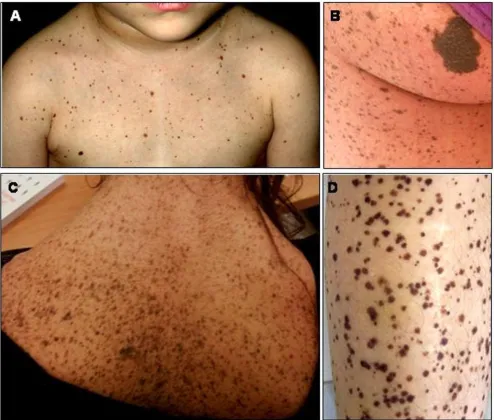
Multiple lentigines are a distinct feature of LS, even if they may be absent in young patients and, quite exceptionally also in subjects older than 5 years [[10]; personal observa-tion] (Figure 1 and 2). Lentigines are flat, black-brown macules, dispersed mostly on the face, neck, and upper part of the trunk, but sparing the mucosae. In general, len-tigines appear at 4–5 years and increase into the thou-sands until puberty, independently from sun exposure
Skin features of LS individual at different ages
Figure 2
(Figure 2). On histological examination, lentigines are characterised by pigment accumulation in the dermis and deeper epidermal layers, with increased number of melanocytes per unit skin area. The cafè-au-lait spots (CLS), occurring in about half of the patients, are similar to those found in Neurofibromatosis type 1 (NF 1), although they appear much darker in the dark skinned individuals (Fig-ure 2). CLS may be congenital or precede the appearance of lentigines [[10]; personal observation]. Occasional hypopigmented skin areas may also be observed [13].
Weight and length
Birth weight is normal or above the average in one third of the newborns [10]. Subsequently, LS patients show retardation of growth, with 25% of cases below the 3rd centile in height and 85% of adults below the 25th centile [[4,14]; personal observation].
Skeletal anomalies
Thorax anomalies, including broad chest, pectus carina-tum or excavacarina-tum are found in up to 75% of the new-borns [10]. Mandibular prognathism, winging of the scapulae, scoliosis, joint hyperflexibility and other find-ings are less common [14].
Genital and urinary tract anomalies
Bilateral cryptorchidism occurs in about 50% of males, but hypospadia and genital hypoplasia are also frequent. Delayed puberty and hypoplastic ovary have been reported in females. More cases are transmitted through affected mothers suggesting a reduced male fertility. Renal anomalies, including horseshoe kidney, are rare [4,10].
Hearing loss
Sensorineural deafness occurs in about 15–25% of patients [6,9]. Most cases are diagnosed at birth or during childhood, but deafness may develop also later in life.
Neurological abnormalities
Hypotonia is common in the newborn and can result in delayed psychomotor development [10]. Mild learning difficulties are reported in about 30% of the cases, while mental retardation is rare [[4,10]; personal observation].
Tumours
Haematological complications, such as myelodysplasia, acute myelogenous leukaemia and neuroblastoma, have been described in a few patients [4,15,16]. Malignant melanoma was diagnosed in a patient with a germline
PTPN11 and a somatic BRAF mutation [17]. Bilateral choristomas have been reported in a 5-year-old girl [18].
Aetiology
LS may be sporadic or inherited as an autosomal domi-nant fully penetrant trait. In approximately 85% of the
patients with a definite diagnosis of LS, a missense muta-tion is found in the PTPN11 gene, located on chromo-some 12q24.1 [9,19]. The PTPN11 gene encodes for the SRC homology 2 (SH2) domain-containing PTPase (SHP2) protein, characterised by two tandemly arranged SH2 (N-SH2 and C-SH2) domains and one protein tyro-sine phosphatase (PTP) domain. SHP2 functions as a cytoplasmic signalling transducer downstream of multi-ple receptors for growth factors, cytokines and hormones, with a particular role through the RAS-mitogen activated protein kinase (MAPK) pathway [20,21]. To the best of our knowledge, 11 different missense PTPN11 mutations, in exon 7, 12 and 13 (Tyr279Cys/Ser, Ala461Thr, Gly464Ala, Thr468Met/Pro, Arg498Trp/Leu, Gln506Pro, and Gln510Glu/Gly), have been reported so far, two of which (Tyr279Cys and Thr468Met) occur in about 65% of the cases [[9,10,22-29], personal data]. Germinal muta-tions in the PTPN11 gene are also responsible for about 40–50% of Noonan (NS) and Noonan-like/Multiple Giant Cell lesions syndrome cases [30,31]. Known changes appear to be exclusive for NS or LS, leading to specific genotype-phenotype correlations between these two disorders [23,31]. Among patients with PTPN11
mutations, an association between exon 7 and 12 muta-tions and HCM, and between exon 8 mutamuta-tions and PVS, has been established [23]. LS patients without PTPN11
mutations show a higher prevalence of ECG abnormali-ties and left ventricle hypertrophy [8]. Analyses of the nat-ural history of HCM in LS patients with different genotypes indicate that patients without PTPN11 muta-tions show a higher frequency of family history of sudden death, increased left atrial dimensions, bradyarrhythmias and other adverse arrhythmic and nonarrhythmic events [12]. Mutations affecting exon 13 in the PTPN11 gene are often associated with an important cardiac phenotype, characterised by rapidly progressive severe biventricular obstructive HCM, often with prenatal onset, and with seri-ous cardiac complications during follow-up (heart failure, septal myectomy, and sudden death) [12,28,32]. Analysis of personal cohorts of LS patients indicate that mutation of the Thr468 residue is less frequently associated with short stature, compared to mutation of the Tyr279 residue (26% vs. 47%), in which also deafness is more common (24% vs. 9%) [personal data]. This data confirm a previ-ous observation of less adverse effects of the Thr468Met mutation on body growth and cardiac development, with lower prevalence of PVS in these patients [33].
Genetic heterogeneity was supported by linkage analysis [36], and recently confirmed by the identification of RAF1
gene mutations in two out of six PTPN11 mutation nega-tive LS patients [37]. RAF1 protein is one of the three mammalian RAF isoforms (ARAF, BRAF and CRAF or RAF1), threonine-serine protein kinases with nonredun-dant developmental functions, acting downstream of RAS [38]. RAF1 gene mutations are also responsible for a sub-set of NS, 75% of which develop HCM [37,39]. The two LS subjects carrying the Leu613Val and Ser257Leu changes disclosed a full blown LS phenotype, with multi-ple lentigines, CLS, HCM and delayed puberty [37]. Pan-dit et al. investigated the functional effect of different RAF1 mutants, including the Leu613Val change, and showed that those associated with HCM had increased kinase activity and enhanced ERK activation [37]. These data reinforce the role of increased RAS signalling in car-diomyocyte hypertrophy pathogenesis and suggest that LS pathogenesis should not be simply related to a reduced RAS signal transduction [37,40].
About 5% of LS patients of the reported series do not have
PTPN11 or RAF1 mutations. Analysis of additional genes encoding for member or the RAS pathway will likely expand the LS genetic heterogeneity.
Distinct missense PTPN11 gene mutations occur as somatic events in myeloid or lymphoid malignancies [[34]; Cosmic database]. Both the spectrum and the distri-bution of these PTPN11 mutations are different from those documented in LS and related disorders.
Diagnosis and differential diagnosis
LS is a rare autosomal dominant disease, with high pene-trance and marked variable expression, mainly character-ised by short stature, facial dysmorphisms, cardiac anomalies and hyperpigmented skin lesions, specifically multiple lentigines and CLS [1,2,6]. According to Voron et al., clinical diagnosis of LS may be suspected in the pres-ence of multiple lentigines and two cardinal features [4]. In the absence of lentiginosis, three features in the patient and the presence of an affected close relative are diagnos-tic. Since some features manifest with advancing age, the diagnosis may be problematic in very young patients with only partial phenotypes. However, molecular testing is supportive in this difficult task [9]. Digilio et al. suggested that diagnosis of LS in the first months of age can be clin-ically suspected in the presence of three main features, including HCM, distinct facial dysmorphisms and CLS [10].
LS is one of the so called 'neuro-cardio-facial-cutane-ous'(NCFC) syndromes [5], which include some overlap-ping disorders, such as NS, Neurofibromatosis type 1, Costello syndrome, Cardiofaciocutaneous syndrome and
LS itself, all caused by mutations in some components of the Ras signalling pathway. These subjects display facial anomalies, heart defects and growth retardation, often associated with skin, skeletal and genital anomalies, and variable degree of mental retardation. In addition, each of these conditions present a few distinct features that are useful handles for differential diagnosis.
Except for its most striking feature, i.e. the multiple lentig-ines, LS largely overlaps with NS [41,42]. While NS patients show more conspicuous facial features in infancy and childhood, PVS (single-ventricle physiology) is the most frequent cardiac defect in this condition, and skin anomalies and deafness have been rarely reported. Con-versely, diagnostic clues of LS are the cutaneous manifes-tations, such as CLS and multiple lentigines, HCM and deafness. The phenotypic overlap between NS and LS may complicate the differential diagnosis in young individuals who have not yet developed lentigines. Molecular diagno-sis and long term follow-up are critical in these individu-als. In fact, re-examination later in life may reveal the presence of CLS or lentigines, as for a patient with the Tyr279Cys mutation reported by Tartaglia et al. [31,43]. Likewise, detection of a LS-related mutation should shift the diagnosis toward this condition, as suggested by Dig-ilio et al. for the patient reported by Takahashi and col-leagues [8,28,32].
LS also displays an important phenotypic overlap with Neurofibromatosis-Noonan syndrome (NFNS), a clinical entity manifesting with the association of facial and car-diac characteristics of NS with clinical features of neurofi-bromatosis 1, including CLS, neurofibromas, central nervous system and skeletal anomalies [44,45]. NFNS is largely caused by NF1 gene mutations [46]. Nevertheless, NFNS may have different potential aetiologies and NFNS phenotype has been described also in patients with muta-tions in both the NF1 and PTPN11 genes [47] as well as in neurofibromatosis 1 (NF1) patients with Noonan-like features [48,49]. In addition, patients with NS-related gene mutations can have pigmentary skin manifestations similar to those present in neurofibromatosis 1. Muta-tion-based differential diagnosis in patients with border-line clinical manifestations is warranted [50].
Genetic counselling
LS is caused by heterozygous missense mutations in auto-somal genes. Familial cases are commonly reported, and prevalence of transmitting mothers might be related to reduced male fertility. Genetic counselling should include:
• revision of pregnancy and developmental history and schooling;
• examination of growth parameters, facial dysmor-phisms, skin, skeleton, joints, heart and external genitalia;
• complete clinical and cardiological examination of par-ents, inclusive of echocardiogram and ECG, if possible;
• revision of natural history of the condition, its manifes-tation and clinical variability, occurrence and recurrence risks, and the eventual recommendation for clinical and molecular investigations to confirm the diagnosis;
• management and follow-up, inclusive of available treat-ments and interventions.
If one of the parents is affected, a 50% recurrence risk is appropriate. Germinal mutations and autosomal recessive inheritance have not been reported so far. Accordingly, in case of identified de novo mutation in sporadic patients, the recurrence risk for siblings is marginal. Molecular investigation should take into account the PTPN11 gene screening first, and then the RAF1 gene screening in
PTPN11-negative individuals.
Antenatal diagnosis
The prenatal differential diagnosis between NS and LS may be extremely difficult. LS should be suspected in foe-tuses with a normal karyotype and HCM. If LS is sus-pected, physical examination of the parents is indicated. If one parent is affected, obstetric ultrasound at different timings and foetal echocardiography at 20 weeks' of ges-tations is indicated. A DNA test for mutation analysis can be carried out on chorionic villi or amniotic fluid samples.
Management, treatment and prognosis
Clinical management, follow-up and treatment of LS patients greatly overlaps that of NS [41,42]. However, a few issues need to be addressed differently, taking into account the specific clinical problems and needs of LS individuals. Baseline studies at diagnosis should include a complete clinical examination, cardiological, genitouri-nary and neurological evaluations and hearing assess-ment. Laboratory studies should include molecular analysis of the PTPN11 and RAF1 genes.
In general, long-term prognosis of LS patients is favoura-ble. In case of cardiac anomalies at diagnosis, a periodic assessment should be performed as recommended by the cardiologist. Otherwise, a complete cardiological assess-ment should be performed annually and particularly at the appearance of multiple lentigines. Mild PVS has a good prognosis, while severe valvular dysplasia of the pul-monary valve may recommend valvulotomy or
valvulec-tomy [8]. As suggested by Limongelli et al., pathologic and clinical findings may be similar in familial HCM and left ventricular hypertrophy associated to LS [8]. Accordingly, LS patients with ventricular hypertrophy may follow familial HCM algorithms [51]. A beta-blockade or cal-cium channel blockers therapy could be indicated in the case of a significant gradient between the left ventricle and the aorta. In the absence of any improvement, surgical removal of the left ventricular outflow obstruction is indi-cated. Fatal events occurring in patients with HCM recom-mend careful risk assessment and prophylaxis against sudden death in patients at risk [8,12,13]. Isolated con-duction defects should be monitored annually and treated as in the general population. Annual hearing assessment should be performed until adulthood and hearing aids indicated, if needed. During follow-up, growth parame-ters should be monitored as in NS [41,42]. If growth hor-mone (GH) therapy is started, the cardiac status should be ongoing assessed, in particular in the presence of HCM. In the case of multiple lentigines or CLS, total UVA-UVB pro-tection should be indicated. Genitourinary, musculoskel-etal, neurological and orthodontic anomalies should be monitored and treated as for NS [41,42]. In the presence of developmental delay or difficulties at school, an infant stimulation program and alternate teaching method should be initiated. Hypotonia usually is benefiting of physical and occupational therapies. On the whole, most adults with LS do not require special medical care. Males with cryptorchidism in childhood may have fertility prob-lems in adulthood.
Unresolved questions
The LS phenotype is extremely heterogeneous, ranging from adults with mild facial features and multiple lentigi-nes, to patients with severe HCM, mental retardation, deafness and additional defects. Genotype-phenotype correlation analysis and functional studies are providing answers to these questions. In early childhood and before the appearance of lentigines, diagnosis of LS is sometimes difficult because of the overlap with NS and NFNS. In these patients, a mutation-based diagnosis is recom-mended.
Presence of patients without PTPN11 and RAF1 mutations further expand genetic heterogeneity of LS and points towards other genes likely involved in the same RAS-MAPK pathway.
Abbreviations
Competing interests
The authors declare that they have no competing interests.
Authors' contributions
AS participated in the design of the study, carried out the molecular genetic studies, analyzed clinical and molecu-lar data, and drafted the manuscript, MCD carried out analysis of clinical data and helped to draft the manu-script, BD conceived the study, participated in its design and coordination, and helped to draft the manuscript. All authors read and approved the final manuscript.
Consent
Written consent was obtained from the patients or by the patient's relative for pubblication. A copy of the written consent is available for review by the Authors of this man-uscript.
Acknowledgements
Written consent for publication was obtained from the patient or their rel-ative. The authors apologise to colleagues whose work was not cited due to limited space. Research in the authors' laboratory is supported in part by grants from the Italian Ministry of Health (Ricerca Corrente 2007 to AS; Ricerca Corrente 2008 to BD; Progetto Programma Italia-Usa "Malattie Rare" to AS) and the Italian Ministry of University and Research (Progetto Ateneo 2007 to BD).
References
1. Gorlin RJ, Anderson RC, Blaw M: Multiple lentigines syndrome.
Am J Dis Child 1969, 17:652-62.
2. Gorlin RJ, Anderson RC, Moller JH: The Leopard (multiple len-tigines) syndrome revisited. Birth Defects Orig Artic Ser 1971,
7(4):110-5.
3. Zeisler EP, W S: Generalized Lentigo. Arch Dermat Syph 1936,
33:109-25.
4. Voron DA, Hatfield HH, Kalkhoff RK: Multiple lentigines syn-drome. Case report and review of the literature. Am J Med 1976, 60:447-56.
5. Bentires-Alj M, Kontaridis MI, Neel BG: Stops along the RAS pathway in human genetic disease. Nat Med 2006, 12:283-5. 6. Coppin BD, Temple IK: Multiple lentigines syndrome
(LEOP-ARD syndrome or progressive cardiomyopathic lentigino-sis). J Med Genet 1997, 34:582-6.
7. Somerville J, Bonham-Carter RE: The heart in lentiginosis. Br Heart J 1972, 34:58-66.
8. Limongelli G, Pacileo G, Marino B, Digilio MC, Sarkozy A, Elliott P, Versacci P, Calabro P, De Zorzi A, Di Salvo G, Syrris P, Patton M, McKenna WJ, Dallapiccola B, Calabro R: Prevalence and clinical significance of cardiovascular abnormalities in patients with the LEOPARD syndrome. Am J Cardiol 2007, 100:736-41. 9. Sarkozy A, Conti E, Digilio MC, Marino B, Morini E, Pacileo G, Wilson
M, Calabro R, Pizzuti A, Dallapiccola B: Clinical and molecular analysis of 30 patients with multiple lentigines LEOPARD syndrome. J Med Genet 2004, 41:e68.
10. Digilio MC, Sarkozy A, de Zorzi A, Pacileo G, Limongelli G, Mingarelli R, Calabro R, Marino B, Dallapiccola B: LEOPARD syndrome: clinical diagnosis in the first year of life. Am J Med Genet A 2006,
140:740-6.
11. Woywodt A, Welzel J, Haase H, Duerholz A, Wiegand U, Potratz J, Sheikhzadeh A: Cardiomyopathic lentiginosis/LEOPARD syn-drome presenting as sudden cardiac arrest. Chest 1998,
113:1415-7.
12. Limongelli G, Sarkozy A, Pacileo G, Calabrò P, Digilio MC, Maddaloni V, Gagliardi G, Di Salvo G, Iacomino M, Marino B, Dallapiccola B, Calabrò R: Genotype-phenotype analysis and natural history of left ventricular hypertrophy in LEOPARD syndrome. Am J Med Genet A 2008, 46():620-8.
13. Selmanowitz VJ, Orentreich N, Felsenstein JM: Lentiginosis pro-fusa syndrome (multiple lentigines syndrome). Arch Dermatol 1971, 104:393-401.
14. Gorlin JR, Cohen MM, Levn LS: Leopard syndrome. In Syndromes of the head and neck Edited by: Gorlin JR, Cohen MM, Levn LS. New York, Oxford University Press; 1990:461-4.
15. Ucar C, Calyskan U, Martini S, Heinritz W: Acute myelomono-cytic leukemia in a boy with LEOPARD syndrome (PTPN11 gene mutation positive. J Pediatr Hematol Oncol 2007, 28:123-5. 16. Merks JH, Caron HN, Hennekam RC: High incidence of
malfor-mation syndromes in a series of 1,073 children with cancer.
Am J Med Genet A 2005, 134(2):132-43.
17. Seishima M, Mizutani Y, Shibuya Y, Arakawa C, Yoshida R, Ogata T:
Malignant melanoma in a woman with leopard syndrome: Identification of a germline PTPN11 mutation and a somatic BRAF mutation. Br J Dermatol 2007, 157:1297-9.
18. Choi WW, Yoo JY, Park KC, Kim KH: Leopard syndrome with a new association of congenital corneal tumor, choristoma.
Pediatr Dermatol 2003, 20:158-60.
19. Digilio MC, Conti E, Sarkozy A, Mingarelli R, Dottorini T, Marino B, Pizzuti A, Dallapiccola B: Grouping of multiple-lentigines/LEOP-ARD and Noonan syndromes on the PTPN11 gene. Am J Hum Genet 2002, 71:389-94.
20. Neel BG, Gu H, Pao L: The 'Shp'ing news: SH2 domain-contain-ing tyrosine phosphatases in cell signaldomain-contain-ing. Trends Biochem Sci 2003, 28:284-93.
21. Tartaglia M, Niemeyer CM, Shannon KM, Loh ML: SHP-2 and mye-loid malignancies. Curr Opin Hematol 2004, 11:44-50.
22. Legius E, Schrander-Stumpel C, Schollen E, Pulles-Heintzberger C, Gewillig M, Fryns JP: PTPN11 mutations in LEOPARD syn-drome. J Med Genet 2002, 39:571-4.
23. Sarkozy A, Conti E, Seripa D, Digilio MC, Grifone N, Tandoi C, Fazio VM, Di Ciommo V, Marino B, Pizzuti A, Dallapiccola B: Correlation between PTPN11 gene mutations and congenital heart defects in Noonan and LEOPARD syndromes. J Med Genet 2003, 40:704-8.
24. Conti E, Dottorini T, Sarkozy A, Tiller GE, Esposito G, Pizzuti A, Dal-lapiccola B: A novel PTPN11 mutation in LEOPARD syn-drome. Hum Mutat 2003, 21:654.
25. Yoshida R, Nagai T, Hasegawa T, Kinoshita E, Tanaka T, Ogata T:
Two novel and one recurrent PTPN11 mutations in LEOP-ARD syndrome. Am J Med Genet 2004, 130(4):432-4.
26. Keren B, Hadchouel A, Saba S, Sznajer Y, Bonneau D, Leheup B, Boute O, Gaillard D, Lacombe D, Layet V, Marlin S, Mortier G, Toutain A, Beylot C, Baumann C, Verloes A, Cave H: PTPN11 mutations in patients with leopard syndrome: A french mul-ticentric experience. J Med Genet 2004, 41:e117.
27. Sarkozy A, Obregon MG, Conti E, Esposito G, Mingarelli R, Pizzuti A, Dallapiccola B: A novel ptpn11 gene mutation bridges noonan syndrome, Multiple Lentigines/LEOPARD syndrome and Noonan- like/Multiple Giant Cell Lesion syndrome. Eur J Hum Genet 2004, 12:1069-72.
28. Digilio MC, Sarkozy A, Pacileo G, Limongelli G, Marino B, Dallapiccola B: PTPN11 gene mutations: linking the Gln510Glu mutation to the "LEOPARD syndrome phenotype". Eur J Pediatr 2006,
165:803-5.
29. Du-Thanh A, Cave H, Bessis D, Puso C, Guilhou JJ, Dereure O: A novel PTPN11 gene mutation in a patient with LEOPARD syndrome. Arch Dermatol 2007, 143:1210-1.
30. Tartaglia M, Mehler EL, Goldberg R, Zampino G, Brunner HG, Kre-mer H, Burgt I van der, Crosby AH, Ion A, Jeffery S, Kalidas K, Patton MA, Kucherlapati RS, Gelb BD: Mutations in PTPN11, encoding the protein tyrosine phosphatase SHP- 2, cause Noonan syn-drome. Nat Genet 2002, 30:123-6.
31. Tartaglia M, Gelb BD: Noonan syndrome and related disorders: genetics and pathogenesis. Annu Rev Genomics Hum Genet 2005,
6:45-68.
32. Takahashi K, Kogaki S, Kurotobi S, Nasuno S, Ohta M, Okabe H, Wada K, Sakai N, Taniike M, Ozono K: A novel mutation in the PTPN11 gene in a patient with Noonan syndrome and rap-idly progressive hypertrophic cardiomyopathy. Eur J Pediatr 2005, 164:497-500.
33. Zenker M, Buheitel G, Rauch R, Koenig R, Bosse K, Kress W, Tietze HU, Doerr HG, Hofbeck M, Singer H, Reis A, Rauch A: Genotype-phenotype correlations in Noonan syndrome. J Pediatr 2004,
Publish with BioMed Central and every scientist can read your work free of charge "BioMed Central will be the most significant development for disseminating the results of biomedical researc h in our lifetime."
Sir Paul Nurse, Cancer Research UK
Your research papers will be:
available free of charge to the entire biomedical community
peer reviewed and published immediately upon acceptance
cited in PubMed and archived on PubMed Central
yours — you keep the copyright
Submit your manuscript here:
http://www.biomedcentral.com/info/publishing_adv.asp
BioMedcentral
34. Tartaglia M, Martinelli S, Stella L, Bocchinfuso G, Flex E, Cordeddu V, Zampino G, Burgt I, Palleschi A, Petrucci TC, Sorcini M, Schoch C, Foa R, Emanuel PD, Gelb BD: Diversity and functional conse-quences of germline and somatic PTPN11 mutations in human disease. Am J Hum Genet 2006, 78:279-90.
35. Kontaridis MI, Swanson KD, David FS, Barford D, Neel BG: PTPN11 (Shp2) mutations in LEOPARD syndrome have dominant negative, not activating, effects. J Biol Chem 2006, 281:6785-92. 36. Kalidas K, Shaw AC, Crosby AH, Newbury-Ecob R, Greenhalgh L, Temple IK, Law C, Patel A, Patton MA, Jeffery S: Genetic hetero-geneity in LEOPARD syndrome: two families with no muta-tions in PTPN11. J Hum Genet 2005, 50:21-5.
37. Pandit B, Sarkozy A, Pennacchio LA, Carta C, Oishi K, Martinelli S, Pogna EA, Schackwitz W, Ustaszewska A, Landstrom A, Bos JM, Ommen SR, Esposito G, Lepri F, Faul C, Mundel P, Lopez Siguero JP, Tenconi R, Selicorni A, Rossi C, Mazzanti L, Torrente I, Marino B, Dig-ilio MC, Zampino G, Ackerman MJ, Dallapiccola B, Tartaglia M, Gelb BD: Gain-of-function RAF1 mutations cause Noonan and LEOPARD syndromes with hypertrophic cardiomyopathy.
Nat Genet 2007, 39:1007-12.
38. Wellbrock C, Karasarides M, Marais R: The RAF proteins take centre stage. Nat Rev Mol Cell Biol 2004, 5:875-85.
39. Razzaque MA, Nishizawa T, Komoike Y, Yagi H, Furutani M, Amo R, Kamisago M, Momma K, Katayama H, Nakagawa M, Fujiwara Y, Mat-sushima M, Mizuno K, Tokuyama M, Hirota H, Muneuchi J, Higashina-kagawa T, Matsuoka R: Germline gain-of-function mutations in RAF1 cause Noonan syndrome. Nat Gene 2007, 39(8):1013-7. 40. Muslin AJ: Role of raf proteins in cardiac hypertrophy and
car-diomyocyte survival. Trends Cardiovasc Med 2005, 15:225-9. 41. Burgt I van der: Noonan syndrome. Orphanet J Rare Dis 2007, 2:4. 42. Allanson J: Noonan syndrome. In Management of Genetic Syndromes
Edited by: Cassidy SB, Allanson JE. New York, Wiley-Liss; 2005. 43. Tartaglia M, Kalidas K, Shaw A, Song X, Musat DL, Burgt I van der,
Brunner HG, Bertola DR, Crosby A, Ion A, Kucherlapati RS, Jeffery S, Patton MA, Gelb BD: PTPN11 mutations in Noonan syndrome: Molecular spectrum, genotype-phenotype correlation, and phenotypic heterogeneity. Am J Hum Genet 2002, 70:1555-63. 44. Opitz JM, Weaver DD: The neurofibromatosis-Noonan
syn-drome. Am J Med Genet 1985, 21:477-90.
45. Friedman JM, Birch PH: Type 1 neurofibromatosis: a descriptive analysis of the disorder in 1,728 patients. Am J Med Genet 1997,
70:138-43.
46. De Luca A, Bottillo I, Sarkozy A, Carta C, Neri C, Bellacchio E, Schir-inzi A, Conti E, Zampino G, Battaglia A, Majore S, Rinaldi MM, Carella M, Marino B, Pizzuti A, Digilio MC, Tartaglia M, Dallapiccola B: NF1 gene mutations represent the major molecular event under-lying neurofibromatosis-Noonan syndrome. Am J Hum Genet 2005, 77:1092-101.
47. Bertola DR, Pereira AC, Passetti F, de Oliveira PS, Messiaen L, Gelb BD, Kim CA, Krieger JE: Neurofibromatosis-Noonan syndrome: molecular evidence of the concurrence of both disorders in a patient. Am J Med Genet A 2005, 136:242-5.
48. Hüffmeier U, Zenker M, Hoyer J, Fahsold R, Rauch A: A variable combination of features of Noonan syndrome and neurofi-bromatosis type I are caused by mutations in the NF1 gene.
Am J Med Genet A 2006, 140:2749-56.
49. Stevenson DA, Viskochil DH, Rope AF, Carey JC: Clinical and molecular aspects of an informative family with neurofi-bromatosis type 1 and Noonan phenotype. Clin Genet 2006,
69:246-53.
50. Sarkozy A, Schirinzi A, Lepri F, Bottillo I, De Luca A, Pizzuti A, Tar-taglia M, Digilio MC, Dallapiccola B: Clinical lumping and molec-ular splitting of LEOPARD and NF1/NF1-Noonan syndromes. Am J Med Genet A 2007, 143(9):1009-11.