DOI 10.1007/s12651-011-0086-2 R E S E A R C H PA P E R
A systemic approach to aging in the work context
Ursula M. Staudinger·Catherine E. Bowen
Accepted: 22 June 2011 / Published online: 27 July 2011 © Institut für Arbeitsmarkt- und Berufsforschung 2011
Abstract In this article we present the interdisciplinary, de-velopmental and systemic approach to the study of work and aging that guides research at the Jacobs Center on Life-long Learning and Institutional Development (JCLL). We introduce basic principles of adult development including its plasticity, multi-directionality, and embeddedness in con-texts. We describe the different dynamic internal (e.g., psy-chological, physiological) and external contexts (e.g., or-ganizations, labor market institutions) relevant to the work context that influence adult development. We present how the various disciplinary perspectives at the JCLL contribute to a fuller understanding of various contextual systems and their interactions with regard to the work context. Finally, we describe how a systemic approach to research on work and aging can contribute to the creation of work contexts conducive to productive development across the adult lifes-pan as summarized in the notion of dynamic human resource management. Importantly, we consider a wider notion of ‘productivity’ that encompasses not only economic aspects but also intellectual, motivational and emotional outputs.
Ein systemischer Ansatz zum Altern im Arbeitskontext
Zusammenfassung Der vorliegende Artikel stellt einen interdisziplinären, entwicklungsorientierten und systemi-schem Ansatz vor, der der Forschung zu Altern und Arbeiten bei der Jacobs Center on Lifelong Learning and Institutio-nal Development (JCLL) zu Grunde liegt. Wir gehen hierbei auf die wichtigsten Grundsätze der Entwicklung
Erwachse-U.M. Staudinger (
)·C.E. BowenJacobs Center on Lifelong Learning and Institutional Development, Jacobs University Bremen, Campus Ring 1, 28759 Bremen, Germany
e-mail:[email protected]
ner ein: Plastizität, Multidirektionalität (Entwicklung bringt Gewinne und Verluste mit sich) sowie Kontextabhängigheit. Darüber hinaus beschreiben wir verschiedene dynamische interne (psychische, physiologische) und externe (z.B., Fir-men, Strukturen des Arbeitsmarkts) Kontexte, die die Ent-wicklung Erwachsener beeinflussen und für den Arbeits-kontext eine Bedeutung haben. Wir erklären wie die unter-schiedlichen disziplinären Perspektiven am JCLL einen Bei-trag dazu leisten, diese verschieden Kontexte der Entwick-lung und deren Zusammenspiel zu verstehen und dadurch die Wechselwirkung zwischen Altern und dem Arbeitskon-text zu erhellen. Schließlich legen wir dar wie ein systemi-scher Forschungsansatz zum Altern im Arbeitskontext einen Beitrag dazu leisten kann, Arbeitskontexte so zu gestalten, dass produktive Entwicklung über die gesamte Lebenspan-ne gefördert wird (im SinLebenspan-ne eiLebenspan-ner ‚dynamischen Personal-entwicklung‘). Hierbei berücksichtigen wir eine weite Defi-nition von ‚Produktivität‘, die nicht nur ökonomische Leis-tung sondern daneben auch intellektuelle, motivationale und emotionale Leistung umfasst.
Keywords Work·Aging·Contextualism·Systemic approach
Schlüsselwörter Arbeiten·Altern·Kontextualismus· Systemischer Forschungsansatz
1 Introduction
of increasing the proportion of older workers in the labor force in order to keep social welfare systems afloat. Com-panies face the challenge of staying innovative and produc-tive with fewer young talents on the labor market. Individu-als need to frequently update their skills and knowledge to maintain employability as well as be able to flexibly adapt to rapidly changing job demands. Above all, adults need to maintain their physical and psychological health as invalu-able resources in their own right, as well as necessary re-sources for maintaining high levels of productivity through-out a career and across the lifespan.
At the Jacobs Center on Lifelong Learning and Insti-tutional Development (JCLL), our research focuses on the analysis of productive adult development and aging. Impor-tantly, ‘productive’ development is not only considered from the traditional economic perspective but also with considera-tion of individuals’ intellectual, emoconsidera-tional and motivaconsidera-tional productivity through, for example, their civic engagement, provision of emotional support or by being a mentor (see be-low). Much of our research revolves around the (paid) work context as both a central influence on adult development and an important arena of adult productivity. With regard to the work context, we aim to understand how individual contexts (e.g., physical and psychological), organizational contexts and broader societal institutional contexts interact to pro-duce outcomes on the individual as well as on the organiza-tional and societal levels. In particular, we aim to understand and identify the contextual and individual conditions under which the upper limits of potential across the lifespan may be reached. We thereby hope to contribute to the ability of both individuals and organizations to better realize more of their potential.
Researching and understanding the complex interplay be-tween work and aging necessitates an interdisciplinary and systemic approach. In this article, we present the fundamen-tal guiding concepts of our approach, as well as present exemplary research findings from some of our research projects that help to illuminate the relationship between work, older age and adult development.
2 A more inclusive notion of productivity
In our study of productive adult development, we consider a wider notion or productivity that extends beyond the eco-nomic sphere and also includes intellectual, emotional and motivational productivity (e.g., Staudinger2008). For exam-ple, people are also intellectually productive when they cre-ate and share ideas, solve problems, and give advice; emo-tionally productive when they contribute to their own and others’ emotional well-being, for example, through their vi-tality, their capacity for comforting others and their good humor, even in the face of difficulties; and motivationally
productive by inspiring others by, for instance, acting as a role model or helping other people to reach their goals. Also from an organizational perspective it is important to consider the multi-faceted ways in which employees can be productive. Indeed, the importance of ‘non-core’ dimen-sions of work performance such as sharing knowledge and experience with colleagues, maintaining a positive mood even when stressed as well as motivating others (i.e., or-ganizational citizenship behaviors) has been acknowledged within the organizational literature. Such behaviors also benefit group and organizational effectiveness (Podsakoff et al. 2000). However, there is some evidence that employ-ees and employers base estimates of work productivity of both older and younger workers to a greater extent on ‘hard qualities’ (e.g., willingness to learn new skills, flexibility) as opposed to qualities related to organizational citizen-ship behaviors (e.g., social skills, reliability) (Van Dalen et al.2010). This suggests that people uniformly evaluate the productivity of older and younger workers, even though there may be systematic differences as to how younger and older adults contribute to workplace productivity. This un-derscores the necessity to consider multiple dimensions of employee productivity in any discussion of work and aging, particularly in light of meta-analytical findings which have revealed a normative age-related increase in organizational citizenship behaviors (Ng and Feldman2008).
3 Development as a lifelong process
observed in the personality domain. Whereas emotional sta-bility, agreeableness and conscientiousness typically tend to increase or at least remain stable across the adult lifespan, openness for new experience tends to stagnate sometime af-ter adolescence and declines afaf-ter midlife (e.g., Staudinger 2002).
Identifying normative developmental gains and losses as well as the conditions under which gains are realized and losses avoided or compensated for can help to identify the potentials as well as the limits of an aging and older work-force. Moreover, knowledge and understanding of develop-ment across the lifespan (in addition to the characteristics of the current cohort of older workers) can aid organizations to prepare for the challenges of an aging workforce by identi-fying specific areas where extra support may be needed not only to remediate declines but also to prevent potential de-clines. Furthermore, the developmental approach can help organizations create contexts in which they can profit from (potential) age-related gains as well as provide insight with regard to how organizations can provide that support. Still, while considering normative developmental trends, it is crit-ical to keep in mind that older people (and older workers) are not a homogeneous group. In fact, with increasing age, chronological age becomes less informative about the skills and characteristics of a person (e.g., Staudinger and Kocka 2010). The increasing between-person variability and the possibility to compensate for normative age-related losses may lie behind the overall null-relationship between chrono-logical age and core job performance (meta-analysis; Ng and Feldman2008).
In addition to being characterized by both gains and losses, adult development is characterized by a consider-able degree of plasticity (e.g., Baltes 1987; Lerner 1984). That is, development is neither completely fixed (predeter-mined), nor is it completely open. Plasticity refers to the range (and limits) of development and is an index of an indi-vidual’s change potential, including how flexible and robust he or she might be in dealing with challenges and demands (resilience). Plasticity is not synonymous with development (i.e., change over time), but rather refers to the degree to which individuals (could potentially) diverge from usually observed developmental trajectories or their own usual level of performance. We are particularly interested in identify-ing the conditions—particularly in the work context—under which the upper potentials of plasticity are reached.
The degree of plasticity is contingent on the sum total of the “resources” available to the individual at any given time (e.g., Staudinger et al.1995). Resources can come from in-ternal contexts (e.g., psychological, physical) but also from the external contexts in which individuals are embedded (e.g., education, money, physical environment, social net-works). For instance, psychological and physical health as well as motivational resources are important internal re-sources that in part determine an individual’s potential to be
productive within the work context and in general. The work context, as one of the most important contexts of adult de-velopment, is in the position to provide many of the external resources that can facilitate—or hinder—productive devel-opment. Examples of resources in the work context include the demands of a job and the satisfaction derived from it; colleagues and, for example, the knowledge they have and share and the emotional and practical support they provide; human resource strategies that create access to further train-ing resources; and at the societal level, laws and institutions that shape attitudes, expectations and opportunities with re-gard to career opportunities (e.g., job mobility) and retire-ment patterns. Indeed, many studies have demonstrated that a number of external resources in the work context influence productive adult development (for a review, see Bowen et al. 2010). For instance, intellectual engagement and cognitive stimulation, which can be provided by a challenging job, can promote more successful cognitive aging (e.g., Hertzog et al. 2009). As another example, the degree to which an employee is allowed to self-determine the content as well as the manner in which to fulfill responsibilities has impor-tant influences on more global control beliefs (Wickrama et al.2008). Finally, analysis of the Whitehall II study partic-ipants (N=10,308 at baseline) found that employees with chronic work stress (measured over 14 years) had more than double the odds of having metabolic syndrome (i.e., three or more risk factors for heart disease and type 2 diabetes, e.g., high blood pressure, high fasting glucose levels) than those without work stress, even after accounting for a range of other risk factors (Chandola et al.2006).
4 Systemic study of developmental contexts
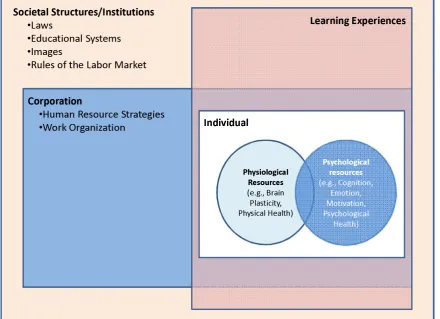
systems of external contexts that likewise influence their productivity (in the more expansive sense) and development. With regard to the work context, learning experiences at the work place (and in other life domains), corporate hu-man resource hu-management, work organization, legal and ed-ucational frameworks, and societal perspectives on aging, work and lifelong learning all have the potential to either further or hinder productive adult development (see Fig.1; cf. Staudinger2006). Internal contexts and external contexts are inextricably intertwined with one another and can affect one another for better or worse, but can also compensate for one another. For instance, a given individual’s learning style is crucial in predicting the success of a given learning context (Schulz and Stamov Roßnagel2010). The dynamic interactions between different developmental influences at different contextual levels (e.g., individual, social, organiza-tional, societal/institutional) necessitate an interdisciplinary research approach that pools knowledge and understanding of these different levels of contextual influences on devel-opment, as well as methodology, from different disciplines. To meet this necessity, the JCLL has successfully integrated expert knowledge from a diversity of different academic fields. Namely, experts from Neuroscience, Human Perfor-mance, Health Psychology, Lifespan Psychology, Organiza-tional Behavior, Business Administration, and Life-course Sociology contribute to creating new insight into productive adult development. In general, our aim is to identify contex-tual and individual characteristics that are crucial to facili-tate productive adult development and aging. This includes identifying changes in internal as well as external contexts and resources across the lifespan as well as understanding the processes mediating such changes. In line with our de-velopmental, systemic approach, a range of disciplines are represented at the JCLL that each contributes to understand-ing how resources on various levels of internal and external contexts interact with each other.
4.1 Physical and psychological resources (internal resources)
Experts from Neurobiology and Human Performance at the JCLL investigate the neurological basis of human perfor-mance, namely, the mechanisms underlying cortical plastic-ity and the structure/function relationships between cogni-tive, sensory, and motor performance and learning. Research in this area aims to better understand how to facilitate corti-cal plasticity. These research questions are addressed using a combination of neuroimaging, neuropsychology, physiol-ogy, and movement science.
Several lifestyle factors such as a healthy diet and physi-cal exercise can enhance health and facilitate recovery from health impairments, as well as compensate for age-related declines in cognition (e.g., Voelcker-Rehage et al. 2010).
For instance, in one longitudinal intervention study we have been investigating the effects of physical fitness on cogni-tive performance as well as emotion regulation. The ma-jor finding was that training increasing aerobic fitness (three times a week) effected significant increases in the speed of information processing which is one of the aspects of cog-nitive functioning that has the strongest age-related declines (Voelcker-Rehage et al.2010). Experts in the field of Health Psychology aim to understand what internal and external factors motivate behaviors such as initiating and maintain-ing a healthy diet as well as physical exercise. It is crucial to not only focus on one kind of health behavior but take a number of health behaviors (i.e., healthy lifestyle) under consideration at the same time. In particular, understanding how external contextual factors can help support people in their efforts to maintain a healthy lifestyle is key to help-ing individuals reach the upper limits of their potential, as well as helping organizations to maintain a healthy work-force.
Fig. 1 Internal and external contextual influences on productive adult development as studied at the JCLL
4.2 External resources (or risk factors): organizational features
Experts from the fields of Organizational Behavior and Business Administration focus directly on how adults be-have in organizational contexts. On the one hand, employ-ees bring a set of (changing and not fixed) personal resources such as motivation, values, personality and competencies to the work context. On the other hand, work contexts offer a variety of external resources (or risks) such as task complex-ity, supervisor support and leadership styles, team diverscomplex-ity, organizational climate as well as human resource policies. It is a crucial finding that human development and aging are not predetermined but rather are the result of the continuous interaction between internal and external resources (or risk factors). Losses in some resources coupled with stability or growth in other resources lead to systematic patterns of qual-itative changes in work behaviors. As one example, work at the JCLL has investigated age-related differences in work motivation. Motivation may decrease for some kinds of job tasks and increase for other kinds of job tasks, and like-wise the level of effort employees commit to certain kinds of tasks (Stamov Roßnagel and Hertel2010). Understanding how organizational behavior changes over the course of the
working lifespan, as well as the mediating mechanisms and moderating factors underlying such changes (e.g., changes in motivation), can aid in the creation of work contexts, for instance, through human resource practices, that facilitate lifelong productive behavior and development.
4.3 External resources (or risk factors): institutions
Specifically, whereas men’s economic resources in retire-ment remain unaffected by divorce in both countries, di-vorced women are more economically disadvantaged rela-tive to their married peers in Germany than in Britain, even though pension-sharing regulations are more favorable for women in Germany. Thus, it seems that current income-related policies such as pension-sharing after divorce can-not counter the powerful impact that gendered employment institutions have on divorced women’s long-term economic resources (Fasang et al.2011).
To sum up, experts from a variety of fields offer expertise on human performance and functioning from a wide vari-ety of perspectives. Research findings from laboratory ex-periments, questionnaire studies, secondary data analysis of representative samples as well as neurobiological methods (e.g., fMRI) and psycho-biological studies (e.g., endocrine studies) complement and reinforce each other. Much of our research is conducted within companies and in close col-laboration with personnel decision-makers and thus creates an arena for the exchange of best practices and the cross-fertilization of academic and organizational knowledge and understanding. Field studies of employees’ performance and attitudes can draw on insight into human performance and development gained in laboratory settings and at the same time the ecological validity of experimental results can be tested by applying them in the work context.
5 Interdisciplinary research projects on work and aging at the JCLL
Two interdisciplinary projects currently under way at the JCLL illustrate how experts from different disciplines can pool their knowledge to increase understanding of the rela-tionships between features of the work context and individ-ual performance: the Demopass Project and Project Mobilis.
5.1 The Demopass Project
Supported by the Bundes Ministerium für Bildung und Forschung, Project “Demopass” (derived from the Ger-man words “Demografie” and “Passung”: demography and match/mismatch) examines matches and mismatches be-tween several organizational levels (employees, manage-ment, and organizational climate) that are crucial for under-standing organizational outcomes, such as employee health and productivity. Demopass identifies five fields of action that are specifically relevant to tackling the challenges posed by demographic change in organizations: (intergenerational) knowledge transfer, further training and on-the-job learn-ing, images of aging in organizations, adaptive competen-cies at the work place, and physical as well as psychological health. All JCLL professors have worked together to con-tribute diverse perspectives within a joint research project.
The project aims to further our understanding or different facets of the work context and employee health and produc-tivity, but also to inform management practice. It is the final goal of the project to develop a toolbox that companies can independently use to diagnose relevant strengths and weak-nesses and thereby identify potential areas of intervention with regard to the aging workforce.
Data collection within the five cooperating companies has been completed. The project now has questionnaire data and indicators of objective health from roughly 1500 em-ployees and their supervisors. A unique feature of the De-mopass Project is its multi-level design, with individuals sampled within their work teams (k=112). This design al-lows for the innovative analysis of not only individual fac-tors but also shared contextual facfac-tors within the team us-ing hierarchical regression models. For instance, the design allows for the appropriate analysis of the influence of the team supervisor’s attitudes, perspectives and practices on employees. In addition, interviews with management repre-sentatives provided background information about corporate and work strategies.
Results from the Demopass Project have revealed im-portant subtleties relevant for both research and organiza-tional practice. For instance, results with regard to knowl-edge transfer within organizations showed that age was posi-tively related to knowledge sharing and negaposi-tively to knowl-edge seeking, which is an important finding as it lays the ground for research on intergenerational knowledge trans-fer, and moreover stresses the importance of a distinction between the two knowledge transfer behaviors (Noethen and Völpel2010). Furthermore, while intrinsic benefits (e.g., en-joyment) significantly influence both individual knowledge sharing and seeking, extrinsic benefits (e.g., money, prestige, more interesting task assignment) were found only to moti-vate knowledge seeking. This result may imply that differ-ent managemdiffer-ent strategies are needed in order to encourage knowledge seeking and knowledge sharing. Results from Demopass also showed that higher levels of chronic work stress in the form of an imbalance between perceived efforts and perceived rewards (effort–reward imbalance; Siegrist 2002) is related to higher levels of burnout but also lower job-performance as assessed by supervisors. These detri-mental relationships are aggravated when employees are overcommitted to their work (i.e., have trouble ‘switching off’ from their work; Feuerhahn et al.2010).
further training activities (Maurer2001). Importantly, the re-lationship between perceived supervisor support and learn-ing self-efficacy was stronger for older (relative to younger) as well as less-educated employees. Therefore, supervisors seem to play a particularly important role in motivating older and less-educated employees to pursue further train-ing activities. As a further example, how positively a super-visor felt about his or her own aging process did not have any direct relationship with employees’ turnover intentions (Bowen and Staudinger 2011). Specifically, working with a supervisor who had more positive perceptions of his or her own aging was not necessarily associated with lower turnover intentions, that is, not all employees were neces-sarily ‘attracted’ (as reflected in lower intentions to leave their current job) by a supervisor with a positive outlook on his or her aging. Rather, the similarity between employee and supervisor aging self-perceptions was related to lower turnover intentions. Importantly, turnover intentions were particularly high among employees with rather positive ag-ing self-perceptions with rather negative supervisors.
5.2 The Mobilis Project
Cognitive aging is not fixed but shows a tremendous amount of plasticity. This has been documented by decades of cog-nitive training research (e.g., Lindenberger and Kray2005). Unfortunately, training research has also revealed that al-though training programs can lead to improvements in cog-nitive functioning, any gains tend to be specific to the prac-ticed task(s) and only to a limited extent transfer to other tasks (Hertzog et al.2009). Moreover, it seems neither rea-sonable nor practical for older adults to continuously un-dergo some type of cognitive training in order to remediate or prevent losses in cognitive functioning. Thus, the Mobilis Project aims to investigate the effect of a kind of natural cog-nitive training intervention, that is, the switching between job-related activities in the course of one’s working life. Our major hypothesis is that for employees at lower and interme-diate levels of qualification, a greater number of switches in the day-to-day activities may result in better cognitive and personality-related functioning at later ages (Zacher et al. 2011). In the sociological and the organizational behavior literature, job-related task switches are discussed under the heading of job mobility (i.e., switch between job-related ac-tivities). Job mobility also is causing heated political debate as it has become an increasingly important feature of the modern labor market and is suspected to be detrimental for the well-being of employees. It has typically been assumed that the increased demand for job mobility may have nega-tive effects, and may pose in particular a challenge for older workers who are stereotypically thought to resist change (Posthuma and Campion2009). However, it may also be the case that job mobility, as an intervention that forces people
to ‘practice’ flexibly adjusting to new work contexts and new demands, may under certain conditions help to compensate for some salient age-related declines in adaptive competen-cies. On the other hand, overly routinized (work) activities and the lack of substantial new challenges over several years may result in a decline of adaptive competences and levels of cognitive performance.
Funded by the Volkswagen Foundation, Project Mobilis investigates the cumulative effects of voluntary and invol-untary job mobility on individuals’ adaptive competencies in old age. Adaptive competence comprises both a cognitive and a personality component. With regard to cognition, our study focuses on perceptual and motor adaptation. With re-gard to higher cognitive functions, we examine whether a higher degree of job mobility supports better adaptation to new cognitive tasks as measured by learning curves. This in-cludes the investigation of the neurobiological mechanisms underlying such adaptation processes. Adaptive competence in the domain of personality includes an individual’s open-ness for new experiences, readiopen-ness to take risks, and flibility. The Mobilis Project represents the collaboration ex-perts from sociology, psychology and neuroscience. Meth-ods and perspectives from each field contribute to a more complete understanding of the relationship between job mo-bility and adaptive competencies.
In an important first empirical step, we have used propen-sity score matching to construct samples from the longi-tudinal and representative German Socioeconomic Panel (SOEP). Propensity Score Matching allows filtering per-sons with nearly identical characteristics differing only in respect to the specific factors of interest, thus resulting in a quasi-experimental study design. The samples differ with respect to their job mobility (high or low mobility) but have been carefully matched for variables that have been empir-ically demonstrated to be related to adaptive competencies (e.g., job profiles, social participation, health, and educa-tional qualifications). In order to account for gender-specific career paths, samples of men and women will be analyzed separately, resulting in a design with four different groups of participants (i.e., male-mobile, male-immobile, female-mobile, female-immobile). Furthermore, we need to con-sider that more adaptive adults also experience or seek out more job mobility. For instance, an adaptive personality, characterized by openness, may lead to a stronger motiva-tion for changes and mobility. Thus, we need to control for openness to experience at the entry to the labor market.
to carefully matched controls. The observation period cov-ered 18 years (Schömann et al. 2011). In future work, we will continue to use these samples to investigate the rela-tionship between job mobility and other indicators of pro-ductive adult development, including job-specific aspects like job commitment and job satisfaction. Furthermore, we will recruit new samples to test the relationship between job mobility and cognitive functions using neurophysiological and neuropsychological methods (functional MRI, behav-ioral tests) to examine cognitive adaptivity and learning abil-ities.
6 Creating ‘development friendly’ work contexts
One of the major aims of the research at the JCLL is to use our research to inform organizational strategies. When con-sidering the aging workforce it is important to keep in mind the seemingly obvious fact that how we are at older ages is at least in part the result of all that has happened before. This seemingly obvious fact is, however, ignored when compa-nies focus interventions only on older workers, although this may well be the age group that needs the most support and attention. Work environments of the early periods of a work biography are at least if not more important for work-related productivity 20 years later. In sum, organizations need to fo-cus on creating ‘development friendly’ work contexts that support productive performance and development across the adult lifespan.
Creating such development-friendly work environments necessitates taking an integrated, developmental approach to human resource management that encompasses interven-tions and active management across various domains par-ticularly relevant for productive performance and develop-ment. We have summarized this approach in the concept Dy-namic Human Resource Management (D-HRM; Staudinger 2007; Staudinger et al.2008). The central assumption of D-HRM is that workers and jobs alike significantly and sys-tematically change across work life. This alters the ‘fit’ be-tween workers and their jobs, which has been shown to be an important determinant of job satisfaction and commitment, as well as work motivation (e.g., Stamov Roßnagel and Bie-mann2011). Ensuring fit becomes even more important with age as motivation becomes an increasingly important deter-minant of performance, as the aging individual is forced to more carefully allocate his or her resources (e.g., Hess et al. 2009). In fact, recent work suggests that age-related changes in motivational variables, as opposed to chronological age per se, underlie changes in work outcomes for middle-aged and older workers (Kanfer and Ackerman2004).
One of the objectives of D-HRM is to provide tools for proactive fit management in order to enable facilitative working conditions in five fields of action across work life:
competence management, diversity management, knowl-edge and experience transfer, health management and cli-mate management. Competence management involves con-tinual assessment of the fit between individual competencies and job demands as well as investment in skill development through formal but also informal further training measures (e.g., courses, job rotation, horizontal career moves). Im-portantly, formal and informal measures of further training need to be tailored to an individual’s (age-related) needs, de-sires and abilities. Diversity management that concentrates not only on sex and ethnicity but also on age can contribute to optimal productivity. For instance, experimental research has demonstrated that under certain circumstances (e.g., in a positive, respectful climate), collaboration between young and old interaction partners can lead to benefits for both in terms of better cognitive performance for the older in-teraction partner and less egocentrism among the younger interaction partners (Kessler and Staudinger2007). Knowl-edge and experience transfer, in particular between genera-tions, can help more experienced employees to update their knowledge as well as prevent less experienced employees from having to ‘re-invent the wheel.’ It is particularly im-portant to avoid potential knowledge loss when colleagues enter retirement. A number of formal and informal strate-gies can be used to encourage knowledge transfer (e.g., job rotation, mentoring programs, alumni networks of retired employees). Modern health management needs to not only focus on ensuring a safe working environment and proper ergonomic design but also on informing individuals about the consequences of a healthy lifestyle as well as providing ample opportunity to practice such a lifestyle in the work context, for instance, by providing healthy food choices in the cafeteria and making physical exercise an integral part of work life.
perceive a more positive image of older workers within the company have lower turnover intentions (Bowen and Staudinger2011). As this research example demonstrates, the climate/social atmosphere in organizations is another contextual feature of the work context that can either act as a resource or a risk with regard to both individual and organizational productivity.
7 Conclusions and outlook
In order for research to reveal meaningful insight about the relationship between work and aging, it is necessary to rec-ognize the various contexts in which the developing indi-vidual is embedded. The complex, dynamic and interrelated contexts at various levels of abstraction that influence de-velopment necessitate a systemic, interdisciplinary, and a process-oriented approach. It is critical to the study of work and aging to recognize that aging is an ongoing, lifelong process that does not suddenly begin at any particular age. Such an approach can help identify the contextual condi-tions that can facilitate—or hinder—the exploitation of the potential for productive development across the lifespan and contribute to an understanding of how individuals and cor-porations interact to form developmental outcomes within the work context (e.g., participation, performance) as well as more generally. Exploiting the full potential of an ag-ing workforce necessitates not only interventions that tar-get older workers, but also setting up younger workers for productive trajectories and continual efforts to optimize de-velopment within the workforce across the working life. In a society of longer lives, it is important to create work en-vironments such that longer working lives become possible, productive, and also desired.
Executive summary
In this article we present the interdisciplinary, developmen-tal and systemic approach to the study of work and ag-ing that guides research at the Jacobs Center on Lifelong Learning and Institutional Development (JCLL). Our aim is to understand the individual and contextual conditions un-der which the maximum potential of productive adult de-velopment is realized. Much of our research focuses on the work context, both as an influence on adult development and an important outlet of productive behavior. Importantly, we consider a wider notion of ‘productivity’ that encompasses not only economic aspects but also intellectual, motivational and emotional outputs.
We take a developmental approach to work and aging. We introduce basic principles of adult development includ-ing its plasticity, multi-directionality, and embeddedness in
contexts. Adult development consists of gains and losses, and is characterized by plasticity. Plasticity refers to the range (and limits) of development and is an index of an individual’s change potential. In other words, development is characterized by a large, but not infinite, range of possi-bilities. There is an increasing amount of inter- as well as intra-individual variability in the gains and losses associated with aging, and furthermore, individuals can compensate for losses. Development takes place in a complex system of in-terrelated circumstances, including dynamic internal (e.g., psychological, physiological) and external contexts (e.g., or-ganizations, labor market institutions). This is important be-cause the degree of plasticity is contingent on the sum total of the “resources” available to the individual at any given time. Resources can come from internal contexts but also from the external contexts—such as the work context—in which individuals are embedded.
Following from these basic principles of development, we argue that the study of work and aging necessitates an interdisciplinary approach. We describe the research con-ducted at the JCLL, which includes experts from a number of disciplines ranging from neuroscience and human perfor-mance, health and lifespan psychology, organizational be-havior and life-course sociology and political science. We cite examples of research within disciplines that help to il-luminate the potential as well as limitations of adult devel-opment on each level of analysis, as well as the conditions under which maximum potential for productive performance and development are reached.
in the day-to-day activities may result in better cognitive and personality-related functioning at later ages. Initial re-sults indicate that people with more varied work biographies (i.e., more job mobility) invested more time in education at higher ages and also showed higher levels of openness to experience relative to carefully matched controls.
Finally, we describe how a systemic approach to research on work and aging can contribute to the creation of work contexts conducive to productive development across the adult lifespan as summarized in the notion of Dynamic Hu-man Resource Management (D-HRM). The D-HRM notion emphasizes that development is a lifelong process; thus, or-ganizations should not only focus on interventions for older workers but also on preparing younger and middle-aged em-ployees for productive trajectories. The main assumption underlying D-HRM is that there is a dynamically changing fit between workers and their jobs across the lifespan, which in turn determines job satisfaction, commitment and moti-vation, and ultimately performance. We argue that organi-zations can benefit from proactively managing the changing fit between employees and their work across five domains, including: competence management, diversity management, knowledge and experience transfer, health management and climate management.
Kurzfassung
Der vorliegende Artikel stellt einen interdisziplinären, ent-wicklungsorientierten und systemischen Ansatz vor, der der Forschung am Jacobs Center on Lifelong Learning and Insti-tutional Development (JCLL) zum Thema Altern und Arbeit zu Grunde liegt. Wir streben danach zu verstehen wie unter Berücksichtigung interner und externer Umstände das ma-ximale Potenzial für eine produktive Entwicklung erreicht werden kann. Ein großer Anteil unserer Forschung konzen-triert sich auf den Arbeitskontext, sowohl als ein zentraler Einflussfaktor auf Entwicklung, aber auch als eine wichtige Sphäre für produktives Verhalten. Wir berücksichtigen eine weite Definition von ‚Produktivität‘, die nicht nur ökono-mische Leistung, sondern auch intellektuelle, motivationale und emotionale Leistung umfasst.
Wir verfolgen einen entwicklungs-basierten Ansatz zu Arbeit und Altern. Wir beziehen uns auf die wichtigsten Grundsätze der Entwicklung Erwachsener: Plastizität, Mul-tidirektionalität (Entwicklung bringt Gewinne und Verluste mit sich) sowie Kontextabhängigheit. Entwicklung besteht immer aus Gewinn und Verlust und wird durch Plastizität charakterisiert. Plastizität verweist auf die Spanne (sowie Grenzen) der Entwicklung und ist ein Index des Potenzi-als der Veränderung eines Individuums. Anders gesagt, Ent-wicklung wird am besten durch eine große aber nicht un-endlich weite Spanne der Möglichkeiten umschrieben. Die
Variabilität der altersabhängigen Gewinne und Verluste, so-wohl zwischen Menschen als auch innerhalb eines Men-schen, wird mit zunehmendem Alter größer. Außerdem ist es möglich, Verluste zu kompensieren. Darüber hinaus fin-det die Entwicklung in einem komplexen System, beste-hend aus dynamisch-internen (psychische, physiologische) und externen (z.B., Organisationen, Strukturen des Arbeits-markts) Kontexten, die die Entwicklung Erwachsener beein-flussen und für den Arbeitskontext eine Bedeutung haben, statt. Dies ist wichtig, weil das Ausmaß der Plastizität davon abhängt, wie viele ‚Ressourcen‘ zu einem bestimmten Zeit-punkt zur Verfügung stehen. Ressourcen können sowohl aus internen Kontexten, aber auch aus externe Kontexten (wie z.B. aus dem Arbeitskontext) in die man eingebettet ist, ge-wonnen werden.
Im Einklang mit diesen Grundsätzen der Entwicklung ar-gumentieren wir, dass die Forschung von Arbeit und Al-tern einen interdisziplinären Ansatz verlangt. Ein breites Spektrum an Perspektiven aus unterschiedlichen Diszipli-nen ist am JCLL vorhanden. Sowohl Experten der Neuro-wissenschaften, Human Performance, Gesundheitspsycho-logie und PsychoGesundheitspsycho-logie der Lebensspanne, als auch Experten aus dem Bereich organisatorisches Verhalten, der Soziologie der Lebensspanne und Politikwissenschaft, arbeiten zusam-men, um die Wechselwirkung zwischen Altern und dem Ar-beitskontext zu entschlüsseln. Wir zitieren Beispiele unsere Forschung, die 1) einen Beitrag dazu leisten, die Potenzia-le sowie Grenzen der Entwicklung auf verschieden Ebenen zu verdeutlichen, und 2) unter welchen Umständen das ma-ximale Potenzial des produktiven Verhaltens und der Ent-wicklung erreicht werden könnte.
Das Projekt Mobilis untersucht den Einfluss der Arbeits-mobilität als ein ‚natürliches‘ kognitives Training auf kogni-tive und Persönlichkeitsfunktionen älterer Erwachsener. Un-sere Hypothese ist, dass für Mitarbeiter mit niedrigem oder mittlerem Bildungsabschluss, eine große Anzahl von Verän-derungen von täglichen Aktivitäten im Zusammenhang mit besseren kognitiven und Persönlichkeitsfunktionen im höhe-ren Alter stehen. Erste Ergebnisse deuten an, dass Menschen mit abwechslungsreichen Arbeitsbiographien (i.e., mehr Ar-beitsmobiltät) im höheren Alter mehr Zeit in Weiterbildung investiert haben und ein höheres Niveau an Offenheit für neue Erfahrungen gezeigt haben, als Menschen in einer ver-gleichbaren Kontrollgruppe mit weniger abwechslungsrei-chen Arbeitsbiographien.
Schließlich beschreiben wir, wie ein systemischer For-schungsansatz zum Altern im Arbeitskontext einen Beitrag dazu leisten kann, Arbeitskontexte so zu gestalten, dass ei-ne produktive Entwicklung über die gesamte Lebenspanei-ne gefördert werden kann (im Sinne einer ‚dynamischen Per-sonalentwicklung‘). Das Konzept einer dynamischen Perso-nalentwicklung unterstreicht, dass Entwicklung ein Prozess ist, der sich über die gesamte Lebensspanne erstreckt. Des-halb sollten Organisationen Interventionen nicht nur auf äl-tere Mitarbeiter fokussieren, sondern auch versuchen, jün-gere Mitarbeiter und Mitarbeiter der mittleren Alters auf ei-ne produktive Entwicklung über die gesamte Lebensspan-ne vorzubereiten. Der Hauptgrundsatz eiLebensspan-ner dynamischen Personalentwicklung ist, dass die ,Passung‘ zwischen Mit-arbeiter und ihrer Arbeit sich mit der Zeit verändert, was wiederum Einfluss auf Arbeitszufriedenheit, Betriebszuge-hörigkeit und Arbeitsmotivation, und letztendlich Arbeits-produktivität hat. Wir argumentieren, dass Organisationen davon profitieren können, wenn sie die Initiative ergreifen, um die Passung in den folgenden fünf Bereichen aktiv zu er-möglichen und zu verbessern: Kompetenzmanagement, Di-versitätsmanagement, Wissens- und Erfahrungstransfer, Ge-sundheitsmanagement und Arbeitsklimamanagement.
Literatur
Baltes, P.B.: Theoretical propositions of lifespan developmental psy-chology: on the dynamics between growth and decline. Dev. Psy-chol. 23, 611–626 (1987)
Baltes, P.B., Lindenberger, U., Staudinger, U.M.: Life-span theory in developmental psychology. In: Lerner, R.M. (ed.) Theoretical Models of Human Development, 6th edn. Handbook of Child Psy-chology, vol. 1, pp. 569–664. Wiley, New York (2006)
Baron, S., Schömann, K.: Strengthening self-confidence in training competence. In: RN 1 “Ageing in Europe”. 9th Conference of the European Sociological Association, Lisbon (2009)
Bowen, C.E., Staudinger, U.M.: Images of aging in the work context are related to employee turn-over intentions (2011, submitted) Bowen, C.E., Noack, C.M.G., Staudinger, U.M.: Aging in the work
context. In: Schaie, K.W., Willis, S. (eds.) Handbook of the Psy-chology of Aging, 7th edn., pp. 263–278. Elsevier, San Diego (2010)
Bronfenbrenner, U.: The Ecology of Human Development: Experi-ments by Nature and Design. Harvard University Press, Cam-bridge (1979)
Chandola, T., Brunner, E., Marmot, M.: Chronic stress at work and the metabolic syndrome: prospective study. Br. Med. J. 332, 521–525 (2006)
Fasang, A., Aisenbrey, S., Schömann, K.: Pension consequences of divorce: evidence from Germany and Britain. J. Marriage Fam. (2011, submitted)
Feuerhahn, N., Kühnel, J., Kudielka, B.M.: Effort-reward-imbalance in combination with over commitment impairs self-rated health and supervisor-rated job performance. Paper presented at the 9th Con-ference of the European Academy of Occupational Health Psy-chology, Rome, Italy, March 2010
Greve, W., Staudinger, U.M.: Resilience in later adulthood and old age: resources and potentials for successful aging. In: Cicchetti, D., Cohen, A. (eds.) Developmental Psychopathology, 2nd edn., pp. 796–840. Wiley, New York (2006)
Hertzog, C., Kramer, A.F., Wilson, R.S., Lindenberger, U.: Enrichment effects on adult cognitive development. Psychol. Sci. Public Inte-rest 9(1), 1–65 (2009)
Hess, T.M., Germain, C.M., Swaim, E.L., Osowski, N.L.: Aging and selective engagement: the moderating impact of motivation on ol-der adults’ resource utilization. J. Gerontol., Ser. B, Psychol. Sci. Soc. Sci. 64B, 447–456 (2009)
Kanfer, R., Ackerman, P.L.: Aging, adult development and work moti-vation. Acad. Manage. Rev. 29(3), 440–458 (2004)
Kessler, E.-M., Staudinger, U.M.: Intergenerational potential: effects of social interaction between older adults and adolescents. Psy-chol. Aging 22(4), 690–704 (2007)
Lerner, R.M.: On the Nature of Human Plasticity. Cambridge Univer-sity Press, New York (1984)
Levy, B.R., Zonderman, A., Slade, M.D., Ferrucci, L.: Negative age stereotypes held earlier in life predict cardiovascular events in la-ter life. Psychol. Sci. 20, 296–298 (2009)
Lindenberger, U., Kray, J.: Kognitive Entwicklung. In: Filipp, S.-H., Staudinger, U.M. (eds.) Entwicklungspsychologie des mittleren und höheren Erwachsenenalters, pp. 299–341. Hogrefe Verlag, Göttingen (2005)
Maurer, T.J.: Career-relevant learning and development, worker age, and beliefs about self-efficacy for development. J. Manag. 27(2), 123–140 (2001)
Muehlig-Versen, A., Bowen, C.E., Staudinger, U.M.: Can openness to experience be promoted in older adulthood? The importance of personal characteristics and stimulating contextual factors (2011, submitted)
Ng, T.W.H., Feldman, D.C.: The relationship of age to ten dimensions of job performance. J. Appl. Psychol. 93(2), 392–423 (2008) Noack, C.M.G., Staudinger, U.M.: Organizational age climate: first
conceptualization and measurement approach (2011, submitted) Noack, C.M.G., Bowen, C.E., Staudinger, U.M.: Will you still need me
when I’m 64? Images of aging in the work context and employees’ organizational commitment (2011a, submitted)
Noack, C.M.G., Baltes, B.B., Staudinger, U.M.: Older worker meta-stereotypes and successful aging in the workplace: adaptiveness of selection, optimization, and compensation strategy use under constrained external resources (2011b, submitted)
Noethen, D., Völpel, S.C.: A multilevel investigation of predictors of sharing and seeking knowledge in teams. Paper presented at the Academy of Management Annual Meeting, Montreal, Canada, August 2010
Posthuma, R.A., Campion, M.A.: Age stereotypes in the workplace: common stereotypes, moderators, and future research directions. J. Manag. 35, 158–188 (2009)
Schömann, K., Geerdes, S., Zacher, H., Godde, B., Staudinger, U.M.: Cumulative occupational mobility as a treatment in propensity score matching (2011, in preparation)
Schulz, M., Stamov Roßnagel, C.: Informal workplace learning: an ex-ploration of age differences in learning competence. Learn. Instr.
20, 383–399 (2010)
Siegrist, J.: Effort-reward imbalance at work and health. In: Perrewe, P.L.G.D.C. (ed.) Historical and Current Perspectives on Stress and Health, pp. 261–291. Elsevier, Amsterdam (2002)
Stamov Roßnagel, C., Biemann, T.: Aging and work motivation: a task-level self-regulation perspective (2011, submitted)
Stamov Roßnagel, C., Hertel, G.: Older workers’ motivation: against the myth of general decline. Manage. Decis. 48, 894–906 (2010) Staudinger, U.M.: Personality and aging. In: Johnson, M., Bengtson,
V.L., Coleman, P.G., Kirkwood, T. (eds.) Handbook of Age and Ageing, pp. 237–244. Cambridge University Press, Cambridge (2002)
Staudinger, U.M.: Konsequenzen des demographischen Wandels für betriebliche Handlungsfelder: Eine interdisciplinäre Perspektive. Z. Betriebswirtsch. 58, 537–560 (2006)
Staudinger, U.M.: Dynamisches Personalmanagement als eine Ant-wort auf den demographischen Wandel. In: Demographischer Wandel als unternehmerische Herausforderung. Report from the 60th German Conference on Business Administration, pp. 35–48. Schäffer-Poeschel, Stuttgart (2007)
Staudinger, U.M.: Produktives Leben im Alter. In: Petermann, F., Schneider, W. (eds.) Enzyklopädie der Psychologie, vol. 7, pp. 885–915. Hogrefe, Göttingen (2008)
Staudinger, U.M., Kocka, J.: More years, more life. English translation of the recommendations of the Joint Academy Initiative on Aging “Gewonnene Jahre”. (Altern in Deutschland Bd. 9). Nova Acta Leopoldina N. F., Bd. 107, Nr. 371. Wissenschaftliche Verlagsge-sellschaft mbH, Stuttgart (2010)
Staudinger, U.M., Marsiske, M., Baltes, P.B.: Resilience and reserve capacity in later adulthood: potential and limits of development across the lifespan. In: Cicchetti, D., Cohen, D.J. (eds.): Risk, Dis-order, and Adaptation. Developmental Psychopathology, vol. 2, pp. 801–947. Wiley, New York (1995)
Staudinger, U.M., Roßnagel, C., Voelpel, S.: Strategische Personal-entwicklung und demographischer Wandel: eine interdisziplinäre Perspektive. In: Schwuchow, K., Gutmann, J. (eds.) Jahrbuch Per-sonalentwicklung 2008 – Ausbildung, Weiterbildung, Manage-ment DevelopManage-ment, pp. 295–304. Luchterhand, München (2008) Van Dalen, H.P., Henkens, K., Schippers, J.: Productivity of older
wor-kers: perceptions of employers and employees. Pop. Dev. Rev.
36(2), 309–330 (2010)
Voelcker-Rehage, C., Godde, B., Staudinger, U.M.: Cardiovascular and motor fitness are both related to cognition in old age. Eur. J. Neu-rosci. 31, 167–176 (2010)
Wickrama, K.A.S., Surjadi, F.F., Lorenz, F.O., Elder, G.H. Jr.: The in-fluence of work control trajectories on men’s mental and physi-cal health during the middle years: mediational role of personal control. J. Gerontol., Ser. A, Biol. Sci. Med. Sci. 63B, 135–145 (2008)
Zacher, H., Geerdes, S., Schoemann, K., Godde, B., Staudinger, U.M.: Career mobility and employee adaptability: a lifespan/life course perspective (2011, in preparation)
Ursula M. Staudinger is Professor of Psychology, Academic Dean
and Vice President of the Jacobs University Bremen. She has published widely on adult development in the work context, resilience and pla-sticity across the lifespan, personality development and wisdom. She is Vice President of the National Academy of Sciences Leopoldina, a Fellow of the American Psychological Association as well as the As-sociation of Psychological Science, and a member of the Heidelberg Academy of Sciences. Between 2008 and 2010 she was president of the German Psychological Society. She is a member of the Demogra-phy Advisory Group of the German government.
Catherine E. Bowen is a postdoctoral fellow at the JCLL. Her work