S T U D Y P R O T O C O L
Open Access
Protocol for a feasibility cluster randomised
controlled trial of a peer-led school-based
intervention to increase the physical
activity of adolescent girls (PLAN-A)
Simon J. Sebire
1*, Mark J. Edwards
1, Rona Campbell
2, Russell Jago
1, Ruth Kipping
2, Kathryn Banfield
1,
Keeley Tomkinson
2, Kirsty Garfield
2, Ronan A. Lyons
3, Joanne Simon
2, Peter S. Blair
2and William Hollingworth
2Abstract
Background:Physical activity levels are low amongst adolescent girls, and this population faces specific barriers to being active. Peer influences on health behaviours are important in adolescence and peer-led interventions might hold promise to change behaviour. This paper describes the protocol for a feasibility cluster randomised controlled trial of Peer-Led physical Activity iNtervention for Adolescent girls (PLAN-A), a peer-led intervention aimed at increasing adolescent girls’physical activity levels.
Methods/design:A two-arm cluster randomised feasibility trial will be conducted in six secondary schools (intervention n= 4; controln= 2) with year 8 (12–13 years old) girls. The intervention will operate at a year group level and consist of year 8 girls nominating influential peers within their year group to become peer-supporters. Approximately 15 % of the cohort will receive 3 days of training about physical activity and interpersonal communication skills. Peer-supporters will then informally diffuse messages about physical activity amongst their friends for 10 weeks. Data will be collected at baseline (time 0 (T0)), immediately after the intervention (time 1 (T1)) and 12 months after baseline measures (time 2 (T2)). In this feasibility trial, the primary interest is in the recruitment of schools and participants (both year 8 girls and peer-supporters), delivery and receipt of the intervention, data provision rates and identifying the cost categories for future economic analysis. Physical activity will be assessed using 7-day accelerometry, with the likely primary outcome in a fully-powered trial being daily minutes of moderate-to-vigorous physical activity. Participants will also complete psychosocial questionnaires at each time point: assessing motivation, self-esteem and peer physical activity norms. Data analysis will be largely descriptive and focus on recruitment, attendance and data provision rates. The findings will inform the sample size required for a definitive trial. A detailed process evaluation using qualitative and quantitative methods will be conducted with a variety of stakeholders (i.e. pupils, parents, teachers and peer-supporter trainers) to identify areas of success and necessary improvements prior to proceeding to a definitive trial.
Discussion:This paper describes the protocol for the PLAN-A feasibility cluster randomised controlled trial which will provide the information necessary to design a fully-powered trial should PLAN-A demonstrate evidence of promise. Trial Registration:ISRCTN12543546
Keywords:Physical activity, Peers, Adolescent girls, Intervention, School
* Correspondence:[email protected]
1Centre for Exercise, Nutrition & Health Sciences, School for Policy Studies,
University of Bristol, Bristol, UK
Full list of author information is available at the end of the article
Background
Amongst children and adolescents, physical activity (PA) is associated with lower levels of cholesterol and blood lipids and favourable blood pressure and body compos-ition [1]. There is also evidence that PA is associated with young people’s mental health [2] and academic per-formance [3]. Despite the benefits of being physically ac-tive during the early years, PA levels decline during childhood [4]. Throughout childhood and adolescence, girls are less active than boys [5] and the age-related de-cline in PA (particularly from early adolescence) is steeper for girls. In England, when measured objectively, 96 % of girls aged 11–15 years performed less than 30 min of moderate-to-vigorous PA (MVPA) per day and none met government recommendations of 60 min of MVPA per day [6].
The psychological correlates of adolescent girls’ PA participation include enjoyment, perceived competence, self-efficacy and physical self-perceptions [7]. Further, qualitative research suggests that these factors are inter-twined with girls’ social (often school) context and changes to friendship groups, peer support, perceived competence, competing priorities, self-presentational concerns and ‘sporty’ gender stereotypes experienced during the transition from primary to secondary school which may also contribute to the observed decline in girls’ PA [8–10]. PA interventions aimed at girls have produced small but significant positive effects and larger effects have been observed for interventions that targeted girls only and used educational and multi-component designs [11]. As such, while it may be possible to increase girls’PA, new and more effective in-terventions are needed.
Promoting young people’s health in schools is a public health priority [12], and school-based interventions can reach many young people over a sustained period. How-ever, a 2009 Cochrane review of school-based PA inter-ventions showed that none were conducted in the UK that involved adolescents and the non-UK interventions for adolescents did not increase PA [13]. Current school-based interventions have focussed on ‘top-down approaches of providing education and short-term struc-tured PA’ [13], and there is a need for alternative de-signs. One approach is to develop interventions which capitalise on naturally occurring determinants within target populations and sustainable health promotion mechanisms (i.e. peer groups and their influence on PA) to promote long-term PA behaviour.
Peers play a central role in influencing adolescents’PA and its determinants through providing peer support, co-participation in PA, peer norms, friendship quality, peer affiliation and peer victimisation [14]. This is sup-ported by social network research which has shown that adolescents choose friends who are similarly active and
that they may alter their PA over time to be more like their friends’ [15]. This work highlights the potential promise of interventions, especially amongst girls, to in-crease PA which capitalise on existing peer processes in schools by promoting peer support and enhancing peer communication skills [14].
Peer-led interventions have targeted a range of health behaviours amongst young people, including smoking, asthma, alcohol consumption, drug use, PA and seden-tary behaviour [16–18]. A recent review of ten peer-led PA interventions [18] found that only two targeted young people: one small special population [19] and one insufficiently-reported study [20], and neither was con-ducted in the UK. Overall, consistent positive effects of the interventions on PA behaviour were reported, sug-gesting that peer-led interventions are viable; however, the existing research is limited by a lack of high quality controlled trials amongst adolescents, interventions which are largely atheoretical and a sole focus on formal methods of peer-peer delivery (e.g. leading educational classes, organised co-participation and formal advice giv-ing) which are both time limited and intensive.
An alternative led approach is to train peer-supporters to informally diffuse health promotion mes-sages to their peers. This approach is based on Diffusion of Innovations theory [21] which conceptualises how ideas, beliefs or behaviours are informally communicated through members of a social system. This theory was adopted in the ASSIST (A Stop Smoking in Schools Trial) study [16]. The ASSIST intervention involves ask-ing pupils within a school year group to nominate influ-ential peers. The nominated individuals then receive training to informally diffuse messages to their peers about the target health behaviour (e.g. not smoking) for 10 weeks. In a cluster randomised controlled trial of AS-SIST, which comprised 10,730 school children aged 12– 13 years from England and Wales, those who received the intervention had lower odds of being a smoker com-pared to pupils in the control condition immediately after the intervention (OR = 0.75, 95 % CI = 0.55 to 1.01) and at 1 (OR = 0.77, 95 % CI = 0.59 to 0.99)- and 2 (OR = 0.85, 95 % CI = 0.72 to 1.02)-year follow-up [16].
changing young people’s health behaviours, behaviour change messages intended for peer-diffusion need to be simple and may benefit from targeting more specific behavioural determinants of particular populations. No previous studies have used the Diffusion of Innovations approach to specifically increase PA levels of adolescent girls [21].
Interventions which target theoretical mechanisms of behaviour change are likely to be more effective than those that do not [23], yet few peer-led PA interventions incorporate theoretical principles [18]. Diffusion of Inno-vations theory remains a fundamental framework for harnessing the influential capacities of change agents (e.g. year 8 girls identified as opinion leaders by their peers); however, it does not help guide either the content or the behaviour change techniques adopted in the peer-training intervention. Self-determination theory (SDT) [24] is a framework which concerns the personal and so-cial conditions needed to foster high quality motivation for behaviour change and has been used to understand motivation for PA amongst children and adolescents [10, 25, 26] and guide PA interventions [27], including a peer-led PA intervention for older adults [28]. SDT con-tends that autonomous motivation for PA (based on au-thentic choices, inherent satisfaction or personal value) is associated with positive behavioural, affective and cog-nitive outcomes, whereas controlled motivation (based on guilt or compliance with others’ demands) under-mines these outcomes. Autonomous motivation is sup-ported by the degree to which the social environment satisfies, and individuals perceive the satisfaction of three psychological needs: autonomy, competence and social belonging. Research amongst children, adolescents and adults has identified positive associations between autonomous versus controlled motivation and PA [26, 29], positive affect, challenge-seeking [29] and quality of life [30]. SDT is well suited to a peer-led intervention model because peer-supporters can create a social cli-mate that can either undermine or facilitate their friends’ interest in PA [18]. It is also possible that peer-supporters could create a social environment which is supportive of other antecedents to autono-mous motivation including health and affiliation mo-tives, perceptions of competence, connectedness and social support and realistic choices and options of how to be physically active [8, 10].
Study objectives
The aim of this study is to assess the feasibility of the
‘PLAN-A’ (Peer-Led physical Activity iNtervention for Adolescent girls) peer-led PA intervention, adapted from the ASSIST model, which is designed to increase the PA of adolescent girls. In a definitive trial, the primary re-search question would test the effectiveness of the
PLAN-A intervention in increasing the PA levels of year 8 girls. The aims of this feasibility study are to:
1. Estimate the recruitment rate of year 8 girls as peer-supporters and non-peer-supporters and monitor their attendance at peer-supporter training. 2. Qualitatively examine the acceptability of the
intervention to pupils, peer-supporter trainers, schools and parents and identify necessary refinements.
3. Estimate accelerometer and questionnaire data provision rates, examine data quality and explore the implications of missing accelerometer data in terms of how these data might be imputed in a definitive trial.
4. Estimate the potential effect of the intervention on daily accelerometer-derived MVPA and secondary PA-related and psychological variables immediately after the intervention (time 1 (T1)) and at 12 months after baseline (time 2 (T2)).
5. Estimate the school-related intraclass correlation co-efficient (ICC) for daily MVPA, combining data from this project with our data from other local sec-ondary schools.
6. Estimate the sample size for an adequately powered definitive trial evaluation.
7. Identify and test the feasibility of collecting the data needed to cost the intervention and conduct a cost-effectiveness analysis in a definitive trial.
8. Examine the consent rate (participants and data custodians) for data linkage to academic achievement, attendance and health records.
Methods/design
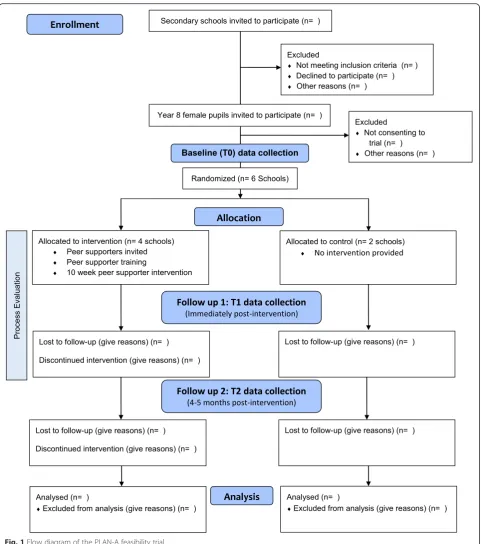
The design is a two-arm cluster randomised controlled trial comparing the PLAN-A intervention against a usual-practice control conducted in six secondary schools, of which four schools will receive the interven-tion and two will serve as controls. Data will be collected at three time points: baseline (time 0 (T0)), immediately after the 10 week intervention (T1) and 12 months post-baseline (T2, 5–6 months post-intervention). Figure 1 shows the study flow diagram. The project has been ap-proved by the research ethics committee of the School for Policy Studies at the University of Bristol (Ref: SPSREC14-15.A27).
Setting
schools will be excluded. The feasibility trial will be con-ducted in six secondary schools, three from each area.
Recruitment
School recruitment
The ASSIST programme is delivered in some schools in the study areas, and it would not be possible to run
Schools which express interest will be contacted and provided with further information. Reserve schools will be recruited to allow for school withdrawal prior to baseline data collection.
Student recruitment
In participating schools, a presentation will be made to all girls in year 8 (in the first term of year 8) to inform them about the trial. This will include details on the intervention, control conditions and the chance of the school being in either condition. All girls will be given study information for themselves and their parents. All year 8 girls in participating schools will be eligible to take part in the study.
Consent
As the intervention operates at a year group level, consent for pupils to participate in the trial will be sought through parent opt-out consent. Parent and child information sheets and opt-out forms will be distributed to all year 8 girls (in an envelope ad-dressed to ‘Parents’) at the point of recruitment and need to be returned prior to baseline data collection. Parents of girls invited to be peer-supporters will be asked to provide written informed consent to allow their daughter to participate in the peer-supporter training. Peer-supporters will also be asked to assent to this role. Adult participants (e.g. peer-supporter trainers, school contacts and parents) will be asked to provide written informed consent if selected for a post-intervention process evaluation interview. Par-ents of study pupils and pupils themselves will be asked to consent to a hypothetical data linkage sce-nario separately to consenting to the trial (i.e. data linkage will not be performed, but we will examine the consent rate). Data custodians (i.e. schools or Local Authorities (LAs)) will also be asked to con-sent to a hypothetical data linkage scenario to assess the feasibility of linking pupils’ study identification number to educational attainment, attendance and health data held by LAs as an efficient means of obtaining such data.
Allocation strategy
School is the unit of randomisation. Six schools will be randomly allocated, stratified by LA area (Wiltshire vs. South Gloucestershire), after baseline data collection has been completed, at an intervention to control ratio of 2:1 within LA area. Four schools will be allocated to the intervention arm and two schools allocated to the control arm. Allocation will be performed (computer generated allocation) by an independent member of the Bristol Randomised Trials Collaboration who will be blind to the school identity.
The statistician and all team members apart from the Pro-ject Manager, Research Assistants and Fieldworkers will be blind to the allocation of schools to trial arms.
The PLAN-A intervention
The PLAN-A intervention is based on the ASSIST [16] model and involves the following components: (a) train-the-trainers programme, (b) peer-nomination, (c) peer-supporter training and (d) a 10-week informal health message peer-diffusion period. These elements are described below.
Peer nomination
All year 8 girls who have not been opted-out of the study in the six schools will be asked to complete a peer nomination questionnaire (as used in ASSIST), in which they identify the female peers they perceive to be influ-ential in their year at school. Nomination will take place before randomisation of schools, and the girls who are nominated in what later become the intervention schools will be alerted to this soon after randomisation. The highest scoring 18 % (those with most nominations) within intervention schools will be invited to be peer-supporters. These girls will attend an in-school recruit-ment meeting with a study staff member. The meeting will outline the peer-supporter role, and pupil and par-ent information sheets and conspar-ent forms will be handed out. Pupils can opt-out of being a peer-supporter at this point. It is expected that ≥15 % of the year group take on the peer-supporter role, as outlined in Diffusion of Innovations theory [21].
Train-the-trainers programme
Peer-supporter training
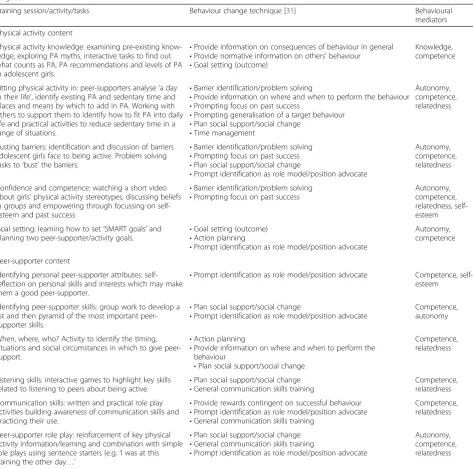
Peer-supporters will attend a 2-day course to develop their skills, knowledge and confidence to promote PA amongst peers. Training will be held off-site and led by two external peer-supporter trainers who will have attended the train-the-trainers programme. The peer-supporter training will build on transferable activities from the previously used ASSIST and AHEAD training and include content focused on PA and interpersonal skills and personal qualities needed to be a peer-supporter. The key components of the peer-supporter training are shown in Table 1 alongside how the inter-vention components map on to behaviour change tech-niques [31] and SDT constructs. The content will be informed by SDT and will aim to build the girls’ per-ceived autonomy, competence and sense of social sup-port for being a peer-supsup-porter and for PA. Peer-supporters will be encouraged to keep these concepts in mind when having informal conversations with their peers. At the approximate mid-point of the 10-week intervention period (see below), peer-supporters will at-tend a 1-day top-up training event which will follow a similar format to the first 2 days and focus on sharing experiences, problem solving and reinforcing key mes-sages about PA and peer-supporting. Lunch and refresh-ments will be provided at all training days. Training will take place on school days.
10-week informal health message peer-diffusion period
Following the training, peer-supporters will be asked to informally promote messages about increasing PA amongst their peers for 10 weeks. Peer-supporters can support anyone they choose, although encouragement will be given in the training for peer-supporters to focus their support on girls in their year group. Peer-supporters will be given a diary to record the nature of the conversations that they have with their peers about PA. During the intervention period, peer-supporters will be able to refer to the study website for tips and email questions that they have to a dedicated study email ad-dress which will be answered and shared, anonymously, on the website as Frequently Asked Questions to help other peer-supporters.
Control group provision
Two schools will be randomly assigned to the control arm after baseline (T0) data collection and will not receive the PLAN-A intervention. These schools will continue with their normal practice. Year 8 pupils in control schools will participate in data collection at T0, T1 and T2.
School and student appreciation
All participating schools (intervention and control) will receive a £500 donation and a summary of the research
findings at the end of the project in recognition of the time devoted to accommodating the study. To maximise timely return of accelerometers and in recognition of the time given to each data collection, all participants will receive a voucher (T0 £5, T1 £10, and T2 £10).
Measures
Recruitment, retention and attendance
Key outcomes are recruitment of schools, pupils, peer-supporters and peer-supporter trainers. Recruitment rates of schools and peer-supporter trainers will be re-corded. Opt-out consent and assent rates of year 8 girls to participate in the trial will be recorded. We will rec-ord attendance of the invited peer-supporters to the re-cruitment meeting, rate of consent (parents) and assent (pupils) to the peer-supporter role and attendance at the peer-supporter training and top-up training.
Outcome measures
All measures will be taken at baseline (T0), immediately after the intervention period (T1) and 12 months after baseline (T2). The likely primary outcome in a definitive trial would be weekday minutes of MVPA per day, mea-sured by accelerometry. This method can provide reli-able estimates of young people’s PA and is validated amongst young people [32]. Participants will be asked to wear an ActiGraph wGT3X-BT accelerometer for 7 days at T0, T1 and T2. Periods of≥60 min of zero counts will be recorded as non-wear and removed. Participants will be included in analysis if they provide at least 2 days of valid weekday data (i.e. 500 min of data between 05:00 and 23:59). Mean minutes of daily MVPA will be esti-mated using the Evenson [33] cut-point which has been found to be the most accurate threshold for adolescents [34]. The intervention could reduce the amount of time participants spend sedentary and/or their mode of travel to school (i.e. active vs. passive). As such, in addition to exploring other potential secondary outcomes (e.g. mi-nutes of MVPA on weekend days and the proportion of girls meeting government physical activity recommenda-tions), we will estimate participants’sedentary time using accelerometery based on a cut-point of less than 100 cpm [33]. To provide an indication of change in sed-entary behaviours, we will also assess pupil self-reported screen-viewing at T0, T1 and T2 [35]. Participants will also report their usual travel mode to and from school at each time point.
definitive trial. At each time point, pupils will also self-report two items developed for this study to assess year-group-based peer support for PA: ‘Has anyone in your year group talked with you recently about physical activ-ity?’(Yes, No, I’m not sure) and‘Did talking to any one in your year help you to be more active?’(Yes, No, I’m not sure, I didn’t speak to anyone). The EQ-5D-Y [42] will be used to measure self-reported quality of life at each time point. At T0 only, participants will complete additional questionnaire items to report demographic information.
Process evaluation
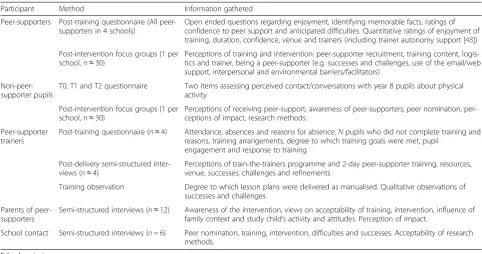
A detailed process evaluation will examine acceptabil-ity of the intervention and methods, intervention de-livery and implementation, potential intervention mechanisms and the influence of school context [43] using qualitative and quantitative approaches amongst peer-supporters, non-peer-supporter pupils, peer-supporter trainers, parents of peer-peer-supporters and school contacts. The process evaluation methods are shown in Table 2.
Table 1PLAN-A peer-supporter training intervention components, behaviour change techniques and behavioural mediators targeted
Training session/activity/tasks Behaviour change technique [31] Behavioural
mediators
Physical activity content
Physical activity knowledge: examining pre-existing know-ledge, exploring PA myths, interactive tasks to find out what counts as PA, PA recommendations and levels of PA in adolescent girls.
•Provide information on consequences of behaviour in general •Provide normative information on others’behaviour •Goal setting (outcome)
Knowledge, competence
Fitting physical activity in: peer-supporters analyse‘a day in their life’, identify existing PA and sedentary time and places and means by which to add in PA. Working with others to support them to identify how to fit PA into daily life and practical activities to reduce sedentary time in a range of situations.
•Barrier identification/problem solving
•Provide information on where and when to perform the behaviour •Prompting focus on past success
•Prompting generalisation of a target behaviour •Plan social support/social change
•Time management
Autonomy, competence, relatedness
Busting barriers: identification and discussion of barriers adolescent girls face to being active. Problem solving tasks to‘bust’the barriers.
•Barrier identification/problem solving •Prompting focus on past success •Plan social support/social change
•Prompt identification as role model/position advocate
Autonomy, competence, relatedness
Confidence and competence: watching a short video about girls’physical activity stereotypes, discussing beliefs in groups and empowering through focussing on self-esteem and past success
•Barrier identification/problem solving •Prompting focus on past success
Autonomy, competence, relatedness, self-esteem
Goal setting: learning how to set‘SMART goals’and planning two peer-supporter/activity goals. •
Goal setting (outcome) •Action planning
•Prompt identification as role model/position advocate
Autonomy, competence
Peer-supporter content
Identifying personal peer-supporter attributes: self-reflection on personal skills and interests which may make them a good peer-supporter.
•Prompt identification as role model/position advocate Competence, self-esteem
Identifying peer-supporter skills: group work to develop a list and then pyramid of the most important peer-supporter skills.
•Plan social support/social change
•Prompt identification as role model/position advocate
Competence, autonomy
When, where, who? Activity to identify the timing, situations and social circumstances in which to give peer-support.
•Action planning
•Provide information on where and when to perform the behaviour
•Plan social support/social change
Competence, relatedness
Listening skills: interactive games to highlight key skills related to listening to peers about being active.
•Plan social support/social change •General communication skills training
Competence, relatedness
Communication skills: written and practical role play activities building awareness of communication skills and practicing their use.
•Provide rewards contingent on successful behaviour •Prompt identification as role model/position advocate •General communication skills training
Competence, relatedness
Peer-supporter role play: reinforcement of key physical activity information/learning and combination with simple role plays using sentence starters (e.g.‘I was at this training the other day…’
•Plan social support/social change •General communication skills training
•Prompt identification as role model/position advocate
Economic data
Data will be collected to estimate intervention costs and examine the feasibility of calculating cost-effectiveness analysis alongside a definitive trial. Resource use data, including intervention materials, venue costs, staff, trainer and pupil time, expenses, travel and administra-tion costs, will be collected prospectively during each stage of the intervention using expense claim forms and data collection forms completed by the research team and school contact.
Sample size
As the study is a feasibility trial, a formal power calcula-tion based on detecting evidence for effectiveness has not been conducted. The feasibility RCT will be con-ducted in six schools (four interventions, two controls). Based on recent experience in local secondary schools, we anticipate that there will be between 60 and 100 fe-male pupils in year 8 per school. Therefore, we expect that the sample size will range between 360 and 600 girls, including between 36 and 60 peer-supporters from the four intervention schools. This is a pragmatically chosen sample to allow us to identify evidence of feasi-bility, recruitment rates and any problems with the inter-vention or research methods. An aim of the feasibility study is to calculate the required sample size for a de-finitive cluster RCT evaluation of the PLAN-A interven-tion. As such, we will estimate the variability in the likely definitive trial outcome (minutes of MVPA per
day) using an ICC. Commensurate with recent recom-mendations [44] and as the ICC for MVPA in the study will be derived only from six schools, to obtain a more accurate ICC estimate for inclusion in a power calcula-tion for a definitive trial, the ICC will be informally com-pared to those obtained in our previous research which has used the same measures amongst adolescent girls (e.g. Bristol Girls’Dance Project) [45].
Data analysis
Quantitative analysis
The main outcomes in this feasibility trial are the consent and recruitment rates (year 8 cohorts and peer-supporters), number and proportion of peer-supporters who receive training, and data provision rates. Analysis of these data will be mainly descriptive (means and SD, or N and %) as ap-propriate. Descriptive comparisons of these data will be made between intervention and control arms. Loss to follow-up in intervention and control groups will be re-ported. The implications of missing accelerometer data will be investigated using multiple imputations. Demographic characteristics will be summarised descriptively as appropriate.
Evidence of promise (i.e. whether the intervention could lead to an increase in daily MVPA) will be exam-ined using appropriate multivariable linear regression models to compare between group differences in means and 95 % CIs of MVPA, adjusted for baseline PA and clustering of participants within schools. As the study is
Table 2Summary of the PLAN-A feasibility trial process evaluation
Participant Method Information gathered
Peer-supporters Post-training questionnaire (All peer-supporters in 4 schools)
Open ended questions regarding enjoyment, identifying memorable facts, ratings of confidence to peer support and anticipated difficulties. Quantitative ratings of enjoyment of training, duration, confidence, venue and trainers (including trainer autonomy support [48])
Post-intervention focus groups (1 per school,n≈30)
Perceptions of training and intervention: peer-supporter recruitment, training content, logis-tics and trainer, being a peer-supporter (e.g. successes and challenges, use of the email/web support, interpersonal and environmental barriers/facilitators)
Non-peer-supporter pupils
T0, T1 and T2 questionnaire Two items assessing perceived contact/conversations with year 8 pupils about physical activity
Post-intervention focus groups (1 per school,n≈30)
Perceptions of receiving peer-support, awareness of peer-supporters, peer nomination, per-ceptions of impact, research methods.
Peer-supporter trainers
Post-training questionnaire (n≈4) Attendance, absences and reasons for absence,Npupils who did not complete training and reasons, training arrangements, degree to which training goals were met, pupil
engagement and response to training
Post-delivery semi-structured inter-views (n≈4)
Perceptions of train-the-trainers programme and 2-day peer-supporter training, resources, venue, successes, challenges and refinements
Training observation Degree to which lesson plans were delivered as manualised. Qualitative observations of successes and challenges.
Parents of peer-supporters
Semi-structured interviews (n≈12) Awareness of the intervention, views on acceptability of training, intervention, influence of family context and study child’s activity and attitudes. Perception of impact.
School contact Semi-structured interviews (n= 6) Peer nomination, training, intervention, difficulties and successes. Acceptability of research methods.
School context
School level data: school and year 8 size, pupil premium allocation
not powered to detect effectiveness, pvalues will not be considered and the focus will be on whether the 95 % CIs include a meaningful difference in MVPA. Based on previous research [46], sample sizes for a future defini-tive trial will be based on detecting a 10-min per day dif-ference in MVPA between trial arms, estimated using the ICC for daily MVPA and based on combinations of different alpha (i.e. significance level) and beta (i.e. power) rates.
A public sector perspective will be taken in the eco-nomic analysis. Where available, national unit costs for staff time will be used to increase the generalisability of findings. Cost per pupil will be estimated by dividing the costs of the peer-supporter programme at each school by the number of female participants in the school year group. We will calculate an incremental cost-effectiveness ratio (ICER) by dividing the mean cost per pupil of the intervention by the difference in daily MVPA in the inter-vention and control schools. The analysis is designed to ex-plore the affordability and potential cost-effectiveness of the intervention rather than provide a definitive comparison.
Qualitative analysis
Recordings of interviews and focus groups will be tran-scribed verbatim. Thematic analysis [47] will be used to analyse these data. Transcripts will be read and reread, and initial codes that categorise the content of each transcript will be produced. These initial codes will then be iteratively refined to produce emergent themes. We will examine divergence and convergence within and be-tween interviews and focus groups and compare the ex-periences of the intervention across the different participant groups to develop a comprehensive under-standing of the intervention acceptability, implementa-tion and mechanisms of impact.
Further details on the statistical and economic and qualitative analysis plans will be made available on the study website (www.plan-a-project.org).
Discussion
The PLAN-A feasibility trial aims to use a peer-led inter-vention to increase the PA of 12–13-year-old girls. As PA levels are low amongst British girls and decrease from childhood to adolescence [4], new intervention ap-proaches are needed which are tailored to the unique determinants of PA amongst adolescent girls and har-ness the potential power of their existing and accepted social networks. The PLAN-A intervention builds on the effective ASSIST peer-led smoking cessation interven-tion model and the feasibility trial aims to assess the po-tential of this approach to increase adolescent girls’ PA. The study will also provide the information needed to design a definitive cluster RCT should evidence of prom-ise be shown.
Trial status
The feasibility trial is registered with the ISRCTN (ISRCTN12543546). Ethical approval for the project was received from the Research Ethics Committee of the School for Policy Studies at the University of Bristol (Ref: SPSREC14-15.A27)). Pupil recruitment and baseline (T0) data collection are planned for September/October 2015.
Abbreviations
AHEAD:Activity and Healthy Eating in ADolecence; ASSIST: A Stop Smoking in Schools Trial; ICC: intraclass correlation coefficient; ICER: incremental cost effectiveness ratio; LA: Local Authority; MVPA: moderate to vigorous physical activity; PA: physical activity; PLAN-A: Peer-Led physical Activity iNtervention for Adolescent girls; RCT: randomised controlled trial; SDT: self-determination theory; T0, T1, T2: time 0, time 1, time 2.
Competing interests
RC is a board member of DECIPHer Impact, a not for profit company that sells the DECIPHer-ASSIST smoking prevention programme (formerly known as ASSIST). There are no further competing interests to declare.
Authors’contributions
The study was conceived by SJS, RJ, RC, WH, RK, PB and RAL. MJE is the Project Manager, KB is the qualitative Research Assistant, KG is the health economics analyst, JS is the trials unit coordinator and KT is the project statistician. The first draft of this manuscript was written by SJS with input from all other authors. All authors have edited and critically reviewed the paper for intellectual content and approved the final version of the paper.
Acknowledgements
The work was undertaken with the support of The Centre for the Development and Evaluation of Complex Interventions for Public Health Improvement (DECIPHer), a UKCRC Public Health Research Centre of Excellence. Joint funding (MR/KO232331/1) from the British Heart Foundation, Cancer Research UK, Economic and Social Research Council, Medical Research Council, the Welsh Government and the Wellcome Trust, under the auspices of the UK Clinical Research Collaboration, is gratefully acknowledged. This study was designed and delivered in collaboration with the Bristol Randomised Trials Collaboration (BRTC), a UKCRC Registered Clinical Trials Unit in receipt of National Institute for Health Research CTU support funding. None of the funders had involvement in the Trial Steering Committee, the data analysis, data interpretation, data collection or writing of the paper. The views expressed in this publication are those of the authors and not necessarily any of the funding bodies listed here. RAL receives funding through the Farr Institute of Health Informatics Research. The Farr Institute is supported by a consortium of ten UK research organisations: Arthritis Research UK, the British Heart Foundation, Cancer Research UK, the Economic and Social Research Council, the Engineering and Physical Sciences Research Council, the Medical Research Council, the National Institute of Health Research, the National Institute for Social Care and Health Research (Welsh Government) and the Chief Scientist Office (Scottish Government Health Directorates), the Wellcome Trust. MRC Grant No: MR/K006525/1.
The sponsor of this study are University of Bristol, Research and Enterprise Development, 3rdFloor, Senate House, Tyndall Avenue, Bristol, and BS8 1TH,
UK www.bristol.ac.uk/red/
Funding
This project was funded by the National Institute for Health Research (Public Health Research Programme) (project number 13/90/16). The views and opinions expressed therein are those of the authors and do not necessarily reflect those of the Public Health Research Programme, NIHR, NHS or the Department of Health.
Author details 1
Centre for Exercise, Nutrition & Health Sciences, School for Policy Studies, University of Bristol, Bristol, UK.2School of Social & Community Medicine,
University of Bristol, Bristol, UK.3Farr Institute, Swansea University Medical
Received: 23 September 2015 Accepted: 31 December 2015
References
1. Janssen I, LeBlanc AG. Systematic review of the health benefits of physical activity and fitness in school-aged children and youth. Int J Behav Nutr Phys Act. 2010;7:40.
2. Biddle SJ, Asare M. Physical activity and mental health in children and adolescents: a review of reviews. Br J Sports Med. 2011;45(11):886–95. 3. Booth JN, Leary SD, Joinson C, Ness AR, Tomporowski PD, Boyle JM et al. Associations between objectively measured physical activity and academic attainment in adolescents from a UK cohort. Br J Sports Med. 2014;48(3):265–70. 4. Dumith SC, Gigante DP, Domingues MR, Kohl HW, 3rd. Physical activity
change during adolescence: a systematic review and a pooled analysis. Int J Epidemiol. 2011;40(3):685–98.
5. Nader PR, Bradley RH, Houts RM, McRitchie SL, O'Brien M. Moderate-to-vigorous physical activity from ages 9 to 15 years. J Am Med Assoc. 2008; 300(3):295–305.
6. Townsend N, Bhatnager P, Wickramasinghe KK, Scarborough P, Foster C, Rayner M. Physical Activity Statistics 2012. London: British Heart Foundation; 2012. 7. Biddle SJH, Whitehead SH, O'Donovan TM, Neville ME. Correlates of
participation in physical activity for adolescent girls: a systematic review of recent literature. J Phys Act Health. 2005;2:421–32.
8. Slater A, Tiggemann M.“Uncool to do sport”: a focus group study of adolescent girl’s reasons for withdrawing from physical activity. Psychol Sport Exerc. 2010;11(6):619–26.
9. Knowles AM, Niven AG, Fawkner SG. Adopting a narrative approach to understanding physical activity behaviour in adolescent girls. Qual Res Sport Exerc & Health. 2013;6:62–76.
10. Gillison F, Sebire S, Standage M. What motivates girls to take up exercise during adolescence? Learning from those who succeed. Brit J Health Psychol. 2011;17(3):536–550.
11. Biddle SJ, Braithwaite R, Pearson N. The effectiveness of interventions to increase physical activity among young girls: a meta-analysis. Prev Med. 2014;62C:119–31.
12. Lemer C. Annual Report of the CMO, Our Children Deserve Better. 2012. 13. Dobbins M, De Corby K, Robeson P, Husson H, Tirilis D. School-based
physical activity programs for promoting physical activity and fitness in children and adolescents aged 6–18. Cochrane Database Syst Rev. 2009;1: CD007651.
14. Fitzgerald A, Fitzgerald N, Aherne C. Do peers matter? A review of peer and/or friends’influence on physical activity among American adolescents. J Adolesc. 2012;35(4):941–58.
15. Macdonald-Wallis K, Jago R, Sterne JA. Social network analysis of childhood and youth physical activity: a systematic review. Am J Prev Med. 2012;43(6):636–42. 16. Campbell R, Starkey F, Holliday J, Audrey S, Bloor M, Parry-Langdon N et al.
An informal school-based peer-led intervention for smoking prevention in adolescence (ASSIST): a cluster randomised trial. Lancet. 2008;371:1595–602. 17. Mellanby AR, Rees JB, Tripp JH. Peer-led and adult-led school health
education: a critical review of available comparative research. Health Educ Res. 2000;15(5):533–45.
18. Martin Ginis KA, Nigg CR, Smith AL. Peer-delivered physical activity interventions: an overlooked opportunity fo physical activity promotion. Transl Behav Med. 2013;3:434–43.
19. Lieberman LJ, Dunn JM, van der Mars H, McCubbin J. Peer tutors’effects on activity levels of deaf students in inclusive elementary physial education. Adapt Phys Act Q. 2000;17:20–39.
20. Thomas AB, Ward E. Peer power: how dare county, North Carolina, is addressing chronic disease throught innovative programming. J Public Health Manage Pract. 2006;12(5):462–7.
21. Rogers EM. Diffusion of Innovations. NY: The Free Press; 1983. 22. Bell S, Audrey S, Cooper A, Noble S, Campbell R. Lessons from a peer-led
obesity prevention programme in English schools. Health Promotion International, 2014; doi:10.1093/heapro/dau008.
23. Michie S. Designing and implementing behaviour change interventions to improve population health. J Health Serv Res Policy. 2008;13 Suppl 3:64–9. 24. Deci EL, Ryan RM. The“what”and“why”of goal pursuits: human needs and
the self-determination of behavior. Psychol Inq. 2000;11:227–68. 25. Teixeira PJ, Carraca EV, Markland D, Silva MN, Ryan RM. Exercise, physical
activity, and self-determination theory: a systematic review. Int J Behav Nutr Phys Activity 2012, 9:78.
26. Sebire SJ, Jago R, Fox KR, Edwards MJ, Thompson JL. Testing a self-determination theory model of children’s physical activity motivation: a cross-sectional study. Int J Behav Nutr Phys Act. 2013;10:111. 27. Fortier MS, Duda JL, Guerin E, Teixeira PJ. Promoting physical activity:
development and testing of self-determination theory-based interventions. Int J Behav Nutr Phys Act. 2012;9:20.
28. Buman MP, Giacobbi PR, Dzierzewski JM, Morgan A, McCrae CS, Roberts BL et al. Peer volunteers improve long-term maintenance of physical activity with older adults: a randomised controlled trial. J Phys Act Health. 2011;8:S257–66. 29. Standage M, Duda JL, Ntoumanis N. A test of self-determination theory in
school physical education. Br J Educ Psychol. 2005;75:411–33.
30. Gillison F, Standage M, Skevington SM. Relationships among adolescents’ weight perceptions, exercise goals, exercise motivation, quality of life and leisure-time exercise behaviour: a self-determination theory approach. Health Educ Res. 2006;21:836–47.
31. Michie S, Ashford S, Sniehotta FF, Dombrowski SU, Bishop A, French DP. A refined taxonomy of behaviour change techniques to help people change their physical activity and healthy eating behaviours: the CALO-RE taxonomy. Psychol Health. 2011;26(11):1479–98.
32. Welk GJ, Schaben JA, Morrow JR. Reliability of accelerometry-based activity monitors: a generalizability study. Med Sci Sports Exerc. 2004;36:1637–45. 33. Evenson KR, Catellier DJ, Gill K, Ondrak KS, McMurray RG. Calibration of two
objective measures of physical activity for children. J Sports Sci. 2008;26(14): 1557–65.
34. Trost SG, Loprinzi PD, Moore R, Pfeiffer KA. Comparison of accelerometer cut points for predicting activity intensity in youth. Med Sci Sports Exerc. 2011;43(7):1360–8.
35. Cillero IH, Jago R, Sebire S. Individual and social predictors of screen-viewing among Spanish school children. Eur J Pediatr. 2011;170(1):93–102. 36. Markland D, Tobin VJ. A modification to the behavioural regulation in
exercise questionnaire to include an assessment of amotivation. J Sport & Exerc Psychol. 2004;26:191–6.
37. McAuley E, Duncan T, Tammen VV. Psychometric properties of the Intrinsic Motivation Inventory in a competitive sport setting: a confirmatory factor-analysis. Res Q Exerc Sport. 1989;60(1):48–58.
38. Marsh HW. Self Description Questionnaire (SDQ) II: a theoretical and empirical basis for the measurement of multiple dimensions of adolescent self-concept. NSW, Australia: University of Western Sydney; 1992. 39. Bartholomew JB, Loukas A, Jowers EM, Allua S. Validation of the physical
activity self-efficacy scale: testing measurement invariance between Hispanic and Caucasian children. J Phys Act Health. 2006;3:70–8. 40. de Farais Junior JC, Da Silva Lopes A, do Nascimento JV, Borgatto AF, Hallal
PC. Development and validation of a questionnaire measuring factors associated with physical activity in adolescents. Brazil J Mother Infant Health. 2011;11(2):301–12.
41. Ling J, Robbins LB, Resnicow K, Bakhoya M. Social support and peer norms scales for physical activity in adolescents. Am J Health Behav. 2014;38(6):881–9. 42. Wille N, Badia X, Bonsel G, Burstrom K, Cavrini G, Devlin N et al.
Development of the EQ-5D-Y: a child-friendly version of the EQ-5D. Qual Life Res. 2010;19(6):875–86.
43. Grant A, Treweek S, Dreischulte T, Foy R, Guthrie B. Process evaluations for cluster-randomised trials of complex interventions: a proposed framework for design and reporting. Trials. 2013;14:15.
44. Elley CR, Kerse NM, Arroll B. Why target sedentary adults in primary health care? Baseline results from the Waikato Heart, Health, and Activity Study. Prev Med. 2003;37(4):342–8.
45. Jago R, Edwards MJ, Sebire SJ, Cooper AR, Powell JE, Bird E et al. Bristol girls dance project (BGDP): protocol for a cluster randomised controlled trial of an after-school dance programme to increase physical activity among 11–12 year old girls. BMC Public Health. 2013;13:1003.
46. Ekelund U, Luan J, Sherar LB, Esliger DW, Griew P, Cooper A et al. Moderate to vigorous physical activity and sedentary time and cardiometabolic risk factors in children and adolescents. JAMA. 2012;307(7):704–12.
47. Braun V, Clarke V. Using thematic analysis in psychology. Qual Res Psychol. 2006;3:77–101.