DOI 10.1007/s13173-011-0040-8 O R I G I N A L PA P E R
Complexity separating classes for edge-colouring
and total-colouring
Raphael Machado·Celina de Figueiredo
Received: 14 May 2011 / Accepted: 12 September 2011 / Published online: 27 September 2011 © The Brazilian Computer Society 2011
Abstract The class of unichord-free graphs was recently investigated in a series of papers (Machado et al. in Theor. Comput. Sci. 411:1221–1234, 2010; Machado, de Figueiredo in Discrete Appl. Math. 159:1851–1864,2011; Trotignon, Vuškovi´c in J. Graph Theory 63:31–67, 2010) and proved to be useful with respect to the study of the com-plexity of colouring problems. In particular, several surpris-ing complexity dichotomies could be found in subclasses of unichord-free graphs. We discuss such results based on the concept of “separating class” and we describe the class of bi-partite unichord-free as a final missing separating class with respect to edge-colouring and total-colouring problems, by proving that total-colouring bipartite unichord-free graphs is NP-complete.
Keywords Theoretical computer science·Computational complexity·Colouring of graphs·Total chromatic number·Bipartite unichord-free
1 Complexity dichotomies and separating classes
Given a classGof graphs and a graph (decision) problemϕ belonging to NP, we say that a full complexity dichotomy
of G was obtained if one describes a partition of G into G1,G2, . . . such that ϕ is classified as polynomial or NP-complete when restricted to each Gi. The concept offull complexity dichotomyis particularly interesting for the in-vestigation of NP-complete problems: as we partition a class
R. Machado (
)·C. de FigueiredoInstituto Nacional de Metrologia, Qualidade e Tecnologia (Inmetro), COPPE—Universidade Federal do Rio de Janeiro, Rio de Janeiro, Brazil
e-mail:[email protected]
Ginto NP-complete subclasses and polynomial subclasses, it becomes clearer why the problem is NP-complete inG. Clearly, if a problemϕis polynomial inG, any partition of Gwill determine polynomial subclasses; and if a problem is NP-complete inG, anyfinitepartitionG1,G2, . . . ,Gn of Gwill determine at least onesubclassGi such that ϕ re-stricted to Gi is NP-complete or the recognition of Gi is NP-complete.
Another interesting tool for the analysis of problems is the idea of separating class. A classGof graphs is a separat-ing classfor problemsϕ1andϕ2ifϕ1is NP-complete when restricted toGandϕ2is polynomial when restricted toG— or vice versa. The nice idea about a separating class is that it shows how the same structure may define a polynomial problem and an NP-complete problem. We recall that the “dual” idea ofseparating problem—a problem that has dis-tinct complexities when restricted to disdis-tinct classes—was already investigated in [3]. For instance, vertex-colouring is a separating problem for planar graphs (NP-complete) and its subclass of series-parallel graphs (polynomial) [3]. It is surprising that for most classes proposed in [3] the complex-ity of edge-colouring remains challenging open.
the Total-Colouring Conjecture1is a central open problem in Graph Theory. In the present work, we consider separating classes for edge-colouring and total-colouring. We claim, however, that not any separating class for these problems is of interest. Observe that it is quite easy to construct (“artifi-cial”) separating classes for these problems. Recall that both edge-colouring and total-colouring are NP-complete prob-lems and consider the classes
Gx:=G:Δ(G)=xandω(G)=Δ(G)+1
forx∈ {3,4,5, . . .}(recall thatΔ(G)denotes the maximum degree inGandω(G)denotes the size of a maximum clique inG).
We invite the reader to check that eachGxwith evenxis a separating class where edge-colouring is polynomial and total-colouring is NP-complete. On the other hand, eachGx with oddxis a separating class where edge-colouring is NP-complete and total-colouring is polynomial.
We argue, however, that classes likeGxare not “interest-ing” classes, in the sense that the polynomiality of the prob-lems edge-colouring or total-colouring do not arise from any nice structural property, but simply from the fact that a “large clique” forces a NO answer in any case. Such sit-uation is analogous to the one that led to the definition of a perfect graph: recall that a graphGis perfect ifevery in-duced subgraphGofGsatisfiesχ (G)=ω(G)(recall that χ (G)denotes the chromatic number ofG). This avoids the occurrence of uninteresting graph classes such as the ones that contain “large cliques”. In this sense, we argue that the separating classes that should be considered in the context of colouring problems should beclosedunder taking induced subgraphs.
Colouring problems in unichord-free graph classes
A graph is unichord-free if it does not contain a cycle with a unique chord (as an induced subgraph). Unichord-free graphs recently attracted great interest because of their rich structure that led to interesting—even surprising—results regarding the complexity of colouring problems. The class of unichord-free graphs is closed under taking induced subraphs—hence interesting to be considered in the context of separating classes. We recall the main results on colour-ing unichord-free graphs:
• Every unichord-free graph G is max{3, ω(G) }-vertex-colourable [11].
• Edge-colouring and total-colouring restricted to unichord-free graphs are NP-complete problems [7,8].
• Edge-colouring restricted to square-free unichord-free graphs with maximum degree 3 is NP-complete [8]; ev-ery non-complete square-free unichord-free graph with maximum degree at least 4 is Class 1 [8].
1The TCC states that every graphGis (Δ(G)+2)-total-colourable.
• Every non-complete square-free unichord-free graph with maximum degree at least 3 is Type 1 [6,7].
• Every chordless2graphGwithΔ(G)≥3 is Class 1 and Type 1 [9].
The third observation determines that a full complexity dichotomy of square-free unichord-free graphs is described for edge-colouring. The partition is constructed as a func-tion of the maximum degree, and the complexity dichotomy is particularly surprising, so far unmatched in the litera-ture: exactly one part is NP-complete, namely the part of unichord-free graphs with maximum degree 3. In each of the other parts, the problem is polynomial.
Observe, additionally, that the class of square-free unichord-free graphs is a separating class for edge-colouring and total-colouring problems. While the class is not the first separating class for edge-colouring and total-colouring de-scribed in the literature (bipartite graphs is one such ex-ample), it is the first one where edge-colouring is actually “harder” than total-colouring. The unexpectability of such result comes from the fact that total-colouring is tradition-ally viewed as a problem “harder” than edge-colouring. The NP-completeness proof of total-colouring [10] is a reduction from edge-colouring, and most classes investigated in the context of total-colouring are classes where edge-colouring is well understood [1,2,12].
The above cited results on edge-colouring and total-colouring in subclasses of unichord-free graphs motivate the search for a subclass where edge-colouring is polyno-mial and total-colouring is NP-complete. We identify bipar-tite unichord-free graphs as an example of such separating class. We describe one additional motivation for the class: it is known that total-colouring is NP-complete for bipartite graphs and for unichord-free graphs, hence it is natural to consider the intersection of the two classes.
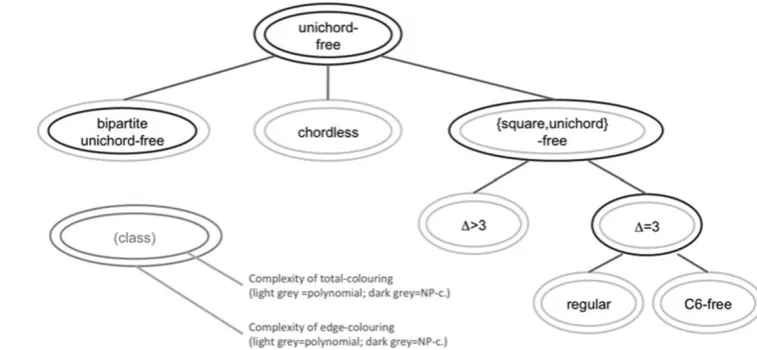
In Sect.2 we determine the NP-completeness of total-colouring bipartite unichord-free graphs establishing this class as a separating class for edge-colouring and total-colouring problems (recall that bipartite graphs are Class 1). Figure 1 presents complexity results on edge-colouring and total-colouring in several subclasses of unichord-free graphs, considering the results in the literature and the result of the present paper.
2 Bipartite unichord-free graphs as a separating class for edge-colouring and total-colouring
Our proposed reduction from the NP-complete problem of edge-colouring a regular graph [5] to total-colouring a regu-lar bipartite unichord-free graph follows the strategy of [10],
Fig. 1 Complexity of edge-colouring and
total-colouring in subclasses of unichord-free
Fig. 2 GraphSt: in any optimal total-colouring all pendant edges
re-ceive same colour
but modifies gadgets from [7,10] to obtain a constructed graph in the target class of regular bipartite unichord-free graphs.
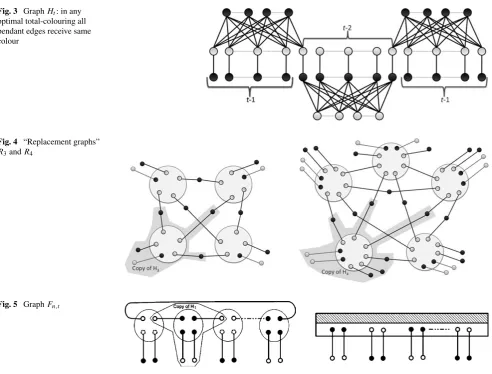
GadgetSt,t≥3 in Fig.2is obtained from the complete bipartite graph Kt−1,t by the addition of t pendant edges incident to thetvertices with degreet−1 [10]. The bipartite gadgetHt,t≥3, is constructed by taking three copies ofSt and identifying two pairs of pendant edges (Htis depicted in Fig.3). Observe thatHt has 3t−4 pendant vertices, 2t−2 of which belong to the “black” partition andt−2 of which are belong to the “white” partition.
The bipartite graph Rt,t ≥3, is constructed by taking t+1 copies ofHt and identifying pairs of pendant vertices of different copies ofHt (the first two graphs of the family are depicted in Fig. 4). Gadget R3 is defined in [10] and extended to familyRt in [7]. Each copy ofHt has one of its black pendant vertices identified with one black pendant vertex of each of the other copies. ConstructingRt in this fashion, we reach a situation where each copy ofHt still has t−2≥1 pendant “white vertices” andt−2≥1 pendant “black vertices”.
The final bipartite gadget Fn,t in Fig. 5 is constructed by takingncopies ofHt and connecting them through the identification of pendant vertices in a linear fashion [10].
Lemma 1 (McDiarmid e Sánchez-Arroyo [10]) Consider graphSt,t≥3.
1. There exists a(t+1)-total-colouring ofStsuch that each of the verticesy1, y2, . . . , yt has a different colour. 2. Any (t+1)-total-colouring of St colours all pendant
edges the same.
Following the strategy of [10], the proofs of Lemmas2,3, and4can be obtained by applying similar reasoning to the present modified corresponding gadgets.
Lemma 2 Consider graphHt.
1. Consider a partial (t +1)-total-colouring π of Ht
such that the pendant edges are coloured the same and the pendant vertices are coloured. This (t +1) -total-colouring extends to a(t+1)-total-colouring ofHt. 2. Any (t+1)-total-colouring of Ht colours all pendant
edges the same.
Lemma 3 Consider graphRt,t≥3.
1. Consider a partial(t+1)-total-colouring ofRtin which t+1pendant edges attached tot+1different copies of
Ht have different colours and the corresponding pendant vertices are coloured.This colouring extends to a(t+1) -total-colouring ofRt.
2. Any (t +1)-total-colouring of Rt colours all pendant
edges of each copy of Ht with a unique colour different of the colour of the other pendant edges.
Lemma 4 Consider graphF =Fn,t,n≥2andt≥3. 1. Consider a partial(t+1)-total-colouring ofF in which
each pendant edge has the same colour and each pendant vertex is coloured.This colouring extends to a(t+1) -total-colouring ofF.
Fig. 3 GraphHt: in any
optimal total-colouring all pendant edges receive same colour
Fig. 4 “Replacement graphs”
R3andR4
Fig. 5 GraphFn,t
Theorem 1 For eachΔ≥3, the total-colouring problem restricted to bipartite unichord-free graphs with maximum degreeΔis NP-complete.
Proof Recall that total-colouring is in NP. Let G be a Δ-regular graph. We construct a bipartite unichord-free graphGwith maximum degreeΔsuch thatGis (Δ+ 1)-total-colourable if and only ifGisΔ-edge-colourable. Step 1. Construct an intermediate graph G˜ substituting
each vertexvofGfor a copy ofRΔ(name this copyR(v)Δ ), associatingΔof the pendant edges ofRΔ—from distinct copies ofHt—with the Δedges ofGincident tov. No-tice thatRΔhasΔ+1 internal copies ofHΔ, so that one of these copies provides no pendant edge to be associated with other edges; such copy is said to beunused. The pen-dant edges can be chosen (among those incident to black or white pendant vertices) in such a way thatG˜ is bipartite. Step 2. ConstructG by taking inG˜, for each copy ofRΔ, one pendant edge from the unused internal copy ofHΔ, and by identifying this edge with a pendant edge fromFn,Δ (any n≥ |V (G)| allows the identification of all pendant edges ofG˜). Once again, the edges can be chosen (among
those incident to black or white vertices) in such a way that the graph stays bipartite.
We invite the reader to check that the constructed graph Gis always bipartite and unichord-free. Figure6shows an example of construction of a bipartite unichord-free graph Gof maximum degree 3 from a cubic graphG.
Notice that each edgeuv∈E(G)is mapped to an edge (uv)∈E(G)with endvertices inR(u)Δ andR(v)Δ .
Suppose thatG isΔ+1-total-colourable and consider a (Δ+1)-total-colouring of G. By construction, the two edges(uv)and(uw)associated to edgesuvanduwofG are incident to the same copyR(u)Δ —by part 2 of Lemma3 these edges(uv)and(uw)receive different colours. More-over, each copy ofRΔhas one edge that is incident toFn,t. So, the unique colour used in part 2 of Lemma4in the pen-dant edges of Fn,t does not appear in the edges of G to which the edges ofGare mapped—and onlyΔcolours are used in these edges. Hence, a (Δ+1)-total-colouring ofG determines aΔ-edge-colouring ofGgiven by the colours of the edges ofGthat are associated to the edges ofG.
Fig. 6 Example of construction ofGfromG
E(G)to its corresponding edge(uv)∈E(G). Additionally give colourΔ+1 to the edges ofGthat are incident to one copy of RΔ andFn,t. By part 1 of Lemmas 3 and4, this partial (Δ+1)-total-colouring ofGextends to a (Δ+ 1)-total-colouring ofG by colouring the internal elements of
each copy ofRΔandFn,t.
Although the result achieved in Theorem1is strong when compared with previous classes [7,10], we should point out that the modified simpler gadgets provide a straightforward proof when compared to [10] and the technique of induction on the minimum degree described in [7] can still be applied to obtain a regular graph. So, the total-colouring problem is NP-complete when restricted toregularbipartite unichord-free graphs.
3 Final remarks
The present work addresses the complexity of edge-colouring and total-edge-colouring restricted to subclasses of unichord-free graphs. In particular, we determine the NP-completeness of total-colouring restricted to bipartite unichord-free graphs—a class polynomially Δ -edge-colourable. The importance of the result is evident consider-ing the previous NP-completeness results of total-colourconsider-ing for both bipartite graphs and unichord-free graphs. More-over, it is interesting to note that unichord-free graphs have a subclass for which edge-colouring is NP-complete but total-colouring is polynomial, namely, the class of {square,unichord}-free graphs [7,8]. Hence, it is of great interest to determine a subclass of unichord-free graphs for which the complexities of edge-colouring and total-colouring are reversed, that is, edge-total-colouring is polynomial and total-colouring is NP-complete. Bipartite unichord-free graphs provide a first example of such class.
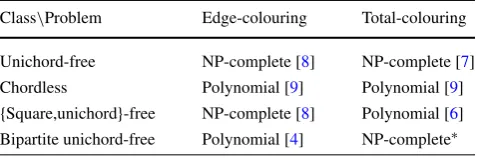
Table1exhibits the four possible combinations of com-plexities of edge-colouring and total-colouring in subclasses of unichord-free graphs.
Table 1 Computational complexity of colouring problems restricted to subclasses of unichord-free graphs—star indicates the result estab-lished in the present paper
Class\Problem Edge-colouring Total-colouring Unichord-free NP-complete [8] NP-complete [7] Chordless Polynomial [9] Polynomial [9]
{Square,unichord}-free NP-complete [8] Polynomial [6] Bipartite unichord-free Polynomial [4] NP-complete∗
References
1. Borodin O, Kostochka A, Woodall D (1997) List edge and list total colourings of multigraphs. J Comb Theory, Ser A 71:184–204 2. Campos C, Mello C (2008) The total chromatic number of some
bipartite graphs. Ars Comb 88:335–347
3. Johnson D (1985) The NP-completeness column: an ongoing guide. J Algorithms 6:434–451
4. König D (1916) Graphok és alkalmazásuk a determinánsok és a halmazok elméletére. Math Termtud Ertesito 34:104–119 5. Leven D, Galil Z (1983) NP-completeness of finding the
chro-matic index of regular graphs. J Algorithms 4:35–44
6. Machado R, de Figueiredo C (2010) Total chromatic number of{square,unichord}-free graphs. Electron Notes Discrete Math 36:671–678
7. Machado R, de Figueiredo C (2011) Total chromatic number of unichord-free graphs. Discrete Appl Math 159:1851–1864 8. Machado R, de Figueiredo C, Vuškovi´c K (2010) Chromatic index
of graphs with no cycle with unique chord. Theor Comput Sci 411:1221–1234
9. Machado R, de Figueiredo C, Trotignon N Edge-colouring and total-colouring chordless graphs. Manuscript available at http://www.liafa.jussieu.fr/~trot/articles/chordless.pdf
10. McDiarmid C, Sánchez-Arroyo A (1994) Total colouring regular bipartite graphs is NP-hard. Discrete Math 124:155–162 11. Trotignon N, Vuškovi´c K (2010) A structure theorem for graphs
with no cycle with a unique chord and its consequences. J Graph Theory 63:31–67