R E V I E W
Open Access
Splenic artery embolization: technically
feasible but not necessarily advantageous
F. Van der Cruyssen
1*and A. Manzelli
2Abstract
Background:The spleen is the second most commonly injured organ in cases of abdominal trauma. Management of splenic injury depends on the clinical status of the patient and can include nonoperative management (NOM), splenic artery embolization (SAE), surgery (operative splenic salvage or splenectomy), or a combination of these treatments. In nonoperatively managed cases, SAE is sometimes used to control haemorrhage. However, the indications for SAE have not been clearly defined and, in some cases, the potential complications of the procedure may outweigh its benefits.
Review of the literature:Through review of the literature we address the question of when SAE is indicated in combination with NOM of splenic injury, and whether SAE may delay needed surgical treatment in some cases. This systematic review highlighted the use of imperfect and inconsistent scoring systems in the diagnosis of splenic injury, the lack of consensus regarding indications for SAE, and the potential for severe morbidities associated with this procedure. Based on current literature and evidence we provide a new, non-verified, decision algorithm. Conclusions:NOM+ SAE involves potential risks and operative management may be preferable to SAE for certain patients. To clarify current literature, we propose a new algorithm for blunt abdominal trauma that should be validated prospectively. New evidence-based protocols should be developed to guide diagnosis and management of patients with splenic trauma.
Keywords: Splenic artery, Embolization, Blunt splenic injury, Nonoperative management, Operative splenic salvage, Splenectomy, Trauma
Background
Abdominal injury occurs in approximately 20–30 % of
all trauma patients. The spleen is the second most com-monly injured organ in both blunt and penetrating ab-dominal trauma [1, 2].
Raza et al. reviewed 1285 cases of abdominal trauma over a ten-year period; 26 % of these suffered a splenic injury. Of the patients in the initial study group, 89.91 % were managed without surgery and 30 % of these had a splenic injury. The initial presen-tation of splenic injury can be variable and depends on the severity of the associated injuries, the amount of blood lost, and the mechanism of trauma. Routine diagnostic workup of suspected splenic injury includes
chest radiographs, abdominal ultrasound, a focused assessment with sonography for trauma (FAST) scan, or CT imaging. Abdominal CT imaging with intraven-ous contrast is the preferred imaging method in hemodynamically stable patients; when the patient is in an unstable condition, a FAST scan that shows the presence of free within the abdomen can indicate that emergency surgery is necessary. Physicians and sur-geons should remain alert for concomitant injuries to the liver (the organ most frequently injured by blunt abdominal trauma) and other intra-abdominal organs.
Splenic artery embolization (SAE) is increasingly be-ing used in medical practice. This trend started in the 1970s when Maddison reported the first successful SAE in a patient with esophageal varices, hepatic cir-rhosis, and recurrent gastrointestinal bleeding [3]. In 1975, Chuang and Reuter reported successful SAE after splenic injury in ten dogs [4]. In 1985, Sclafani et al. reported that embolization of 107 arterial * Correspondence:[email protected]
1Third year master’s student, Faculty of Medicine, Catholic University of Leuven (KU Leuven), Gasthuisberg, Belgium
Full list of author information is available at the end of the article
injuries yielded an 82.2 % success rate [5]. There was a further evolution towards proximal SAE or more distal and selective embolization of the branches of the splenic artery.
Until the 1990s splenectomy remained the treat-ment of choice for splenic injury, but nonoperative management (NOM) became increasingly popular in the pediatric setting around 1992 when Haller et al. reported on the safety of NOM of solid organ injuries in children [6]. Sclafani reported in 1995 a study of 172 patients and the use angiography with subsequent use of proximal embolization of the splenic artery when extravasation was present [7]. In his study NOM was used in stable patients with no extravasa-tion on angiography, splenectomy or splenorrhaphy was performed in unstable patients or in patients with associated injuries or disease. Overall splenic salvage rate was 88 % with a splenic salvage rate of 97 % in the patients managed non-operatively.
The first large multi-institutional study was published in 2000 by Peitzman et al. [8]. In this EAST study 1488 patients with blunt splenic injury were reviewed. The au-thors report operative management in 38,5 % of the
pa-tients and immediate operative management was
proportional to the grade of injury. In patient groups with a larger hemoperitoneum, more laparotomies were performed. They further report a NOM failure rate of 10,8 % of which 60,9 % within the first 24 h of admit-tance. 54,8 % of the patients were successfully managed nonoperatively.
In 2005 Haan reported on 648 patients in a single institution study with splenic salvage rates of 90 % after SAE and 100 % after planned NOM [9]. Failure of NOM increased with higher injury grades but 80 % of grade IV and V injuries were successfully managed nonoperatively. Interestingly, a 40 % failure rate was reported when an arteriovenous fistula was present, even after embolization.
Currently, between 60 and 80 % of splenic injuries are managed without surgery and the reported suc-cess rates for NOM range between 85 and 94 %. NOM can be combined with SAE when certain
con-ditions are met, and retrospective studies have
reported higher success rates and higher splenic
salvage rates when NOM is combined with SAE [10–12].
However, no consensus has been reached on the cor-rect indications for combining NOM and SAE, espe-cially in higher grade splenic injuries. In the current literature, the use of NOM in combination with SAE for treatment of blunt splenic injury is dependent on multiple factors, which are: the grade of the splenic in-jury, the injury severity score (ISS), patient age, the presence of contrast blush on CT, active extravasation on angiography, need for transfusion, the presence of
significant hemoperitoneum, and the presence of splenic artery pseudoaneurysms. Most trauma proto-cols consider hemodynamic instability or a high-grade
splenic lesion (IV–V) to be indications for emergency
laparotomy. Operative splenic salvage (OSS) or splen-ectomy can then be attempted. However, based on the currently available literature the use of NOM, SAE, or OSS is controversial. Retrospective review of data, small study groups, and changes in protocols or in standard practice make it difficult to draw conclusions regarding the optimal management of splenic injuries.
Methods & results
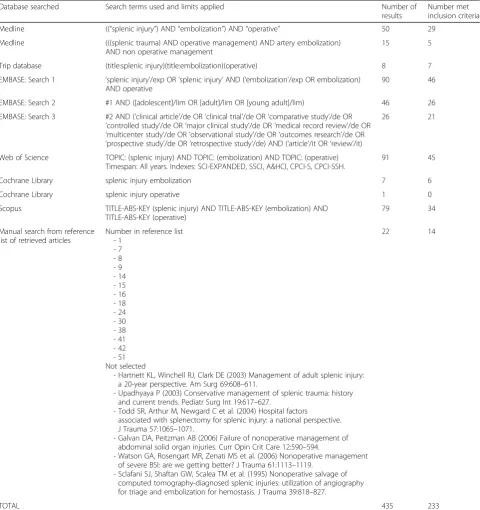
We reviewed the literature and used critical interpret-ive synthesis methodology in the following discussion. A search of the following databases was conducted during October 2015: Medline database, Trip data-base, EMBASE, Web of Science, Cochrane Library, and Scopus. We also manually searched the reference lists of the retrieved articles. Our search terms included: splenic injury, embolization, operative, management.
We included original research articles that reported on splenic injury in combination with embolization therapy, operative, and nonoperative management. Papers were excluded if they focused specifically on adolescent, pediatric, or neonatal populations and if they included specific diagnostic groups. Guidelines, surveys, and meta-analyses were also excluded. The search was exe-cuted sequentially and is documented in Table 1. All articles were assessed for relevance by reading the abstract and, where needed, the entire paper using the above criteria.
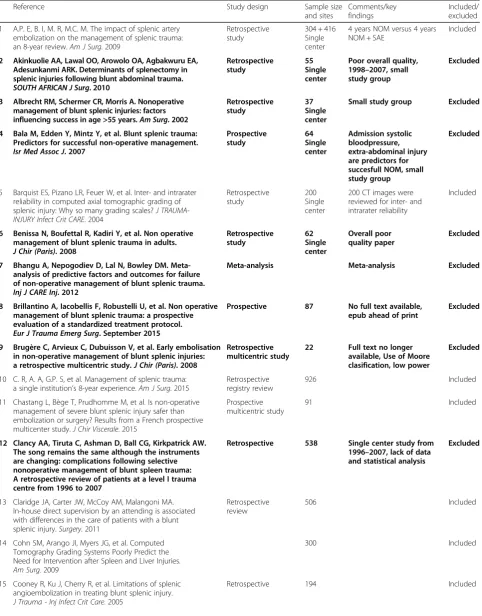
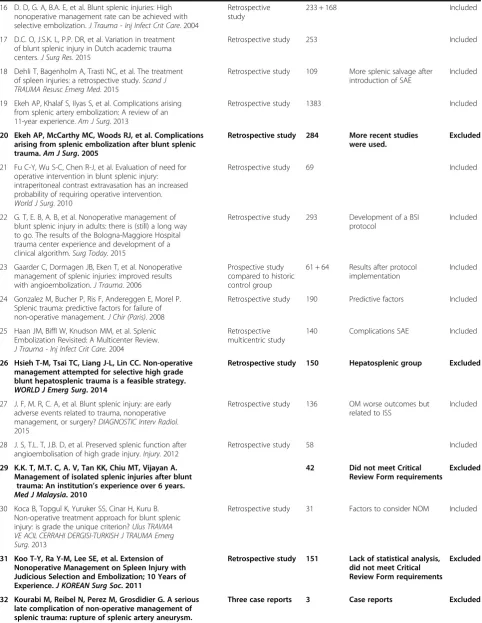
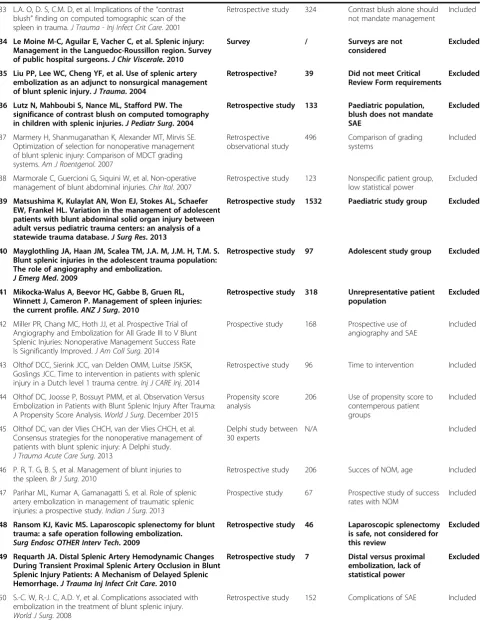
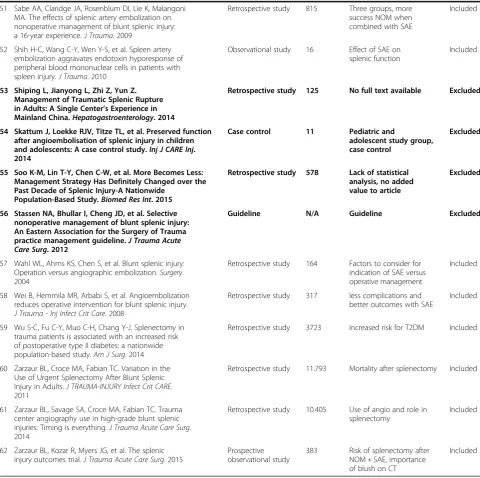
Duplicates were excluded and the final selection of arti-cles was based on their relevance and quality. Papers were excluded if no full text could be obtained. To select high-quality studies, we assessed all articles following the Critical Review Form for Quantitative Studies and guide-lines from Law et al. [13]. An overview of the selected articles is presented in Table 2. Excluded articles are also presented in Table 2 for reference. Despite the large amount of articles retrieved, we were not able to carry out a meta-analysis because of the heterogeneity of study methods, data and quality of articles.
In order to further support the literature review we
propose a new, non-verified, algorithm for blunt
abdominal trauma, based on existing algorithms presented in the literature and modified according to our findings (Fig. 1).
Discussion
Hemodynamically unstable patients
protocols. However, in cases of splenic injury, SAE and NOM is increasingly being performed even in patients that are hemodynamically unstable. The use of NOM or SAE in hemodynamically unstable pa-tients is highly controversial and should be further studied. Delays in diagnostic testing and inappropriate selection of hemodynamically unstable patients for
this treatment protocol could increase morbidity and mortality rates, as some authors have suggested [14–16]. Importantly, there has been little research on man-aging patients with transient hemodynamic stability, although Hagiwara et al. did report successful SAE in 15 patients with transient responses to fluid adminis-tration [17].
Table 1Search results and number of articles retrieved after applying the selection criteria. After the initial search, all articles were entered in a reference database (Mendeley)
Database searched Search terms used and limits applied Number of
results
Number met inclusion criteria
Medline ((“splenic injury”) AND“embolization”) AND“operative” 50 29
Medline (((splenic trauma) AND operative management) AND artery embolization) AND non operative management
15 5
Trip database (title:splenic injury)(title:embolization)(operative) 8 7
EMBASE: Search 1 ‘splenic injury’/exp OR‘splenic injury’AND (‘embolization’/exp OR embolization) AND operative
90 46
EMBASE: Search 2 #1 AND ([adolescent]/lim OR [adult]/lim OR [young adult]/lim) 46 26
EMBASE: Search 3 #2 AND (‘clinical article’/de OR‘clinical trial’/de OR‘comparative study’/de OR ‘controlled study‘/de OR‘major clinical study‘/de OR‘medical record review‘/de OR ‘multicenter study‘/de OR‘observational study’/de OR‘outcomes research’/de OR ‘prospective study’/de OR‘retrospective study’/de) AND (‘article’/it OR‘review’/it)
26 21
Web of Science TOPIC: (splenic injury) AND TOPIC: (embolization) AND TOPIC: (operative) Timespan: All years. Indexes: SCI-EXPANDED, SSCI, A&HCI, CPCI-S, CPCI-SSH.
91 45
Cochrane Library splenic injury embolization 7 6
Cochrane Library splenic injury operative 1 0
Scopus TITLE-ABS-KEY (splenic injury) AND TITLE-ABS-KEY (embolization) AND TITLE-ABS-KEY (operative)
79 34
Manual search from reference list of retrieved articles
Number in reference list - 1
- 7 - 8 - 9 - 14 - 15 - 16 - 18 - 24 - 30 - 38 - 41 - 42 - 51 Not selected
- Hartnett KL, Winchell RJ, Clark DE (2003) Management of adult splenic injury: a 20-year perspective. Am Surg 69:608–611.
- Upadhyaya P (2003) Conservative management of splenic trauma: history and current trends. Pediatr Surg Int 19:617–627.
- Todd SR, Arthur M, Newgard C et al. (2004) Hospital factors associated with splenectomy for splenic injury: a national perspective. J Trauma 57:1065–1071.
- Galvan DA, Peitzman AB (2006) Failure of nonoperative management of abdominal solid organ injuries. Curr Opin Crit Care 12:590–594.
- Watson GA, Rosengart MR, Zenati MS et al. (2006) Nonoperative management of severe BSI: are we getting better? J Trauma 61:1113–1119.
- Sclafani SJ, Shaftan GW, Scalea TM et al. (1995) Nonoperative salvage of computed tomography-diagnosed splenic injuries: utilization of angiography for triage and embolization for hemostasis. J Trauma 39:818–827.
22 14
Table 2Summary table of articles that met inclusion criteria after initial selection. Articles marked in bold were excluded
Reference Study design Sample size
and sites
Comments/key findings
Included/ excluded
1 A.P. E, B. I, M. R, M.C. M. The impact of splenic artery embolization on the management of splenic trauma: an 8-year review.Am J Surg. 2009
Retrospective study
304 + 416 Single center
4 years NOM versus 4 years NOM + SAE
Included
2 Akinkuolie AA, Lawal OO, Arowolo OA, Agbakwuru EA, Adesunkanmi ARK. Determinants of splenectomy in splenic injuries following blunt abdominal trauma.
SOUTH AFRICAN J Surg. 2010
Retrospective study
55 Single center
Poor overall quality, 1998–2007, small study group
Excluded
3 Albrecht RM, Schermer CR, Morris A. Nonoperative management of blunt splenic injuries: factors influencing success in age >55 years.Am Surg. 2002
Retrospective study
37 Single center
Small study group Excluded
4 Bala M, Edden Y, Mintz Y, et al. Blunt splenic trauma: Predictors for successful non-operative management.
Isr Med Assoc J. 2007
Prospective study
64 Single center
Admission systolic bloodpressure, extra-abdominal injury are predictors for succesfull NOM, small study group
Excluded
5 Barquist ES, Pizano LR, Feuer W, et al. Inter- and intrarater reliability in computed axial tomographic grading of splenic injury: Why so many grading scales?J TRAUMA-INJURY Infect Crit CARE. 2004
Retrospective study
200 Single center
200 CT images were reviewed for inter- and intrarater reliability
Included
6 Benissa N, Boufettal R, Kadiri Y, et al. Non operative management of blunt splenic trauma in adults.
J Chir (Paris). 2008
Retrospective study
62 Single center
Overall poor quality paper
Excluded
7 Bhangu A, Nepogodiev D, Lal N, Bowley DM. Meta-analysis of predictive factors and outcomes for failure of non-operative management of blunt splenic trauma.
Inj J CARE Inj. 2012
Meta-analysis Meta-analysis Excluded
8 Brillantino A, Iacobellis F, Robustelli U, et al. Non operative management of blunt splenic trauma: a prospective evaluation of a standardized treatment protocol.
Eur J Trauma Emerg Surg. September 2015
Prospective 87 No full text available,
epub ahead of print
Excluded
9 Brugère C, Arvieux C, Dubuisson V, et al. Early embolisation in non-operative management of blunt splenic injuries: a retrospective multicentric study.J Chir (Paris). 2008
Retrospective multicentric study
22 Full text no longer available, Use of Moore clasification, low power
Excluded
10 C. R, A. A, G.P. S, et al. Management of splenic trauma: a single institution’s 8-year experience.Am J Surg. 2015
Retrospective registry review
926 Included
11 Chastang L, Bège T, Prudhomme M, et al. Is non-operative management of severe blunt splenic injury safer than embolization or surgery? Results from a French prospective multicenter study.J Chir Viscerale. 2015
Prospective multicentric study
91 Included
12 Clancy AA, Tiruta C, Ashman D, Ball CG, Kirkpatrick AW. The song remains the same although the instruments are changing: complications following selective nonoperative management of blunt spleen trauma: A retrospective review of patients at a level I trauma centre from 1996 to 2007
Retrospective 538 Single center study from 1996–2007, lack of data and statistical analysis
Excluded
13 Claridge JA, Carter JW, McCoy AM, Malangoni MA. In-house direct supervision by an attending is associated with differences in the care of patients with a blunt splenic injury.Surgery. 2011
Retrospective review
506 Included
14 Cohn SM, Arango JI, Myers JG, et al. Computed Tomography Grading Systems Poorly Predict the Need for Intervention after Spleen and Liver Injuries.
Am Surg. 2009
300 Included
15 Cooney R, Ku J, Cherry R, et al. Limitations of splenic angioembolization in treating blunt splenic injury.
J Trauma - Inj Infect Crit Care. 2005
Table 2Summary table of articles that met inclusion criteria after initial selection. Articles marked in bold were excluded(Continued)
16 D. D, G. A, B.A. E, et al. Blunt splenic injuries: High nonoperative management rate can be achieved with selective embolization.J Trauma - Inj Infect Crit Care. 2004
Retrospective study
233 + 168 Included
17 D.C. O, J.S.K. L, P.P. DR, et al. Variation in treatment of blunt splenic injury in Dutch academic trauma centers.J Surg Res. 2015
Retrospective study 253 Included
18 Dehli T, Bagenholm A, Trasti NC, et al. The treatment of spleen injuries: a retrospective study.Scand J TRAUMA Resusc Emerg Med. 2015
Retrospective study 109 More splenic salvage after introduction of SAE
Included
19 Ekeh AP, Khalaf S, Ilyas S, et al. Complications arising from splenic artery embolization: A review of an 11-year experience.Am J Surg. 2013
Retrospective study 1383 Included
20 Ekeh AP, McCarthy MC, Woods RJ, et al. Complications arising from splenic embolization after blunt splenic trauma.Am J Surg. 2005
Retrospective study 284 More recent studies were used.
Excluded
21 Fu C-Y, Wu S-C, Chen R-J, et al. Evaluation of need for operative intervention in blunt splenic injury: intraperitoneal contrast extravasation has an increased probability of requiring operative intervention.
World J Surg. 2010
Retrospective study 69 Included
22 G. T, E. B, A. B, et al. Nonoperative management of blunt splenic injury in adults: there is (still) a long way to go. The results of the Bologna-Maggiore Hospital trauma center experience and development of a clinical algorithm.Surg Today. 2015
Retrospective study 293 Development of a BSI protocol
Included
23 Gaarder C, Dormagen JB, Eken T, et al. Nonoperative management of splenic injuries: improved results with angioembolization.J Trauma. 2006
Prospective study compared to historic control group
61 + 64 Results after protocol implementation
Included
24 Gonzalez M, Bucher P, Ris F, Andereggen E, Morel P. Splenic trauma: predictive factors for failure of non-operative management.J Chir (Paris). 2008
Retrospective study 190 Predictive factors Included
25 Haan JM, Biffl W, Knudson MM, et al. Splenic Embolization Revisited: A Multicenter Review.
J Trauma - Inj Infect Crit Care. 2004
Retrospective multicentric study
140 Complications SAE Included
26 Hsieh T-M, Tsai TC, Liang J-L, Lin CC. Non-operative management attempted for selective high grade blunt hepatosplenic trauma is a feasible strategy.
WORLD J Emerg Surg. 2014
Retrospective study 150 Hepatosplenic group Excluded
27 J. F, M. R, C. A, et al. Blunt splenic injury: are early adverse events related to trauma, nonoperative management, or surgery?DIAGNOSTIC Interv Radiol. 2015
Retrospective study 136 OM worse outcomes but related to ISS
Included
28 J. S, T.L. T, J.B. D, et al. Preserved splenic function after angioembolisation of high grade injury.Injury. 2012
Retrospective study 58 Included
29 K.K. T, M.T. C, A. V, Tan KK, Chiu MT, Vijayan A. Management of isolated splenic injuries after blunt
trauma: An institution’s experience over 6 years.
Med J Malaysia. 2010
42 Did not meet Critical Review Form requirements
Excluded
30 Koca B, Topgul K, Yuruker SS, Cinar H, Kuru B. Non-operative treatment approach for blunt splenic injury: is grade the unique criterion?Ulus TRAVMA VE ACIL CERRAHI DERGISI-TURKISH J TRAUMA Emerg Surg. 2013
Retrospective study 31 Factors to consider NOM Included
31 Koo T-Y, Ra Y-M, Lee SE, et al. Extension of Nonoperative Management on Spleen Injury with Judicious Selection and Embolization; 10 Years of Experience.J KOREAN Surg Soc. 2011
Retrospective study 151 Lack of statistical analysis, did not meet Critical Review Form requirements
Excluded
32 Kourabi M, Reibel N, Perez M, Grosdidier G. A serious late complication of non-operative management of splenic trauma: rupture of splenic artery aneurysm.
J Chir (Paris). 2008
Table 2Summary table of articles that met inclusion criteria after initial selection. Articles marked in bold were excluded(Continued)
33 L.A. O, D. S, C.M. D, et al. Implications of the“contrast blush”finding on computed tomographic scan of the spleen in trauma.J Trauma - Inj Infect Crit Care. 2001
Retrospective study 324 Contrast blush alone should not mandate management
Included
34 Le Moine M-C, Aguilar E, Vacher C, et al. Splenic injury: Management in the Languedoc-Roussillon region. Survey of public hospital surgeons.J Chir Viscerale. 2010
Survey / Surveys are not
considered
Excluded
35 Liu PP, Lee WC, Cheng YF, et al. Use of splenic artery embolization as an adjunct to nonsurgical management of blunt splenic injury.J Trauma. 2004
Retrospective? 39 Did not meet Critical Review Form requirements
Excluded
36 Lutz N, Mahboubi S, Nance ML, Stafford PW. The significance of contrast blush on computed tomography in children with splenic injuries.J Pediatr Surg. 2004
Retrospective study 133 Paediatric population, blush does not mandate SAE
Excluded
37 Marmery H, Shanmuganathan K, Alexander MT, Mirvis SE. Optimization of selection for nonoperative management of blunt splenic injury: Comparison of MDCT grading systems.Am J Roentgenol. 2007
Retrospective observational study
496 Comparison of grading systems
Included
38 Marmorale C, Guercioni G, Siquini W, et al. Non-operative management of blunt abdominal injuries.Chir Ital. 2007
Retrospective study 123 Nonspecific patient group, low statistical power
Excluded
39 Matsushima K, Kulaylat AN, Won EJ, Stokes AL, Schaefer EW, Frankel HL. Variation in the management of adolescent patients with blunt abdominal solid organ injury between adult versus pediatric trauma centers: an analysis of a statewide trauma database.J Surg Res. 2013
Retrospective study 1532 Paediatric study group Excluded
40 Mayglothling JA, Haan JM, Scalea TM, J.A. M, J.M. H, T.M. S. Blunt splenic injuries in the adolescent trauma population: The role of angiography and embolization.
J Emerg Med. 2009
Retrospective study 97 Adolescent study group Excluded
41 Mikocka-Walus A, Beevor HC, Gabbe B, Gruen RL, Winnett J, Cameron P. Management of spleen injuries: the current profile.ANZ J Surg. 2010
Retrospective study 318 Unrepresentative patient population
Excluded
42 Miller PR, Chang MC, Hoth JJ, et al. Prospective Trial of Angiography and Embolization for All Grade III to V Blunt Splenic Injuries: Nonoperative Management Success Rate Is Significantly Improved.J Am Coll Surg. 2014
Prospective study 168 Prospective use of angiography and SAE
Included
43 Olthof DCC, Sierink JCC, van Delden OMM, Luitse JSKSK, Goslings JCC. Time to intervention in patients with splenic injury in a Dutch level 1 trauma centre.Inj J CARE Inj. 2014
Retrospective study 96 Time to intervention Included
44 Olthof DC, Joosse P, Bossuyt PMM, et al. Observation Versus Embolization in Patients with Blunt Splenic Injury After Trauma: A Propensity Score Analysis.World J Surg. December 2015
Propensity score analysis
206 Use of propensity score to contemperous patient groups
Included
45 Olthof DC, van der Vlies CHCH, van der Vlies CHCH, et al. Consensus strategies for the nonoperative management of patients with blunt splenic injury: A Delphi study.
J Trauma Acute Care Surg. 2013
Delphi study between 30 experts
N/A Included
46 P. R, T. G, B. S, et al. Management of blunt injuries to the spleen.Br J Surg. 2010
Retrospective study 206 Succes of NOM, age Included
47 Parihar ML, Kumar A, Gamanagatti S, et al. Role of splenic artery embolization in management of traumatic splenic injuries: a prospective study.Indian J Surg. 2013
Prospective study 67 Prospective study of success rates with NOM
Included
48 Ransom KJ, Kavic MS. Laparoscopic splenectomy for blunt trauma: a safe operation following embolization.
Surg Endosc OTHER Interv Tech. 2009
Retrospective study 46 Laparoscopic splenectomy is safe, not considered for this review
Excluded
49 Requarth JA. Distal Splenic Artery Hemodynamic Changes During Transient Proximal Splenic Artery Occlusion in Blunt Splenic Injury Patients: A Mechanism of Delayed Splenic Hemorrhage.J Trauma Inj Infect Crit Care. 2010
Retrospective study 7 Distal versus proximal embolization, lack of statistical power
Excluded
50 S.-C. W, R.-J. C, A.D. Y, et al. Complications associated with embolization in the treatment of blunt splenic injury.
World J Surg. 2008
Most studies in the literature are retrospective case series that describe the immediate technical success of SAE without comparisons with surgical treatment or a purely conservative approach. Operative intervention by means of splenectomy is thought to increase mor-bidity and mortality rates, but this is biased by higher injury severity scores in patients that are surgically managed. A large study of 11,793 patients by Zarzaur et al. (2011) could not confirm a correlation between splenectomy and in-hospital mortality when the data were corrected for demographic, physiologic, and
injury-related factors [18]. The risk of overwhelming post-splenectomy sepsis has been advocated as a con-cern and relative contraindication for splenectomy; however, this rare complication occurs in only ap-proximately 0.9 % of splenectomy cases and is
prevent-able by immunization [19]. A recent, large,
population-based study classified 9719 patients with splenic injuries into two groups, splenectomy or non-splenectomy, and compared these against a control group of 30,413 patients with other abdominal injuries. This study warned of a two-fold increased risk of
Table 2Summary table of articles that met inclusion criteria after initial selection. Articles marked in bold were excluded(Continued)
51 Sabe AA, Claridge JA, Rosenblum DI, Lie K, Malangoni MA. The effects of splenic artery embolization on nonoperative management of blunt splenic injury: a 16-year experience.J Trauma. 2009
Retrospective study 815 Three groups, more success NOM when combined with SAE
Included
52 Shih H-C, Wang C-Y, Wen Y-S, et al. Spleen artery embolization aggravates endotoxin hyporesponse of peripheral blood mononuclear cells in patients with spleen injury.J Trauma. 2010
Observational study 16 Effect of SAE on splenic function
Included
53 Shiping L, Jianyong L, Zhi Z, Yun Z. Management of Traumatic Splenic Rupture in Adults: A Single Center’s Experience in Mainland China.Hepatogastroenterology. 2014
Retrospective study 125 No full text available Excluded
54 Skattum J, Loekke RJV, Titze TL, et al. Preserved function after angioembolisation of splenic injury in children and adolescents: A case control study.Inj J CARE Inj. 2014
Case control 11 Pediatric and
adolescent study group, case control
Excluded
55 Soo K-M, Lin T-Y, Chen C-W, et al. More Becomes Less: Management Strategy Has Definitely Changed over the Past Decade of Splenic Injury-A Nationwide
Population-Based Study.Biomed Res Int. 2015
Retrospective study 578 Lack of statistical analysis, no added value to article
Excluded
56 Stassen NA, Bhullar I, Cheng JD, et al. Selective nonoperative management of blunt splenic injury: An Eastern Association for the Surgery of Trauma practice management guideline.J Trauma Acute Care Surg. 2012
Guideline N/A Guideline Excluded
57 Wahl WL, Ahrns KS, Chen S, et al. Blunt splenic injury: Operation versus angiographic embolization.Surgery. 2004
Retrospective study 164 Factors to consider for indication of SAE versus operative management
Included
58 Wei B, Hemmila MR, Arbabi S, et al. Angioembolization reduces operative intervention for blunt splenic injury.
J Trauma - Inj Infect Crit Care. 2008
Retrospective study 317 less complications and better outcomes with SAE
Included
59 Wu S-C, Fu C-Y, Muo C-H, Chang Y-J. Splenectomy in trauma patients is associated with an increased risk of postoperative type II diabetes: a nationwide population-based study.Am J Surg. 2014
Retrospective study 3723 Increased risk for T2DM Included
60 Zarzaur BL, Croce MA, Fabian TC. Variation in the Use of Urgent Splenectomy After Blunt Splenic Injury in Adults.J TRAUMA-INJURY Infect Crit CARE. 2011
Retrospective study 11.793 Mortality after splenectomy Included
61 Zarzaur BL, Savage SA, Croce MA, Fabian TC. Trauma center angiography use in high-grade blunt splenic injuries: Timing is everything.J Trauma Acute Care Surg. 2014
Retrospective study 10.405 Use of angio and role in splenectomy
Included
62 Zarzaur BL, Kozar R, Myers JG, et al. The splenic injury outcomes trial.J Trauma Acute Care Surg. 2015
Prospective observational study
383 Risk of splenectomy after NOM + SAE, importance of blush on CT
developing type II diabetes post-splenectomy [20]. In contrast, some authors have reported higher morbidity after SAE than after surgical intervention [21]. In addition, there is evidence of splenic functional alter-ations after SAE, although research suggests that no immunizations are necessary after NOM combined with SAE [22]. In a 2010 paper, Shih and colleagues demonstrated a cytokine hyporesponse after SAE [23] therefore, SAE should not be considered definitively safer than splenectomy.
Hemodynamically stable patients
SAE, as opposed to pure conservative management, is even more difficult to advocate in hemodynamically stable patients. In a 2015 study, Olthoff et al. looked at the management of 253 patients with splenic injury
in Dutch trauma centers taking into account
hemodynamic instability on admission, high-grade
injury, and ISS [24]. Although the rate of NOM was comparable between the five trauma centers reviewed, the use of SAE for splenic injuries was highly variable between the centers, illustrating the lack of consensus that exists regarding the management of blunt splenic injury.
In hemodynamically stable patients, retrospective studies have shown that NOM has a reduced failure
rate when combined with SAE [12, 25–30], but
pro-spective studies and certain retropro-spective studies have failed to confirm these findings [11, 15]. Several stud-ies have been published that show increased numbers of both minor and major complications, leading to an increase in time spent in the hospital, with the use of
SAE [15, 31–33]. Moreover, there is no consensus on
the follow-up management and imaging of patients with splenic injuries. Given the lack of evidence in the literature, Olthof et al. published a study in 2013 l
l
l
l
l
l
l l l
l
l l l
l l l
l
l
l
l
l l l l
l ll
l
l l l
l l l l l l l
l l
l
using the Delphi method to reach an expert opinion on the optimal management and follow-up protocol for blunt splenic injury [28]. In several questionnaires, trauma surgeons and interventional radiologists have tried to reach consensus on the indications for, and optimal follow-up management and imaging to use with, NOM combined with SAE. Almost all of the ex-perts used the American Association for the Surgery of Trauma (AAST) scoring system to grade splenic injuries (Table 3). They all agreed on the use of NOM with or without SAE in small graded injuries
(I–II) with no or only a small hemoperitoneum. In
high-grade injuries (III–V) with a large
hemoperito-neum and active contrast extravasation half of the ex-perts would still attempt NOM + SAE, but most of them would not make a second attempt if the initial SAE failed. Most importantly, they all agreed that rapid intervention is needed for SAE to succeed.
Current recommendations are that intervention
should be performed within 60 min of admission in stable patients with active contrast extravasation and within 15 to 30 min when a large hemoperitoneum is present. No consensus was reached on management after failure of the initial NOM, or on the appropriate length of stay (LOS) in the hospital.
In search of better criteria for determining the need for intervention, Koca et al. correlated the results of NOM with the American Association for the Surgery of Trauma (AAST) splenic injury grade (see below) [34]. They found that hemodynamically stable patients can safely be treated with NOM, including patients with multi-organ injuries and higher grade splenic injuries. Most injuries are lower grade injuries (I–III), and not surprisingly transfusion is correlated with the injury grade. A 2008 article by Gonzalez et al. added the degree of hemoperitoneum and associated injuries as predictive factors for NOM failure [35]. In 2004, Wahl and col-leagues retrospectively analyzed 164 patients with blunt splenic injuries; [36] after univariate analysis they found
that lower blood pressure, higher ISS, lower pH, and more packed RBC transfusions are the best indicators of the need for operative intervention. Age, heart rate, splenic abbreviated injury scale score, and GCS did not significantly correlate with the need for operative man-agement. Similarly, Tugnoli et al. (2014) presented the algorithm used in the Bologna-Maggiore Hospital; in 293 patients with splenic injuries admitted between 2009 and 2013 [37] they reported a NOM success rate of 95.8 %. All hemodynamically stable cases with active contrast extravasation or grade V injuries were embo-lized, preferably proximally within the splenic artery.
In a 2015 AAST prospective observational study, Zarzaur et al. investigated the risk of delayed splenectomy after NOM with or without SAE [38]. They found that the only risk factor for delayed splenectomy was the finding of active extravasation at presentation; thus calling for closer obser-vation of patients with this finding irrespective of whether SAE was performed. Patients with grade I injury had no risk for delayed splenectomy. In cases with higher grade (II to V) injuries, the authors advocated close observation for 10–14 days. In the 2005 study of Haan et al. the presence of arteriovenous fistula on CT imaging was predictive for 40 % of failure rates in nonoperatively managed patients [9]. The presence of vascular lesions (arteriovenous fistulas, pseudoaneurysms) and impact on NOM success rates was further investigated by several authors. In a 2014 study, the Wake Forest University investigated failure rates after angi-ography with subsequent embolization, ignoring presence or absence of any vascular lesion, for all grade III to V splenic injuries in stable patients in a protocolized manner and comparing this to a historic control group [39]. From 168 patients 67 % were managed nonoperatively with an overall NOM failure rate of 5 %. In the patient group where protocol was violated the failure rate was 25 % compared to 3 % in the protocol group (P = 0.03). Comparing this to a historic control group, 52 % patients underwent NOM with a significant higher failure rate of 15 % (P = 0.04). For each injury grade they reported lower failure rates in the study
Table 3Traditionally used American Association for the Surgery of Trauma (AAST) scoring system for splenic injuries
Grade Hematoma Laceration
I Subcapsular < 10 % of surface area Capsular tear < 1 cm deep into parenchyma
II Subcapsular 10–50 % of surface area Capsular tear 1–3 cm deep into parenchyma
NO involvement of trabecular vessels
III Subcapsular > 50 % of surface area OR
Expanding, ruptured subcapsular or parenchymal hematoma OR
Intraparenchymal hematoma > 5 cm or expanding
>3 cm deep into parenchyma or trabecular vessel involvement
IV Segmental or hilar vessel involvement with major
devascularization (>25 %) of spleen
group compared to the control group and when protocol was followed. However, they did not reach statistical signifi-cance when comparing patients treated according to proto-col or patients deviating from protoproto-col in injury grades IV and V. The authors did not report on complications or on splenic function after embolization in their study group, no data is available whether proximal or distal embolization was used.
Another prospective study from Parihar et al. [40] found a shorter LOS in SAE patients (5.4 days compared with 6.6 days for NOM patients without SAE), as well as higher hemoglobin concentrations and systolic blood pressures. A recent study, which used propensity score analysis, found no statistically significant difference be-tween observation and embolization in the subsequent splenectomy rate [41].
Scoring systems
Many scoring systems have been developed to grade splenic injuries, among which the AAST grading system for splenic injury (Table 3) is the most popular. Two separate studies have correlated CT findings with the AAST injury grade and subsequent need for interven-tion. In the study by Barquist et al. [42], four radiologists retrospectively reviewed 200 CT images of patients who had undergone splenectomy; the operative grading of the splenic injuries was used as a gold standard. The weighted kappa score for intrarater reproducibility was
0.15–0.77 and the interrater kappa score was 0–0.84
(mean 0.23). In the study by Cohn et al. [43], five radiol-ogists reviewed CT scans of 300 patients with liver and splenic injuries using the AAST grading system. Twenty-one percent of the patients with splenic injuries visible on CT images required intervention. Cohn et al. reached the same conclusion as Barquist et al.; the sensitivity of the AAST injury grade for predicting the need for inter-vention is poor and interrater variability, even among experienced radiologists, is high. Both thus concluded that the AAST scoring system is unreliable because even experienced radiologists often underestimate the magni-tude of the injury, and other factors should also be con-sidered when evaluating indications for surgery or angiography. The authors also evaluated kappa scores for the reporting of contrast blush on CT imaging and found that they were similarly variable, although con-trast blush on CT imaging is considered a major indica-tion that intervenindica-tion is needed.
In 2001, Protetch et al. reported that the incidence of contrast blush was related to the grade of injury, with 3.2 % of grade I/II injuries and up to 37.6 % of grade IV and V injuries showing a contrast blush in CT images [44]. Interventions were more frequent when a contrast blush was present, but multivariate regression analysis showed no correlation between finding a contrast blush
and splenic intervention. This was confirmed by both Thompson et al. and Michailidou et al.; both also re-ported that the size of the contrast blush was correlated with the need for intervention [45, 46]. They both found that similar cut-off values (1 cm and 1.5 cm) indicated the need for intervention. Other factors that also corre-lated with the need for intervention in splenic injury were injury grade, hypotension on admission to the emergency department, and age. The findings of these studies support the need for better protocols and param-eters to allow proper assessment of the need for inter-vention in cases of splenic trauma.
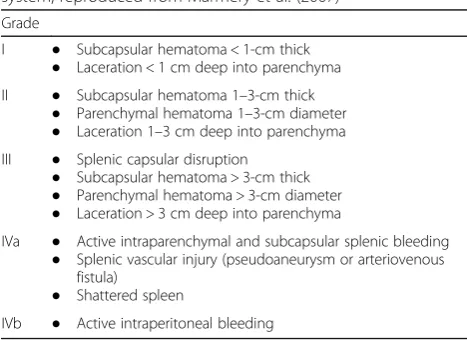
In 2007, Marmery et al. suggested a new grading sys-tem for splenic injury that takes into account active bleeding or splenic vascular injury (including splenic pseudoaneurysms and arteriovenous fistulas) [47]. Their new grading system was statistically significantly better than the AAST grading system in terms of its ability to predict the need for splenic arteriography (P = 0.0036) or
the combination of arteriography and surgery (P =
0.0006). Table 4 presents the proposed new grading system.
Complications
There has been much research published, and work is still ongoing, to understand the complications after SAE compared with those after surgery and NOM. All of the treatment modalities for splenic injury are associated with high morbidity rates. Specific morbidities associated with SAE include pancreatitis, splenic infarction, post-embolization syndrome, and intestinal perforation.
Two retrospective studies examined the complications that occur after SAE [32, 33]. Ekeh et al. reviewed 1383 patients with blunt splenic injury over an 11-year period; 78.5 % were treated nonoperatively, and of this group 8.1 % underwent SAE. Major complications including splenic infarction, splenic abscess, contrast-induced
Table 4Newly proposed Multi-Detector CT (MDCT) grading system, reproduced from Marmery et al. (2007)
Grade
I ● Subcapsular hematoma < 1-cm thick ● Laceration < 1 cm deep into parenchyma II ● Subcapsular hematoma 1–3-cm thick
● Parenchymal hematoma 1–3-cm diameter ● Laceration 1–3 cm deep into parenchyma III ● Splenic capsular disruption
● Subcapsular hematoma > 3-cm thick ● Parenchymal hematoma > 3-cm diameter ● Laceration > 3 cm deep into parenchyma
IVa ● Active intraparenchymal and subcapsular splenic bleeding ● Splenic vascular injury (pseudoaneurysm or arteriovenous
fistula) ● Shattered spleen
renal insufficiency, and splenic cysts occurred in 14 % of the patients who underwent SAE. Wu et al. reported that 28.5 % of patients who underwent SAE experienced major complications. Distal embolization was associated with more major complications than proximal SAE. Minor complications (pleural effusion, coil migration, and fever) occurred in 34 % and 61.9 % of the patients in the SAE groups in the studies by Ekeh et al. and Wu et al., respectively.
In 2004, Haan et al. reported SAE complication rates in 140 patients and reported a splenic salvage rate of 87 % [31]. This rate indirectly correlated with injury se-verity scores. More than 80 % of the grade IV and V
in-juries in their study were successfully managed
nonoperatively. No significant difference was noted in patients older than 55 years of age. The presence of a significant hemoperitoneum did not alter success rates; however, the presence of arteriovenous fistulas did. They concluded that complications after SAE are common, but do not seem to influence outcomes.
In 2008, Wei et al. published a retrospective study show-ing lower complication rates after SAE even with higher splenic Abbreviated Injury Scores in this group compared with the operatively managed group (6 % vs. 36 %,P < 0.01) [30]. They found that the introduction of SAE reduced op-erative interventions by 16 % between 2000 and 2006 in their Level 1 center. A French prospective multicenter study investigated complication rates in 91 patients [21]. Twenty percent underwent splenectomy with a post-surgical morbidity of 15 %. Fifteen patients (16 %) under-went embolization and 67 were initially managed nono-peratively. In the embolization group with severe injury (grade III–V), the morbidity was 73 %. The splenectomy group with severe injury had a total morbidity of 70 %. The NOM group had a morbidity of 58 %. Specific morbidities
after NOM, surgery, and SAE were 10, 15, and 47 % (P =
0.02), respectively. The study concluded that embolization should not be used as a prophylactic measure, but should only be used in cases with active bleeding. We could not find well-designed studies comparing complication rates between the three treatment modalities.
Other factors to be considered
Need for transfusion
In their 2015 study of 253 patients, Olthoff et al. found a very large variation but no significant difference in the need for transfusion between patients treated with SAE and those treated with NOM [24]. The mean number of transfused blood products was 5.5 units (±9.9) in the NOM group versus 9.1 units (±17.2) in embolized pa-tients (P = 0.75). Rosati et al. reported on the need for transfusion in patients requiring immediate splenectomy
(70 %), embolization (46.5 %), and NOM (25.9 %), but failed to adjust these data for injury severity and con-founders [12]. They found that the need for transfusion was a major risk factor for mortality (adjusted OR = 2.63; CI 1.27–5.42,P = 0.009). Dent et al. compared transfu-sion rates between NOM, early embolization, and
opera-tive management [25]. They reported a 2.1-unit
difference in the transfusion rate (P < 0.01)of the NOM group versus the operative management group, and found no statistically significant difference between transfusion rates in the early embolization and operative management groups without correcting for confounders. They also found no difference in transfusion rates when
they compared patients who underwent early
embolization versus late embolization.
Impact of direct supervision
A retrospective review in 2011 investigated the impact of direct supervision (DS) or indirect supervision (IS) on the management of splenic injuries [48]. Using data from 506 cases the authors found significant differences in compliance with protocols (DS, 95 % vs. IS, 82 %, P <
0.001), operation rates (DS 16 %, vs. IS, 8 %,P = 0.016), ICU use (IS, 84.1 % vs. DS, 73.0 %, P = 0.029), hospital costs (IS, $142.956 ± $36.219 vs. DS, $62.981 ± $8.784,P
= 0.048), and use of SAE without indication (IS, 8 vs. DS, 0). Interestingly, there were no reported differences in mortality or splenectomy rates.
Time to intervention and volume of the centers.
In 2014, Olthof et al. retrospectively examined the time to intervention in patients undergoing SAE and pa-tients undergoing surgery in a cohort of 96 adults [49]. In hemodynamically stable patients, the median time to intervention for patients in the SAE group was 117 min compared with 105 min for patients in the surgery group. The differences in time to intervention or re-intervention, and the complication rates were not signifi-cantly different between the two patient groups. There was a higher transfusion rate for patients in the splenic surgery group; the median number of transfused units of packed RBCs was eight for hemodynamically unstable patients undergoing SAE versus 24 for patients
undergo-ing splenic surgery (P = 0.09). A report published in
We could not find any articles comparing the relation-ship between time to intervention and success or com-plication rates between patients undergoing NOM, SAE, or splenic surgery.
Costs & Length of stay
Different authors have investigated the costs of SAE versus surgical management. Wahl et al. reported no sig-nificant cost differences between these two treatment modalities (SAE, $49.300 ± $40.460 vs. OM, $54.590 ± $34.760) [36]. This was confirmed by Wei et al., who found the costs associated with SAE to be $47,000 ± $31,000 and the costs associated with OM to be $40,000 ± $34,000 [30]. Both authors assessed the LOS and differences in LOS in patients who received different treatments. Wahl et al. found an average LOS of 45 ± 26 days for patients who went directly to the operating theatre, compared with 14 ± 15 days for patients who underwent SAE (P < 0.02). Wei et al. found that the average LOS in the surgical group was 14 ± 10 days and in the SAE group was 12 ± 12 days (P > 0.05). Bruce et al. also came to the same conclusion in their 2011 study; [51] in that study the median total hospital charges were $41,269 (± $31,128) for the NOM + SAE group
com-pared with $46,356 (± $11,334) for the OM group (P =
0.545). They did report higher procedure-related charges for OM patients compared with patients undergoing
NOM + SAE ($28,709 ± $6941 vs. $19,062 ± $14,025; P =
0.16); however, this was offset by more charges for a
greater number of radiological evaluations in the other group.
Summary
Based on the literature review we propose a new, non-verified, decision algorithm for splenic trauma. We hope this can further serve as a tree of order in the vast amount of publications concerning this topic. We stress that this algorithm is not verified and should be further verified in well designed, prospective studies, is it to be used in daily practice.
The term hemodynamically unstable is not clearly de-fined in most literature and it is often unclear if authors included or excluded transient responders. The nature of the patient’s response to fluid therapy is important and should be considered in all splenic trauma proto-cols. Most authors agree that surgical intervention is in-dicated when the patient is hemodynamically unstable. In close relation with response to fluid resuscitation is time to intervention, which is an important factor to consider from the start. Higher splenic salvage rates are achieved when earlier intervention is possible and expert opinion states that intervention is recommended within one hour of admittance. In prospect, when the time to
intervention will be several hours OM or NOM may be better options than SAE, depending on the clinical pres-entation. Clinicians and surgeons should always keep in mind that pre- and post-intervention delays make it in-creasingly difficult to operate because of the several sur-gical and nonsursur-gical issues that can develop (e.g., clotting of the intraperitoneal hemorrhage, infection, and development of comorbidities). Non responders should be triaged promptly with a minimal delay to-wards surgical intervention.
There is a distinction between major and minor com-plications and treatment-specific morbidities. While it is difficult to correlate complications with the embolization procedure, especially in small studies, it is interesting to look at treatment-specific complications and associated risk-benefit ratios; however, no well-designed studies compare NOM, NOM + SAE, and OM for the treatment of splenic trauma. Until such studies are available, we should look at the clinical value and possible risks of an intervention on a patient-specific level while considering all factors, and keeping in mind the relatively high com-plication rate after SAE. It is important to avoid the bias of expecting operative interventions to have higher com-plication rates than SAE, which seems like a less invasive procedure. Increased use of NOM with or without SAE should not erode clinical judgment and surgical skills.
Currently there is no evidence of reduced transfusion rates when SAE is used in conjunction with NOM com-pared with NOM alone. Transfusion rates are higher in patients who undergo an operative intervention and are a risk factor for mortality; however, no studies are avail-able that compare similar patient groups and their corre-sponding transfusion rates.
Multiple studies have reported on the cost effective-ness of splenic injury management: operative interven-tion brings the costs of surgery and of higher transfusion rates; however, conversely NOM + SAE re-quires higher imaging costs and there is ultimately no significant difference between the costs of the two interventions.
intervention but recent studies have shown that the size of the contrast blush is what matters. Though whether a cut-off value of 1 cm or 1.5 cm is more suitable for determining the optimal treatment is not yet known. Ac-cording to the literature, the presence of a hemoperito-neum does not alter the success rates of SAE.
The MDCT grading system proposed by Marmery et al. has shown a better correlation with the need for intervention than the conventionally used AAST grading system. Currently, there is no consensus on the use of one grading system that correlates well with the need for intervention, and most published studies have used the AAST grading system. Lack of standardized grading makes it difficult to compare older studies with recent and future studies. Interpreting CT images and grading the splenic injury is difficult and should be performed by experienced radiologists using the proposed grading sys-tem with a consistent technique. We propose the use of specific image analysis protocols to achieve a consistent approach and improve future studies. We propose the use of the MDCT grading system in our decision algorithm.
The treatment plan should be managed by experienced trauma surgeons or interventional radiologists using a multidisciplinary approach when possible. It should be clear who is responsible for assessing the indications for SAE, NOM, or OM. The literature has shown better re-sults when protocols are in place; and ideally there should be consensus on who is responsible for initiating treatment.
Conclusions
The current literature is unclear on the correct indica-tions for NOM ± SAE versus surgery for splenic trauma. To further clarify current evidence we propose, a non-verified, decision algorithm for blunt abdominal trauma. A prospective well designed study is needed to validate our decision algorithm. Consensus on the management of blunt splenic injury between radiologists, trauma sur-geons and emergency medicine physicians could reduce conflicting data, improve current protocols, and avoid harm to patients. More prospective data and well-designed studies, taking into account other factors in-cluding long term results and morbidity, on the manage-ment of splenic trauma are needed.
Additional file
Additional file 1: Table 1.Search results and number of articles retrieved after applying the selection criteria.After the initial search, all articles were entered in a reference database (Mendeley).Table 2. Summary table of articles that met inclusion criteria after initial selection. Articles marked in grey were excluded.Table 3.Traditionally used American Association for the Surgery of Trauma (AAST) scoring system for splenic injuries.Figure 1.Algorithm for management of splenic trauma
modified from Ekeh and Tugnoli.8, 32 Abbreviations: HD: hemodynamically; BP: blood pressure; FAST: Focused Assessment with Sonography for Trauma; ICU: Intensive Care Unit; SAE: splenic artery embolization; MDCT: Multidetector CT grading (Table 4); NOM: non operative management; CE: contrast extravasation; IV: intravenous. (ZIP 126 kb)
Abbreviations
AAST:American Association for the Surgery of Trauma; BP: Blood pressure; CE: Contrast extravasation; DS: Direct supervision; FAST scan: Focused assessment with sonography for trauma; GCS: Glasgow coma scale; HD: Hemodynamically; ICU: Intensive care unit; IS: Indirect supervision; ISS: Injury severity score; IV: Intravenous; LOS: Length of stay; MDCT: Multidetector computer tomography; NOM: Nonoperative management; OM: Operative management; OR: Operating room; OSS: Operative splenic salvage; RBCs: Red blood cells; SAE: Splenic artery embolization
Acknowledgements None.
Funding None.
Availability of data and materials
All datasets and figures supporting the conclusions of this article are included within the article and its Additional file 1.
Authors’contributions
FvdC and AM were responsible for the study concept and design. FvdC carried out the literature search. Both authors critically reviewed the manuscript for important intellectual content. AM was the study supervisor. Both authors read and approved the final version of the manuscript.
Competing interests
The authors declare that they have no competing interests.
Consent for publication
Written consent was obtained from both patients.
Ethics approval and consent to participate Not applicable.
Author details
1Third year master’s student, Faculty of Medicine, Catholic University of Leuven (KU Leuven), Gasthuisberg, Belgium.2Department of Upper Gastrointestinal Surgery, Royal Devon & Exeter Hospital, Exeter, UK.
Received: 28 April 2016 Accepted: 11 August 2016
References
1. Raza M, Abbas Y, Devi V, Prasad KV, Rizk KN, Nair PP. Nonoperative management of abdominal trauma–a 10 years review. World J Emerg Surg. 2013;8(1):14.
2. Søreide K. Epidemiology of major trauma. Br J Surg. 2009;96(7):697–8. 3. Maddison FE. Embolic therapy of hypersplenism. Invest Radiol.
1973;8(4):280–1.
4. Chuang VP, Reuter SR. Selective arterial embolization for the control of traumatic splenic bleeding. Invest Radiol. 1975;10(1):18–24.
5. Panetta T, Sclafani SJA, Goldstein AS, Phillips TF. Percutaneous transcatheter embolization for arterial trauma. J Vasc Surg. 1985;2(1):54–64.
6. Haller Jr JA, Papa P, Drugas G, Colombani P. Nonoperative management of solid organ injuries in children. Is it safe? Ann Surg. 1994;219(6):625–8. discussion 628–631.
8. Peitzman AB, Heil B, Rivera L, et al. Blunt splenic injury in adults: multi-institutional study of the Eastern association for the surgery of trauma. J Trauma. 2000;49(2):177–87. discussion 187–189.
9. Haan JM, Bochicchio GV, Kramer N, Scalea TM. Nonoperative management of blunt splenic injury: a 5-year experience. J Trauma. 2005;58(3):492–8. 10. Fu C-Y, Wu S-C, Chen R-J, et al. Evaluation of need for operative
intervention in blunt splenic injury: intraperitoneal contrast extravasation has an increased probability of requiring operative intervention. World J Surg. 2010;34(11):2745–51.
11. Ekeh AP, Izu B, Ryan M, McCarthy M. The impact of splenic artery embolization on the management of splenic trauma: an 8-year review. Am J Surg. 2009;197(3):337–41.
12. Rosati C, Ata A, Siskin GP, et al. Management of splenic trauma: a single institution’s 8-year experience. Am J Surg. 2015;209(2):308–14. 13. Law M, Stewart D, Letts L, Pollock N, Bosch J, Westmorland M.
Guidelines for critical review form : qualitative studies. McMaster Univ Occup Ther Evidence-Based Pract Res Gr. 2007;1–12.
14. Cooney R, Ku J, Cherry R, et al. Limitations of splenic angioembolization in treating blunt splenic injury. J Trauma. 2005;59(4):926–32.
15. Peitzman AB, Harbrecht BG, Rivera L, Heil B. Eastern Association for the Surgery of Trauma Multi institutional Trials Workgroup. Failure of observation of blunt splenic injury in adults: variability in practice and adverse consequences. J Am Coll Surg. 2005;201(2):179–87.
16. Peitzman AB, Ferrada P, Puyana JC. Nonoperative management of blunt trauma: have we gone too far? Surg Infect. 2009;10(5):427–33.
17. Hagiwara A, Fukushima H, Murata A, Matsuda H, Shimazaki S. Blunt splenic injury: usefulness of transcatheter arterial embolization in patients with a transient response to fluid resuscitation. Radiology. 2005;235(1):57–64. 18. Zarzaur BL, Croce MA, Fabian TC. Variation in the use of urgent splenectomy
after blunt splenic injury in adults. J Trauma. 2011;71(5):1333–9. 19. Holdsworth R, Irving A, Cuschieri A. Postsplenectomy sepsis and its
mortality rate: actual versus perceived risks. Br J Surg. 1991;78(9):1031–8. 20. Wu S-C, Fu C-Y, Muo C-H, Chang Y-J. Splenectomy in trauma patients is
associated with an increased risk of postoperative type II diabetes: a nationwide population-based study. Am J Surg. 2014;208(5):811–6. 21. Chastang L, Bège T, Prudhomme M, et al. Is non-operative management of
severe blunt splenic injury safer than embolization or surgery? Results from a French prospective multicenter study. J Visc Surg. 2015;152(2):85–91. 22. Skattum J, Titze TL, Dormagen JB, et al. Preserved splenic function after
angioembolisation of high grade injury. Injury. 2012;43(1):62–6. 23. Shih H-C, Wang C-Y, Wen Y-S, et al. Spleen artery embolization aggravates
endotoxin hyporesponse of peripheral blood mononuclear cells in patients with spleen injury. J Trauma. 2010;68(3):532–7.
24. Olthoff DC, Luitse JSK, de Rooij PP, et al. Variation in treatment of blunt splenic injury in Dutch academic trauma centers. J Surg Res. 2015;194(1):233–8.
25. Dent D, Alsabrook G, Erickson BA, et al. Blunt splenic injuries: high nonoperative management rate can be achieved with selective embolization. J Trauma. 2004;56(5):1063–7.
26. Dehli T, Bagenholm A, Trasti NC, et al. The treatment of spleen injuries: a retrospective study. Scand J Trauma Resusc Emerg Med. 2015;23(1):85. 27. Gaarder C, Dormagen JB, Eken T, et al. Nonoperative management of
splenic injuries: improved results with angioembolization. J Trauma. 2006;61(1):192–8.
28. Olthof DC, van der Vlies CHCH, van der Vlies CHCH, et al. Consensus strategies for the nonoperative management of patients with blunt splenic injury: a Delphi study. J Trauma Acute Care Surg. 2013;74(6):1567–74.
29. Sabe AA, Claridge JA, Rosenblum DI, Lie K, Malangoni MA. The effects of splenic artery embolization on nonoperative management of blunt splenic injury: a 16-year experience. J Trauma. 2009;67(3):565.
30. Wei B, Hemmila MR, Arbabi S, et al. Angioembolization reduces operative intervention for blunt splenic injury. J Trauma. 2008;64(6):1472–7. 31. Haan JM, Biffl W, Knudson MM, et al. Splenic embolization revisited: a
multicenter review. J Trauma. 2004;56(3):542–7.
32. Ekeh AP, Khalaf S, Ilyas S, et al. Complications arising from splenic artery embolization: a review of an 11-year experience. Am J Surg. 2013;205(3): 250–4.
33. Wu S-C, Chen R-J, Yang AD, et al. Complications associated with embolization in the treatment of blunt splenic injury. World J Surg. 2008; 32(3):476–82.
34. Koca B, Topgul K, Yuruker SS, Cinar H, Kuru B. Non-operative treatment approach for blunt splenic injury: is grade the unique criterion? J Trauma Emerg Surg. 2013;19(4):337–42.
35. Gonzalez M, Bucher P, Ris F, Andereggen E, Morel P. Splenic trauma: predictive factors for failure of non-operative management. J Chir (Paris). 2008;145(6):561–7.
36. Wahl WL, Ahrns KS, Chen S, et al. Blunt splenic injury: Operation versus angiographic embolization. Surgery. 2004;136(4):891–9.
37. Tugnoli G, Bianchi E, Biscardi A, et al. Nonoperative management of blunt splenic injury in adults: there is (still) a long way to go. The results of the Bologna-Maggiore Hospital trauma center experience and development of a clinical algorithm. Surg Today. 2015;45(10):1210–7.
38. Zarzaur BL, Kozar R, Myers JG, et al. The splenic injury outcomes trial. J Trauma Acute Care Surg. 2015;79(3):335–42.
39. Miller PR, Chang MC, Requarth JA, et al. Prospective Trial of Angiography and Embolization for All Grade III to V Blunt Splenic Injuries: nonoperative management success rate is significantly improved. J Am Coll Surg. 2014;218(4):644–8.
40. Parihar ML, Kumar A, Gamanagatti S, et al. Role of splenic artery embolization in management of traumatic splenic injuries: a prospective study. Indian J Surg. 2013;75(5):361–7.
41. Olthof DC, Joosse P, Bossuyt PMM, et al. Observation versus embolization in patients with blunt splenic injury after trauma: a propensity score analysis. World J Surg. 2016;40(5):1264–71.
42. Barquist ES, Pizano LR, Feuer W, et al. Inter- and intrarater reliability in computed axial tomographic grading of splenic injury: why so many grading scales? J Trauma. 2004;56(2):334–8.
43. Cohn SM, Arango JI, Myers JG, et al. Computed tomography grading systems poorly predict the need for intervention after spleen and liver injuries. Am Surg. 2009;75(2):133–9.
44. Omert LA, Salyer D, Dunham CM, Porter J, Silva A, Protetch J. Implications of the“contrast blush”finding on computed tomographic scan of the spleen in trauma. J Trauma. 2001;51(2):272–8.
45. Thompson BE, Munera F, Cohn SM, MacLean AA, Cameron J, Rivas L, et al. Novel computed tomography scan scoring system predicts the need for intervention after splenic injury. J Trauma. 2006;60(5):1083–6.
46. Michailidou M, Velmahos GC, van der Wilden G, Alam HB, de Moya M, Chang Y.“Blush”on trauma computed tomography: not as bad as we think! J Trauma Acute Care Surg. 2012;73(3):580–4.
47. Marmery H, Shanmuganathan K, Alexander MT, Mirvis SE. Optimization of selection for nonoperative management of blunt splenic injury: Comparison of MDCT grading systems. Am J Roentgenol. 2007;189(6):1421–7. 48. Claridge JA, Carter JW, McCoy AM, Malangoni MA. In-house direct
supervision by an attending is associated with differences in the care of patients with a blunt splenic injury. Surgery. 2011;150(4):718–25. 49. Olthof DC, Sierink JC, van Delden OM, Luitse JSK, Goslings JC. Time to
intervention in patients with splenic injury in a Dutch level 1 trauma centre. Injury. 2014;45(1):95–100.
50. Zarzaur BL, Savage SA, Croce MA, Fabian TC. Trauma center angiography use in high-grade blunt splenic injuries: timing is everything. J Trauma Acute Care Surg. 2014;77(5):666–71.
51. Bruce PJP, Helmer SD, Harrison PB, Sirico T, Haan JM. Nonsurgical management of blunt splenic injury: Is it cost effective? Am J Surg. 2011;202(6):810–6. doi:10.1016/j.amjsurg.2011.06.041.
• We accept pre-submission inquiries
• Our selector tool helps you to find the most relevant journal • We provide round the clock customer support
• Convenient online submission • Thorough peer review
• Inclusion in PubMed and all major indexing services • Maximum visibility for your research
Submit your manuscript at www.biomedcentral.com/submit
![Fig. 1 Algorithm for management of splenic trauma modified from Ekeh and Tugnoli [8, 28]](https://thumb-us.123doks.com/thumbv2/123dok_us/809743.1578284/8.595.59.538.87.452/fig-algorithm-management-splenic-trauma-modified-ekeh-tugnoli.webp)