R E S E A R C H
Open Access
Recommendations for clear aligner therapy
using digital or plaster study casts
Hsiu-Ching Ko
1*, Weitao Liu
1, Derek Hou
1, Sepideh Torkan
1, Charles Spiekerman
2and Greg J. Huang
1Abstract
Background:Clear aligner therapy has evolved considerably since its introduction 20 years ago. Clinicians have become more experienced with aligner therapy, but little is known about the types of malocclusions that clinicians currently treat with aligners. Similarly, it is not known if viewing digital vs plaster models has any impact on the treatment planning process for aligners. The aim of this study was to assess which types of malocclusions are recommended for treatment with clear aligners, and also to determine if recommendations for aligner treatment differed when using digital versus plaster models.
Methods:Sixteen orthodontists treatment planned 20 cases at two time points with either the same or different model formats (digital versus plaster). As part of the treatment planning process, they were asked whether each patient was a good candidate for Invisalign® treatment, and if not, why. Generalized estimating equations regression (GEE), the permutation test, and a logistic regression model with GEE were used to analyze the data.
Results:No significant difference was found between the Invisalign® choices in the digital model group and those in the plaster model group at T1 (p= 0.59). There was no significant difference between the agreement rate of the different formats group and that of the same format group (p= 0.97). Cases with extractions had less Invisalign® recommendations (15%) compared to cases with no extractions (55%) (p= 0.0015). Cases with surgery had less Invisalign® recommendations (29%) compared to cases with no surgery (57%) (p= 0.035).
Conclusions:In this study, viewing orthodontic records with digital versus plaster models did not influence decisions about Invisalign® recommendations. Additionally, the orthodontists in this study tended to not recommend Invisalign® for extraction cases, surgical cases, or difficult cases.
Background
Orthodontic patients increasingly expect more esthetic and comfortable treatment options. Clear aligners meet these criteria, but many orthodontists do not feel that they can be utilized for all patients [1,2]. Studies have shown that aligners are able to perform some types of orthodon-tic tooth movement successfully, while more complex movements, like extrusions, anteroposterior correction, and severe rotations, pose more challenges [3–5]. During the past few years, Align Technology has attempted to ad-dress these concerns by introducing improvements to the Invisalign® product that allow for better control tooth movement. The effect of these improvements on
clinician’s attitudes towards cases that can be successfully treated with aligners has not yet been investigated.
Along with the increasing prevalence of aligner therapy, digital models are gradually replacing plaster models and will eventually become the new standard for orthodontic records. However, many orthodontists still find familiarity in plaster models that can be physically articulated and measured, and studies have reported that models are the single most important orthodontic record for treatment planning [6,7]. Several studies have looked at the accuracy of digital models, and in general, they have been found to be reasonably accurate compared to plaster models [8–12]. However, more importantly, it is not known whether asses-sing a case with digital instead of plaster models may influ-ence the final treatment plan.
The purpose of this study was to assess which types of malocclusions were or were not recommended for treat-ment with clear aligners and also to determine if these
* Correspondence:[email protected];[email protected]
1Department of Orthodontics, School of Dentistry, University of Washington,
1959 NE Pacific ST, Health Sciences Center, D-569, Box 357446, Seattle, WA 98195-7446, USA
Full list of author information is available at the end of the article
decisions differed when using digital versus plaster models.
Methods
This study was approved by the Human Subjects Div-ision at the University of Washington. We recruited 16 orthodontists, all of whom were in practice for a mini-mum of 5 years and did not routinely use digital models (other than for Invisalign® cases) (Table 1). The ortho-dontists were shown how to navigate the OrthoCad soft-ware (Align Technology, San Jose, CA) prior to viewing the records in the study. The orthodontists assessed a total of 20 cases at the beginning of the study (T1) and reassessed these same 20 cases again after at least 3 months had passed (T2).
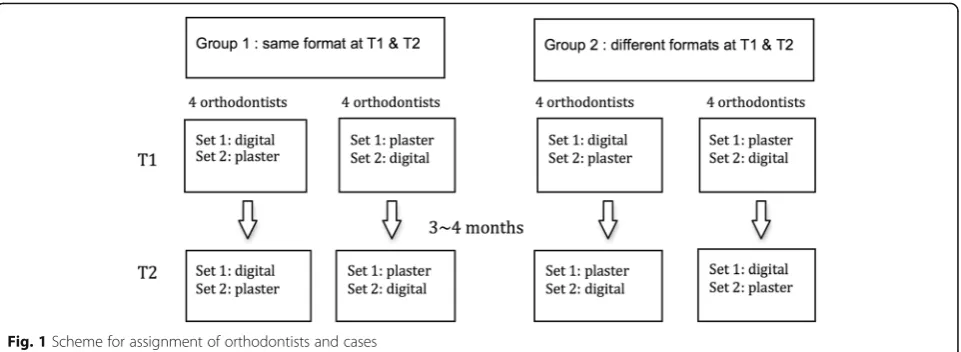
Orthodontists were divided into two groups based upon matching for gender and years in practice (as well as possible). The demographics of the two groups are shown in Table 1. One group was shown the same for-mat models at the two time points, and the second group was shown different format models at the two time points. The pre-determined assignment scheme (shown in Fig. 1) ensured that all combinations of treat-ment planning with either digital or plaster models were equally distributed over the two time points. This infor-mation was used to determine if the type of model used affected the decision regarding the use of Invisalign®.
Ten different case types were planned to be included in the study to represent the breadth of cases typically seen in practice, such as Class I with various degrees of crowding, Class II division 1, Class II division 2, Class III, and open bite. We purposely weighted the sample towards cases with at least moderate difficulty, as they would offer better ability to discriminate between aligner recommendations. A list of all patients started in 2012 at the UW Graduate Orthodontic Clinic patient population was reviewed to identify cases that matched the categor-ies planned to be included in the study. Ultimately two sets of ten cases each were selected based on matching
of age, gender, A-P, vertical, transverse, and amount of crowding. A summary of these cases is presented in Table2.
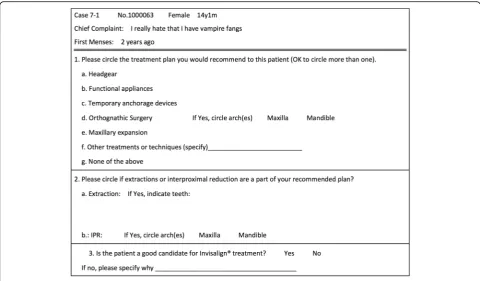
The records of these 20 cases were assembled and imported into Dolphin Imaging (Patterson Dental, Chatsworth, CA) to be accessed during the study, and included intra- and extra-oral photographs, as well as the panoramic and lateral cephalometric radiographs. The plaster models were scanned using the iTero HD 2.9 intra-oral scanner (Align Technology, San Jose, CA), and the digital casts were shown using OrthoCad soft-ware (Align Technology, San Jose, CA). All patient iden-tifiers were removed, and only study numbers were used during the evaluation by orthodontists. Subject’s eyes were blocked out in all facial photographs. A standard-ized form was used for treatment planning each patient (Fig.2).
At the initial treatment planning session, orthodontists were shown the intra- and extra-oral photos, panoramic radiographs, lateral cephalometric radiographs, and the study models in either digital or plaster format. After at least 3 months had passed the orthodontists were asked to treatment plan the same cases again, using either digital or plaster models based on the pre-assigned scheme (Fig.1).
Statistical analysis
A generalized estimating equations regression was utilized to determine if there was a difference in the recommenda-tion for Invisalign® treatment based upon the type of model (plaster versus digital) that was viewed. The permutation test was utilized to assess if there was a difference between the agreement rate of those who viewed the models twice with different formats and that of those who viewed the models twice with the same format. The level of signifi-cance was set atp< 0.05. Additionally, a logistic regression model with GEE was utilized to help explain why Invisa-lign® was not recommended as a treatment option.
Results
There was no significant difference between the percent-age recommending Invisalign® in the digital model group and that in the plaster model group at T1 (p= 0.59). In the digital model group, 75.6% of initial treatment plans at T1 did not recommend using Invisalign®, while this rate was 76.9% in the plaster group (Table3).
Additionally, there was no significant difference be-tween the agreement rate of those who viewed models twice with different formats and that of those who viewed models twice with the same format (p= 0.97). Thus, the percentages of cases that practitioners felt could be treated by Invisalign® did not appear to be in-fluenced by the manner (plaster versus digital) in which the models were presented (Table 4). Therefore, we
Table 1The demographic characteristics of the orthodontists
Group of practitioners
1 2
Same format of models Different formats of models Gender
Male 6 4
Female 2 4
Years in practice
Average 22.8 27.6
< 10 2 1
11~20 1 1
21~30 2 3
decided to pool the recommendations from all 16 asses-sors at the first assessment time point in order to assess reasons for not recommending aligners.
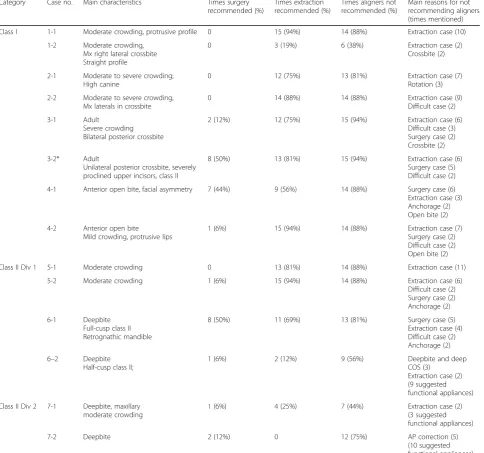
Table 5 reports the case characteristics, number and percentage of surgical plans, extraction plans, and Invi-salign® recommendations. The main reasons are also listed for each case. (The maximum number of recom-mendations for each parameter is 16.)
In the Class I category, it was evident that cases re-quiring extractions were not judged to be good candi-dates for Invisalign®. Two Class I open bite cases (recommended extractions by 56% and 91% of the judges, respectively) also were not judged to be good candidates for Invisalign®. Only one of the subjects in the Class I category was judged to be a reasonable candi-date for Invisalign® (case 1-2), and the percentage of the raters who recommended extraction for this patient was the lowest in this category (19%).
In the Class II division 1 category, extractions were in-cluded in the treatment plans of the majority for patients other than patient 6-2. This subject had minimal
crowding and only a half-cusp A-P discrepancy. Almost half of the practitioners felt this case could be treated with Invisalign®.
The two patients in the adolescent Class II division 2 category did not have high extraction rates. However, only one (case 7-1) had more than 50% of the orthodon-tists recommend Invisalign® as an option. This patient had moderate crowding in the upper arch and less growth potential, while case 7-2 had minimal crowding and more growth potential. Functional appliances were suggested for both of these patients, but more for case 7-2. The patient with more need for functional appli-ances seemed to have a lower rate of recommendations for Invisalign®. In the adult Class II division 2 category, the patient with less need for extractions had a higher rate of recommendations for Invisalign®.
Finally, in the Class III patients, it was shown that the patients with less severe A-P discrepancies had higher rates of recommendations for Invisalign®. The cases re-quiring surgery were not judged to be good candidates for Invisalign®.
Table 2Summary of patient characteristics
Pair Set 1 Set 2 Main condition
of interest
Case no. Age Gender Case no. Age Gender
Class I 1 1-1 15 years and 1 month F 1-2 16 years and 6 months F Crowding
2 2-1 14 years and 5 months M 2-2 14 years and 9 months M Crowding
3 3-1 21 years and 9 months M 3-2* 22 years and 11 months M Adult; posterior crossbite
4 4-41 13 years and 7 months M 4-2 14 years and 2 months M Anterior open bite
Class II div 1 5 5-1 13 years and 4 months F 5-2 13 years and 5 months F Crowding
6 6-1 13 years and 9 months F 6-2 12 years and 8 months F Deepbite
Class II div 2 7 7-1 14 years and 1 month F 7-2 12 years and 7 months F Adolescent; deepbite
8 8-1 30 years and 9 months F 8-2 28 years and 9 months F Adult
Class III 9 9-1 15 years and 5 months F 9-2 15 years and 1 month F Mild A-P discrepancy
10 10-1 16 years and 6 months F 10-2 16 years and 7 months F Severe A-P discrepancy
*This patient had a Class II posterior malocclusion
The results shown in Table6outline the reasons given for not recommending Invisalign® in the total treatment plans. The highest one was extraction plan (36%), and the second one was surgery (23%). Others were con-cerned about the severity of case, anchorage, and A-P correction.
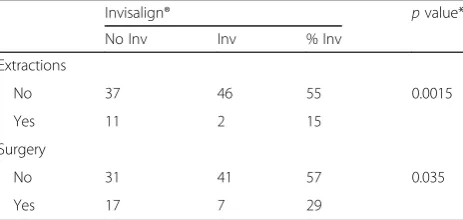
Among those cases which were fairly equal in the rec-ommendation for or against using aligners (cases 1-2, 6-2, 7-1, 8-1, 8-2, 9-2), there was a significant difference among extractions and surgery choices (Table 7). Cases with extractions had significantly fewer Invisalign® recom-mendations (15%) compared to cases with no extractions (55%) (p= 0.0015). Additionally, cases with surgery had significantly fewer Invisalign® recommendations (29%) compared to cases with no surgery (57%) (p= 0.035).
Discussion
This study was performed to assess what types of maloc-clusions orthodontists felt would be suitable for treat-ment with aligners, and also to determine if using digital versus plaster models would affect treatment plans. It
has been reported that digital models are an adequate replacement for plaster models with respect to treatment planning for fixed appliance therapy [13,14], but no one has assessed this for aligner therapy. In the present study, we did not find a difference in decisions regarding the use of aligners with plaster versus digital models. Good intra-rater agreement was observed when aligners were chosen as a treatment option with all combinations of digital or plaster models.
Table 5shows that the most common reasons for not recommending Invisalign® were extractions (36%), orthognathic surgery (23%), difficult tooth movements (12%), concerns about anchorage (10%), and A-P correc-tion (10%). This supports the finding of Phan and Ling’s publication in 2007 that stated the following conditions were contra-indicated for aligners: crowding and spacing over 5 mm, skeletal anterior-posterior discrepancies of more than 2 mm, centric-relation and centric-occlusion discrepancies, open bites, severely rotated teeth, extru-sion of teeth, severely tipped teeth, teeth with short clin-ical crowns, and arches with multiple missing teeth [1]. Table 7 also reveals that cases with extractions or
Table 3Percentage of decisions aligners not recommended at T1
Invisalign® recommendation Models Difference 95% confidence interval of difference
pvalue Digital Plaster
% of decisions not recommending 75.60% 76.90% 1.25% −3.30% 5.80% 0.59
surgery had fewer Invisalign® recommendations com-pared to cases with no extractions or surgery.
When treating crowded cases with extractions, it is critical to be aware of canine position, mesio-distal root tipping adjacent to the extraction sites during space closure, incisor torque, and rotation of teeth. In the
present study, it was shown that cases requiring extrac-tions were not judged to be good candidates for Invisa-lign®. In 2003, Bollen, et al. reported that only 29% of those with two or more premolars extracted were able to complete space closure with the initial series of aligners, and none completed the overall treatment [15].
Table 4Intra-rater agreement when viewing the case twice
Invisalign® recommendation Models Difference in agreement
95% confidence
interval of difference p value Different formats Same format
Same decision at T1 and T2 82% 81% 1% −21% 20% 0.97
Table 5Characteristics, treatment plans, and Invisalign® recommendations
Category Case no. Main characteristics Times surgery recommended (%)
Times extraction recommended (%)
Times aligners not recommended (%)
Main reasons for not recommending aligners (times mentioned) Class I 1-1 Moderate crowding, protrusive profile 0 15 (94%) 14 (88%) Extraction case (10)
1-2 Moderate crowding, Mx right lateral crossbite Straight profile
0 3 (19%) 6 (38%) Extraction case (2)
Crossbite (2)
2-1 Moderate to severe crowding; High canine
0 12 (75%) 13 (81%) Extraction case (7) Rotation (3) 2-2 Moderate to severe crowding,
Mx laterals in crossbite
0 14 (88%) 14 (88%) Extraction case (9) Difficult case (2) 3-1 Adult
Severe crowding Bilateral posterior crossbite
2 (12%) 12 (75%) 15 (94%) Extraction case (6) Difficult case (3) Surgery case (2) Crossbite (2)
3-2* Adult
Unilateral posterior crossbite, severely proclined upper incisors, class II
8 (50%) 13 (81%) 15 (94%) Extraction case (6) Surgery case (5) Difficult case (2) 4-1 Anterior open bite, facial asymmetry 7 (44%) 9 (56%) 14 (88%) Surgery case (6) Extraction case (3) Anchorage (2) Open bite (2) 4-2 Anterior open bite
Mild crowding, protrusive lips
1 (6%) 15 (94%) 14 (88%) Extraction case (7) Surgery case (2) Difficult case (2) Open bite (2) Class II Div 1 5-1 Moderate crowding 0 13 (81%) 14 (88%) Extraction case (11)
5-2 Moderate crowding 1 (6%) 15 (94%) 14 (88%) Extraction case (6) Difficult case (2) Surgery case (2) Anchorage (2) 6-1 Deepbite
Full-cusp class II Retrognathic mandible
8 (50%) 11 (69%) 13 (81%) Surgery case (5) Extraction case (4) Difficult case (2) Anchorage (2)
6–2 Deepbite Half-cusp class II;
1 (6%) 2 (12%) 9 (56%) Deepbite and deep COS (3)
Extraction case (2) (9 suggested functional appliances) Class II Div 2 7-1 Deepbite, maxillary
moderate crowding
1 (6%) 4 (25%) 7 (44%) Extraction case (2) (3 suggested functional appliances)
7-2 Deepbite 2 (12%) 0 12 (75%) AP correction (5)
In a prospective study, Kravitz, et al. reported maxillary and mandibular canines achieved only about one third of the predicted rotation in a prospective study [2]. However, in 2015, Li, et al. reported that Invisalign® ap-pliances were as successful as fixed apap-pliances in cor-recting Class I adult extraction cases by assessing the overall improvement in the ABO-OGS scores in a multi-center randomized controlled trial. OGS scores were similar for alignment, occlusal relations, interproximal contacts, and root angulation, but Invisalign® OGS scores were not as good as braces in reference to occlu-sal contacts and buccolingual inclination [4].
When treating Class II and Class III cases, surgery or camouflage decisions (with or without extractions) were based on the severity of the A-P discrepancy. In this study, it was shown that practitioners were reluctant to treat cases requiring surgery with Invisalign®. In surgical cases, fixed appliances are helpful for efficient dental
decompensation and inter-arch fixation during surgery. Although there are case reports of treatment with aligners for orthognathic surgery cases [16], many ortho-dontists feel that fixed appliances are more effective to control post-surgical tooth movement and inter-arch coordination.
Besides extraction and surgery, this study found that orthodontists were also concerned about anteroposterior correction. It has been reported that molar distalization in mild Class II malocclusions can be achieved with clear aligners [3,5,17]. Some authors have reported low suc-cess rates with Invisalign® for correcting large A-P dis-crepancies. In the official clinical guide of Invisalign® treatment [18], it is recommended that for Class II cases, the amount of A-P correction be limited to 2–4 mm. This correction is largely from dental, not skeletal, changes. For severe Class II malocclusions (4 mm+), Invisalign® recommends using sagittal correctors prior to starting aligner therapy. In the official clinical guide of Invisalign® treatment for Class III cases [19], the amount of Class III correction that can be achieved with aligners is under 2 mm. This amount of anteroposterior correc-tion can be achieved in several ways, including precision
Table 5Characteristics, treatment plans, and Invisalign® recommendations(Continued)
Category Case no. Main characteristics Times surgery recommended (%)
Times extraction recommended (%)
Times aligners not recommended (%)
Main reasons for not recommending aligners (times mentioned) 8-1 Adult
Deepbite
8 (50%) 3 (19%) 9 (56%) Surgery case (3) Extraction case (3) 8-2 Adult
Severe crowding
3 (19%) 13 (81%) 14 (88%) Extraction case (7) Surgery case (3) Difficult case (2) Anchorage (2)
Class III 9-1 Mild A-P discrepancy Asymmetry
12 (75%) 1 (6%) 9 (56%) Surgery case (6) AP correction (2)
9-2 Mild A-P discrepancy Asymmetry
2 (12%) 0 8 (50%) Severity (3)
AP correction (3)
10-1 Anterior crossbite, severe A-P discrepancy Asymmetry
10 (63%) 4 (25%) 15 (94%) Surgery case (7) Difficult case (4) Anchorage (2) 10-2 Anterior crossbite,
severe A-P discrepancy Asymmetry
13 (81%) 3 (19%) 15 (94%) Surgery case (10) Deepbite or deep COS (2)
*This patient had a Class II posterior malocclusion
Table 6The percentages of the reasons given for not recommending Invisalign®
Reasons to not recommend Invisalign® Percentage Deepbite, deep curve of Spee 3
A-P correction 8
Surgery case 23
Extraction case 36
7’s not erupted 1
Rotation correction 2
Difficult case 12
Crossbite 3
Anchorage, control of movement 10
Open bite 2
Total 100
Table 7Extraction, surgery, and Invisalign® choices
Invisalign® pvalue*
No Inv Inv % Inv
Extractions
No 37 46 55 0.0015
Yes 11 2 15
Surgery
No 31 41 57 0.035
Yes 17 7 29
cuts for elastics, sequential staging of tooth movements, optimized attachments, and incorporation of TADs. Likewise, large tooth movements may be challenging, as each aligner typically has less than 0.25 mm of pro-grammed tooth movement [2,3,5]. Teeth that need sig-nificant rotation or translation will require many aligners to accomplish these movements. Vertical and transverse problems may also be difficult to correct, as indicated by the low number of recommendations for aligners when patients displayed these characteristics.
According to a clinical study in 2009, the mean accuracy of tooth movement with Invisalign® was 41% [2]. During the past few years, Align Technology has launched new ma-terials, techniques, and software to expand the scope of tooth movement, the management of extractions, the ability to correct anteroposterior relationships, and the correction of vertical problems [20–22]. In 2011, Align Technology claimed that Invisalign® G4 attachments and SmartForce features provided greater root tip control for canines and central incisors, mesio-distal root uprighting, space closure, and improved optimized extrusion attachments for anterior open bites [20]. In 2013, Invisalign® G5 featured more pre-dictable deepbite correction by using new SmartForce at-tachments, precision bite ramps, pressure areas for the incisors and canines, and optimized premolar attachments for retention and extrusion to level the curve of Spee [21]. In 2014, Invisalign® G6 was engineered to improve clinical outcomes for orthodontic treatment of severe crowding and bimaxillary protrusion which require premolar extrac-tion and maximum anchorage [22]. The new SmartStage technology, SmartForce, optimized retraction attachments, and optimized anchorage attachments are designed to elim-inate unwanted tipping and anterior extrusion during re-traction, to improve bodily movement during canine retraction, and to maximize posterior anchorage [22].
In this study, approximately 70% of the orthodontists had been in practice for more than 20 years, and half of the orthodontists were routinely treating patients with aligners. Only 3 cases out of 20 cases (15%) had more than half of the practitioners recommend clear aligners. These cases tended to be the less severe malocclusions. While this percentage may seem low, including more challenging malocclusions allowed us to better investi-gate the reasons that aligners were not recommended.
Previous publications on the Invisalign® technique have mainly covered technical aspects or materials or have presented results from case reports or case series. Orthodontists often recommend aligner therapy to pa-tients based on their past experiences. In this study, most orthodontists avoided recommending aligners to patients requiring extractions, surgery, or difficult tooth movements. While Align Technology continues to release new materials, software, and features to broaden the scope of Invisalign® care, orthodontists may still be basing their
recommendations from their experience with earlier Invi-salign® materials and techniques. Thus, InviInvi-salign® may need to provide orthodontists with additional education and evidence in order to change their opinions regarding case selection.
Conclusions
In this study, viewing orthodontic records with digital versus plaster models did not influence decisions about Invisalign® recommendations. Additionally, our sample of orthodontists tended to not recommend Invisalign® to treat extraction cases, surgical cases, or difficult cases.
Abbreviations
GEE:Generalized estimating equations regression
Funding
We would like to thank Invisalign® for providing an intra-oral scanner for cre-ating the digital scans, and Align Technology for providing $5000 to assist with the cost of performing the study.
Availability of data and materials Please contact the author for data requests.
Authors’contributions
HCK contributed to the data analysis and interpretation, drafting of the article, and critical revision of the article. WL contributed to the conception and design of the work, data collection, and critical revision of the article. DH and ST contributed to the data collection and critical revision of the article. CS contributed to the data analysis and interpretation and critical revision of the article. GJH contributed to the conception and design of the work, data analysis and interpretation, drafting of the article, and critical revision of the article. All authors gave the final approval of the version to be published.
Ethics approval and consent to participate
This project was approved by the Human Subjects Division at the University of Washington.
Consent for publication Not applicable
Competing interests
The authors declare that they have no competing interests.
Publisher’s Note
Springer Nature remains neutral with regard to jurisdictional claims in published maps and institutional affiliations.
Author details
1Department of Orthodontics, School of Dentistry, University of Washington,
1959 NE Pacific ST, Health Sciences Center, D-569, Box 357446, Seattle, WA 98195-7446, USA.2Department of Biostatistics, School of Public Health,
University of Washington, Seattle, USA.
Received: 15 May 2018 Accepted: 12 June 2018
References
1. Phan X, Ling PH. Clinical limitations of Invisalign. J Can Dent Assoc. 2007 Apr;73(3):263–6.
2. Kravitz ND, Kusnoto B, BeGole E, Obrez A, Agran B. How well does Invisalign work? A prospective clinical study evaluating the efficacy of tooth movement with Invisalign. Am J Orthod Dentofac Orthop. 2009;135:27–35. 3. Rossini G, Parrini S, Castroflorio T, Deregibus A, Debernardi CL. Efficacy of
4. Li W, Wang S, Zhang Y. The effectiveness of the Invisalign appliance in extraction cases using the the ABO model grading system: a multicenter randomized controlled trial. Int J Clin Exp Med. 2015;8(5):8276–82. 5. Simon M, Keilig L, Schwarze J, Jung BA, Bourauel C. Treatment outcome
and efficacy of an aligner technique—regarding incisor torque, premolar derotation and molar distalization. BMC Oral Health. 2014;14:68.https://doi. org/10.1186/1472-6831-14-68.
6. Han UK, Vig KW, Weintraub JA, Vig PS, Kowalski CJ. Consistency of orthodontic treatment decisions relative to diagnostic records. Am J Orthod Dentofac Orthop. 1991;100(3):212–9.
7. Nijkamp PG, Habets LL, Aartman IH, Zentner A. The influence of cephalometrics on orthodontic treatment planning. Eur J Orthod. 2008; 30(6):630–5.
8. Hayashi K, Sachdeva AU, Saitoh S, Lee SP, Kubota T, Mizoguchi I. Assessment of the accuracy and reliability of new 3-dimensional scanning devices. Am J Orthod Dentofac Orthop. 2013;144(4):619–25.
9. Sousa MV, Vasconcelos EC, Janson G, Garib D, Pinzan A. Accuracy and reproducibility of 3-dimensional digital model measurements. Am J Orthod Dentofac Orthop. 2012;142(2):269–73.
10. Costalos PA, Sarraf K, Cangialosi TJ, Efstratiadis S. Evaluation of the accuracy of digital model analysis for the American Board of Orthodontics objective grading system for dental casts. Am J Orthod Dentofac Orthop. 2005;128(5):624–9. 11. Leifert MF, Leifert MM, Efstratiadis SS, Cangialosi TJ. Comparison of space
analysis evaluations with digital models and plaster dental casts. Am J Orthod Dentofac Orthop. 2009;136(1):16.e1–4. discussion 16
12. Santoro M, Galkin S, Teredesai M, Nicolay OF, Cangialosi TJ. Comparison of measurements made on digital and plaster models. Am J Orthod Dentofac Orthop. 2003;124:101–5.
13. Rheude B, Sadowsky PL, Ferriera A, Jacobson A. An evaluation of the use of digital study models in orthodontic diagnosis and treatment planning. Angle Orthod. 2005;75(3):300–4.
14. Whetten JL, Williamson PC, Heo G, Varnhagen C, Major PW. Variations in orthodontic treatment planning decisions of Class II patients between virtual 3-dimensional models and traditional plaster study models. Am J Orthod Dentofac Orthop. 2006;130(4):485–91.
15. Bollen AM, Huang G, King G, Hujoel P, Ma T. Activation time and material stiffness of sequential removable orthodontic appliance. Part 1: ability to complete treatment. Am J Orthod Dentofac Orthop. 2003;124(5):496–501. 16. Renato Pagani, Fabrizio Signorino, Pier Paolo Poli, Pietro Manzini, Irene
Panisi. The use of Invisalign® system in the management of the orthodontic treatment before and after Class III surgical approach. Case reports in dentistry volume 2016 (2016), Article ID 9231219, 10 pages.
17. Ravera S, Castroflorio T, Garino F, Daher S, Cugliari G, Deregibus A. Maxillary molar distalization with aligners in adult patients: a multicenter
retrospective study. Prog Orthod. 2016;17(12)https://doi.org/10.1186/ s40510-016-0126-0. Epub 2016 Apr 18
18. Clinical considerations for class II treatments. [Document on the internet] Align Technology; 2013. Available fromhttps://learn.invisalign.com/classII. Accessed 26 June 2018.
19. Clinical considerations for class III treatments. [Document on the internet] Align Technology; 2013. Available fromhttps://learn.invisalign.com/classIII. Accessed 26 June 2018.
20. Align Techonology. Align Technology introduces Invisalign G4. San Jose: Align Techonology; 2011. Available fromhttp://investor.aligntech.com/index. php/news-releases/news-release-details/align-technology-introduces-invisalign-g4. Cited 11 Oct 2011.
21. Align Techonology. Align Techonology announces Invisalign G5 innovations for treatment of deep bite. San Jose: Align Techonology; 2013. Available from http://investor.aligntech.com/index.php/news-releases/news-release-details/align-technology-announces-invisalign-g5-innovations-treatment. Cited 3 Dec 2013.