R E S E A R C H A R T I C L E
Open Access
Contribution of Arab countries to breast cancer
research: comparison with non-Arab Middle
Eastern countries
Waleed M Sweileh
1*, Sa
’
ed H Zyoud
2, Samah W Al-Jabi
2and Ansam F Sawalha
1Abstract
Background:Breast cancer is one of the most common types of cancers affecting women worldwide. The main
objective of this study was to assess and compare research activity in breast cancer in Arab countries with non-Arab Middle Eastern countries.
Methods:Publications about“breast cancer”as a research topic were retrieved using the ISI Web of Science database. Analysis was confined to original research and review articles. Research productivity was assessed by assessing number of publications and time trend of these publications, names of journals, citation analysis, top 10 active institutions as well as country contribution to breast cancer research. The quantity and quality of publications from Arab countries in addition to 3 other Middle East countries (Turkey, Iran and Israel) were assessed and compared using theh-index tool.
Results:A total of 1658 original research and review articles about“breast cancer”were published from Arab countries. Annual research productivity from Arab countries in the field of“breast cancer”was negligible but showed a significant increase in the last decade. Retrieved documents had relatively high citation parameters as measured by h-index of 61 and average citations of 17.46 per document. The highest research productivity was from Egypt with a total publication of 582 (35.10%). Cairo University with a total of 149 (8.99%) publications had the highest research productivity among institutions in Arab world. Forty four documents (2.65%) of breast cancer documents were published inSaudi Medical Journal.Arab researchers collaborated mostly with researchers from the United States of America (305; 18.40%) in breast cancer research. Compared with other non-Arab Middle Eastern countries, Arab countries had higher research productivity than some countries and lower than others, particularly Israel.
Conclusions:The present data reveals a good contribution of some Arab countries to the field of“breast cancer” research. There is a gap between Arab countries and Israel in the quality of breast cancer research.
Keywords:Bibliometric, Breast cancer, Arab world, Middle Eastern Region, ISI Web of Science
Background
Breast cancer is one of the most common types of can-cers among women in the Arab world [1]. Research in general and in breast cancer in particular is important for each country in order to understand the cultural and genetic differences among different people in different geographical areas. Therefore, assessing research about breast cancer from Arab countries has an important impact on the future policies in the fight against such an
emotionally disturbing type of cancer. In addition, no doubt that high research activity in breast cancer can reflect positively on screening programs, awareness, epidemiological data and clinical practice. Assessing re-search activity in any subject in any geographical region is not an easy task given the diversity of academic data-bases and indexing methods of such datadata-bases. One of the most commonly utilized methods to assess research activity is known as bibliometric methods which have been applied to various medical subjects in different countries [2-8]. No doubt that the Arab world have wit-nessed great progress in the past few decades in medical education and medical practice including establishing
* Correspondence:[email protected] 1
Department of Pharmacology and Toxicology, College of Medicine and Health Sciences, An-Najah National University, Nablus, Palestine Full list of author information is available at the end of the article
high standards private hospitals and private medical col-leges. Furthermore, many governments in the Arab world, particularly in the Arab Gulf, have financially en-dorsed the development of medical research and practice to serve the general public health of their people. The Arab world has an overall population of around 380 mil-lion and extends over a large geographical area in north-ern Africa and Middle East. Our research group have previously published several bibliometric studies in dif-ferent medical disciplines like osteoporosis, diabetes, toxicology and others [9-11]. In this study, our research group is trying to shed light on a very important health topic pertaining to women’s health and public health as well which is breast cancer research activity in Arab countries. The objective of this study was to assess pub-lication trend in Arab countries in breast cancer and compare it with non-Arab Middle Eastern countries. Such study will give an insight into research activity and will encourage those in the field of breast cancer.
Methods
The methodology as well as the tool used in this study were discussed in previous publications by the same group [11,12]. The tool used was ISI Web of Science (WoS) [13]. The method used in this study is similar to the method used by the authors in their previous publi-cations [11,14,15]. For the purpose of this study, WoS is preferred over PubMed because PubMed does not allow for citation analysis. Similarly, WoS is preferred over Scopus because WoS includes the most influential and prestigious journals in all medical fields. All Arab coun-tries were used as country keys followed by “breast can-cer”phrase as a topic. We focused on the phrase“breast cancer” as search topic (TS) and excluded any other as-sociated phrases like “mammary ducts” because we are interested in breast cancer per se rather than associated cancers. Because the WoS database does not recognize Palestine as an independent state yet, search for breast cancer documents from Palestine was carried out using separate search keys. The results from 21 Arab countries and those from Palestine were combined and the result-ant data were analyzed. Only original research articles and review articles were included in the analysis. Fur-thermore, analysis was made up to year 2012 while 2013 and 2014 years were excluded because they are still open for new journal issues. The standard competition ranking (SCR) was used to present the top 10 ranking data while journal’s impact factors (IF) were evaluated using the Journal Citation Report (JCR; Web of Science) 2013 sci-ence edition by Thomson Reuters (New York, NY, USA).
Results
The total number of worldwide publications in breast can-cer retrieved from Arab countries was 1658 publications
while worldwide number was 206,710. Therefore, “breast cancer” research output from Arab countries represents 0.8% of the global research productivity in“breast cancer”. The first article about breast cancer co-authored by an Arab researcher was published in 1977 inCancer Journal and the title of the article was:“Clinical and prognostic fea-tures of a rapidly progressing breast-cancer in Tunisia”.
The annual number of publications from Arab coun-tries indicated that “breast cancer” research output remained low until mid-1990s and showed a significant increase in the last three years. Approximately 50% of breast cancer documents from Arab countries were pub-lished in 2010, 2011 and 2012. Figure 1 shows the an-nual growth of breast cancer research documents from Arab countries. When retrieved data were analyzed by country, Egypt (582; 35.10%) had the highest re-search output followed by Kingdom of Saudi Arabia (372; 22.44%) and Tunisia (172; 10.37%). No data related to breast cancer was found from Somalia, Djibouti, Mauritania and Comoros (Table 1). The language of most breast cancer documents published from Arab countries was English (1589; 95.84%) while the remaining docu-ments were published in French language (69; 4.16%). One hundred and ninety three (11.64%) documents were open access while the remaining (88.36%) were not open access. Countries whose researchers collaborated most in breast cancer research with investigators in the Arab world include the United States of America (USA); (305; 18.40%) followed by France (139; 8.38%) and England (132; 7.96%).
The total number of citations for breast cancer docu-ments from the Arab world, at the time of data analysis, was 28,953 with an average citation of 17.46 per document. Of the 1658 documents considered for the h-index, 61 had been cited at least 61 times at the time of data analysis. When stratified by country, theh index was highest for breast cancer documents published from Egypt (h-index = 43) followed by those published from KSA (h-index =31) and Tunisia (h-index =26). Of the 1658 breast cancer documents published from Arab countries, there were 660 (39.81%) documents in the oncology research area, 185 (11.16%) in the pharmacology/ pharmacy research areas, and 128 (7.72%) documents in Biochemistry/Molecular Biology. Other research areas found in published documents from the Arab countries are shown in Table 2.
shows the top 10 most productive Arabic institutions in breast cancer. The most productive institution was Cairo University (149; 8.99%) followed by King Saud University (117; 7.06%). Eight institutions in the top 10 list are academic institutions affiliated with teaching hospitals that have oncology departments.
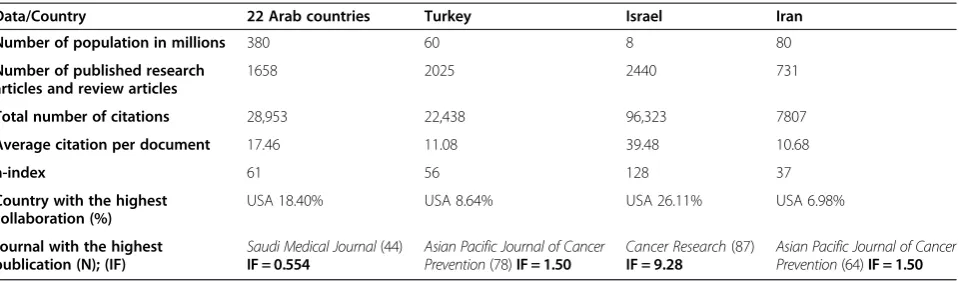
Compared with other non-Arab countries in the Middle East, the research productivity from the Arab countries was lesser than that from Israel and Turkey but higher than that from Iran (Figure 1). Thehindex of breast cancer documents published from Arab countries was higher than that of Turkey and Iran but was much lower than that from Israel. The journal with the highest number of breast cancer documents published from Arab countries was Saudi Medical Journal (IF of 0.55); that from Turkey and Iran was Asian Pacific Journal of Cancer Prevention(IF = 1.50), while that from Israel was Journal of Cancer Research(IF = 9.28); (Table 5). The an-nual growth of breast cancer research output from Arab countries, Israel, Turkey and Iran is shown in Figure 1. Breast cancer research in Israel started as early as 1973 and showed a continuous momentum since then. How-ever, breast cancer research in Arab countries, Turkey and Iran started breast cancer research after 1977 and showed great fluctuations up until mid-1990s. Regarding research interests, biochemistry/ genetics and cell biol-ogy constituted approximately 25% of breast cancer
documents from Israel but less than 10% in Arab coun-tries or Turkey or Iran. Finally, it should be noted that of the documents published from Israel, there were 16 documents about breast cancer in Israeli Arab women, either in comparison with Jewish women or being inves-tigated as a separate cultural group.
Discussion
In this study, we assessed the research activity about breast cancer from Arab countries. We used the ISI web of science database as a method to assess research activ-ity. Up to the author’s best knowledge, this is the first bibliometric study to assess breast cancer research activ-ity from Arab world. Bibliometric studies that assessed global breast cancer research productivity has been pre-viously published but with no detailed emphasis on Arab region [16,17].
the analysis since these journals are not listed in the WoS. Therefore, the result obtained might be lesser than the actual research activity in Arab countries. Despite that, our study reflects a close approximation of breast cancer research activity in the Arab world and that is present in international and reputable journals. The ISI of Web of Science gives a powerful and attractive cit-ation analysis for bibliometric studies. Furthermore, the ISI Web of Science database reflects publications in journals which have scientific and international impact as well as large audience and readers in the field of breast cancer.
Table 1 Contribution of each Arab country to the 1658 breast cancer published documents
Country Number of documents
N (%) = 1658 (100%)* h
index
Egypt 582 (35.10) 43
Kingdom of Saudi Arabia 372 (22.44) 31
Tunisia 172 (10.37) 26
Kuwait 121 (7.30) 21
Lebanon 120 (7.24) 23
United Arab Emirates 89 (5.37) 22
Jordan 79 (4.76) 18
Morocco 73 (4.40) 15
Qatar 32 (1.93) 11
Algeria 27 (1.63) 9
Sudan 21 (1.28) 6
Iraq 21 (1.28) 7
Libya 20 (1.21) 6
Syria 18 (1.09) 8
Yemen 17 (1.03) 7
Oman 13 (0.78) 7
Palestine 10 (0.52) 6
Bahrain 7 (0.42) 3
Somalia 0 (0.0) 0
Comoros 0 (0.0) 0
Djibouti 0 (0.0) 0
Mauritania 0 (0.0) 0
*total exceeds 100% because of overlap in some documents among more than one Arab country.
Table 2 Research areas of the 1658 breast cancer documents published from the 22 Arab countries
SCRa Research area Number (%)
N = 1658 (100%)
1st Oncology 660 (39.81)
2nd Pharmacology Pharmacy 185 (11.16)
3rd Biochemistry Molecular Biology 128 (7.72)
4th Pathology 103 (6.21)
5th General Internal Medicine 101 (6.09)
6th Chemistry 94 (5.67)
6th Obstetrics Gynecology 94 (5.67)
8th Cell Biology 89 (5.37)
9th Radiology Nuclear Medicine Medical Imaging 74 (5.49)
10th Surgery 54 (3.26)
Abbreviation:SCR = Standard Competition Ranking. a
Equal research areas have the same ranking number, and then a gap is left in the ranking numbers.
Table 3 Top 10 journals in which breast cancer documents from the 22 Arab countries were published
SCRa Journal Number (%)
N = 1456 IFb
1st Saudi Medical Journal 44 (2.65) 0.554
2nd Asian Pacific Journal of Cancer Prevention 41 (2.47) 1.50
2nd Breast Cancer Research and Treatment 41 (2.47) 4.19
4th Anticancer Research 38 (2.29) 1.872
5th Breast 25 (1.51) 2.581
6th European Journal of Medicinal Chemistry 24 (1.45) 3.432
6th Medical Oncology 24 (1.45) 2.058
9th Life Science Journal Acta Zhengzhou University Overseas Edition
22 (1.33) 0.165
10th Cancer 20 (1.21) 4.901
10th International Journal of Cancer 20 (1.21) 5.007
Abbreviations:SCR = Standard Competition Ranking; NA = not available; IF = impact factor.
a
Equal journals have the same ranking number, and then a gap is left in the ranking numbers.
b
The impact factor was reported according to Institute for Scientific Information (ISI) journal citation reports (JCR) 2012.
Table 4 Top 10 active institutions in breast cancer research in Arab countries
SCR Institution Number (%)
N = 1658
Country
1st Cairo University 149 (8.99) Egypt
2nd King Saud University 117 (7.06) KSA
3rd King Faisal Specialist Hospital Research Center
115 (6.94) KSA
4th Kuwait University 104 (6.27) Kuwait
5th American University of Beirut 83 (5.01) Lebanon
6th Alexandria University 56 (3.38) Egypt
7th Mansoura University 53 (3.20) Egypt
8th Ain Shams University 47 (2.84) Egypt
9th Assiut University 46 (2.97) Egypt
10th National Research Center 45 (2.71) Egypt
Breast cancer is one of the most emotionally devastat-ing types of cancers for women all over the world. One of the best methods to combat breast cancer and im-prove the quality of life of women in Arab world is to do breast cancer screening surveys. Unfortunately, it has been reported that breast cancer screening participation rates are low among women in the Arab world [18]. Ef-forts to combat breast cancer at the global and regional levels should be collective and all those in field need to contribute in this fight against breast cancer at all levels. Research is an important aspect and contribution that can help in combating breast cancer globally and at the regional level. The importance of regional research about breast cancer stems from the fact that cultural and genetic variations might affect breast cancer dis-ease profile among women in different regions and countries.
Our results showed that breast cancer research was neglected in most Arab countries during the 1970s and 1980s. Despite the valuable contribution of Arabs to medicine throughout history [19], reports indicated that medical research activity in Arab world is still lagging behind compared to non-Arab countries in the region like Israel, Turkey or Iran [9,20-24]. Until the time of writing this manuscript, breast cancer research activity is considered low in many Arab countries including those with good economy like Bahrain. On the other hand, breast cancer research in Egypt and KSA showed a steep rise in the past decade. Actually, some of the research activity in Egypt and KSA was governmentally funded suggesting a national policy to promote cancer research as one preventive strategy to combat this devastating type of cancer. Our findings regarding research activity from Egypt and KSA might not be surprising given that previous research indicated that Egypt and KSA have high biomedical research output [24,25]. Low research activity in some Arab countries is a multi-faceted prob-lem that could be attributed at least in part to, inadequate research infra- structure in many cancer institutions in
these countries, the modest governmental and non-governmental funding, in addition to a poor cooper-ation between industry and academia. Governments in the Arab world need to consider these factors if they wish to improve the status of their scientific re-search [24,26-28].
Our study indicated that the average citation per breast cancer document from Arab world was 17.46. This is relatively a high number and suggests that there is a growing interest in breast cancer from the Arab world and that competition in this field is growing as well. Highly cited articles positively contribute to the h-index of the individual author and to the institution and country [29-32]. The citation is a key indicator of research quality [33]. The h-index simultaneously meas-ure the quality and quantity of scientific output. How-ever, h-index measured using different databases can give different values and therefore each database has pros and cons when measuring the h-index [34-36]. Crit-icisms have also been addressed to the use ofh-index as a marker of publication quality and citation. For example, the h-index does not consider the context of citations, the number of authors in the document, and gives equal values for book citation and research citation. Therefore, the h-index has lesser predictive accuracy and preci-sion than mean citations per paper, although this is controversial [37,38].
In our study, the h-index of breast cancer docu-ments published from Israel was higher than that for breast cancer documents published from Arab coun-tries or Iran or Turkey. One possible reason for this is the impact factor of journals in which Israeli re-searchers publish their breast cancer research. Israeli researchers with high quality research tend to publish their research in high impact factor journals like Cancer Research Journal.Such publications in high impact jour-nals might have increased the citations for Israeli publi-cations in the field of breast cancer [39,40]. When submitting a manuscript for publications, authors are
Table 5 Breast cancer research output from Arab countries compared with that from Turkey, Israel, and Iran
Data/Country 22 Arab countries Turkey Israel Iran
Number of population in millions 380 60 8 80
Number of published research articles and review articles
1658 2025 2440 731
Total number of citations 28,953 22,438 96,323 7807
Average citation per document 17.46 11.08 39.48 10.68
h-index 61 56 128 37
Country with the highest collaboration (%)
USA 18.40% USA 8.64% USA 26.11% USA 6.98%
Journal with the highest publication (N); (IF)
Saudi Medical Journal(44)
IF = 0.554
Asian Pacific Journal of Cancer Prevention(78)IF = 1.50
Cancer Research(87)
IF = 9.28
usually inclined to submit to journals that are publi-cation free, follow open access policy, preferably have a high impact factor, and above all have a short edi-torial and revision time [41,42]. Researchers from Arab world have preferred publishing breast cancer research in Saudi medical Journal. This medical jour-nal poses no publication fee and represents an open forum for medical research discussions in the Arab world.
Our results showed that authors from Arab and non-Arab countries like Israel, Turkey and Iran collaborated mainly with authors from the USA in breast cancer re-search. International collaboration is beveled to increase the quantity and quality of research activity [43-45]. Breast cancer research in Israel was evidently better than that from Arab countries in quantitative and qualitative terms. One possible reason for this is the intensive collaboration between Israeli and the USA researchers in the field of breast cancer. One explanation for this inten-sive collaboration between Israeli and the USA re-searchers is the fact that the status of cancer research in Israel is parallel to that in the USA. Collaboration in re-search activity can increase the visibility, quantity and quality of research output from any particular country or institution [46-50].
Our study has points of strength and points of weak-nesses. This is the first study in the Arab world to inves-tigate and assess breast cancer research activity. The study showed that only few Arab countries, particularly Egypt and KSA had good research output in breast can-cer while other Arab countries had limited research activity in this field. Of course, this study does not mean to negatively criticize research activity in any particular country, rather it meant to draw attention and encour-age researchers in this field. Finally, it should be men-tioned that our study has few limitations which are the same as those of previously published bibliometric studies [51-53].
Conclusion
The present data reveals a good late momentum for breast cancer research activity from the Arab world. However, the quantity and quality of breast cancer re-search was low for some Arab countries. Governmental funding and survey programs are important to increase the volume of data available for research in Arab coun-tries. No doubt that researchers in Arab countries need to invest more in the molecular biology and genetics of breast cancer among Arab in order to bridge the gap in this field of research with Israeli researchers. Higher education institutions and research centers in Arab countries should build new bridges of collaboration with their international counterparts to promote breast can-cer research in Arab countries.
Abbreviations
ISI:Institute for Scientific Information; KSA: Kingdom of Saudi Arabia; USA: United States of America; JCR: Journal Citation Report; SCR: Standard Competition Ranking; IFs: Impact factors; WoS: Web of Science.
Competing interests
The authors declare that they have no competing interests.
Authors’contributions
WS led study design, data collection, statistical analysis and drafting of manuscript; SZ made part of the statistical analysis and wrote part of the article; SA and AS revised the article for important intellectual content. All authors read and approved the final manuscript and agreed on its submission.
Acknowledgement
The authors would like to express many thanks and gratitude to An-Najah University for help in conducting this study.
Author details
1Department of Pharmacology and Toxicology, College of Medicine and
Health Sciences, An-Najah National University, Nablus, Palestine.2Department
of Clinical and Community Pharmacy, College of Medicine and Health Sciences, An-Najah National University, Nablus, Palestine.
Received: 21 March 2014 Accepted: 4 March 2015
References
1. Salim EI, Moore MA, Al-Lawati JA, Al-Sayyad J, Bazawir A, Bener A, et al. Cancer epidemiology and control in the arab world - past, present and future. Asian Pac J Cancer Prev. 2009;10(1):3–16.
2. Wallin JA. Bibliometric methods: pitfalls and possibilities. Basic Clin Pharmacol Toxicol. 2005;97(5):261–75.
3. Bramness JG, Henriksen B, Person O, Mann K. A Bibliometric Analysis of European versus USA Research in the Field of Addiction. Research on Alcohol, Narcotics, Prescription Drug Abuse, Tobacco and Steroids 2001–2011. Eur Addict Res. 2014;20(1):16–22.
4. Hofman K, Ryce A, Prudhomme W, Kotzin S. Reporting of non-communicable disease research in low- and middle-income countries: a pilot bibliometric analysis. J Med Libr Assoc. 2006;94(4):415–20.
5. Huber JT, Gullion JS. Complementary and alternative medicine as represented in the HIV/AIDS body of knowledge: a bibliometric analysis. Med Ref Serv Q. 2003;22(3):23–32.
6. Rashidi A, Rahimi B, Delirrad M. Bibliometric analysis of parasitological research in iran and Turkey: a comparative study. Iran J Parasitol. 2013;8(2):313–22.
7. Zyoud SH, Al-Jabi SW, Sweileh WM, Awang R. Assessing the scientific research productivity of a leading toxicology journal: A case study of Human & Experimental Toxicology from 2003 to 2012. SAGE Open Med. 2014;2:2050312114523424.
8. Zyoud SH, Al-Jabi SW, Sweileh WM. Worldwide research productivity of paracetamol (acetaminophen) poisoning: a bibliometric analysis (2003–2012). Hum Exp Toxicol. 2014;34(1):12–23.
9. Zyoud SH, Al-Jabi SW, Sweileh WM, Awang R. A bibliometric analysis of toxicology research productivity in Middle Eastern Arab countries during a 10-year period (2003–2012). Health Res Policy Syst. 2014;12(1):4. 10. Sweileh WM, Al-Jabi SW, Zyoud SH, Sawalha AF, Ghanim MA. Osteoporosis
is a neglected health priority in Arab World: a comparative bibliometric analysis. Springer Plus. 2014;3(1):427.
11. Sweileh WM, Zyoud SH, Al-Jabi SW, Sawalha AF. Assessing urology and nephrology research activity in Arab countries using ISI web of science bibliometric database. BMC Res Notes. 2014;7(1):258.
12. Sweileh WM, Zyoud SH, Al-Jabi SW, Sawalha AF. Bibliometric analysis of diabetes mellitus research output from Middle Eastern Arab countries during the period (1996–2012). Scientometrics. 2014;101(1):819–32.
13. Thomson Reuters. Web of Knowledge. 2013 [cited 2013 December 11]; Available from: http://wokinfo.com/media/pdf/SSR1103443WoK5-2_web3.pdf 14. Sweileh WM, Al-Jabi SW, Sawalha AF, Zyoud SH. Bibliometric analysis of
15. Sweileh WM, Zyoud SH, Al-Jabi SW, Sawalha AF. Substance use disorders in Arab countries: research activity and bibliometric analysis. Subst Abuse Treat Prev Policy. 2014;9:33.
16. Perez-Santos JL, Anaya-Ruiz M. Mexican breast cancer research output, 2003–2012. Asian Pac J Cancer Prev. 2013;14(10):5921–3.
17. Glynn RW, Scutaru C, Kerin MJ, Sweeney KJ. Breast cancer research output, 1945–2008: a bibliometric and density-equalizing analysis. Breast Cancer Res. 2010;12(6):R108.
18. Donnelly TT, Khater AH, Al-Bader SB, Al Kuwari MG, Al-Meer N, Malik M, et al. Arab women’s breast cancer screening practices: a literature review. Asian Pac J Cancer Prev. 2013;14(8):4519–28.
19. Abdel-Halim RE. Contributions of Ibn Al-Nafis (1210–1288 AD) to the progress of medicine and urology. A study and translations from his medical works. Saudi Med J. 2008;29(1):13–22.
20. Al-Khader AA. Enhancing research productivity in the Arab world. Saudi Med J. 2004;25(10):1323–7.
21. Benamer HT, Bredan A, Bakoush O. Scientific publication productivity of Libyan medical schools: a bibliometric study of papers listed in PubMed, 1988–2007. Educ Health (Abingdon). 2009;22(2):310.
22. Bissar-Tadmouri N, Tadmouri GO. Bibliometric analyses of biomedical research outputs in Lebanon and the United Arab Emirates (1988–2007). Saudi Med J. 2009;30(1):130–9.
23. Farhat T, Abdul-Sater Z, Obeid M, Arabi M, Diab K, Masri S, et al. Research in congenital heart disease: a comparative bibliometric analysis between developing and developed countries. Pediatr Cardiol. 2013;34(2):375–82.
24. Benamer HT, Bakoush O. Arab nations lagging behind other Middle Eastern countries in biomedical research: a comparative study. BMC Med Res Methodol. 2009;9:26.
25. Shaban SF, Abu-Zidan FM. A quantitative analysis of medical publications from Arab countries. Saudi Med J. 2003;24(3):294–6.
26. Bredan A, Benamer H, Bakoush O. Visibility of Arab countries in the world biomedical literature. Libyan J Med. 2011;6:6325.
27. Tadmouri GO, Bissar-Tadmouri N. Biomedical publications in an unstable region: the Arab world, 1988–2002. Lancet. 2003;362(9397):1766. 28. El-Azami-El-Idrissi M, Lakhdar-Idrissi M, Ouldim K, Bono W, Amarti-Riffi A,
Hida M, et al. Improving medical research in the Arab world. Lancet. 2013;382(9910):2066–7.
29. Plomp R. The highly cited papers of professors as an indicator of a research group’s scientific performance. Scientometrics. 1994;29(3):377–93. 30. Aksnes DW, Sivertsen G. The effect of highly cited papers on national
citation indicators. Scientometrics. 2004;59(2):213–24.
31. Aksnes DW. Citation rates and perceptions of scientific contribution. J Am Soc Inf Sci Technol. 2006;57(2):169–85.
32. Fowler JH, Aksnes DW. Does self-citation pay? Scientometrics. 2007;72(3):427–37.
33. Vinkler P. Eminence of scientists in the light of the h-index and other scientometric indicators. J Inform Sci. 2007;33(4):481–91.
34. Jacsó P. The pros and cons of computing the h-index using Web of Science. Online Inf Rev. 2008;32(5):673–88.
35. Jacsó P. The pros and cons of computing the h-index using Scopus. Online Inf Rev. 2008;32(4):524–35.
36. Jacsó P. The pros and cons of computing the h-index using Google Scholar. Online Inf Rev. 2008;32(3):437–52.
37. Lehmann S, Jackson AD, Lautrup BE. Measures for measures. Nature. 2006;444(7122):1003–4.
38. Hirsch JE. Does the h index have predictive power? Proc Natl Acad Sci U S A. 2007;104(49):19193–8.
39. Garfield E. The history and meaning of the journal impact factor. JAMA. 2006;295(1):90–3.
40. Garfield E. The meaning of the impact factor. Int J Clin Health Psychol. 2003;3(2):363–9.
41. Søreide K, Winter DC. Global survey of factors influencing choice of surgical journal for manuscript submission. Surgery. 2009;147(4):475–80.
42. Schroter S. Importance of free access to research articles on decision to submit to the BMJ: survey of authors. BMJ. 2006;332(7538):394–6. 43. Lee S, Bozeman B. The impact of research collaboration on scientific
productivity. Social Studies Sci. 2005;35(5):673–702.
44. Abramo G, D’Angelo CA, Di Costa F. Research collaboration and productivity: is there correlation? High Educ. 2009;57(2):155–71.
45. Sweileh WM, Zyoud SH, Al-Jabi SA, Sawalha AF. Quantity and quality of obesity-related research in Arab countries: assessment and comparative analysis. Health Res Policy Syst. 2014;12(1):33.
46. Bordons M, Gomez I, Fernandez MT, Zulueta MA, Mendez A. Local, domestic and international scientific collaboration in biomedical research. Scientometrics. 1996;37(2):279–95.
47. Bozeman B, Corley E. Scientists’collaboration strategies: implications for scientific and technical human capital. Res Policy. 2004;33(4):599–616. 48. Wagner CS. Six case studies of international collaboration in science.
Scientometrics. 2005;62(1):3–26.
49. He Z-L, Geng X-S, Campbell-Hunt C. Research collaboration and research output: A longitudinal study of 65 biomedical scientists in a New Zealand university. Res Policy. 2009;38(2):306–17.
50. Basu A, Kumar BSV. International collaboration in Indian scientific papers. Scientometrics. 2000;48(3):381–402.
51. Li XQ, Tao KM, Zhou QH, Ling CQ. Scientific publications from mainland China, Taiwan, and Hong Kong in integrative and complementary medicine journals: a ten-year literature survey. Am J Chin Med. 2011;39(4):639–49. 52. Sweileh WM, Zyoud SH, Sawalha AF, Abu-Taha A, Hussein A, Al-Jabi SW.
Medical and biomedical research productivity from Palestine, 2002–2011. BMC Res Notes. 2013;6:41.
53. Zyoud SH, Al-Jabi SW, Sweileh WM, Awang R. A bibliometric analysis of research productivity of Malaysian publications in leading toxicology journals during a 10-year period (2003–2012). Hum Exp Toxicol. 2013;33(12):1284–93.
Submit your next manuscript to BioMed Central and take full advantage of:
• Convenient online submission
• Thorough peer review
• No space constraints or color figure charges
• Immediate publication on acceptance
• Inclusion in PubMed, CAS, Scopus and Google Scholar
• Research which is freely available for redistribution