R E V I E W
Open Access
Role of milk and dairy intake in cognitive
function in older adults: a systematic
review and meta-analysis
Jounghee Lee
1, Zhuxuan Fu
2, Mei Chung
3, Dai-Ja Jang
4and Hae-Jeung Lee
5*Abstract
Background:As aging populations increase across the globe, research on lifestyle factors that prevent cognitive
decline and dementia is urgently needed. Therefore, a systematic review was conducted to examine the effects of varying levels of milk intake alone or in combination with other dairy products on the outcomes of cognitive function and disorders in adults.
Methods:A comprehensive search was conducted across 3 databases (PUBMED, CINAHL, and EMBASE) from their
inception through October 2017. Prospective cohort studies and randomized controlled trials (RCTs) that enrolled adults were included. Studies with follow-up durations of less than 4 weeks and studies including schizophrenic patients were excluded. Two independent investigators conducted abstract and full-text screenings, data
extractions, and risk-of-bias (ROB) assessments using validated tools. Studies were synthesized qualitatively using a strength of evidence (SoE) rating tool. A random-effects model for meta-analysis was conducted when at least 3 unique studies reported sufficient quantitative data for the same outcome.
Results:A total of 1 RCT and 7 cohort studies were included. One medium-quality small RCT (n= 38 participants)
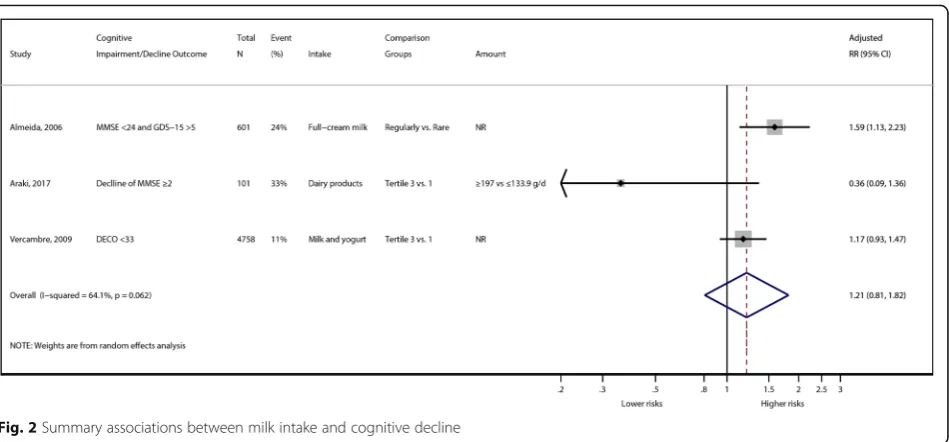
showed that only spatial working memory was marginally better in the high dairy diet group compared to the low dairy diet group. Two of the 7 cohort studies were rated as having a high ROB, and only 1 cohort study was rated as having a low ROB. There were large methodological and clinical heterogeneities, such as the methods used to assess milk or dairy intake and the characteristics of the study populations. It was impossible to conduct a dose-response meta-analysis because the studies utilized different categories of exposures (e.g., different frequencies of milk consumption or the amount of dairy intake). Thus, the overall SoE was rated as insufficient regarding the associations between milk intake and cognitive decline, dementia, and Alzheimer’s disease outcomes. Our meta-analysis of 3 cohort studies showed no significant association between milk intake and cognitive decline outcome (pooled adjusted risk ratio = 1.21; 95% CI: 0.81, 1.82; for highest vs. lowest intake) with large statistical heterogeneity (I2= 64.1%).
Conclusions:The existing evidence (mostly observational) is too poor to draw a firm conclusion regarding the effect
of milk or dairy intake on the risk of cognitive decline or disorders in adults.
Keywords:Milk, Cognitive decline, Alzheimer’s disease, Meta-analysis, Systematic review
* Correspondence:[email protected];[email protected]
5Department of Food and Nutrition, Gachon University, Seongnam-si,
Gyeonggi-do 461-701, South Korea
Full list of author information is available at the end of the article
© The Author(s). 2018Open AccessThis article is distributed under the terms of the Creative Commons Attribution 4.0 International License (http://creativecommons.org/licenses/by/4.0/), which permits unrestricted use, distribution, and reproduction in any medium, provided you give appropriate credit to the original author(s) and the source, provide a link to the Creative Commons license, and indicate if changes were made. The Creative Commons Public Domain Dedication waiver
Background
The prevention of cognitive decline and dementia is an in-creasingly important public health priority due to the growth of the global elderly population [1]. The global prevalence of dementia has been rising, and the number of people with dementia is projected to total 81.1 million by 2040 [2]. Dementia, the most severe cognitive disorder, not only negatively impacts the patients’quality of life but also creates a substantial burden for caregivers [3,4].
Cognitive decline is a precursor to mild cognitive im-pairment (MCI) and is potentially the earliest clinical in-dicator of dementia [5, 6]. Most patients experience a subjective cognitive decline, also called subjective mem-ory complaint, before noticeable cognitive impairment [7, 8]. Subjective Cognitive Decline (SCD) refers to a self-experienced persistent decline in cognitive abilities in comparison with a prior normal status and independ-ent of the objective performance on neuropsychological tests [9]. By definition, SCD is a sign of preclinical Alz-heimer’s disease and can occur before objective cognitive impairment appears. SCD can be diagnosed by several questionnaires of self-reported cognitive performance, such as the Mini Mental Status Examination (MMSE) and the Global Deterioration Scale (GDS) without the use of neuropsychological tests for objective assessment of cognitive function [10]. Currently, there is no ‘gold standard’ measure for SCD [11]. The international SCD Initiative Working Group has systematically identified 34 self-report SCD measures and has found wide varia-tions in the definivaria-tions, cognitive domains, optimal items for each domain, item response options, and time frame across measures [12,13].
SCD is a potential marker for future Mild Cognitive Im-pairment (MCI). Currently, MCI is diagnosed by one of three criteria: the revised Mayo Clinic Criteria, the Diagnostic and Statistical Manual of Mental Disorders, fifth edition (DSM-5), or the National Institute on
Aging-Alzheimer’s Association workgroup (NIA-AA) [14].
Among the three diagnostic criteria, one commonly shared core characteristic is the objective evidence of im-pairment from standardized neuropsychological tests in
≥1 cognitive domains (i.e., memory, executive function, at-tention, language, and visuospatial skills) [14]. Although there is no gold standard regarding neuropsychological tests, it is critical to investigate all major cognitive do-mains for objective cognitive impairment. Dementia [15], including Alzheimer’s disease and vascular dementia, can be detected by objective measures of cognitive impairment and biomarkers, such as β-amyloid (1–42), total tau, and phospho-tau-181 in cerebrospinal fluid [16].
Milk and dairy products are recommended by many dietary guidelines for meeting the daily requirements for calcium, protein, and vitamin B12 intake. These nutri-ents are important for maintaining good health in older
adults. The biological mechanisms linking milk or dairy consumption to cognitive function are not fully under-stood. It has been postulated that phospholipids in the milk fat globule membrane (MFGM) might affect cogni-tive function [17]. There are several possible reasons for why the intake of MFGM could benefit cognitive func-tion [18]. First, MFGM contains high levels of choline derivatives (i.e., phosphocholine, glycerophosphocholine,
phosphatidylcholine and sphingomyelin) [19]. These
compounds may play an important role in the develop-ment of the nervous system. Second, sphingomyelin me-tabolites are essential elements of the myelin sheath that covers the axons of neurons. Therefore, sphingomyelin metabolites support the myelination and production of neurotransmitters in the brain. Additionally, previous studies have suggested that dietary phospholipids are ef-fective transporters of essential fatty acids that could im-prove brain health by lowering endoplasmic reticulum stress [20], which is known to increase the risk of neuro-degenerative disorders such as Alzheimer’s disease. Lastly, the solubility of phospholipids in brain cell membranes may enhance the neuroplasticity of the hippocampus and support dopamine and glutamate transmission [19].
A previous meta-analysis that examined the potential relationship between milk consumption (with or without other dairy products) and cognitive function or disorders showed that the highest level of milk intake compared to the lowest intake level (as defined by the original stud-ies) was significantly associated with a lower risk of cog-nitive disorders (pooled odds ratio [OR] = 0.72; 95% CI: 0.56–0.93; I2= 64%) [21]. However, this meta-analysis pooled cohort studies and cross-sectional studies together and did not consider the risk-of-bias across the studies in-cluded in the meta-analysis as per the PRISMA (Preferred Reporting Items for Systematic Reviews and Meta-ana-lyses) guideline [22]. A risk-of-bias assessment can help explain variation (heterogeneity) in the results of studies included in a systematic review or meta-analysis, in that more rigorous studies are more likely to yield results that are closer to the truth. The potential limitations of the in-cluded studies must be carefully considered in the evi-dence synthesis in order to obtain reliable conclusions.
Therefore, we conducted a systematic review and
meta-analysis following the rigorous methods outlined in the Cochrane handbook for systematic reviews to evaluate whether there is a causal relationship between milk intake and cognitive function or dementia.
Methods
inception to October 12, 2017) and EMBASE (from incep-tion to October 12, 2017) and were limited to human stud-ies without language restrictions. The complete search strategy is presented in Additional file 1: Table S1. In addition to the citations identified in our searches, all stud-ies included in Wu and Sun’s meta-analysis were also evalu-ated based on the eligibility criteria of the present study.
For the present systematic review, prospective cohort studies and intervention trials with follow-up durations of longer than 4 weeks in adults, aged 18 years or older, were included. To be included, studies must have com-pared varying doses of milk intake, alone or in combination with other dairy products (i.e., yogurt and cheese), and re-ported outcomes related to cognitive function, including any stage of dementia (i.e., cognitive decline, mild cognitive impairments, and dementia) or any type of dementia (i.e., Alzheimer’s disease and vascular dementia). Studies includ-ing schizophrenic patients or those that measured only iso-lated specific nutrients in milk were excluded.
Study selection process
All citations identified from the literature searches were in-dependently screened by at least two investigators, accord-ing to the pre-established screenaccord-ing criteria to exclude irrelevant abstracts (e.g., animal, in vitro, and cross-sec-tional studies). The abstract screening was performed using an open-source, online software—Abstrackr [23]. Full-text screening was independently executed by two investigators based on the final study eligibility criteria. Conflicts regard-ing both the abstract and full-text screenregard-ings were resolved by group consensus.
Data extraction, and quality assessment
Two independent investigators extracted data from each included study using the standardized data extraction forms. Discrepancies were resolved between the two vestigators. The risk of bias (i.e., quality) of each in-cluded study was assessed using validated tools. For prospective cohort studies, we adapted the Newcastle
Ottawa Scale (NOS) [24]. The modified NOS tool
in-cluded quality items regarding potential selection bias, comparability of the comparison groups (e.g., potential for confounding bias), adequate sample size (e.g., power calculation), and potential biases in outcome assess-ments and selective outcome reporting. The response options for each quality item were high, unclear, or low risk, with detailed instructions on how to reach these judgements (Additional file 1: Table S2). When five or more items were rated as having a high or unclear risk, the overall risk of bias (ROB) was rated as high. When less than two of the quality items were rated as having a high or unclear risk, the overall ROB was rated as low. These cutoffs for rating the overall ROB were arbitrary, as the NOS did not provide guidance for overall ROB
rating. For intervention trials, we used the revised Cochrane risk-of-bias tool for the specific intervention trial designs [25]. This ROB tool includes quality items re-garding potential bias arising from the randomization process, bias due to deviations from the intended interven-tion, bias due to missing outcome data, bias in outcome measurement, and bias in selective outcome reporting. The suggested algorithms for reaching ROB judgments, as spe-cified in the tool manual, were followed [25].
Qualitative synthesis
All the included studies were qualitatively synthesized in narrative form and in summary tables that tabulated the key features of the study populations, study designs, in-terventions or exposures, outcomes, and results. The strength of evidence (SoE) for major comparisons and outcomes was assessed through a consensus process of the entire research team, using an evidence grading sys-tem utilized by the American Diabetes Association and other prominent groups [26, 27]. Briefly, for each out-come, the SoE level was rated as A (Strong), B (Moder-ate), C (Limited), D (Inadequ(Moder-ate), E (Expert Consensus or Clinical Experience), or NA (Not Applicable). Further details can be found in Additional file1: Table S3.
Quantitative synthesis
In light of large clinical heterogeneity (e.g., different out-come measures and various milk intake exposures), a random-effects meta-analysis was performed when there were at least three unique studies that reported sufficient quantitative data for the same outcome [28]. After care-ful examination of all the extracted quantitative data and heterogeneity issues, only prospective cohort studies reporting the associations between milk intake and cog-nitive decline outcomes could be pooled. Further, a meta-analysis comparing only the highest and the lowest milk intake level was conducted, because data were in-sufficient to conduct a dose-response meta-regression. Both the Q statistic (considered significant when the P value was less than 0.10) and the I2index were used to quantify the extent of statistical heterogeneity [29]. I2 values of 25%, 50% and 75% were defined as low, moder-ate and high heterogeneity, respectively. However, these cutoffs are arbitrary and were used for descriptive pur-poses only [30]. All calculations and meta-analyses were conducted in Stata SE 14 (Stata Corp). The analytical dataset can be found in the Additional file2. Two-tailed
Pvalues less than 0.05 were considered significant.
Results
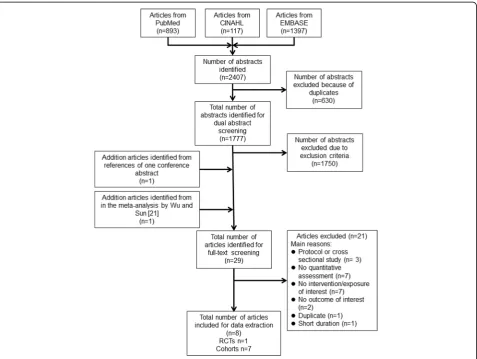
articles (1 RCT and 7 prospective cohort studies). Figure1
summarizes the details of the literature search and selec-tion process. The characteristics of the included studies are summarized in Tables1and2. In this paper, we orga-nized results by research questions, namely the effects of milk intake on cognitive function, cognitive decline/im-pairment, and dementia. One RCT examined only cogni-tive function outcomes, and the results of this RCT were summarized first, before the results of cohort studies.
Milk and dairy intake and cognitive function RCTs
Only one crossover RCT [31] met the inclusion criteria (Table1). Participants (n= 38) were randomized to either a high-dairy diet (four servings of reduced-fat dairy foods per day) or the low-dairy diet (one serving of reduced-fat dairy foods per day) for 6 months, followed by an alternate diet switch for another 6 months, without a washout period. Nine indicators were used to measure cognitive performance: 1) verbal memory, 2) processing speed, 3) working memory, 4) visual attention, 5) verbal fluency, 6)
abstract reasoning, 7) selective reasoning, 8) executive function, and 9) psychological well-being. Among these cognitive function outcomes, only backward spatial span in working memory showed a significant difference be-tween the high-dairy and low-dairy diet groups (mean ± SEM; 7.9 ± 0.4 vs. 7.3 ± 0.4,P= 0.046 [31]) (Table1). The overall ROB of this crossover RCT was rated as moderate due to the high risk for selective outcome reporting bias, some concerns regarding bias due to deviations from intended interventions and bias in outcome measure-ments, and no information regarding the randomization process (Table4).
Cohort studies
Two cohort studies [32,33] investigated the associations between milk or dairy intake and cognitive functions among older male and female adults after 5 to 20 years of follow-up in France and in the U.S. (Table2). One co-hort study assessed milk intake using a food-frequency questionnaire (FFQ) [33], and the other evaluated total dairy and milk intake using a 24-h recall [32]. The two
cohort studies utilized the following assessment tools to assess cognitive function: DWRT (Delayed Word Recall Test), DSST (Digital Symbol Substitution Test), WFT (Word Fluency Test), RI-48 test, and the Delis-KapLan Trail Making Test. Both studies showed mixed results regarding the associations between milk intake and a variety of cognitive function outcomes. Specifically, the first cohort study showed no significant association be-tween total dairy intake and cognitive function (i.e.,
working memory and verbal memory [32]). This study
indicated no significant association between milk intake and working memory, while a higher milk intake was as-sociated with poorer verbal memory performance [32]. The other study showed no significant association be-tween milk intake and verbal learning, short-term mem-ory, executive function or expressive language but found that a higher milk intake was significantly negatively as-sociated with executive function [33] (Table 3). The overall ROB was rated as moderate for both studies, pri-marily due to inadequate methods used to ascertain ex-posure, unclear risk for statistical power and high risk for biased outcome assessment methods (Table4).
Milk and dairy intake and cognitive decline or impairment
Three cohort studies [34–36] reported the associations between milk or dairy intake and cognitive decline or cog-nitive impairment among elderly participants after 4.8 to 13 years of follow-up (Table 2). Milk or dairy intake was
assessed by FFQ or diet history questionnaire. One of
these studies compared a ‘regular’ consumption group
with a ‘rare’consumption group of full-cream milk [36], while the other two studies investigated the associations between cognitive decline/impairments and tertiles of milk intake [34,35]. Cognitive impairment or decline was assessed using the MMSE (Mini-Mental State Examin-ation), DECO (‘DEtérioration Cognitive Observée’, ob-served cognitive deterioration) and IADL (Iinstrumental Activities of Daily Living). One cohort study found that the regular full-cream milk consumption group demon-strated a significant decrease in successful mental health aging compared with the rare consumption group (ad-justed hazard ratio = 0.63; 95% CI: 0.45, 0.89) [36]. The other two studies found no significant associations be-tween milk and dairy consumption and cognitive decline [34, 35] (Table 3). Our random-effects meta-analysis re-sults did not show significant differences in risk for cogni-tive decline or cognicogni-tive impairment by comparing the highest milk intake to lowest intake groups (pooled ad-justed risk ratio = 1.21; 95% CI: 0.81, 1.82), with large stat-istical heterogeneity (I2= 64.1%) (Fig.2). Overall, the ROB was rated as being moderate or high, mainly due to high loss of follow-up (> 20%) and inadequate methods used to ascertain exposure (Table4).
Milk and dairy intake and Alzheimer’s disease
Two cohort studies [37,38] examined the associations be-tween milk or dairy intake and Alzheimer’s disease among
Table 1Characteristics of the included RCT studiesa
Author, Year [Reference]
Country Duration Male (%)
Baseline Age (years)
Number of Participants
Intervention Outcome Measures ROB assessments
Type Method of Assessment
Crichton, 2012 [31]
South Australia and Canada
6 months 28.9 51.6 38 Four servings of reduce fat dairy/day vs. one serving of reduced fat diary/ day
a. Verbal memory b. Processing speed c. Working memory d. Visual attention e. Verbal fluency f. Abstract reasoning g. Selective attention h. Executive function i.
Psychological well-being
a. RAVLT total, RAVLT delayed verbal recall, RAVLT written recall b. Digit symbol coding, inspection time c. Spatial Span forward, Spatial Span backward, Spatial Span total, Letter Number Sequencing d. Letter cancellation e. Initial letter fluency f. Matric reasoning g. Stroop interference h. Design fluency total i. DASS total
•Bias arising from the
randomization process: Some concerns •Bias due to
deviations from intended interventions: Some concerns •Bias due to
missing outcome data: High ROB •Bias in
measurement of the outcome: Some concerns •Bias in the
selection of the reported results: Low ROB •Overall ROB:
Moderate (= Some concerns) a
Table 2 Characteristics of the included cohort studies a Autho r, Year [Refe rence] Coho rt name Co untry
Follow- Up (years)
Mal
e
(%)
Basel
ine
Age (years) (me
an) Hea lth Status Number of Participants Expo sure O utcome Adjustment Type Met hod of Easeme nt Categ ory Type Met hod of Ass essment Nutrient s Demographics Medi cation
Life style
Almei da, 2006 [ 36 ], NR Aus tralia 4.8 10 0 Impaired cog nitive function : 77.3; prese rved cog nitive function : 77.6 Gener ally healthy 601 Consu med full -cream milk regul arly Self-re ported questionna ire Dicho tomous : Regu lar vs. Rare Cogn itive fun ction MMS E, GDS-1 5 XX Araki, 2017 [ 35 ], Follow up for the J-EDIT trial Jap an 6 42 .62 NR Diab etes mell itus 237 Dairy produ cts Yoshi mura et al. ’ s validat ed FFQ Tertiles of dairy inta ke
(g/d): ≤133.
Table
2
Characteristics
of
the
included
cohort
studies
a (Continued)
Autho
r,
Year
[Refe
rence]
Coho
rt
name
Co
untry
Follow- Up (years)
Mal
e
(%)
Basel
ine
Age (years) (me
an)
Hea
lth
Status
Number
of
Participants
Expo
sure
O
utcome
Adjustment
Type
Met
hod
of
Easeme
nt
Categ
ory
Type
Met
hod
of
Ass
essment
Nutrient
s
Demographics
Medi
cation
Life style
Mutuelle Génér
ale
de
l’
Educ
ation
Nationale
)
subc
ohort
of
208
foods
and beverages
Yamada,
2003
[
37
],
Adu
lt
H
ealth
Study
follow-up
study
Jap
an
22
b
26
.8
NR
Gener
ally
healthy
1774
Milk
inta
ke
self- administered questionna
ire
betw
een
1965
and
1968
Daily
vs.
<
4
times
a
we
ek
AD,
VaD
DSM-IV
X
X
X
X
aAD
Alzheimer
’
s
disease,
DECO
observed
cognitive
deterioration,
DSM
the
Diagnostic
and
Statistical
Manual,
DSST
the
Digit
Symbol
Substitution
Test,
DWRT
the
Delayed
Word
Recall
Test,
FFQ
Food
Frequency
Questionnaire,
GDS-15
Geriatric
Depression
Scale
15,
IADL
instrumental
activities
of
daily
living,
MMSE
Mini-Mental
State
Examination,
NR
not
reported,
TMT
the
Delis-Kaplan
trail-making
test,
VaD
vascular
dementia,
WFT
the
Word
Fluency
Test
bFollow-up
time
is
calculated
based
on
the
first
year
of
cognitive
assessment
minus
the
last
year
of
baseline
information
assessment,
since
the
data
ar
e
not
reported
in
the
original
Table
4
Risk
of
bias
assessment
for
the
included
cohort
studies
a
Autho
r,
Year
Represe
ntativeness
of
the
expo
sed
cohort
Selec
tion
of
the
non-expose
d
cohort
Asce
rtainment
of
the
nut
rient
’
s
exp
osure
Outcom
e
of
intere
st
abs
ent
at
basel
ine
Contr
ol
for
impo
rtant
confo
unders
Adequ
ate
sample
size
and
powe
r
Out
come
ass
essment
Comp
letenes
s
of
cohort
fol
low-up
Sele
ctive
Out
come
Re
porting
Overall ROB
Almei
da,
2006
[
36
]
High
Low
Hig
h
High
Low
Low
Hig
h
High
Lo
w
Hig
h
Araki,
2017
[
35
]
High
Low
Hig
h
Low
Low
Unclea
r
Hig
h
Low
Lo
w
Mod
erate
Kesse
-Guyot,
2016
[
32
]
High
Low
Low
High
Low
Unclea
r
Hig
h
Low
Lo
w
Mod
erate
Ozawa, 2014
[
38
]
Low
Low
Low
Low
Low
Unclea
r
Low
Low
Lo
w
Low
Petruski- Ivleva,
2017
[
33
]
Low
Low
Hig
h
Low
Low
Unclea
r
Hig
h
Low
Lo
w
Mod
erate
Verc
ambre,
2009
[
34
]
High
Low
Hig
h
High
Low
Unclea
r
Hig
h
High
Lo
w
Hig
h
Yamada, 2003
[
37
]
High
Low
Hig
h
High
Low
Unclea
r
Low
Low
Lo
w
Mod
erate
aDetailed
instructions
of
the
modified
NOS
tool
are
presented
in
Additional
file
1
:
Table
elderly participants [38] and adult men and women [37] after 17 and 22 years of follow-up. Milk or dairy intake was assessed using an FFQ, and Alzheimer’s disease was assessed by DSM (Diagnostic and Statistical Manual of Mental Disorders) in both studies (Table2). The results of these two studies were inconsistent. One study showed that consuming milk less than twice a week was not sig-nificantly associated with the risk of developing Alzhei-mer’s disease, compared with daily or 2 to 4 times a week milk intake [37]. Overall, the ROB of this study was rated as being moderate, primarily due to concerns about the representativeness of the study population and inadequate methods used to ascertain exposure (Table 4). The other study reported that higher milk and dairy intake signifi-cantly reduced the risk of Alzheimer’s disease (Pfor trend = 0.03 [38]) (Table 3). Overall, the ROB of this study was rated as being low (Table4).
Milk and dairy intake and vascular dementia
Two cohort studies assessed the relationship between milk or dairy intake and vascular dementia, assessed by DSM [37, 38]. The characteristics of these two cohorts were described earlier (Table 2). Similar to Alzheimer’s
disease outcomes, these two studies showed inconsistent results for vascular dementia outcomes. Specifically, the first study reported that the almost daily milk intake group (vs. < 4 times a week of milk intake group) had a significantly reduced risk of vascular dementia [37], while the second study showed nonsignificant associa-tions between quartiles of milk and dairy intake and risk of vascular dementia [38]. Overall, the ROB of the two studies was rated as being low and moderate, as de-scribed earlier (Table4).
Milk and dairy intake and all-cause dementia
One cohort study assessed the association between milk and dairy intake and all-cause dementia, assessed by DSM III, after 17 years of follow-up [38]. The character-istics of this study were described earlier (Table 2). The results showed no significant associations between quar-tiles of milk and dairy intake and risk for developing all-cause dementia (Table 3). Overall, the ROB of this study was rated as being low (Table4).
Overall strength of evidence (SoE)
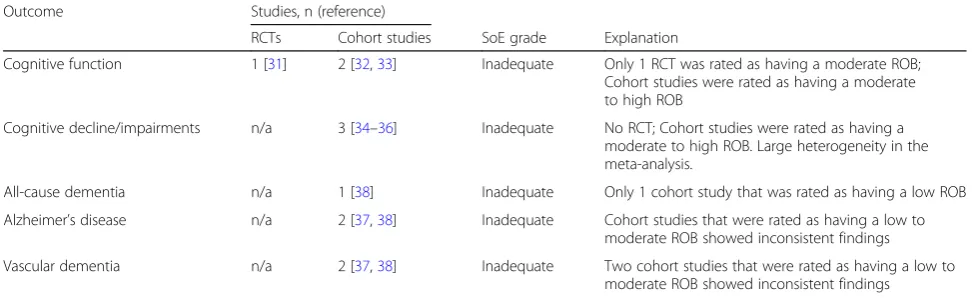
We graded the overall SoE as being inadequate for the causal relationships between milk consumption and cog-nitive decline/impairment, all-cause/vascular dementia, and Alzheimer’s disease (Table5).
Discussion
age-related cognitive disorders and adjusted for different sets of confounding factors in the statistical analyses.
The strength of this systematic review is that we followed the highest methodological standards for evidence synthesis and employed strict inclusion criteria regarding the study designs, which can better determine a causal inference. The previous meta-analysis included cross-sectional studies and did not consider risk-of-bias in their analyses or in drawing their conclusions [21]. Because cross-sectional studies can-not assess the temporality between milk intake and cognitive function, we selected only prospective cohort studies and intervention studies for this systematic review. However, our meta-analysis is limited because of the concerns of risk-of-bias in the included cohort studies (e.g., potential re-sidual confounding) and imprecise measurements of milk intake due to the limitations of FFQs for assessing dietary exposures in observational studies. Additionally, our meta-analysis was based on extreme quantile (highest vs. lowest quintile/quartile) comparisons, which has very limited interpretability, because the definitions of intake levels varied across studies. The variations in exposure levels may explain the large statistical heterogeneity (I2= 64%;P= 0.06) in the meta-analysis, but we could not conduct a dose-response meta-analysis due to insufficient quantitative data to esti-mate and standardized the‘doses’of milk intake levels.
In light of the limitations in this body of evidence, we have a few suggestions for future research. First, the use of biomarkers would overcome the limitations of self-reported dietary assessments. These self-reported dietary assess-ments are prone to measurement errors due to recall bias, under/over-reporting, and incompleteness of the food com-position database [39, 40]. Because self-reported dietary measures rely heavily on the responders’recall, recall bias is a particularly important issue in the study of cognitive func-tion. Mild cognitive impairment has shown to attenuate the validity of FFQs when comparing to biomarkers of nutrient intake [41, 42]. Poor cognitive ability was associated with suspected recall errors on the FFQ [43]. As an objective
complementary tool for dietary assessment, milk intake bio-markers, such as adipose tissue and circulating levels of pentadecanoic acid (C15:0) [44], would be very useful. Sec-ond, there is an urgent need to develop validated, standard-ized tests of cognitive impairment and dementia to make the research outcomes comparable and able to be quantita-tively combined. We found substantial heterogeneity in the assessment tools across the included studies and poor de-scriptions of outcome measures. Each outcome measure for cognitive impairment and dementia exclusively assessed cognition, function, and other domains (e.g., quality of life, mood, and behavior) or a combination of these domains [45]. To increase the usefulness of SCD measures, the inter-national SCD Initiative Working Group issued a call for international collaboration to promote the harmonization and pooling of cognitive self-reported data and greater consistency in the measurement of cognitive decline [12]. The working group had agreed to a common framework and research procedures to study the role of SCD as a marker of preclinical Alzheimer’s disease [9]. Specifically, there is a need to derive a small number of well-con-structed, easy-to-administer items with adequate reliability across diverse samples of older adults. In summary, future research could be improved through the use of milk intake biomarkers and standardized assessment tools for cognitive function to strengthen causal inferences.
Conclusions
Based on best available evidence, we concluded that the overall strength of evidence is inadequate for the effects of milk or dairy consumption on cognitive decline and disor-ders, due to the insufficient number of high-quality studies and large heterogeneity across studies. To draw a firm con-clusion, high quality RCTs with sufficient sample sizes, use of milk intake biomarkers, and standardized assessment tools for cognitive function are needed to identify the role of milk or dairy intake in cognitive function among older adults.
Table 5SoE grading: higher vs. lower milk intake by outcomea
Outcome Studies, n (reference)
RCTs Cohort studies SoE grade Explanation
Cognitive function 1 [31] 2 [32,33] Inadequate Only 1 RCT was rated as having a moderate ROB; Cohort studies were rated as having a moderate to high ROB
Cognitive decline/impairments n/a 3 [34–36] Inadequate No RCT; Cohort studies were rated as having a moderate to high ROB. Large heterogeneity in the meta-analysis.
All-cause dementia n/a 1 [38] Inadequate Only 1 cohort study that was rated as having a low ROB
Alzheimer’s disease n/a 2 [37,38] Inadequate Cohort studies that were rated as having a low to moderate ROB showed inconsistent findings
Vascular dementia n/a 2 [37,38] Inadequate Two cohort studies that were rated as having a low to moderate ROB showed inconsistent findings
a
Additional files
Additional file 1:Table S1.Search strategy.Table S2.Detailed
instructions of the modified NOS tool.Table S3.SoE grading system.
(DOC 83 kb)
Additional file 2:Analytical dataset. (XLSX 9 kb)
Abbreviations
DECO:‘DEtérioration Cognitive Observée’(observed cognitive deterioration); DSM: Diagnostic and Statistical Manual of Mental Disorders; DSST: Digital Symbol Substitution Test; DWRT: Delayed Word Recall Test; FFQ: Food frequency questionnaire; GDS: Global Deterioration Scale; IADL: Instrumental Activities of Daily Living; MCI: Mild cognitive impairment; MFGM: Milk fat globule membrane; MMSE: Mini Mental Status Examination; MMSE:
Mini-Mental State Examination; NIA-AA: National Institute on Aging-Alzheimer’s
Association workgroup; NOS: Newcastle Ottawa Scale; PRISMA: Preferred reporting items for systematic reviews and meta-analyses; RCT: Randomized controlled trial; ROB: Risk of bias; SCD: Subjective Cognitive Decline; SoE: Strength of evidence; WFT: Word Fluency Test
Acknowledgments
The authors thank Jian Shi for performing the abstract and full-text screen-ing, data extraction, and risk-of-bias assessment for this project.
Funding
This research was supported by the National Research Council of Science &
Technology (NST) (No. CAP-16-07-KIOM, GN160800–01) and Korea Food
Re-search Institute (E0150302–03), South Korea.
Availability of data and materials
We included 5 tables and 2 figures in this manuscript. Additionally, there are 3 supplementary tables and a supplemental data file online.
Authors’contributions
HL, JL, DJ, and MC designed research; ZF and JL conducted research; ZF and MC analyzed data; and JL, ZF, and MC interpreted the results and wrote the manuscript. All authors read and approved the final manuscript.
Ethics approval and consent to participate
Not applicable.
Consent for publication
Not applicable.
Competing interests
The authors declare that they have no competing interests.
Publisher’s Note
Springer Nature remains neutral with regard to jurisdictional claims in published maps and institutional affiliations.
Author details
1Department of Nutrition Education, Kyonggi University, Suwon-si, South
Korea.2Department of Epidemiology, University of Pittsburgh, Pittsburgh, USA.3Department of Public Health and Community Medicine, School of
Medicine, Tufts University, Boston, USA.4Research Group of Nutrition and
Diet, Korea Food Research Institute, Wanju-gun, South Korea.5Department of
Food and Nutrition, Gachon University, Seongnam-si, Gyeonggi-do 461-701, South Korea.
Received: 30 April 2018 Accepted: 6 August 2018
References
1. United Nations. World population ageing. New York: UN; 2015.
2. Ferri CP, Prince M, Brayne C, Brodaty H, Fratiglioni L, Ganguli M, Hall K,
Hasegawa K, Hendrie H, Huang Y. Global prevalence of dementia: a Delphi
consensus study. Lancet. 2006;366:2112–7.
3. Srivastava G, Tripathi RK, Tiwari SC, Singh B, Tripathi SM. Caregiver burden
and quality of life of key caregivers of patients with dementia. Indian J
Psychol Med. 2016;38:133–6.
4. Crichton GE, Bryan J, Murphy KJ, Buckley J. Review of dairy consumption
and cognitive performance in adults: findings and methodological issues.
Dement Geriatr Cogn Disord. 2010;30:352–61.
5. Petersen RC, Smith GE, Waring SC, Ivnik RJ, Tangalos EG, Kokmen E. Mild
cognitive impairment: clinical characterization and outcome. Arch Neurol.
1999;56:303–8.
6. Balzac F. Subjective cognitive decline: the earliest sign of alzheimer’s
disease? Neurology Rev. 2013;21:33–7.
7. Cheng YW, Chen TF, Chiu MJ. From mild cognitive impairment to subjective
cognitive decline: conceptual and methodological evolution.
Neuropsychiatr Dis Treat. 2017;13:491–8.
8. Mitchell AJ. Is it time to separate subjective cognitive complaints from the
diagnosis of mild cognitive impairment? Age Ageing. 2008;37:497–9.
9. Jessen F, Amariglio RE, van Boxtel M, Breteler M, Ceccaldi M, Chetelat G,
Dubois B, Dufouil C, Ellis KA, van der Flier WM, et al. A conceptual framework for research on subjective cognitive decline in preclinical
Alzheimer's disease. Alzheimers Dement. 2014;10:844–52.
10. Sperling RA, Aisen PS, Beckett LA, Bennett DA, Craft S, Fagan AM, Iwatsubo
T, Jack CR Jr, Kaye J, Montine TJ, et al. Toward defining the preclinical stages of Alzheimer's disease: recommendations from the National Institute on Aging-Alzheimer's Association workgroups on diagnostic guidelines for
Alzheimer's disease. Alzheimers Dement. 2011;7:280–92.
11. Molinuevo JL, Rabin LA, Amariglio R, Buckley R, Dubois B, Ellis KA, Ewers M,
Hampel H, Kloppel S, Rami L, et al. Implementation of subjective cognitive
decline criteria in research studies. Alzheimers Dement. 2017;13:296–311.
12. Rabin LA, Smart CM, Crane PK, Amariglio RE, Berman LM, Boada M, Buckley
RF, Chetelat G, Dubois B, Ellis KA, et al. Subjective cognitive decline in older adults: an overview of self-report measures used across 19 international
research studies. J Alzheimers Dis. 2015;48(Suppl 1):S63–86.
13. Studart AN, Nitrini R. Subjective cognitive decline: the first clinical
manifestation of Alzheimer’s disease? Dement Neuropsychol. 2016;10:170–7.
14. Vega JN, Newhouse PA. Mild cognitive impairment: diagnosis, longitudinal
course, and emerging treatments. Curr Psychiatry Rep. 2014;16:490.
15. Petersen RC, Caracciolo B, Brayne C, Gauthier S, Jelic V, Fratiglioni L. Mild
cognitive impairment: a concept in evolution. J Intern Med. 2014;275:214–28.
16. Humpel C. Identifying and validating biomarkers for Alzheimer’s disease.
Trends Biotechnol. 2011;29:26–32.
17. Hess JM, Jonnalagadda SS, Slavin JL. Dairy foods: current evidence of their
effects on bone, cardiometabolic, cognitive, and digestive health. Compr
Rev Food Sci Food Saf. 2016;15:251–68.
18. Spitsberg V. Invited review: bovine milk fat globule membrane as a
potential nutraceutical. J Dairy Sci. 2005;88:2289–94.
19. Verardo V, Gómez-Caravaca AM, Arráez-Román D, Hettinga K. Recent
advances in phospholipids from colostrum, milk and dairy by-products. Int J Mol Sci. 2017;18:173.
20. Conway V, Gauthier SF, Pouliot Y. Buttermilk: much more than a source of
milk phospholipids. Anim Front. 2014;4:44–51.
21. Wu L, Sun D. Meta-analysis of milk consumption and the risk of cognitive
disorders. Nutrients. 2016;8:824.
22. Moher D, Liberati A, Tetzlaff J, Altman DG, and the PG: Preferred reporting
items for systematic reviews and meta-analyses: the prisma statement. Ann
Intern Med 2009, 151:264–269.
23. Wallace BC, Small K, Brodley CE, Lau J, Trikalinos TA. Deploying an
interactive machine learning system in an evidence-based practice center: abstrackr. In: Proceedings of the 2nd ACM SIGHIT International Health
Informatics Symposium. Boston: ACM; 2012. p. 819–24.
24. Wells GA, Shea B, O'Connell D, Peterson J, Welch V, Losos M, Tugwell P. The
Newcastle-Ottawa scale (NOS) for assessing the quality of nonrandomised studies in meta-analyses. Ottawa: Ottawa Hospital Research Institute; 2011.
25. Higgins J, Sterne J, SavovićJ, Page M, Hróbjartsson A, Boutron I, Reeves B,
Eldridge S. A revised tool for assessing risk of bias in randomized trials. Cochrane Methods. Cochrane Database Syst Rev. 2016; Issue 10(Suppl 1).
26. Cho SS, Qi L, Fahey GC, Klurfeld DM. Consumption of cereal fiber, mixtures of
whole grains and bran, and whole grains and risk reduction in type 2 diabetes,
obesity, and cardiovascular disease. Am J Clin Nutr. 2013;98:594–619.
27. Introduction. The American Diabetes Association’s (ADA) evidence-based
practice guidelines, standards, and related recommendations and
28. DerSimonian R, Laird N. Meta-analysis in clinical trials. Control Clin Trials.
1986;7:177–88.
29. Higgins JP, Green S. Cochrane handbook for systematic reviews of
interventions. Chichester: John Wiley & Sons; 2011.
30. Higgins JP, Thompson SG, Deeks JJ, Altman DG. Measuring inconsistency in
meta-analyses. BMJ. 2003;327:557–60.
31. Crichton GE, Murphy KJ, Howe PR, Buckley JD, Bryan J. Dairy consumption
and working memory performance in overweight and obese adults.
Appetite. 2012;59:34–40.
32. Kesse-Guyot E, Assmann KE, Andreeva VA, Ferry M, Hercberg S, Galan P.
Consumption of dairy products and cognitive functioning: findings from
the SU.VI.MAX 2 study. J Nutr Health Aging. 2016;20:128–37.
33. Petruski-Ivleva N, Kucharska-Newton A, Palta P, Couper D, Meyer K, Graff M,
Haring B, Sharrett R, Heiss G. Milk intake at midlife and cognitive decline over 20 years. the atherosclerosis risk in communities (ARIC) Study. Nutrients. 2017;9:1134.
34. Vercambre M-N, Boutron-Ruault M-C, Ritchie K, Clavel-Chapelon F, Berr C.
Long-term association of food and nutrient intakes with cognitive and functional decline: a 13-year follow-up study of elderly French women. Br J
Nutr. 2009;102:419–27.
35. Araki A, Yoshimura Y, Sakurai T, Umegaki H, Kamada C, Iimuro S, Ohashi Y,
Ito H. Low intakes of carotene, vitamin B2, pantothenate and calcium predict cognitive decline among elderly patients with diabetes mellitus: the Japanese elderly diabetes intervention trial. Geriatr Gerontol Int. 2017;17:
1168–75.
36. Almeida OP, Norman P, Hankey G, Jamrozik K, Flicker L. Successful mental
health aging: results from a longitudinal study of older Australian men. Am
J Geriatr Psychiatry. 2006;14:27–35.
37. Yamada M, Kasagi F, Sasaki H, Masunari N, Mimori Y, Suzuki G. Association
between dementia and midlife risk factors: the radiation effects research
foundation adult health study. J Am Geriatr Soc. 2003;51:410–4.
38. Ozawa M, Ohara T, Ninomiya T, Hata J, Yoshida D, Mukai N, Nagata M,
Uchida K, Shirota T, Kitazono T. Milk and dairy consumption and risk of dementia in an elderly Japanese population: the Hisayama study. J Am
Geriatr Soc. 2014;62:1224–30.
39. Jenab M, Slimani N, Bictash M, Ferrari P, Bingham SA. Biomarkers in
nutritional epidemiology: applications, needs and new horizons. Hum
Genet. 2009;125:507–25.
40. Baylin A, Campos H. The use of fatty acid biomarkers to reflect dietary
intake. Curr Opin Lipidol. 2006;17:22–7.
41. Bowman GL, Shannon J, Ho E, Traber MG, Frei B, Oken BS, Kaye JA, Quinn
JF. Reliability and validity of food frequency questionnaire and nutrient biomarkers in elders with and without mild cognitive impairment.
Alzheimer Dis Assoc Disord. 2011;25:49–57.
42. Zuniga K, McAuley E. Considerations in selection of diet assessment
methods for examining the effect of nutrition on cognition. J Nutr Health
Aging. 2015;19:333–40.
43. Pope SK, Kritchevsky SB, Morris MC, Block G, Tylavsky FA, Lee JS, Stewart S,
Harris T, Rubin SM, Simonsick EM. Cognitive ability is associated with suspected reporting errors on food frequency questionnaires. J Nutr Health
Aging. 2007;11:55–8.
44. Riserus U, Marklund M. Milk fat biomarkers and cardiometabolic disease.
Curr Opin Lipidol. 2017;28:46–51.
45. Harrison JK, Noel-Storr AH, Demeyere N, Reynish EL, Quinn TJ. Outcomes